weight KIA STONIC 2018 User Guide
[x] Cancel search | Manufacturer: KIA, Model Year: 2018, Model line: STONIC, Model: KIA STONIC 2018Pages: 523, PDF Size: 24.99 MB
Page 310 of 523
Instructions about safety chains may
be provided by the hitch manufacturer or by the trailer manufacturer. Follow
the manufacturer’s recommendation
for attaching safety chains. Always leave just enough slack so you can turn
with your trailer. And, never allow safe‐
ty chains drag on the ground.
Trailer brakes
If your trailer is equipped with a braking
system, make sure it conforms to your
country’s regulations and that it is properly installed and operating cor‐
rectly.
If your trailer weighs more than the
maximum trailer weight without trailer brakes loaded, then it needs its own
brakes and they must be adequate. Be
sure to read and follow the instructions for the trailer brakes so you’ll be able
to install, adjust and maintain them
properly. • Don’t tap into your vehicle's brake system.
WARNING
nTrailer brakes
(Continued)
(Continued)
Do not use a trailer with its ownbrakes unless you are absolutelycertain that you have properly setup the brake system. This is not atask for amateurs. Use an experi‐enced, competent trailer shop forthis work.
Driving with a trailer
Towing a trailer requires a certain
amount of experience. Before setting out for the open road, you must get to
know your trailer. Acquaint yourself
with the feel of handling and braking with the added weight of the trailer.
And always keep in mind that the vehi‐
cle you are driving is now a good deal longer and not nearly so responsive as
your vehicle is by itself.
Before you start, check the trailer hitch
and platform, safety chains, electrical connector(s), lights, tires and mirror
adjustment. If the trailer has electric
brakes, start your vehicle and trailer moving and then apply the trailer brake
controller by hand to be sure the
brakes are working. This lets you check your electrical connection at the same
time. During your trip, check occasionally to
be sure that the load is secure, and that the lights and trailer brakes are
still working.
Following distance
Stay at least twice as far behind the
vehicle ahead as you would when driv‐ ing your vehicle without a trailer. This
can help you avoid situations that re‐
quire heavy braking and sudden turns.
Passing
You’ll need more passing distance up
ahead when you’re towing a trailer. And, because of the increased vehicle
length, you’ll need to go much farther
beyond the passed vehicle before you can return to your lane.
Backing up
Hold the bottom of the steering wheel
with one hand. Then, to move the trail‐ er to the left, just move your hand to
the left. To move the trailer to the
right, move your hand to the right. Al‐ ways back up slowly and, if possible,
have someone guide you.
Driving your vehicle
6-88
Page 311 of 523
Making turns
When you’re turning with a trailer,
make wider turns than normal. Do this so your trailer won’t strike soft should‐
ers, curbs, road signs, trees, or other
objects. Avoid jerky or sudden maneu‐ vers. Signal well in advance.
Turn signals when towing a trailer
When you tow a trailer, your vehicle
has to have a different turn signal flasher and extra wiring. The green ar‐
rows on your instrument panel will
flash whenever you signal a turn or lane change. Properly connected, the
trailer lights will also flash to alert oth‐
er drivers you’re about to turn, change lanes, or stop.
When towing a trailer, the green ar‐
rows on your instrument panel will
flash for turns even if the bulbs on the trailer are burned out. Thus, you may
think drivers behind you are seeing
your signals when, in fact, they are not. It’s important to check occasionally to
be sure the trailer bulbs are still work‐
ing. You must also check the lights ev‐ ery time you disconnect and then re‐
connect the wires.
Do not connect a trailer lighting system
directly to your vehicle’s lighting sys‐ tem. Use only an approved trailer wir‐
ing harness. Have yourself assisted by a professio‐
nal workshop in installing the wiring harness.
Kia recommends to visit an authorized
Kia dealer/service partner.
WARNING
Failure to use an approved trailerwiring harness could result in dam‐age to the vehicle electrical systemand/or personal injury.
Driving on grades
Reduce the speed and shift to a lower
gear before you start down a long or steep downgrade. If you don’t shift
down, you might have to use your
brakes so much that they would get hot and no longer operate efficiently.
On a long uphill grade, shift down and
reduce your speed to around 70 km/h
(45 mph) to reduce the possibility of engine and transaxle overheating.
If your trailer weighs more than the
maximum trailer weight without trailer
brakes and you have an automatic transaxle, you should drive in D (Drive)
when towing a trailer. Operating your vehicle in D (Drive)
when towing a trailer will minimize heat build up and extend the life of
your transaxle.
CAUTION
•When towing a trailer on steepgrades (in excess of 6%) pay closeattention to the engine coolanttemperature gauge to ensure theengine does not overheat. If theneedle of the coolant temperaturegauge moves across the dial to‐wards L
Page 313 of 523
Maintenance when trailer
towing
Your vehicle will need service more of‐
ten when you regularly pull a trailer.
Important items to pay particular at‐ tention to include engine oil, automatic
transaxle fluid, axle lubricant and cool‐
ing system fluid. Brake condition is an‐ other important item to frequently
check. Each item is covered in this man‐
ual, and the Index will help you find them quickly. If you’re trailering, it’s a
good idea to review these sections be‐
fore you start your trip.
Don’t forget to also maintain your trail‐ er and hitch. Follow the maintenance
schedule that accompanied your trailer
and check it periodically. Preferably, conduct the check at the start of each
day’s driving. Most importantly, all
hitch nuts and bolts should be tight.
CAUTION
•Due to higher load during trailerusage, overheating might occur inhot days or during uphill driving. Ifthe coolant gauge indicates over‐heating, switch off the A/C andstop the vehicle in a safe area tocool down the engine.
•When towing, check the transaxlefluid more frequently.
•If your vehicle is not equipped withan air conditioner, you should in‐stall a condenser fan to improveengine performance when towinga trailer.
If you do decide to pull a trailer
Here are some important points if you
decide to pull a trailer:
• Consider using a sway control. You can ask a hitch dealer about swaycontrol. • Do not do any towing with your car
during its first 2,000 km (1,200 miles)
in order to allow the engine to prop‐
erly break in. Failure to heed this cau‐
tion may result in serious engine or transaxle damage.
• When towing a trailer, Kia recom‐ mends that you consult an author‐
ized Kia dealer/service partner on ad‐
ditional requirements such as a tow‐
ing kit, etc.
• Always drive your vehicle at a moder‐ ate speed (less than 100 km/h
(60 mph)).
• On a long uphill grade, do not exceed 70 km/h (45 mph) or the posted tow‐
ing speed limit, whichever is lower.
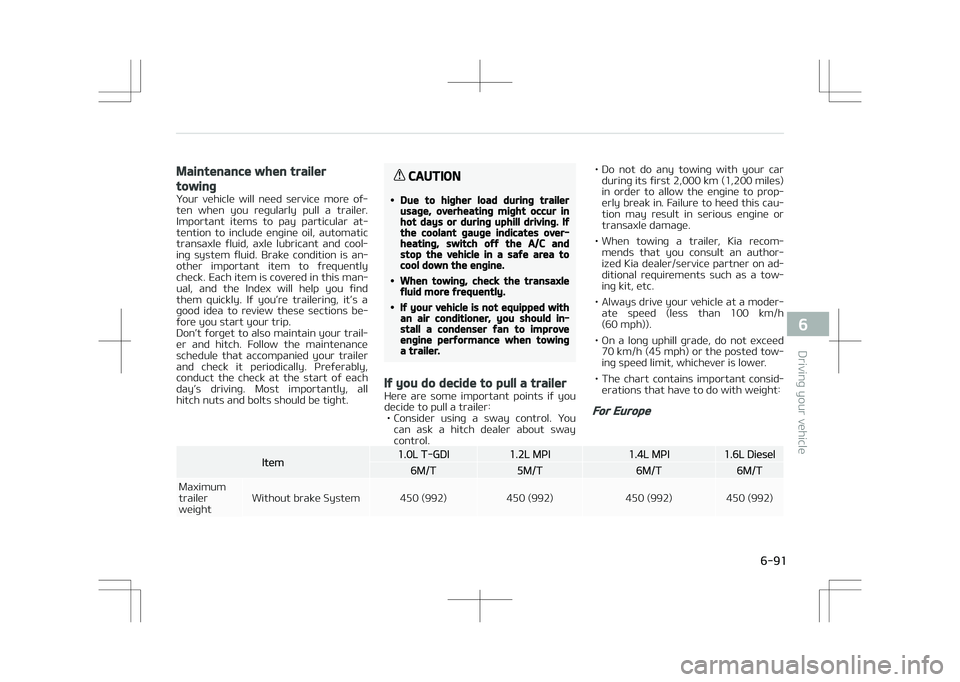
• The chart contains important consid‐ erations that have to do with weight:
For Europe
Item1.0L T-GDI1.2L MPI1.4L MPI1.6L Diesel
6M/T5M/T6M/T6M/T
Maximum trailerweight Without brake System 450 (992) 450 (992) 450 (992) 450 (992)
6-91
6
Driving your vehicle
Page 314 of 523
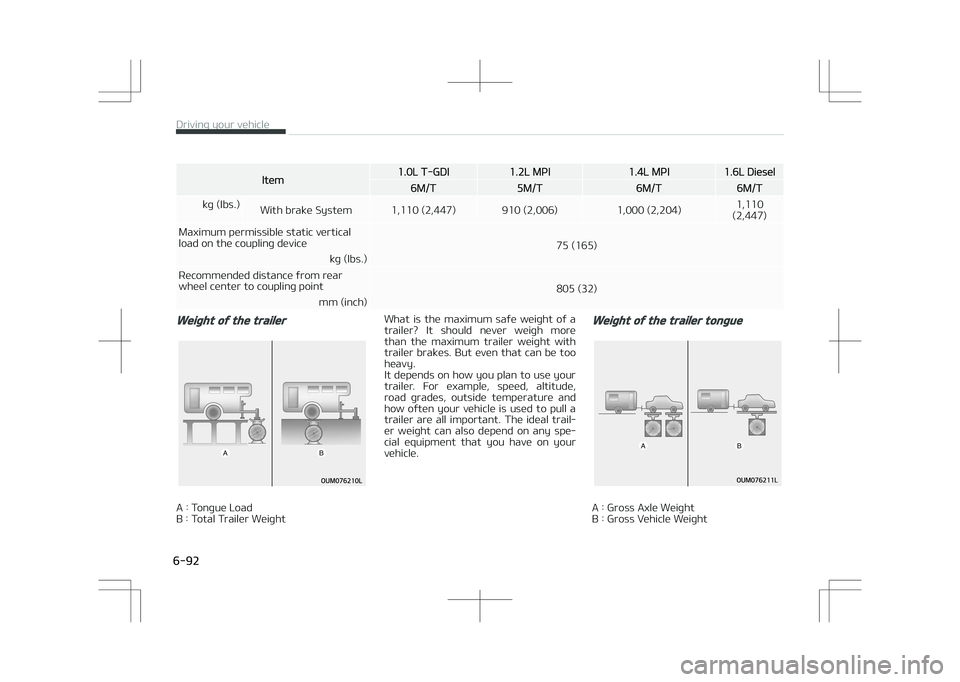
Item1.0L T-GDI1.2L MPI1.4L MPI1.6L Diesel
6M/T5M/T6M/T6M/T
kg (Ibs.) With brake System 1,110 (2,447) 910 (2,006) 1,000 (2,204) 1,110
(2,447)
Maximum permissible static vertical
load on the coupling device 75 (165)
kg (Ibs.)
Recommended distance from rear
wheel center to coupling point 805 (32)
mm (inch)
Weight of the trailer
A : Tongue Load
B : Total Trailer Weight What is the maximum safe weight of a
trailer? It should never weigh more than the maximum trailer weight with
trailer brakes. But even that can be too
heavy.
It depends on how you plan to use your trailer. For example, speed, altitude,
road grades, outside temperature and
how often your vehicle is used to pull a trailer are all important. The ideal trail‐
er weight can also depend on any spe‐
cial equipment that you have on your vehicle.
Weight of the trailer tongue
A : Gross Axle Weight
B : Gross Vehicle Weight
Driving your vehicle
6-92
Page 315 of 523
The tongue load of any trailer is an im‐
portant weight to measure because it affects the total gross vehicle weight
(GVW) of your vehicle. This weight in‐
cludes the curb weight of the vehicle, any cargo you may carry in it, and the
people who will be riding in the vehicle.
And if you tow a trailer, you must add the tongue load to the GVW because
your vehicle will also be carrying that
weight.
The trailer tongue should weigh a max‐ imum of 10% of the total loaded trailer
weight, within the limits of the maxi‐
mum trailer tongue load permissible.
After you've loaded your trailer, weigh the trailer and then the tongue, sepa‐
rately, to see if the weights are proper.
If they aren’t, you may be able to cor‐ rect them simply by moving some
items around in the trailer.
WARNING
nTrailer
(Continued)
(Continued)
•Never load a trailer with moreweight in the rear than in thefront. The front should be loadedwith approximately 60% of the to‐tal trailer load; the rear should beloaded with approximately 40% ofthe total trailer load.
•Never exceed the maximumweight limits of the trailer or trail‐er towing equipment. Improperloading can result in damage toyour vehicle and/or personal injury.Check weights and loading at acommercial scale or highway pa‐trol office equipped with scales.
•An improperly loaded trailer cancause loss of vehicle control.
6-93
6
Driving your vehicle
Page 316 of 523
VEHICLE WEIGHT
This section will guide you in the proper
loading of your vehicle, to keep your loaded vehicle weight within its design
rating capability. Properly loading your
vehicle will provide maximum return of the vehicle design performance. Before
loading your vehicle, familiarize your‐
self with the following terms for deter‐ mining your vehicle's weight ratings,
from the vehicle's specifications and
the certification label:
Base curb weight
This is the weight of the vehicle includ‐
ing a full tank of fuel and all standard equipment. It does not include passen‐
gers, cargo, or optional equipment.
Vehicle curb weight
This is the weight of your new vehicle
when you picked it up from your dealer plus any aftermarket equipment.
Cargo weight
This figure includes all weight added to
the Base Curb Weight, including cargo and optional equipment.
GAW (Gross axle weight)
This is the total weight placed on each
axle (front and rear) - including vehicle curb weight and all payload.
GAWR (Gross axle weight rating)
This is the maximum allowable weight
that can be carried by a single axle
(front or rear). These numbers are shown on the certification label.
The total load on each axle must never
exceed its GAWR.
GVW (Gross vehicle weight)
This is the Base Curb Weight plus actual
Cargo Weight plus passengers.
GVWR (Gross vehicle weight
rating)
This is the maximum allowable weight
of the fully loaded vehicle (including all options, equipment, passengers and
cargo). The GVWR is shown on the cer‐
tification label located on the driver’s (or front passenger’s) door sill.
Overloading
WARNING
nVehicle weight
The gross axle weight rating (GAWR)and the gross vehicle weight rating
(Continued)
(Continued)
(GVWR) for your vehicle are on thecertification label attached to thedriver's (or front passenger’s) door.Exceeding these ratings can causean accident or vehicle damage. Youcan calculate the weight of your loadby weighing the items (and people)before putting them in the vehicle.Be careful not to overload your vehi‐cle.
Driving your vehicle
6-94
Page 413 of 523
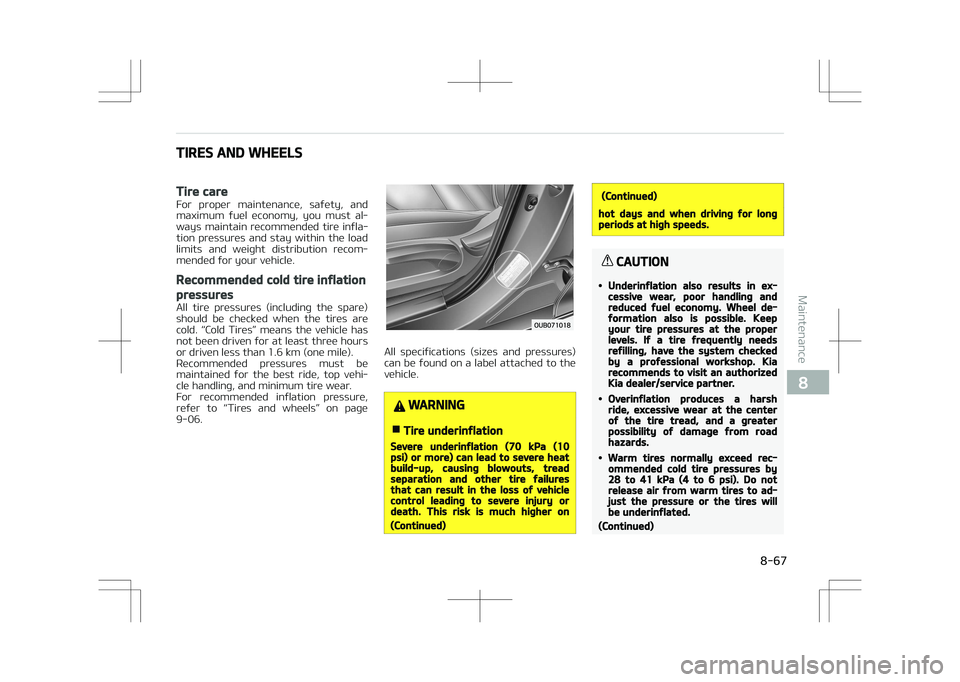
TIRES AND WHEELS
Tire care
For proper maintenance, safety, and
maximum fuel economy, you must al‐
ways maintain recommended tire infla‐ tion pressures and stay within the load
limits and weight distribution recom‐
mended for your vehicle.
Recommended cold tire inflation
pressures
All tire pressures (including the spare)
should be checked when the tires are cold. L
Page 416 of 523
NOTICE
Rotate radial tires that have an
asymmetric tread pattern only from
front to rear and not from right to
left.
WARNING
•Do not use the compact spare tire(if equipped) for tire rotation.
•Do not mix bias ply and radial plytires under any circumstances.This may cause unusual handlingcharacteristics that could result indeath, severe injury, or propertydamage.
Wheel alignment and tire
balance
The wheels on your vehicle were
aligned and balanced carefully at the factory to give you the longest tire life
and best overall performance.
In most cases, you will not need to have
your wheels aligned again. However, if
you notice unusual tire wear or your vehicle pulling one way or the other,
the alignment may need to be reset. If you notice your vehicle vibrating
when driving on a smooth road, your wheels may need to be rebalanced.
CAUTION
Improper wheel weights can damageyour vehicle's aluminum wheels. Useonly approved wheel weights.
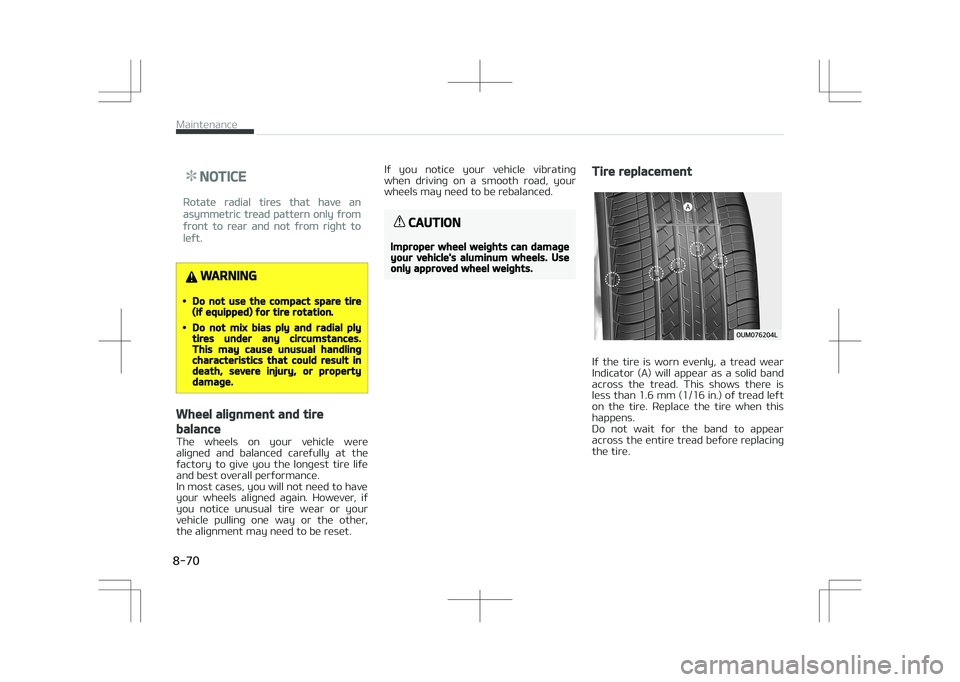
Tire replacement
If the tire is worn evenly, a tread wear
Indicator (A) will appear as a solid band across the tread. This shows there is
less than 1.6 mm (1/16 in.) of tread left
on the tire. Replace the tire when this happens.
Do not wait for the band to appear
across the entire tread before replacing
the tire.
Maintenance
8-70
Page 483 of 523
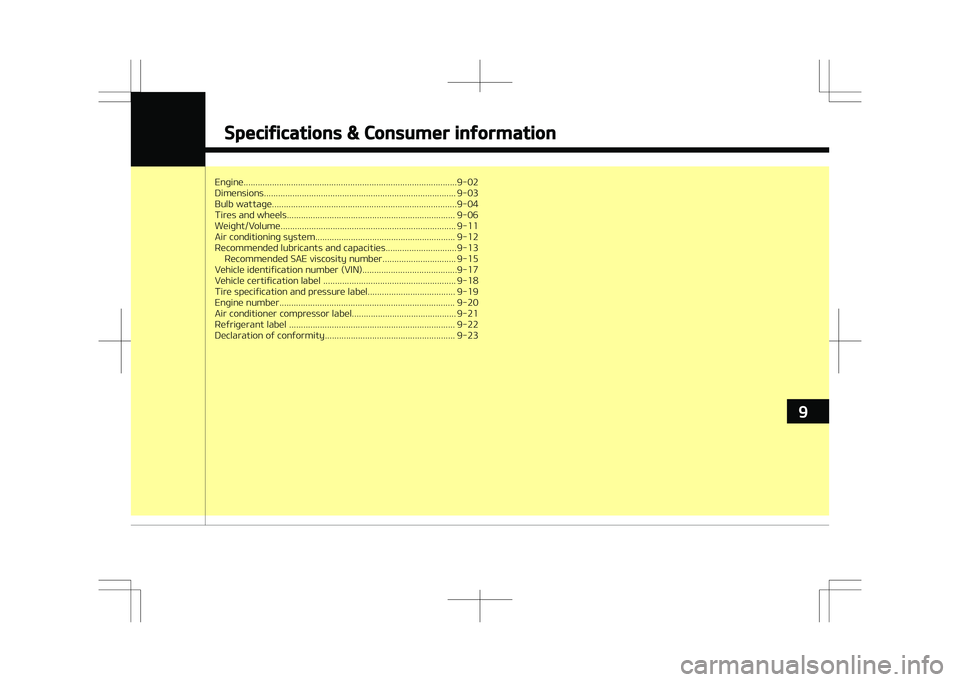
Engine..........................................................................................9-02
Dimensions................................................................................. 9-03
Bulb wattage..............................................................................9-04
Tires and wheels....................................................................... 9-06
Weight/Volume.......................................................................... 9-11
Air conditioning system........................................................... 9-12
Recommended lubricants and capacities.............................. 9-13Recommended SAE viscosity number............................... 9-15
Vehicle identification number (VIN)........................................9-17
Vehicle certification label ........................................................ 9-18
Tire specification and pressure label..................................... 9-19
Engine number.......................................................................... 9-20
Air conditioner compressor label............................................ 9-21
Refrigerant label ...................................................................... 9-22
Declaration of conformity....................................................... 9-23
Specifications & Consumer information
9
Page 493 of 523
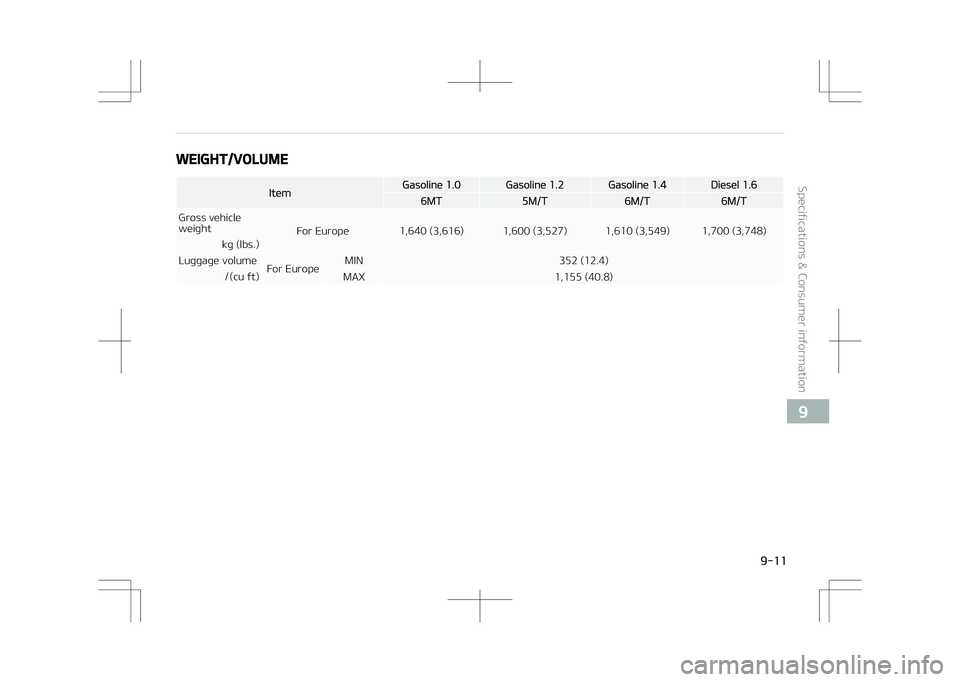
WEIGHT/VOLUME
ItemGasoline 1.0Gasoline 1.2Gasoline 1.4Diesel 1.6
6MT5M/T6M/T6M/T
Gross vehicle weight For Europe 1,640 (3,616) 1,600 (3,527) 1,610 (3,549) 1,700 (3,748)
kg (lbs.)
Luggage volume For EuropeMIN
352 (12.4)
MAX 1,155 (40.8)
l (cu ft)
9-11
9
Specifications & Consumer information