belt KIA STONIC 2018 Owner's Guide
[x] Cancel search | Manufacturer: KIA, Model Year: 2018, Model line: STONIC, Model: KIA STONIC 2018Pages: 523, PDF Size: 24.99 MB
Page 67 of 523
WARNING
Always use seat belts and child re‐straints – every trip, every time, ev‐eryone! Air bags inflate with consid‐erable force and in the blink of aneye. Seat belts help keep occupantsin proper position to obtain maxi‐mum benefit from the air bag. Evenwith air bags, improperly belted andunbelted occupants can be severelyinjured when the air bag inflates. Al‐ways follow the precautions aboutseat belts, air bags and occupantsafety contained in this manual.To reduce the chance of serious orfatal injuries and receive the maxi‐mum safety benefit from your re‐straint system:•Never place a child in any child orbooster seat in the front seat.
•ABC – Always Buckle Children inthe back seat. It is the safest placefor children of any age to ride.
•Front and side air bags can injureoccupants improperly positioned inthe front seats.
(Continued)
(Continued)
•Move your seat as far back aspractical from the front air bags,while still maintaining control ofthe vehicle.
•You and your passengers shouldnever sit or lean unnecessarilyclose to the air bags. Improperlypositioned drivers and passengerscan be severely injured by inflatingair bags.
•Never lean against the door orcenter console – always sit in anupright position.
•Do not allow a passenger to ride inthe front seat when the passeng‐er’s front air bag OFF indicator isilluminated, because the air bagwill not deploy in the event of amoderate or severe frontal crash.
(Continued)
(Continued)
•No objects should be placed overor near the air bag modules on thesteering wheel, instrument paneland the front passenger's panelabove the glove box, because anysuch object could cause harm ifthe vehicle is in a crash severeenough to cause the air bags todeploy.
•Do not tamper with or disconnectSRS wiring or other components ofthe SRS system. Doing so could re‐sult in injury, due to accidental de‐ployment of the air bags or byrendering the SRS inoperative.
•If the SRS air bag warning light re‐mains illuminated while the vehicleis being driven, have the systeminspected by a professional work‐shop. Kia recommends to visit anauthorized Kia dealer/service part‐ner.
(Continued)
3-47
3
Safety features of your vehicle
Page 68 of 523
(Continued)
•Air bags can only be used once -have the system replaced by aprofessional workshop.Kia recommends to visit an au‐thorized Kia dealer/service part‐ner.
•The SRS is designed to deploy thefront air bags only when an impactis sufficiently severe and when theimpact angle is less than 30° fromthe forward longitudinal axis ofthe vehicle. Additionally, the airbags will only deploy once. Seatbelts must be worn at all times.
•Front air bags are not intended todeploy in side-impact, rear-impactor rollover crashes. In addition,front air bags will not deploy infrontal crashes below the deploy‐ment threshold.
•A child restraint system must nev‐er be placed in the front seat. Theinfant or child could be severely in‐jured or killed by an air bag deploy‐ment in case of an accident.
(Continued)
(Continued)
•Children age 12 and under must al‐ways be properly restrained in therear seat. Never allow children toride in the front passenger seat. Ifa child over 12 must be seated inthe front seat, he or she must beproperly belted and the seatshould be moved as far back aspossible.
•For maximum safety protection inall types of crashes, all occupantsincluding the driver should alwayswear their seat belts whether ornot an air bag is also provided attheir seating position to minimizethe risk of severe injury or death inthe event of a crash. Do not sit orlean unnecessarily close to the airbag while the vehicle is in motion.
(Continued)
(Continued)
•Sitting improperly or out of posi‐tion can result in serious or fatalinjury in a crash. All occupantsshould sit upright with the seatback in an upright position, cen‐tered on the seat cushion withtheir seat belt on, legs comforta‐bly extended and their feet on thefloor until the vehicle is parked andthe ignition key is removed.
•The SRS air bag system must de‐ploy very rapidly to provide pro‐tection in a crash. If an occupant isout of position because of notwearing a seat belt, the air bagmay forcefully contact the occu‐pant causing serious or fatal inju‐ries.
Safety features of your vehicle
3-48
Page 70 of 523
CAUTION
•If the passenger’s front air bagON/OFF switch is not workingproperly, the air bag warning light() on the instrument panel willilluminate.And, the passenger's front air bagOFF indicator () will not illumi‐nate (The passenger's front airbag ON indicator comes on andgoes off after approximately 60seconds), the SRS Control Modulereactivate the passenger’s frontair bag and the passenger’s frontair bag will inflate in frontal impactcrashes even if the passenger’sfront air bag ON/OFF switch is setto the OFF position.In this case, have the system in‐spected by a professional work‐shop. Kia recommends to visit anauthorized Kia dealer/service part‐ner.
(Continued)
(Continued)
•If the SRS air bag warning lightblinks or does not illuminate whenthe ignition switch is turned to theON position, or if it illuminateswhile the vehicle is being driven,have the system inspected by aprofessional workshop. Kia recom‐mends to visit an authorized Kiadealer/service partner.
WARNING
•The driver is responsible for theproper position of the passenger’sfront air bag ON/OFF switch.
•Deactivate the passenger's frontair bag only when the ignitionswitch is switched off, or the mal‐function may occur in the SRSControl Module.And there may be a danger thatthe driver's and/or front passeng‐er’s and/or side and curtain air bagmay fail to trigger, or not triggercorrectly during a collision.
(Continued)
(Continued)
•Never install a rearward facingchild seat on the front passenger'sseat unless the passenger's frontair bag has been deactivated. Theinfant or child could be severely in‐jured or killed by an air bag deploy‐ment in case of an accident.
•Even though your vehicle is equip‐ped with the passenger's front airbag ON/OFF switch, do not install achild restraint system in the frontpassenger's seat. A child restraintsystem must never be placed inthe front seat. Children who aretoo large for child restraint sys‐tems should always occupy therear seat and use the available lap/shoulder belts. Children are affor‐ded the most safety in the eventof an accident when they are re‐strained by a proper restraint sys‐tem in the rear seat.
•As soon as the child seat is no lon‐ger needed on the front passeng‐er's seat, reactivate the front pas‐senger's air bag.
(Continued)
Safety features of your vehicle
3-50
Page 71 of 523
(Continued)
•Never place or insert any object in‐to any small opening near side air‐bag labels attached to the vehicleseats. When the air bag deploys,the object may affect the deploy‐ment and result in unexpected ac‐cident or bodily harm.
WARNING
nNo attaching objects
No objects (such as crash pad cover,cellular phone holder, cup holder,perfume or stickers) should beplaced over or near the air bag mod‐ules on the steering wheel, instru‐ment panel, windshield glass, andthe front passenger's panel abovethe glove box. Such objects couldcause harm if the vehicle is in acrash severe enough to cause the airbags to deploy. Do not place any ob‐jects over the air bag or between theair bag and yourself.
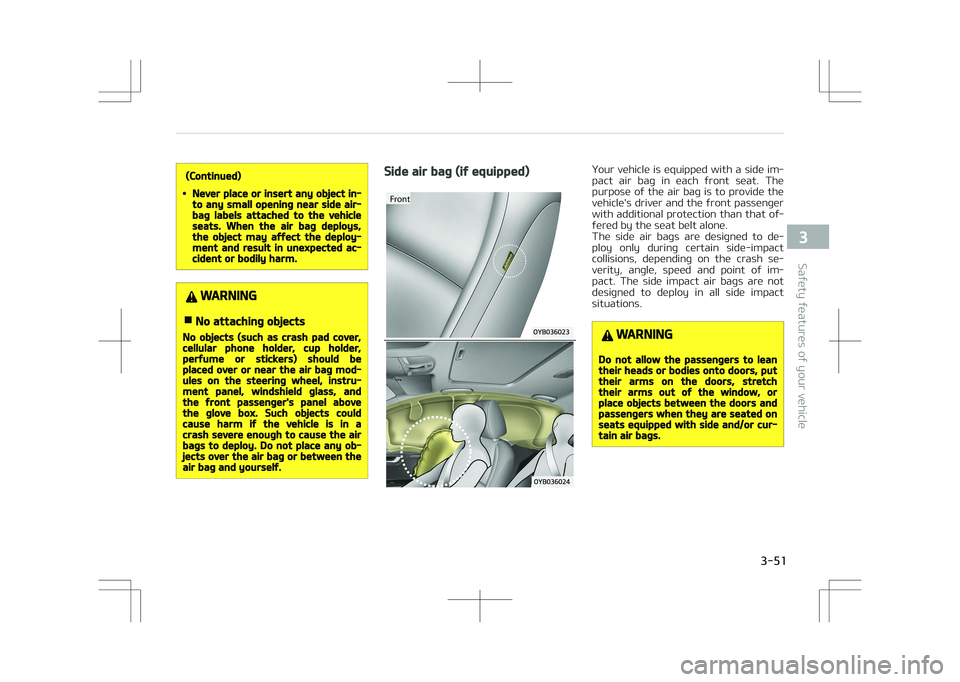
Side air bag (if equipped)
Front
Your vehicle is equipped with a side im‐
pact air bag in each front seat. The purpose of the air bag is to provide the
vehicle's driver and the front passenger
with additional protection than that of‐ fered by the seat belt alone.
The side air bags are designed to de‐
ploy only during certain side-impact
collisions, depending on the crash se‐ verity, angle, speed and point of im‐
pact. The side impact air bags are not
designed to deploy in all side impact situations.
WARNING
Do not allow the passengers to leantheir heads or bodies onto doors, puttheir arms on the doors, stretchtheir arms out of the window, orplace objects between the doors andpassengers when they are seated onseats equipped with side and/or cur‐tain air bags.
3-51
3
Safety features of your vehicle
Page 72 of 523
NOTICE
nif equipped with rollover sen‐
sor
•Also, both side of the side air bags
deploy in certain rollover situa‐
tions.
•The side air bag may deploy when
the rollover sensor detects the sit‐
uation as a rollover.
WARNING
•The side air bag is supplemental tothe seat belt systems and is not asubstitute for them. Thereforeyour seat belts must be worn at alltimes while the vehicle is in mo‐tion. The air bags deploy only in
certain side impact or rollover*1
conditions severe enough to causesignificant injury to the vehicle oc‐cupants.
(Continued)
*1 Only vehicle equipped with rolloversensor.
(Continued)
•For best protection from the sideair bag system and to avoid beinginjured by the deploying side airbag, both front and all rear (ifequipped) seat occupants shouldsit in an upright position with theseat belt properly fastened.
•Do not use any accessory seatcovers.
•Use of seat covers could reduce orprevent the effectiveness of thesystem.
•To prevent unexpected deploy‐ment of the side air bag that mayresult in personal injury, avoid im‐pact to the side impact sensorwhen the ignition switch is on.
•If the seat or seat cover is dam‐aged, have the system serviced bya professional workshop.Kia recommends to visit an au‐thorized Kia dealer/service part‐ner.
WARNING
nNo attaching objects
•Do not place any objects over theair bag or between the air bag andyourself. Also, do not attach anyobjects around the area the air baginflates such as the door, side doorglass, front and rear pillar.
•Do not place any objects betweenthe door and the seat. They maybecome dangerous projectiles ifthe side air bag inflates.
•Do not install any accessories onthe side or near the side air bags.
•Do not hang heavy items on thecoat hooks for safety reasons.
Safety features of your vehicle
3-52
Page 73 of 523
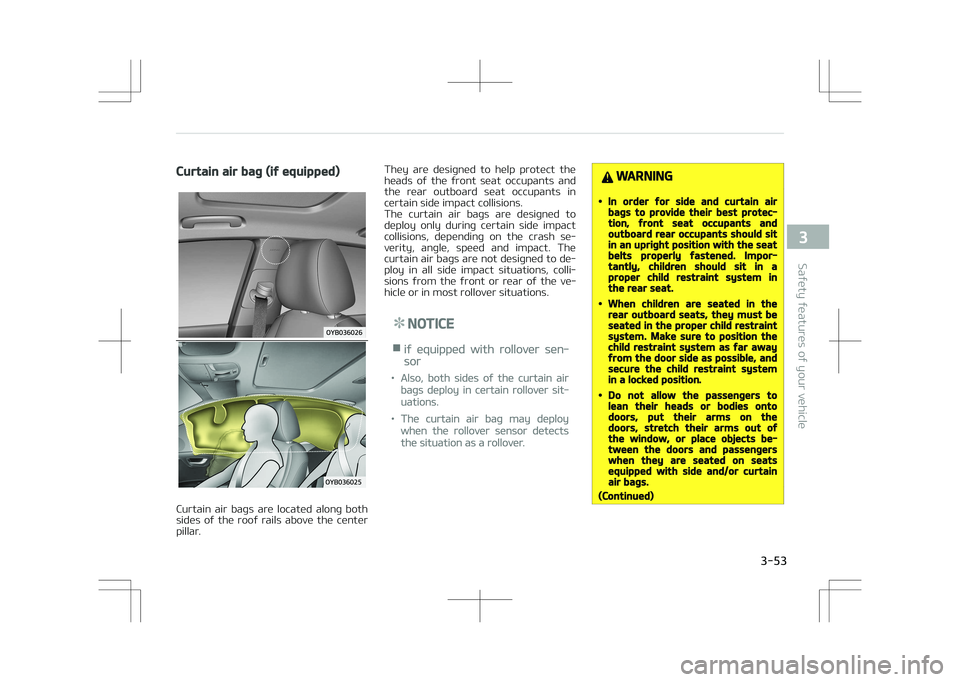
Curtain air bag (if equipped)
Curtain air bags are located along both
sides of the roof rails above the center pillar. They are designed to help protect the
heads of the front seat occupants and
the rear outboard seat occupants in certain side impact collisions.
The curtain air bags are designed to
deploy only during certain side impact
collisions, depending on the crash se‐ verity, angle, speed and impact. The
curtain air bags are not designed to de‐
ploy in all side impact situations, colli‐ sions from the front or rear of the ve‐
hicle or in most rollover situations.
NOTICE
nif equipped with rollover sen‐
sor
•Also, both sides of the curtain air
bags deploy in certain rollover sit‐
uations.
•The curtain air bag may deploy
when the rollover sensor detects
the situation as a rollover.
WARNING
•In order for side and curtain airbags to provide their best protec‐tion, front seat occupants andoutboard rear occupants should sitin an upright position with the seatbelts properly fastened. Impor‐tantly, children should sit in aproper child restraint system inthe rear seat.
•When children are seated in therear outboard seats, they must beseated in the proper child restraintsystem. Make sure to position thechild restraint system as far awayfrom the door side as possible, andsecure the child restraint systemin a locked position.
•Do not allow the passengers tolean their heads or bodies ontodoors, put their arms on thedoors, stretch their arms out ofthe window, or place objects be‐tween the doors and passengerswhen they are seated on seatsequipped with side and/or curtainair bags.
(Continued)
3-53
3
Safety features of your vehicle
Page 77 of 523
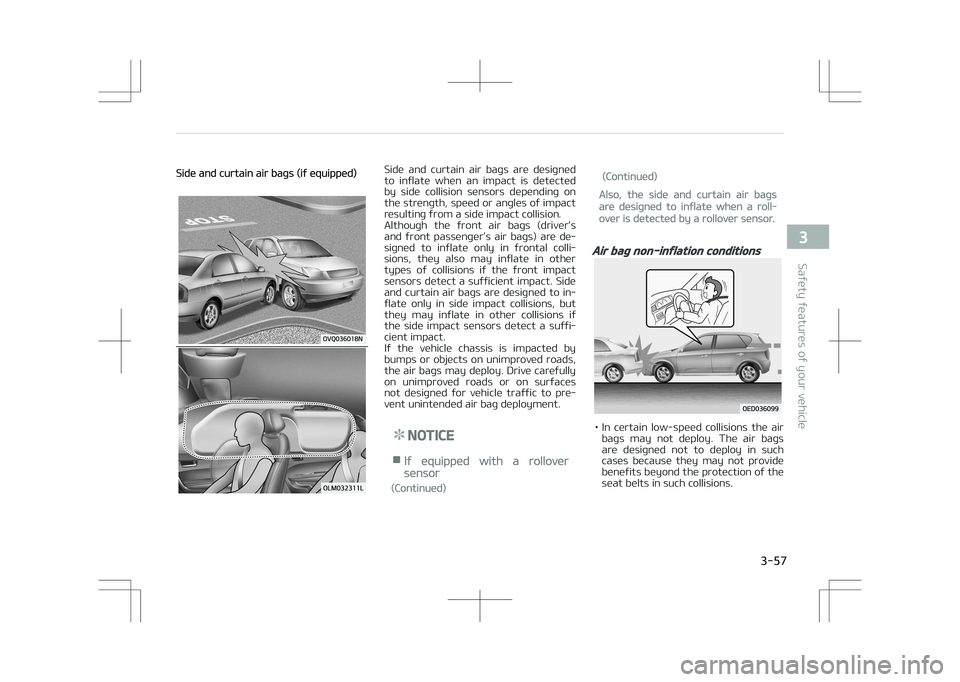
Side and curtain air bags (if equipped)Side and curtain air bags are designed
to inflate when an impact is detected by side collision sensors depending on
the strength, speed or angles of impact
resulting from a side impact collision.
Although the front air bags (driver’s and front passenger’s air bags) are de‐
signed to inflate only in frontal colli‐
sions, they also may inflate in other types of collisions if the front impact
sensors detect a sufficient impact. Side
and curtain air bags are designed to in‐ flate only in side impact collisions, but
they may inflate in other collisions if
the side impact sensors detect a suffi‐ cient impact.
If the vehicle chassis is impacted by
bumps or objects on unimproved roads,
the air bags may deploy. Drive carefully on unimproved roads or on surfaces
not designed for vehicle traffic to pre‐
vent unintended air bag deployment.
NOTICE
nIf equipped with a rollover
sensor
(Continued)
(Continued)
Also, the side and curtain air bags
are designed to inflate when a roll‐
over is detected by a rollover sensor.
Air bag non-inflation conditions
• In certain low-speed collisions the air bags may not deploy. The air bags
are designed not to deploy in such cases because they may not provide
benefits beyond the protection of the
seat belts in such collisions.
3-57
3
Safety features of your vehicle
Page 80 of 523
SRS care
The SRS is virtually maintenance-free
and so there are no parts you can safe‐
ly service by yourself. If the SRS air bag warning light does not illuminate, or
continuously remains on, have the sys‐
tem inspected by a professional work‐ shop.
Kia recommends to visit an authorized
Kia dealer/service partner.
WARNING
•Modification to SRS components orwiring, including the addition ofany kind of badges to the pad cov‐ers or modifications to the bodystructure, can adversely affectSRS performance and lead to pos‐sible injury.
•For cleaning the air bag pad cov‐ers, use only a soft, dry cloth orone which has been moistenedwith plain water. Solvents or clean‐ers could adversely affect the airbag covers and proper deploymentof the system.
(Continued)
(Continued)
•No objects should be placed overor near the air bag modules on thesteering wheel, instrument panel,and the front passenger's panelabove the glove box, because anysuch object could cause harm ifthe vehicle is in a crash severeenough to cause the air bags to in‐flate.
•If the air bags inflate, have thesystem replaced by a professionalworkshop.Kia recommends to visit an au‐thorized Kia dealer/service part‐ner.
•Do not tamper with or disconnectSRS wiring, or other componentsof the SRS system. Doing so couldresult in injury, due to accidentalinflation of the air bags or by ren‐dering the SRS inoperative.
(Continued)
(Continued)
•If components of the air bag sys‐tem must be discarded, or if thevehicle must be scrapped, certainsafety precautions must be ob‐served. An authorized Kia dealerknows these precautions and cangive you the necessary informa‐tion. Failure to follow these pre‐cautions and procedures could in‐crease the risk of personal injury.
•If your car was flooded and hassoaked carpeting or water onflooring, you shouldn't try to startthe engine; in this case, have yourvehicle inspected by a professionalworkshop. Kia recommends tocontact an authorized Kia dealer/service partner.
Additional safety precautions
•Never let passengers ride in the cargoarea or on top of a folded-down backseat. All occupants should sit upright,
fully back in their seats with their
seat belts on and their feet on the
floor.
Safety features of your vehicle
3-60
Page 81 of 523
•Passengers should not move out ofor change seats while the vehicle ismoving. A passenger who is not
wearing a seat belt during a crash or
emergency stop can be thrown
against the inside of the vehicle,
against other occupants, or out of
the vehicle.
•
Each seat belt is designed to restrainone occupant. If more than one per‐
son uses the same seat belt, they
could be seriously injured or killed in a
collision.
•
Do not use any accessories on seatbelts. Devices claiming to improve oc‐
cupant comfort or reposition the seat
belt can reduce the protection provi‐
ded by the seat belt and increase the
chance of serious injury in a crash.
•
Passengers should not place hard orsharp objects between themselvesand the air bags. Carrying hard or
sharp objects on your lap or in your
mouth can result in injuries if an air
bag inflates. •
Keep occupants away from the airbag covers.
All occupants should sit
upright, fully back in their seats with
their seat belts on and their feet on
the floor. If occupants are too close
to the air bag covers, they could be injured if the air bags inflate.
•
Do not attach or place objects on ornear the air bag covers. Any object
attached to or placed on the front or
side air bag covers could interfere with the proper operation of the air
bags.
•
Do not modify the front seats. Modi‐
fication of the front seats could in‐
terfere with the operation of the
supplemental restraint system sens‐ ing components or side air bags.
•
Do not place items under the frontseats. Placing items under the front
seats could interfere with the opera‐
tion of the supplemental restraint
system sensing components and wir‐ ing harnesses.
•
Never hold an infant or child on yourlap. The infant or child could be seri‐
ously injured or killed in the event of
a crash. All infants and children should be properly restrained in ap‐
propriate child safety seats or seat
belts in the rear seat.
WARNING
•Sitting improperly or out of posi‐tion can cause occupants to beshifted too close to a deploying airbag, strike the interior structureor be thrown from the vehicle re‐sulting in serious injury or death.
•Always sit upright with the seat‐back in an upright position, cen‐tered on the seat cushion withyour seat belt on, legs comfortablyextended and your feet on thefloor.
Adding equipment to or
modifying your air bag-
equipped vehicle
If you modify your vehicle by changing
your vehicle's frame, bumper system, front end or side sheet metal or ride
height, this may affect the operation of
your vehicle's air bag system.
3-61
3
Safety features of your vehicle
Page 147 of 523
WARNING AND INDICATOR LIGHTS
Warning lights
NOTICE
nWarning lights
Make sure that all warning lights are
OFF after starting the engine. If any
light is still ON, this indicates a situa‐
tion that needs attention.
Air bag Warning Light
This warning light illumi‐nates:
• Once you set the ignition switch or Engine Start/Stop Button
to the ON position. - It illuminates for approximately 6 seconds and then goes off.
• When there is a malfunction with the SRS.
In this case, have the vehicle inspec‐
ted by a professional workshop. Kia
recommends to visit an authorized
Kia dealer/service partner.
Seat Belt Warning Light
This warning light informs the driver that the seat belt
is not fastened.
❈ For more details, refer to the L