maintenance Lancia Flavia 2013 Owner handbook (in English)
[x] Cancel search | Manufacturer: LANCIA, Model Year: 2013, Model line: Flavia, Model: Lancia Flavia 2013Pages: 244, PDF Size: 2.87 MB
Page 7 of 244
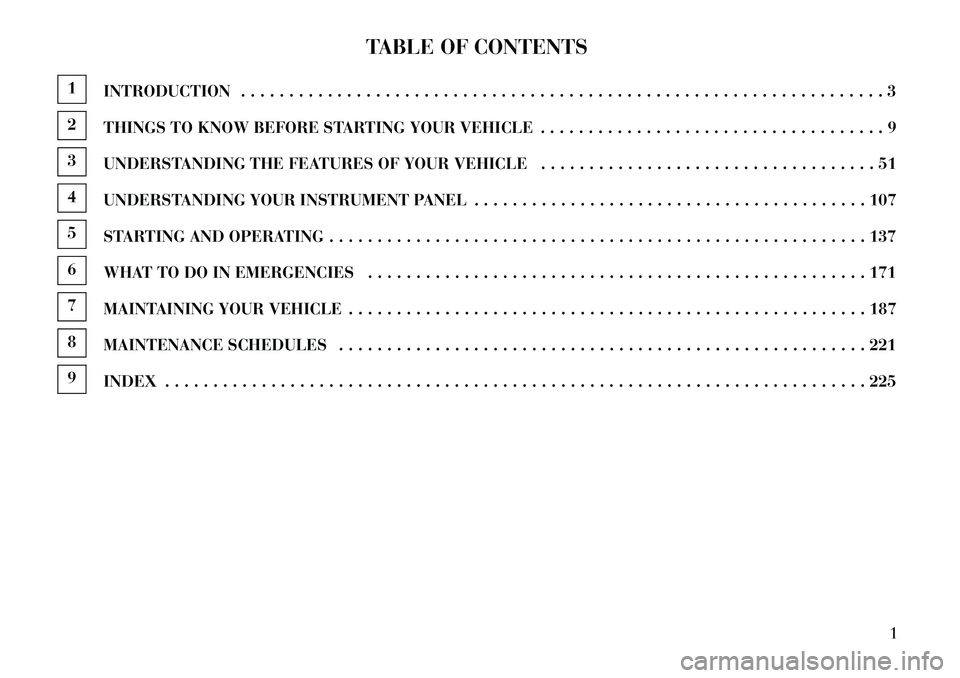
TABLE OF CONTENTS
1INTRODUCTION . . . . . . . . . . . . . . . . . . . . . . . . . . . . . . . . . . . . . . . . . . . . . . . . . . . . . . . . . . . . . . . . . . . 32THINGS TO KNOW BEFORE STARTING YOUR VEHICLE . . . . . . . . . . . . . . . . . . . . . . . . . . . . . . . . . . . . 93UNDERSTANDING THE FEATURES OF YOUR VEHICLE . . . . . . . . . . . . . . . . . . . . . . . . . . . . . . . . . . . 514UNDERSTANDING YOUR INSTRUMENT PANEL . . . . . . . . . . . . . . . . . . . . . . . . . . . . . . . . . . . . . . . . . 1075STARTING AND OPERATING . . . . . . . . . . . . . . . . . . . . . . . . . . . . . . . . . . . . . . . . . . . . . . . . . . . . . . . . 1376WHAT TO DO IN EMERGENCIES . . . . . . . . . . . . . . . . . . . . . . . . . . . . . . . . . . . . . . . . . . . . . . . . . . . . 1717MAINTAINING YOUR VEHICLE . . . . . . . . . . . . . . . . . . . . . . . . . . . . . . . . . . . . . . . . . . . . . . . . . . . . . . 1878MAINTENANCE SCHEDULES . . . . . . . . . . . . . . . . . . . . . . . . . . . . . . . . . . . . . . . . . . . . . . . . . . . . . . . 2219INDEX . . . . . . . . . . . . . . . . . . . . . . . . . . . . . . . . . . . . . . . . . . . . . . . . . . . . . . . . . . . . . . . . . . . . . . . . . 225
1
Page 10 of 244
INTRODUCTION
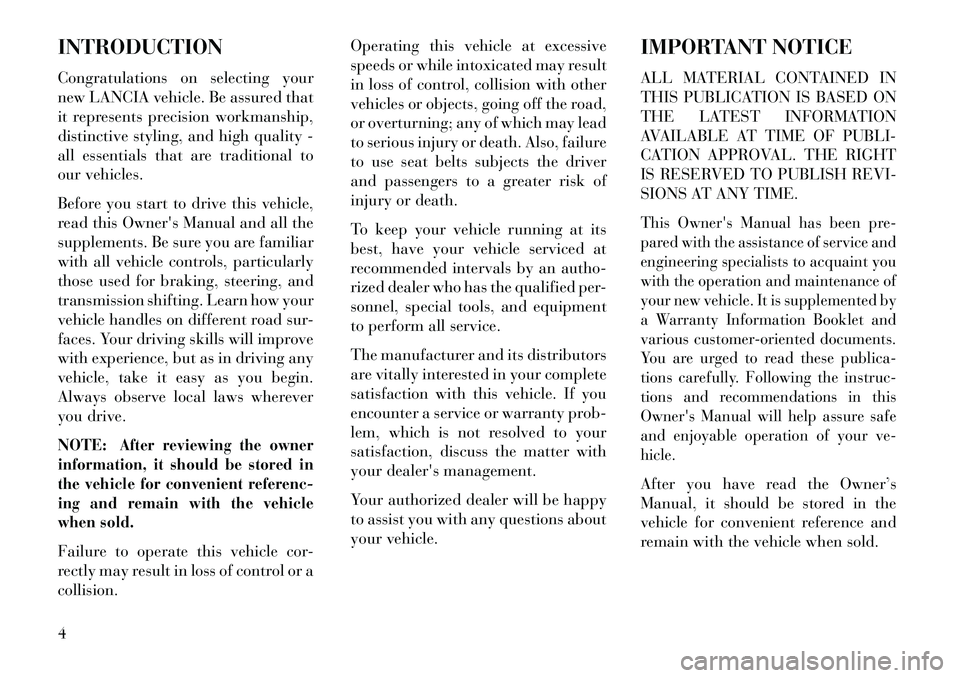
Congratulations on selecting your
new LANCIA vehicle. Be assured that
it represents precision workmanship,
distinctive styling, and high quality -
all essentials that are traditional to
our vehicles.
Before you start to drive this vehicle,
read this Owner's Manual and all the
supplements. Be sure you are familiar
with all vehicle controls, particularly
those used for braking, steering, and
transmission shifting. Learn how your
vehicle handles on different road sur-
faces. Your driving skills will improve
with experience, but as in driving any
vehicle, take it easy as you begin.
Always observe local laws wherever
you drive.
NOTE:
After reviewing the owner
information, it should be stored in
the vehicle for convenient referenc-
ing and remain with the vehicle
when sold.
Failure to operate this vehicle cor-
rectly may result in loss of control or a
collision. Operating this vehicle at excessive
speeds or while intoxicated may result
in loss of control, collision with other
vehicles or objects, going off the road,
or overturning; any of which may lead
to serious injury or death. Also, failure
to use seat belts subjects the driver
and passengers to a greater risk of
injury or death.
To keep your vehicle running at its
best, have your vehicle serviced at
recommended intervals by an autho-
rized dealer who has the qualified per-
sonnel, special tools, and equipment
to perform all service.
The manufacturer and its distributors
are vitally interested in your complete
satisfaction with this vehicle. If you
encounter a service or warranty prob-
lem, which is not resolved to your
satisfaction, discuss the matter with
your dealer's management.
Your authorized dealer will be happy
to assist you with any questions about
your vehicle.
IMPORTANT NOTICE
ALL MATERIAL CONTAINED IN
THIS PUBLICATION IS BASED ON
THE LATEST INFORMATION
AVAILABLE AT TIME OF PUBLI-
CATION APPROVAL. THE RIGHT
IS RESERVED TO PUBLISH REVI-
SIONS AT ANY TIME.
This Owner's Manual has been pre-
pared with the assistance of service and
engineering specialists to acquaint you
with the operation and maintenance of
your new vehicle. It is supplemented by
a Warranty Information Booklet and
various customer-oriented documents.
You are urged to read these publica-
tions carefully. Following the instruc-
tions and recommendations in this
Owner's Manual will help assure safe
and enjoyable operation of your ve-
hicle.After you have read the Owner’s
Manual, it should be stored in the
vehicle for convenient reference and
remain with the vehicle when sold.
4
Page 19 of 244

WARNING!(Continued)
Allowing children to be in a ve- hicle unattended is dangerous for
a number of reasons. A child or
others could be seriously or fa-
tally injured. Children should be
warned not to touch the parking
brake, brake pedal or the shift
lever.
Do not leave the Key Fob in or
near the vehicle, or in a location
accessible to children, and do not
leave the ignition in the ACC or
ON/RUN position. A child could
operate power windows, other
controls, or move the vehicle.
Do not leave children or animals
inside parked vehicles in hot
weather. Interior heat build-up
may cause serious injury or
death.CAUTION!
An unlocked car is an invitation to
thieves. Always remove key from
the ignition and lock all doors when
leaving the vehicle unattended. KEY-IN-IGNITION
REMINDER
Opening the driver's door when the
key is in the ignition sounds a signal to
remind you to remove the key.
NOTE:
The Key-In-Ignition reminder
only sounds when the ignition
key is placed in the LOCK or
ACC position.
With either/both front doors open and a key in the ignition,
the power door lock buttons on
the interior trim panel are dis-
abled. This is an attempt to limit
locking the keys in the vehicle.
LOCKING THE DOORS
WITH THE KEY
There is only one external door lock
cylinder which is located in the driv-
er's door.
You can insert the key with either side
up. To lock the door, turn the key
clockwise. To unlock the door, turn
the key counterclockwise. For door lock lubrication, see “Maintenance
Procedures” in “Maintaining Your Ve-
hicle” of this manual.
SENTRY KEY®
The Sentry Key® Immobilizer System
prevents unauthorized vehicle opera-
tion by disabling the engine. The sys-
tem does not need to be armed or
activated. Operation is automatic, re-
gardless of whether the vehicle is
locked or unlocked.
The system uses ignition keys which
have an embedded electronic chip
(transponder) to prevent unauthor-
ized vehicle operation. Therefore,
only keys that are programmed to the
vehicle can be used to start and oper-
ate the vehicle. The system will shut
the engine off in two seconds if some-
one uses an invalid key to start the
engine.
NOTE: A key which has not been
programmed is also considered an
invalid key, even if it is cut to fit the
ignition switch lock cylinder for
that vehicle.
13
Page 43 of 244
WARNING!
Deployed air bags and seat belt pre-
tensioners cannot protect you in
another collision. Have the air
bags, seat belt pretensioners, and
the front seat belt retractor assem-
blies replaced by an authorized
dealer immediately. Also, have the
Occupant Restraint Controller Sys-
tem serviced as well.
Maintaining Your Air Bag SystemWARNING!
Modifications to any part of the air bag system could cause it to
fail when you need it. You could
be injured if the air bag system is
not there to protect you. Do not
modify the components or wiring,
including adding any kind of
badges or stickers to the steering
wheel hub trim cover or the upper
right side of the instrument panel.
Do not modify the front bumper,
vehicle body structure, or add
aftermarket side steps or running
boards.
(Continued)
WARNING!(Continued)
It is dangerous to try to repair any part of the air bag system your-
self. Be sure to tell anyone who
works on your vehicle that it has
an air bag system.
Do not attempt to modify any part of your air bag system. The
air bag may inflate accidentally
or may not function properly if
modifications are made. Take
your vehicle to an authorized
dealer for any air bag system ser-
vice. If your seat, including your
trim cover and cushion, needs to
be serviced in any way (including
removal or loosening/tightening
of seat attachment bolts), take
the vehicle to your authorized
dealer. Only manufacturer ap-
proved seat accessories may be
used. If it is necessary to modify
the air bag system for persons
with disabilities, contact your au-
thorized dealer. Air Bag Warning Light
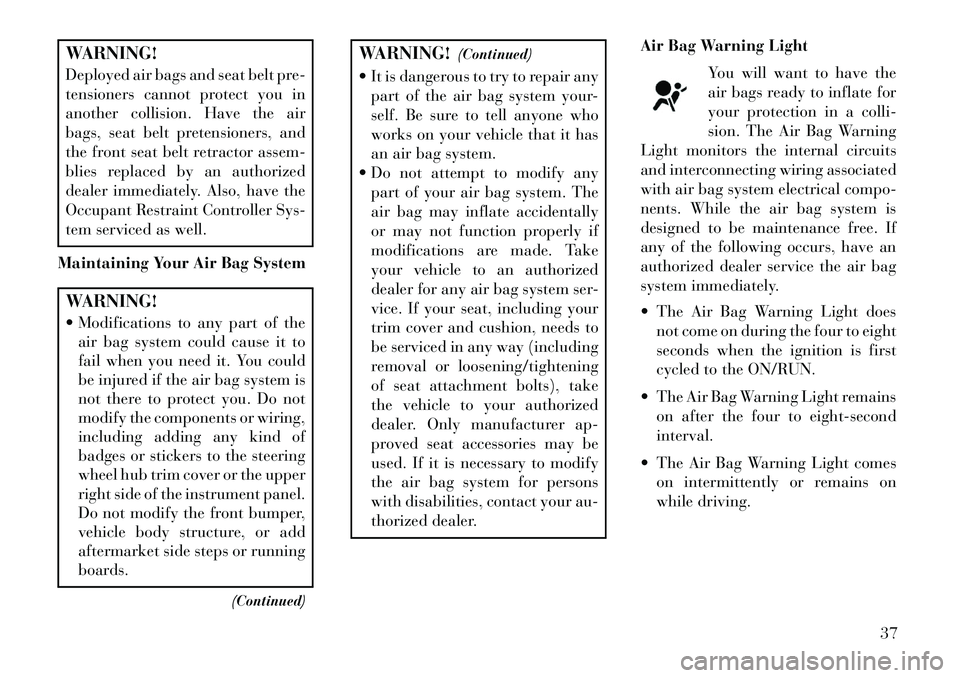
You will want to have the
air bags ready to inflate for
your protection in a colli-
sion. The Air Bag Warning
Light monitors the internal circuits
and interconnecting wiring associated
with air bag system electrical compo-
nents. While the air bag system is
designed to be maintenance free. If
any of the following occurs, have an
authorized dealer service the air bag
system immediately.
The Air Bag Warning Light does not come on during the four to eight
seconds when the ignition is first
cycled to the ON/RUN.
The Air Bag Warning Light remains on after the four to eight-second
interval.
The Air Bag Warning Light comes on intermittently or remains on
while driving.
37
Page 53 of 244

5. Remove slack in the tether strap
according to the child restraint manu-
facturer's instructions.WARNING!An incorrectly anchored tether strap
could lead to increased head motion
and possible injury to the child. Use
only the anchor positions directly
behind the child seat to secure a
child restraint top tether strap.Transporting Pets
Air Bags deploying in the front seat
could harm your pet. An unrestrained
pet will be thrown about and possibly
injured, or injure a passenger during
panic braking or in a collision.
Pets should be restrained in the rear
seat in pet harnesses or pet carriers
that are secured by seat belts.
ENGINE BREAK-IN
RECOMMENDATIONS
A long break-in period is not required
for the engine and drivetrain (trans-
mission and axle) in your vehicle.
Drive moderately during the first
500 km. After the initial 100 km, speeds
up to 80 or 90 km/h are desirable.While cruising, brief full-throttle ac-
celeration within the limits of local
traffic laws contributes to a good
break-in. Wide-open throttle accel-
eration in low gear can be detrimental
and should be avoided.The engine oil installed in the engine at
the factory is a high-quality energy con-
serving type lubricant. Oil changes
should be consistent with anticipated
climate conditions under which vehicle
operations will occur. For the recom-
mended viscosity and quality grades,
refer to “Maintenance Procedures” in
“Maintaining Your Vehicle”. NON-
DETERGENT OR STRAIGHT MIN-
ERAL OILS MUST NEVER BE USED.A new engine may consume some oil
during its first few thousand kilome-
ters of operation. This should be con-
sidered a normal part of the break-in
and not interpreted as an indication of
difficulty.SAFETY TIPS
Transporting Passengers
NEVER TRANSPORT PASSENGERS
IN THE CARGO AREA.WARNING!
Do not leave children or animals
inside parked vehicles in hot
weather. Interior heat build-up
may cause serious injury or death. It is extremely dangerous to ride
in a cargo area, inside or outside
of a vehicle. In a collision, people
riding in these areas are more
likely to be seriously injured or
killed.
Do not allow people to ride in any area of your vehicle that is not
equipped with seats and seat
belts.
Be sure everyone in your vehicle is in a seat and using a seat belt
properly.
47
Page 140 of 244

OPERATING TIPS
NOTE:
Refer to the chart at the end
of this section for suggested control
settings for various weather condi-
tions.
Summer Operation
The engine cooling system in air-
conditioned vehicles must be pro-
tected with a high-quality antifreeze
coolant to provide proper corrosion
protection and to protect against en-
gine overheating. A solution of 50%
ethylene glycol antifreeze coolant and
50% water is recommended. Refer to
“Maintenance Procedures” in “Main-
taining Your Vehicle” for proper cool-
ant selection.
Winter Operation
Use of the air Recirculation Mode dur-
ing winter months is not recom-
mended because it may cause window
fogging. Vacation Storage
Anytime you store your vehicle, or
keep it out of service (i.e., vacation)
for two weeks or more, run the air
conditioning system at idle for about
five minutes in the fresh air and high
blower settings. This will ensure ad-
equate system lubrication to minimize
the possibility of compressor damage
when the system is started again.
Window Fogging
Interior fogging on the windshield can
be quickly removed by turning the
mode selector to Defrost. The Defrost/
Floor mode can be used to maintain a
clear windshield and provide suffi-
cient heating. If side window fogging
becomes a problem, increase blower
speed. Vehicle windows tend to fog on
the inside in mild but rainy or humid
weather.
NOTE: Recirculate without A/C
should not be used for long periods
as fogging may occur.
Side Window Demisters
A side window demister outlet is lo-
cated at each end of the instrument
panel. These non-adjustable outlets
direct air toward the side windows
when the system is in the FLOOR,
MIX, or DEFROST mode. The air is
directed at the area of the windows
through which you view the outside
mirrors.
134
Page 142 of 244

Outside Air Intake
Make sure the air intake, located di-
rectly in front of the windshield, is
free of obstructions such as leaves.
Leaves collected in the air intake may
reduce airflow, and if they enter the
plenum, they could plug the water
drains. In winter months, make sure
the air intake is clear of ice, slush, and
snow.
A/C Air Filter
The A/C Filter prevents most dust
and pollen from entering the cabin.
The filter acts on air coming from
outside the vehicle and recirculated
air within the passenger compart-
ment. Refer to “Maintenance Proce-
dures” in “Maintaining Your Vehicle”
for A/C Air Filter service information
or see your authorized dealer for ser-
vice. Refer to “Maintenance Sched-
ules” for filter service intervals.
136
Page 167 of 244

CAUTION!
To avoid damage to your vehicle or
tires, observe the following precau-
tions:
Because of restricted chain clear-
ance between tires and other sus-
pension components, it is impor-
tant that only chains in good
condition are used. Broken chains
can cause serious damage. Stop
the vehicle immediately if noise
occurs that could indicate chain
breakage. Remove the damaged
parts of the chain before further
use. Do not exceed 70 km/h.
Drive cautiously and avoid severeturns and large bumps, especially
with a loaded vehicle.
Install chains on the front wheels as tightly as possible and then
retighten after driving about
0.8 km.
Do not drive for prolonged peri- ods of time on dry pavement.
(Continued)
CAUTION!(Continued)
Observe the tire chain manufactur-
er's instructions on the method of
installation, operating speed, and
conditions for use. Always use the
lower suggested operating speed of
the chain manufacturer, if different
from the speed recommended by
the vehicle manufacturer.
This notice applies to all chain trac-
tion devices, including link and cable
(radial) chains.
TIRE ROTATION
RECOMMENDATIONS
Tires on the front and rear axles of
vehicles operate at different loads and
perform different steering, driving,
and braking functions. For these rea-
sons, they wear at unequal rates.These effects can be reduced by timely
rotation of tires. The benefits of rota-
tion are especially worthwhile with ag-
gressive tread designs such as those on
all season type tires. Rotation will in-
crease tread life, help to maintain mud,
snow, and wet traction levels, and con-
tribute to a smooth, quiet ride.
Refer to the “Maintenance Schedule”
for the proper maintenance intervals.
The reasons for any rapid or unusual
wear should be corrected prior to ro-
tation being performed.
TIRE PRESSURE
MONITOR SYSTEM
(TPMS)
The Tire Pressure Monitor System
(TPMS) will warn the driver of a low
tire pressure based on the vehicle rec-
ommended cold placard pressure.
The tire pressure will vary with tem-
perature by about 7 kPa for every
7°C. This means that when the out-
side temperature decreases, the tire
pressure will decrease. Tire pressure
should always be set based on cold
inflation tire pressure. This is defined
as the tire pressure after the vehicle
has not been driven for at least three
hours, or driven less than 1.6 km after
a three hour period. The cold tire in-
flation pressure must not exceed the
maximum inflation pressure molded
into the tire sidewall. Refer to “Tires –
General Information” in “Starting
161
Page 169 of 244

NOTE:
The TPMS is not intended to re-
place normal tire care and main-
tenance, or to provide warning of
a tire failure or condition. The TPMS should not be used asa tire pressure gauge while ad-
justing your tire pressure.
Driving on a significantly under-
inflated tire causes the tire to
overheat and can lead to tire fail-
ure. Under-inflation also reduces
fuel efficiency and tire tread life,
and may affect the vehicle’s han-
dling and stopping ability.The TPMS is not a substitute for
proper tire maintenance, and it is
the driver’s responsibility to
maintain correct tire pressure us-
ing an accurate tire pressure
gauge, even if under-inflation has
not reached the level to trigger il-
lumination of the “Tire Pressure
Monitoring Telltale Light.” Seasonal temperature changes will affect tire pressure, and the
TPMS will monitor the actual
tire pressure in the tire. PREMIUM SYSTEM
The Tire Pressure Monitor System
(TPMS) uses wireless technology with
wheel rim mounted electronic sensors
to monitor tire pressure levels. Sen-
sors, mounted to each wheel as part of
the valve stem, transmit tire pressure
readings to the Receiver Module.
NOTE: It is particularly impor-
tant for you to check the tire pres-
sure in all of the tires on your ve-
hicle monthly and to maintain the
proper pressure.
The TPMS consists of the following
components:
1. Receiver Module
2. Four Tire Pressure Monitoring
Sensors
3. Three Trigger Modules (mounted
in three of the four wheel-wells)
4. Various Tire Pressure Monitoring
System Messages, which display in
the Electronic Vehicle Information
Center (EVIC)
5.
Tire Pressure Monitoring Telltale
Light
Tire Pressure Monitoring Low
Pressure Warnings
The “Tire Pressure Monitoring
Telltale Light” will illuminate
in the instrument cluster and a
chime will sound when tire pressure is
low in one or more of the four active
road tires. In addition, the Electronic
Vehicle Information Center (EVIC)
will display a “Inflate Tire to XX”
message for a minimum of five sec-
onds and a graphic showing the pres-
sure values of each tire with the low
tire pressure values flashing. The rec-
ommended cold placard pressure in-
flation value is the pressure value dis-
played in the “Inflate Tire to XX”
message displayed in the EVIC.
Should this occur, you should stop as
soon as possible, and inflate all tires
with low pressure (those flashing in
the EVIC graphic) to the vehicle’s rec-
ommended cold placard pressure
value. Once the system receives the
updated tire pressures, the system will
automatically update, the “Inflate
Tire to XX” message will no longer be
displayed, the graphic display in the
EVIC will stop flashing, and the “Tire
163
Page 172 of 244

WARNING!
Carbon monoxide (CO) in exhaust
gases is deadly. Follow the precau-
tions below to prevent carbon mon-
oxide poisoning:
Do not inhale exhaust gases. Theycontain carbon monoxide, a col-
orless and odorless gas, which can
kill. Never run the engine in a
closed area, such as a garage, and
never sit in a parked vehicle with
the engine running for an ex-
tended period. If the vehicle is
stopped in an open area with the
engine running for more than a
short period, adjust the ventila-
tion system to force fresh, outside
air into the vehicle.
Guard against carbon monoxide with proper maintenance. Have
the exhaust system inspected ev-
ery time the vehicle is raised.
Have any abnormal conditions
repaired promptly. Until re-
paired, drive with all side win-
dows fully open. MMT IN GASOLINE
MMT is a manganese containing me-
tallic additive that is blended into
some gasoline to increase octane.
Gasoline blended with MMT provides
no performance advantage beyond
gasoline of the same octane number
without MMT. Gasoline blended with
MMT reduces spark plug life and re-
duces emission system performance in
some vehicles. The manufacturer rec-
ommends that gasoline without MMT
be used in your vehicle. The MMT
content of gasoline may not be indi-
cated on the gasoline pump; therefore,
you should ask your gasoline retailer
whether or not his/her gasoline con-
tains MMT.
MATERIALS ADDED TO
FUEL
Besides using unleaded gasoline with
the proper octane rating, gasolines
that contain detergents, corrosion and
stability additives are recommended.
Using gasolines that have these addi-
tives will help improve fuel economy,
reduce emissions, and maintain ve-
hicle performance.
Indiscriminate use of fuel system
cleaning agents should be avoided.
Many of these materials intended for
gum and varnish removal may con-
tain active solvents or similar ingredi-
ents. These can harm fuel system gas-
ket and diaphragm materials.
166