air condition Lancia Musa 2011 Owner handbook (in English)
[x] Cancel search | Manufacturer: LANCIA, Model Year: 2011, Model line: Musa, Model: Lancia Musa 2011Pages: 218, PDF Size: 3.91 MB
Page 52 of 218
51
SAFETY
STARTING
AND DRIVING
WARNING
LIGHTS AND
MESSAGES
IN AN
EMERGENCY
MAINTENANCE
AND CARE
TECHNICAL
SPECIFICA-
TIONS
INDEX
DASHBOARD
AND
CONTROLS
HEATED REAR WINDOW AND
DOOR MIRROR
DEMISTING/DEFROSTING
(for versions/markets, where provided)
Press button C-fig. 59to activate the
function. The LED in the button will
light up when the function is on.
The function is timed and automati-
cally deactivated by the system after
a given time. Press Cagain to switch
it off before.
IMPORTANT Do not apply stickers
on the inside of the rear window over
the heating filaments to avoid dam-
age that might cause it to stop work-
ing properly.Cooling
Proceed as follows:
❒stop internal air recirculation by
turning knob F-fig. 59to
Ú.
❒turn ring Bclockwise to increase
the temperature;
❒turn knob Aanticlockwise to re-
duce the fan speed.
LOOKING AFTER THE SYSTEM
Run the climate control system for at
least 10 minutes every month during
the winter. Have the system inspected
at a Lancia Dealership before the
summer. AIR CONDITIONING
(cooling and dehumidifying)
Proceed as follows:
❒turn the ring B-fig. 59to the blue
sector to select the temperature;
❒turn knob Ato the required speed;
❒turn the ring Eto
«;
❒turn the knob Fto
….
❒press button D
√(the LED on the
button will light up).
Page 53 of 218
52
SAFETY
STARTING
AND DRIVING
WARNING
LIGHTS AND
MESSAGES
IN AN
EMERGENCY
MAINTENANCE
AND CARE
TECHNICAL
SPECIFICA-
TIONS
INDEX
DASHBOARD
AND
CONTROLS
The temperature of the air taken in is
always controlled automatically de-
pending on the temperature set on the
display (except when the system is
turned off or under certain conditions
when the compressor is off. The fol-
lowing parameters and functions can
be manually set:
❒air temperature on driver/front
passenger side;
❒fan speed (continuous variation);
❒air distribution to five positions
(driver/front passenger side);
❒compressor on;
❒one-zone/two-zone distribution pri-
ority;
❒fast demist/defrost function;
❒air recirculation;
❒heated rear window;
❒system off. ❒compressor activation (to cool/
dehumidify air);
❒air recirculation.
All functions may be manually
changed. In order words, you may se-
lect one or more functions and change
the parameters as required. Auto-
matic control of the manually
changed functions will be suspended:
the system will change override your
settings only for safety related reasons
(e.g. risk of misting up).
Manual selections will always have
higher priority over automatic settings
and will be stored until the user
switches the system back to automatic
mode, except for the cases in which
the system will intervene for particu-
lar, safety-related reasons.
You can adjust one function automat-
ically and have the automatic system
control all the others.
The amount of air introduced into the
passenger compartment is indepen-
dent from speed of the car because the
fan is controlled by the electronic sys-
tem.AUTOMATIC TWO-
ZONE CLIMATE
CONTROL SYSTEM
(for versions/markets, where provided)
GENERAL INFORMATION
The two-zone automatic climate con-
trol system distributes air in the pas-
senger compartment in two zones:
driver’s and passenger’s side. Tem-
perature is controlled on the basis of
an “equivalent temperature” princi-
ple; in other words, the system con-
tinuously works to keep the comfort
level inside the car constant and to
compensate for possible variations of
external conditions, including sun ra-
diation detected by a specific sensor.
The automatically controlled para-
meters and functions are:
❒air temperature at the vents on dri-
ver/front passenger side;
❒air at vents on driver/front passen-
ger side;
❒fan speed (continuous air flow vari-
ation);
Page 56 of 218
55
SAFETY
STARTING
AND DRIVING
WARNING
LIGHTS AND
MESSAGES
IN AN
EMERGENCY
MAINTENANCE
AND CARE
TECHNICAL
SPECIFICA-
TIONS
INDEX
DASHBOARD
AND
CONTROLS
This function may be used to heat up
the passenger compartment as fast as
possible and exploit the system po-
tential to the maximum. The function
uses the maximum coolant tempera-
ture while air and fan speed distribu-
tion are managed by the system ac-
cording to conditions.
Specifically, if the heating fluid is not
warm enough, the fan will not start
up at the maximum speed immedi-
ately to limit introducing excessively
cool air into the passenger compart-
ment.
All manual settings will be allowed
when this function is on.
To switch the function off, simply turn
the temperature knob anticlockwise
and set the required temperature.
❒LOfunction (maximum cooling):
select by turning the temperature
knob anticlockwise under the mini-
mum value (16 °C). It can be oper-
ated from either by the driver or by
the front passenger (by selecting the
MONOfunction). This function is used to adjust the
temperature in the passenger com-
partment when the driver only is in
the car.
To go back to separate air and tem-
perature distribution in the two zones
of the passenger compartment, sim-
ply turn the knobs Hor press (A-
MONO) when the LED on the button
is on.
Turn the knobs either all to the right
or all to the left to the extreme HIor
LOpositions to use the maximum
heating or maximum cooling func-
tions:
❒HIfunction (maximum heating):
select by turning the temperature
knob clockwise over the maximum
value (32 °C). It can be operated from
either by the driver or by the front
passenger (by selecting the MONO
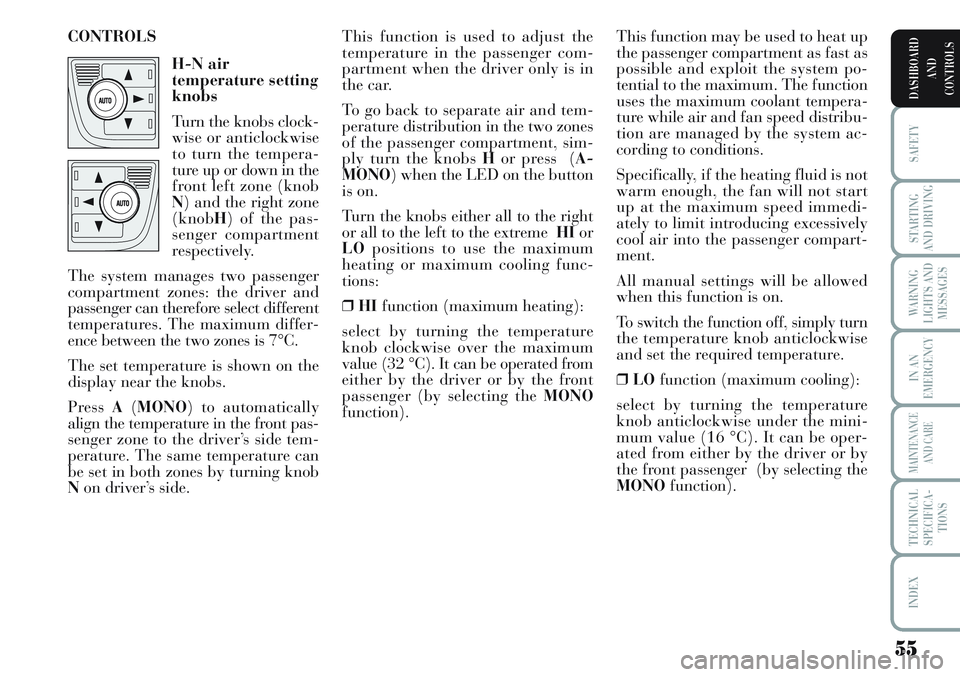
function). CONTROLS
H-N air
temperature setting
knobs
Turn the knobs clock-
wise or anticlockwise
to turn the tempera-
ture up or down in the
front left zone (knob
N) and the right zone
(knobH) of the pas-
senger compartment
respectively.
The system manages two passenger
compartment zones: the driver and
passenger can therefore select different
temperatures. The maximum differ-
ence between the two zones is 7°C.
The set temperature is shown on the
display near the knobs.
Press A(MONO) to automatically
align the temperature in the front pas-
senger zone to the driver’s side tem-
perature. The same temperature can
be set in both zones by turning knob
Non driver’s side.
Page 57 of 218
56
SAFETY
STARTING
AND DRIVING
WARNING
LIGHTS AND
MESSAGES
IN AN
EMERGENCY
MAINTENANCE
AND CARE
TECHNICAL
SPECIFICA-
TIONS
INDEX
DASHBOARD
AND
CONTROLS
˙
▼Air flow between foot well vents
(hotter air) and central and side
dashboard vents (cooler air). This
distribution is particularly useful
in spring and autumn on a sunny
day.
▲
▼Air flow distributed between foot
well vents and windscreen and front
side window defrosting/demisting
vents. This allows an adequate
warming of the passenger com-
partment and prevents the win-
dows from misting up. This function may be used to cool
down the passenger compartment as
fast as possible and exploit the system
potential to the maximum. The func-
tion activates air recirculation and the
climate control compressor, air distri-
bution and fan speed are managed by
the system according to environmen-
tal conditions. All manual settings will
be allowed when this function is on.
To switch the function off, simply turn
the temperature knob anticlockwise
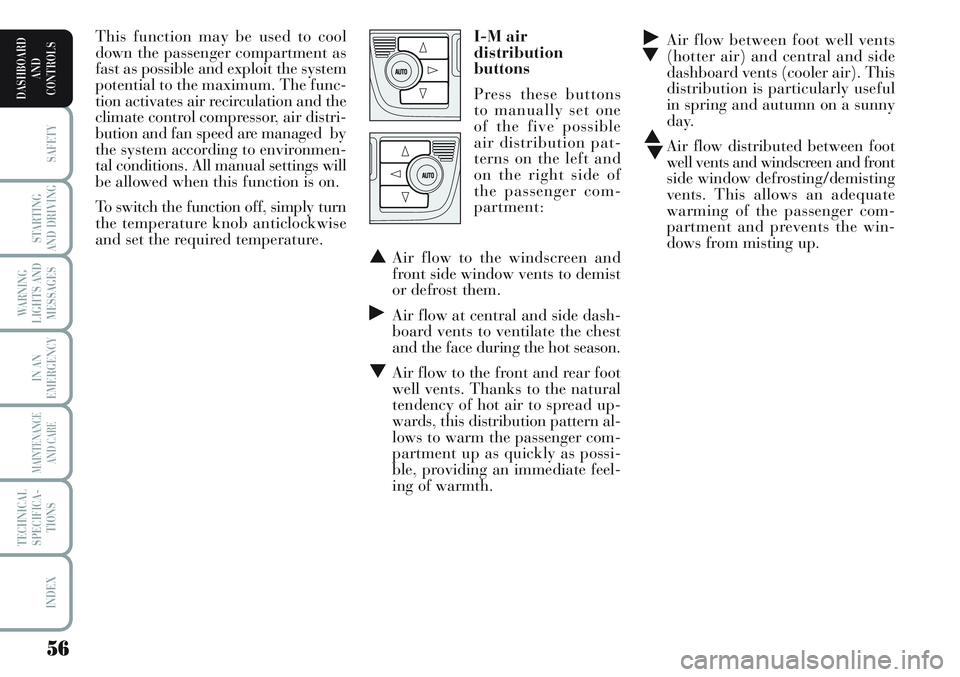
and set the required temperature.I-M air
distribution
buttons
Press these buttons
to manually set one
of the five possible
air distribution pat-
terns on the left and
on the right side of
the passenger com-
partment:
▲Air flow to the windscreen and
front side window vents to demist
or defrost them.
˙Air flow at central and side dash-
board vents to ventilate the chest
and the face during the hot season.
▼Air flow to the front and rear foot
well vents. Thanks to the natural
tendency of hot air to spread up-
wards, this distribution pattern al-
lows to warm the passenger com-
partment up as quickly as possi-
ble, providing an immediate feel-
ing of warmth.
Page 59 of 218
58
SAFETY
STARTING
AND DRIVING
WARNING
LIGHTS AND
MESSAGES
IN AN
EMERGENCY
MAINTENANCE
AND CARE
TECHNICAL
SPECIFICA-
TIONS
INDEX
DASHBOARD
AND
CONTROLS
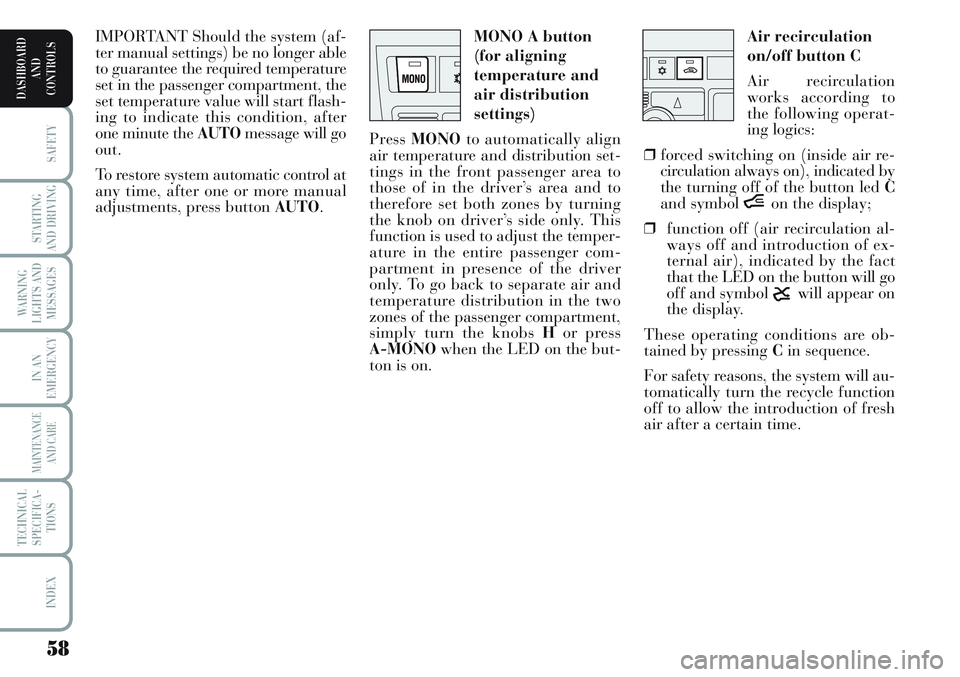
Air recirculation
on/off button C
Air recirculation
works according to
the following operat-
ing logics:
❒forced switching on (inside air re-
circulation always on), indicated by
the turning off of the button led C
and symbol
íon the display;
❒function off (air recirculation al-
ways off and introduction of ex-
ternal air), indicated by the fact
that the LED on the button will go
off and symbol
êwill appear on
the display.
These operating conditions are ob-
tained by pressing Cin sequence.
For safety reasons, the system will au-
tomatically turn the recycle function
off to allow the introduction of fresh
air after a certain time. MONO A button
(for aligning
temperature and
air distribution
settings)
Press MONOto automatically align
air temperature and distribution set-
tings in the front passenger area to
those of in the driver’s area and to
therefore set both zones by turning
the knob on driver’s side only. This
function is used to adjust the temper-
ature in the entire passenger com-
partment in presence of the driver
only. To go back to separate air and
temperature distribution in the two
zones of the passenger compartment,
simply turn the knobs Hor press
A-MONOwhen the LED on the but-
ton is on. IMPORTANT Should the system (af-
ter manual settings) be no longer able
to guarantee the required temperature
set in the passenger compartment, the
set temperature value will start flash-
ing to indicate this condition, after
one minute the AUTOmessage will go
out.
To restore system automatic control at
any time, after one or more manual
adjustments, press button AUTO.
Page 60 of 218
59
SAFETY
STARTING
AND DRIVING
WARNING
LIGHTS AND
MESSAGES
IN AN
EMERGENCY
MAINTENANCE
AND CARE
TECHNICAL
SPECIFICA-
TIONS
INDEX
DASHBOARD
AND
CONTROLS
IMPORTANT The air recirculation
function makes it possible to reach the
required heating or cooling conditions
faster. It is however inadvisable to use
it on rainy/cold days as it would con-
siderably increase the possibility of
the windows misting inside, especially
if the climate control compressor is
off.
Recirculation is forced off (i.e. air is
introduced from the outside) when
the the outside temperature is colder
than 5-7°C to prevent misting up.Climate control
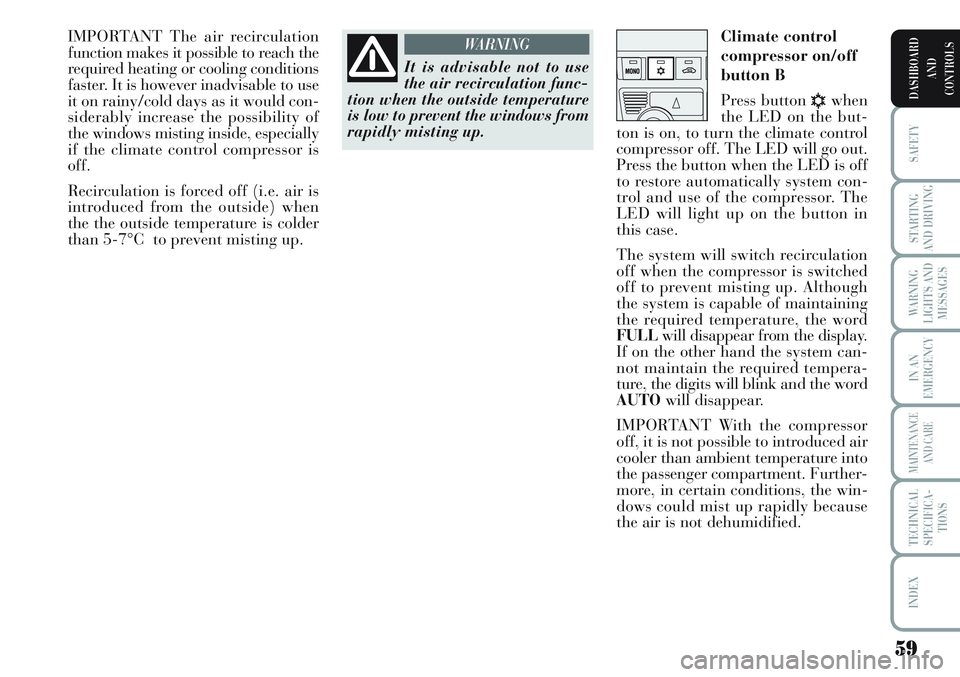
compressor on/off
button B
Press button
√when
the LED on the but-
ton is on, to turn the climate control
compressor off. The LED will go out.
Press the button when the LED is off
to restore automatically system con-
trol and use of the compressor. The
LED will light up on the button in
this case.
The system will switch recirculation
off when the compressor is switched
off to prevent misting up. Although
the system is capable of maintaining
the required temperature, the word
FULLwill disappear from the display.
If on the other hand the system can-
not maintain the required tempera-
ture, the digits will blink and the word
AUTOwill disappear.
IMPORTANT With the compressor
off, it is not possible to introduced air
cooler than ambient temperature into
the passenger compartment. Further-
more, in certain conditions, the win-
dows could mist up rapidly because
the air is not dehumidified.
It is advisable not to use
the air recirculation func-
tion when the outside temperature
is low to prevent the windows from
rapidly misting up.
WARNING
Page 61 of 218
60
SAFETY
STARTING
AND DRIVING
WARNING
LIGHTS AND
MESSAGES
IN AN
EMERGENCY
MAINTENANCE
AND CARE
TECHNICAL
SPECIFICA-
TIONS
INDEX
DASHBOARD
AND
CONTROLS
IMPORTANT The fast demist/defrost
function will remain on for approxi-
mately 3 minutes, from when the en-
gine coolant reaches a temperature of
50°C (petrol versions) or 35°C (Mul-
tijet versions).
When this function is on, the LED of
the corresponding button switches on
and that of the rear window demister.
The message FULL AUTOgoes off on
the display.
You can only adjust the fan speed and
switch the rear window demister off
manually when this function is active.
To restore running operations before
this function was activated, press ei-
ther button F, air recirculation button
C, compressor button Bor button
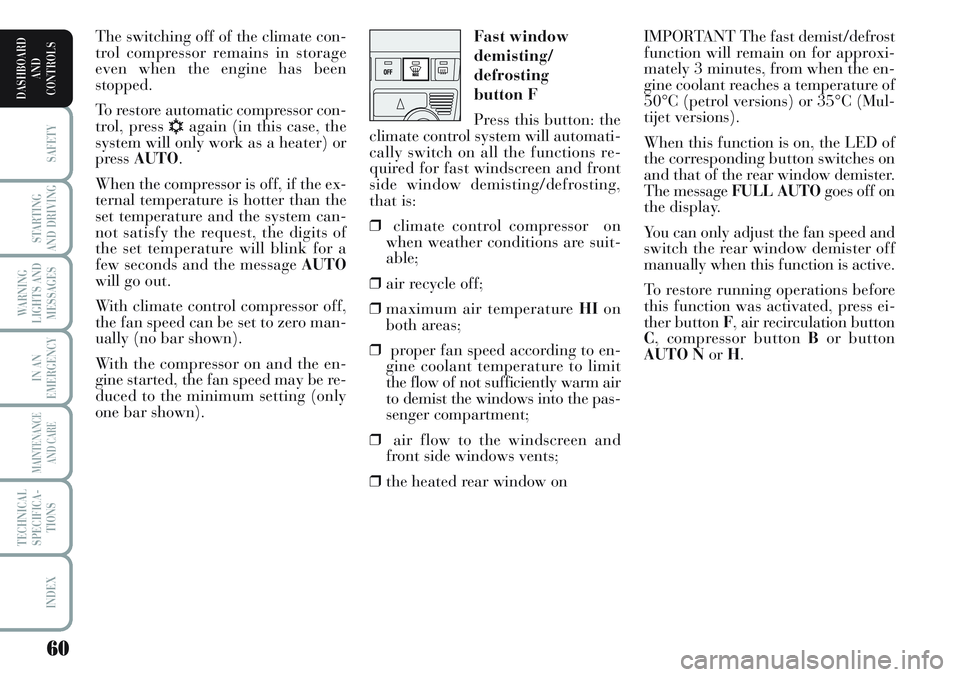
AUTO NorH. Fast window
demisting/
defrosting
button F
Press this button: the
climate control system will automati-
cally switch on all the functions re-
quired for fast windscreen and front
side window demisting/defrosting,
that is:
❒climate control compressor on
when weather conditions are suit-
able;
❒air recycle off;
❒maximum air temperature HIon
both areas;
❒proper fan speed according to en-
gine coolant temperature to limit
the flow of not sufficiently warm air
to demist the windows into the pas-
senger compartment;
❒air flow to the windscreen and
front side windows vents;
❒the heated rear window on The switching off of the climate con-
trol compressor remains in storage
even when the engine has been
stopped.
To restore automatic compressor con-
trol, press
√again (in this case, the
system will only work as a heater) or
press AUTO.
When the compressor is off, if the ex-
ternal temperature is hotter than the
set temperature and the system can-
not satisfy the request, the digits of
the set temperature will blink for a
few seconds and the message AUTO
will go out.
With climate control compressor off,
the fan speed can be set to zero man-
ually (no bar shown).
With the compressor on and the en-
gine started, the fan speed may be re-
duced to the minimum setting (only
one bar shown).
Page 62 of 218
61
SAFETY
STARTING
AND DRIVING
WARNING
LIGHTS AND
MESSAGES
IN AN
EMERGENCY
MAINTENANCE
AND CARE
TECHNICAL
SPECIFICA-
TIONS
INDEX
DASHBOARD
AND
CONTROLS
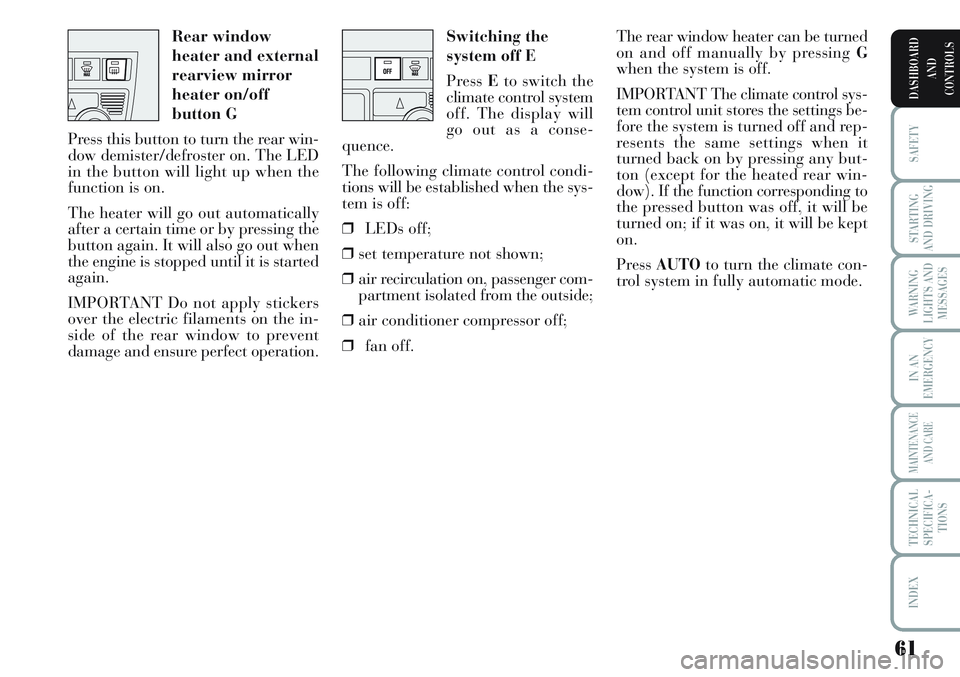
Switching the
system off E
Press Eto switch the
climate control system
off. The display will
go out as a conse-
quence.
The following climate control condi-
tions will be established when the sys-
tem is off:
❒LEDs off;
❒set temperature not shown;
❒air recirculation on, passenger com-
partment isolated from the outside;
❒air conditioner compressor off;
❒fan off.The rear window heater can be turned
on and off manually by pressing G
when the system is off.
IMPORTANT The climate control sys-
tem control unit stores the settings be-
fore the system is turned off and rep-
resents the same settings when it
turned back on by pressing any but-
ton (except for the heated rear win-
dow). If the function corresponding to
the pressed button was off, it will be
turned on; if it was on, it will be kept
on.
Press AUTOto turn the climate con-
trol system in fully automatic mode. Rear window
heater and external
rearview mirror
heater on/off
button G
Press this button to turn the rear win-
dow demister/defroster on. The LED
in the button will light up when the
function is on.
The heater will go out automatically
after a certain time or by pressing the
button again. It will also go out when
the engine is stopped until it is started
again.
IMPORTANT Do not apply stickers
over the electric filaments on the in-
side of the rear window to prevent
damage and ensure perfect operation.
Page 95 of 218
94
SAFETY
STARTING
AND DRIVING
WARNING
LIGHTS AND
MESSAGES
IN AN
EMERGENCY
MAINTENANCE
AND CARE
TECHNICAL
SPECIFICA-
TIONS
INDEX
DASHBOARD
AND
CONTROLS
late how much particulates has been
trapped by the filter. Since this filter
physically traps particulate, it should
be regenerated (cleaned) at regular in-
tervals by burning carbon particles.
The regeneration procedure is con-
trolled automatically by the engine
management control unit according to
the filter conditions and vehicle use
conditions. The following phenomena
may occur during the regeneration:
limited increase of idle speed, activation
of electric fan, limited increase of
smoke, high temperatures at the ex-
haust. These are not faults; they do not
impair vehicle performance or damage
the environment. If the dedicated mes-
sage is displayed, refer to section
“Warning lights and messages”.PROTECTING THE
ENVIRONMENT
The devices for curtailing petrol engine
emissions are the following:
❒three-way catalytic converter;
❒Lambda sensor;
❒fuel evaporation system.
In addition, do not let the engine run,
even for a test, with one or more spark
plugs disconnected.
The devices for reducing diesel fuel en-
gine emissions are the following:
❒oxidising catalytic converter;
❒exhaust gas recirculation system
(E.G.R.);
❒diesel particulate filter (DPF)
DPF (DIESEL PARTICULATE
FILTER)
(for 1.3 Multijet 90 HP - 1.3 Multijet
95 HP versions)
The Diesel Particulate Filter is a me-
chanical filter, integral with the exhaust
system, that physically traps particu-
lates present in the exhaust gases of
Diesel engines. The diesel particular fil-
ter has been adopted to eliminate al-
most totally particulates in compliance
with current / future law regulations.
During normal use of the vehicle, the
engine control unit records a set of data
(e.g.: travel time, type of route, tem-
peratures, etc.) and it will then calcu- When refuelling, fasten the cap to the
device inside the flap as shown in the
diagram.
IMPORTANT The airtight sealing of
the tank may cause a slight vacuum.
A suction noise when you release the
cap is therefore entirely normal.
After refuelling, fasten the cap by
turning it clockwise until you hear it
click, then turn the key clockwise ad
remove the key from the flap.
Do not approach naked
flames or lit cigarettes to
the fuel filler: fire risk. Keep your
face away from the fuel filler to
prevent breathing in harmful
vapours.
WARNING
The catalytic converter de-
velops high temperature
during operation. Do not park on
grass, dry leaves, pine needles or
other flammable material: fire
risk.
WARNING
Page 119 of 218
118
WARNING
LIGHTS AND
MESSAGES
IN AN
EMERGENCY
MAINTENANCE
AND CARE
TECHNICAL
SPECIFICA-
TIONS
INDEX
DASHBOARD
AND
CONTROLS
SAFETY
STARTING
AND DRIVING
CONTAINING
RUNNING COSTS
Here are some suggestions which may
help you to keep the running costs of
your vehicle down and lower the
amount of toxic emissions released
into the atmosphere.
GENERAL CONSIDERATIONS
Car maintenance
Have checks and adjustments carried
out in accordance with the “Service
schedule”.
Ty r e s
Check tyre pressure regularly at least
once every four weeks: excessively low
pressure will increase consumption
because rolling resistance will be
higher.
Unnecessary loads
Do not travel with an overloaded
boot. The weight of the car (especially
when driving in town) and its trim
greatly affects consumption and sta-
bility.Roof rack/ski rack
Remove the roof rack or the ski rack
from the roof after use. These acces-
sories decrease aerodynamic penetra-
tion of the car and have a negative ef-
fect on consumption. It is better to use
a trailer to transport particularly
bulky objects.
Electric devices
Use electric devices only for the
amount of time needed. Rear heated
window, additional headlights, wind-
screen wipers and heater fan need a
considerable amount of energy, there-
fore increasing the requirement of
current increases fuel consumption
(up to +25% in the urban cycle).
Climate control
The climate control system requires
higher fuel consumption (up to +20%
in average): use the air vents when the
external temperature allows to.
Spoilers
The use of non-certified aerodynamic
items may adversely affect air drag
and fuel consumption levels.DRIVING STYLE
Starting
Do not warm the engine up with the
car standing: the engine warms up
very slowly in these conditions, in-
creasing consumption and emissions.
It is advisable to start off immediately
and slowly keeping the engine speed
down: the engine will warm up much
faster this way.
Unnecessary actions
Avoid revving up when starting at
traffic lights or before stopping the
engine. The latter action, like dou-
bling the clutch, is unnecessary and
causes increase of consumption and
pollution.
Gear selection
Use a higher gear as soon as traffic
and road conditions allow. Using a
low gear for faster acceleration will in-
crease consumption.
In the same way improper use of a
high gear increases consumption,
emissions an engine wear.