oil Lancia Thesis 2006 Owner handbook (in English)
[x] Cancel search | Manufacturer: LANCIA, Model Year: 2006, Model line: Thesis, Model: Lancia Thesis 2006Pages: 386, PDF Size: 8.69 MB
Page 188 of 386
187
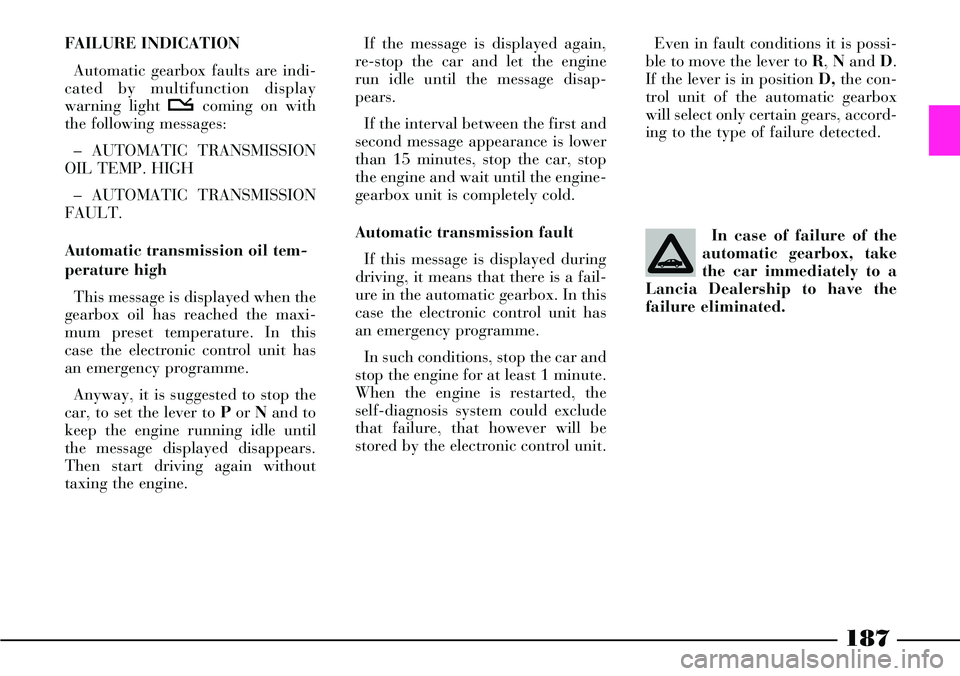
Even in fault conditions it is possi-
ble to move the lever to R, Nand D.
If the lever is in position D,the con-
trol unit of the automatic gearbox
will select only certain gears, accord-
ing to the type of failure detected.
In case of failure of the
automatic gearbox, take
the car immediately to a
Lancia Dealership to have the
failure eliminated.FAILURE INDICATION
Automatic gearbox faults are indi-
cated by multifunction display
warning light tcoming on with
the following messages:
– AUTOMATIC TRANSMISSION
OIL TEMP. HIGH
– AUTOMATIC TRANSMISSION
FAULT.
Automatic transmission oil tem-
perature high
This message is displayed when the
gearbox oil has reached the maxi-
mum preset temperature. In this
case the electronic control unit has
an emergency programme.
Anyway, it is suggested to stop the
car, to set the lever to Por Nand to
keep the engine running idle until
the message displayed disappears.
Then start driving again without
taxing the engine.If the message is displayed again,
re-stop the car and let the engine
run idle until the message disap-
pears.
If the interval between the first and
second message appearance is lower
than 15 minutes, stop the car, stop
the engine and wait until the engine-
gearbox unit is completely cold.
Automatic transmission fault
If this message is displayed during
driving, it means that there is a fail-
ure in the automatic gearbox. In this
case the electronic control unit has
an emergency programme.
In such conditions, stop the car and
stop the engine for at least 1 minute.
When the engine is restarted, the
self-diagnosis system could exclude
that failure, that however will be
stored by the electronic control unit.
Page 228 of 386

227
BOOT
The boot can be opened both from
the outside and the inside of the car.
IMPORTANT Faulty closing of the
boot is signalled by the lighting of
the relevant symbol on the multi-
function display, together with mes-
sage “BOOT OPEN”With the battery flat, or
after the interruption of
one of the protection
fuses, or if you want to disconnect
a loaded battery (e.g. for a car
stop period), before opening the
luggage compartment bonnet
carefully read and comply with
the instructions contained in the
paragraph “If battery is to be dis-
connected” in the chapter “In an
emergency”.
OPENING FROM THE INSIDE
Boot tailgate is opened electrically.
It can be opened only when the igni-
tion key is at MARand the car is
stopped, or for 3 minutes after turn-
ing the key to STOPwithout open-
ing or closing a door.
To open the boot, press button A
(fig. 192), placed on the central con-
sole, as follows:
– a short pressure of the button will
release the boot lock– a prolonged pressure of the but-
ton will release the lock and open
the boot.
Boot lifting is facilitated by the
action of gas dampers.
The dampers are cali-
brated so as to ensure
correct lifting of the boot
tailgate with the weights estab-
lished by the manufacturer.
Addition of extra equipment (e.g.
spoiler, etc.) can adversely affect
operation and safety of use.
fig. 192
L0A0167b
Page 256 of 386
255
SAFE DRIVING
In designing THESIS, LANCIA has
made every effort to come up with a
car able to provide driver and pas-
senger with top-class levels of safety.
Nevertheless it is always the behav-
iour of the person at the wheel that
determines road safety.
Below you will find some simple
tips to help you travel in safety
under different conditions. You will
no doubt be familiar with many of
them already, but it will be useful to
read them all carefully.
BEFORE GETTING BEHIND
THE WHEEL
– Make sure all lights, including
the headlights, are working proper-
ly.
– Adjust the position of the seats,
steering wheel, driving and door
mirrors properly for the best driving
position.
– Carefully adjust the head
restraints so that the back of the
head and not the nape of the neck is
supported. Make sure that nothing (mats etc.)
gets in the way of the pedals when
they are pushed down.
– Make sure that any child
restraint systems (child seats, carri-
ers etc.) are properly fixed on the
rear seat.
– Place any objects in the boot in
such a way that they cannot be
thrown forwards in the event of an
accident.
– Do not eat a heavy meal before
travelling. Light eating will help
keep your reflexes prompt. Above
all, do not have anything alcoholic to
drink.
Periodically, remember to check:
– tyre pressure and conditions;
– engine oil level;
– coolant level and cooling system
conditions;
– brake fluid level;
– power steering fluid level;
– windscreen washer fluid level. WHEN TRAVELLING
– The first rule of safe driving is
prudence.
– Prudence also means putting
yourself into a position where you
can predict wrong or imprudent
behaviour from other drivers.
– Stick closely to the rules of the
road in the particular country where
the vehicle is being driven and,
above all, do not exceed speed limits.
– Ensure that, besides yourself, all
the other passengers in the vehicle
have their seat belts fastened, that
children are sitting in the appropri-
ate child seats and any animals in
the car are placed in suitable com-
partments.
– You should be physically fit and
mentally alert before setting out on
long journeys.
Page 257 of 386

256
Make sure that any mats
are appropriate in size:
any hindrance, even
slight, to the braking system may
require a higher pedal stroke
than normal.
Water, ice and salt on
the road may deposit on
brake disks, reducing
braking efficiency the first time
they are used.Driving while drunk or
under the influence of
drugs or certain medi-
cines is dangerous both for you
and other road users.
Always fasten both front
and back seat belts,
including child restraint
systems if there are children trav-
elling with you. Travelling with
seat belts unfastened increases
the risk of injury or death if you
are involved in a collision. Take care when fitting
additional spoilers, alloy
rims and wheel caps: they
might reduce ventilation of the
brakes, thus their efficiency dur-
ing abrupt braking or long down-
hill slopes.
Never drive with objects
on the floor in front of the
driver’s seat: they might
get stuck under the pedals mak-
ing it impossible to accelerate or
brake.
Page 262 of 386

261
Gear selections
As soon as the traffic and road con-
ditions allow it, shift to a higher
gear. Using a lower gear to liven up
acceleration greatly increases con-
sumption. In the same way, improp-
er use of the higher gears will
increase consumption, emissions
and wear and tear on the engine.
Top speeds
Fuel consumption increases con-
siderably as speed increases. For
example, when accelerating from 90
to 120 km/h, fuel consumption
increases up to approximately
+30%. Your speed should be kept as
even as possible and superfluous
braking and acceleration avoided, as
this increases both consumption and
emissions. A “smooth” driving style
should be adopted by attempting to
anticipate manoeuvres to avoid
imminent danger, and to keep a safe
distance from the vehicle in front to
avoid braking sharplyAcceleration
Accelerating violently increasing
the revs will greatly effect consump-
tion and emissions: acceleration
should be gradual and not exceed
the maximum torque.
CONDITIONS OF USE
Cold starting
Frequent cold starting will not
enable the engine to reach optimal
running temperature. It follows,
therefore, that consumption will be
higher (from +15 to +30% in towns)
as will the production of toxic emis-
sions. Spoilers
The use of optional extras which
are not certified for specific use on
the car may reduce the aerodynamic
penetration of the car and increase
consumption.
DRIVING STYLE
Starting
Do not warm the engine when the
car is stationary or at high or low
revs: in this way the engine will
warm up gradually increasing con-
sumption and emissions. You should
drive off slowly straight away avoid-
ing high revs so that the engine will
warm up more quickly.
Unnecessary actions
Avoid revving the engine when
stopped at traffic lights or before
switching off the engine and avoid
doubling the clutch as these actions
have no purpose on modern vehicles
and serve only to increase consump-
tion and pollution.
Page 270 of 386
269
USING THE CAR AGAIN
Before using the car again after a
prolonged period of inactivity, the
following operations are recom-
mended:
– Do not dry-dust the car body.
– Check for fluid leaks (oil, brake
and clutch fluid, engine coolant
etc.).
– Change engine oil and filter.
– Check the level of:
– brake and clutch fluid
– engine coolant.
– Check the air cleaner and change
it, if required.
– Check the tyre pressure and the
tyres for signs of damage, cuts or
cracks. If this is the case, have them
replaced.
– Check the engine belt conditions.STORING THE CAR
The following precautions should
be taken if the car will not be used
for several months:
– Park the car in covered, dry and
if possible well-ventilated premises.
– Engage a gear.
– If the car is parked on flat
ground, disengage the electric park-
ing brake as described in the rele-
vant paragraph.
– Clean and protect the painted
parts using protective wax.
– Sprinkle talcum powder on the
rubber windscreen and rear window
wiper blades and lift them off the
glass.
– Slightly open the windows.
– Inflate the tyres to 0.5 bar above
the normal specified pressure, lean
them on wood boards, if possible
and check it at intervals.– Do not switch the electronic
alarm system on.
– Remove the negative cable (-)
from the battery terminal and check
the battery charge. This check
should be performed every month if
the car is to be stored for long peri-
ods. Recharge the battery if it falls
below 12.5V.
IMPORTANT Before opening the
luggage compartment bonnet to dis-
connect the battery, carefully read
and comply with instructions con-
tained in the paragraph “If battery is
to be disconnected” in the chapter
“In an emergency”.
– Do not drain the engine cooling
system.
– Cover the car with a cloth or per-
forated plastic sheet. Do not use
sheets of non-perforated plastic as
they do not allow moisture on the
body to evaporate.
Page 298 of 386
297
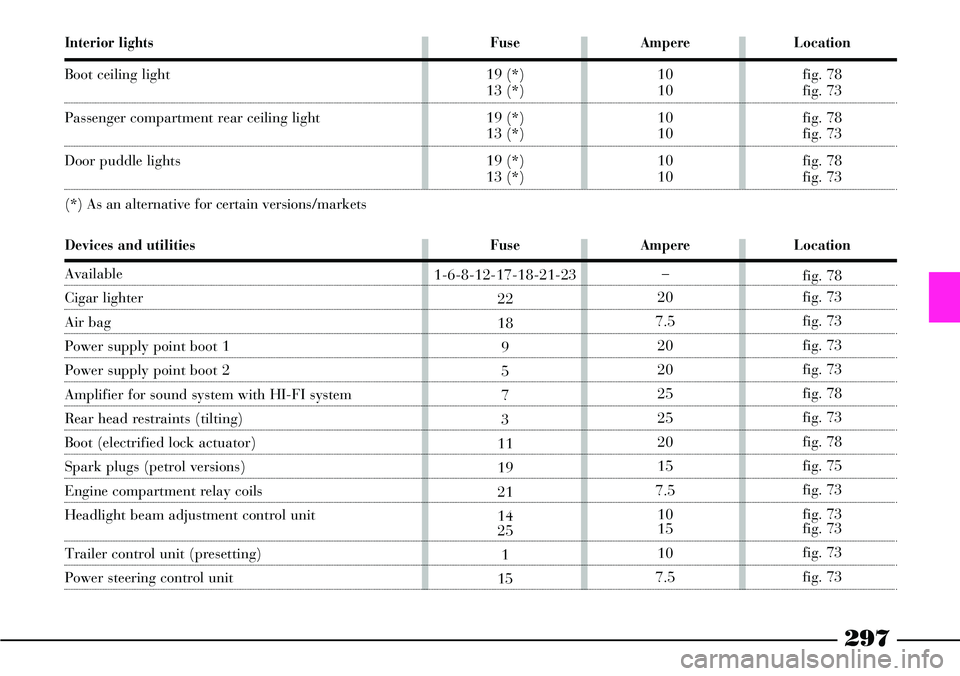
Interior lights
Boot ceiling light
Passenger compartment rear ceiling light
Door puddle lights
(*) As an alternative for certain versions/markets
Fuse
19 (*)
13 (*)
19 (*)
13 (*)
19 (*)
13 (*)
Ampere
10
10
10
10
10
10
Location
fig. 78
fig. 73
fig. 78
fig. 73
fig. 78
fig. 73
Fuse
1-6-8-12-17-18-21-23
22
18
9
5
7
3
11
19
21
14
25
1
15
Ampere
–
20
7.5
20
20
25
25
20
15
7.5
10
15
10
7.5
Location
fig. 78
fig. 73
fig. 73
fig. 73
fig. 73
fig. 78
fig. 73
fig. 78
fig. 75
fig. 73
fig. 73
fig. 73
fig. 73
fig. 73
Devices and utilities
Available
Cigar lighter
Air bag
Power supply point boot 1
Power supply point boot 2
Amplifier for sound system with HI-FI system
Rear head restraints (tilting)
Boot (electrified lock actuator)
Spark plugs (petrol versions)
Engine compartment relay coils
Headlight beam adjustment control unit
Trailer control unit (presetting)
Power steering control unit
Page 314 of 386
313
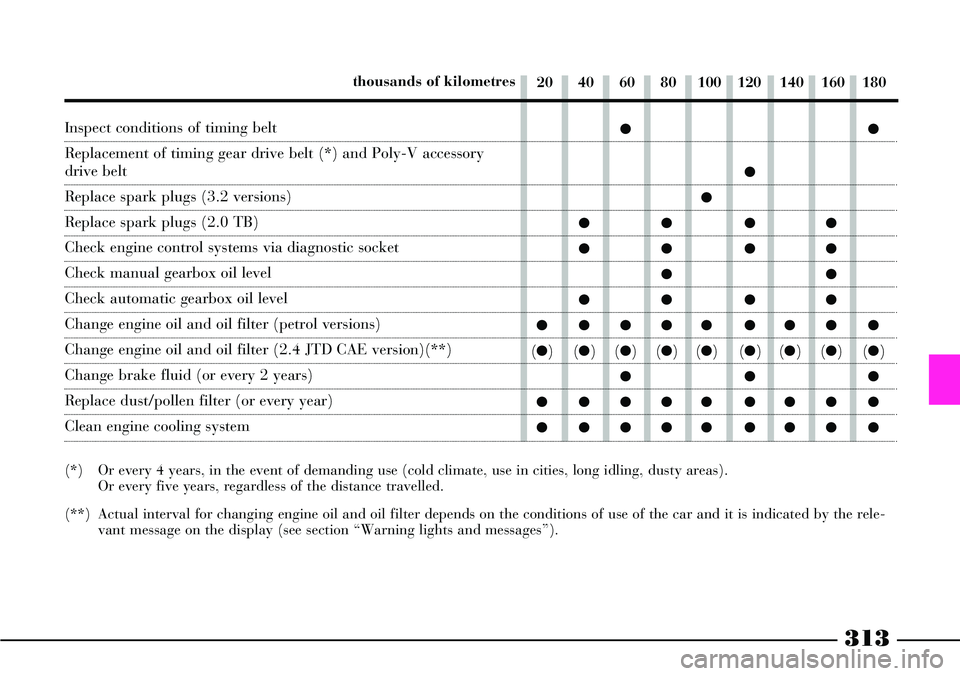
Inspect conditions of timing belt
Replacement of timing gear drive belt (*) and Poly-V accessory
drive belt
Replace spark plugs (3.2 versions)
Replace spark plugs (2.0 TB)
Check engine control systems via diagnostic socket
Check manual gearbox oil level
Check automatic gearbox oil level
Change engine oil and oil filter (petrol versions)
Change engine oil and oil filter (2.4 JTD CAE version)(**)
Change brake fluid (or every 2 years)
Replace dust/pollen filter (or every year)
Clean engine cooling system
(*) Or every 4 years, in the event of demanding use (cold climate, use in cities, long idling, dusty areas).
Or every five years, regardless of the distance travelled.
(**) Actual interval for changing engine oil and oil filter depends on the conditions of use of the car and it is indicated by the rele-
vant message on the display (see section “Warning lights and messages”).20 40 60 80 100 120 140 160 180 thousands of kilometres
çç
ç
ç
çç çç
çç çç
çç
çç çç
ççççç çççç
(ç)(ç)(ç)(ç)(ç)(ç)(ç)(ç)(ç)
ççç
ççççç çççç
ççççç çççç
Page 315 of 386
314
ADDITIONAL
CHECKS
Every 1,000 kmor before long
trips, check and top up as necessary:
– engine coolant level
– brake/hydraulic clutchfluid
level
– power steering fluid level
– windscreen/rear window and
headlight washer fluid level
– tyre pressure and conditions.
Every 3,000 kmcheck the engine
oil level and top up as necessary.
You are recommended to use FL
Seleniaproducts that are designed
and produced specifically for LAN-
CIA cars (see “Capacities” in
“Technical Specifications”).
ANNUAL
INSPECTION
SCHEDULE
The following annual inspection
schedule is recommended for
cars travelling less than 20,000
km a year (e.g. approximately
10,000 km). The schedule
includes the following opera-
tions:
1) Check tyre condition and wear
and adjust pressure (including spare
wheel)
2) Check wear on windscreen/rear
window blades
3) Check rear disc brake pad con-
ditions and wear
4) Inspect conditions of: under-
body protection and outside body-
work, piping (exhaust - fuel lines -
brake lines), rubber parts (boots -
sleeves - bushings, etc.), brake and
fuel line hoses5) check for bonnet and boot lock
cleanness, lever cleanness and lubri-
cation
6) Check primary and secondary
battery charge status
7) Check conditions of various con-
trol belts
8) Check and top up fluid levels
(engine coolant, brakes, windscreen
washer, battery, etc.)
9) Change engine oil
10) Replace engine oil filter
11) Replace dust/pollen filter.
Page 316 of 386
315
Do not smoke while
working in the engine
compartment: the pres-
ence of flammable gas and
vapour could cause a fire.
Be careful not to mix up
the various types of fluids
when you are topping up:
they are all mutually incompati-
ble and could damage the car.
Maintenance of your car
should be entrusted to a
Lancia Dealership. For
ordinary routine maintenance
operations which you are able to
carry out yourself, ensure that
you have the necessary tools and
original Lancia spare parts and
fluids available. Do not carry out
servicing operations if you have
no experience.IMPORTANT - Engine oil
If the car is normally driven in one
of the following particularly severe
conditions:
– towing a trailer
– on dirty roads
– for short, repeated trips (less
than 7-8 km) with outside tempera-
ture below zero
– with engine frequently idling or
for long distances at low speed (e.g.
taxi, door-to-door deliveries) or pro-
longed storage
change the engine oil more frequent-
ly than shown in the Service
Schedule.
IMPORTANT - Air cleaner
Replace the air cleaner more fre-
quently than shown in the Service
Schedule if the car is used on dusty
roads.
If you are in doubt about how often
the engine oil or the air cleaner
should be changed in relation to how
you use the car, contact a Lancia
Dealership.