recommended oil Lancia Voyager 2012 Owner handbook (in English)
[x] Cancel search | Manufacturer: LANCIA, Model Year: 2012, Model line: Voyager, Model: Lancia Voyager 2012Pages: 344, PDF Size: 3.95 MB
Page 27 of 344
PROGRAMMING
ADDITIONAL
TRANSMITTERS
Refer to Sentry Key® “Customer Key
Programming.”
If you do not have a programmed
RKE transmitter, contact your autho-
rized dealer for details.
TRANSMITTER BATTERY
REPLACEMENT
The recommended replacement bat-
tery is one CR2032 battery.
NOTE:
Perchlorate Material — specialhandling may apply. Batteries
could contain dangerous mate-
rials. Please dispose of them ac-
cording to respect for environ-
ment and local laws.
Do not touch the battery termi- nals that are on the back hous-
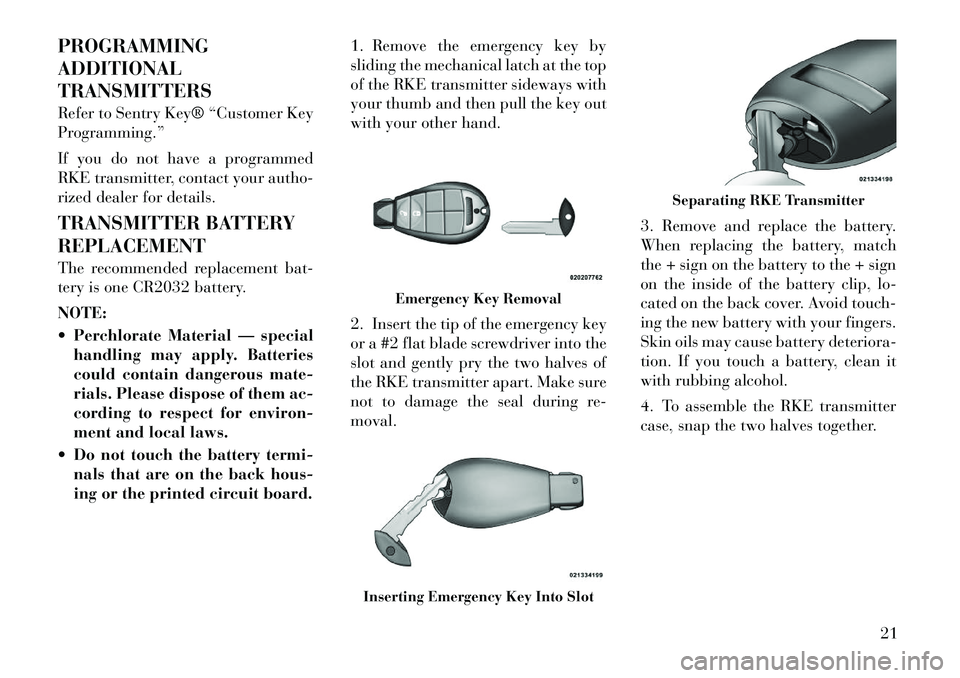
ing or the printed circuit board. 1. Remove the emergency key by
sliding the mechanical latch at the top
of the RKE transmitter sideways with
your thumb and then pull the key out
with your other hand.
2. Insert the tip of the emergency key
or a #2 flat blade screwdriver into the
slot and gently pry the two halves of
the RKE transmitter apart. Make sure
not to damage the seal during re-
moval.
3. Remove and replace the battery.
When replacing the battery, match
the + sign on the battery to the + sign
on the inside of the battery clip, lo-
cated on the back cover. Avoid touch-
ing the new battery with your fingers.
Skin oils may cause battery deteriora-
tion. If you touch a battery, clean it
with rubbing alcohol.
4. To assemble the RKE transmitter
case, snap the two halves together.
Emergency Key Removal
Inserting Emergency Key Into Slot
Separating RKE Transmitter
21
Page 68 of 344

Installing The Child Restraint
System
We urge you to carefully follow the
directions of the manufacturer when
installing your child restraint. Many,
but not all, restraint systems will be
equipped with separate straps on each
side, with each having a hook or con-
nector, and a means for adjusting the
tension in the strap. Forward-facing
toddler restraints and some rearward-
facing infant restraints will also be
equipped with a tether strap, a hook
and means for adjusting the tension in
the strap. Not all child restraint sys-
tems will be installed as described
here. Again, carefully follow the in-
stallation instructions that are pro-
vided with the child restraint system.
In general, you will first loosen the
child seat adjusters on the lower
straps and tether straps so that you
can more easily attach the hook or
connector to the lower anchorages
and tether anchorages. Then tighten
all three straps as you push the child
restraint rearward and downward
into the seat.Not all child restraint systems will be
installed as we have described here.
Again, carefully follow the instruc-
tions that come with the child re-
straint system.
WARNING!
Improper installation of a child re-
straint to the ISOFIX anchorages
can lead to failure of an infant or
child restraint. The child could be
badly injured or killed. Follow the
manufacturer's directions exactly
when installing an infant or child
restraint.
Transporting Pets
Air Bags deploying in the front seat
could harm your pet. An unrestrained
pet could be thrown about and possi-
bly injured, or injure a passenger dur-
ing panic braking or in a collision.
Pets should be restrained in the rear
seat in pet harnesses or pet carriers
that are secured by seat belts. ENGINE BREAK-IN
RECOMMENDATIONS
A long break-in period is not required
for the engine and drivetrain (trans-
mission and axle) in your vehicle.
Drive moderately during the first
500 km. After the initial 100 km,
speeds up to 80 or 90 km/h are desir-
able.
While cruising, brief full-throttle ac-
celeration within the limits of local
traffic laws contributes to a good
break-in. Wide-open throttle accel-
eration in low gear can be detrimental
and should be avoided.
The engine oil installed in the engine
at the factory is a high-quality energy
conserving type lubricant. Oil
changes should be consistent with an-
ticipated climate conditions under
which vehicle operations will occur.
For the recommended viscosity and
quality grades, refer to “Maintenance
Procedures” in “Maintaining Your Ve-
hicle”. NON-DETERGENT OR
STRAIGHT MINERAL OILS MUST
NEVER BE USED.
62
Page 295 of 344

oil that meets FIAT Qualification
9.55535, API SM/CF, ACEA C3 or
equivalent.
Synthetic Engine Oils
You may use synthetic engine oils pro-
vided the recommended oil quality
requirements are met, and the recom-
mended maintenance intervals for oil
and filter changes are followed.
Materials Added To Engine Oil
Do not add any supplemental materi-
als, other than leak detection dyes, to
the engine oil. Engine oil is an engi-
neered product and its performance
may be impaired by supplemental ad-
ditives.
Disposing Of Used Engine Oil And
Oil Filters
Care should be taken in disposing of
used engine oil and oil filters from
your vehicle. Used oil and oil filters,
indiscriminately discarded, can pres-
ent a problem to the environment.
Contact your dealer, service station,
or governmental agency for advice on
how and where used oil and oil filters
can be safely discarded in your area.ENGINE OIL FILTER
The engine oil filter should be re-
placed with a new filter at every en-
gine oil change.
Engine Oil Filter Selection
This manufacturer's engines have a
full-flow type oil filter. Use a filter of
this type for replacement. The quality
of replacement filters varies consider-
ably. Only high quality filters should
be used to assure most efficient ser-
vice. LANCIA engine oil filters are a
high quality oil filter and are recom-
mended.
ENGINE AIR CLEANER
FILTER
Refer to the “Maintenance Schedule”
for the proper maintenance intervals.
WARNING!
The air induction system (air
cleaner, hoses, etc.) can provide a
measure of protection in the case of
engine backfire. Do not remove the
air induction system (air cleaner,
hoses, etc.) unless such removal is
necessary for repair or maintenance.
Make sure that no one is near the
engine compartment before starting
the vehicle with the air induction
system (air cleaner, hoses, etc.) re-
moved. Failure to do so can result in
serious personal injury.
Engine Air Cleaner Filter
Selection
The quality of replacement engine air
cleaner filters varies considerably.
Only high quality filters should be
used to assure most efficient service.
LANCIA engine air cleaner filters are
a high quality filter and are recom-
mended.
289
Page 305 of 344

Master Cylinder – Brake Fluid
Level Check
The fluid level in the master cylinder
should be checked when performing
underhood services, or immediately if
the “Brake System Warning Light”
indicates system failure.
Clean the top of the master cylinder
area before removing the cap. Add
fluid to bring the level up to the top of
the “FULL” mark on the side of the
master cylinder reservoir.
Overfilling of fluid is not recom-
mended because it may cause leaking
in the system.
Add enough fluid to bring the level up
to the requirements described on the
brake fluid reservoir. With disc
brakes, fluid level can be expected to
fall as the brake pads wear. However,
low fluid level may be caused by a
leak and a checkup may be needed.
Use only manufacturer's recom-
mended brake fluid. Refer to “Fluids,
Lubricants and Genuine Parts” in
“Maintaining Your Vehicle” for fur-
ther information.
WARNING!
Use only manufacturer's recom-mended brake fluid. Refer to
“Fluids, Lubricants and Genuine
Parts” in “Maintaining Your Ve-
hicle” for further information. Us-
ing the wrong type of brake fluid
can severely damage your brake
system and/or impair its perfor-
mance. The proper type of brake
fluid for your vehicle is also iden-
tified on the original factory in-
stalled hydraulic master cylinder
reservoir.
To avoid contamination from for-
eign matter or moisture, use only
new brake fluid or fluid that has
been in a tightly closed container.
Keep the master cylinder reservoir
cap secured at all times. Brake
fluid in a open container absorbs
moisture from the air resulting in
a lower boiling point. This may
cause it to boil unexpectedly dur-
ing hard or prolonged braking,
resulting in sudden brake failure.
This could result in a accident.
(Continued)
WARNING!(Continued)
Overfilling the brake fluid reser-
voir can result in spilling brake
fluid on hot engine parts, causing
the brake fluid to catch fire. Brake
fluid can also damage painted and
vinyl surfaces, care should be
taken to avoid its contact with
these surfaces.
Do not allow petroleum based
fluid to contaminate the brake
fluid. Brake seal components
could be damaged, causing partial
or complete brake failure. This
could result in an accident.
AUTOMATIC
TRANSMISSION
The automatic transmission and dif-
ferential assembly are contained
within a single housing.
Selection Of Lubricant
It is important that the proper lubri-
cant is used in the transmission to
assure optimum transmission perfor-
mance. Use only the manufacturer's
recommended transmission fluid. Re-
fer to “Fluids, Lubricants and Genu-
ine Parts” in “Maintaining Your Ve-
299
Page 318 of 344

FLUIDS, LUBRICANTS, AND GENUINE PARTS
ENGINEComponentFluids and Lubricants Specs (Genuine Parts)
Engine Coolant* Contact a LANCIA Dealership.
Engine Oil – 3.6L Engine** SAE Grade 5W-30 fully synthetic engine oil that meets FIAT Classification
9.55535, API SN, ILSAC GF-5 (SELENIA K POWER, Contractual Technical
Reference N° F042.F11)
Engine Oil – 2.8L Diesel Engine** SAE Grade 5W-30 fully synthetic engine oil that meets FIAT Classification
9.55535, API SM/CF, ACEA C3 (SELENIA MULTIPOWER C3, Contractual
Technical Reference N° 510.D07)
Spark Plugs – 3.6L Engine RER8ZWYCB4 (Gap 1.1 mm)
Fuel Selection – 3.6L Engine 91 Octane or higher
Fuel Selection – 2.8L Diesel Engine 50 Cetane or higher (Less than 15 ppm Sulfur).
Diesel Fuel Additive – 2.8L Diesel En-
gine Additive for diesel with antifreeze and protective action for diesel engines. (TU-
TELA DIESEL ART, Contractual Technical Reference N° F601.L06. To be
mixed with the diesel fuel: 25 cc per 10 litres)
* Do not top up or mix with fluids
with different specifications.
** Lubricants with ACEA C3 perfor-
mance as a minimum may be used for
Diesel engines in an emergency, where no original products are available. In
such event, the engine may not pro-
vide optimal performance. We recom-
mend having the lubricant replaced
with one of the recommended lubri-
cants at the Lancia Service Networkas soon as possible. Using products
with specifications lower than ILSAC
GF-5 for gasoline engines or lower
than ACEA C3 for Diesel engines may
cause engine damage not covered by
warranty.
312