heater LAND ROVER DISCOVERY 1999 User Guide
[x] Cancel search | Manufacturer: LAND ROVER, Model Year: 1999, Model line: DISCOVERY, Model: LAND ROVER DISCOVERY 1999Pages: 1529, PDF Size: 34.8 MB
Page 308 of 1529

ENGINE MANAGEMENT SYSTEM - V8
DESCRIPTION AND OPERATION 18-2-9
Pin out details connector C0634
Connector 2 (C0635): This connector contains 24 pins and is primarily used for Heated Oxygen Sensors (HO
2S)
control and earth. The HO
2S sensors require a heater circuit to assist in heating the tip of the sensors to enable closed
loop fuelling to be implemented quickly after cold starting.
Pin out details connector C0635
Pin No. Function Signal type Reading
1 Ignition position II Input 12 V
2 Not used - -
3 Not used - -
4 Chassis earth Earth 0V
5 Fuel injectors earth Earth 0V
6 Power stage earth Earth 0V
7 Permanent battery supply Input battery supply 12V
8 Switched relay positive Input switched 0-12V
9 Not used - -
Pin No. Function Signal type Reading
1HO
2S heater RH bank - downstream Output PWM 12-0V
2 Not used - -
3 Not used - -
4 Not used - -
5 Thermostat monitoring sensor Earth 0V
6 Not used - -
7HO
2S heater LH bank - downstream Output PWM 12-0V
8HO
2S sensor RH bank - downstream Earth/ Signal 0V
9HO
2S sensor LH bank - upstream Earth/ Signal 0V
10 HO
2S sensor RH bank - upstream Earth/ Signal 0V
11 HO
2S sensor LH bank - downstream Earth/ Signal 0V
12 Not used - -
13 HO
2S heater RH bank - upstream Output PWM 12-0V
14 HO
2S sensor RH bank - downstream Input/ Signal Analogue 0-5V
15 HO
2S sensor LH bank - upstream Input/ Signal Analogue 0-5V
16 HO
2S sensor RH bank - upstream Input/ Signal Analogue 0-5V
17 HO
2S sensor LH bank - downstream Input/ Signal Analogue 0-5V
18 Fuel pump relay Output Switch to earth
19 HO
2S heater LH bank - upstream Output PWM 12-0V
20 Not used - -
21 Thermostat monitoring sensor Signal Analogue 0-5V
22 Not used - -
23 Main relay Output Switch to earth
24 EVAP system leak detection pump motor (NAS
vehicles with positive pressure type, EVAP system
leak detection capability only)Output Switch to earth
Page 311 of 1529

ENGINE MANAGEMENT SYSTEM - V8
18-2-12 DESCRIPTION AND OPERATION
Connector 4 (C0637): This connector contains 40 pins and facilitates use of TestBook via the Diagnostic connector.
Also contained in this connector is the Malfunction Indicator Lamp (MIL), this instrument panel lamp informs the driver
of concerns within the engine management system.
Pin out details connector C0637
Pin No. Function Signal type Reading
1 Not used - -
2 Not used - -
3 Not used - -
4 Not used - -
5 Not used - -
6 Not used - -
7 Not used - -
8 Low fuel level Input, signal Active high
9 Fuel tank pressure sensor (NAS vehicles with
vacuum type, EVAP system leak detection
capability only)Output, reference 5V
10 Not used - -
11 Not used - -
12 Analogue fuel level (NAS vehicles with positive
pressure type, EVAP system leak detection only)Input, signal 0-5V
13 Not used - -
14 Fuel tank pressure sensor (NAS vehicles with
vacuum type, EVAP system leak detection
capability only)Input, signal Analogue 0-5V
15 Not used - -
16 ATC compressor request Input, signal Active low
17 Engine speed output Output, signal PWM 0-5V
18 Not used - -
19 Not used - -
20 Malfunction indicator lamp 'ON' Output Switched earth
21 Not used - -
22 Vehicle speed signal (VSS) Input, signal PWM 0-12V
23 Not used - -
24 Not used - -
25 Not used - -
26 Not used - -
27 Not used - -
28 Not used - -
29 ATC compressor relay Output Switched earth
30 Not used - -
31 Positive pressure type EVAP system heater (02MY
vehicles only)Output, drive Switched earth
32 Diagnostic connector K-line Bi-directional Serial 0-12V
33 Immobiliser serial W link Input, signal Serial 0-12V
34 Rough road signal Input, signal PWM 0-12V
35 Not used - -
36 CAN data bus 'high line' Bi-directional 5-2.5V
37 CAN data bus 'low line' Bi-directional 0-2.5V
38 ATC stand by Input, signal Active low
39 Not used - -
40 Not used - -
Page 329 of 1529
ENGINE MANAGEMENT SYSTEM - V8
18-2-30 DESCRIPTION AND OPERATION
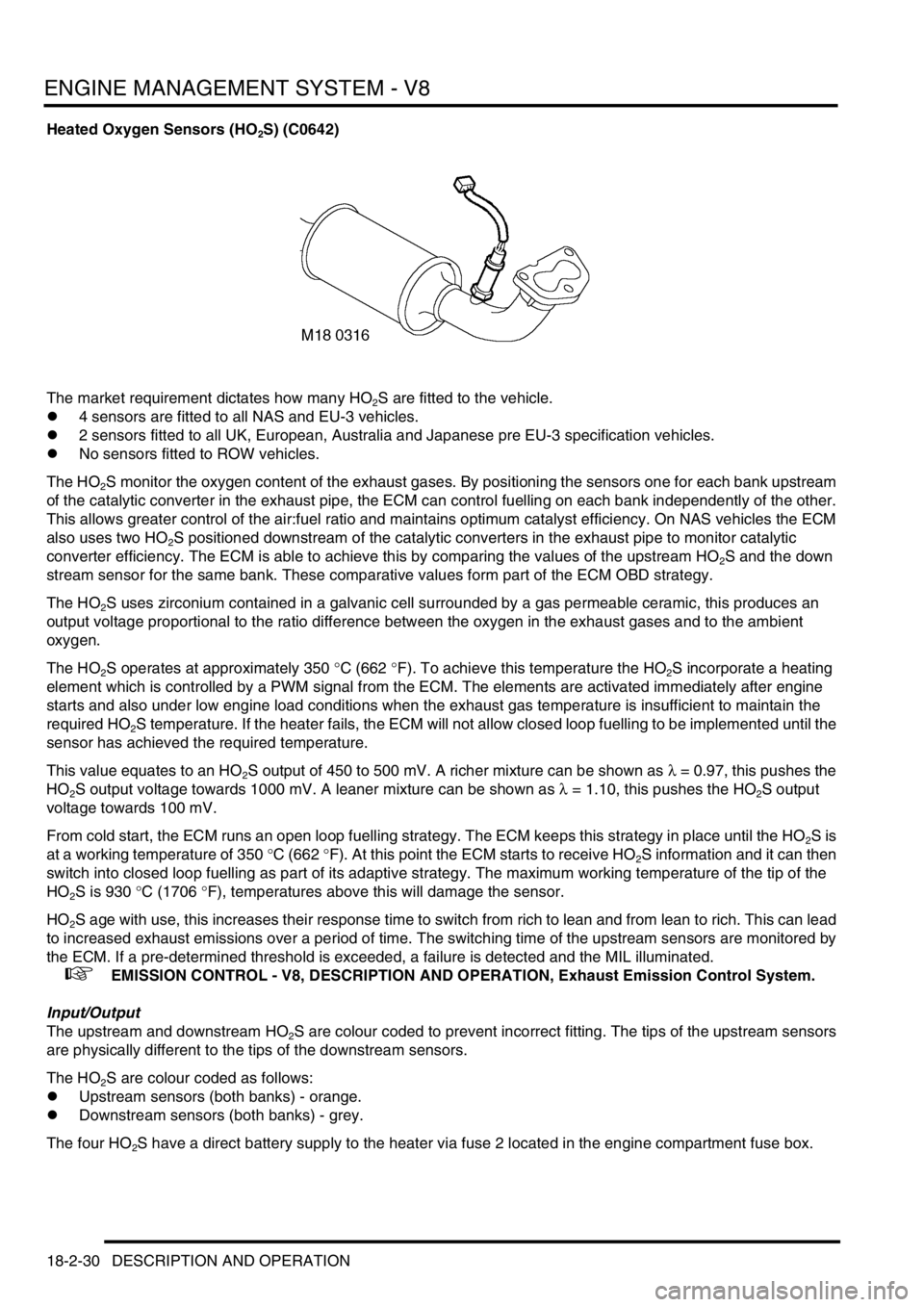
Heated Oxygen Sensors (HO2S) (C0642)
The market requirement dictates how many HO
2S are fitted to the vehicle.
l4 sensors are fitted to all NAS and EU-3 vehicles.
l2 sensors fitted to all UK, European, Australia and Japanese pre EU-3 specification vehicles.
lNo sensors fitted to ROW vehicles.
The HO
2S monitor the oxygen content of the exhaust gases. By positioning the sensors one for each bank upstream
of the catalytic converter in the exhaust pipe, the ECM can control fuelling on each bank independently of the other.
This allows greater control of the air:fuel ratio and maintains optimum catalyst efficiency. On NAS vehicles the ECM
also uses two HO
2S positioned downstream of the catalytic converters in the exhaust pipe to monitor catalytic
converter efficiency. The ECM is able to achieve this by comparing the values of the upstream HO
2S and the down
stream sensor for the same bank. These comparative values form part of the ECM OBD strategy.
The HO
2S uses zirconium contained in a galvanic cell surrounded by a gas permeable ceramic, this produces an
output voltage proportional to the ratio difference between the oxygen in the exhaust gases and to the ambient
oxygen.
The HO
2S operates at approximately 350 °C (662 °F). To achieve this temperature the HO2S incorporate a heating
element which is controlled by a PWM signal from the ECM. The elements are activated immediately after engine
starts and also under low engine load conditions when the exhaust gas temperature is insufficient to maintain the
required HO
2S temperature. If the heater fails, the ECM will not allow closed loop fuelling to be implemented until the
sensor has achieved the required temperature.
This value equates to an HO
2S output of 450 to 500 mV. A richer mixture can be shown as λ = 0.97, this pushes the
HO
2S output voltage towards 1000 mV. A leaner mixture can be shown as λ = 1.10, this pushes the HO2S output
voltage towards 100 mV.
From cold start, the ECM runs an open loop fuelling strategy. The ECM keeps this strategy in place until the HO
2S is
at a working temperature of 350 °C (662 °F). At this point the ECM starts to receive HO
2S information and it can then
switch into closed loop fuelling as part of its adaptive strategy. The maximum working temperature of the tip of the
HO
2S is 930 °C (1706 °F), temperatures above this will damage the sensor.
HO
2S age with use, this increases their response time to switch from rich to lean and from lean to rich. This can lead
to increased exhaust emissions over a period of time. The switching time of the upstream sensors are monitored by
the ECM. If a pre-determined threshold is exceeded, a failure is detected and the MIL illuminated.
+ EMISSION CONTROL - V8, DESCRIPTION AND OPERATION, Exhaust Emission Control System.
Input/Output
The upstream and downstream HO
2S are colour coded to prevent incorrect fitting. The tips of the upstream sensors
are physically different to the tips of the downstream sensors.
The HO
2S are colour coded as follows:
lUpstream sensors (both banks) - orange.
lDownstream sensors (both banks) - grey.
The four HO
2S have a direct battery supply to the heater via fuse 2 located in the engine compartment fuse box.
Page 330 of 1529

ENGINE MANAGEMENT SYSTEM - V8
DESCRIPTION AND OPERATION 18-2-31
The heater is driven by the ECM providing an earth path for the circuit as follows:
lUpstream LH bank via pin 19 of connector C0635 of the ECM.
lUpstream RH bank via pin 13 of connector C0635 of the ECM.
lDownstream LH bank via pin 7 of connector C0635 of the ECM.
lDownstream RH bank via pin 1 of connector C0635 of the ECM.
The HO
2S output signal is measured by the ECM as follows:
lUpstream LH bank via pin 15 of connector C0635 of the ECM.
lUpstream RH bank via pin 16 of connector C0635 of the ECM.
lDownstream LH bank via pin 17 of connector C0635 of the ECM.
lDownstream RH bank via pin 14 of connector C0635 of the ECM.
The HO
2S earth path for the signal is supplied by the ECM as follows:
lUpstream LH bank via pin 9 of connector C0635 of the ECM.
lUpstream RH bank via pin 10 of connector C0635 of the ECM.
lDownstream LH bank via pin 11 of connector C0635 of the ECM.
lDownstream RH bank via pin 8 of connector C0635 of the ECM.
The HO
2S voltage is difficult to measure using a multimeter, the output can be monitored using TestBook. A rich
mixture would read 500 to 1000 mV, a weak mixture would read 100 mV to 500 mV, the reading should switch from
rich to weak. The open loop default voltage is 450 mV, this is used by the ECM to set the air/ fuel ratio until the tip of
the HO
2S reaches operating temperature.
The HO
2S can fail the following ways or supply incorrect signal:
lSensor open circuit.
lShort circuit to vehicle supply.
lShort circuit to vehicle earth.
lSensor disconnected.
lStoichiometric ratio outside the correct operating band.
lContamination from leaded fuel.
lAir leak into the exhaust system.
lWiring loom damage.
lSensors fitted incorrectly or cross wired.
In the event of a HO
2S signal failure any of the following symptoms may be observed:
lDefault to open loop fuelling on defective bank.
lIf the sensors are crossed over (LH bank to RH bank), the engine will run normally after initial start up, but
performance will become progressively worse as the sensors go towards maximum rich for one bank of cylinders
and maximum lean for the other. The ECM will eventually default into open loop fuelling.
lHigh CO reading.
lExcess emissions.
lStrong hydrogen sulphide (H
2S) smell until the ECM defaults to open loop fuelling. .
lMIL illuminated (NAS market only).
A number of diagnostic tests are performed by the ECM with regards to the HO
2sensors:
lHO
2 sensor and system diagnostics
lHO
2 sensor heater diagnostics
lHO
2 sensor switching period (ageing) diagnostics
lRear HO
2 sensor adaption diagnostic (NAS only)
lCatalyst monitoring diagnostic
For further details of the heated oxygen sensors and exhaust emission control, refer to the V8 Emission Control
section of this manual.
+ EMISSION CONTROL - V8, DESCRIPTION AND OPERATION, Exhaust Emission Control System.
Page 331 of 1529

ENGINE MANAGEMENT SYSTEM - V8
18-2-32 DESCRIPTION AND OPERATION
Should a malfunction of the component occur the following fault codes may be evident and can be retrieved by
TestBook:
P Code J2012 Description Land Rover Description
P1129 O
2 sensors swapped bank to bank (sensor 1) Front sensors transposed
P0130 O
2 sensor circuit malfunction (bank 1, sensor 1) Front sensor LH bank stoichiometric ratio outside
operating band
P0132 O
2 sensor circuit high voltage (bank 1, sensor 1) Front sensor LH bank short circuit to battery supply
P0134 O
2 sensor circuit no activity detected (bank 1,
sensor 1)Front sensor LH bank open circuit
P0150 O
2 sensor circuit malfunction (bank 2, sensor 1) Front sensor RH bank stoichiometric ratio outside
operating band
P0152 O
2 sensor circuit high voltage (bank 2, sensor 1) Front sensor RH bank short circuit to battery supply
P0154 O
2 sensor circuit no activity detected (bank 2,
sensor 1)Front sensor RH bank open circuit
P0136 O
2 sensor circuit malfunction (bank 1, sensor 2) Rear sensor LH bank stoichiometric ratio outside
operating band (NAS only)
P0137 O
2 sensor circuit low voltage (bank 1, sensor 2) Rear sensor LH bank short circuit to earth (NAS only)
P0138 O
2 sensor circuit high voltage (bank 1, sensor 2) Rear sensor LH bank short circuit to battery supply
(NAS only)
P0140 O
2 sensor circuit no activity detected (bank 1,
sensor 2)Rear sensor LH bank open circuit (NAS only)
P0156 O
2 sensor circuit malfunction (bank 2, sensor 2) Rear sensor RH bank stoichiometric ratio outside
operating band (NAS only)
P0157 O
2 sensor circuit low voltage (bank 2, sensor 2) Rear sensor RH bank short circuit to earth (NAS only)
P0158 O
2 sensor circuit high voltage (bank 2, sensor 2) Rear sensor RH bank short circuit to battery voltage
(NAS only)
P0160 O
2 sensor circuit no activity detected (bank 2,
sensor 2)Rear sensor RH bank open circuit (NAS only)
P0133 O
2 sensor circuit slow response (bank 1, sensor
1)Front sensor aged - period time too long/too short LH
bank
P0153 O
2 sensor circuit slow response (bank 2, sensor
1)Front sensor aged - period time too long/too short RH
bank
P1170 Downstream fuel trim malfunction (bank 1) Front sensor aged - rear HO
2S adaption too lean/too
rich LH bank (NAS and EU-3 only)
P1173 Downstream fuel trim malfunction (bank 2) Front sensor aged - rear HO
2S adaption too lean/too
rich RH bank (NAS and EU-3 only)
P0135 O
2 sensor heater circuit malfunction (bank 1,
sensor 1)Front sensor heater LH bank - short/open circuit
P0141 O
2 sensor heater circuit malfunction (bank 1,
sensor 2)Rear sensor heater LH bank - short/open circuit (NAS
and EU-3 only)
P0155 O
2 sensor heater circuit malfunction (bank 2,
sensor 1)Front sensor heater RH bank - short/open circuit
P0161 O
2 sensor heater circuit malfunction (bank 2,
sensor 2)Rear sensor heater RH bank - short/open circuit (NAS
and EU-3 only)
P0420 - Catalyst efficiency deteriorated - LH bank (NAS and
EU-3 only)
P0430 - Catalyst efficiency deteriorated - RH bank (NAS and
EU-3 only)
Page 358 of 1529
ENGINE MANAGEMENT SYSTEM - V8
DESCRIPTION AND OPERATION 18-2-59
⇒ Drive cycle C:
1Switch ignition on for 30 seconds.
2Ensure engine coolant temperature is less than 60°C (140°F).
3Start the engine and allow to idle for 2 minutes.
4Perform 2 light accelerations (0 to 35 mph (0 to 60 km/h) with light pedal pressure).
5Perform 2 medium accelerations (0 to 45 mph (0 to 70 km/h) with moderate pedal pressure).
6Perform 2 hard accelerations (0 to 55 mph (0 to 90 km/h) with heavy pedal pressure).
7Cruise at 60 mph (100 km/h) for 8 minutes.
8Cruise at 50 mph (80 km/h) for 3 minutes.
9Allow engine to idle for 3 minutes.
10Connect TestBook and with the engine still running, check for fault codes.
NOTE: The following areas have an associated readiness test which must be flagged as complete, before a problem
resolution can be verified:
lcatalytic converter fault;
lEvaporative loss system fault;
lHO
2 sensor fault;
lHO
2 sensor heater fault.
When carrying out a drive cycle C to determine a fault in any of the above areas, select the readiness test icon to
verify that the test has been flagged as complete.
⇒ Drive cycle D:
1Switch ignition on for 30 seconds.
2Ensure engine coolant temperature is less than 35°C (95°F).
3Start the engine and allow to idle for 2 minutes.
4Perform 2 light accelerations (0 to 35 mph (0 to 60 km/h) with light pedal pressure).
5Perform 2 medium accelerations (0 to 45 mph (0 to 70 km/h) with moderate pedal pressure).
6Perform 2 hard accelerations (0 to 55 mph (0 to 90 km/h) with heavy pedal pressure).
7Cruise at 60 mph (100 km/h) for 5 minutes.
8Cruise at 50 mph (80 km/h) for 5 minutes.
9Cruise at 35 mph (60 km/h) for 5 minutes.
10Allow engine to idle for 2 minutes.
11Connect TestBook and check for fault codes.
⇒ Drive cycle E:
1Ensure fuel tank is at least a quarter full.
2Carry out Drive Cycle A.
3Switch off ignition.
4Leave vehicle undisturbed for 20 minutes.
5Switch on ignition.
6Connect TestBook and check for fault codes.
Page 418 of 1529

COOLING SYSTEM - V8
DESCRIPTION AND OPERATION 26-2-3
1Heater matrix
2Heater return hose
3Heater inlet hose
4Heater inlet pipe
5Throttle housing
6Connecting hose
7Throttle housing inlet hose
8Throttle housing return pipe
9Manifold outlet pipe
10Heater return pipe
11Coolant pump
12Radiator top hose
13Connecting hose
14Radiator bleed pipe15Viscous fan
16Radiator
17Gearbox oil cooler
18Engine oil cooler (Only applicable to vehicles
up to VIN 756821)
19Radiator bottom hose
20Thermostat housing
21Bleed screw
22Coolant pump feed hose
23Expansion tank
24Pressure cap
25Connecting hose
26Overflow pipe
Page 420 of 1529

COOLING SYSTEM - V8
DESCRIPTION AND OPERATION 26-2-5
1Heater matrix
2Heater return hose
3Heater inlet hose
4Heater inlet pipe
5Throttle housing
6Throttle housing inlet hose
7Throttle housing return pipe
8Manifold outlet pipe
9Heater return pipe
10Coolant pump11Bleed screw
12Radiator top hose
13Radiator bleed pipe
14Radiator
15Radiator bottom hose
16Thermostat housing
17Coolant pump feed hose
18Expansion tank
19Pressure cap
20Overflow/breather pipe
Page 421 of 1529

COOLING SYSTEM - V8
26-2-6 DESCRIPTION AND OPERATION
Description
General
The cooling system used on the V8 engine is a pressure relief by-pass type system which allows coolant to circulate
around the cylinder block and the heater circuit when the thermostat is closed. With coolant not passing through the
radiator, this promotes faster heater warm-up which in turn improves passenger comfort.
A coolant pump is located in a housing at the front of the engine and is driven by a drive belt. The pump is connected
into the coolant passages cast in the cylinder block and pumps coolant from the radiator through the cylinder block.
A viscous fan is attached by means of a nut to the coolant pump pulley drive spindle. The fan draws air through the
radiator to assist in cooling when the vehicle is stationary. The fan rotational speed is controlled relative to the running
temperature of the engine by a thermostatic valve regulated by a bi-metallic coil.
The cooling system uses a 50/50 mix of anti-freeze and water.
Thermostat housing
A plastic thermostat housing is located behind the radiator. The housing has three connections which locate the
radiator bottom hose, top hose and coolant pump feed hose. The housing contains a wax element and a spring loaded
by-pass flow valve.
Thermostat - Main valve
The thermostat is used to maintain the coolant at the optimum temperature for efficient combustion and to aid engine
warm-up. The thermostat is closed at temperatures below approximately 82°C (179°F). When the coolant
temperature reaches approximately 82°C the thermostat starts to open and is fully open at approximately 96°C
(204°F). In this condition the full flow of coolant is directed through the radiator.
The thermostat is exposed to 90% hot coolant from the engine on one side and 10% cold coolant returning from the
radiator bottom hose on the other side.
Hot coolant from the engine passes from the by-pass pipe through four sensing holes in the flow valve into a tube
surrounding 90% of the thermostat sensitive area. Cold coolant returning from the engine, cooled by the radiator,
conducts through 10% of the sensitive area.
In cold ambient temperatures, the engine temperature is raised by approximately 10°C (50°F) to compensate for the
heat loss of 10% exposure to the cold coolant returning from the bottom hose.
By-pass flow valve
The by-pass flow valve is held closed by a light spring. It operates to further aid heater warm-up. When the main valve
is closed and the engine speed is at idle, the coolant pump does not produce sufficient flow and pressure to open the
valve. In this condition the valve prevents coolant circulating through the by-pass circuit and forces the coolant through
the heater matrix only. This provides a higher flow of coolant through the heater matrix to improve passenger comfort
in cold conditions.
When the engine speed increases above idle the coolant pump produces a greater flow and pressure than the heater
circuit can take. The pressure acts on the flow valve and overcomes the valve spring pressure, opening the valve and
limiting the pressure in the heater circuit. The valve modulates to provide maximum coolant flow through the heater
matrix and yet allowing excess coolant to flow into the by-pass circuit to provide the engine's cooling needs at higher
engine rev/min.
Page 422 of 1529

COOLING SYSTEM - V8
DESCRIPTION AND OPERATION 26-2-7
Inlet manifold - Cooling connections
Coolant leaves the cylinder block via an outlet pipe attached to the front of the air intake manifold. The pipe is
connected to the thermostat housing and the radiator by a branch hose off the radiator top hose.
Hot coolant from the engine is also directed from the inlet manifold via pipes and hoses into the heater matrix. Coolant
is circulated through the heater matrix at all times when the engine is running.
A further tapping from the inlet manifold supplies coolant to the throttle housing via a hose. The coolant circulates
through a plate attached to the bottom of the housing and is returned through a plastic bleed pipe to an expansion
tank. The hot coolant heats the air intake of the throttle housing preventing ice from forming.
An Engine Coolant Temperature (ECT) sensor is fitted in the inlet manifold adjacent to the manifold outlet pipe. The
sensor monitors coolant temperature emerging from the engine and sends signals to the ECM for engine
management and temperature gauge operation.
+ ENGINE MANAGEMENT SYSTEM - V8, DESCRIPTION AND OPERATION, Description - engine
management.
Expansion tank
The expansion tank is located in the engine compartment. The tank is made from moulded plastic and attached to
brackets on the right hand inner wing. A maximum coolant when cold level is moulded onto the tank.
Excess coolant created by heat expansion is returned to the expansion tank from the radiator bleed pipe at the top of
the radiator. An outlet pipe is connected into the pump feed hose and replaces the coolant displaced by heat
expansion into the system when the engine is cool.
The expansion tank is fitted with a sealed pressure cap. The cap contains a pressure relief valve which opens to allow
excessive pressure and coolant to vent through the overflow pipe. The relief valve opens at a pressure of 1.4 bar (20
lbf.in
2) and above.
Heater matrix
The heater matrix is fitted in the heater assembly inside the passenger compartment. Two pipes pass through the
bulkhead into the engine compartment and provide coolant flow to and from the matrix. The pipes from the bulkhead
are connected to the matrix, sealed with 'O' rings and clamped with circular rings.
The matrix is constructed from aluminium with two end tanks interconnected with tubes. Aluminium fins are located
between the tubes and conduct heat away from the hot coolant flowing through the tubes. Air from the heater
assembly is warmed as it passes through the matrix fins. The warm air is then distributed into the passenger
compartment as required.
+ HEATING AND VENTILATION, DESCRIPTION AND OPERATION, Description.When the engine is
running, coolant from the engine is constantly circulated through the heater matrix.
Radiator
The 45 row radiator is located at the front of the vehicle. The cross-flow type radiator is manufactured from aluminium
with moulded plastic end tanks interconnected with tubes. Aluminium fins are located between the tubes and conduct
heat from the hot coolant flowing through the tubes, reducing the cooling temperature as it flows through the radiator.
Air intake from the front of the vehicle when moving carries heat away from the fins. When the vehicle is stationary,
the viscous fan draws air through the radiator fins to prevent the engine from overheating.
Two connections at the top of the radiator provide for the attachment of the top hose and bleed pipe. A connection at
the bottom of the radiator allows for the attachment of the bottom hose to the thermostat housing.
Two smaller radiators are located in front of the cooling radiator. The lower radiator provides cooling of the gearbox
oil and the upper radiator provides cooling for the engine oil.
+ MANUAL GEARBOX - R380, DESCRIPTION AND OPERATION, Description.
+ AUTOMATIC GEARBOX - ZF4HP22 - 24, DESCRIPTION AND OPERATION, Description.
+ ENGINE - V8, DESCRIPTION AND OPERATION, Description.
Pipes and hoses
The coolant circuit comprises flexible hoses and metal formed pipes which direct coolant into and out of the engine,
radiator and heater matrix. Plastic pipes are used for the bleed and overflow pipes to the expansion tank.
A bleed screw is installed in the radiator top hose and is used to bleed air during system filling. A drain plug is fitted
to each cylinder bank in the cylinder block. These are used to drain the block of coolant.