wheel LAND ROVER DISCOVERY 1999 Service Manual
[x] Cancel search | Manufacturer: LAND ROVER, Model Year: 1999, Model line: DISCOVERY, Model: LAND ROVER DISCOVERY 1999Pages: 1529, PDF Size: 34.8 MB
Page 187 of 1529
ENGINE - V8
12-2-32 REPAIRS
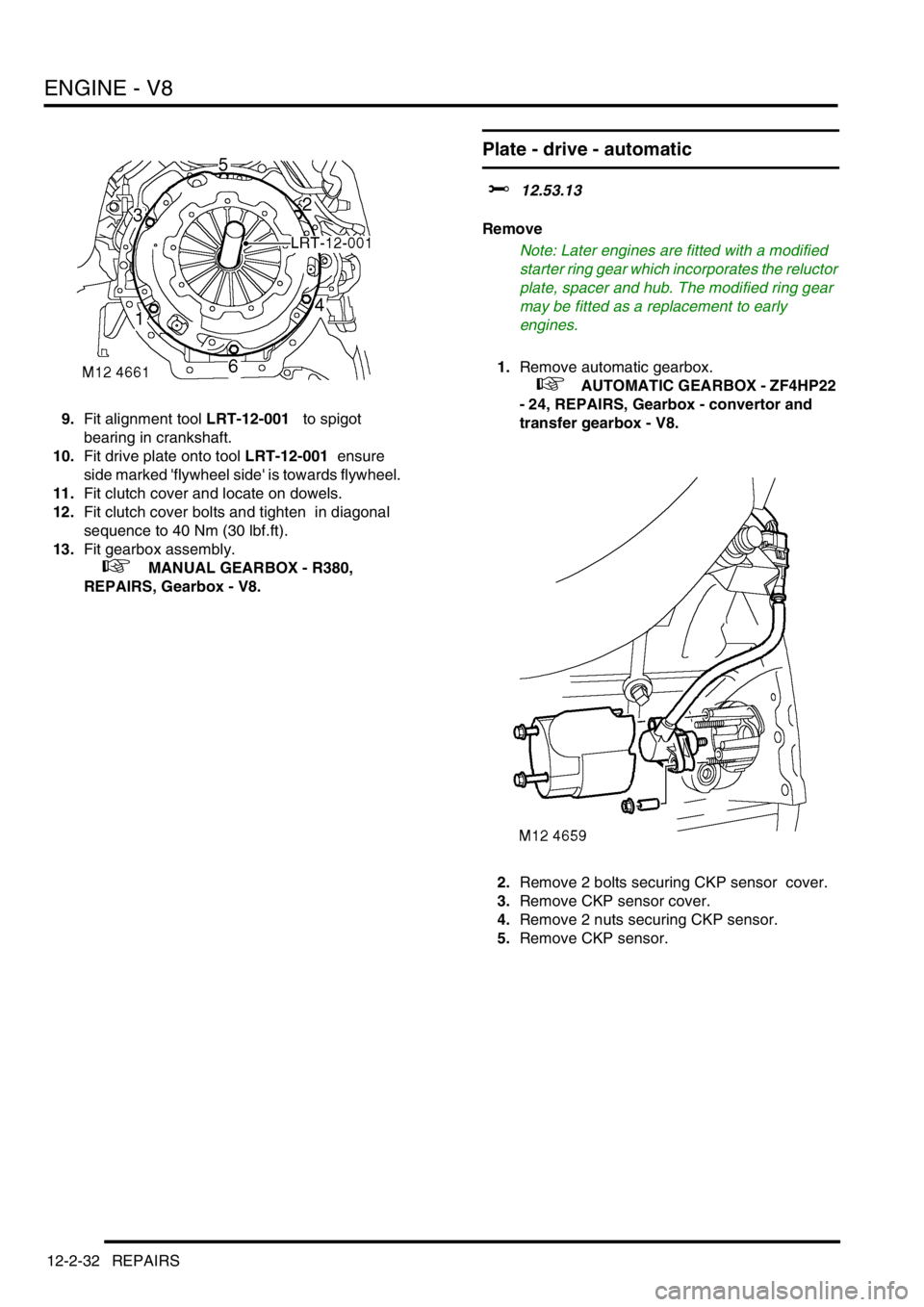
9.Fit alignment tool LRT-12-001 to spigot
bearing in crankshaft.
10.Fit drive plate onto tool LRT-12-001 ensure
side marked 'flywheel side' is towards flywheel.
11.Fit clutch cover and locate on dowels.
12.Fit clutch cover bolts and tighten in diagonal
sequence to 40 Nm (30 lbf.ft).
13.Fit gearbox assembly.
+ MANUAL GEARBOX - R380,
REPAIRS, Gearbox - V8.
Plate - drive - automatic
$% 12.53.13
Remove
Note: Later engines are fitted with a modified
starter ring gear which incorporates the reluctor
plate, spacer and hub. The modified ring gear
may be fitted as a replacement to early
engines.
1.Remove automatic gearbox.
+ AUTOMATIC GEARBOX - ZF4HP22
- 24, REPAIRS, Gearbox - convertor and
transfer gearbox - V8.
2.Remove 2 bolts securing CKP sensor cover.
3.Remove CKP sensor cover.
4.Remove 2 nuts securing CKP sensor.
5.Remove CKP sensor.
Page 189 of 1529

ENGINE - V8
12-2-34 REPAIRS
Ring gear - starter
$% 12.53.19
Remove
1.Remove flywheel.
+ ENGINE - V8, REPAIRS, Flywheel.
2.Drill a 3 mm (0.12 in) diameter hole at root of 2
teeth.
3.Apply a cold chisel in root of one of ring gear
teeth, strike chisel with hammer to break ring
gear.
WARNING: SUITABLE EYE PROTECTION
MUST BE WORN.
4.Remove starter ring gear. Refit
1.Clean flywheel and starter ring gear.
2.Heat new starter ring gear evenly to 350°C
(660°F), indicated when the ring is a light blue
colour.
3.Locate ring gear on flywheel and press ring
gear hard against flange on flywheel.
4.Ensure ring gear is correctly seated around the
complete circumference of flywheel and allow
to cool.
5.Fit flywheel.
+ ENGINE - V8, REPAIRS, Flywheel.
Page 205 of 1529
ENGINE - V8
12-2-50 OVERHAUL
Reassembly
1.Ensure both seal location and running surface
on crankshaft are clean. Ensure that bolt holes
in crankshaft are clean and dry.
2.Lubricate replacement oil seal with engine oil.
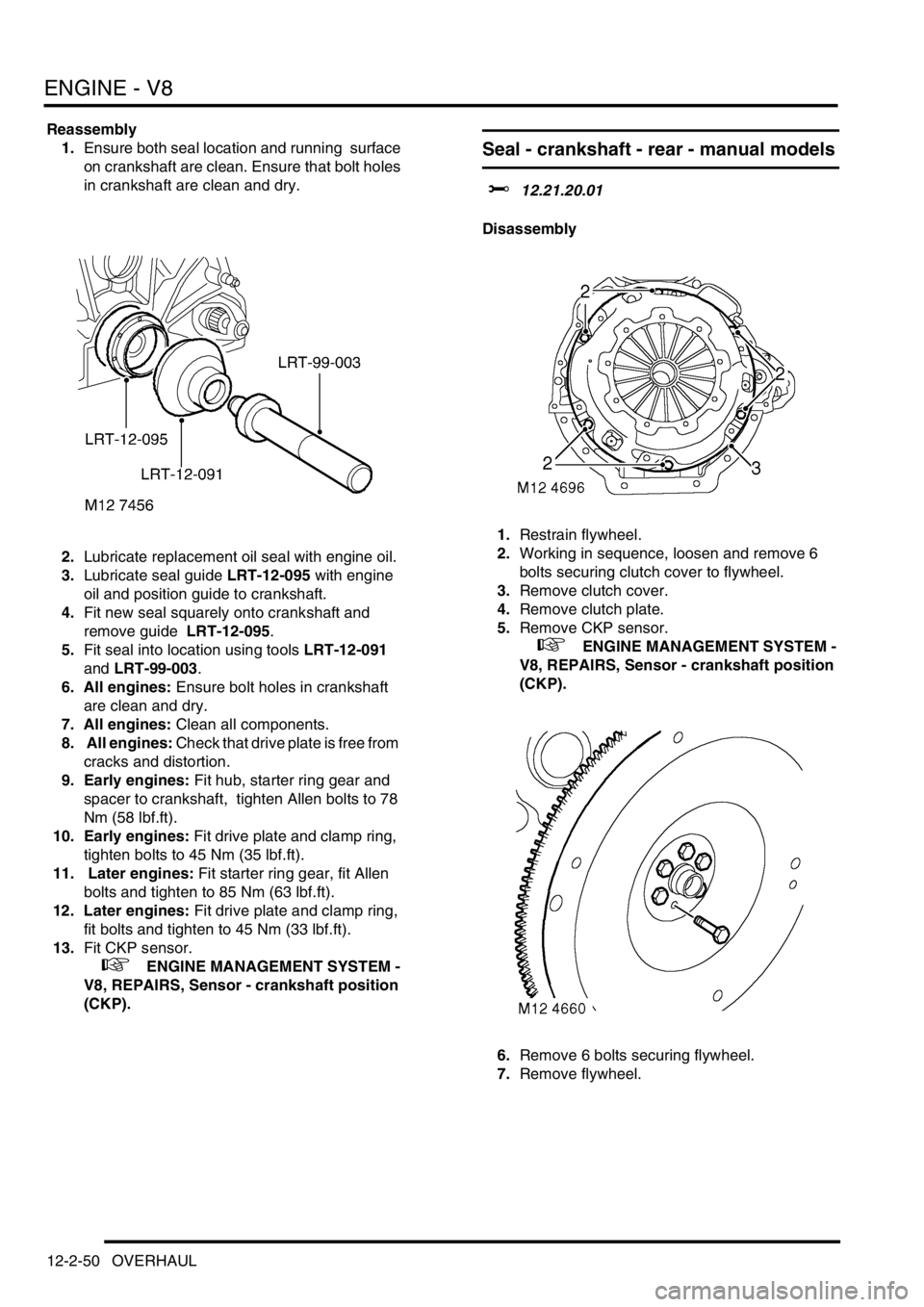
3.Lubricate seal guide LRT-12-095 with engine
oil and position guide to crankshaft.
4.Fit new seal squarely onto crankshaft and
remove guide LRT-12-095.
5.Fit seal into location using tools LRT-12-091
and LRT-99-003.
6. All engines: Ensure bolt holes in crankshaft
are clean and dry.
7. All engines: Clean all components.
8. All engines: Check that drive plate is free from
cracks and distortion.
9. Early engines: Fit hub, starter ring gear and
spacer to crankshaft, tighten Allen bolts to 78
Nm (58 lbf.ft).
10. Early engines: Fit drive plate and clamp ring,
tighten bolts to 45 Nm (35 lbf.ft).
11. Later engines: Fit starter ring gear, fit Allen
bolts and tighten to 85 Nm (63 lbf.ft).
12. Later engines: Fit drive plate and clamp ring,
fit bolts and tighten to 45 Nm (33 lbf.ft).
13.Fit CKP sensor.
+ ENGINE MANAGEMENT SYSTEM -
V8, REPAIRS, Sensor - crankshaft position
(CKP).
Seal - crankshaft - rear - manual models
$% 12.21.20.01
Disassembly
1.Restrain flywheel.
2.Working in sequence, loosen and remove 6
bolts securing clutch cover to flywheel.
3.Remove clutch cover.
4.Remove clutch plate.
5.Remove CKP sensor.
+ ENGINE MANAGEMENT SYSTEM -
V8, REPAIRS, Sensor - crankshaft position
(CKP).
6.Remove 6 bolts securing flywheel.
7.Remove flywheel.
Page 206 of 1529
ENGINE - V8
OVERHAUL 12-2-51
8.Carefully remove oil seal from cylinder block to
avoid damage to seal location or running
surface on crankshaft.
Reassembly
1.Ensure both seal location and running surface
on crankshaft are clean. Ensure that bolt holes
are clean and dry.
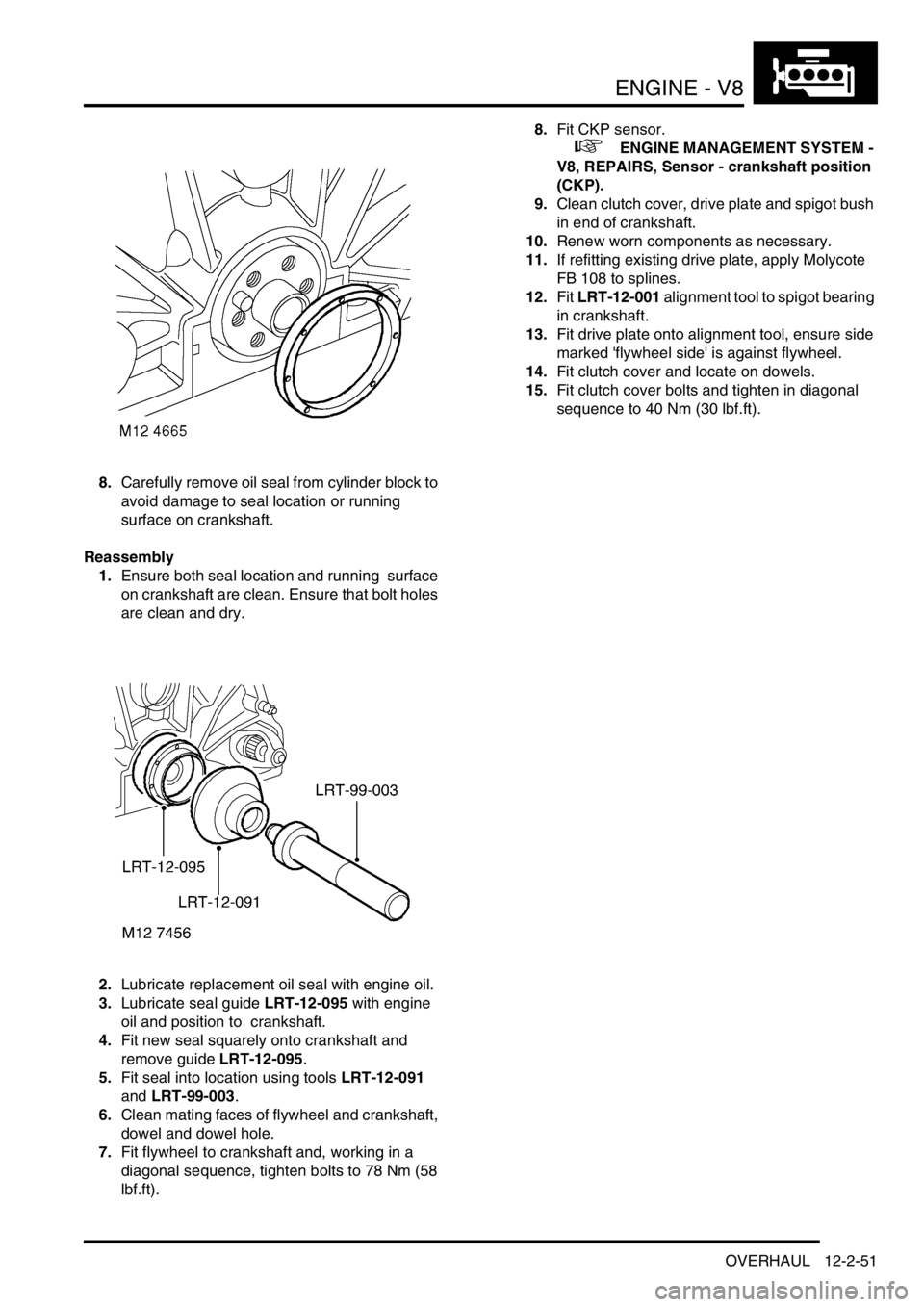
2.Lubricate replacement oil seal with engine oil.
3.Lubricate seal guide LRT-12-095 with engine
oil and position to crankshaft.
4.Fit new seal squarely onto crankshaft and
remove guide LRT-12-095.
5.Fit seal into location using tools LRT-12-091
and LRT-99-003.
6.Clean mating faces of flywheel and crankshaft,
dowel and dowel hole.
7.Fit flywheel to crankshaft and, working in a
diagonal sequence, tighten bolts to 78 Nm (58
lbf.ft). 8.Fit CKP sensor.
+ ENGINE MANAGEMENT SYSTEM -
V8, REPAIRS, Sensor - crankshaft position
(CKP).
9.Clean clutch cover, drive plate and spigot bush
in end of crankshaft.
10.Renew worn components as necessary.
11.If refitting existing drive plate, apply Molycote
FB 108 to splines.
12.Fit LRT-12-001 alignment tool to spigot bearing
in crankshaft.
13.Fit drive plate onto alignment tool, ensure side
marked 'flywheel side' is against flywheel.
14.Fit clutch cover and locate on dowels.
15.Fit clutch cover bolts and tighten in diagonal
sequence to 40 Nm (30 lbf.ft).
Page 207 of 1529

ENGINE - V8
12-2-52 OVERHAUL
Bearing - spigot - crankshaft
$% 12.21.45.01
Disassembly
1.Remove 6 bolts securing clutch cover.
2.Remove clutch cover.
3.Tap a thread in spigot bush to accommodate a
suitable impulse extractor.
4.Fit extractor to bush.
5.Remove bush from crankshaft. Reassembly
1.Clean bush register in rear of crankshaft.
2.Using a suitable drift, fit new bush to crankshaft
so that it is flush with or up to a maximum of 1.6
mm (0.06 in) below the end of the crankshaft.
3.Ream spigot bush to 19.117 + 0.025 − 0.00 mm
(0.75 + 0.001 − 0.00 in) .
4.Remove all traces of swarf on completion.
5.Clean mating faces of flywheel and crankshaft,
dowel and dowel hole.
6.Fit clutch cover to flywheel and tighten bolts by
diagonal slection to 40 Nm (30 lbf.ft).
Page 251 of 1529
EMISSION CONTROL - V8
17-2-18 DESCRIPTION AND OPERATION
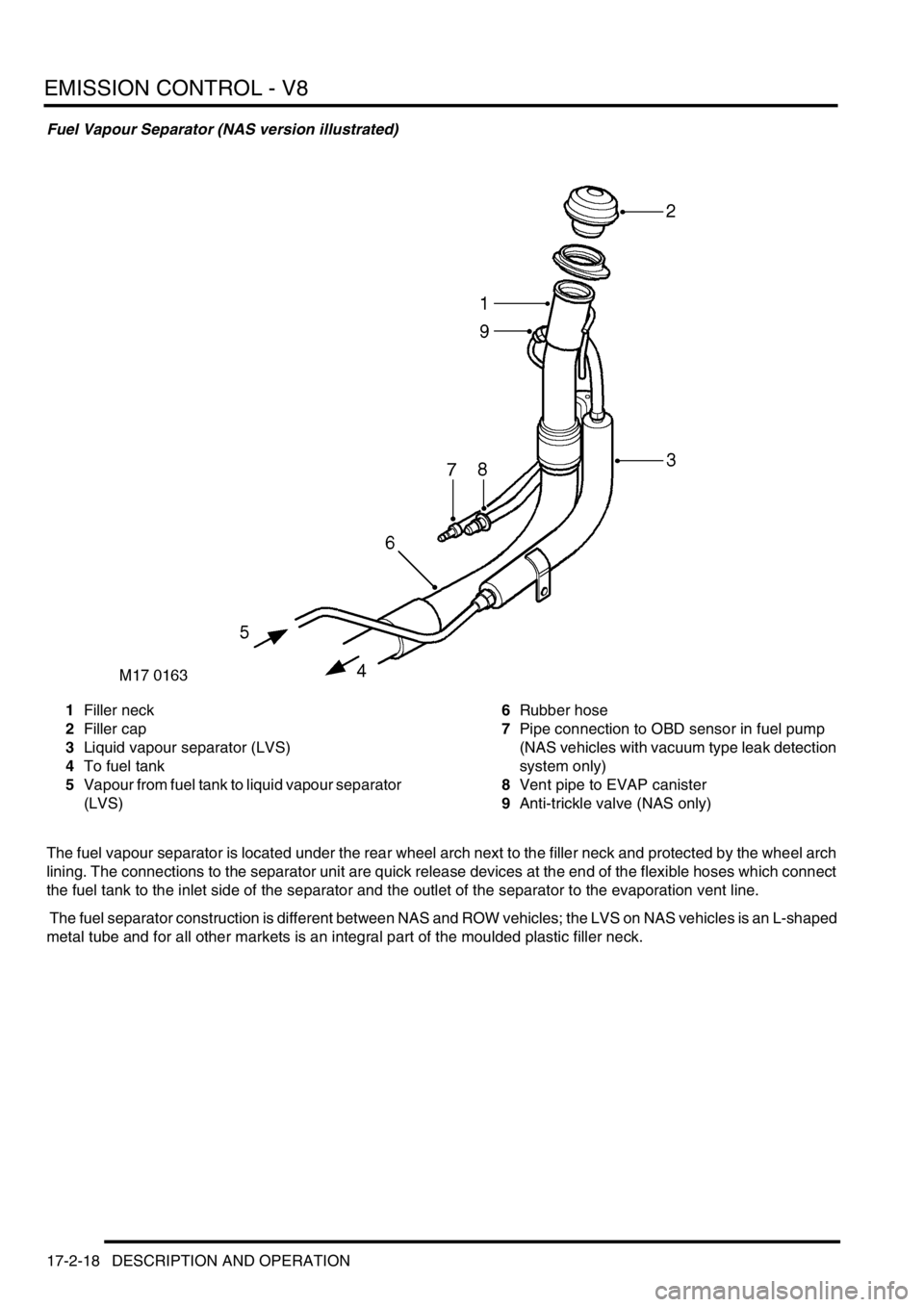
Fuel Vapour Separator (NAS version illustrated)
1Filler neck
2Filler cap
3Liquid vapour separator (LVS)
4To fuel tank
5Vapour from fuel tank to liquid vapour separator
(LVS)6Rubber hose
7Pipe connection to OBD sensor in fuel pump
(NAS vehicles with vacuum type leak detection
system only)
8Vent pipe to EVAP canister
9Anti-trickle valve (NAS only)
The fuel vapour separator is located under the rear wheel arch next to the filler neck and protected by the wheel arch
lining. The connections to the separator unit are quick release devices at the end of the flexible hoses which connect
the fuel tank to the inlet side of the separator and the outlet of the separator to the evaporation vent line.
The fuel separator construction is different between NAS and ROW vehicles; the LVS on NAS vehicles is an L-shaped
metal tube and for all other markets is an integral part of the moulded plastic filler neck.
Page 313 of 1529
ENGINE MANAGEMENT SYSTEM - V8
18-2-14 DESCRIPTION AND OPERATION
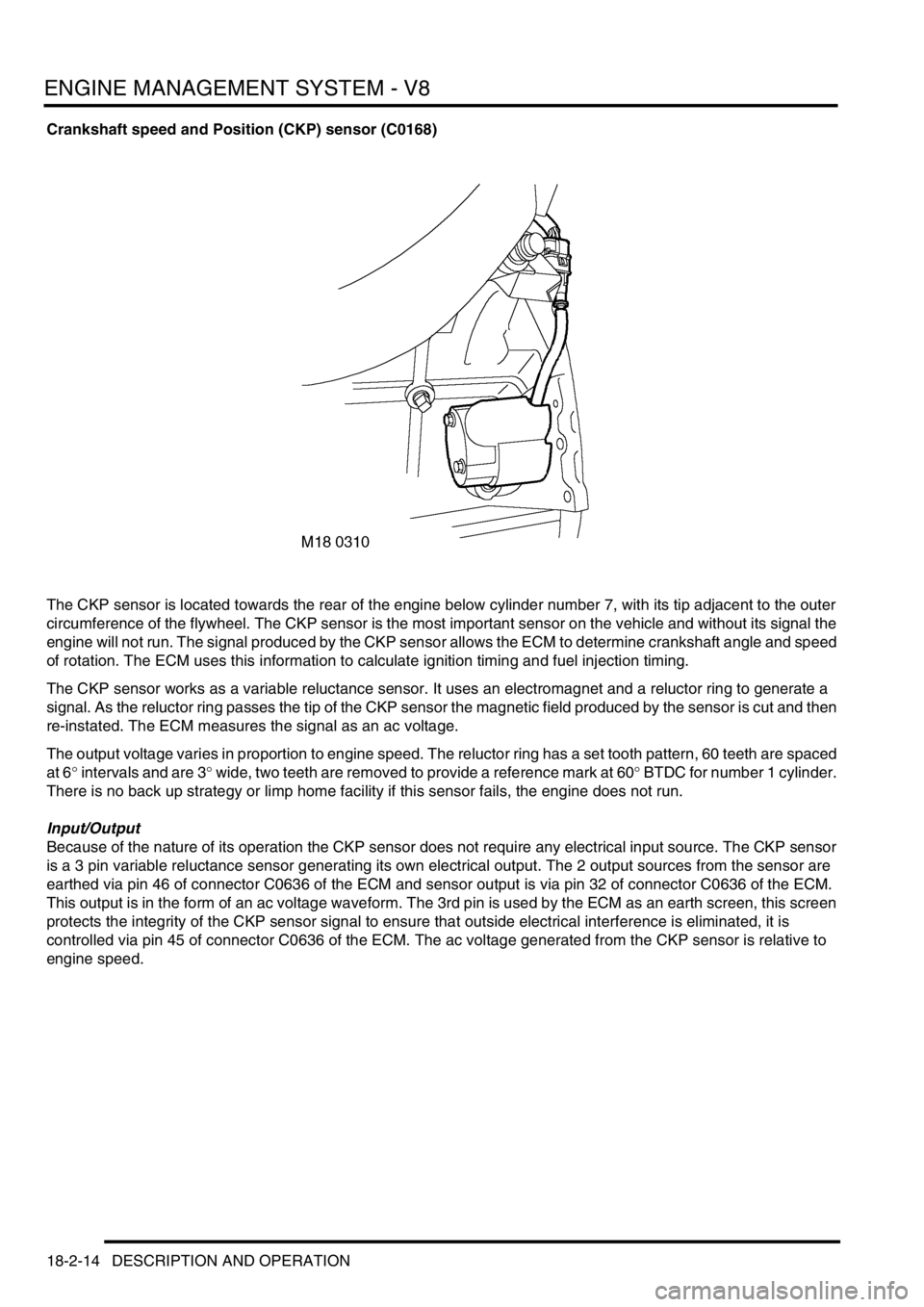
Crankshaft speed and Position (CKP) sensor (C0168)
The CKP sensor is located towards the rear of the engine below cylinder number 7, with its tip adjacent to the outer
circumference of the flywheel. The CKP sensor is the most important sensor on the vehicle and without its signal the
engine will not run. The signal produced by the CKP sensor allows the ECM to determine crankshaft angle and speed
of rotation. The ECM uses this information to calculate ignition timing and fuel injection timing.
The CKP sensor works as a variable reluctance sensor. It uses an electromagnet and a reluctor ring to generate a
signal. As the reluctor ring passes the tip of the CKP sensor the magnetic field produced by the sensor is cut and then
re-instated. The ECM measures the signal as an ac voltage.
The output voltage varies in proportion to engine speed. The reluctor ring has a set tooth pattern, 60 teeth are spaced
at 6° intervals and are 3° wide, two teeth are removed to provide a reference mark at 60° BTDC for number 1 cylinder.
There is no back up strategy or limp home facility if this sensor fails, the engine does not run.
Input/Output
Because of the nature of its operation the CKP sensor does not require any electrical input source. The CKP sensor
is a 3 pin variable reluctance sensor generating its own electrical output. The 2 output sources from the sensor are
earthed via pin 46 of connector C0636 of the ECM and sensor output is via pin 32 of connector C0636 of the ECM.
This output is in the form of an ac voltage waveform. The 3rd pin is used by the ECM as an earth screen, this screen
protects the integrity of the CKP sensor signal to ensure that outside electrical interference is eliminated, it is
controlled via pin 45 of connector C0636 of the ECM. The ac voltage generated from the CKP sensor is relative to
engine speed.
Page 314 of 1529
ENGINE MANAGEMENT SYSTEM - V8
DESCRIPTION AND OPERATION 18-2-15
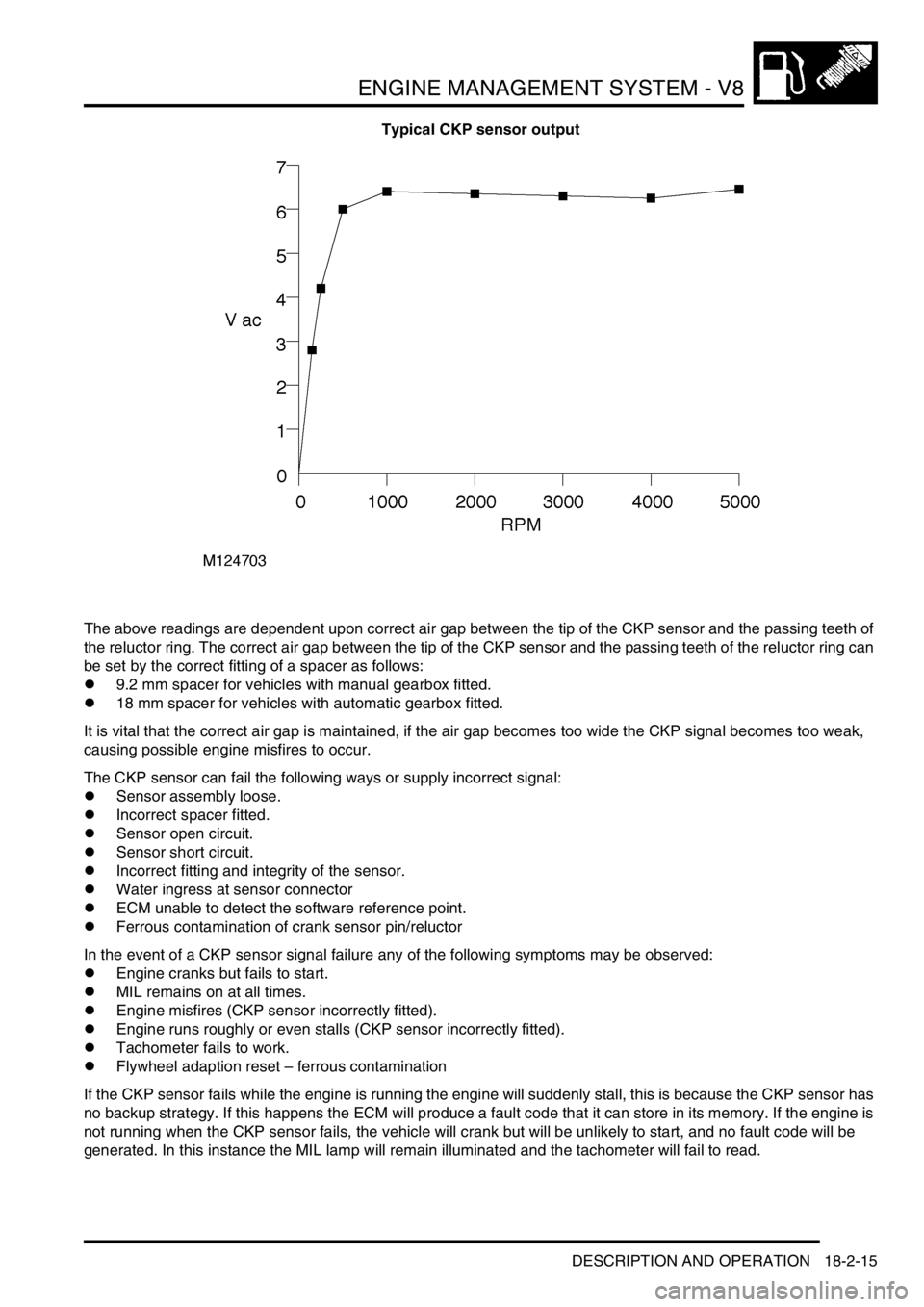
Typical CKP sensor output
The above readings are dependent upon correct air gap between the tip of the CKP sensor and the passing teeth of
the reluctor ring. The correct air gap between the tip of the CKP sensor and the passing teeth of the reluctor ring can
be set by the correct fitting of a spacer as follows:
l9.2 mm spacer for vehicles with manual gearbox fitted.
l18 mm spacer for vehicles with automatic gearbox fitted.
It is vital that the correct air gap is maintained, if the air gap becomes too wide the CKP signal becomes too weak,
causing possible engine misfires to occur.
The CKP sensor can fail the following ways or supply incorrect signal:
lSensor assembly loose.
lIncorrect spacer fitted.
lSensor open circuit.
lSensor short circuit.
lIncorrect fitting and integrity of the sensor.
lWater ingress at sensor connector
lECM unable to detect the software reference point.
lFerrous contamination of crank sensor pin/reluctor
In the event of a CKP sensor signal failure any of the following symptoms may be observed:
lEngine cranks but fails to start.
lMIL remains on at all times.
lEngine misfires (CKP sensor incorrectly fitted).
lEngine runs roughly or even stalls (CKP sensor incorrectly fitted).
lTachometer fails to work.
lFlywheel adaption reset – ferrous contamination
If the CKP sensor fails while the engine is running the engine will suddenly stall, this is because the CKP sensor has
no backup strategy. If this happens the ECM will produce a fault code that it can store in its memory. If the engine is
not running when the CKP sensor fails, the vehicle will crank but will be unlikely to start, and no fault code will be
generated. In this instance the MIL lamp will remain illuminated and the tachometer will fail to read.
Page 315 of 1529

ENGINE MANAGEMENT SYSTEM - V8
18-2-16 DESCRIPTION AND OPERATION
It is vital that the CKP sensor output wires are not reversed (i.e. the connector is fitted incorrectly) as this will cause
a 3° advance in ignition timing. This happens because the ECM uses the falling edge of the signal waveform as its
reference or timing point for each passing tooth on the reluctor.
Whenever a new crankshaft position sensor is fitted or the flywheel is removed, the adaptive values will have to be
reset, using TestBook.
Should a malfunction of the component occur, the following fault codes may be evident and can be retrieved by
TestBook:
P Code J2012 description Land Rover description
P0335 Crankshaft position sensor a circuit malfunction Reference mark outside search window for more than
two revs, with engine speed above 500 rev/min
P0336 Crankshaft position sensor a circuit range/
performanceIncorrect number of teeth detected ±1 tooth between
reference marks with engine speed above 500 rpm
Page 316 of 1529
ENGINE MANAGEMENT SYSTEM - V8
DESCRIPTION AND OPERATION 18-2-17
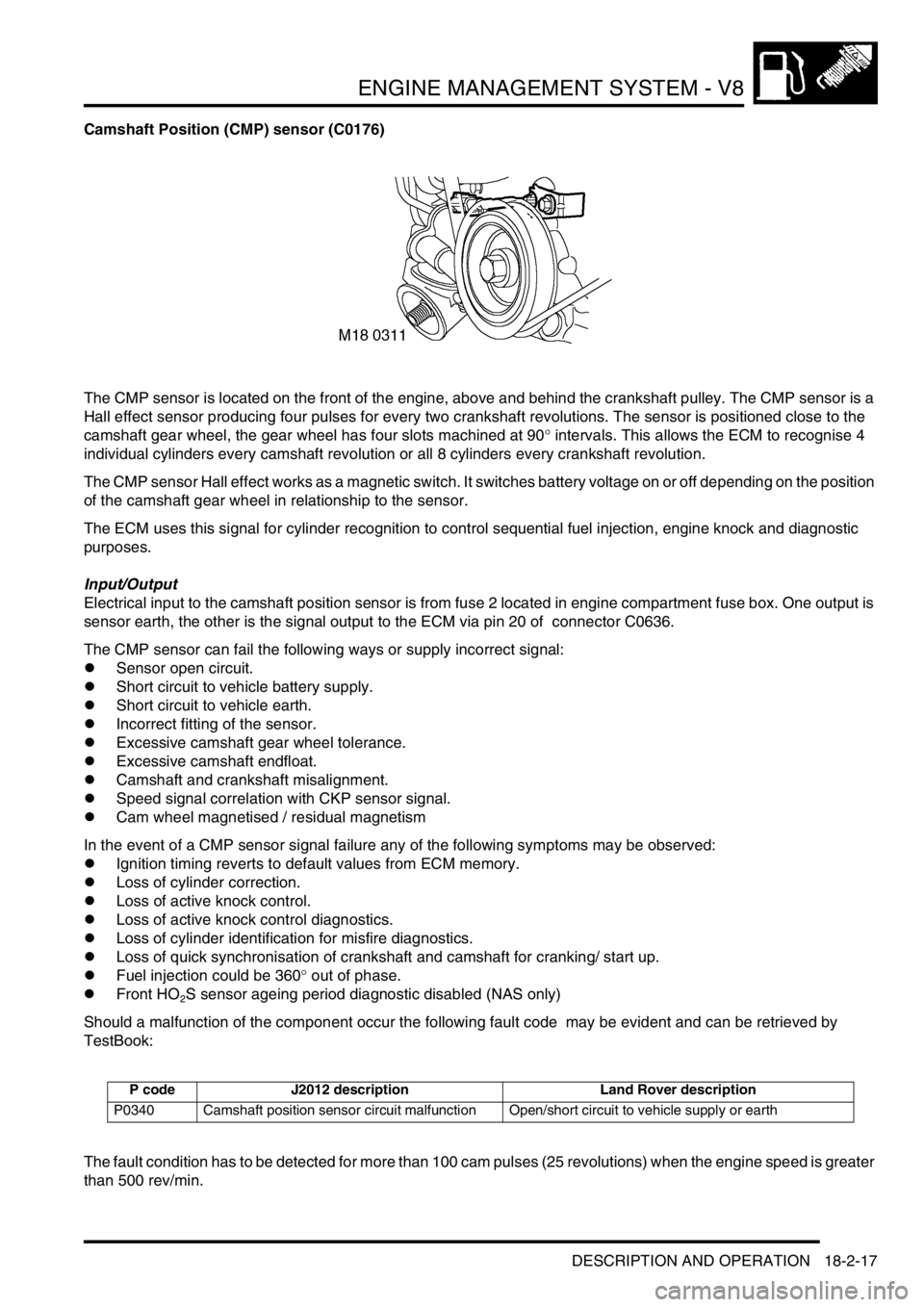
Camshaft Position (CMP) sensor (C0176)
The CMP sensor is located on the front of the engine, above and behind the crankshaft pulley. The CMP sensor is a
Hall effect sensor producing four pulses for every two crankshaft revolutions. The sensor is positioned close to the
camshaft gear wheel, the gear wheel has four slots machined at 90° intervals. This allows the ECM to recognise 4
individual cylinders every camshaft revolution or all 8 cylinders every crankshaft revolution.
The CMP sensor Hall effect works as a magnetic switch. It switches battery voltage on or off depending on the position
of the camshaft gear wheel in relationship to the sensor.
The ECM uses this signal for cylinder recognition to control sequential fuel injection, engine knock and diagnostic
purposes.
Input/Output
Electrical input to the camshaft position sensor is from fuse 2 located in engine compartment fuse box. One output is
sensor earth, the other is the signal output to the ECM via pin 20 of connector C0636.
The CMP sensor can fail the following ways or supply incorrect signal:
lSensor open circuit.
lShort circuit to vehicle battery supply.
lShort circuit to vehicle earth.
lIncorrect fitting of the sensor.
lExcessive camshaft gear wheel tolerance.
lExcessive camshaft endfloat.
lCamshaft and crankshaft misalignment.
lSpeed signal correlation with CKP sensor signal.
lCam wheel magnetised / residual magnetism
In the event of a CMP sensor signal failure any of the following symptoms may be observed:
lIgnition timing reverts to default values from ECM memory.
lLoss of cylinder correction.
lLoss of active knock control.
lLoss of active knock control diagnostics.
lLoss of cylinder identification for misfire diagnostics.
lLoss of quick synchronisation of crankshaft and camshaft for cranking/ start up.
lFuel injection could be 360° out of phase.
lFront HO
2S sensor ageing period diagnostic disabled (NAS only)
Should a malfunction of the component occur the following fault code may be evident and can be retrieved by
TestBook:
The fault condition has to be detected for more than 100 cam pulses (25 revolutions) when the engine speed is greater
than 500 rev/min.
P code J2012 description Land Rover description
P0340 Camshaft position sensor circuit malfunction Open/short circuit to vehicle supply or earth