wheel LAND ROVER DISCOVERY 1999 Repair Manual
[x] Cancel search | Manufacturer: LAND ROVER, Model Year: 1999, Model line: DISCOVERY, Model: LAND ROVER DISCOVERY 1999Pages: 1529, PDF Size: 34.8 MB
Page 352 of 1529

ENGINE MANAGEMENT SYSTEM - V8
DESCRIPTION AND OPERATION 18-2-53
Function
With the ECM operating in the 'New' state, TestBook is required to instruct the ECM to learn the new BCU code. If the
ECM is in delivery state (i.e. direct from the supplier), it will not run the vehicle and will store a new ECM fault code
when it is fitted. This code must be cleared after instructing the ECM to learn the BCU code using TestBook.
When the ECM is in the 'Secure' state, no further action is required as the ECM has successfully learned the BCU
code. A 'Secure' ECM can not be configured to a 'No Code' state.
If the vehicle is fitted with an ECM with a valid code, the engine will start and the MIL will go out.
However, if the ECM has an invalid BCU security code the engine will crank, start, and then immediately stall. The
status of the security system can only be interrogated using TestBook.
TestBook is able to retrieve the following immobilisation fault codes:
Misfire detection
Due to increasing legislation, all new vehicles must be able to detect two specific levels of misfire.
Conditions
The ECM is able to carry out misfire detection as part of the OBD system using the following component parts:
lFlywheel reluctor adaptation.
lCalculation of engine roughness.
lDetection of excess emissions misfire.
lDetection of catalyst damaging misfire.
Function
The flywheel/ reluctor ring is divided into four segments 90° wide. The ECM misfire detection system uses information
generated by the CKP to determine crankshaft speed and position. If a misfire occurs, there will be an instantaneous
slight decrease in engine speed. The ECM misfire detection system is able to compare the length of time each 90°
segment takes and is therefore able to pinpoint the source of the misfire.
For the ECM misfire detection system to be calibrated for the tolerances of the reluctor tooth positions, the flywheel/
reluctor ring must be 'adapted' as follows:
l1800 - 3000 rev/min = speed range 1.
l3000 - 3800 rev/min = speed range 2.
l3800 - 4600 rev/min = speed range 3.
l4600 - 5400 rev/min = speed range 4.
The ECM carries out flywheel/ reluctor ring adaptions across all the above speed ranges and can be monitored by
TestBook. The test should be carried out as follows:
lEngine at normal operating temperature.
lSelect second gear (for both automatic and manual transmission vehicles).
lAccelerate until engine rev limiter is operational.
lRelease throttle smoothly to allow engine to decelerate throughout the speed ranges.
lRepeat process as necessary until all adaptations are complete.
P Code J2012 Description Land Rover Description
P1666 Engine anti-theft signal circuit malfunction BCU serial link frame/ bit timing error
P1667 Engine anti-theft signal circuit low Serial link short circuit to earth
P1668 Engine anti-theft signal circuit high Serial link open circuit
P1672 Engine anti-theft signal circuit wrong code
receivedSecure ECM, received incorrect code
P1673 Engine anti-theft signal new engine control
module not configuredNew ECM fitted
P1674 Engine anti-theft signal No code ECM, valid code received
Page 353 of 1529

ENGINE MANAGEMENT SYSTEM - V8
18-2-54 DESCRIPTION AND OPERATION
TestBook is able to retrieve the following misfire detection fault codes:
TestBook is able to retrieve the following Catalyst damage fault codes:
The flywheel/ reluctor ring adaptions must be reset if the CKP sensor or the flywheel are changed.
P Code J2012 Description Land Rover Description
P0300 Random/multiple cylinder misfire detected Excess emissions level of misfire on more than one
cylinder
P0301 Cylinder 1 misfire detected Excess emissions level of misfire detected on cylinder
No.1
P0302 Cylinder 2 misfire detected Excess emissions level of misfire detected on cylinder
No.2
P0303 Cylinder 3 misfire detected Excess emissions level of misfire detected on cylinder
No.3
P0304 Cylinder 4 misfire detected Excess emissions level of misfire detected on cylinder
No.4
P0305 Cylinder 5 misfire detected Excess emissions level of misfire detected on cylinder
No.5
P0306 Cylinder 6 misfire detected Excess emissions level of misfire detected on cylinder
No.6
P0307 Cylinder 7 misfire detected Excess emissions level of misfire detected on cylinder
No.7
P0308 Cylinder 8 misfire detected Excess emissions level of misfire detected on cylinder
No.8
P Code J2012 Description Land Rover Description
P1300 Misfire detected sufficient to cause catalyst
damageCatalyst damaging level of misfire on more than one
cylinder
P1301 No description Catalyst damaging level of misfire detected on cylinder
No.1
P1302 No description Catalyst damaging level of misfire detected on cylinder
No.2
P1303 No description Catalyst damaging level of misfire detected on cylinder
No.3
P1304 No description Catalyst damaging level of misfire detected on cylinder
No.4
P1305 No description Catalyst damaging level of misfire detected on cylinder
No.5
P1306 No description Catalyst damaging level of misfire detected on cylinder
No.6
P1307 No description Catalyst damaging level of misfire detected on cylinder
No.7
P1308 No description Catalyst damaging level of misfire detected on cylinder
No.8
Page 355 of 1529

ENGINE MANAGEMENT SYSTEM - V8
18-2-56 DESCRIPTION AND OPERATION
Function
Input for the rough road signal is measured via pin 34 of connector C0637 of the ECM. The SLABS ECU generates
a PWM signal that varies in accordance with changing road conditions. The rough road PWM signal operates at a
frequency of 2.33 Hz ± 10%. The significance of changes in the PWM signal are shown in the following table:
The rough road signal can fail in the following ways:
lHarness or connector damage
lSLABS failure — wheel speed sensor
A rough road signal failure may be evident from the following:
lHDC / ABS warning light on
Should a malfunction of the rough road signal occur, the following fault codes may be evident and can be retrieved
by TestBook:
Hill Descent Control (HDC) signal
The ECM transmits throttle angle, engine torque, engine identification (Td5 or V8), and transmission type (automatic
or manual) data to the SLABS ECU to support the Hill Descent Control system. The information is transmitted via a
0 – 12V pulse width modulated (PWM) signal at a frequency of 179.27 Hz.
Function
The HDC signal output from the ECM is via pin 29 of connector C0636. The ECM generates a PWM signal that varies
in pulse width in accordance with changing throttle angle or engine torque. The throttle angle data is transmitted on
pulses 1, 3, 5 and 37. The engine torque data is transmitted on pulses 2,4,6 and 38. The engine and transmission
information is transmitted on pulse 39. A synchronising pulse is transmitted after every 39th pulse.
The HDC signal can fail in the following ways:
lHarness or connector damage
A HDC signal failure may be evident from the following:
lHDC / ABS warning light on
lHDC inoperative
lAudible warning
Should a malfunction of the HDC signal occur, the following fault codes may be evident and can be retrieved by
TestBook:
PWM signal Indication
<10% Electrical short circuit to ground
25% ± 5 % Smooth road
50% ± 5 % SLABS error
75% ± 5% Rough road
>90% Electrical short circuit to battery voltage
P Code J2012 Description Land Rover Description
P1590 ABS rough road signal circuit malfunction Hardware is OK, but SLABS ECU is sending an error
signal
P1591 ABS rough road signal circuit low Signal from SLABS ECU short circuit to earth
P1592 ABS rough road signal circuit high Signal from SLABS ECU short circuit to vehicle battery
supply
P Code J2012 Description Land Rover Description
P1663 Throttle angle/Torque signal circuit malfunction SLABS HDC link open circuit
P1664 Throttle angle/Torque signal circuit low SLABS HDC link short circuit to ground
P1665 Throttle angle/Torque signal circuit high SLABS HDC link short circuit to battery voltage
Page 364 of 1529

ENGINE MANAGEMENT SYSTEM - V8
DESCRIPTION AND OPERATION 18-2-65
SLABS ECU
The SLABS ECU provides the road speed signal to the cruise control ECU. This is the same speed signal provided
to the ECM. Cruise control will only operate between 28 - 125 mph (45 - 200 km/h). Cruise control will not operate if
a road speed signal is not present.
Input/Output
The input from the SLABS ECU to the cruise control ECU is a square wave oscillating between 0 - 12 Volts at a
frequency of 8,000 pulses per mile (1.6 km).
ECU operating parameters (connector connected and cruise control master switch on)
Pin No. Condition Volts Ohms
15 Road wheels stopped 0
15 Road wheels turning 0 - 12 Volts with a
frequency of 8,000
pulses per mile 1.6 km)
Page 366 of 1529

ENGINE MANAGEMENT SYSTEM - V8
DESCRIPTION AND OPERATION 18-2-67
SET+/RES switches
The cruise control system uses two steering wheel switches labelled SET+ and RES.
The SET+ switch performs the set speed, tap up and accelerator functions. The RES switch performs the resume and
suspend functions.
With the cruise control master switch on and the vehicle in the cruise control operating speed range, one press of the
SET+ switch stores a speed value in the cruise control ECU. If the switch is pressed and held while the vehicle is
under cruise control operation, speed increases until the switch is released. At this point the cruise control ECU stores
the new speed value. If the switch is tapped (held down for less than 0.5 second) the cruise control ECU increases
vehicle speed by 1 mph (1.5 km/h).
If the RES switch is pressed while the systems is inactive (no stored values) the system will not respond. If there is
a stored value in the cruise control ECU memory and the switch is pressed, the cruise control system operates and
holds the vehicle at the stored road speed. If the cruise control system is active and the RES switch is depressed,
the cruise control ECU deactivates cruise operation but maintains the current set speed value.
Input/Output
The input from the SET+ switch to the cruise control ECU is either 12 Volts or an open circuit.
The input from the RES switch to the cruise control ECU is either 12 Volts or an open circuit.
The following diagnostic information is available through TestBook:
lThe state of operator switch SET+.
lThe state of operator switch RES.
ECU operating parameters (connector connected)
Pin No. Condition Volts Ohms
4 Ignition in position II, SET+ switch
releasedMore than 10,000
4 Ignition in position II, SET+ switch
pressed12
2 Ignition in position II, RES switch
releasedMore than 10,000
2 Ignition in position II, RES switch
pressed12
Page 396 of 1529

ENGINE MANAGEMENT SYSTEM - V8
REPAIRS 18-2-97
Switch - cruise control (set/resume)
$% 19.75.33
Remove
1.Remove the key from the starter switch.
Disconnect both battery leads, negative lead
first. Wait ten minutes before starting work.
2.Remove driver's airbag module.
+ RESTRAINT SYSTEMS, REPAIRS,
Airbag module - drivers.
3.Release remote control switches multiplug and
leads from steering wheel base.
4.Disconnect remote control switches multiplug
from harness.
5.Remove 2 screws securing remote control
switches to steering wheel base.
6.Release and remove remote control switches
from steering wheel.
Refit
1.Fit remote control switches to steering wheel
and secure with screws.
2.Connect remote control switches multiplug to
harness.
3.Secure leads and multiplug to base of steering
wheel.
4.Fit driver's airbag module.
+ RESTRAINT SYSTEMS, REPAIRS,
Airbag module - drivers.
Switch - clutch pedal - cruise control
$% 19.75.34
Remove
1.Remove 3 fasteners and move driver's side
lower closing panel aside.
2.Disconnect multiplug from clutch pedal switch.
3.Remove switch from pedal bracket.
Refit
1.Engage switch fully into pedal bracket location
and connect multiplug.
2.Position lower closing panel and secure with
fasteners.
Page 424 of 1529
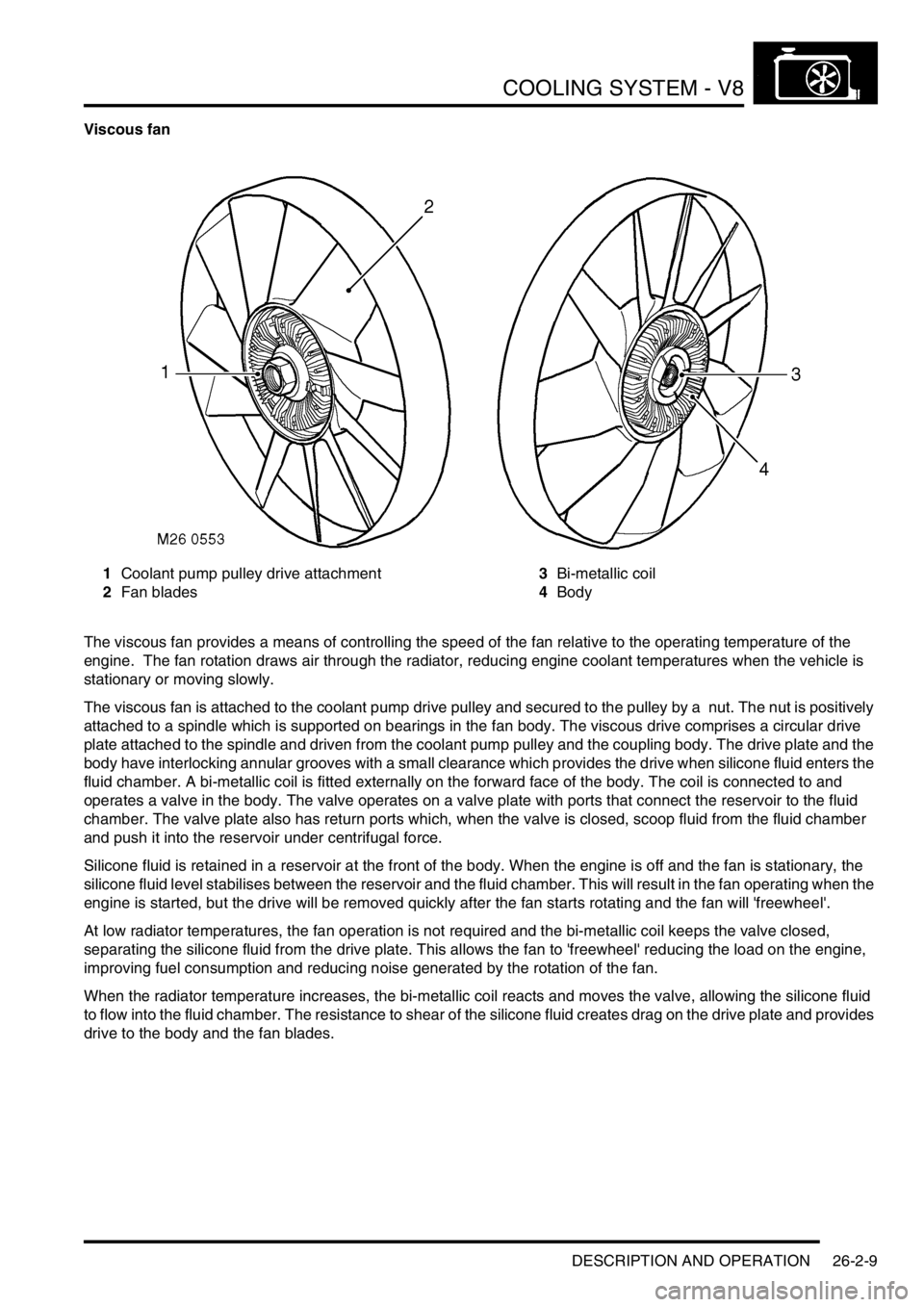
COOLING SYSTEM - V8
DESCRIPTION AND OPERATION 26-2-9
Viscous fan
1Coolant pump pulley drive attachment
2Fan blades3Bi-metallic coil
4Body
The viscous fan provides a means of controlling the speed of the fan relative to the operating temperature of the
engine. The fan rotation draws air through the radiator, reducing engine coolant temperatures when the vehicle is
stationary or moving slowly.
The viscous fan is attached to the coolant pump drive pulley and secured to the pulley by a nut. The nut is positively
attached to a spindle which is supported on bearings in the fan body. The viscous drive comprises a circular drive
plate attached to the spindle and driven from the coolant pump pulley and the coupling body. The drive plate and the
body have interlocking annular grooves with a small clearance which provides the drive when silicone fluid enters the
fluid chamber. A bi-metallic coil is fitted externally on the forward face of the body. The coil is connected to and
operates a valve in the body. The valve operates on a valve plate with ports that connect the reservoir to the fluid
chamber. The valve plate also has return ports which, when the valve is closed, scoop fluid from the fluid chamber
and push it into the reservoir under centrifugal force.
Silicone fluid is retained in a reservoir at the front of the body. When the engine is off and the fan is stationary, the
silicone fluid level stabilises between the reservoir and the fluid chamber. This will result in the fan operating when the
engine is started, but the drive will be removed quickly after the fan starts rotating and the fan will 'freewheel'.
At low radiator temperatures, the fan operation is not required and the bi-metallic coil keeps the valve closed,
separating the silicone fluid from the drive plate. This allows the fan to 'freewheel' reducing the load on the engine,
improving fuel consumption and reducing noise generated by the rotation of the fan.
When the radiator temperature increases, the bi-metallic coil reacts and moves the valve, allowing the silicone fluid
to flow into the fluid chamber. The resistance to shear of the silicone fluid creates drag on the drive plate and provides
drive to the body and the fan blades.
Page 426 of 1529

COOLING SYSTEM - V8
DESCRIPTION AND OPERATION 26-2-11
Viscous fan operation
A = Cold, B = Hot
1Drive plate
2Fan body
3Clearance
4Valve plate
5Valve
6Bi-metallic coil7Fluid seals
8Ball race
9Fluid chamber
10Reservoir
11Return port
When the engine is off and the fan is not rotating, the silicone fluid stabilises within the fluid chamber and the reservoir.
The fluid levels equalise due to the return port in the valve plate being open between the fluid chamber and the
reservoir. In this condition, when the engine is started, silicone fluid is present in the fluid chamber and causes drag
to occur between the drive plate and the body. This causes the fan to operate initially when the engine is started.
As the fan speed increases, centrifugal force and a scoop formed on the fluid chamber side of the valve plate, pushes
the silicone fluid through the return port in the valve plate into the reservoir. As the fluid chamber empties, the drag
between the drive plate and body is reduced, causing the drive plate to slip. This reduces the rotational speed of the
fan and allows it to 'freewheel'.
When the coolant temperature is low, the heat emitted from the radiator does not affect the bi-metallic coil. The valve
remains closed, preventing fluid escaping from the reservoir into the fluid chamber. In this condition the fan will
'freewheel' at a slow speed.
As the coolant temperature increases, the heat emitted from the radiator causes the bi-metallic coil to tighten. This
movement of the coil moves the valve to which it is attached. The rotation of the valve exposes ports in the valve plate
which allow silicone fluid to spill into the fluid chamber. As the fluid flows into the clearance between the annular
grooves in the drive plate and body, drag is created between the two components. The drag is due to the viscosity
and shear qualities of the silicone fluid and cause the drive plate to rotate the body and fan blades.
As the coolant temperature decreases, the bi-metallic coil expands, rotating the valve and closing off the ports in the
valve plate. When the valve is closed, centrifugal force pushes silicone fluid through the return port, emptying the fluid
chamber. As the fluid chamber empties, the drag between the drive plate and the body is reduced and the body slips
on the drive plate, slowing the rotational speed of the fan.
Page 458 of 1529

CLUTCH - V8
DESCRIPTION AND OPERATION 33-2-3
1Brake/clutch reservoir
2Connecting hose
3Bolt 2 off
4Master cylinder
5Clutch pedal
6Gearbox housing
7Primary driveshaft
8Bolt 2 off
9Slave cylinder
10Bleed nipple
11Pressure plate
12Drive plate13Flywheel
14Metal hydraulic pipes
15Ball spigot
16Clutch release bearing sleeve
17Bolt 2 off
18Pivot washer
19Release lever
20Release bearing
21Retaining clip
22Pipe
23Pipe
Page 460 of 1529

CLUTCH - V8
DESCRIPTION AND OPERATION 33-2-5
1Brake/clutch reservoir
2Fluid supply pipe
3Hydraulic feed pipe
4Master cylinder
5Piston
6Clutch pedal
7Primary driveshaft
8Engine crankshaft
9Drive plate
10Flywheel
11Ring gear12Cover - Pressure plate
13Leaf spring
14Retractor clip
15Diaphragm
16Release bearing
17Ball spigot
18Release bearing sleeve
19Release lever
20Slave cylinder
21Piston
22Bleed nipple