wheel LAND ROVER DISCOVERY 1999 Repair Manual
[x] Cancel search | Manufacturer: LAND ROVER, Model Year: 1999, Model line: DISCOVERY, Model: LAND ROVER DISCOVERY 1999Pages: 1529, PDF Size: 34.8 MB
Page 461 of 1529

CLUTCH - V8
33-2-6 DESCRIPTION AND OPERATION
Description
General
The clutch system is a conventional diaphragm type clutch operated by a hydraulic cylinder. The clutch requires no
adjustment to compensate for wear.
Hydraulic clutch
The hydraulic clutch comprises a master cylinder, slave cylinder and a hydraulic reservoir, which is also shared with
the braking system. The master and slave cylinders are connected to each other hydraulically by plastic and metal
pipes. The plastic section of the pipe allows ease of pipe routing and also absorbs engine movements and vibrations.
The master cylinder comprises a body with a central bore. Two ports in the body connect the bore to the hydraulic
feed pipe to the slave cylinder and the brake/clutch fluid reservoir. A piston is fitted in the bore and has an external
rod which is attached to the clutch pedal with a pin. Two coiled springs on the clutch pedal reduce the effort required
to depress the pedal.
The master cylinder is mounted on the bulkhead in the engine compartment and secured with two bolts. The cylinder
is connected to the shared brake/clutch reservoir on the brake servo by a braided connecting hose.
The slave cylinder is located on the left hand side of the gearbox housing and secured with two bolts. A heat shield
protects the underside of the cylinder from heat generated from the exhaust system. The slave cylinder comprises a
cylinder with a piston and a rod. A port in the cylinder body provides the attachment for the hydraulic feed pipe from
the master cylinder. A second port is fitted with a bleed nipple for removing air from the hydraulic system after
servicing. The piston rod locates on a clutch release lever located in the gearbox housing. The rod is positively
retained on the release lever with a clip.
Clutch mechanism
The clutch mechanism comprises a flywheel, drive plate, pressure plate, release lever and a release bearing. The
clutch mechanism is fully enclosed at the rear of the engine by the gearbox housing.
A clutch release bearing sleeve is attached in the gearbox housing with two bolts and located on two dowels. A spigot
with a ball end is formed on the release bearing sleeve and provides a mounting and pivot point for the clutch release
lever. A dished pivot washer is located on the ball of the spigot. When the release lever is located on the ball, the pivot
washer seats against the rear face of the release lever. A spring clip is located on the lever and the pivot washer and
secures the lever on the spigot. A small bolt retains the spring clip in position.
The release lever is forked at its inner end and locates on the clutch release bearing carrier. The outer end of the
release lever has a nylon seat which locates the slave cylinder piston rod. A second nylon seat, positioned centrally
on the release lever, locates on the ball spigot of the release bearing sleeve and allows the release lever to pivot freely
around the ball.
The clutch release bearing locates on the clutch release lever and the release bearing sleeve. The bearing is retained
on a carrier which has two flats to prevent the carrier rotating on the release lever. A clip retains the release lever on
the carrier. The bearing and carrier are not serviceable individually.
Flywheel
The flywheel is bolted to a flange on the rear of the crankshaft with six bolts. A dowel on the crankshaft flange ensures
that the flywheel is correctly located. A ring gear is fitted on the outside diameter of the flywheel and seats against a
flange. The ring gear is an interference fit on the flywheel and is installed by heating the ring and cooling the flywheel.
The ring gear is a serviceable item and can be replaced if damaged or worn.
The operating face of the flywheel is machined to provide a smooth surface for the drive plate to engage on. Three
dowels and six threaded holes provide for the location and attachment of the pressure plate. The flywheel is balanced
to ensure that it does not produce vibration when rotating. A machined slot, with a series of holes within the slot, is
located on the engine side of the flywheel. The slot accommodates the tip of the crankshaft position sensor which is
used by the Engine Control Module (ECM) for engine management.
+ ENGINE MANAGEMENT SYSTEM - V8, DESCRIPTION AND OPERATION, Description - engine
management.
Page 462 of 1529

CLUTCH - V8
DESCRIPTION AND OPERATION 33-2-7
Pressure plate
1Leaf spring
2Fulcrum ring
3Fulcrum ring
4Drive plate
5Pressure plate6Diaphragm
7Cover
8Rivet
9Retractor clip
The pressure plate assembly comprises a pressure plate, cover and diaphragm and is mounted on and rotates with
the flywheel.
The pressure plate is forged from cast iron and machined to provide a smooth surface for the drive plate to engage
on. Three lugs on the outer diameter of the pressure plate connect it via three leaf springs to the cover. The leaf
springs have two tempered steel leaves which assist in pulling the pressure plate away from the drive plate when the
clutch pedal is depressed.
The cover is made from pressed steel and houses and locates all pressure plate components. Shouldered rivets
support the diaphragm and fulcrum rings inside the cover. The cover also provides attachment for balance weights
when the pressure plate assembly is balanced. Three holes in the cover locate on the dowels on the flywheel and six
further holes provide for the attachment of the cover to the flywheel with six bolts and spring washers. Larger holes
in the cover provide ventilation for the drive plate and pressure plate and flywheel contact surfaces.
The diaphragm comprises a cast ring with eighteen fingers. The diaphragm is attached to the cover with nine
shouldered rivets. Two circular steel fulcrum rings are also secured by the shouldered rivets on each side of the
diaphragm. The fulcrum rings allow the diaphragm to pivot between them when the clutch is depressed or released.
When pressure is applied to the diaphragm fingers by the release bearing, the diaphragm pivots between the fulcrum
rings and moves away from the pressure plate. Retractor clips are secured to the pressure plate and are located on
the outer diameter of the diaphragm. The retractor clips ensure that the diaphragm remains in contact with the
pressure plate.
Page 463 of 1529
CLUTCH - V8
33-2-8 DESCRIPTION AND OPERATION
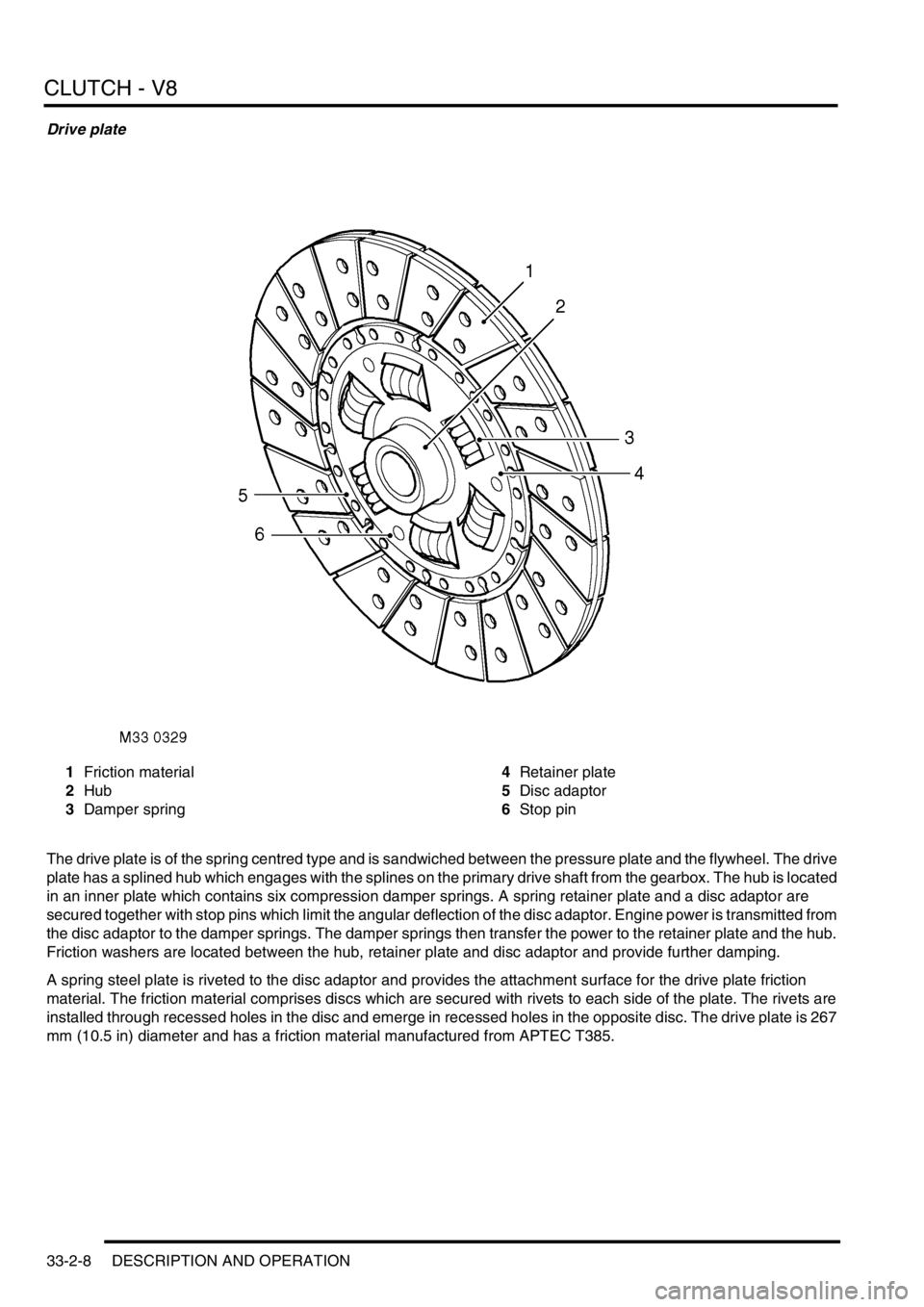
Drive plate
1Friction material
2Hub
3Damper spring4Retainer plate
5Disc adaptor
6Stop pin
The drive plate is of the spring centred type and is sandwiched between the pressure plate and the flywheel. The drive
plate has a splined hub which engages with the splines on the primary drive shaft from the gearbox. The hub is located
in an inner plate which contains six compression damper springs. A spring retainer plate and a disc adaptor are
secured together with stop pins which limit the angular deflection of the disc adaptor. Engine power is transmitted from
the disc adaptor to the damper springs. The damper springs then transfer the power to the retainer plate and the hub.
Friction washers are located between the hub, retainer plate and disc adaptor and provide further damping.
A spring steel plate is riveted to the disc adaptor and provides the attachment surface for the drive plate friction
material. The friction material comprises discs which are secured with rivets to each side of the plate. The rivets are
installed through recessed holes in the disc and emerge in recessed holes in the opposite disc. The drive plate is 267
mm (10.5 in) diameter and has a friction material manufactured from APTEC T385.
Page 464 of 1529

CLUTCH - V8
DESCRIPTION AND OPERATION 33-2-9
Operation
Hydraulic operation
Refer to illustration.
+ CLUTCH - V8, DESCRIPTION AND OPERATION, Hydraulic operation.
When the clutch pedal is depressed, the master cylinder piston is pushed into the master cylinder. The movement of
the piston pressurises the fluid in the master cylinder, forcing the pressurised fluid into the hydraulic feed pipe to the
slave cylinder. The hydraulic pressure is felt at the slave cylinder piston which moves under the hydraulic force
applied, pushing the clutch release lever via the piston rod.
When the clutch pedal is released, the force applied to the release lever by the fingers of the diaphragm, moves the
release lever, which pushes the slave cylinder piston into the cylinder. The displaced hydraulic fluid is pushed up the
hydraulic feed pipe and returned to the master cylinder.
Mechanism operation
When the clutch pedal is depressed, hydraulic pressure extends the piston and rod in the slave cylinder. The
extension of the piston pushes the rod against the outer end of the release lever which pivots around the ball spigot.
The inner end of the release lever pivots towards the engine applying pressure to the release bearing. The release
bearing slides along the release bearing sleeve and pushes on the fingers of the diaphragm. The diaphragm pivots
about the fulcrum rings in the cover. As the diaphragm is deflected, it removes pressure from the pressure plate. The
pressure plate moves away from the drive plate assisted by the three leaf springs and retractor clips.
The removal of force from the pressure plate on the drive plate reduces the friction between the flywheel, drive plate
and pressure plate. The drive plate slips between the flywheel and the pressure plate preventing rotary movement
being transferred from the flywheel and pressure plate to the primary driveshaft.
When the clutch pedal is released, hydraulic force is removed from the piston in the slave cylinder. This allows the
fingers of the diaphragm to push the release bearing along the release bearing sleeve. The movement of the release
bearing moves the release lever which pivots on the ball spigot, pushing the piston and rod back into the slave
cylinder.
The removal of pressure from the release bearing on the diaphragm, causes the diaphragm to pivot around the
fulcrum rings in the cover. The force applied to the pressure plate from the diaphragm overcomes the force of the leaf
springs and the pressure plate moves towards the drive plate and flywheel.
The pressure plate applies pressure to the drive plate which is pushed against the flywheel. As the clutch pedal is
progressively released, the friction between the drive plate, flywheel and pressure plate increases. The increase in
friction transfers the rotary movement of the flywheel and pressure plate to the drive plate which in turn starts to rotate
the primary driveshaft. When the clutch pedal is released fully, the force applied by the diaphragm to the pressure
plate forces the drive plate onto the flywheel with no slippage.
Page 468 of 1529

CLUTCH - V8
REPAIRS 33-2-13
REPAIRS
Clutch assembly
$% 33.10.01
Remove
1.Remove gearbox assembly.
+ MANUAL GEARBOX - R380,
REPAIRS, Gearbox - V8.
2.Restrain flywheel.
3.Working in diagonal sequence, progressively
loosen 6 bolts securing clutch cover to flywheel.
Remove bolts.
4.Remove clutch cover.
5.Remove clutch plate.
6.Renew all worn or damaged components.Refit
1.Clean clutch cover and flywheel mating faces
and spigot bush in end of crankshaft.
2.Fit LRT-12-001 to spigot bearing in crankshaft.
3.Fit clutch plate onto LRT-12-001, ensure side
marked 'flywheel side' is against flywheel.
4.Fit clutch cover and locate on dowels.
5.Fit clutch cover bolts and progressively tighten,
in diagonal sequence shown, to 40 Nm. (30
lbf.ft).
6.Fit gearbox assembly.
+ MANUAL GEARBOX - R380,
REPAIRS, Gearbox - V8.
Page 540 of 1529
TRANSFER BOX - LT230SE
DESCRIPTION AND OPERATION 41-15
Functionality – Vehicles up to 03 model year only
The function of the differential lock used in previous applications is performed on this vehicle by the Electronic Traction
Control System. However, for the purposes of 2 wheel rolling road testing , the differential lock components are
retained. For all driving conditions however, the differential lock must be set in the unlocked position.
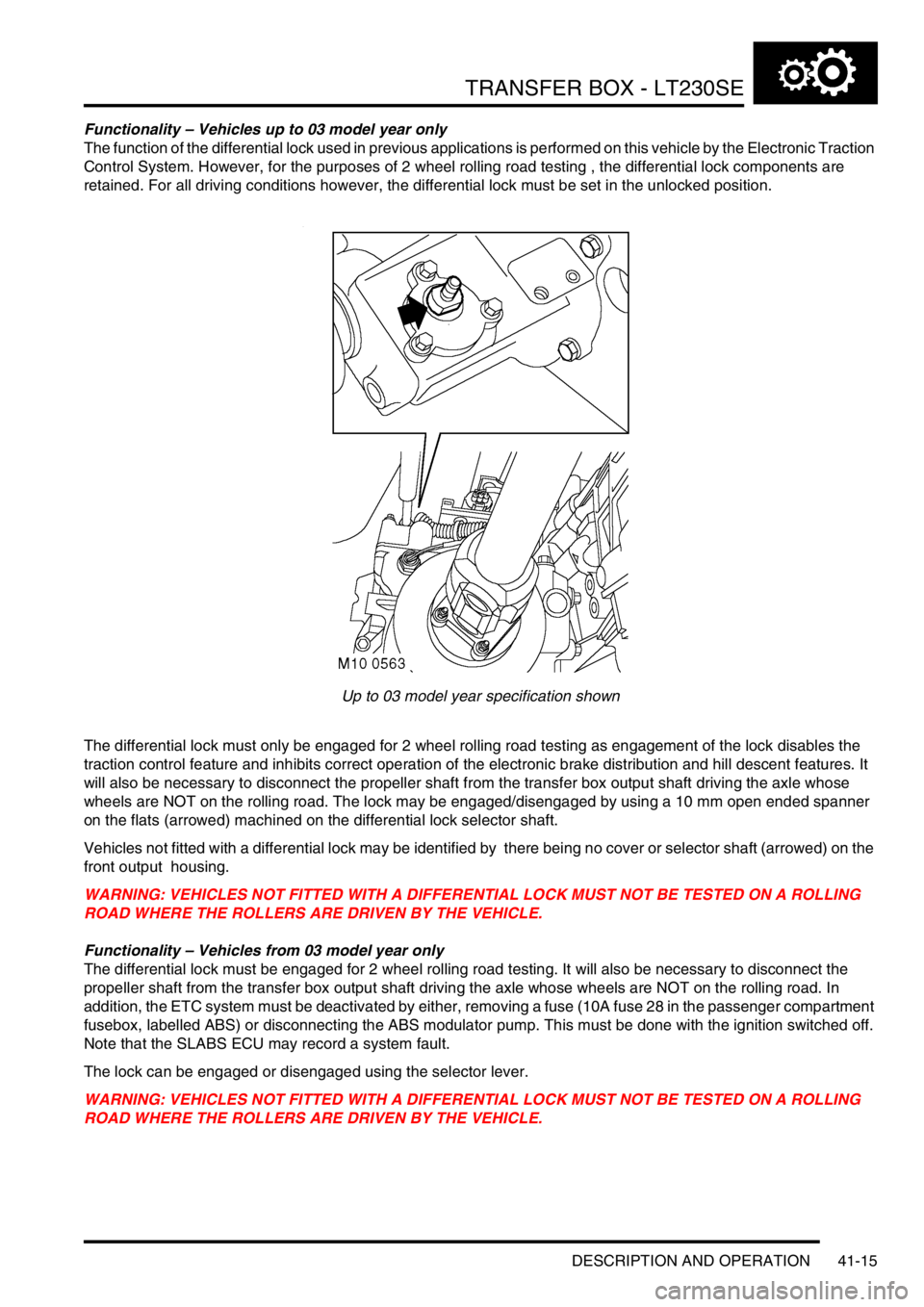
Up to 03 model year specification shown
The differential lock must only be engaged for 2 wheel rolling road testing as engagement of the lock disables the
traction control feature and inhibits correct operation of the electronic brake distribution and hill descent features. It
will also be necessary to disconnect the propeller shaft from the transfer box output shaft driving the axle whose
wheels are NOT on the rolling road. The lock may be engaged/disengaged by using a 10 mm open ended spanner
on the flats (arrowed) machined on the differential lock selector shaft.
Vehicles not fitted with a differential lock may be identified by there being no cover or selector shaft (arrowed) on the
front output housing.
WARNING: VEHICLES NOT FITTED WITH A DIFFERENTIAL LOCK MUST NOT BE TESTED ON A ROLLING
ROAD WHERE THE ROLLERS ARE DRIVEN BY THE VEHICLE.
Functionality – Vehicles from 03 model year only
The differential lock must be engaged for 2 wheel rolling road testing. It will also be necessary to disconnect the
propeller shaft from the transfer box output shaft driving the axle whose wheels are NOT on the rolling road. In
addition, the ETC system must be deactivated by either, removing a fuse (10A fuse 28 in the passenger compartment
fusebox, labelled ABS) or disconnecting the ABS modulator pump. This must be done with the ignition switched off.
Note that the SLABS ECU may record a system fault.
The lock can be engaged or disengaged using the selector lever.
WARNING: VEHICLES NOT FITTED WITH A DIFFERENTIAL LOCK MUST NOT BE TESTED ON A ROLLING
ROAD WHERE THE ROLLERS ARE DRIVEN BY THE VEHICLE.
Page 604 of 1529

AUTOMATIC GEARBOX - ZF4HP22 - 24
DESCRIPTION AND OPERATION 44-7
The gearbox consists of a torque converter housing, an intermediate plate, a gearbox housing and a rear extension
housing, bolted together in series. The rear of the gearbox is supported by a rubber mounting installed between a
mounting bracket on the gearbox and the LH chassis rail. A heat shield is installed on the mounting to protect it from
the exhaust.
Sectioned view of gearbox
1Lock-up clutch
2Impeller
3Turbine
4Forward drive clutch
5Reverse drive clutch
6Brake clutch
7Brake clutch
8Brake clutch
9Epicyclic gear set10Epicyclic gear set
11Clutch
12Brake clutch
13Output shaft
14Freewheel (one way clutch)
15Freewheel (one way clutch)
16Freewheel (one way clutch)
17Stator and one way clutch
Torque converter housing
The torque converter housing attaches the gearbox to the engine and contains the torque converter. Different torque
converter housings are used to accommodate the difference between the V8 and Td5 engine interfaces. The torque
converter is connected to the engine drive plate and transmits the drive from the engine to the gearbox input shaft.
When engaged, a hydraulic lock-up clutch in the torque converter prevents slippage, to give a direct drive from the
engine to the gearbox for improved driving response.
Intermediate plate
The intermediate plate supports the gearbox input shaft and provides the interface between the transmission fluid
pump and the lubrication circuit. The pump attaches to the front of the intermediate plate and is driven by the impeller
in the torque converter. The pump pressurises transmission fluid drawn from the sump on the gearbox housing. The
pressurised fluid then circulates through the torque converter and gearbox housing components for cooling,
lubrication and gear shift purposes. Ports around the outer periphery of the intermediate plate provide the inlet and
outlet connections to the fluid cooler and a pressure take-off point for servicing.
Page 607 of 1529

AUTOMATIC GEARBOX - ZF4HP22 - 24
44-10 DESCRIPTION AND OPERATION
The lock-up and brake clutches are operated by pressurised transmission fluid from the valve block in the sump. A
manual valve and four solenoid valves, also known as Motorised Valves (MV), control the supply of pressurised
transmission fluid from the valve block:
lThe manual valve controls the supply in P, R, N and D.
lSolenoid valves MV 1 and MV 2 control the supplies that operate the brake clutches for shift control.
lSolenoid valve MV 3 controls the supply that operates the lock-up clutch.
lSolenoid valve MV 4 modulates the pressure of the supplies to the brake clutches, to control shift quality.
Operation of the manual valve is controlled by the selector lever assembly. In the gearbox, a selector shaft engages
with the manual valve. The selector shaft is connected to the selector lever assembly via the selector cable and a
selector lever on the left side of the gearbox. The selector shaft also operates a mechanism that locks the output shaft
when P is selected.
Operation of the solenoid valves is controlled by the EAT ECU.
An output shaft speed sensor in the gearbox housing outputs a signal to the EAT ECU. The EAT ECU compares
output shaft speed with engine speed to determine the engaged gear, and output shaft speed with vehicle speed to
confirm the range selected on the transfer box.
A bayonet lock electrical connector in the gearbox casing, to the rear of the selector lever, connects the solenoid
valves and the output shaft speed sensor to the vehicle wiring.
A pressed steel sump encloses the valve block and collects transmission fluid draining from the gearbox housing. A
suction pipe and filter on the underside of the valve block connect to the inlet side of the fluid pump. A magnet is
installed in the sump to collect any magnetic particles that may be present. A level plug and a drain plug are installed
in the sump for servicing.
Rear extension housing
The rear extension housing provides the interface between the gearbox housing and the transfer box. A splined
extension shaft, secured to the gearbox output shaft by a bolt, transmits the drive from the gearbox to the transfer
box. A seal in the rear of the housing prevents leakage past the extension shaft. A breather pipe, attached to the left
side of the rear extension housing, ventilates the interior of the gearbox and rear extension housings to atmosphere.
The open end of the breather pipe is located in the engine compartment at the right front corner of the engine sump
on gearboxes fitted to early vehicles and is clipped to the top of the gearbox on later vehicles.
Gearbox power flows
The following Figures show the power flow through the gearbox for each forward gear when D is selected, and for
reverse. The key to the Item numbers on the Figures, and in parenthesis in the accompanying text, can be found on
the 'Sectioned view of gearbox' Figure, above.
1st Gear (D selected)
Clutches (4) and (11) are engaged. The front planet gear carrier of gear set (9) locks against the gearbox housing
through freewheel (15) when the engine powers the vehicle, and freewheels when the vehicle is coasting. Gear set
(10) rotates as a solid unit with the front planet gear carrier. In 1st gear hold brake clutch (8) is applied to provide
overrun braking.
Page 608 of 1529

AUTOMATIC GEARBOX - ZF4HP22 - 24
DESCRIPTION AND OPERATION 44-11
2nd Gear (D selected)
Clutches (4), (6), (7) and (11) are engaged. Freewheel (15) overruns. The hollow shaft with the sun wheel of gear set
(9) is locked. Gear set (10) also rotates as a solid unit.
3rd Gear (D selected)
Clutches (4), (5), (7) and (11) are engaged. Freewheels (15) and (16) are overrun. Gear sets (9) and (10) rotate as a
solid unit.
4th Gear (D selected)
Clutches (4), (5), (7) and (12) are engaged. Freewheels (14), (15) and (16) are overrun. Gear set (9) rotates as a solid
unit. The hollow shaft with the sun wheel of gear set (10) is locked.
Page 618 of 1529

AUTOMATIC GEARBOX - ZF4HP22 - 24
ADJUSTMENTS 44-21
ADJUST ME NTS
Cable - selector
$% 44.30.04
Check
1.Position vehicle on ramp.
2.Select position 'P'.
3.Loosen selector cable trunnion nut.
4.Ensure that gearbox selector lever is in 'P'
position, (fully forward) and tighten trunnion
nut.
5.Lower ramp.
Stall test
$% 44.30.13
Testing
1.Chock the wheels and fully apply the
handbrake.
2.Start the engine and run it until it reaches
normal operating temperature.
3.Apply the footbrake and select 'D'.
4.Fully depress the accelerator pedal and note
the tachometer reading. The figures should be
as given below. Do not carry out stall test for
longer than 10 seconds, and DO NOT repeat
until 30 minutes have elapsed.
lV8: 2200 to 2400 rev/min
lDiesel: 2600 to 2800 rev/min
5.A reading below 1300 rev/min indicates a
torque converter fault, ie stator free-wheel.
6.A reading between 1300 and 2200 rev/min (V8)
or between 1300 and 2600 rev/min (Diesel)
indicates reduced engine power.
7.A reading above 2400 rev/min (V8) or above
2800 rev/min (Diesel) indicates clutch slip.
NOTE: The figures quoted above were
measured at sea level with an ambient
temperature of 20
°C (68°F). At higher altitudes
or higher ambient temperatures, these figures
will be reduced.