oil change LAND ROVER DISCOVERY 2002 User Guide
[x] Cancel search | Manufacturer: LAND ROVER, Model Year: 2002, Model line: DISCOVERY, Model: LAND ROVER DISCOVERY 2002Pages: 1672, PDF Size: 46.1 MB
Page 233 of 1672
ENGINE - TD5
12-1-94 OVERHAUL
15.Remove bolt and remove timing chain
adjustable guide.
16.Remove bolt and remove timing chain
lubrication jet.
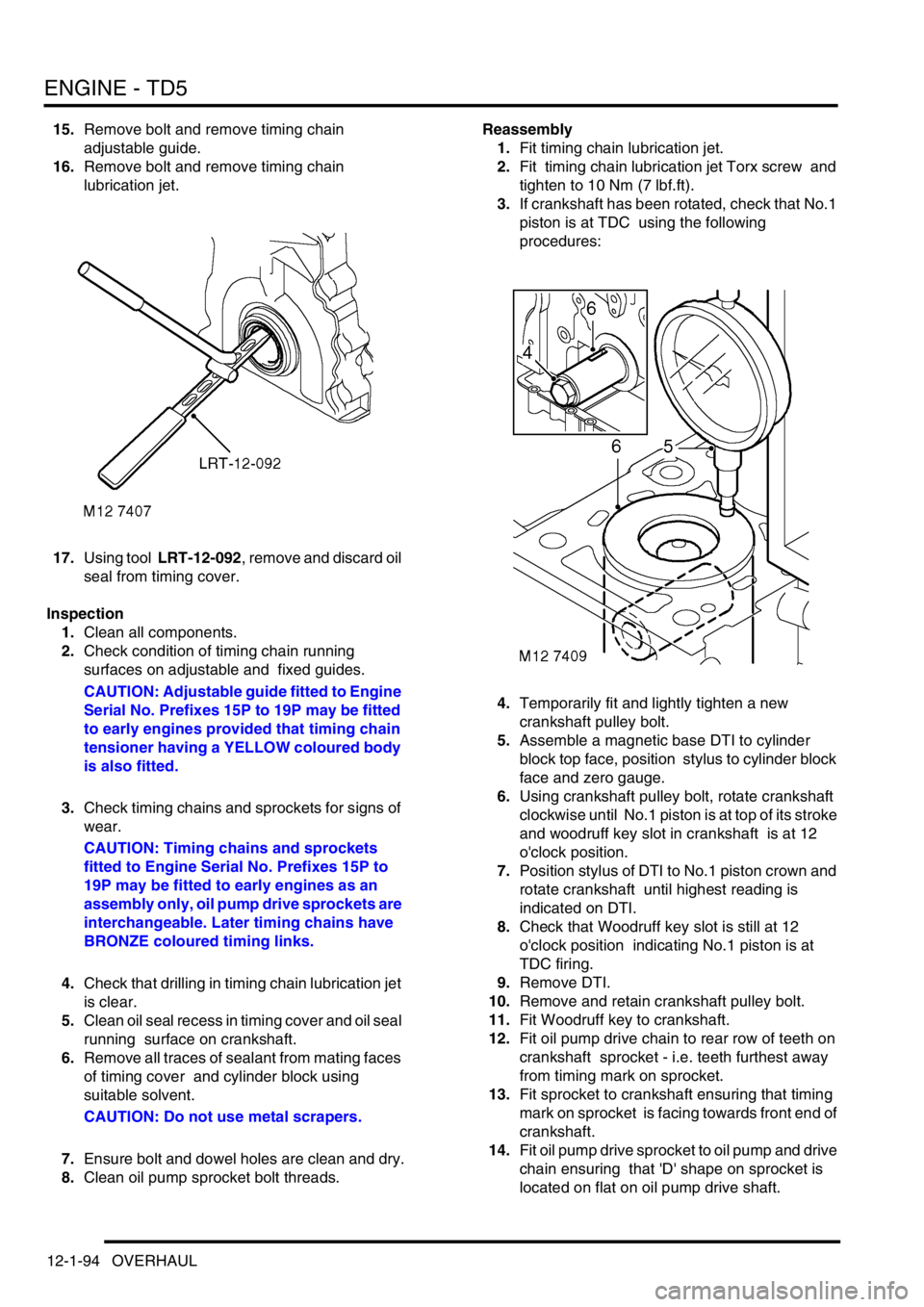
17.Using tool LRT-12-092, remove and discard oil
seal from timing cover.
Inspection
1.Clean all components.
2.Check condition of timing chain running
surfaces on adjustable and fixed guides.
CAUTION: Adjustable guide fitted to Engine
Serial No. Prefixes 15P to 19P may be fitted
to early engines provided that timing chain
tensioner having a YELLOW coloured body
is also fitted.
3.Check timing chains and sprockets for signs of
wear.
CAUTION: Timing chains and sprockets
fitted to Engine Serial No. Prefixes 15P to
19P may be fitted to early engines as an
assembly only, oil pump drive sprockets are
interchangeable. Later timing chains have
BRONZE coloured timing links.
4.Check that drilling in timing chain lubrication jet
is clear.
5.Clean oil seal recess in timing cover and oil seal
running surface on crankshaft.
6.Remove all traces of sealant from mating faces
of timing cover and cylinder block using
suitable solvent.
CAUTION: Do not use metal scrapers.
7.Ensure bolt and dowel holes are clean and dry.
8.Clean oil pump sprocket bolt threads.Reassembly
1.Fit timing chain lubrication jet.
2.Fit timing chain lubrication jet Torx screw and
tighten to 10 Nm (7 lbf.ft).
3.If crankshaft has been rotated, check that No.1
piston is at TDC using the following
procedures:
4.Temporarily fit and lightly tighten a new
crankshaft pulley bolt.
5.Assemble a magnetic base DTI to cylinder
block top face, position stylus to cylinder block
face and zero gauge.
6.Using crankshaft pulley bolt, rotate crankshaft
clockwise until No.1 piston is at top of its stroke
and woodruff key slot in crankshaft is at 12
o'clock position.
7.Position stylus of DTI to No.1 piston crown and
rotate crankshaft until highest reading is
indicated on DTI.
8.Check that Woodruff key slot is still at 12
o'clock position indicating No.1 piston is at
TDC firing.
9.Remove DTI.
10.Remove and retain crankshaft pulley bolt.
11.Fit Woodruff key to crankshaft.
12.Fit oil pump drive chain to rear row of teeth on
crankshaft sprocket - i.e. teeth furthest away
from timing mark on sprocket.
13.Fit sprocket to crankshaft ensuring that timing
mark on sprocket is facing towards front end of
crankshaft.
14.Fit oil pump drive sprocket to oil pump and drive
chain ensuring that 'D' shape on sprocket is
located on flat on oil pump drive shaft.
Page 239 of 1672
ENGINE - TD5
12-1-100 OVERHAUL
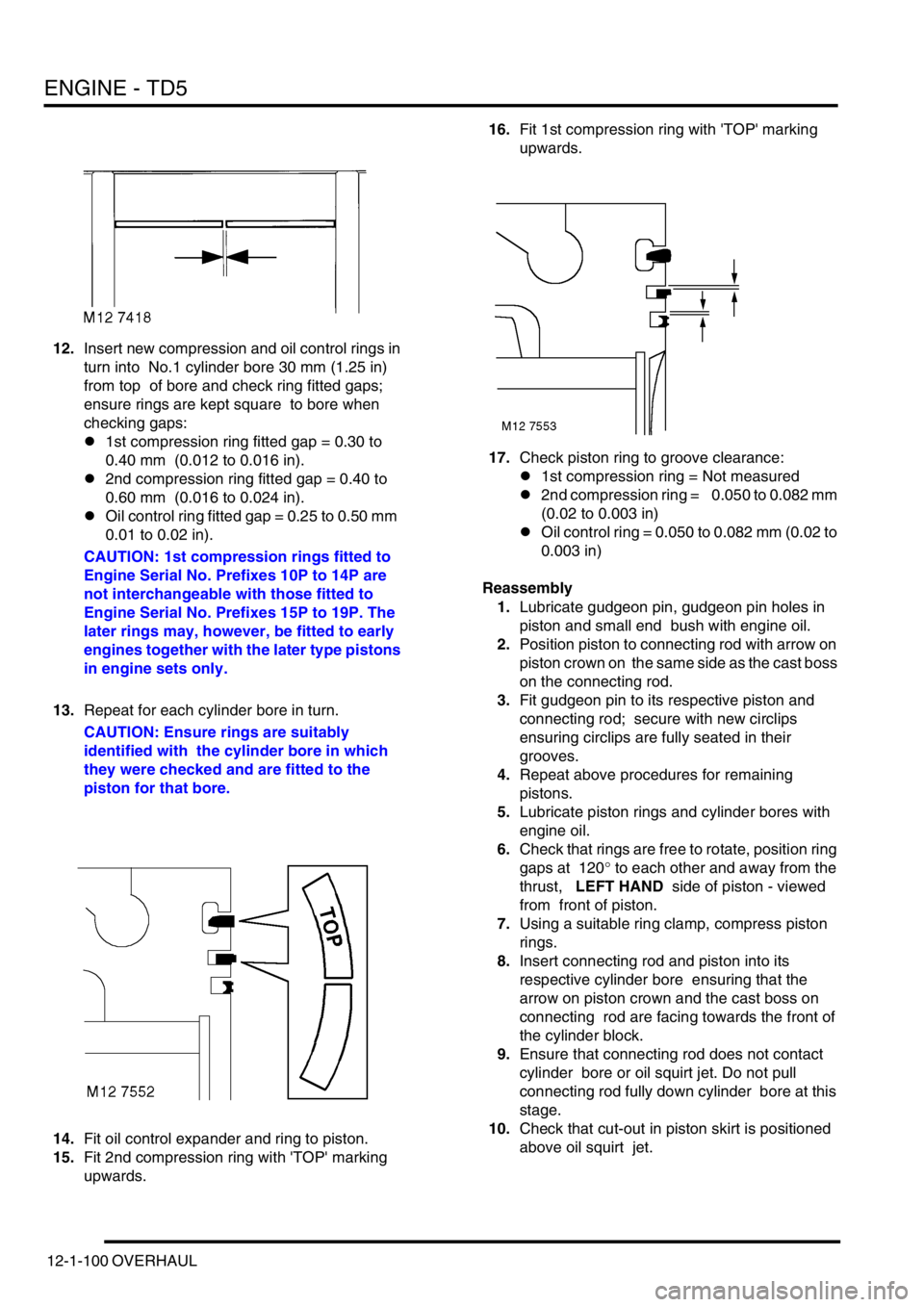
12.Insert new compression and oil control rings in
turn into No.1 cylinder bore 30 mm (1.25 in)
from top of bore and check ring fitted gaps;
ensure rings are kept square to bore when
checking gaps:
l1st compression ring fitted gap = 0.30 to
0.40 mm (0.012 to 0.016 in).
l2nd compression ring fitted gap = 0.40 to
0.60 mm (0.016 to 0.024 in).
lOil control ring fitted gap = 0.25 to 0.50 mm
0.01 to 0.02 in).
CAUTION: 1st compression rings fitted to
Engine Serial No. Prefixes 10P to 14P are
not interchangeable with those fitted to
Engine Serial No. Prefixes 15P to 19P. The
later rings may, however, be fitted to early
engines together with the later type pistons
in engine sets only.
13.Repeat for each cylinder bore in turn.
CAUTION: Ensure rings are suitably
identified with the cylinder bore in which
they were checked and are fitted to the
piston for that bore.
14.Fit oil control expander and ring to piston.
15.Fit 2nd compression ring with 'TOP' marking
upwards. 16.Fit 1st compression ring with 'TOP' marking
upwards.
17.Check piston ring to groove clearance:
l1st compression ring = Not measured
l2nd compression ring = 0.050 to 0.082 mm
(0.02 to 0.003 in)
lOil control ring = 0.050 to 0.082 mm (0.02 to
0.003 in)
Reassembly
1.Lubricate gudgeon pin, gudgeon pin holes in
piston and small end bush with engine oil.
2.Position piston to connecting rod with arrow on
piston crown on the same side as the cast boss
on the connecting rod.
3.Fit gudgeon pin to its respective piston and
connecting rod; secure with new circlips
ensuring circlips are fully seated in their
grooves.
4.Repeat above procedures for remaining
pistons.
5.Lubricate piston rings and cylinder bores with
engine oil.
6.Check that rings are free to rotate, position ring
gaps at 120
° to each other and away from the
thrust, LEFT HAND side of piston - viewed
from front of piston.
7.Using a suitable ring clamp, compress piston
rings.
8.Insert connecting rod and piston into its
respective cylinder bore ensuring that the
arrow on piston crown and the cast boss on
connecting rod are facing towards the front of
the cylinder block.
9.Ensure that connecting rod does not contact
cylinder bore or oil squirt jet. Do not pull
connecting rod fully down cylinder bore at this
stage.
10.Check that cut-out in piston skirt is positioned
above oil squirt jet.
Page 379 of 1672

EMISSION CONTROL - V8
17-2-42 DESCRIPTION AND OPERATION
Secondary air injection system
When the engine is started, the engine control module checks the engine coolant temperature and if it is below 55°
C, the ECM grounds the electrical connection to the coil of the secondary air injection (SAI) pump relay.
A 12V battery supply is fed to the inertia switch via fuse 13 in the engine compartment fusebox. When the inertia
switch contacts are closed, the feed passes through the switch and is connected to the coil of the Main relay. An earth
connection from the Main relay coil is connected to the ECM. When the ECM completes the earth path, the coil
energises and closes the contacts of the Main relay.
The Main and Secondary Air Injection (SAI) pump relays are located in the engine compartment fusebox. When the
contacts of the Main relay are closed, a 12V battery supply is fed to the coil of the SAI pump relay. An earth connection
from the coil of the SAI pump relay is connected to the ECM. When the ECM completes the earth path, the coil
energises and closes the contacts of the SAI pump relay to supply 12V to the SAI pump via fusible link 2 in the engine
compartment fusebox. The SAI pump starts to operate, and will continue to do so until the ECM switches off the earth
connection to the coil of the SAI pump relay.
The SAI pump remains operational for a period determined by the ECM and depends on the starting temperature of
the engine, or for a maximum operation period determined by the ECM if the target engine coolant temperature has
not been reached in the usual time.
When the contacts of the main relay are closed, a 12V battery supply is fed to the SAI solenoid valve via Fuse 2 in
the engine compartment fusebox.
The ECM grounds the electrical connection to the SAI vacuum solenoid valve at the same time as it switches on the
SAI pump motor. When the SAI vacuum solenoid valve is energised, a vacuum is provided to the operation control
ports on both of the vacuum operated SAI control valves at the exhaust manifolds. The control vacuum is sourced
from the intake manifold depression and routed to the SAI control valves via a vacuum reservoir and the SAI vacuum
solenoid valve.
The vacuum reservoir is included in the vacuum supply circuit to prevent vacuum fluctuations caused by changes in
the intake manifold depression affecting the operation of the SAI control valves.
When a vacuum is applied to the control ports of the SAI control valves, the valves open to allow pressurised air from
the SAI pump to pass through to the exhaust ports in the cylinder heads for combustion.
When the ECM has determined that the SAI pump has operated for the desired duration, it switches off the earth paths
to the SAI pump relay and the SAI vacuum solenoid valve. With the SAI vacuum solenoid valve de-energised, the
valve closes, cutting off the vacuum supply to the SAI control valves. The SAI control valves close immediately and
completely to prevent any further pressurised air from the SAI pump entering the exhaust manifolds.
The engine coolant temperature sensor incurs a time lag in respect of detecting a change in temperature and the SAI
pump automatically enters a 'soak period' between operations to prevent the SAI pump overheating. The ECM also
compares the switch off and start up temperatures, to determine whether it is necessary to operate the SAI pump.
This prevents the pump running repeatedly and overheating on repeat starts.
Other factors which may prevent or stop SAI pump operation include the prevailing engine speed / load conditions.
Page 426 of 1672

ENGINE MANAGEMENT SYSTEM - TD5
DESCRIPTION AND OPERATION 18-1-33
The turbocharger is exposed to extremely high operating temperatures (up to 1,000 °C (1832 °F)) because of the hot
exhaust gases and the high speed revolution of the turbine (up to 150,000 rev/min). In order to resist wear of the
turbine bearings a flow of lubrication oil is supplied from the engine lubrication system to keep the bearings cool. Oil
is supplied from a tapping at the front of the full-flow filter adaptor housing via a metal pipe with banjo connections.
Oil is returned to the sump via a metal pipe which connects to the cylinder block at a port below the turbocharger
assembly.
A heatshield is attached to the left hand side of the engine to protect adjacent components from the heat generated
at the turbocharger. The heatshield is attached to the engine by two bolts an additional bolt attaches the heatshield
to the turbocharger casting.
The engine control module controls the amount of boost pressure the engine receives by way of the turbocharger.
When full boost is reached a control signal is sent to the wastegate modulator, and a vacuum is applied to the
wastegate valve. The wastegate valve opens, bypassing some of the exhaust gas away from the turbine to be output
to the exhaust system.
The engine should be allowed to idle for 15 seconds following engine start up and before the engine is switched off
to protect the turbocharger by maintaining oil supply to the turbine bearings.
Intercooler
The intercooler is an air-to-air heat exchanger which lowers the intake air temperature to obtain a higher air density
for better combustion efficiency. The intercooler receives compressed air from the turbocharger via a metal pipe; it
cools the intake air via the intercooler matrix and delivers it to the intake manifold by means of a rubber hose which
connects between the intercooler outlet and the intake manifold outlet. The rubber hose is connected to ports at each
end by metal band clips.
+ COOLING SYSTEM - Td5, DESCRIPTION AND OPERATION, Description.
The intercooler is located at the front of the engine bay, forward of the radiator.
Page 502 of 1672

ENGINE MANAGEMENT SYSTEM - V8
DESCRIPTION AND OPERATION 18-2-45
Ignition timing
The ignition timing is an important part of the ECM adaptive strategy. Ignition is controlled by a direct ignition system
using two four-ended coils operating on the wasted spark principle.
When the ECM triggers an ignition coil to spark, current from the coil travels to one spark plug, then jumps the gap at
the spark plug electrodes, igniting the mixture in the cylinder in the process. Current continues to travel along the earth
path (via the cylinder head) to the spark plug negative electrode at the cylinder that is on the exhaust stroke. The
current jumps across the spark plug electrodes and back to the coil completing the circuit. Since it has simultaneously
sparked in a cylinder that is on the exhaust stroke, it has not provided an ignition source there and is consequently
termed 'wasted'.
Conditions
The ECM calculates ignition timing using input from the following:
lCKP sensor.
lKnock sensors (KS).
lMAF sensor.
lTP sensor (idle only).
lECT sensor.
Function
At engine start up, the ECM sets ignition timing dependent on ECT information and starting rev/min from the CKP. As
the running characteristics of the engine change, the ignition timing changes. The ECM compares the CKP signal to
stored values in its memory, and if necessary advances or retards the spark via the ignition coils.
Ignition timing is used by the ECM for knock control.
Knock control
The ECM uses active knock control to prevent possible engine damage due to pre-ignition. This is achieved by
converting engine block noise into a suitable electrical signal that can be processed by the ECM. A major contributing
factor to engine 'knock' is fuel quality, the ECM can function satisfactorily on 91 RON fuel as well as the 95 RON fuel
that it is calibrated for.
Conditions
The ECM knock control system operates as follows:
lHot running engine.
l91 or 95 RON fuel.
Function
The ECM knock control uses two sensors located one between the centre two cylinders of each bank. The knock
sensors consist of piezo ceramic crystals that oscillate to create a voltage signal. During pre-ignition, the frequency
of crystal oscillation increases which alters the signal output to the ECM.
If the knock sensors detect pre-ignition in any of the cylinders, the ECM retards the ignition timing by 3
° for that
particular cylinder. If this action stops the engine knock, the ignition timing is restored to its previous figure in
increments of 0.75
°. If this action does not stop engine knock then the ECM retards the ignition timing a further 3° up
to a maximum of -15
° and then restores it by 0.75° and so on until the engine knock is eliminated.
The ECM also counteracts engine knock at high intake air temperatures by retarding the ignition as above. The ECM
uses the IAT signal to determine air temperature.
Page 590 of 1672
COOLING SYSTEM - TD5
DESCRIPTION AND OPERATION 26-1-7
Pipes and hoses
The coolant circuit comprises flexible hoses and metal formed pipes which direct the coolant into and out of the
engine, radiator and heater matrix. Plastic pipes are used for the bleed and overflow pipes to the expansion tank.
A bleed screw is installed in the radiator top hose and is used to bleed air during system filling. A drain plug to drain
the heater and cylinder block circuit of coolant is located on the underside of the coolant pump feed pipe.
Oil cooler
The oil cooler is located on the left hand side of the engine block behind the oil centrifuge and oil filter. Oil from the oil
pump is passed through a heat exchanger which is surrounded by coolant in a housing on the side of the engine.
Full water pump flow is directed along the cooler housing which also distributes the flow evenly along the block into
three core holes for cylinder cooling. This cools the engine oil before it is passed into the engine. A small percentage
of the coolant from the oil cooler passes into a metal pipe behind the engine. It then flows into the lower radiator via
a hose.
Fuel cooler
The fuel cooler is located on the right hand side of the engine and is attached to the inlet manifold. The cooler is
cylindrical in design and has a coolant feed connection at its forward end. A 'T' connection at the rear of the cooler
provides a connection for the coolant return from the heater matrix and coolant return from the fuel cooler.
The 'T' connection houses a thermostat which opens at approximately 82
°C. This prevents the cooler operating in
cold climates.
Two quick release couplings on the cooler allow for the connection of the fuel feed from the pressure regulator and
return to the fuel tank. A counter flow system is used within the cooler.
Fuel flows around a coolant jacket within the cooler and flows from the back to the front of the cooler. As the hot fuel
cools travelling slowly forwards it meets progressively colder coolant travelling in the opposite direction maintaining a
differential cooling effect.
EGR Cooler
The EGR Cooler is mounted on the front of the cylinder head. Coolant from the oil cooler flows around the EGR cooler,
cooling the exhaust gas, to improve exhaust emissions, before being returned to the expansion tank.
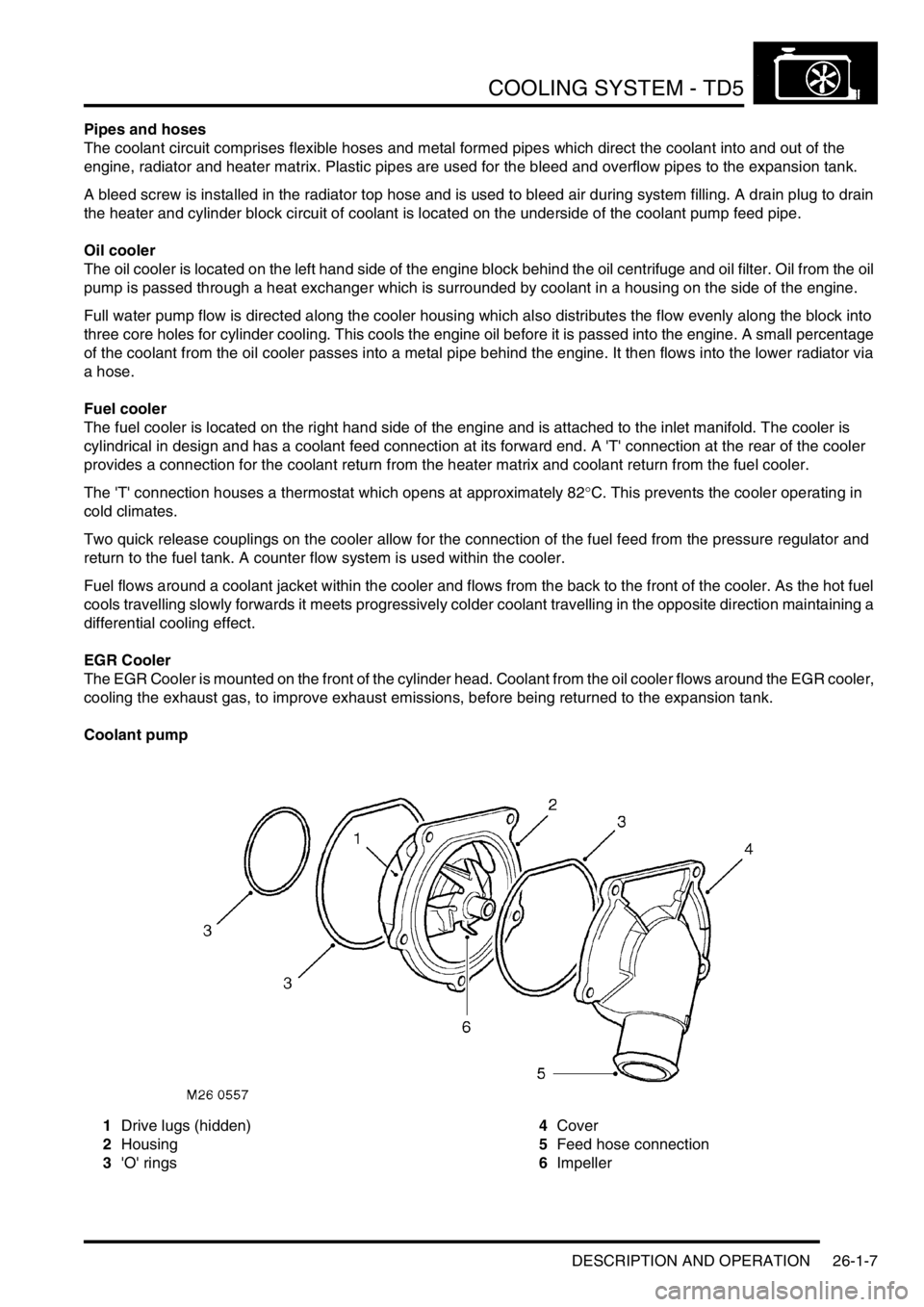
Coolant pump
1Drive lugs (hidden)
2Housing
3'O' rings4Cover
5Feed hose connection
6Impeller
Page 593 of 1672

COOLING SYSTEM - TD5
26-1-10 DESCRIPTION AND OPERATION
Operation
Coolant flow - Engine warm up
Refer to illustration.
+ COOLING SYSTEM - Td5, DESCRIPTION AND OPERATION, Cooling system coolant flow.
During warm up the coolant pump moves fluid through the cylinder block and it emerges from the outlet housing. From
the outlet housing, the warm coolant flow is prevented from flowing through the upper and lower radiators because
both thermostats are closed. The coolant is directed into the heater circuit.
Some coolant from the by-pass pipe can pass through small sensing holes in the flow valve. The warm coolant enters
a tube in the thermostat housing and surrounds 90% of the thermostat sensitive area. Cold coolant returning from the
radiator bottom hose conducts through 10% of the thermostat sensitive area. In cold ambient temperatures the engine
temperature can be raised by up to 10
°C (50°F) to compensate for the heat loss of the 10% exposure to the cold
coolant return from the radiator bottom hose.
At engine speeds below 1500 rev/min, the by-pass valve is closed only allowing the small flow through the sensing
holes. As the engine speed increases above 1500 rev/min, the greater flow and pressure from pump overcomes the
light spring and opens the by-pass flow valve. The flow valve opens to meet the engine's cooling needs at higher
engine speeds and prevents excess pressure in the cooling system. With both thermostats closed, maximum flow is
directed through the heater circuit.
The heater matrix acts as a heat exchanger reducing the coolant temperature as it passes through the matrix. Coolant
emerges from the heater matrix and flows to the fuel cooler 'T' connection via the heater return hose. From the fuel
cooler the coolant is directed into the coolant pump feed pipe and recirculated around the heater circuit. In this
condition the cooling system is operating at maximum heater performance.
Coolant flow - Engine hot
As the coolant temperature increases the main thermostat opens. This allows some coolant from the outlet housing
to flow through the top hose and into the radiator to be cooled. The hot coolant flows from the left tank in the radiator,
along the tubes to the right tank. The air flowing through the fins between the tubes cools the coolant as it passes
through the radiator.
A controlled flow of the lower temperature coolant is drawn by the pump and blended with hot coolant from the by-
pass and the heater return pipes in the pump feed pipe. The pump then passes this coolant, via the cylinder block, to
the oil cooler housing, cooling the engine oil before entering the block to cool the cylinders.
When the fuel temperature increases, the heat from the fuel conducts through the fuel cooler 'T' connection and
causes the fuel thermostat to open.
Pre EU3 models: Coolant from the cylinder block flows through the oil cooler and via a pipe and hose enters the
lower radiator. The coolant in the lower radiator is subjected to an additional two passes through the lower radiator to
further reduce the coolant temperature. From the lower radiator the coolant flows , via a hose, to the fuel cooler.
As the hot fuel cools, travelling slowly forwards through the cooler, it meets the progressively colder coolant travelling
in the opposite direction from the lower radiator.
EU3 models: Coolant from the cylinder block flows through the oil cooler to the EGR cooler and then back to the
expansion tank. and via a pipe and hose enters the lower radiator. The lower temperature coolant from the oil cooler
housing is subjected to an additional two passes through the lower radiator to further reduce the coolant temperature.
From the lower radiator the coolant flows , via a hose, to the fuel cooler.
As the hot fuel cools, travelling slowly forwards through the cooler, it meets the progressively colder coolant travelling
in the opposite direction from the lower radiator.
Page 685 of 1672

MANUAL GEARBOX - R380
37-2 DESCRIPTION AND OPERATION
Gearbox casings, gear change and oil
pump
Page 686 of 1672

MANUAL GEARBOX - R380
DESCRIPTION AND OPERATION 37-3
1Front cover
2Input shaft oil seal
3Oil filler/level plug
4Sealing washer
5Oil drain plug
6Gear case
7Interlock spool retainer, bolt and 'O' ring
8Centre plate
9Locating dowels
10Selector plug, detent balls and spring
11Splash shield and retaining bolt
12Extension housing
13Gate plate and retaining bolt
14Interlock spool retainer, retaining bolt and 'O'
ring – if fitted – extension housing
15Inhibitor cam spring
16Inhibitor cam
17Reverse inhibitor shaft
18Output shaft oil seal
19Oil seal collar
20Oil pump and retaining bolt
21'O' ring
22Reverse lamp switch23Oil by-pass block - UK and European models
24Bolt - oil by-pass block
25'O' ring - oil by-pass block
26Thermostat and housing - non UK and non
European models
27'O' ring - thermostat housing
28Bolt - thermostat housing
29Oil pick-up pipe
30Oil filter
31Oil pick-up ring
32Rubber gaiter
33Cable tie
34Upper gear lever
35Clamp bolt
36Bias springs
37Bolts and washers - bias adjusting plate and
housing
38Bias adjusting plate
39Lower gear lever and ball
40Railko bush
41Oil seal
42Gear change housing
Page 689 of 1672

MANUAL GEARBOX - R380
37-6 DESCRIPTION AND OPERATION
R380 gearbox cross section
1Input shaft
2Breather
3Input shaft 4th gear
4Selector shaft
53rd/4th selector fork
6Output shaft 3rd gear
7Output shaft 2nd gear
81st/2nd selector fork
9Output shaft 1st gear
10Selective shims - output shaft and layshaft end-
float
11Selective shim - reverse gear idler shaft end-
float
125th/reverse selector fork
13Selector yoke
14Gear change assembly15Railko bush
16Output shaft 5th gear
17Output shaft oil seal
18Output shaft
19Oil pump
205th/reverse gear synchromesh assembly
21Output shaft reverse gear
22Centre plate
23Oil filter
241st/2nd synchromesh assembly
25Layshaft
263rd/4th gear synchromesh assembly
27Input shaft oil seal