oil change LAND ROVER DISCOVERY 2002 Owner's Manual
[x] Cancel search | Manufacturer: LAND ROVER, Model Year: 2002, Model line: DISCOVERY, Model: LAND ROVER DISCOVERY 2002Pages: 1672, PDF Size: 46.1 MB
Page 690 of 1672

MANUAL GEARBOX - R380
DESCRIPTION AND OPERATION 37-7
Description
General
The R380 all synchromesh gearbox has five forward speeds and reverse and is mounted in line with the engine. The
clutch bell housing is bolted to the front of the gearbox and the transfer box is mounted at the rear.
Gearbox casings
Gearbox casings consist of a front cover, gearcase, centre plate and extension housing. All casings with the exception
of the front cover are located to each other by dowels and sealed. Gearbox filler/level and drain plugs are located in
the gearcase.
Reverse lamp switch
A reverse lamp switch is inserted into the extension housing. Selection of reverse gear will close the switch allowing
current from fuse 25 to flow through the switch to illuminate the reverse lamps. The switch also provides a feed to the
BCU and the automatic interior mirror - if fitted; the mirror moving to the dimming position.
Gearchange assembly
The gearchange assembly is bolted to the top of the gearcase, the upper gear lever being attached to the lower gear
lever by means of a clamp bolt. The lower gear lever ball is housed in a Railko bush inserted in the gear change
housing, the end of the lever locating in the selector yoke which is attached to the end of the selector shaft. Bias
springs provide a positive return of the gear lever to the neutral position with selection of 1st/2nd and 5th/reverse gears
being against bias spring pressure. Spring loaded detent balls fitted in the centre plate locate in grooves in the selector
shaft to provide positive gear and neutral selection.
Lubrication
Lubrication is by an oil pump located in the extension housing and driven by the layshaft with additional lubrication
being provided by splash. The pump directs oil via a filter and internal drillings in the output shaft to lubricate the
components. On non UK and non European models, provision for oil cooling is by means of a thermostat housed in
a cover bolted to the side of the extension housing. The cover incorporates tappings for connections to an oil cooler.
On UK and European models, the thermostat and cover are replaced by an oil by-pass block.
Internal pressures produced within the gearbox are vented to atmosphere via a plastic breather pipe. The pipe is
attached to the extension housing and is routed across the top of the gearcase and secured at the open end by a clip
attached to the engine cylinder block.
Selector shaft and forks
Selector forks for 1st/2nd, 3rd/4th and 5th/reverse gears are located on a single selector shaft; the 1st/2nd and 3rd/
4th selector forks are inside the main gearcase whilst the 5th/reverse selector fork is inside the extension housing.
Each of the selector forks locates inside its corresponding synchromesh hub.
Synchromesh assemblies
Each synchromesh assembly is located on the output shaft adjacent to its corresponding gears and comprises a
synchromesh ring, hub, slippers and sleeve. The hubs and slippers are retained in the sleeves by means of spring
clips. 1st/2nd and 3rd synchromesh assemblies are fitted with double synchromesh rings whilst 4th, 5th and reverse
assemblies are fitted with single rings.
Page 698 of 1672
MANUAL GEARBOX - R380
REPAIRS 37-15
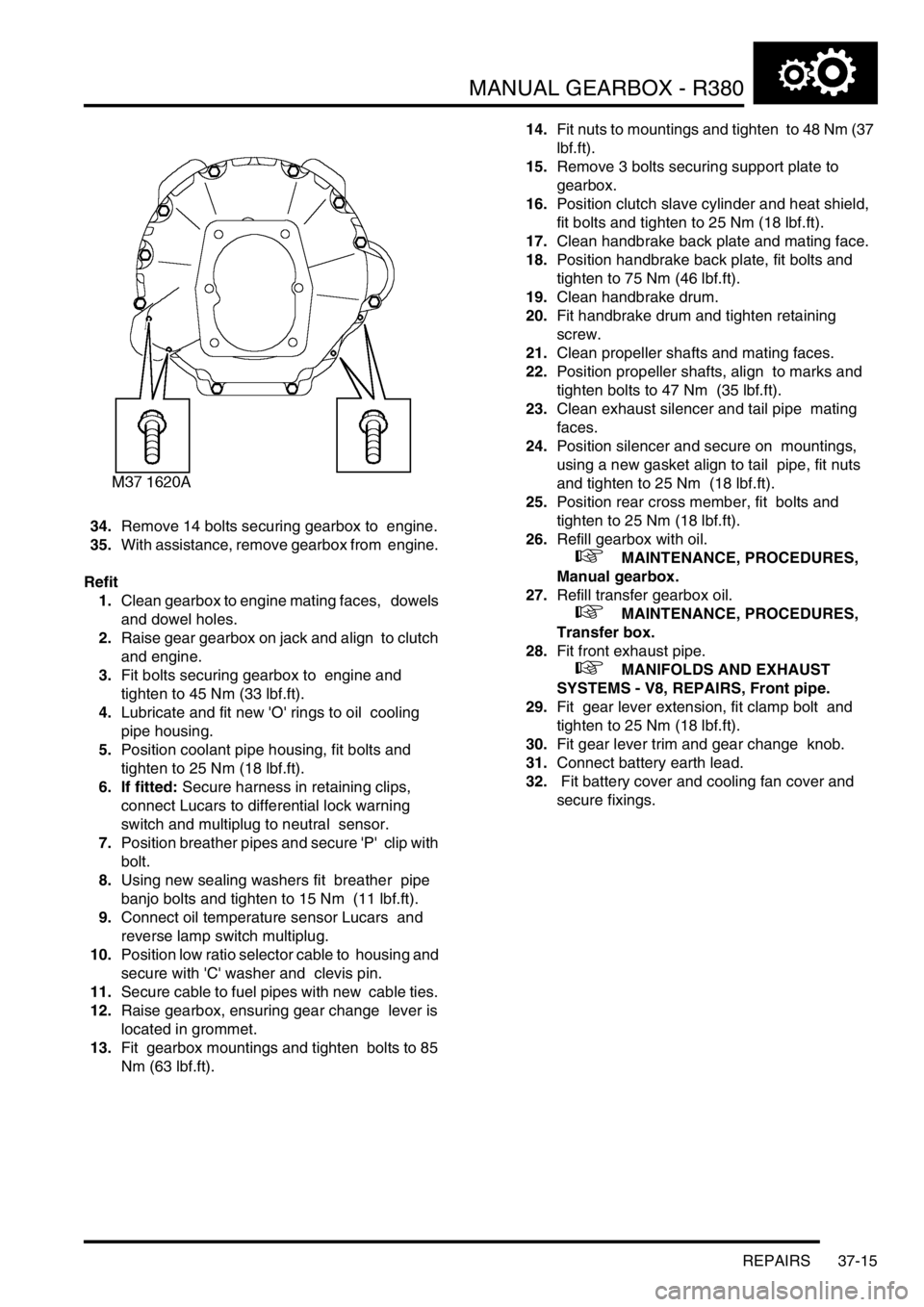
34.Remove 14 bolts securing gearbox to engine.
35.With assistance, remove gearbox from engine.
Refit
1.Clean gearbox to engine mating faces, dowels
and dowel holes.
2.Raise gear gearbox on jack and align to clutch
and engine.
3.Fit bolts securing gearbox to engine and
tighten to 45 Nm (33 lbf.ft).
4.Lubricate and fit new 'O' rings to oil cooling
pipe housing.
5.Position coolant pipe housing, fit bolts and
tighten to 25 Nm (18 lbf.ft).
6. If fitted: Secure harness in retaining clips,
connect Lucars to differential lock warning
switch and multiplug to neutral sensor.
7.Position breather pipes and secure 'P' clip with
bolt.
8.Using new sealing washers fit breather pipe
banjo bolts and tighten to 15 Nm (11 lbf.ft).
9.Connect oil temperature sensor Lucars and
reverse lamp switch multiplug.
10.Position low ratio selector cable to housing and
secure with 'C' washer and clevis pin.
11.Secure cable to fuel pipes with new cable ties.
12.Raise gearbox, ensuring gear change lever is
located in grommet.
13.Fit gearbox mountings and tighten bolts to 85
Nm (63 lbf.ft). 14.Fit nuts to mountings and tighten to 48 Nm (37
lbf.ft).
15.Remove 3 bolts securing support plate to
gearbox.
16.Position clutch slave cylinder and heat shield,
fit bolts and tighten to 25 Nm (18 lbf.ft).
17.Clean handbrake back plate and mating face.
18.Position handbrake back plate, fit bolts and
tighten to 75 Nm (46 lbf.ft).
19.Clean handbrake drum.
20.Fit handbrake drum and tighten retaining
screw.
21.Clean propeller shafts and mating faces.
22.Position propeller shafts, align to marks and
tighten bolts to 47 Nm (35 lbf.ft).
23.Clean exhaust silencer and tail pipe mating
faces.
24.Position silencer and secure on mountings,
using a new gasket align to tail pipe, fit nuts
and tighten to 25 Nm (18 lbf.ft).
25.Position rear cross member, fit bolts and
tighten to 25 Nm (18 lbf.ft).
26.Refill gearbox with oil.
+ MAINTENANCE, PROCEDURES,
Manual gearbox.
27.Refill transfer gearbox oil.
+ MAINTENANCE, PROCEDURES,
Transfer box.
28.Fit front exhaust pipe.
+ MANIFOLDS AND EXHAUST
SYSTEMS - V8, REPAIRS, Front pipe.
29.Fit gear lever extension, fit clamp bolt and
tighten to 25 Nm (18 lbf.ft).
30.Fit gear lever trim and gear change knob.
31.Connect battery earth lead.
32. Fit battery cover and cooling fan cover and
secure fixings.
Page 702 of 1672
MANUAL GEARBOX - R380
REPAIRS 37-19
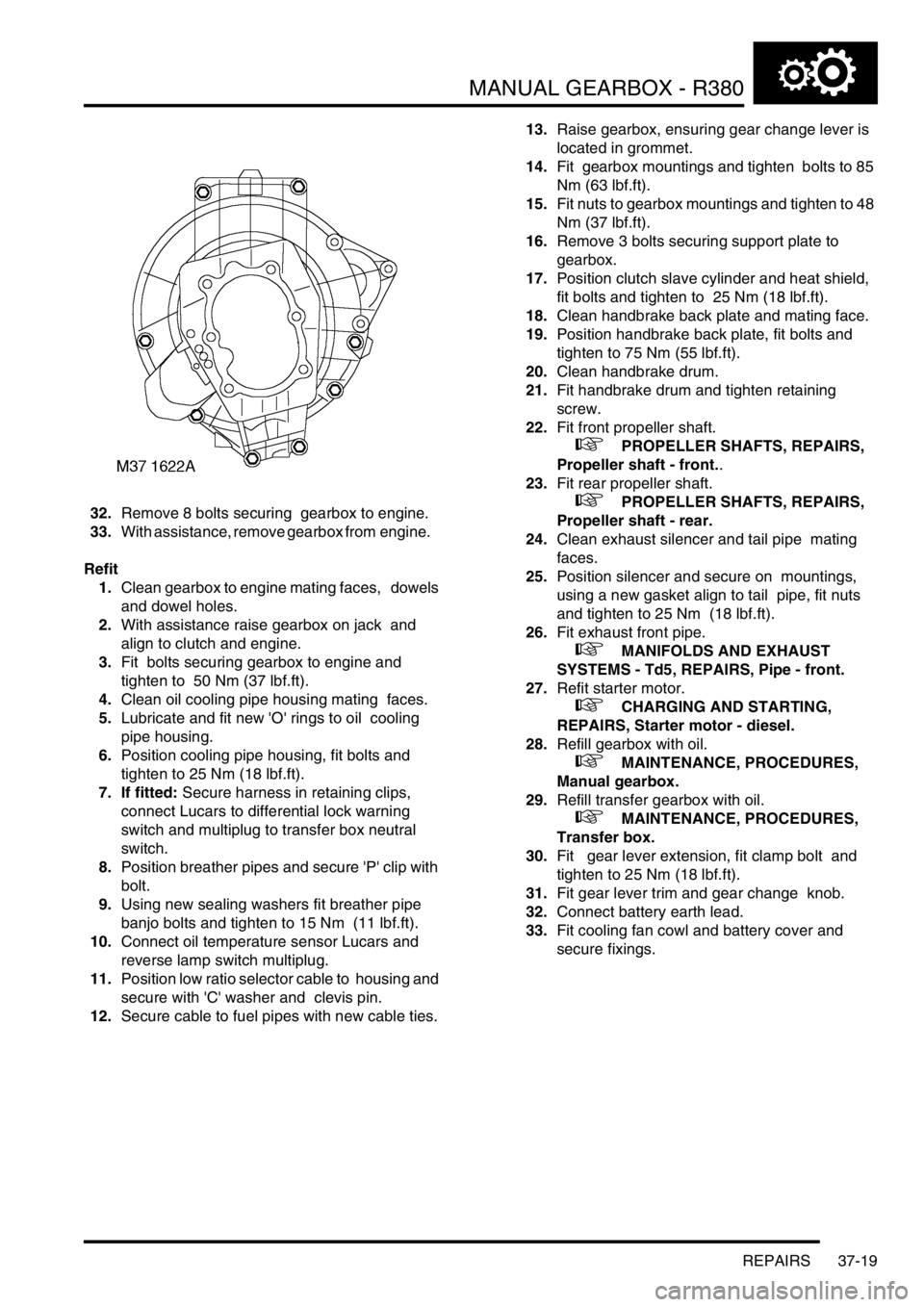
32.Remove 8 bolts securing gearbox to engine.
33.With assistance, remove gearbox from engine.
Refit
1.Clean gearbox to engine mating faces, dowels
and dowel holes.
2.With assistance raise gearbox on jack and
align to clutch and engine.
3.Fit bolts securing gearbox to engine and
tighten to 50 Nm (37 lbf.ft).
4.Clean oil cooling pipe housing mating faces.
5.Lubricate and fit new 'O' rings to oil cooling
pipe housing.
6.Position cooling pipe housing, fit bolts and
tighten to 25 Nm (18 lbf.ft).
7. If fitted: Secure harness in retaining clips,
connect Lucars to differential lock warning
switch and multiplug to transfer box neutral
switch.
8.Position breather pipes and secure 'P' clip with
bolt.
9.Using new sealing washers fit breather pipe
banjo bolts and tighten to 15 Nm (11 lbf.ft).
10.Connect oil temperature sensor Lucars and
reverse lamp switch multiplug.
11.Position low ratio selector cable to housing and
secure with 'C' washer and clevis pin.
12.Secure cable to fuel pipes with new cable ties. 13.Raise gearbox, ensuring gear change lever is
located in grommet.
14.Fit gearbox mountings and tighten bolts to 85
Nm (63 lbf.ft).
15.Fit nuts to gearbox mountings and tighten to 48
Nm (37 lbf.ft).
16.Remove 3 bolts securing support plate to
gearbox.
17.Position clutch slave cylinder and heat shield,
fit bolts and tighten to 25 Nm (18 lbf.ft).
18.Clean handbrake back plate and mating face.
19.Position handbrake back plate, fit bolts and
tighten to 75 Nm (55 lbf.ft).
20.Clean handbrake drum.
21.Fit handbrake drum and tighten retaining
screw.
22.Fit front propeller shaft.
+ PROPELLER SHAFTS, REPAIRS,
Propeller shaft - front..
23.Fit rear propeller shaft.
+ PROPELLER SHAFTS, REPAIRS,
Propeller shaft - rear.
24.Clean exhaust silencer and tail pipe mating
faces.
25.Position silencer and secure on mountings,
using a new gasket align to tail pipe, fit nuts
and tighten to 25 Nm (18 lbf.ft).
26.Fit exhaust front pipe.
+ MANIFOLDS AND EXHAUST
SYSTEMS - Td5, REPAIRS, Pipe - front.
27.Refit starter motor.
+ CHARGING AND STARTING,
REPAIRS, Starter motor - diesel.
28.Refill gearbox with oil.
+ MAINTENANCE, PROCEDURES,
Manual gearbox.
29.Refill transfer gearbox with oil.
+ MAINTENANCE, PROCEDURES,
Transfer box.
30.Fit gear lever extension, fit clamp bolt and
tighten to 25 Nm (18 lbf.ft).
31.Fit gear lever trim and gear change knob.
32.Connect battery earth lead.
33.Fit cooling fan cowl and battery cover and
secure fixings.
Page 730 of 1672
MANUAL GEARBOX - R380
OVERHAUL 37-47
Lever - gear change
$% 37.16.04
Disassembly
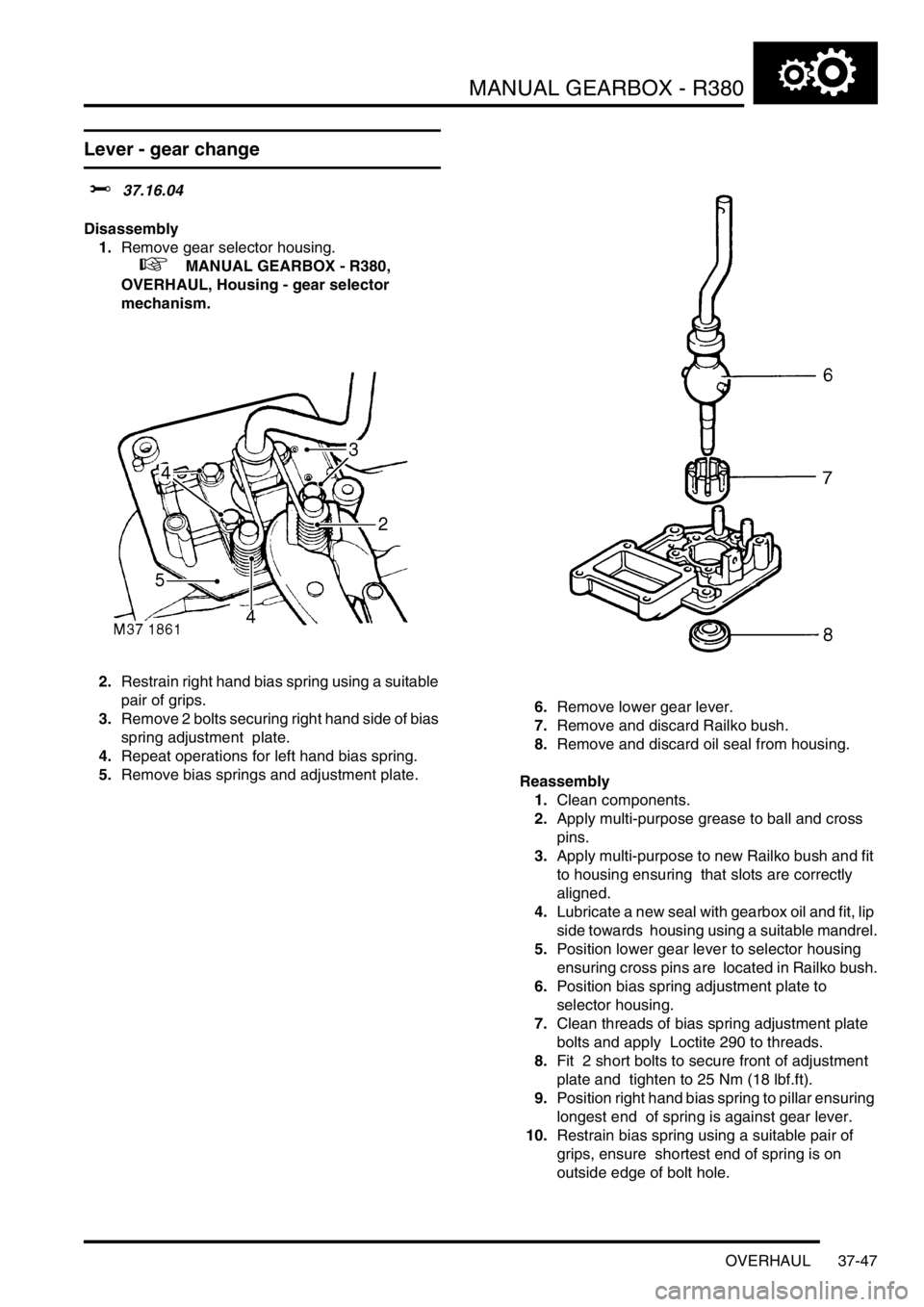
1.Remove gear selector housing.
+ MANUAL GEARBOX - R380,
OVERHAUL, Housing - gear selector
mechanism.
2.Restrain right hand bias spring using a suitable
pair of grips.
3.Remove 2 bolts securing right hand side of bias
spring adjustment plate.
4.Repeat operations for left hand bias spring.
5.Remove bias springs and adjustment plate.6.Remove lower gear lever.
7.Remove and discard Railko bush.
8.Remove and discard oil seal from housing.
Reassembly
1.Clean components.
2.Apply multi-purpose grease to ball and cross
pins.
3.Apply multi-purpose to new Railko bush and fit
to housing ensuring that slots are correctly
aligned.
4.Lubricate a new seal with gearbox oil and fit, lip
side towards housing using a suitable mandrel.
5.Position lower gear lever to selector housing
ensuring cross pins are located in Railko bush.
6.Position bias spring adjustment plate to
selector housing.
7.Clean threads of bias spring adjustment plate
bolts and apply Loctite 290 to threads.
8.Fit 2 short bolts to secure front of adjustment
plate and tighten to 25 Nm (18 lbf.ft).
9.Position right hand bias spring to pillar ensuring
longest end of spring is against gear lever.
10.Restrain bias spring using a suitable pair of
grips, ensure shortest end of spring is on
outside edge of bolt hole.
Page 765 of 1672

TRANSFER BOX - LT230SE
41-32 REPAIRS
6.Remove bolt securing outer cable clip to cross
shaft housing, remove cable.
Refit
1.Clean change levers, abutment bracket and
clevis pins.
2.Apply Mobilith SHC 100 grease to inner cable
ends and clevis pins.
3.Position cable and secure to high/low lever
abutment bracket with 'C' clip.
4.Secure inner cable to high/low lever with clevis
pin.
5.Position outer cable clip to cross shaft housing,
tighten bolt to 15 Nm (11 lbf.ft).
6.Adjust high/low selector cable.
+ TRANSFER BOX - LT230SE,
ADJUSTMENTS, Cable - high/low selector.
Oil seal - input shaft
$% 41.20.50
Remove
1.Remove transfer box.
+ TRANSFER BOX - LT230SE,
REPAIRS, Transfer box - V8.
+ TRANSFER BOX - LT230SE,
REPAIRS, Transfer box - Diesel.
2.Lever input shaft oil seal from transfer box.
Refit
1.Clean oil seal recess in transfer gearbox.
2.Lubricate new input shaft oil seal with gearbox
oil.
3.Using tool LRT-37-014 fit input shaft seal to
transfer box.
4.Fit transfer box.
+ TRANSFER BOX - LT230SE,
REPAIRS, Transfer box - V8.
+ TRANSFER BOX - LT230SE,
REPAIRS, Transfer box - Diesel.
Page 801 of 1672
AUTOMATIC GEARBOX - ZF4HP22 - 24
44-4 DESCRIPTION AND OPERATION
Description
General
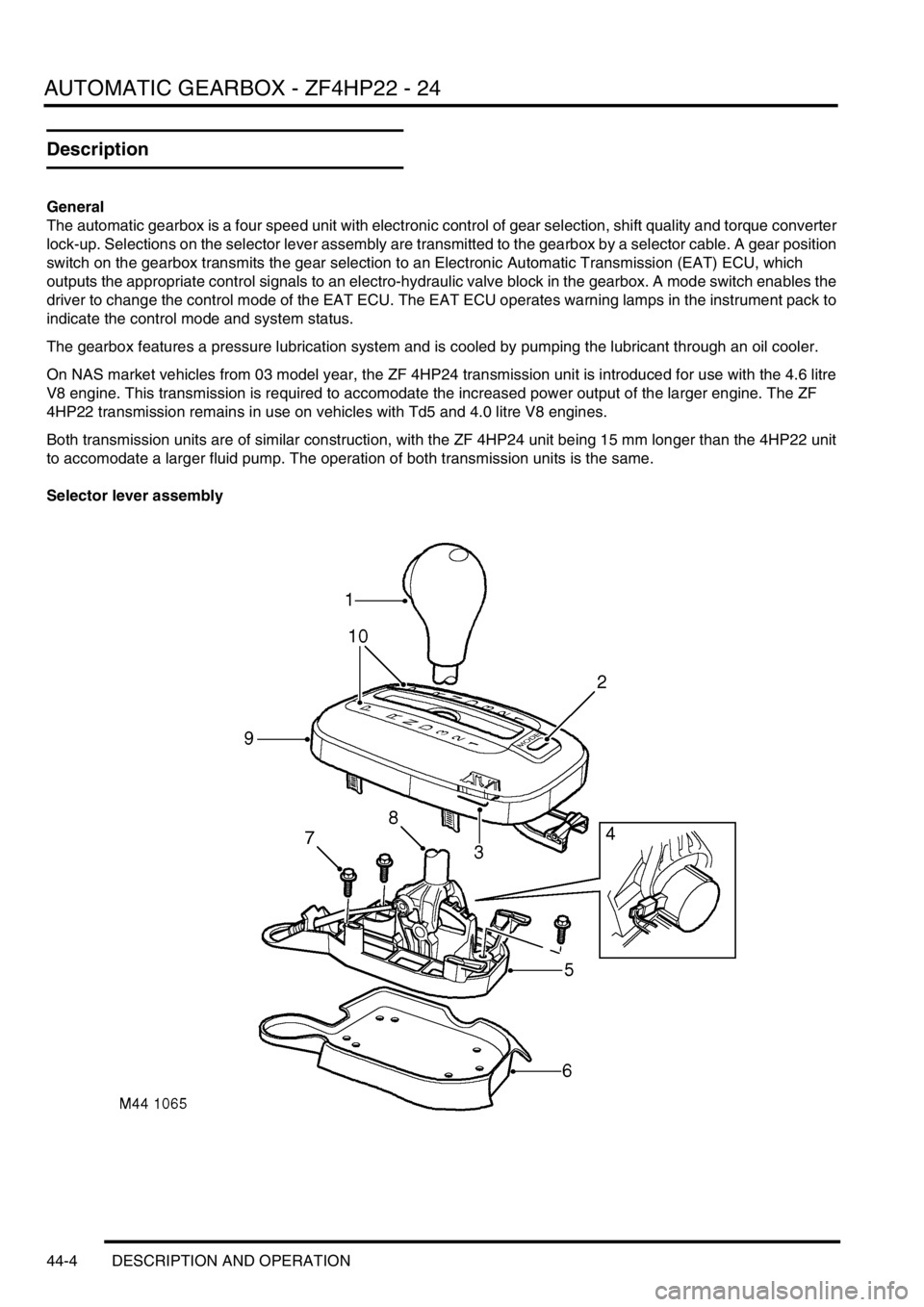
The automatic gearbox is a four speed unit with electronic control of gear selection, shift quality and torque converter
lock-up. Selections on the selector lever assembly are transmitted to the gearbox by a selector cable. A gear position
switch on the gearbox transmits the gear selection to an Electronic Automatic Transmission (EAT) ECU, which
outputs the appropriate control signals to an electro-hydraulic valve block in the gearbox. A mode switch enables the
driver to change the control mode of the EAT ECU. The EAT ECU operates warning lamps in the instrument pack to
indicate the control mode and system status.
The gearbox features a pressure lubrication system and is cooled by pumping the lubricant through an oil cooler.
On NAS market vehicles from 03 model year, the ZF 4HP24 transmission unit is introduced for use with the 4.6 litre
V8 engine. This transmission is required to accomodate the increased power output of the larger engine. The ZF
4HP22 transmission remains in use on vehicles with Td5 and 4.0 litre V8 engines.
Both transmission units are of similar construction, with the ZF 4HP24 unit being 15 mm longer than the 4HP22 unit
to accomodate a larger fluid pump. The operation of both transmission units is the same.
Selector lever assembly
Page 810 of 1672
AUTOMATIC GEARBOX - ZF4HP22 - 24
DESCRIPTION AND OPERATION 44-13
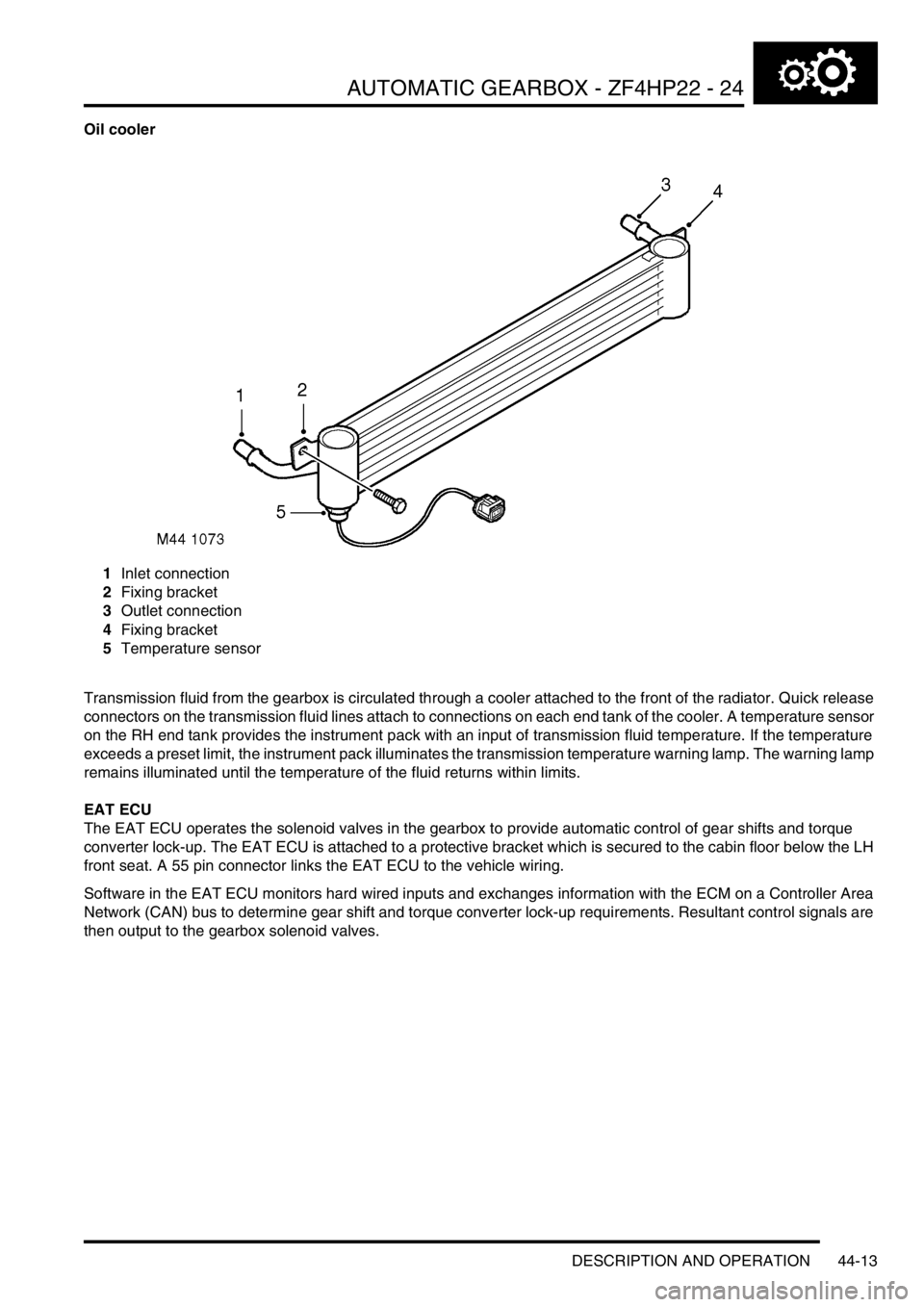
Oil cooler
1Inlet connection
2Fixing bracket
3Outlet connection
4Fixing bracket
5Temperature sensor
Transmission fluid from the gearbox is circulated through a cooler attached to the front of the radiator. Quick release
connectors on the transmission fluid lines attach to connections on each end tank of the cooler. A temperature sensor
on the RH end tank provides the instrument pack with an input of transmission fluid temperature. If the temperature
exceeds a preset limit, the instrument pack illuminates the transmission temperature warning lamp. The warning lamp
remains illuminated until the temperature of the fluid returns within limits.
EAT ECU
The EAT ECU operates the solenoid valves in the gearbox to provide automatic control of gear shifts and torque
converter lock-up. The EAT ECU is attached to a protective bracket which is secured to the cabin floor below the LH
front seat. A 55 pin connector links the EAT ECU to the vehicle wiring.
Software in the EAT ECU monitors hard wired inputs and exchanges information with the ECM on a Controller Area
Network (CAN) bus to determine gear shift and torque converter lock-up requirements. Resultant control signals are
then output to the gearbox solenoid valves.
Page 945 of 1672

FRONT SUSPENSION
60-6 DESCRIPTION AND OPERATION
Spring Data
The following table shows spring fitment applicablity.
Spring Fitment Applicability
The following table shows standard springs and uprated springs required when a front winch is fitted.
Winch Fitment Spring Applicability
Panhard rod
A Panhard rod is used to ensure that the axle remains centrally located. The Panhard rod has bushes pressed into
housings at each end which provide for the attachment to the axle and chassis. One end of the Panhard rod locates
in a fabricated bracket on the axle and is secured with a bolt and locknut. The opposite end is attached to a fabricated
bracket on the chassis and is also secured with a bolt and a locknut. The Panhard rod is shaped at one end to allow
clearance for the axle casing.
The attachment bolts for the Panhard rod are coated with a clear, dry wax which reduces friction on the bolt and allows
the correct torque to be applied to the clamping of the bushes. The bolts can be re-used, but if bolt replacement is
necessary the correct bolt with the wax coating must be used.
On models from 03 Model Year, the Panhard rod is shortened by 30 mm (1.18 in). This modification was introduced
to enhance the suspension bump steer characteristics in line with other suspension improvements introduced
simultaneously. The change to the Panhard rod also required the relocation of the attachment brackets on the axle
casing and the chassis.
Colour Code Total No. of Coils Free Length
Red/Purple 7.4 371 mm (14.6 in)
Yellow/Purple 7.4 378.4 mm (14.9 in)
Blue/Purple 7.4 365 mm (14.4 in)
Grey/Purple 7.4 387 mm (15.2 in)
Purple/Purple 7.4 373.8 mm (14.7 in)
Yellow/Orange 7.4 394.6 mm (15.5 in)
Green/Orange 7.4 382.6 mm (15 in)
Pink/Brown 7.6 405.6 mm (15.9 in)
Left Hand Drive Right Hand Drive
RH side LH side RH side LH side
Red/Purple Red/Purple Yellow/Purple Blue/Purple
Yellow/Purple Yellow/Purple Grey/Purple Purple/Purple
Grey/Purple Grey/Purple Yellow/Orange Green/Orange
Standard Spring Winch Fitted Spring
RH Side LH Side Both Sides
Red/Purple Red/Purple Grey/Purple
Yellow/Purple Blue/Purple Yellow/Orange
Yellow/Purple Yellow/Purple Yellow/Orange
Grey/Purple Purple/Purple Green/Orange
Grey/Purple Grey/Purple Green/Orange
Yellow/Orange Green/Orange Pink/Brown
Page 956 of 1672

FRONT SUSPENSION
DESCRIPTION AND OPERATION 60-17
The valve block directs hydraulic pressure to the actuators via solenoid operated directional control valves. A solenoid
operated pressure control valve regulates the required pressure to the actuators. The three valve solenoids are
controlled by signals received from the ACE ECU. A pressure transducer monitors the pressure delivered by the
pump. A replacable high pressure filter is installed into the lower face of the valve block and filters fluid before it
reaches the valves.
The valve block is located on the outside of the right hand chassis longitudinal. The valve block is secured to the
chassis with three bolts and rubber bushes. The rubber bushes isolate the valve block from the chassis, preventing
hydraulic noise from the valve block transmitting through the chassis and body.
The two solenoid operated directional control valves (DCV's) are fitted to ports in the top face of the valve block. The
DCV's are screwed into the valve block and sealed with O ring seals. Each DCV has a solenoid for electrical operation
of the valve. The solenoid is sealed to the DCV with two O ring and secured with a cap. The cap, coil and O rings are
serviceable items. The DCV's are non-serviceable and failure of a DCV requires the replacement of the valve block
assembly.
The pressure control valve is fitted to a port in the rear face of the valve block. The pressure control valve is screwed
into the valve block and sealed with O rings. The pressure control valve has a coil for electrical operation. The coil is
sealed to the pressure control valve with two O rings and secured with a cap. The cap, coil and O rings are serviceable
items. The pressure control valve is non-serviceable and failure requires replacement of the valve block assembly.
The pressure transducer is fitted to a port in the forward face of the valve block. The pressure transducer is screwed
into the valve block and sealed with an O ring seal. The pressure transducer is a serviceable item.
The high pressure filter locates in a port on the lower face of the valve block. The gauze and fibre filter is sealed in
the port with O ring seals. A threaded cap secures the filter in the valve block and is also sealed with an O ring seal.
A threaded hole on the lower face of the filter allows a bolt to be fitted to remove the filter from the port. If a system
component is replaced, the filter must be changed.
Four ports are located on the forward face of the valve block and two ports on the rear. Each port is fitted with a seal
pack which contains two O ring seals and backing rings. The ACE pipes locate and seal in the seal packs and are
secured to the valve block with the studs and nuts located on the forward and rear faces.
Actuators
Two actuators are used for the ACE system and are attached to the front and rear torsion bars. The actuators apply
hydraulically generated force to the torsion bar to oppose lateral forces caused by the vehicle cornering.
Each actuator is a conventional double-acting cylinder. A piston is attached to a rod and moves within the cylinder
when hydraulic pressure is applied. The rod is sealed at the point where it exits the cylinder. The outer end of the rod
is threaded and locates in a bush in the ACE long arm and secured with a nut. A rubber gaiter covers the rod and
prevents dirt and moisture from damaging the rod surface and cylinder seals. The cylinder has a forked attachment
which locates on the short arm bush and secured with a bolt and nut.
Two banjo connections provide for the attachment of the hydraulic hoses from the ACE valve block. The connections
provide hydraulic flow to each side of the piston to extend or retract the rod.
Page 1379 of 1672

AIR CONDITIONING
82-6DESCRIPTION AND OPERATION
Condenser
1Condenser matrix
2Outlet connection
3Inlet connection
The condenser transfers heat from the refrigerant to the surrounding air.
The condenser is installed immediately in front of the oil coolers. Rubber mounting bushes are used to mount the
condenser to the chassis sidemembers and brackets on the headlamp panels.
Ambient air, passing through the condenser matrix due to ram effect and/or the cooling fan, absorbs heat from the
refrigerant, which changes state from a vapour to a liquid.