air condition LAND ROVER DISCOVERY 2002 Workshop Manual
[x] Cancel search | Manufacturer: LAND ROVER, Model Year: 2002, Model line: DISCOVERY, Model: LAND ROVER DISCOVERY 2002Pages: 1672, PDF Size: 46.1 MB
Page 4 of 1672

CONTENTS
CONTENTS 1
INTRODUCTION ...................................................................................... 01-1
How To Use This Manual................................................................................................................ 01-1
Repairs and Replacements ............................................................................................................. 01-1
Specifications .................................................................................................................................. 01-2
Abbreviations and Symbols ............................................................................................................ 01-3
GENERAL INFORMATION ...................................................................... 03-1
General Precautions ....................................................................................................................... 03-1
Safety Instructions .......................................................................................................................... 03-2
Environmental Precautions ............................................................................................................. 03-3
General Fitting Instructions ............................................................................................................. 03-6
Ball and Roller Bearings ................................................................................................................. 03-7
Oil Seals.......................................................................................................................................... 03-8
Joints and Joint Faces .................................................................................................................... 03-9
Locking Devices .............................................................................................................................. 03-9
Screw Threads ................................................................................................................................ 03-10
Bolt and Nut Identification ............................................................................................................... 03-11
Flexible Pipes and Hoses ............................................................................................................... 03-13
Rolling Road Testing....................................................................................................................... 03-15
Fuel Handling Precautions .............................................................................................................. 03-16
Electrical Precautions ..................................................................................................................... 03-17
Supplementary Restraint System Precautions ............................................................................... 03-18
SRS Component Replacement Policy ............................................................................................ 03-23
Air Conditioning System Precautions .............................................................................................. 03-24
Air Conditioning Compressor Replacement .................................................................................... 03-26
Body Repairs .................................................................................................................................. 03-26
GENERAL DATA ..................................................................................... 04-1
Engine - Td5 ................................................................................................................................... 04-1
Engine - V8 ..................................................................................................................................... 04-4
Fuel system - Td5 ........................................................................................................................... 04-8
Fuel system - V8 ............................................................................................................................. 04-9
Cooling system - Td5 ...................................................................................................................... 04-9
Cooling system - V8 ........................................................................................................................ 04-10
Clutch - Td5 .................................................................................................................................... 04-10
Clutch - V8 ...................................................................................................................................... 04-11
Manual gearbox - R380 .................................................................................................................. 04-12
Transfer box - LT230SE .................................................................................................................. 04-13
Automatic gearbox - ZF4HP22/24 .................................................................................................. 04-13
Rear axle......................................................................................................................................... 04-13
Front axle ........................................................................................................................................ 04-13
Steering........................................................................................................................................... 04-14
Suspension ..................................................................................................................................... 04-15
Brakes ............................................................................................................................................. 04-16
Wheels and tyres ............................................................................................................................ 04-16
Air conditioning ............................................................................................................................... 04-17
Electrical - Td5 ................................................................................................................................ 04-17
Electrical - V8 .................................................................................................................................. 04-17
Dimensions ..................................................................................................................................... 04-18
Weights ........................................................................................................................................... 04-18
Page 5 of 1672

CONTENTS
2CONTENTS
IDENTIFICATION NUMBERS .................................................................. 05-1
Vehicle Identification Number ......................................................................................................... 05-1
Identification Number Locations ..................................................................................................... 05-3
TORQUE WRENCH SETTINGS .............................................................. 06-1
Maintenance ................................................................................................................................... 06-1
Engine Td5 ..................................................................................................................................... 06-2
Engine V8 ....................................................................................................................................... 06-4
Emission control - Td5 .................................................................................................................... 06-5
Emission control - V8 ...................................................................................................................... 06-5
Engine management system - Td5 ................................................................................................. 06-5
Engine management system - V8................................................................................................... 06-6
Cooling system ............................................................................................................................... 06-6
Manifolds and exhaust systems - Td5 ............................................................................................ 06-6
Manifolds and exhaust systems - V8 .............................................................................................. 06-7
Clutch.............................................................................................................................................. 06-7
Manual gearbox - R380 .................................................................................................................. 06-8
Transfer box - LT230SE ................................................................................................................. 06-8
Automatic gearbox - ZF4HP22/24 .................................................................................................. 06-9
Propeller shafts ............................................................................................................................... 06-9
Axles ............................................................................................................................................... 06-9
Steering .......................................................................................................................................... 06-10
Front suspension ............................................................................................................................ 06-11
Rear suspension ............................................................................................................................. 06-12
Brakes............................................................................................................................................. 06-12
Restraint systems ........................................................................................................................... 06-13
Body................................................................................................................................................ 06-14
Heating and air conditioning ........................................................................................................... 06-15
Wipers and washers ....................................................................................................................... 06-15
Electrical ......................................................................................................................................... 06-15
LIFTING AND TOWING ........................................................................... 08-1
LIFTING .......................................................................................................................................... 08-1
TOWING ......................................................................................................................................... 08-2
TRANSPORTING ........................................................................................................................... 08-3
CAPACITIES, FLUIDS AND LUBRICANTS ............................................ 09-1
Capacities ....................................................................................................................................... 09-1
Fluids .............................................................................................................................................. 09-2
Anti-Freeze Concentration .............................................................................................................. 09-3
Lubrication ...................................................................................................................................... 09-3
MAINTENANCE ........................................................................................ 10-1
PROCEDURES
V8 engine underbonnet view .......................................................................................................... 10-1
Diesel underbonnet view ................................................................................................................ 10-2
Seats and seat belts ...................................................................................................................... 10-3
Lamps, horns and warning indicators ........................................................................................... 10-5
Wipers and washers ...................................................................................................................... 10-5
Handbrake .................................................................................................................................. 10-6
Page 24 of 1672

CONTENTS
CONTENTS 21
PAINTING ................................................................................................ 77-5-1
PROCEDURES
Panel preparation............................................................................................................................ 77-5-1
Paint preparation............................................................................................................................. 77-5-2
HEATING AND VENTILATION................................................................. 80-1
DESCRIPTION AND OPERATION
Heating and ventilation component layout ...................................................................................... 80-1
Fuel burning heater component layout ........................................................................................... 80-2
Description ...................................................................................................................................... 80-3
Operation ........................................................................................................................................ 80-13
REPAIRS
Heater control and fan switch ....................................................................................................... 80-15
Cables - heater control .................................................................................................................. 80-15
Servo - recirculation flap ............................................................................................................... 80-17
Switch - recirculation control ......................................................................................................... 80-18
Servo - air distribution control ........................................................................................................ 80-19
Servo - air temperature control ....................................................................................................... 80-20
Plenum Air Intake ........................................................................................................................... 80-20
Heater assembly - models without air conditioning ......................................................................... 80-21
Heater assembly - models with air conditioning .............................................................................. 80-23
Blower assembly ............................................................................................................................ 80-25
Motor - blower ............................................................................................................................. 80-26
Resistor pack - power resistor A/C ............................................................................................... 80-27
Heater matrix ................................................................................................................................ 80-28
Pipe - Heater - Feed ...................................................................................................................... 80-29
Pipe - Heater - Return .................................................................................................................... 80-29
Fuel burning heater - (FBH) - Td5................................................................................................... 80-30
AIR CONDITIONING ................................................................................. 82-1
DESCRIPTION AND OPERATION
A/C refrigerant system component layout ....................................................................................... 82-1
A/C control system component layout ............................................................................................ 82-2
Description ...................................................................................................................................... 82-3
Operation ........................................................................................................................................ 82-18
DESCRIPTION AND OPERATION
Rear A/C refrigerant system component layout .............................................................................. 82-23
Rear A/C distribution and control component layout ....................................................................... 82-24
Description ...................................................................................................................................... 82-25
Operation ........................................................................................................................................ 82-27
REFRIGERANT RECOVERY, RECYCLING AND RECHARGING
Refrigerant recovery, recycling and recharging .............................................................................. 82-29
REPAIRS
Compressor - diesel ........................................................................................................................ 82-31
Compressor - V8 ............................................................................................................................. 82-32
Fan - condenser ............................................................................................................................ 82-33
Page 32 of 1672

INTRODUCTION
01-3
Abbreviations and Symbols
A Amperes
AAP Ambient Air Pressure
AAT Ambient Air Temperature
ABDC After Bottom Dead Centre
ABS Anti-Lock Brake System
ABS / TC Anti-lock Brake System / Traction
Control
ac Alternating current
A/C Air Conditioning
ACE Active Cornering Enhancement
ACEA Association of Constructors of
European Automobiles
AFR Air Fuel Ratio
AP Ambient Pressure
ASC Anti-shunt Control
ATC Air Temperature Control
ATDC After Top Dead Centre
AUX Auxiliary
AVC Automatic Volume Control
BBDC Before Bottom Dead Centre
BBUS Battery Backed Up Sounder
BCU Body Control Unit
BDC Bottom Dead Centre
bhp Brake Horse Power
BP Boost Pressure
BPP Brake Pedal Position
BS British Standard
BTDC Before Top Dead Centre
BWD Backward
C Celsius
CAN Controller Area Network
CD Compact Disc
CDC Centre Differential Control
CDL Central Door Locking
CD - ROM Compact Disc - Read Only
Memory
CFC Chlorofluorocarbon
CHMSL Centre High Mounted Stop Lamp
CKP Crankshaft Position
CLV Calculated Load Value
cm Centimetre
cm
2Square centimetre
cm3Cubic centimetre
CMP Camshaft Position
CPP Clutch Pedal Position
CO Carbon Monoxide
CO
2Carbon Dioxide
COB Clear Over Base
CR Common Rail
CVS Canister Vent Solenoid
dB Decibels
DDM Driver's Door Module
deg. Degree, angle or temperature
DI Direct Injection
dia. DiameterDIN Deutsche Industrie Normen
(German Industrial Standards)
dc Direct current
DCV Directional Control Valve
DOHC Double Overhead Camshaft
DSP Digital Signal Processing
DTI Dial Test Indicator
DMF Dual Mass Flywheel
DVD Digital Versatile Disc
EACV Electronic Air Control Valve
EAT Electronic Automatic
Transmission
EBD Electronic Brake pressure
Distribution
ECD European Community Directive
ECM Engine Control Module
ECT Engine Coolant Temperature
ECU Electronic Control Unit
EDC Electronic Diesel Control
EEPROM Electronic Erasable
Programmable Read Only
Memory
EGR Exhaust Gas Recirculation
EKA Emergency Key Access
ELR Emergency Locking Retractor
EN European Norm
EOBD European On Board Diagnostics
EON Enhanced Other Network
ERL Electrical Reference Library
ETC Electronic Traction Control
EUI Electronic Unit Injector
EVAP Evaporative Emission
EVR Electronic Vacuum Regulator
F Fahrenheit
ft. Feet
FBH Fuel Burning Heater
FET Field Effect Transistor
FIP Fuel Injection Pump
FTC Fast Throttle Control
FWD Forward
> Greater than
g Gramme or Gravity
gal. Gallons
GMT Greenwich Mean Time
GPS Global Positioning System
hHour
hc High compression
HC Hydro Carbons
HDC Hill Descent Control
HDOP Height Dilation Of Precision
HDPE High Density Polyethylene
HFS Heated Front Screen
Hg Mercury
HO
2S Heated Oxygen Sensor
HMW High Molecular Weight
Page 38 of 1672

GENERAL INFORMATION
03-3
Environmental Precautions
General
This section provides general information which can
help to reduce the environmental impacts from the
activities carried out in workshops.
Emissions to air
Many of the activities that are carried out in
workshops emit gases and fumes which contribute to
global warming, depletion of the ozone layer and/or
the formation of photochemical smog at ground
level. By considering how the workshop activities are
carried out, these gases and fumes can be
minimised, thus reducing the impact on the
environment.
Exhaust fumes
Running car engines is an essential part of workshop
activities and exhaust fumes need to be ventilated to
atmosphere. However, the amount of time engines
are running and the position of the vehicle should be
carefully considered at all times, to reduce the
release of poisonous gases and minimise the
inconvenience to people living nearby.
Solvents
Some of the cleaning agents used are solvent based
and will evaporate to atmosphere if used carelessly,
or if cans are left unsealed. All solvent containers
should be firmly closed when not needed and
solvent should be used sparingly. Suitable
alternative materials may be available to replace
some of the commonly used solvents. Similarly,
many paints are solvent based and the spray should
be minimised to reduce solvent emissions.
Refrigerant
It is illegal to release any refrigerants into the
atmosphere. Discharge and replacement of these
materials from air conditioning units should only be
carried out using the correct equipment.
Checklist
Always adhere to the following.
Engines:
ldon't leave engines running unnecessarily;
lminimise testing times and check where the
exhaust fumes are being blown.
Materials:
lkeep lids on containers of solvents;
lonly use the minimum quantity;
lconsider alternative materials;
lminimise over-spray when painting. Gases:
luse the correct equipment for collecting
refrigerants;
ldon't burn rubbish on site.
Discharges to water
Most sites will have two systems for discharging
water: storm drains and foul drains. Storm drains
should only receive clean water, foul drains will take
dirty water.
The foul drain will accept many of the normal waste
waters such as washing water, detergents and
domestic type wastes, but oil, petrol, solvent, acids,
hydraulic oil, antifreeze and other such substances
should never be poured down the drain. If in any
doubt speak to the Water Company first.
Every precaution must be taken to prevent spillage of
oil, fuel, solvents etc. reaching the drains. All
handling of such materials must take place well away
from the drains and preferably in an area with a kerb
or wall around it, to prevent discharge into the drain.
If a spillage occurs it should be soaked up
immediately. Having a spill kit available will make
this easier.
Additional precautions
Check whether the surface water drains are
connected to an oil water separator, this could
reduce the pollution if an incident was to occur. Oil
water separators do need regular maintenance to
ensure effectiveness.
Checklist
Always adhere to the following.
Disposal:
lnever pour anything down a drain without first
checking that it is environmentally safe to do so,
and that it does not contravene any local
regulations or bye-laws;
l have oil traps emptied regularly.
Spillage prevention:
lstore liquids in a walled area;
lmake sure that taps on liquid containers are
secure and cannot be accidentally turned on;
lprotect bulk storage tanks from vandalism by
locking the valves;
ltransfer liquids from one container to another in
an area away from open drains;
lensure lids are replaced securely on containers;
lhave spill kits available near to points of storage
and handling of liquids.
Page 41 of 1672

GENERAL INFORMATION
03-6
General Fitting Instructions
Component removal
Whenever possible, clean components and
surrounding area before removal.
lBlank off openings exposed by component
removal.
lImmediately seal fuel, oil or hydraulic lines when
apertures are exposed; use plastic caps or
plugs to prevent loss of fluid and ingress of dirt.
lClose the open ends of oilways exposed by
component removal with tapered hardwood
plugs or conspicuous plastic plugs.
lImmediately a component is removed, place it in
a suitable container; use a separate container
for each component and its associated parts.
lClean bench and provide marking materials,
labels and containers before dismantling a
component.
Dismantling
Observe scrupulous cleanliness when dismantling
components, particularly when brake, fuel or
hydraulic system parts are being worked on. A
particle of dirt or a cloth fragment could cause a
serious malfunction if trapped in these systems.
lBlow out all tapped holes, crevices, oilways and
fluid passages with an air line. Ensure that any
'O' rings used for sealing are correctly replaced
or renewed, if disturbed during the process.
lUse marking ink to identify mating parts and
ensure correct reassembly. Do not use a centre
punch or scriber to mark parts, they could
initiate cracks or distortion in marked
components.
lWire together mating parts where necessary to
prevent accidental interchange (e.g. roller
bearing components).
lWire labels on to all parts which are to be
renewed, and to parts requiring further
inspection before being passed for reassembly;
place these parts in separate containers from
those containing parts for rebuild.
lDo not discard a part due for renewal until after
comparing it with a new part, to ensure that its
correct replacement has been obtained.Cleaning components
Always use the recommended cleaning agent or
equivalent. Ensure that adequate ventilation is
provided when volatile degreasing agents are being
used. Do not use degreasing equipment for
components containing items which could be
damaged by the use of this process.
General inspection
All components should be inspected for wear or
damage before being reassembled.
lNever inspect a component for wear or
dimensional check unless it is absolutely clean;
a slight smear of grease can conceal an
incipient failure.
lWhen a component is to be checked
dimensionally against recommended values,
use the appropriate measuring equipment
(surface plates, micrometers, dial gauges etc.).
Ensure the measuring equipment is calibrated
and in good serviceable condition.
lReject a component if its dimensions are
outside the specified tolerances, or if it appears
to be damaged.
lA part may be refitted if its critical dimension is
exactly to its tolerance limit and it appears to be
in satisfactory condition. Use 'Plastigauge' 12
Type PG-1 for checking bearing surface
clearances.
Page 42 of 1672
GENERAL INFORMATION
03-7
Ball and Roller Bearings
General
When removing and installing bearings, ensure that
the following practices are observed to ensure
component serviceability.
lRemove all traces of lubricant from bearing
under inspection by cleaning with a suitable
degreasant; maintain absolute cleanliness
throughout operations.
lConduct a visual inspection for markings on
rolling elements, raceways, outer surface of
outer rings or inner surface of inner rings. Reject
any bearings found to be marked, since marking
in these areas indicates onset of wear.
lHold inner race of bearing between finger and
thumb of one hand and spin outer race to check
that it revolves absolutely smoothly. Repeat,
holding outer race and spinning inner race.
lRotate outer ring gently with a reciprocating
motion, while holding inner ring; feel for any
check or obstruction to rotation. Reject bearing
if action is not perfectly smooth.
lLubricate bearing with generous amounts of
lubricant appropriate to installation.
lInspect shaft and bearing housing for
discoloration or other markings which indicate
movement between bearing and seatings.
lEnsure that shaft and housing are clean and
free from burrs before fitting bearing.
lIf one bearing of a pair shows an imperfection, it
is advisable to replace both with new bearings;
an exception could be if the faulty bearing had
covered a low mileage, and it can be
established that damage is confined to only one
bearing.
lNever refit a ball or roller bearing without first
ensuring that it is in a fully serviceable condition.
lWhen hub bearings are removed or displaced,
new bearings must be fitted; do not attempt to
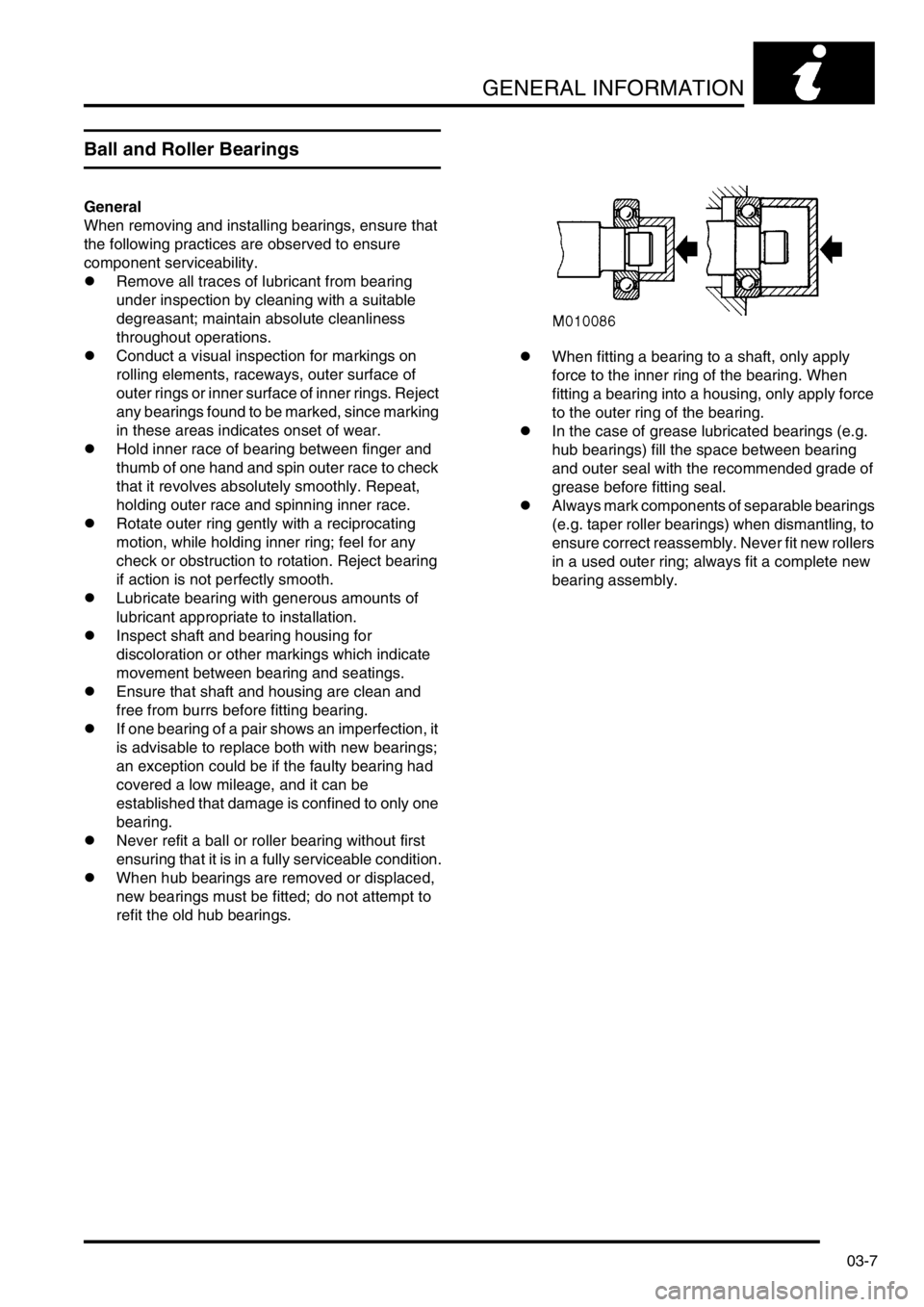
refit the old hub bearings.lWhen fitting a bearing to a shaft, only apply
force to the inner ring of the bearing. When
fitting a bearing into a housing, only apply force
to the outer ring of the bearing.
lIn the case of grease lubricated bearings (e.g.
hub bearings) fill the space between bearing
and outer seal with the recommended grade of
grease before fitting seal.
lAlways mark components of separable bearings
(e.g. taper roller bearings) when dismantling, to
ensure correct reassembly. Never fit new rollers
in a used outer ring; always fit a complete new
bearing assembly.
Page 52 of 1672
GENERAL INFORMATION
03-17
Electrical Precautions
General
The following guidelines are intended to ensure the
safety of the operator while preventing damage to the
electrical and electronic components fitted to the
vehicle. Where necessary, specific precautions are
detailed in the individual procedures of this manual.
Equipment
Prior to commencing any test procedure on the
vehicle ensure that the relevant test equipment is
working correctly and any harness or connectors are
in good condition. It is particularly important to check
the condition of the lead and plugs of mains operated
equipment.
Polarity
Never reverse connect the vehicle battery and
always ensure the correct polarity when connecting
test equipment.
High voltage circuits
Whenever disconnecting live ht circuits always use
insulated pliers and never allow the open end of the
ht lead to contact other components, particularly
ECU's. Exercise caution when measuring the voltage
on the coil terminals while the engine is running, high
voltage spikes can occur on these terminals.
Connectors and harnesses
The engine compartment of a vehicle is a particularly
hostile environment for electrical components and
connectors:
lAlways ensure electrically related items are dry
and oil free before disconnecting and
connecting test equipment.
lEnsure disconnected multiplugs and sensors
are protected from being contaminated with oil,
coolant or other solutions. Contamination could
impair performance or result in catastrophic
failure.
lNever force connectors apart using tools to
prise apart or by pulling on the wiring harness.
lAlways ensure locking tabs are disengaged
before disconnection, and match orientation to
enable correct reconnection.
lEnsure that any protection (covers, insulation
etc.) is replaced if disturbed.Having confirmed a component to be faulty:
lSwitch off the ignition and disconnect the
battery.
lRemove the component and support the
disconnected harness.
lWhen replacing the component keep oily hands
away from electrical connection areas and push
connectors home until any locking tabs fully
engage.
Battery disconnection
Before disconnecting the battery, disable the alarm
system and switch off all electrical equipment. If the
radio is to be serviced, ensure the security code has
been deactivated.
CAUTION: To prevent damage to electrical
components, always disconnect the battery
when working on the vehicle's electrical system.
The ground lead must be disconnected first and
reconnected last.
CAUTION: Always ensure that battery leads are
routed correctly and are not close to any
potential chafing points.
Battery charging
Only recharge the battery with it removed from the
vehicle. Always ensure any battery charging area is
well ventilated and that every precaution is taken to
avoid naked flames and sparks.
Ignition system safety precautions
The vehicle's ignition system produces high voltage
and the following precautions should be observed
before carrying out any work on the system.
WARNING: Before commencing work on an
ignition system, ensure all high tension
terminals, adapters and diagnostic equipment
are adequately insulated and shielded to prevent
accidental personal contacts and minimise the
risk of shock. Wearers of surgically implanted
pacemaker devices should not be in close
proximity of ignition circuits or diagnostic
equipment.
Disciplines
Switch off the ignition prior to making any connection
or disconnection in the system to prevent electrical
surges caused by disconnecting 'live' connections
damaging electronic components.
Ensure hands and work surfaces are clean and free
of grease, swarf, etc. Grease collects dirt which can
cause electrical tracking (short-circuits) or high-
resistance contacts.
When handling printed circuit boards, treat with care
and hold by the edges only; note that some electronic
components are susceptible to body static.
Page 53 of 1672
GENERAL INFORMATION
03-18
Connectors should never be subjected to forced
removal or refit, especially inter-board connectors.
Damaged contacts can cause short-circuit and open-
circuit fault conditions.
Prior to commencing test, and periodically during a
test, touch a good vehicle body earth to discharge
static charge. Some electronic components are
vulnerable to the static electricity that may be
generated by the operator.
Grease for electrical connectors
Some under bonnet and under body connectors may
be protected against corrosion by the application of a
special grease during vehicle production. Should
connectors be disturbed in service, repaired or
replaced, additional grease should be applied: Part
No. BAU 5811, available in 150 gm tubs.
NOTE: The use of greases other than BAU 5811
must be avoided as they can migrate into relays,
switches etc. contaminating the contacts and leading
to intermittent operation or failure.
Supplementary Restraint System
Precautions
General
The Supplementary Restraint System (SRS)
provides active protection for vehicle occupants in
the event of a serious collision. The system
components include airbags and pretensioner seat
belts which are automatically deployed when a
severe frontal crash condition is detected.
In order to assure system integrity, it is essential that
the SRS system is regularly checked and maintained
so that it is ready for operation in the event of an
accident.
The SRS system contains components which could
be potentially hazardous to the service engineer if
not serviced and handled correctly. The following
guidelines are intended to alert the service engineer
to potential sources of danger and emphasise the
importance of ensuring integrity of the SRS
components fitted to the vehicle.
Where necessary, additional specific precautions are
detailed in the Restraint Systems section of this
Manual which should be referred to prior to
commencing repair operations.
It should be noted that these precautions are not
restricted to operations performed when servicing
the SRS system. The same care should be exercised
when working on ancillary systems and components
located in the vicinity of SRS components; these
include but are not limited to steering system (driver's
airbag), body and trim components (passenger's
airbag and seat belt pretensioners) and electrical
system components (SRS harnesses etc.).
Page 54 of 1672
GENERAL INFORMATION
03-19
WARNING: Do not use rear facing child seats in
the front passenger seat if the vehicle is fitted
with a passenger airbag.
WARNING: It is imperative that before any work
is undertaken on the SRS system the appropriate
information is read thoroughly.
WARNING: Replace the airbag every 10 years.
Do not install used SRS parts from another car.
When repairing an SRS system, always use
approved new parts.
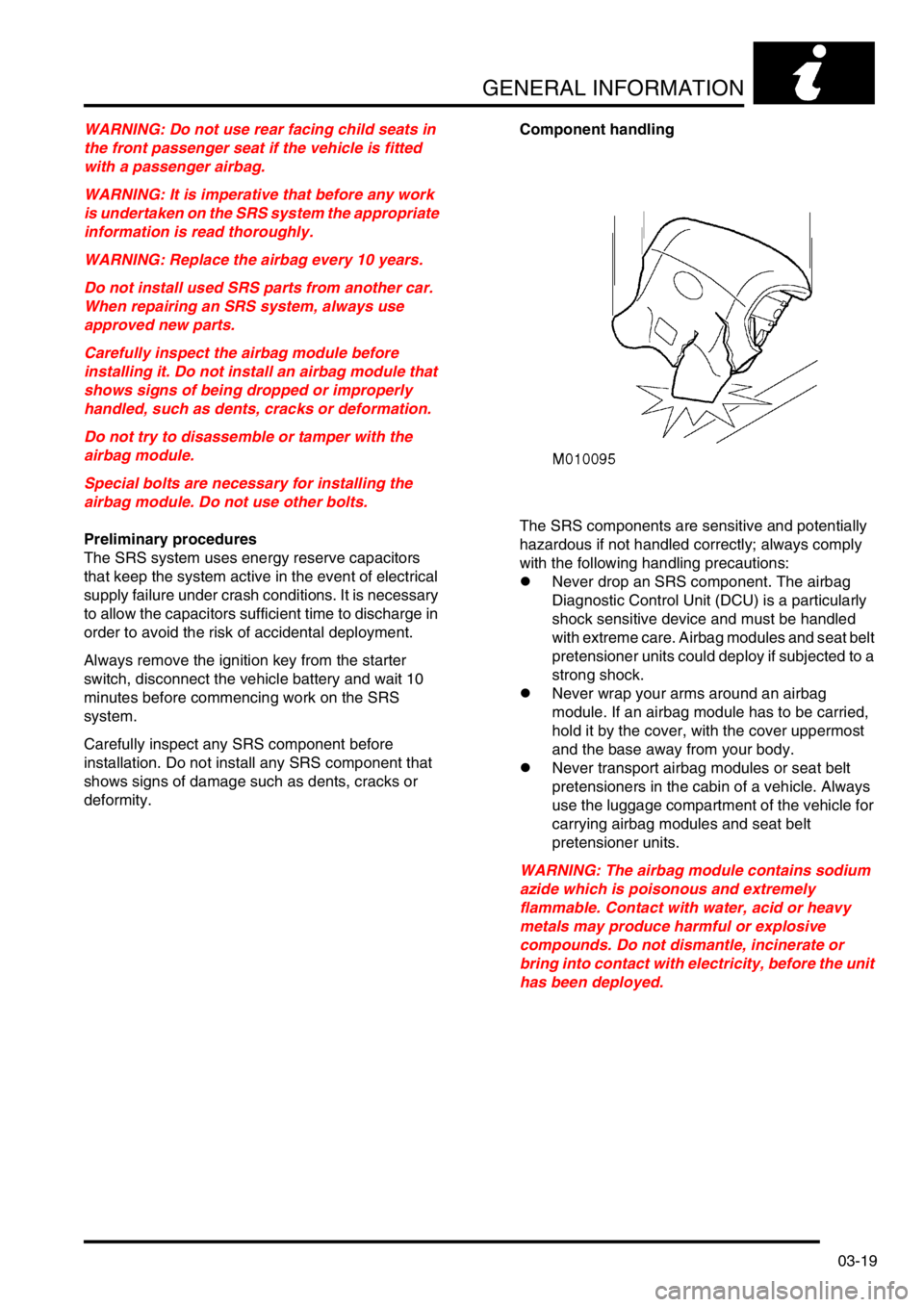
Carefully inspect the airbag module before
installing it. Do not install an airbag module that
shows signs of being dropped or improperly
handled, such as dents, cracks or deformation.
Do not try to disassemble or tamper with the
airbag module.
Special bolts are necessary for installing the
airbag module. Do not use other bolts.
Preliminary procedures
The SRS system uses energy reserve capacitors
that keep the system active in the event of electrical
supply failure under crash conditions. It is necessary
to allow the capacitors sufficient time to discharge in
order to avoid the risk of accidental deployment.
Always remove the ignition key from the starter
switch, disconnect the vehicle battery and wait 10
minutes before commencing work on the SRS
system.
Carefully inspect any SRS component before
installation. Do not install any SRS component that
shows signs of damage such as dents, cracks or
deformity.Component handling
The SRS components are sensitive and potentially
hazardous if not handled correctly; always comply
with the following handling precautions:
lNever drop an SRS component. The airbag
Diagnostic Control Unit (DCU) is a particularly
shock sensitive device and must be handled
with extreme care. Airbag modules and seat belt
pretensioner units could deploy if subjected to a
strong shock.
lNever wrap your arms around an airbag
module. If an airbag module has to be carried,
hold it by the cover, with the cover uppermost
and the base away from your body.
lNever transport airbag modules or seat belt
pretensioners in the cabin of a vehicle. Always
use the luggage compartment of the vehicle for
carrying airbag modules and seat belt
pretensioner units.
WARNING: The airbag module contains sodium
azide which is poisonous and extremely
flammable. Contact with water, acid or heavy
metals may produce harmful or explosive
compounds. Do not dismantle, incinerate or
bring into contact with electricity, before the unit
has been deployed.