roof LAND ROVER DISCOVERY 2002 Service Manual
[x] Cancel search | Manufacturer: LAND ROVER, Model Year: 2002, Model line: DISCOVERY, Model: LAND ROVER DISCOVERY 2002Pages: 1672, PDF Size: 46.1 MB
Page 1302 of 1672

PANEL REPAIRS
REPAIRS 77-2-53
Repair
1.Remove existing panel(s), prepare panel joint
faces and install new panel(s) in accordance
with Panel Replacement Procedure. Punch or
drill holes in new panel for plug welding as
shown.
2. During welding operations, apply 'Heat
shrink paste' to roof and body side panel to
avoid heat damage to paintwork.Refit
1.Fit and secure wiring.
2.Fit side and rear drip rail finishers.
3.Fit alpine light glass.
+ SCREENS, REPAIRS, Glass - alpine
light.
4.Fit windscreen.
+ SCREENS, REPAIRS, Windscreen.
5.Fit 'D' post outer trim finishers.
6.Fit rear door aperture seals.
7.Fit tread plates to rear door apertures.
8.Fit front door aperture seals.
9.Fit 'A' post lower trim panels.
10.Fit tread plates to front door apertures.
11.Fit roof bars.
+ EXTERIOR FITTINGS, REPAIRS,
Roof bars.
12.Fit rear headrests.
13.Fit rear seats.
+ SEATS, REPAIRS, Seat - rear.
14.Fit front seats.
+ SEATS, REPAIRS, Seat - front.
15. Models with fixed roof: Fit head lining.
+ INTERIOR TRIM COMPONENTS,
REPAIRS, Headlining.
16. Models with sunroof: Fit sunroof drain tubes.
17. Models with sunroof: Fit rear sunroof.
+ SUNROOF, REPAIRS, Sunroof -
rear.
18. Models with sunroof: Fit front sunroof.
+ SUNROOF, REPAIRS, Sunroof -
front.
19.Connect leads/multiplug to alternator.
20.Connect battery leads, negative lead last.
M77 1715A
Page 1304 of 1672
PANEL REPAIRS
TIMES 77-2-55
TIME S
TIME SCHEDULES
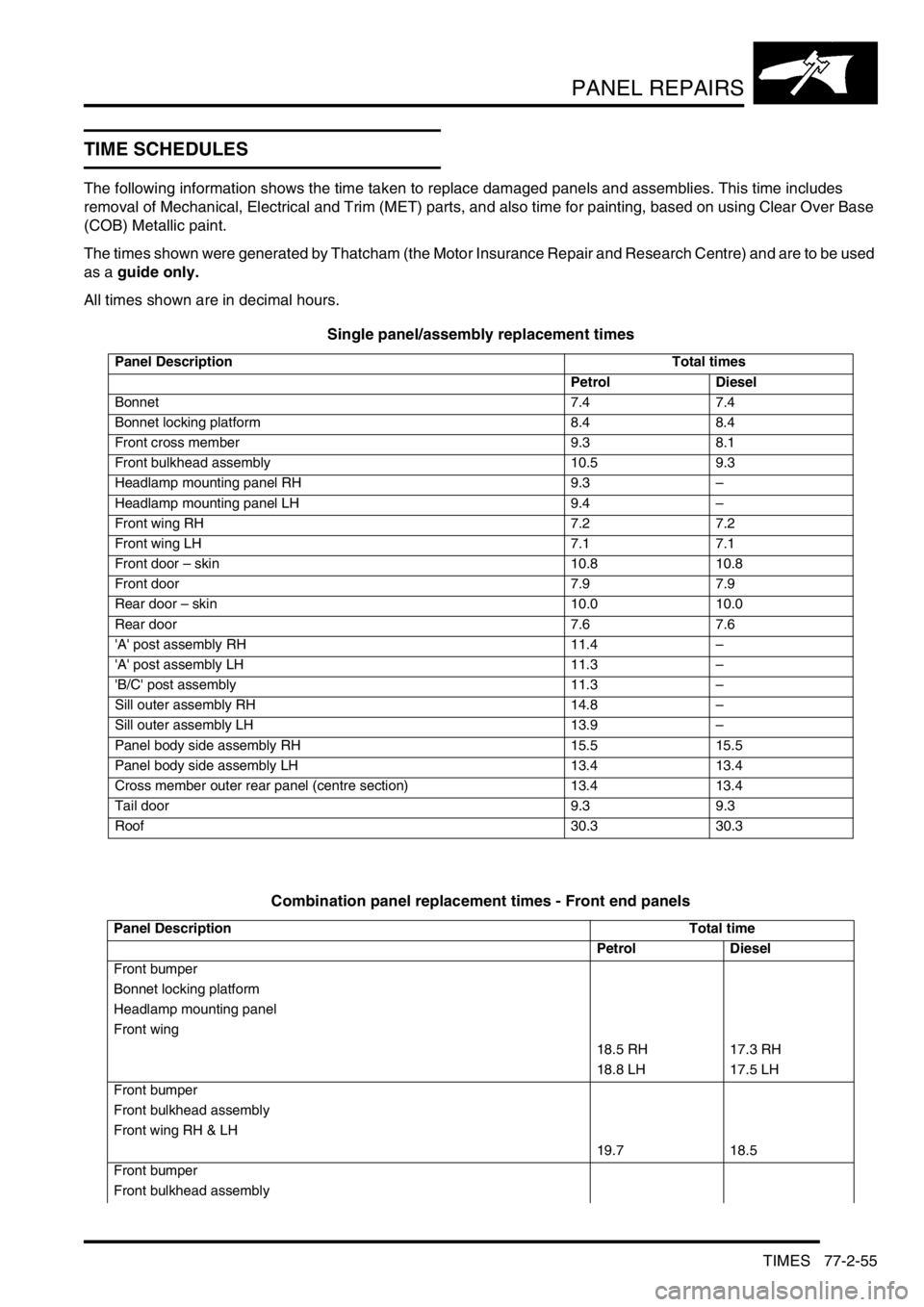
The following information shows the time taken to replace damaged panels and assemblies. This time includes
removal of Mechanical, Electrical and Trim (MET) parts, and also time for painting, based on using Clear Over Base
(COB) Metallic paint.
The times shown were generated by Thatcham (the Motor Insurance Repair and Research Centre) and are to be used
as a guide only.
All times shown are in decimal hours.
Single panel/assembly replacement times
Combination panel replacement times - Front end panels
Panel Description Total times
Petrol Diesel
Bonnet 7.4 7.4
Bonnet locking platform 8.4 8.4
Front cross member 9.3 8.1
Front bulkhead assembly 10.5 9.3
Headlamp mounting panel RH 9.3–
Headlamp mounting panel LH 9.4–
Front wing RH 7.2 7.2
Front wing LH 7.1 7.1
Front door – skin 10.8 10.8
Front door 7.9 7.9
Rear door – skin 10.0 10.0
Rear door 7.6 7.6
'A' post assembly RH 11.4–
'A' post assembly LH 11.3–
'B/C' post assembly 11.3–
Sill outer assembly RH 14.8–
Sill outer assembly LH 13.9–
Panel body side assembly RH 15.5 15.5
Panel body side assembly LH 13.4 13.4
Cross member outer rear panel (centre section) 13.4 13.4
Tail door 9.3 9.3
Roof 30.3 30.3
Panel DescriptionTotal time
Petrol Diesel
Front bumper
Bonnet locking platform
Headlamp mounting panel
Front wing
18.5 RH 17.3 RH
18.8 LH 17.5 LH
Front bumper
Front bulkhead assembly
Front wing RH & LH
19.7 18.5
Front bumper
Front bulkhead assembly
Page 1309 of 1672

BODY SEALING MATERIALS
77-3-2 MATERIALS AND APPLICATIONS
Approved materials
The following is a table of materials approved by Land Rover for use during body repairs.
Description - Usage Supplier Part Number
Cavity waxes
Inner Cavity Wax (Amber) 3M 08901/11/21
Inner Cavity Wax (Transparent) 3M 08909/19/29
Cavity Wax Croda PW57
Engine bay waxes/lacquers
Astrolan Engine Bay Wax and Cosmetic Wax Astors DA3243/1
Engine Bay Cosmetic Wax/Lacquer Croda PW197
Engine Bay Cosmetic Wax/Lacquer Dinol 4010
Miscellaneous materials
Aerosol Auto Adhesive (Trim) - impact adhesive for trim parts 3M 08080
Flexible Parts Repair Material - rubber modified polypropylene parts 3M 05900
Waterproof Cloth Tape - sealing panel apertures 3M Y387/Y3998
Sound Dampening Foam Gurit-Essex Betacore 7999
Water Shedder Repair (Aerosol) Teroson
Seam sealers
Body Caulking - type (b) gaps between panels 3M 08568
Bolted Panel Sealer - between bolted panels 3M 08572
Drip Chek Clear - bolted, spot welded and bonded panel edges; type (a) and
(b) gaps between panels; type (c) clinch joints 3M 08401
Drip Chek Heavy - type (b) gaps between panels; type (c) clinch joints 3M 08531
Polyurethane Seam Sealer - bolted, spot welded and bonded panel edges;
type (a) and (b) gaps between panels; type (b) clinch joints3M 08684/89/94
Polyurethane Sealer (Sachet) - bolted panel edges; type (b) clinch joints 3M 08703/83/88
Sprayable Sealer - lap joints 3M 08800/23
Super Seam Sealer - lap joints; type (b) clinch joints 3M 08537
Weld Thru' Sealer - between spot welded panels 3M 08626
Betafill Clinch and Brushable Sealer - type (b) clinch joints Gurit-Essex 10211/15/20
Clinch, Joint and Underbody Coating - lap joints Gurit-Essex 10101/10707
Leak Chek Clear - between bolted panels; spot welded and bonded panel
edges; type (c) clinch joints; type (a) gaps between panels Kent Industries 10075
Putty - type (b) gaps between panels Kent Industries
Polyurethane Seam Sealer - bolted, spot welded and bonded panel edges;
between bonded panels; type (a) and (b) gaps between panels PPG 6500
Polyurethane Seam Sealer - bolted, spot welded and bonded panel edges;
between bonded panels; type (b) gaps between panels Teroson 92
Terolan Light Seam Sealer - bolted, spot welded and bonded panel edges;
type (a) and (b) gaps between panels; between bonded panels; type (c)
clinch jointsTeroson
Page 1327 of 1672
CORROSION PREVENTION AND SEALING
77-4-12 SEALING
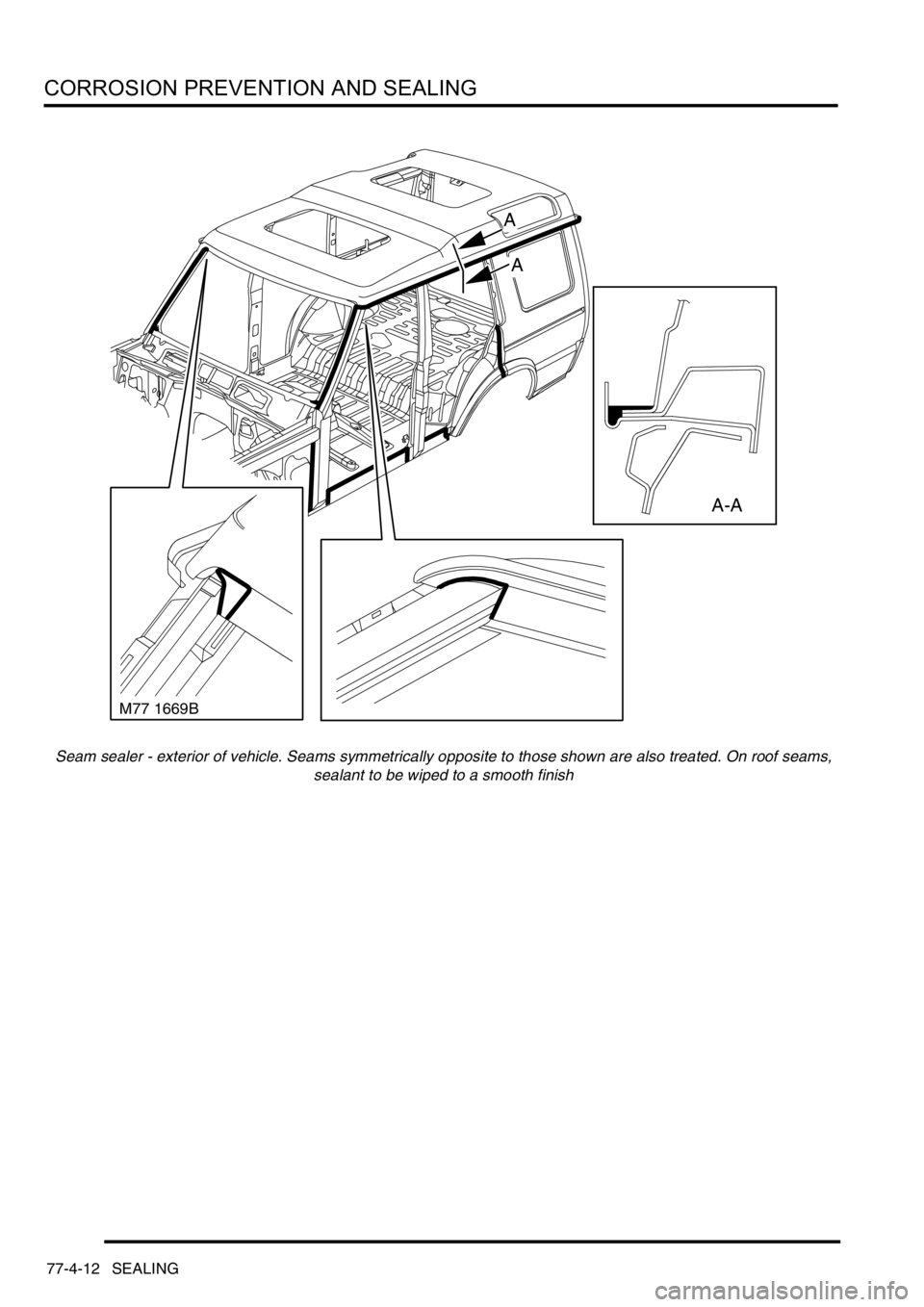
Seam sealer - exterior of vehicle. Seams symmetrically opposite to those shown are also treated. On roof seams,
sealant to be wiped to a smooth finish
A
A
A-A
M77 1669B
Page 1337 of 1672
CORROSION PREVENTION AND SEALING
77-4-22 SEALING
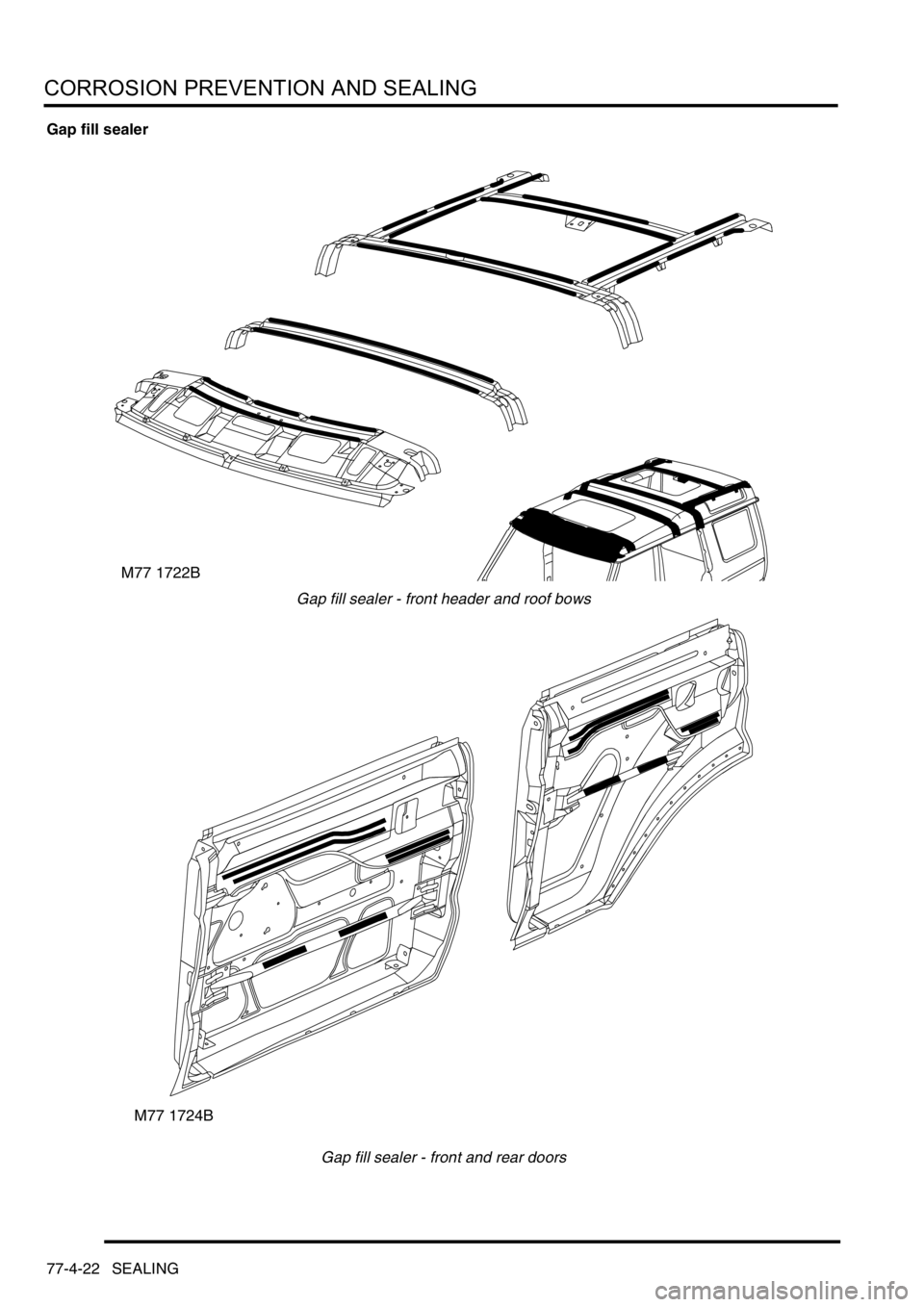
Gap fill sealer
Gap fill sealer - front header and roof bows
Gap fill sealer - front and rear doors
M77 1722B
M77 1724B
Page 1376 of 1672

AIR CONDITIONING
DESCRIPTION AND OPERATION 82-3
Description
General
The air conditioning system controls the temperature, distribution and volume of air supplied to the vehicle interior to
provide a comfortable cabin environment. The system is electronically controlled and features automatic and manual
modes of operation, with separate temperature control of the LH and RH air outlets. The automatic modes provide
optimum control of the system under most ambient conditions and require no manual intervention. The manual modes
allow individual functions of automatic operation to be overridden, to accommodate personal preferences.
The air conditioning system consists of a refrigerant system, a heater assembly and a control system. It also uses the
same air inlet duct and distribution ducts as the Heating and Ventilation system on non air conditioned vehicles.
+ HEATING AND VENTILATION, DESCRIPTION AND OPERATION, Description.
Fresh or recirculated inlet air flows into the heater assembly from the blower in the air inlet duct. In the heater
assembly, the air is cooled and/or heated, depending on the selected cabin temperature and ambient conditions, then
directed to selected air outlets.
On vehicles with rear air conditioning, additional cooling is provided by recirculating air through a second evaporator
and distributing it to outlets in the roof.
+ AIR CONDITIONING, DESCRIPTION AND OPERATION, Description.
Page 1399 of 1672

AIR CONDITIONING
82-26DESCRIPTION AND OPERATION
The rear evaporator/blower assembly cools and dehumidifies air from the cabin and supplies it to the rear distribution
system. The unit is installed on the left side of the loadspace, behind the quarter trim. A grille in the quarter trim allows
air to flow from the loadspace into the evaporator/blower. Refrigerant lines for the evaporator and a condensate drain
tube are attached to the rear floor.
The evaporator and blower are installed in a common housing, which also incorporates the resistor pack for the
blower. A thermostatic expansion valve is integrated into the inlet refrigerant line. A rear blower relay is attached to
the top of the housing.
Evaporator
The evaporator absorbs heat from the recirculated air being supplied to the distribution ducts.
Thermostatic expansion valve
The thermostatic expansion valve meters the flow of refrigerant into the evaporator to match the heat load of the air
passing through the evaporator matrix. A capillary tube, attached to the outlet pipe of the evaporator and connected
to the thermostatic expansion valve, automatically adjusts the valve opening in relation to the refrigerant temperature
at the evaporator outlet.
Blower
The blower controls the volume of air being supplied to the distribution outlets. The blower is an open hub, centrifugal
fan powered by an electric motor. A dust filter is installed over the fan inlet. The blower switch on the control panel
and the resistor pack control the operation of the blower, which can be selected to run at one of four speeds.
Resistor pack
The resistor pack supplies reduced voltages to the blower motor for blower speeds 1, 2 and 3. For blower speed 4,
the resistor pack is bypassed and battery voltage drives the motor at full speed. The pack is installed in the air outlet
from the blower fan, so that any heat generated is dissipated by the air flow.
Distribution system
Air ducts
Ducts connected to the rear evaporator/blower motor assembly distribute air to five vent assemblies in the roof.
Vent assemblies
The vent assemblies allow occupants to control the flow and direction of air. Each vent assembly incorporates a
thumbwheel to regulate flow and moveable vanes to control direction.
Rear control system
The control system operates the blower to control the operation of the rear A/C. The control system consists of two
control switches and a rear blower relay.
Control switches
A rear A/C switch and a blower speed switch are installed on a control panel in the roof lining. The A/C switch is a
latching pushswitch with an amber indicator lamp which illuminates when rear A/C is selected on. The blower speed
switch is a slide switch with a positive detent at each of four speed positions (there is no off position).
Rear blower relay
The rear blower relay controls the electrical supply to the blower.
Page 1400 of 1672

AIR CONDITIONING
DESCRIPTION AND OPERATION 82-27
Operation
The rear A/C only operates if the front A/C is on to pump refrigerant through the rear evaporator/blower assembly.
When the rear A/C switch is selected on, the indicator lamp in the switch illuminates and the rear blower relay is
energised. The rear blower relay switches battery power to the blower motor, which runs at the speed selected on the
blower speed switch.
The air from the blower passes through the evaporator matrix, which absorbs heat from the air. The cooled air is then
supplied to the roof vents through the distribution ducts. The heat absorbed by the refrigerant in the evaporator is
sensed by the thermostatic expansion valve. The thermostatic expansion valve then opens and regulates the flow of
refrigerant through the evaporator in proportion to the amount of heat being absorbed from the air.
When the rear A/C switch is selected off, the blower stops. The thermostatic expansion valve senses the subsequent
decrease in temperature of the refrigerant in the evaporator. The thermostatic expansion valve then closes and stops
the flow of refrigerant, except for a minimal bleed flow.
Page 1420 of 1672
AIR CONDITIONING
REPAIRS 82-47
Duct - centre - rear
$% 82.26.70
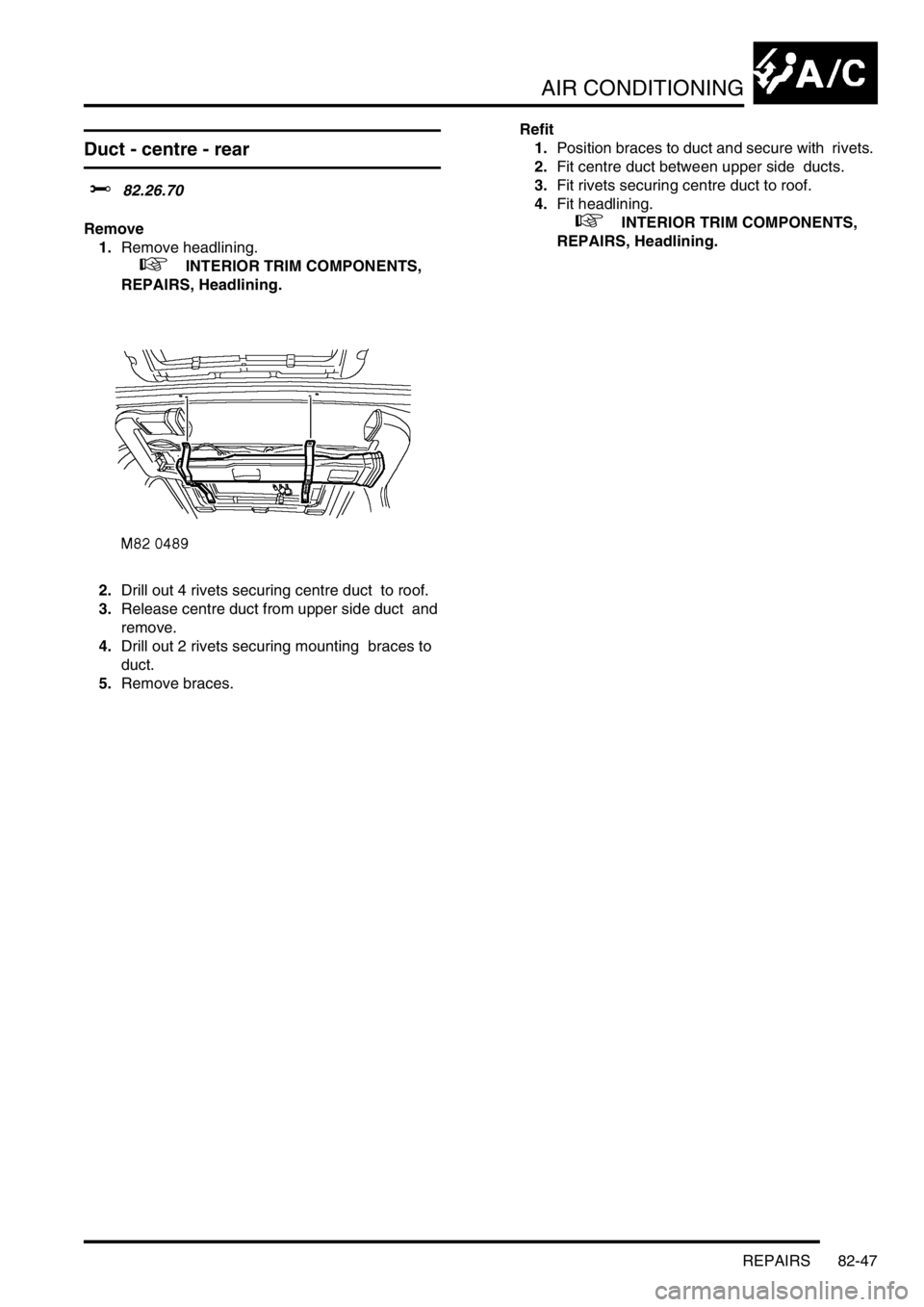
Remove
1.Remove headlining.
+ INTERIOR TRIM COMPONENTS,
REPAIRS, Headlining.
2.Drill out 4 rivets securing centre duct to roof.
3.Release centre duct from upper side duct and
remove.
4.Drill out 2 rivets securing mounting braces to
duct.
5.Remove braces. Refit
1.Position braces to duct and secure with rivets.
2.Fit centre duct between upper side ducts.
3.Fit rivets securing centre duct to roof.
4.Fit headlining.
+ INTERIOR TRIM COMPONENTS,
REPAIRS, Headlining.
Page 1470 of 1672

BODY CONTROL UNIT
DESCRIPTION AND OPERATION 86-3-1
BODY CONTROL UNIT DESCRIPTION AND OPERAT ION
Description
General
The Body Control Unit (BCU) is located behind the passenger glovebox and is connected to the main harness by four
connectors on its bottom edge and an additional connector located on the side of the BCU casing. Mounting the BCU
behind the fascia makes it reasonably inaccessible for intruders to disable the anti-theft system.
The BCU uses solid-state microprocessor control to perform logical operations and timing functions for a variety of
the vehicle's electrically operated systems, these include:
lDoor locking.
lAnti-theft alarm and immobilisation system.
lExterior lighting including direction indicators and hazard warning lamps.
lCourtesy lighting.
lWipers and washers.
lElectric windows and sunroof.
lHeated windows.
The BCU also communicates with several other electronically controlled systems such as the EAT ECU and SLABS
ECU and also has a datalink between the Intelligent Driver Module (IDM) and the instrument pack. The datalink is a
low speed bus capable of transmitting and receiving messages at a data rate of 10,400 bits per second. Additional
inputs and outputs to peripheral devices are included which are necessary for determining vehicle status for particular
logical operations e.g. crank, ignition key inserted, fuel flap enable etc.
The BCU receives its power supply from the engine compartment fuse box, and is protected by a 10 A fuse.
The BCU communicates with the IDM to provide the control signals to perform power switching operations in
conjunction with dedicated relays.
IDM
The IDM is integrated into the passenger compartment fuse box, which is mounted behind the fascia below the
steering column. There are no harnesses between the fuse box and the IDM. The IDM performs the power switching
operations for several of the vehicle's electrical systems.
The IDM communicates with the BCU and the instrument pack via a serial interface. If the BCU or the IDM is replaced,
the communications link between the two units has to be re-established. This can be done either by switching on the
ignition and leaving it on for five minutes, or by using TestBook. The vehicle immobilisation will remain active until the
communications link between the BCU and IDM has been re-established.
Transit mode
To prevent excessive battery drain during transit to overseas markets, the vehicle is placed in a transit mode. The
following functions are disabled when the vehicle is in transit mode:
lVolumetric sensors.
lPassive immobilisation.
lImmobilisation of the vehicle by use of door lock.
lIgnition key interlock.
lElectric seat enable time-out with driver's door open.