roof LAND ROVER DISCOVERY 2002 Repair Manual
[x] Cancel search | Manufacturer: LAND ROVER, Model Year: 2002, Model line: DISCOVERY, Model: LAND ROVER DISCOVERY 2002Pages: 1672, PDF Size: 46.1 MB
Page 1474 of 1672
BODY CONTROL UNIT
DESCRIPTION AND OPERATION 86-3-5
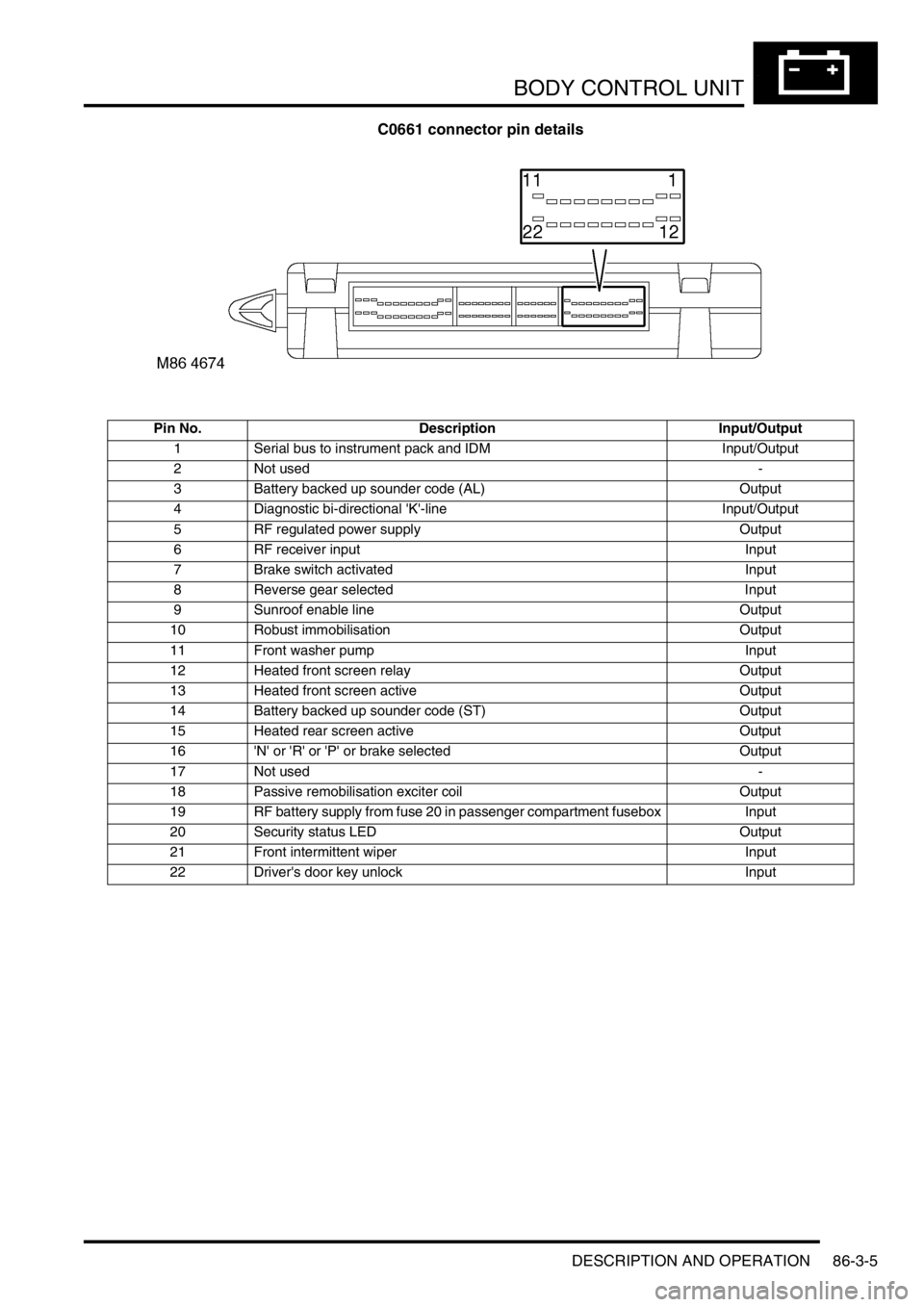
C0661 connector pin details
Pin No. Description Input/Output
1 Serial bus to instrument pack and IDM Input/Output
2 Not used-
3 Battery backed up sounder code (AL) Output
4 Diagnostic bi-directional 'K'-line Input/Output
5 RF regulated power supply Output
6 RF receiver input Input
7 Brake switch activated Input
8 Reverse gear selected Input
9 Sunroof enable line Output
10 Robust immobilisation Output
11 Front washer pump Input
12 Heated front screen relay Output
13 Heated front screen active Output
14 Battery backed up sounder code (ST) Output
15 Heated rear screen active Output
16 'N' or 'R' or 'P' or brake selected Output
17 Not used-
18 Passive remobilisation exciter coil Output
19 RF battery supply from fuse 20 in passenger compartment fusebox Input
20 Security status LED Output
21 Front intermittent wiper Input
22 Driver's door key unlock Input
Page 1480 of 1672

BODY CONTROL UNIT
DESCRIPTION AND OPERATION 86-3-11
Programmable options
The BCU can be programmed with a number of options to satisfy specific market requirements and customer
preferences. The options can be set using TestBook.
Function Option Details
Transmission Manual The vehicle is fitted with manual transmission.
Automatic The vehicle is fitted with automatic transmission.
Front fog lamps None The vehicle is not fitted with front fog lamps.
Main The front fog lamps will operate if the headlamps are on main
beam.
No main The front fog lamps will not operate if the headlamps are on main
beam.
Interlocks None The vehicle is not fitted with key, shift or transfer box interlocks.
Shift The vehicle is fitted with key, shift and transfer box interlocks.
No transfer The vehicle is fitted with key and shift interlocks, but not a transfer
box interlock.
Daylight running lamps None The vehicle is not fitted with daylight running lamps.
No main The daylight running lamps are on if the headlamp main beams
are off.
No heads The daylight running lights are on with headlamp main and dipped
beams off and the gearbox not in Park.
Programmed wash/ wipe Normal The front wipers operate if the front wash is operated.
No wipe The front wipers do not operate if the front wash is operated.
Key-in warning Disabled The ignition key in audible warning is disabled.
Enabled The ignition key in audible warning is generated if the ignition key
is in and the driver's door is open.
Electric front seats None The vehicle is not fitted with electric front seats.
Normal Electric seat adjustment is available for 45 seconds after the
driver's door opens or if the ignition is on.
Ignition II Electric seat adjustment is available if the ignition is on.
Electric front windows Driver cancel The front windows will be disabled 44 seconds after the driver's
door is opened.
All cancel The front windows will be disabled 44 seconds after any door is
opened.
No cancel The front windows will be disabled when the ignition is turned off.
Heated front screen Fitted The vehicle is fitted with heated front screens.
None The vehicle is not fitted with heated front screens.
Rear windows and
sunroofDriver cancel The rear windows and sunroof will be disabled 44 seconds after
the driver's door is opened.
All cancel The rear windows and sunroof will be disabled 44 seconds after
any door is opened.
No cancel The rear windows and sunroof will be disabled when the ignition
switch is turned off.
Gear position indicator
illuminationAlways The automatic gearbox selector illumination is on when the
ignition is on.
Sidelights The automatic gearbox selector illumination is on when the
ignition is on and the sidelights are off.
Hill descent control None The vehicle is not fitted with hill descent control.
Fitted The vehicle is fitted with hill descent control.
Courtesy headlamps Disabled The vehicle is not fitted with courtesy headlamps.
Enabled The vehicle is fitted with courtesy headlamps.
Odometer error warning Disabled The odometer will not flash if there is an odometer error.
Enabled The odometer will flash if there is an odometer error.
Page 1483 of 1672

BODY CONTROL UNIT
86-3-14 DESCRIPTION AND OPERATION
Alarm system
The alarm system comprises the following components:
lRF receiver.
lRF transmitter.
lBCU.
lIDM.
lDoor switches, door lock switches and bonnet switch.
lBattery backed-up sounder (BBUS).
lStatus LED.
On non NAS vehicles, power supply for the alarm sounder and the battery BBUS is provided through two relays in the
passenger compartment fuse box. Each of the coils of the alarm relays are directly connected to the IDM which
controls their operation under the direction of BCU signals received via the serial data bus.
On NAS vehicles, an audible warning is provided through operation of the vehicle horns. The BCU provides an earth
path for the coil of the horn relay to initiate vehicle horn operation.
+ ALARM SYSTEM AND HORN, DESCRIPTION AND OPERATION, Description.
Central Door Locking (CDL)
The BCU carries out the logic control operation for CDL. A CDL switch is mounted on the fascia panel and has two
inputs to the BCU, one for lock and one for unlock.
Door locking and unlocking can be performed using the remote transmitter in the keys and the receiver unit located
above the vehicle's headlining, behind the rear sunroof aperture. The receiver detects the signals sent from the
remote transmitter and sends a decoded signal to the BCU for processing.
Four methods of door locking are available:
lRemote handset locking.
lVehicle key locking.
lCDL switch locking.
lSpeed related locking.
Two security levels of door locking are available, CDL and Superlocking. The anti-theft alarm system works in
conjunction with the CDL system.
Electric windows and sunroof
The BCU controls the logical operations and the timing periods for the electric front windows. The rear windows are
hard-wired and the two electric sunroofs are controlled by a dedicated ECU which is enabled by the BCU.
The front windows are electrically operated using two rocker switches located in the centre console. Electric motors
are located in each of the front doors.
The rear windows are enabled by the IDM controlling the operation of the rear window relay located in the passenger
compartment fuse box.
Wipers and washers
The wiper and washer functions are controlled by the BCU and the IDM.
The front wipers and washers are operated from the switch stalk located on the right hand side of the steering column
and only operate when the ignition switch is in position I or II. The front wipers are operated by a motor located below
the windscreen plenum.
+ WIPERS AND WASHERS, DESCRIPTION AND OPERATION, Description.
Page 1491 of 1672

BODY CONTROL UNIT
86-3-22 DESCRIPTION AND OPERATION
The following outputs are generated by the BCU dependent on the prevailing logic conditions and the input requests
the BCU has detected:
lUnlock all doors enable.
lLock passenger and rear doors enable.
lSuperlock all doors enable.
lLock driver's door enable.
All lock/ unlock pulses have a duration of 800 ms.
Input/Output logic for door lock/unlock
To determine if the vehicle speed is appropriate for enabling speed related locking, the BCU uses the vehicle speed
signal supplied over the serial data bus from the instrument pack.
Electric windows and sunroof
Three modes of operation are available:
lDriver cancel – the front windows, rear windows and sunroof will be disabled 44 seconds after the driver's door
is opened.
lAll cancel – The front windows, rear windows and sunroof will be disabled 44 seconds after any door is opened.
lNo cancel – the front windows, rear windows and sunroof will be disabled when the ignition is turned off.
The BCU will allow window and sunroof operation when the ignition key is in position II. The BCU provides a voltage
to the window control switches. When the switches are pressed, they provide a path to earth to complete the circuit
and initiate window operation. Window and sunroof operation is suspended when the ignition switch is in the crank
position.
For front window operation, the BCU checks the status of the following inputs:
lIgnition state.
lDriver's door open.
lPassenger or rear door open.
lFront right window down.
lFront right window up.
lFront left window down.
lFront left window up.
lRight window stall detect.
lLeft window stall detect.
The front window motors are directly connected to the BCU by two wires. Each wire can be used as a feed or return,
dependent on the required direction for motor operation (open or close). The BCU provides the following outputs:
lRight window up.
lRight window down.
lLeft window up.
lLeft window down.
The electric front windows are enabled when the ignition switch is in position II and is disabled if the ignition switch is
moved to the crank position.
Output/Request Superlock all
doors enableUnlock all doors
enableLock driver's
door enableLock passenger
and rear doors
enable
Unlock request 0100
Lock request 0011
Superlock request 1011
Single point entry request 0101
Lock passenger and rear doors
request0001
Page 1492 of 1672

BODY CONTROL UNIT
DESCRIPTION AND OPERATION 86-3-23
The BCU checks the status of the following inputs to determine when to provide the rear window enable and sunroof
enable output signals:
lIgnition state.
lDriver's door open.
lPassenger or rear door open.
The rear window enable and sunroof enable lines are on when the ignition switch is in position II, and are switched
off if the ignition switch is moved to the crank position.
The BCU monitors the circuit current draw when the windows are operating to detect the occurrence of a stall
condition. If the BCU determines that the window has stalled, it will cut the power supply to stop the operation of the
window motor. The BCU only starts to check for a stall condition after the window has been operating for 500 ms. This
delay period enables the initial current surge to pass and eliminates false detections of window stall. A stall condition
is activated when a nominal current value is exceeded for a period greater than 300 ms.
If the BCU detects that it has been operating the same window motor in one direction for more than 10
± 0.2 seconds,
without the BCU detecting a stall condition or the control switch being released, it will automatically stop operation of
the window motor (timed out). Window operation can resume when the window switch is released and pressed again.
If the window was operating in one touch mode, the window operation will resume on the next press of the window
switch.
One touch mode automatically lowers the window to its fully open position, without the need for the window switch to
be kept pressed for the duration of the window travel. One touch mode is initialised if the window switch is pressed
for a period of less than 0.4
± 0.2 second. One touch mode continues to lower the window until the BCU detects:
lA stall condition exists (window has reached bottom of travel).
lWindow switch is repressed in either direction for more than 0.4
± 0.2 second.
lThe BCU has operated the motor for a period greater than 10
± 0.2 seconds.
A timeout function is included which allows the windows and sunroofs to be operated for a period of 44
± 1 seconds
after the ignition key has been removed from the ignition switch. The timeout function will be cancelled if the BCU
detects the following conditions:
lThe driver's door has been closed after the ignition has been switched off.
lAny door open after the ignition is switched off.
The preconditions are programmed into the BCU dependent on market specification.
The BCU does not directly control rear window operation, but it can request the IDM to remove the power feed to the
rear windows. The IDM enables power supply to be provided to the rear lift relay in the passenger fuse box. When the
relay coil is energised the relay contacts close and power is applied to the rear window motor. If the window lift
isolation switch located in the centre console is latched out, the earth path from the LH and RH rear door window
switches is broken and operation of the rear window motors through the use of the rear window switches is prevented.
Rear window operation using the console switches is not affected by the isolation switch.
In the event of a communications link failure occurring while rear window enable is on, the relay remains on until the
ignition switch is turned to the off position.
Page 1514 of 1672

ALARM SYSTEM AND HORN
DESCRIPTION AND OPERATION 86-4-5
Description
General
The anti-theft system deters the theft of the vehicle with both active and passive systems. The active systems monitor
the vehicle perimeter and, in some markets the vehicle interior, for intrusion. If the system detects intrusion, an alarm
sounds. The passive systems include a vehicle immobiliser as well as protection against intrusion through super
locking the doors. The vehicle is immobilised whenever the ignition key is removed from the ignition switch. Super
locking prevents the interior door handles from opening the doors. In addition, there are many features and functions
that enhance system operation.
It is possible to perform the various functions associated with the anti-theft system remotely. To accomplish this, the
handset generates a radio frequency when the lock button or unlock button is depressed. This signal is transmitted
to the Body Control Unit (BCU) via a receiver located in front of rear sunroof beneath the headlining. Precise alignment
of the handset to the receiver is not necessary. The approximate operating range between the handset and the
receiver is 10 metres (33 feet).
It is important to understand the configuration of the system on each particular vehicle. There are many
different combinations of features with dedicated operating modes. System configuration for each vehicle
can be determined using TestBook.
The anti-theft system is controlled centrally by the BCU, which is located below and behind the passenger glovebox.
A serial communication link communicates between the Intelligent Driver Module (IDM) located within the fusebox,
the BCU and the LED located in the instrument panel.
The state of the alarm is stored in the BCU. If the battery is disconnected while the alarm is armed, the alarm will be
triggered when the battery is reconnected.
NOTE: Disconnecting the battery while the alarm is armed triggers the alarm. Always disarm the alarm system before
disconnecting the battery.
The BCU also receives inputs from the following components:
lIgnition key in sensor.
lIgnition switch.
lFuel cut off switch.
lFuel flap release switch.
The BCU also interacts with the following components:
lStarter relay.
lVehicle horns.
lDirection indicators.
lFuel flap release actuator.
lCourtesy lamps.
Page 1520 of 1672

ALARM SYSTEM AND HORN
DESCRIPTION AND OPERATION 86-4-11
Central door locking switches
A momentary action switch mounted on the fascia allows for central door locking/unlocking from within the vehicle.
The switch is mounted adjacent to the clock.
Input/Output
The input from the central door locking/unlocking switch to the BCU is either zero volts or an open circuit. Zero volts
indicates the switch is closed. An open circuit indicates that the switch is open. When the BCU sees an open circuit,
it pulls the input high internally.
The central door locking/unlocking switch has a dedicated signal input to the BCU. This allows the BCU to identify
the lock/ unlock request.
TestBook provides the ability to monitor the real time state of the central door locking/ unlocking switch.
Handset and receiver
The handset is incorporated in the key. It uses coded radio frequency signals to lock, unlock and super lock the vehicle
remotely with a range of up to 10 metres (33 ft). The handset also mobilises the vehicle by transmitting a
remobilisation signal when the handset is within range of the passive remobilisation exciter coil.
The receiver is located in front of the rear sunroof beneath the headlining. Signals transmitted by the handset are
distributed to the BCU via the receiver.
Input/Output
The BCU supplies the receiver with a 12 volts power supply. On receiving a valid signal from the handset, the receiver
transmits a 1000 baud signal to the BCU to allow locking/unlocking of the vehicle.
TestBook provides the ability to monitor the real time state of the remote receiver.
Page 1537 of 1672

ALARM SYSTEM AND HORN
86-4-28 REPAIR
Receiver - alarm system - models with
sunroof
$% 86.77.31
Remove
1.Remove trim seal from rear sunroof.
2.Release sunroof switch and remove screw
securing headlining.
3.Remove 2 nuts securing receiver to roof panel,
disconnect multiplug and remove receiver.
Refit
1.Connect multiplug to receiver, fit to roof panel,
tighten nuts to 10 Nm (7 lbf.ft).
2.Fit and tighten screw securing headlining.
3.Fit sunroof switch
4.Fit sunroof trim seal.
5.Connect multiplug to receiver, fit to roof panel
and secure with nuts tighten to 10 Nm (7 lbf.ft).
Receiver - alarm system - models
without sunroof
$% 86.77.31
Remove
1.Release rear door upper trim finisher.
2.Remove 3 Torx bolts securing rear headrest,
remove headrest. Repeat operation on
opposite side.
3.Remove both 'D' post trim casings.
+ INTERIOR TRIM COMPONENTS,
REPAIRS, Trim casing - 'D' post.
4.Release rear interior light lens, remove 2 nuts
to release light.
5.Release 2 studs securing rear headlining,
carefully lower lining.
6.Remove 2 studs securing alarm receiver.
7.Disconnect multiplug from alarm receiver and
remove receiver.
Refit
1.Connect multiplug to receiver.
2.Position receiver and secure with studs.
3.Position rear end of headlining, secure with
studs.
4.Position interior light fit and tighten nuts.
5.Fit interior light lens.
6.Fit both 'D' post trim casings.
+ INTERIOR TRIM COMPONENTS,
REPAIRS, Trim casing - 'D' post.
7.Fit 3 Torx bolts securing headrest and tighten to
25 Nm (18 lbf.ft). Repeat operation on opposite
side.
8.Fit rear door upper finisher
M86 5632
M86 5762
Page 1573 of 1672
HARNESSES
86-7-2 REPAIRS
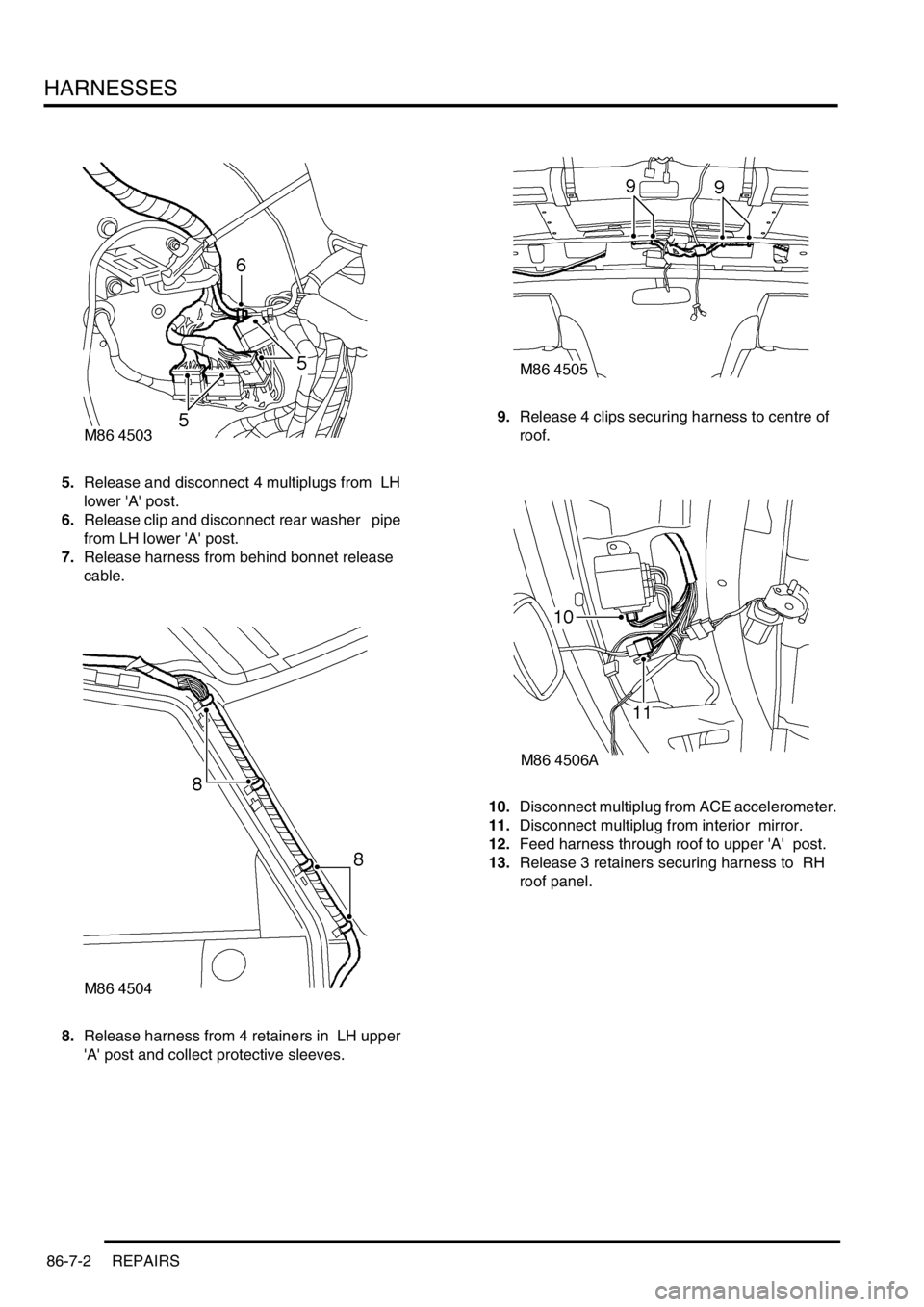
5.Release and disconnect 4 multiplugs from LH
lower 'A' post.
6.Release clip and disconnect rear washer pipe
from LH lower 'A' post.
7.Release harness from behind bonnet release
cable.
8.Release harness from 4 retainers in LH upper
'A' post and collect protective sleeves. 9.Release 4 clips securing harness to centre of
roof.
10.Disconnect multiplug from ACE accelerometer.
11.Disconnect multiplug from interior mirror.
12.Feed harness through roof to upper 'A' post.
13.Release 3 retainers securing harness to RH
roof panel.
Page 1574 of 1672
HARNESSES
REPAIRS 86-7-3
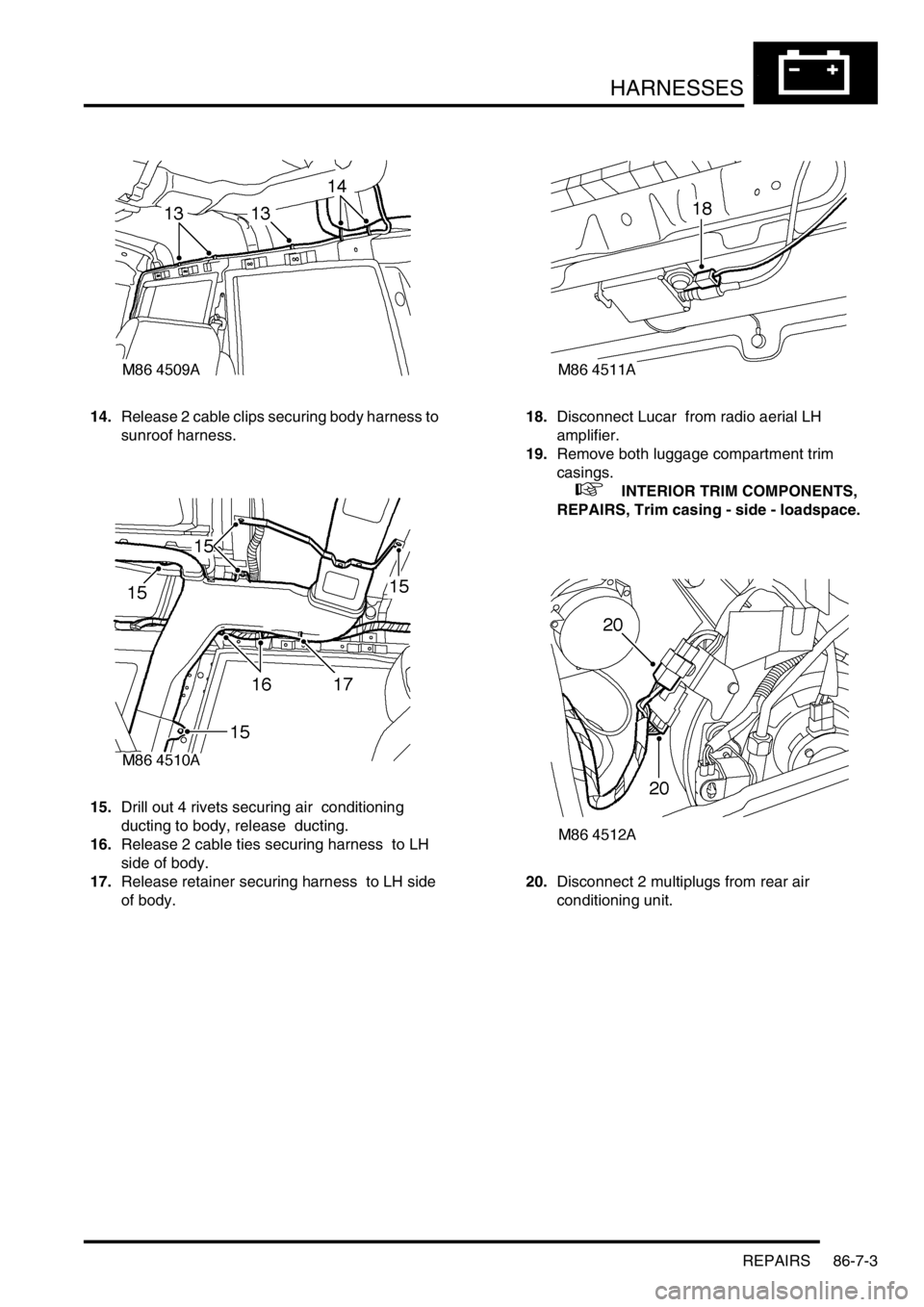
14.Release 2 cable clips securing body harness to
sunroof harness.
15.Drill out 4 rivets securing air conditioning
ducting to body, release ducting.
16.Release 2 cable ties securing harness to LH
side of body.
17.Release retainer securing harness to LH side
of body. 18.Disconnect Lucar from radio aerial LH
amplifier.
19.Remove both luggage compartment trim
casings.
+ INTERIOR TRIM COMPONENTS,
REPAIRS, Trim casing - side - loadspace.
20.Disconnect 2 multiplugs from rear air
conditioning unit.