earth LAND ROVER DISCOVERY 2002 Manual PDF
[x] Cancel search | Manufacturer: LAND ROVER, Model Year: 2002, Model line: DISCOVERY, Model: LAND ROVER DISCOVERY 2002Pages: 1672, PDF Size: 46.1 MB
Page 470 of 1672

ENGINE MANAGEMENT SYSTEM - V8
DESCRIPTION AND OPERATION 18-2-13
Input/Output
Because of the nature of its operation the CKP sensor does not require any electrical input source. The CKP sensor
is a 3 pin variable reluctance sensor generating its own electrical output. The 2 output sources from the sensor are
earthed via pin 46 of connector C0636 of the ECM and sensor output is via pin 32 of connector C0636 of the ECM.
This output is in the form of an ac voltage waveform. The 3rd pin is used by the ECM as an earth screen, this screen
protects the integrity of the CKP sensor signal to ensure that outside electrical interference is eliminated, it is
controlled via pin 45 of connector C0636 of the ECM. The ac voltage generated from the CKP sensor is relative to
engine speed.
Typical CKP sensor output
The above readings are dependent upon correct air gap between the tip of the CKP sensor and the passing teeth of
the reluctor ring. The correct air gap between the tip of the CKP sensor and the passing teeth of the reluctor ring can
be set by the correct fitting of a spacer as follows:
l9.2 mm spacer for vehicles with manual gearbox fitted.
l18 mm spacer for vehicles with automatic gearbox fitted.
It is vital that the correct air gap is maintained, if the air gap becomes too wide the CKP signal becomes too weak,
causing possible engine misfires to occur.
The CKP sensor can fail the following ways or supply incorrect signal:
lSensor assembly loose.
lIncorrect spacer fitted.
lSensor open circuit.
lSensor short circuit.
lIncorrect fitting and integrity of the sensor.
lWater ingress at sensor connector
lECM unable to detect the software reference point.
lFerrous contamination of crank sensor pin/reluctor
Page 472 of 1672
ENGINE MANAGEMENT SYSTEM - V8
DESCRIPTION AND OPERATION 18-2-15
Input/Output
Electrical input to the camshaft position sensor is from fuse 2 located in engine compartment fuse box. One output is
sensor earth, the other is the signal output to the ECM via pin 20 of connector C0636.
The CMP sensor can fail the following ways or supply incorrect signal:
lSensor open circuit.
lShort circuit to vehicle battery supply.
lShort circuit to vehicle earth.
lIncorrect fitting of the sensor.
lExcessive camshaft gear wheel tolerance.
lExcessive camshaft endfloat.
lCamshaft and crankshaft misalignment.
lSpeed signal correlation with CKP sensor signal.
lCam wheel magnetised / residual magnetism
In the event of a CMP sensor signal failure any of the following symptoms may be observed:
lIgnition timing reverts to default values from ECM memory.
lLoss of cylinder correction.
lLoss of active knock control.
lLoss of active knock control diagnostics.
lLoss of cylinder identification for misfire diagnostics.
lLoss of quick synchronisation of crankshaft and camshaft for cranking/ start up.
lFuel injection could be 360
° out of phase.
lFront HO
2S sensor ageing period diagnostic disabled (NAS only)
Should a malfunction of the component occur the following fault code may be evident and can be retrieved by
TestBook:
The fault condition has to be detected for more than 100 cam pulses (25 revolutions) when the engine speed is greater
than 500 rev/min.
Engine Coolant Temperature (ECT) sensor (C0196)
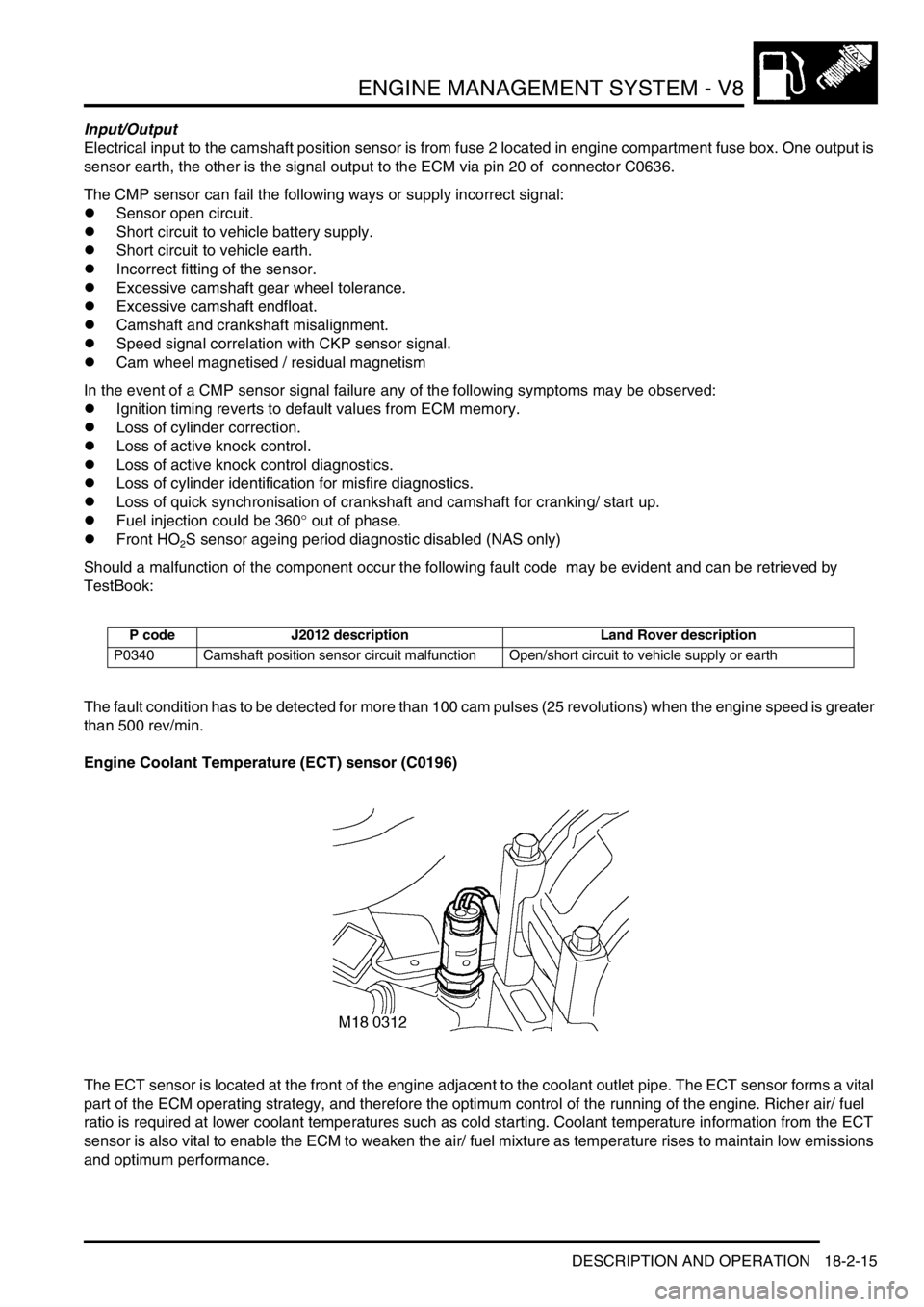
The ECT sensor is located at the front of the engine adjacent to the coolant outlet pipe. The ECT sensor forms a vital
part of the ECM operating strategy, and therefore the optimum control of the running of the engine. Richer air/ fuel
ratio is required at lower coolant temperatures such as cold starting. Coolant temperature information from the ECT
sensor is also vital to enable the ECM to weaken the air/ fuel mixture as temperature rises to maintain low emissions
and optimum performance.
P code J2012 description Land Rover description
P0340 Camshaft position sensor circuit malfunction Open/short circuit to vehicle supply or earth
Page 473 of 1672

ENGINE MANAGEMENT SYSTEM - V8
18-2-16 DESCRIPTION AND OPERATION
For NAS vehicles with secondary air injection, the signal from the ECT sensor is monitored at engine start, to
determine whether the conditions are cold enough to warrant secondary air injection to be employed. The ECT sensor
is then monitored to switch off the secondary air injection when the required engine coolant temperature has been
attained.
+ EMISSION CONTROL - V8, DESCRIPTION AND OPERATION, Secondary air injection system.
The ECT works as a Negative Temperature Coefficient (NTC) sensor. As temperature rises, the resistance in the
sensor decreases, as temperature decreases, the resistance in the sensor increases. The ECT sensor forms part of
a voltage divider chain with a pull up resistor within the ECM. Consequently as the ECT sensor resistance changes,
the analogue voltage at the input signal from the ECT sensor to the ECM will be adjusted which corresponds to the
temperature of the engine coolant. With this information, the ECM can implement the correct strategies for cold start,
warm up etc. The ECM supplies the instrument cluster with a pulse width modulated (PWM) coolant temperature
signal to drive the temperature gauge.
Input/Output
The electrical input and output to and from the ECT sensor are reference voltage and sensor earth. The ECM provides
the ECT sensor with a 5 volt reference via pin 22 of connector C0636 of the ECM, and earth via pin 21 of connector
C0636 of the ECM. The normal operating parameters of the ECT sensor are as follows
Should the sensor fail the ECM has a back up strategy that uses a changing default value during warm up based on
the signal from the inlet air temperature sensor. When the strategy default value reaches 60
°C (140 °F), the ECM
implements a fixed default value of 85
°C (185 °F). It will also illuminate the MIL.
M124704A
0
20
40
60
80
100
120
140
160
0
0.5
1
1.5
2
2.5
3
3.5
4
4.5
5
VkΩ
kΩ
V
°C
145-50-35-20-5102540557085100115130
Page 474 of 1672

ENGINE MANAGEMENT SYSTEM - V8
DESCRIPTION AND OPERATION 18-2-17
The ECT sensor can fail the following ways or supply incorrect signal:
lSensor open circuit.
lShort circuit to vehicle supply.
lShort circuit to earth.
lIncorrect mechanical fitting.
lSignal fixed above 40
°C (140 °F) will not be detected.
lSignal fixed below 40
°C (140 °F) will be detected.
In the event of an ECT sensor signal failure any of the following symptoms may be observed:
lDifficult cold start.
lDifficult hot start.
lDriveability concern.
lMIL illuminated.
lInstrument cluster temperature warning lamp illuminated.
lTemperature gauge reads excessively hot.
lTemperature gauge reads excessively cold.
lCooling fan will not run.
There are three types of ECT sensor diagnostic checks:
lThe ECT sensor signal is within limits, but is inaccurate – the engine has to be running and the signal indicates
a coolant temperature below 40
°C (104°F). The signal differs too much from the coolant temperature model for
longer than 2.53 seconds.
lThe ECT sensor signal is greater than the maximum threshold value – the ECM has to be powered up to perform
the diagnostic, but the engine does not need to be running.
lThe ECT sensor signal is less than the minimum threshold value – the ECM has to be powered up to perform
the diagnostic, but the engine does not need to be running.
Should a malfunction of the component occur the following fault codes may be evident and can be retrieved by
TestBook:
P code J2012 description Land Rover description
P0116 Engine coolant temperature circuit/range
performance problemSignal differs too much from temperature model for
longer than 2.53s
P0117 Engine coolant temperature circuit low input Open circuit or short circuit to battery supply
P0118 Engine coolant temperature circuit high input Short circuit to earth
Page 476 of 1672

ENGINE MANAGEMENT SYSTEM - V8
DESCRIPTION AND OPERATION 18-2-19
Input/Output
The ECM provides the thermostat monitoring sensor with a 5 volt reference via pin 21 of connector C0635 of the ECM,
and an earth via pin 5 of connector C0635 of the ECM.
There are three types of thermostat monitoring sensor diagnostic checks:
lSensor signal is above maximum threshold. For the ECM to register this as a fault, and illuminate the MIL, the
temperature registered by the thermostat monitoring sensor must be above 140
°C (284 °F) for more than 1
second.
lSensor signal is below minimum threshold. For the ECM to register this as a fault, and illuminate the MIL, the
temperature registered by the thermostat monitoring sensor must be below -33
°C (-27 °F) for more than 1
second, while the inlet air temperature reading is greater than -32
°C (-25 °F).
lSignal difference between ECT sensor and thermostat monitoring sensor is below maximum threshold. For the
ECM to register this as a fault, and illuminate the MIL, the following conditions must exist:
lNo maximum or minimum threshold signal faults exist.
lNo faults are recorded against the thermostat monitoring sensor or vehicle speed signal.
lEngine not in idle speed control.
lFuel cut-off not active.
lEngine speed is greater than 400 rpm.
lRoad speed is greater than 0 mph.
lIntegrated mass air flow from engine start to fuel cut-off is greater than set value (between 3 kg and 10 kg
dependent upon engine coolant temperature at engine start).
lEngine coolant temperature at engine start is between 9
°C and 39 °C (48 °F and 102 °F).
lHigh range is selected.
lDelay time before thermostat monitoring is enabled is between set limits (between 50 and 500 seconds
dependent upon engine coolant temperature at engine start).
lEngine coolant temperature is greater than 90
°C (194 °F).
lThe difference between the ECT sensor reading and the thermostat monitoring sensor reading is less than
39
°C (102 °F).
Page 477 of 1672
ENGINE MANAGEMENT SYSTEM - V8
18-2-20 DESCRIPTION AND OPERATION
Should a malfunction occur, the following fault codes may be evident and can be retrieved by TestBook:
Mass Air Flow (MAF)/ Inlet Air Temperature (IAT) sensor (C0149)
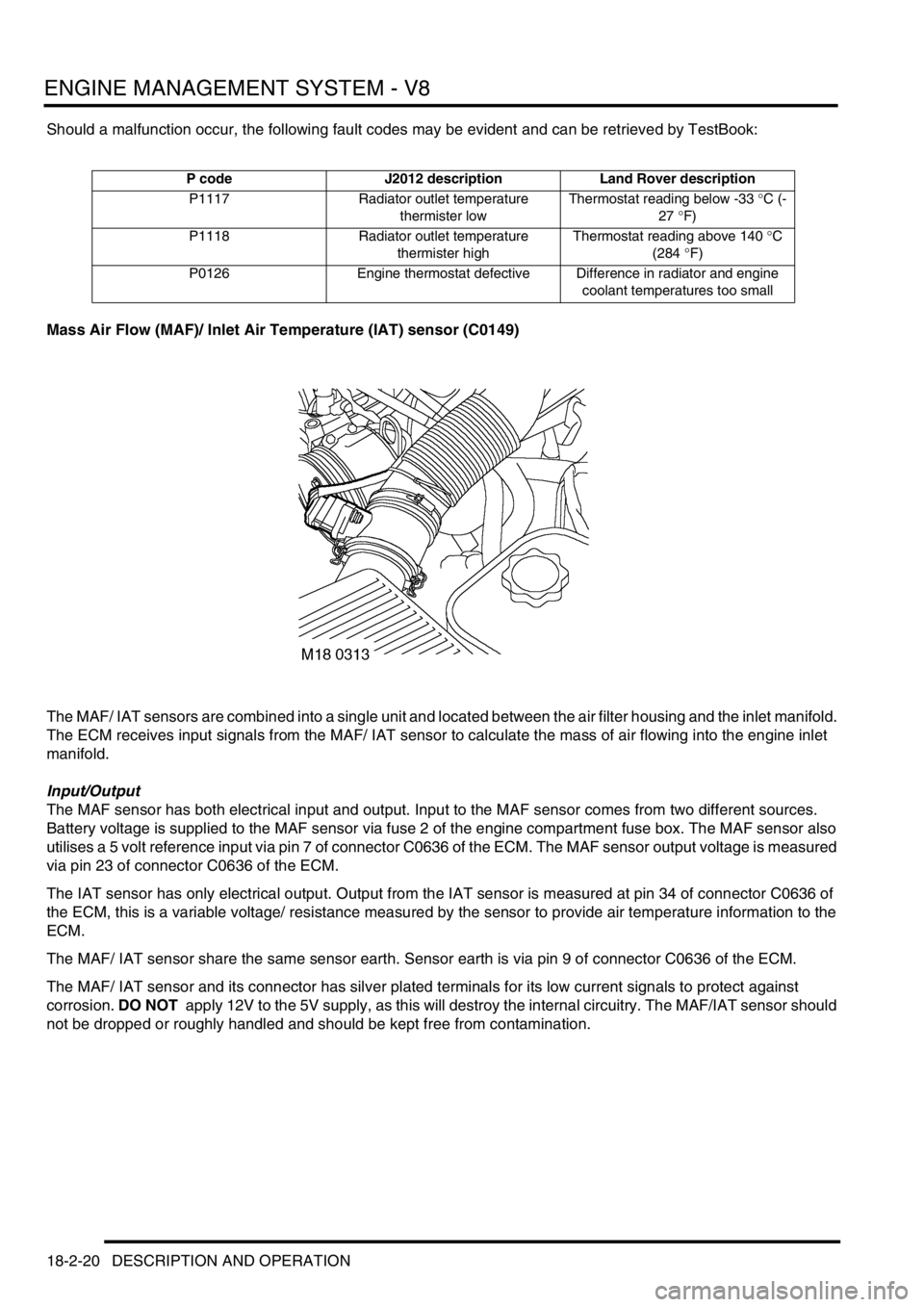
The MAF/ IAT sensors are combined into a single unit and located between the air filter housing and the inlet manifold.
The ECM receives input signals from the MAF/ IAT sensor to calculate the mass of air flowing into the engine inlet
manifold.
Input/Output
The MAF sensor has both electrical input and output. Input to the MAF sensor comes from two different sources.
Battery voltage is supplied to the MAF sensor via fuse 2 of the engine compartment fuse box. The MAF sensor also
utilises a 5 volt reference input via pin 7 of connector C0636 of the ECM. The MAF sensor output voltage is measured
via pin 23 of connector C0636 of the ECM.
The IAT sensor has only electrical output. Output from the IAT sensor is measured at pin 34 of connector C0636 of
the ECM, this is a variable voltage/ resistance measured by the sensor to provide air temperature information to the
ECM.
The MAF/ IAT sensor share the same sensor earth. Sensor earth is via pin 9 of connector C0636 of the ECM.
The MAF/ IAT sensor and its connector has silver plated terminals for its low current signals to protect against
corrosion. DO NOT apply 12V to the 5V supply, as this will destroy the internal circuitry. The MAF/IAT sensor should
not be dropped or roughly handled and should be kept free from contamination.
P code J2012 description Land Rover description
P1117 Radiator outlet temperature
thermister lowThermostat reading below -33 °C (-
27 °F)
P1118 Radiator outlet temperature
thermister highThermostat reading above 140 °C
(284 °F)
P0126 Engine thermostat defective Difference in radiator and engine
coolant temperatures too small
Page 478 of 1672
ENGINE MANAGEMENT SYSTEM - V8
DESCRIPTION AND OPERATION 18-2-21
Mass Air Flow (MAF) Sensor
The MAF sensor utilises a “hot film” element contained in the air intake duct to monitor the mass of the air flow being
drawn into the engine. The MAF sensor contains two sensing elements, one element is controlled at ambient
temperature (e.g. 25
°C (77°F)), while the other is heated to 200°C (360°F) above the ambient temperature (e.g. 225°C
(437
°F)).
When the intake air passes the heated element, it cools it down, so lowering the resistance of the hot film element. In
order to maintain the same temperature, the circuit to the heated element has to supply more current. The change in
current causes a corresponding change in potential difference to be detected in the monitoring circuit. This change is
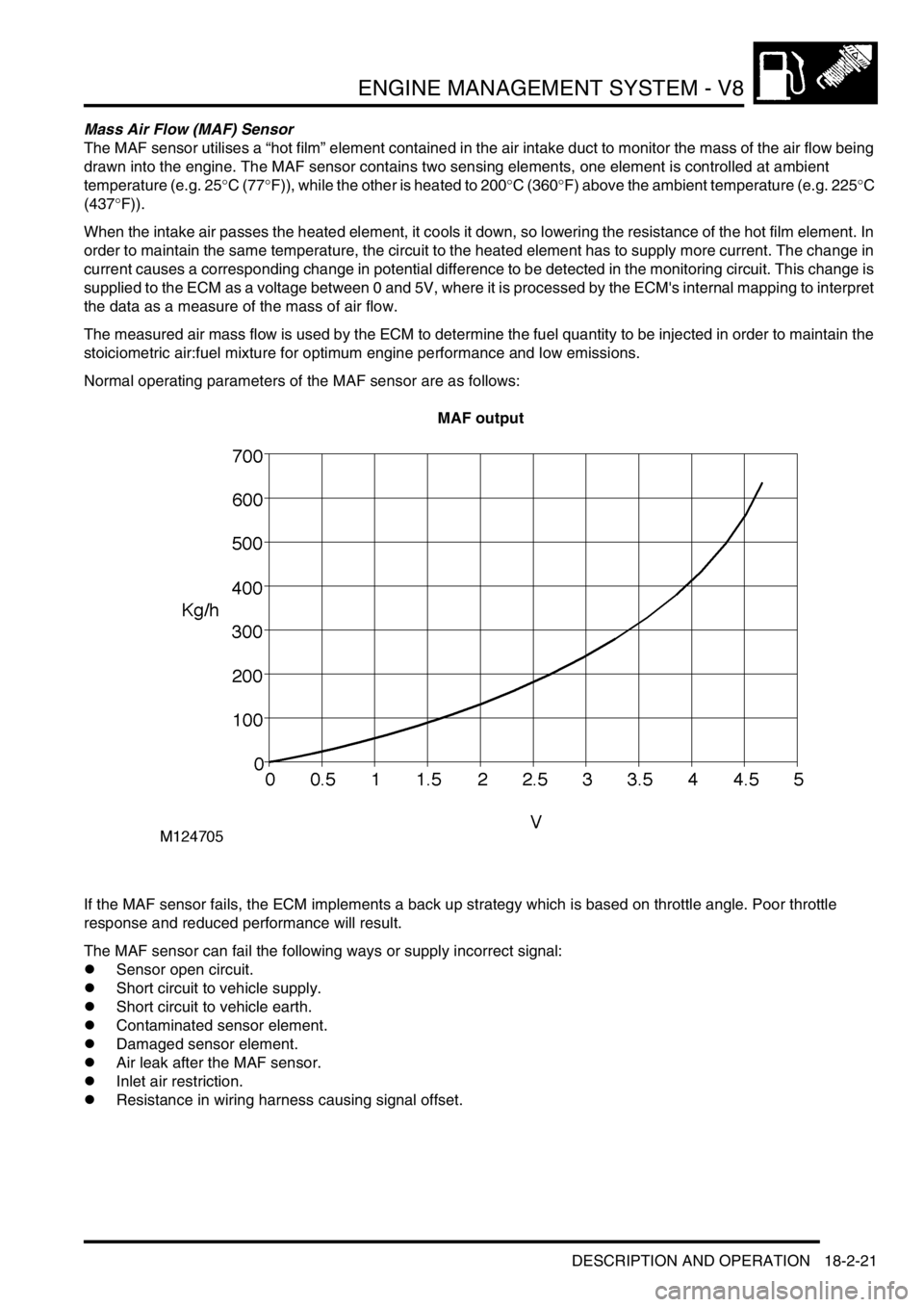
supplied to the ECM as a voltage between 0 and 5V, where it is processed by the ECM's internal mapping to interpret
the data as a measure of the mass of air flow.
The measured air mass flow is used by the ECM to determine the fuel quantity to be injected in order to maintain the
stoiciometric air:fuel mixture for optimum engine performance and low emissions.
Normal operating parameters of the MAF sensor are as follows:
MAF output
If the MAF sensor fails, the ECM implements a back up strategy which is based on throttle angle. Poor throttle
response and reduced performance will result.
The MAF sensor can fail the following ways or supply incorrect signal:
lSensor open circuit.
lShort circuit to vehicle supply.
lShort circuit to vehicle earth.
lContaminated sensor element.
lDamaged sensor element.
lAir leak after the MAF sensor.
lInlet air restriction.
lResistance in wiring harness causing signal offset.
Page 480 of 1672

ENGINE MANAGEMENT SYSTEM - V8
DESCRIPTION AND OPERATION 18-2-23
Should the IAT sensor fail, the ECM defaults to an assumed air temperature of 45 °C (113 °F).
The IAT sensor can fail the following ways or supply incorrect signal:
lSensor open circuit.
lShort circuit to vehicle battery supply.
lShort circuit to vehicle earth.
lIncreased sensor resistance.
lDamaged sensor element.
In the event of an IAT sensor signal failure any of the following symptoms may be observed:
lAdaptive fuelling disabled.
lIdle speed adaption disabled.
lCatalyst monitoring affected due to exhaust temperature model.
lIdle speed actuator test disabled.
lWarm up ignition angle affected.
lCondenser fan hot restart inhibited.
There are two types of IAT sensor diagnostic checks:
lThe IAT sensor signal is less than the minimum threshold – the engine has to have been running for longer than
180 seconds, and idle speed control must have been operational for longer than 10 seconds. No fuel cut off is
active. The IAT sensor signal must be less than -35
°C (-31°F) for longer than 200 ms.
lThe IAT sensor signal is greater than the maximum threshold – the ECM has to be powered up (engine does not
need to be running), and the signal must be greater than 140
°C (284°F) for longer than 200 ms.
If the IAT sensor fails the following fault codes will be produced and can be retrieved by TestBook:
P code J2012 description Land Rover description
P0112 Intake air temperature circuit low input Intake air temperature signal less than minimum
threshold, after time for exhaust to warm up
P0113 Intake air temperature circuit high input Intake air temperature signal greater than maximum
threshold
Page 482 of 1672
ENGINE MANAGEMENT SYSTEM - V8
DESCRIPTION AND OPERATION 18-2-25
Throttle Position (TP) sensor (C0175)
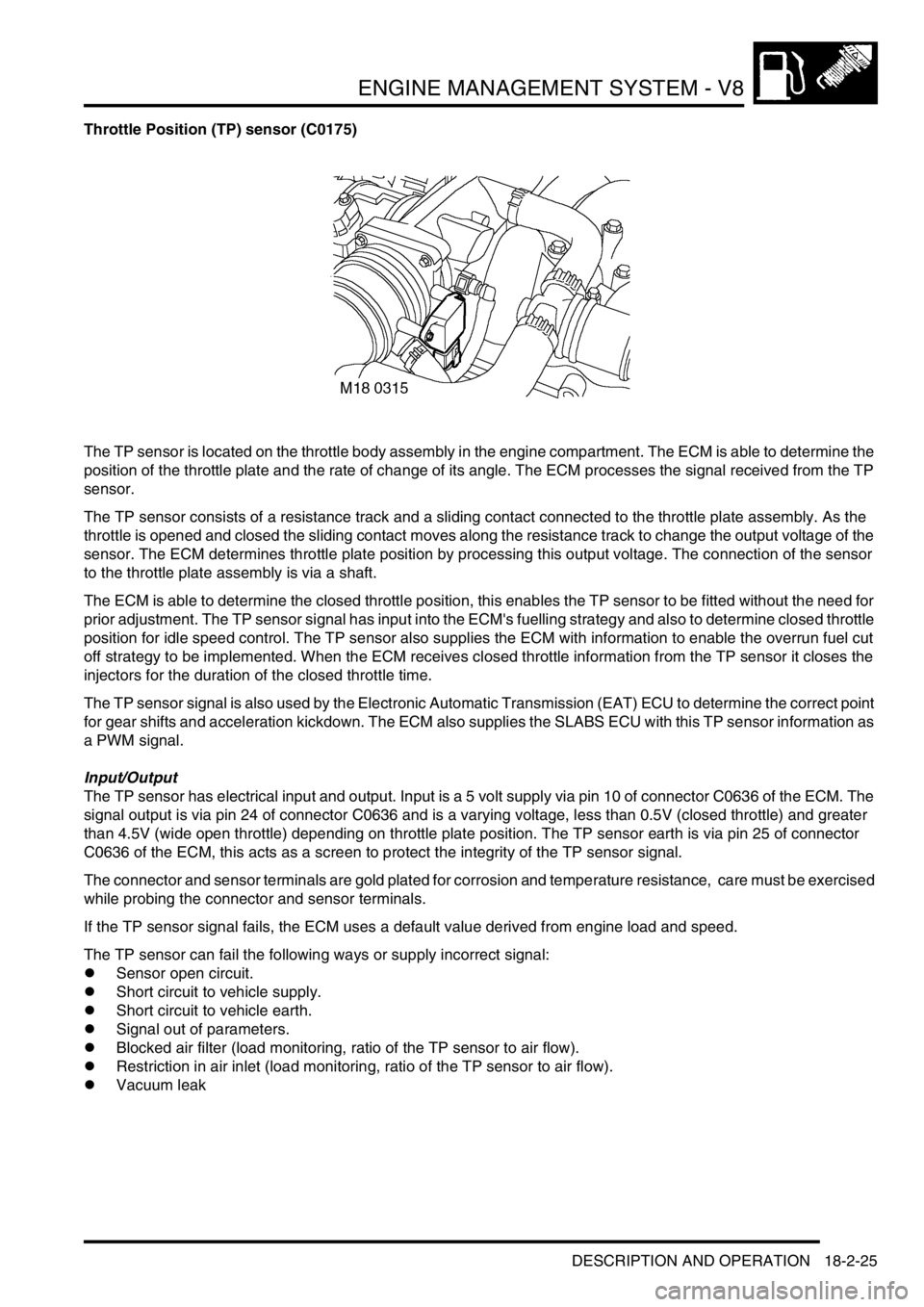
The TP sensor is located on the throttle body assembly in the engine compartment. The ECM is able to determine the
position of the throttle plate and the rate of change of its angle. The ECM processes the signal received from the TP
sensor.
The TP sensor consists of a resistance track and a sliding contact connected to the throttle plate assembly. As the
throttle is opened and closed the sliding contact moves along the resistance track to change the output voltage of the
sensor. The ECM determines throttle plate position by processing this output voltage. The connection of the sensor
to the throttle plate assembly is via a shaft.
The ECM is able to determine the closed throttle position, this enables the TP sensor to be fitted without the need for
prior adjustment. The TP sensor signal has input into the ECM's fuelling strategy and also to determine closed throttle
position for idle speed control. The TP sensor also supplies the ECM with information to enable the overrun fuel cut
off strategy to be implemented. When the ECM receives closed throttle information from the TP sensor it closes the
injectors for the duration of the closed throttle time.
The TP sensor signal is also used by the Electronic Automatic Transmission (EAT) ECU to determine the correct point
for gear shifts and acceleration kickdown. The ECM also supplies the SLABS ECU with this TP sensor information as
a PWM signal.
Input/Output
The TP sensor has electrical input and output. Input is a 5 volt supply via pin 10 of connector C0636 of the ECM. The
signal output is via pin 24 of connector C0636 and is a varying voltage, less than 0.5V (closed throttle) and greater
than 4.5V (wide open throttle) depending on throttle plate position. The TP sensor earth is via pin 25 of connector
C0636 of the ECM, this acts as a screen to protect the integrity of the TP sensor signal.
The connector and sensor terminals are gold plated for corrosion and temperature resistance, care must be exercised
while probing the connector and sensor terminals.
If the TP sensor signal fails, the ECM uses a default value derived from engine load and speed.
The TP sensor can fail the following ways or supply incorrect signal:
lSensor open circuit.
lShort circuit to vehicle supply.
lShort circuit to vehicle earth.
lSignal out of parameters.
lBlocked air filter (load monitoring, ratio of the TP sensor to air flow).
lRestriction in air inlet (load monitoring, ratio of the TP sensor to air flow).
lVacuum leak
Page 484 of 1672

ENGINE MANAGEMENT SYSTEM - V8
DESCRIPTION AND OPERATION 18-2-27
The HO2S uses zirconium contained in a galvanic cell surrounded by a gas permeable ceramic, this produces an
output voltage proportional to the ratio difference between the oxygen in the exhaust gases and to the ambient
oxygen.
The HO
2S operates at approximately 350 °C (662 °F). To achieve this temperature the HO2S incorporate a heating
element which is controlled by a PWM signal from the ECM. The elements are activated immediately after engine
starts and also under low engine load conditions when the exhaust gas temperature is insufficient to maintain the
required HO
2S temperature. If the heater fails, the ECM will not allow closed loop fuelling to be implemented until the
sensor has achieved the required temperature.
This value equates to an HO
2S output of 450 to 500 mV. A richer mixture can be shown as λ = 0.97, this pushes the
HO
2S output voltage towards 1000 mV. A leaner mixture can be shown as λ = 1.10, this pushes the HO2S output
voltage towards 100 mV.
From cold start, the ECM runs an open loop fuelling strategy. The ECM keeps this strategy in place until the HO
2S is
at a working temperature of 350
°C (662 °F). At this point the ECM starts to receive HO2S information and it can then
switch into closed loop fuelling as part of its adaptive strategy. The maximum working temperature of the tip of the
HO
2S is 930 °C (1706 °F), temperatures above this will damage the sensor.
HO
2S age with use, this increases their response time to switch from rich to lean and from lean to rich. This can lead
to increased exhaust emissions over a period of time. The switching time of the upstream sensors are monitored by
the ECM. If a pre-determined threshold is exceeded, a failure is detected and the MIL illuminated.
+ EMISSION CONTROL - V8, DESCRIPTION AND OPERATION, Exhaust emission control system.
Input/Output
The upstream and downstream HO
2S are colour coded to prevent incorrect fitting. The tips of the upstream sensors
are physically different to the tips of the downstream sensors.
The HO
2S are colour coded as follows:
lUpstream sensors (both banks) - orange.
lDownstream sensors (both banks) - grey.
The four HO
2S have a direct battery supply to the heater via fuse 2 located in the engine compartment fuse box.
The heater is driven by the ECM providing an earth path for the circuit as follows:
lUpstream LH bank via pin 19 of connector C0635 of the ECM.
lUpstream RH bank via pin 13 of connector C0635 of the ECM.
lDownstream LH bank via pin 7 of connector C0635 of the ECM.
lDownstream RH bank via pin 1 of connector C0635 of the ECM.
The HO
2S output signal is measured by the ECM as follows:
lUpstream LH bank via pin 15 of connector C0635 of the ECM.
lUpstream RH bank via pin 16 of connector C0635 of the ECM.
lDownstream LH bank via pin 17 of connector C0635 of the ECM.
lDownstream RH bank via pin 14 of connector C0635 of the ECM.
The HO
2S earth path for the signal is supplied by the ECM as follows:
lUpstream LH bank via pin 9 of connector C0635 of the ECM.
lUpstream RH bank via pin 10 of connector C0635 of the ECM.
lDownstream LH bank via pin 11 of connector C0635 of the ECM.
lDownstream RH bank via pin 8 of connector C0635 of the ECM.
The HO
2S voltage is difficult to measure using a multimeter, the output can be monitored using TestBook. A rich
mixture would read 500 to 1000 mV, a weak mixture would read 100 mV to 500 mV, the reading should switch from
rich to weak. The open loop default voltage is 450 mV, this is used by the ECM to set the air/ fuel ratio until the tip of
the HO
2S reaches operating temperature.