earth LAND ROVER DISCOVERY 2002 Repair Manual
[x] Cancel search | Manufacturer: LAND ROVER, Model Year: 2002, Model line: DISCOVERY, Model: LAND ROVER DISCOVERY 2002Pages: 1672, PDF Size: 46.1 MB
Page 443 of 1672

ENGINE MANAGEMENT SYSTEM - TD5
18-1-50 REPAIRS
2.Disconnect multiplug from AAP sensor.
3.Release 2 clips and remove cover from air
filter.
4.Remove air filter element.
Refit
1.Clean air filter body and cover.
2.Fit new air filter element.
3.Position air cleaner cover and secure clips.
4.Position MAF sensor and secure clips.
5.Connect multiplug to AAP sensor.
Sensor - fuel temperature
$% 19.22.08
Remove
1.Remove 3 bolts and remove engine acoustic
cover.
2.Release fixings and remove battery cover.
3.Disconnect battery earth lead.
4.Disconnect multiplug from fuel temperature
sensor.
5. Thoroughly clean area around fuel
temperature sensor before removal.
6.Remove fuel temperature sensor and discard
sealing washer.
Refit
1.Clean fuel temperature sensor mating faces.
2.Fit new sealing washer and tighten fuel
temperature sensor to 13 Nm (10 lbf.ft) .
3.Connect multiplug to fuel temperature sensor.
4.Connect battery earth lead.
5.Fit battery cover and secure fixings.
6.Fit engine acoustic cover, and secure with
fixings.
Page 446 of 1672
ENGINE MANAGEMENT SYSTEM - TD5
REPAIRS 18-1-53
Element - fuel filter
$% 19.25.07
Remove
1.Release turnbuckles and remove battery cover.
2.Disconnect battery earth lead.
3.Raise rear of vehicle.
WARNING: Do not work on or under a
vehicle supported only by a jack. Always
support the vehicle on safety stands.
4.Clean area around fuel filter.
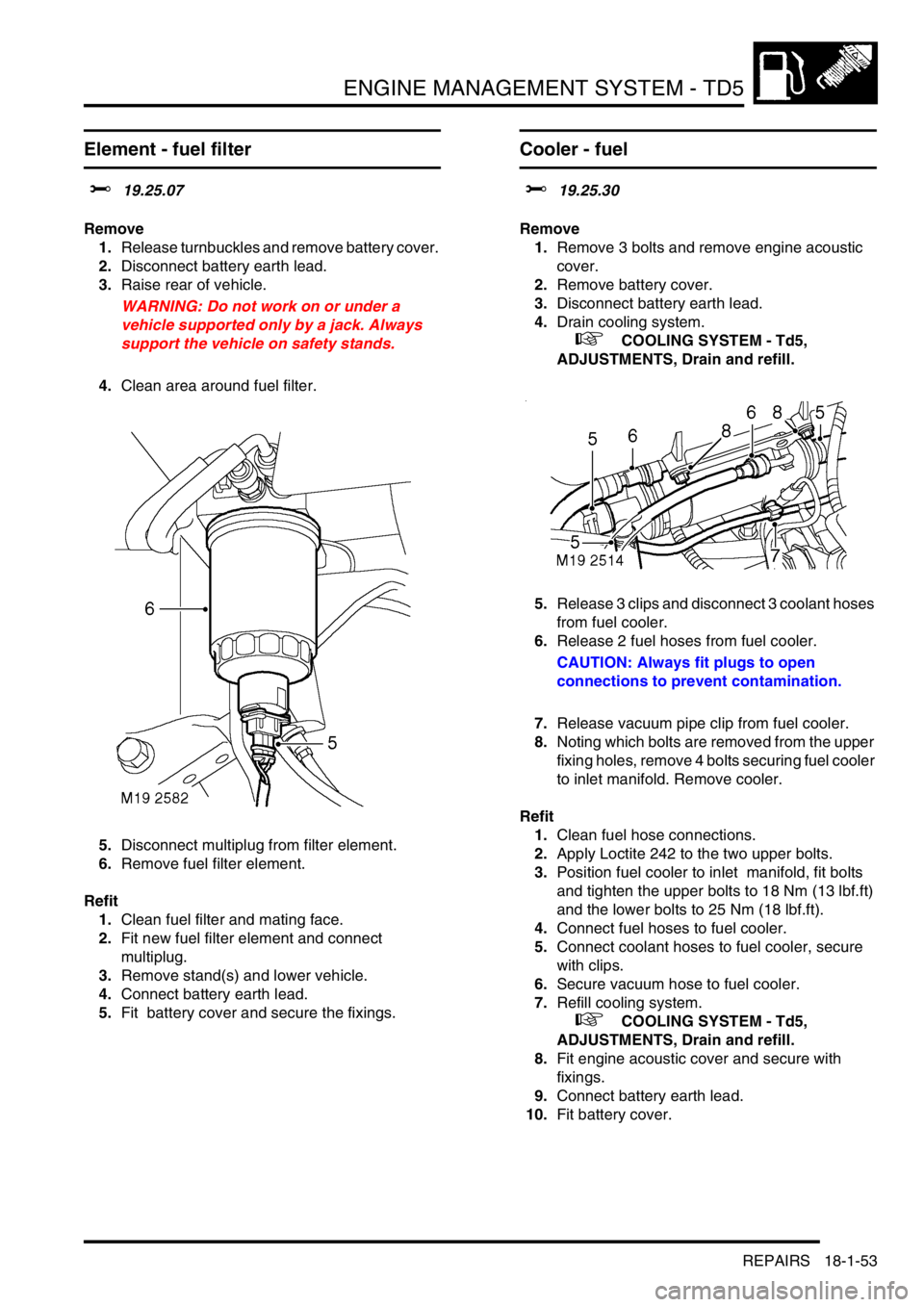
5.Disconnect multiplug from filter element.
6.Remove fuel filter element.
Refit
1.Clean fuel filter and mating face.
2.Fit new fuel filter element and connect
multiplug.
3.Remove stand(s) and lower vehicle.
4.Connect battery earth lead.
5.Fit battery cover and secure the fixings.
Cooler - fuel
$% 19.25.30
Remove
1.Remove 3 bolts and remove engine acoustic
cover.
2.Remove battery cover.
3.Disconnect battery earth lead.
4.Drain cooling system.
+ COOLING SYSTEM - Td5,
ADJUSTMENTS, Drain and refill.
5.Release 3 clips and disconnect 3 coolant hoses
from fuel cooler.
6.Release 2 fuel hoses from fuel cooler.
CAUTION: Always fit plugs to open
connections to prevent contamination.
7.Release vacuum pipe clip from fuel cooler.
8.Noting which bolts are removed from the upper
fixing holes, remove 4 bolts securing fuel cooler
to inlet manifold. Remove cooler.
Refit
1.Clean fuel hose connections.
2.Apply Loctite 242 to the two upper bolts.
3.Position fuel cooler to inlet manifold, fit bolts
and tighten the upper bolts to 18 Nm (13 lbf.ft)
and the lower bolts to 25 Nm (18 lbf.ft).
4.Connect fuel hoses to fuel cooler.
5.Connect coolant hoses to fuel cooler, secure
with clips.
6.Secure vacuum hose to fuel cooler.
7.Refill cooling system.
+ COOLING SYSTEM - Td5,
ADJUSTMENTS, Drain and refill.
8.Fit engine acoustic cover and secure with
fixings.
9.Connect battery earth lead.
10.Fit battery cover.
Page 448 of 1672

ENGINE MANAGEMENT SYSTEM - TD5
REPAIRS 18-1-55
Turbocharger
$% 19.42.01
Remove
1.Remove 3 bolts and remove engine acoustic
cover.
2.Release fixings and remove battery cover.
3.Disconnect battery earth lead.
4.Remove cooling fan cover.
5.Remove 3 bolts and remove exhaust manifold
heat shield.
6.Release clip and disconnect breather hose
from camshaft cover.
7.Release clip and disconnect vacuum hose from
turbocharger wastegate.
8.Loosen clips and release air intake and outlet
hoses from turbocharger. 9.Remove turbocharger oil feed banjo bolt and
discard sealing washers.
10.Remove 2 bolts and release turbocharger oil
drain pipe and discard gasket.
11.Remove 3 nuts and release exhaust front pipe
from turbocharger and discard gasket.
12.Remove 3 nuts securing turbocharger to
exhaust manifold.
13. Remove turbocharger and discard gasket.
Refit
1.Clean turbocharger and exhaust manifold
mating faces.
2.Using a new gasket, fit turbocharger to exhaust
manifold and tighten nuts to 30 Nm (22 lbf.ft).
3.Using new gasket, align exhaust front pipe and
tighten nuts to 30 Nm (22 lbf.ft).
4.Using new gasket, align turbocharger drain
pipe and tighten bolts to 9 Nm (7 lbf.ft).
5.Fit banjo bolt to oil feed pipe using new sealing
washers and tighten to 25 Nm (18 lbf.ft)..
6.Position air hoses to turbocharger and tighten
clips.
7.Position and secure breather hose to camshaft
cover.
8.Position and secure vacuum hose to
turbocharger wastegate.
9.Position exhaust manifold heat shield and
tighten M6 bolts to 9 Nm (7 lbf.ft) and M8 bolt to
25 Nm (18 lbf.ft).
10.Fit fan cowl and secure fixings.
11.Fit acoustic cover and secure the fixings.
12.Connect battery earth lead.
13.Fit battery cover and secure fixings.
Page 452 of 1672

ENGINE MANAGEMENT SYSTEM - TD5
REPAIRS 18-1-59
Regulator - fuel pressure
$% 19.45.06
Remove
1.Release turnbuckles and remove battery cover
2.Disconnect battery earth lead.
3.Remove 3 bolts and remove engine acoustic
cover.
4.Remove 2 bolts and remove engine lifting eye.
5.Position cloth to absorb fuel spillage.
6.Release and disconnect hose from fuel cooler. 7.Release and disconnect fuel hose from
pressure regulator.
Always fit plugs to open connections to
prevent contamination.
8.Disconnect multiplug from fuel temperature
sensor.
9.Remove 3 bolts, remove pressure regulator
from cylinder head and collect gasket.
10.Remove and discard 'O' ring and fuel filter.
Page 453 of 1672

ENGINE MANAGEMENT SYSTEM - TD5
18-1-60 REPAIRS
11.Remove fuel temperature sensor and discard
sealing washer.
12.Remove fuel hose and fuel pipe and discard 'O'
rings.
Refit
1.Clean fuel pressure regulator and mating face.
2.Clean fuel pipe unions.
3.Using new 'O' rings, fit fuel pipe and fuel hose
to pressure regulator and tighten unions to 25
Nm (18 lbf.ft).
4.Using new sealing washer, fit fuel temperature
sensor and tighten to 14 Nm (10 lbf.ft).
5.Fit new fuel filter and 'O' ring.
6.Using a new gasket, position pressure
regulator and tighten bolts to 25 Nm (18 lbf.ft).
7.Connect multiplug to fuel temperature sensor.
8.Connect fuel hoses to pressure regulator and
fuel cooler.
9.Fit engine lifting eye and tighten bolts to 25 Nm
(18 lbf.ft).
10.Fit engine acoustic cover and tighten bolts to 10
Nm (6 lbf.ft).
11.Connect battery earth lead.
12.Fit battery cover and secure fixings.
Glow plugs
$% 19.60.31
Remove
1.Remove 3 bolts and remove engine acoustic
cover.
2.Release turnbuckles and remove battery cover.
3.Disconnect battery earth lead.
4.Disconnect 4 glow plug leads.
5.Loosen and remove 4 glow plugs.
Refit
1.Thoroughly clean glow plugs and seating area
in cylinder head.
2.Apply a suitable anti-sieze compound to
threads of glow plugs.
3.Fit glow plugs and tighten to 16 Nm (12 lbf. ft).
4.Connect glow plug leads.
5.Fit engine acoustic cover and secure fixings.
6.Connect battery earth lead.
7.Fit battery cover and secure fixings.
Page 465 of 1672

ENGINE MANAGEMENT SYSTEM - V8
18-2-8 DESCRIPTION AND OPERATION
Input/Output
The ECM has various sensors fitted to the engine to allow it to monitor engine condition. The ECM processes these
signals and decides what actions to carry out to maintain optimum engine operation by comparing the information
from these signals to mapped data within its memory.
Connector 1 (C0634): This connector contains 9 pins and is used primarily for ECM power input and earth. The ECM
requires a permanent battery supply, if this permanent feed is lost i.e. the battery discharges or is disconnected the
ECM will lose its adapted values and its Diagnostic Trouble Codes (DTC). These adapted values are a vital part of
the engine management's rolling adaptive strategy. Without an adaptive strategy, driveability, performance, emission
control, and fuel consumption are adversely affected. The ECM can be damaged by high voltage inputs, so care must
be taken when removing and replacing the ECM.
Pin out details connector C0634
Connector 2 (C0635): This connector contains 24 pins and is primarily used for Heated Oxygen Sensors (HO
2S)
control and earth. The HO
2S sensors require a heater circuit to assist in heating the tip of the sensors to enable closed
loop fuelling to be implemented quickly after cold starting.
Pin out details connector C0635
Pin No. Function Signal type Reading
1 Ignition position II Input 12 V
2 Not used - -
3 Not used - -
4 Chassis earth Earth 0V
5 Fuel injectors earth Earth 0V
6 Power stage earth Earth 0V
7 Permanent battery supply Input battery supply 12V
8 Switched relay positive Input switched 0-12V
9 Not used - -
Pin No. Function Signal type Reading
1HO
2S heater RH bank - downstream Output PWM 12-0V
2 Not used - -
3 Not used - -
4 Not used - -
5 Thermostat monitoring sensor Earth 0V
6 Not used - -
7HO
2S heater LH bank - downstream Output PWM 12-0V
8HO
2S sensor RH bank - downstream Earth/ Signal 0V
9HO
2S sensor LH bank - upstream Earth/ Signal 0V
10 HO
2S sensor RH bank - upstream Earth/ Signal 0V
11 HO
2S sensor LH bank - downstream Earth/ Signal 0V
12 Not used - -
13 HO
2S heater RH bank - upstream Output PWM 12-0V
14 HO
2S sensor RH bank - downstream Input/ Signal Analogue 0-5V
15 HO
2S sensor LH bank - upstream Input/ Signal Analogue 0-5V
16 HO
2S sensor RH bank - upstream Input/ Signal Analogue 0-5V
17 HO
2S sensor LH bank - downstream Input/ Signal Analogue 0-5V
18 Fuel pump relay Output Switch to earth
19 HO
2S heater LH bank - upstream Output PWM 12-0V
20 Not used - -
21 Thermostat monitoring sensor Signal Analogue 0-5V
22 Not used - -
23 Main relay Output Switch to earth
24 EVAP system leak detection pump motor (NAS
vehicles with positive pressure type, EVAP system
leak detection capability only)Output Switch to earth
Page 466 of 1672

ENGINE MANAGEMENT SYSTEM - V8
DESCRIPTION AND OPERATION 18-2-9
Connector 3 (C0636): This connector contains 52 pins and is used for most sensor and actuator inputs and outputs.
Sensor and actuator control is vital to ensure that the ECM maintains adaptive strategy
Pin out details connector C0636
Pin No. Function Signal type Reading
1 Injector cylinder number 2 Output Switch to earth
2 Injector cylinder number 5 Output Switch to earth
3 Purge valve Output, signal PWM 12-0V
4 SAI vacuum solenoid valve (NAS vehicles from
2000MY only)Output Switch to earth
5 Not used - -
6 Fuel tank pressure sensor (NAS vehicles with
vacuum type, EVAP system leak detection
only)Earth 0V
7 MAF sensor 5V supply Output, reference 5V
8 Not used - -
9 MAF sensor earth Earth 0V
10 TP sensor 5V supply Output, reference 5V
11 Not used - -
12 Not used - -
13 Not used - -
14 Injector cylinder number 7 Output Switch to earth
15 Injector cylinder number 6 Output Switch to earth
16 SAI pump relay (NAS vehicles from 2000MY
only)Output Switch to earth
17 CMP sensor Earth 0V
18 Low range switch (manual transmission only) Input, signal Active low
19 Not used - -
20 CMP signal Input, signal Digital switch 0-12V
21 ECT sensor Earth 0V
22 Coolant temperature signal Input, signal Analogue 0-5V
23 MAF sensor signal Input, signal Analogue 0-5V
24 TP sensor signal Input, signal Analogue 0-5V
25 TP sensor earth Earth 0V
26 Not used - -
27 Injector cylinder number 3 Output Switch to earth
28 Injector cylinder number 8 Output Switch to earth
29 Hill decent control output Output, signal PWM 0-12V
30 EVAP canister vent solenoid (CVS) valve (NAS
vehicles with vacuum type, EVAP system leak
detection only)Output Switch to earth
30 Leak detection pump solenoid (NAS vehicles
with positive pressure type, EVAP system leak
detection only)Output Switch to earth
31 A/C condenser fan Output Switch to earth
32 CKP sensor signal Input, signal Analogue, 0-300V peak
33 Not used - -
34 IAT sensor signal Input, signal Analogue 0-5V
35 KS, RH bank earth Earth 0V
36 KS, RH bank signal Input, signal Analogue
37 Not used - -
38 Not used - -
39 Not used - -
40 Injector cylinder number 4 Output Switch to earth
41 Injector cylinder number 1 Output Switch to earth
Page 467 of 1672

ENGINE MANAGEMENT SYSTEM - V8
18-2-10 DESCRIPTION AND OPERATION
Connector 4 (C0637): This connector contains 40 pins and facilitates use of TestBook via the Diagnostic connector.
Also contained in this connector is the Malfunction Indicator Lamp (MIL), this instrument panel lamp informs the driver
of concerns within the engine management system.
Pin out details connector C0637
42 Idle air control valve open Output, signal PWM 12-0V
43 Idle air control valve close Output, signal PWM 12-0V
44 ECT sensor signal Output, signal PWM 0-12V
45 CKP sensor earth screen Earth 0V
46 CKP sensor signal Earth reference 0V
47 Not used - -
48 KS, LH bank earth Earth 0V
49 KS, LH bank signal Input, signal Analogue
50 Not used - -
51 Not used - -
52 Not used - -
Pin No. Function Signal type Reading
1 Not used - -
2 Not used - -
3 Not used - -
4 Not used - -
5 Not used - -
6 Not used - -
7 Not used - -
8 Low fuel level Input, signal Active high
9 Fuel tank pressure sensor (NAS vehicles with
vacuum type, EVAP system leak detection
capability only)Output, reference 5V
10 Not used - -
11 Not used - -
12 Analogue fuel level (NAS vehicles with positive
pressure type, EVAP system leak detection only)Input, signal 0-5V
13 Not used - -
14 Fuel tank pressure sensor (NAS vehicles with
vacuum type, EVAP system leak detection
capability only)Input, signal Analogue 0-5V
15 Not used - -
16 ATC compressor request Input, signal Active low
17 Engine speed output Output, signal PWM 0-5V
18 Not used - -
19 Not used - -
20 Malfunction indicator lamp 'ON' Output Switched earth
21 Not used - -
22 Vehicle speed signal (VSS) Input, signal PWM 0-12V
23 Not used - -
24 Not used - -
25 Not used - -
26 Not used - -
27 Not used - -
28 Not used - -
29 ATC compressor relay Output Switched earth
30 Not used - - Pin No. Function Signal type Reading
Page 468 of 1672

ENGINE MANAGEMENT SYSTEM - V8
DESCRIPTION AND OPERATION 18-2-11
31 Positive pressure type EVAP system heater
(02MY vehicles only)Output, drive Switched earth
32 Diagnostic connector K-line Bi-directional Serial 0-12V
33 Immobiliser serial W link Input, signal Serial 0-12V
34 Rough road signal Input, signal PWM 0-12V
35 Not used - -
36 CAN data bus 'high line' Bi-directional 5-2.5V
37 CAN data bus 'low line' Bi-directional 0-2.5V
38 ATC stand by Input, signal Active low
39 Not used - -
40 Not used - - Pin No. Function Signal type Reading
Page 469 of 1672
ENGINE MANAGEMENT SYSTEM - V8
18-2-12 DESCRIPTION AND OPERATION
Connector 5 (C0638): This connector contains 9 pins and is used to control the ignition system. The ignition coils are
supplied with power and a switching earth completes the circuit.
Pin out details connector C0638
Crankshaft speed and Position (CKP) sensor (C0168)
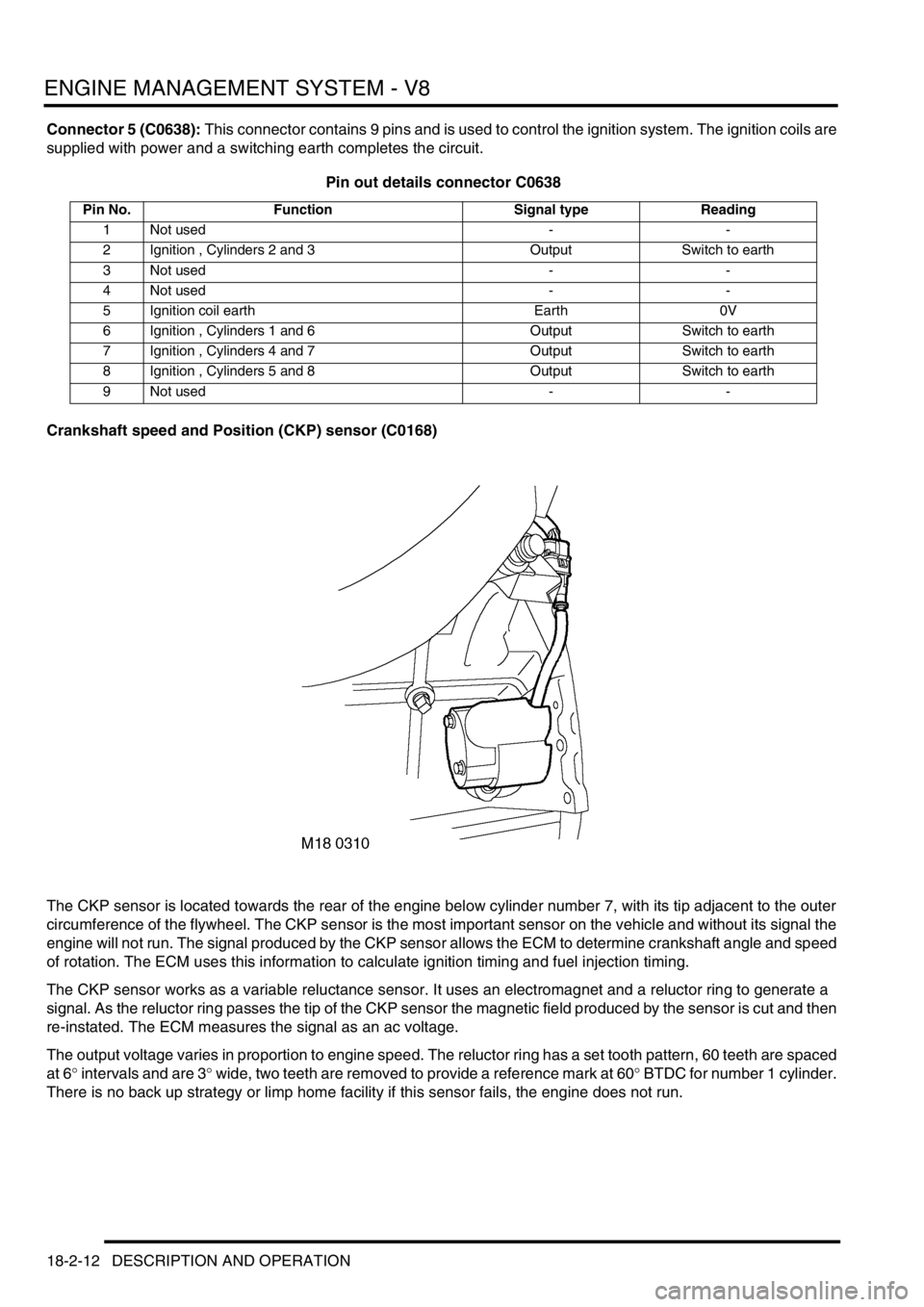
The CKP sensor is located towards the rear of the engine below cylinder number 7, with its tip adjacent to the outer
circumference of the flywheel. The CKP sensor is the most important sensor on the vehicle and without its signal the
engine will not run. The signal produced by the CKP sensor allows the ECM to determine crankshaft angle and speed
of rotation. The ECM uses this information to calculate ignition timing and fuel injection timing.
The CKP sensor works as a variable reluctance sensor. It uses an electromagnet and a reluctor ring to generate a
signal. As the reluctor ring passes the tip of the CKP sensor the magnetic field produced by the sensor is cut and then
re-instated. The ECM measures the signal as an ac voltage.
The output voltage varies in proportion to engine speed. The reluctor ring has a set tooth pattern, 60 teeth are spaced
at 6
° intervals and are 3° wide, two teeth are removed to provide a reference mark at 60° BTDC for number 1 cylinder.
There is no back up strategy or limp home facility if this sensor fails, the engine does not run.
Pin No. Function Signal type Reading
1 Not used - -
2 Ignition , Cylinders 2 and 3 Output Switch to earth
3 Not used - -
4 Not used - -
5 Ignition coil earth Earth 0V
6 Ignition , Cylinders 1 and 6 Output Switch to earth
7 Ignition , Cylinders 4 and 7 Output Switch to earth
8 Ignition , Cylinders 5 and 8 Output Switch to earth
9 Not used - -