earth LAND ROVER DISCOVERY 2002 Workshop Manual
[x] Cancel search | Manufacturer: LAND ROVER, Model Year: 2002, Model line: DISCOVERY, Model: LAND ROVER DISCOVERY 2002Pages: 1672, PDF Size: 46.1 MB
Page 516 of 1672

ENGINE MANAGEMENT SYSTEM - V8
DESCRIPTION AND OPERATION 18-2-59
ECU operating parameters (connector connected and cruise control master switch on)
Cruise control ECU
The cruise control ECU controls the cruise control system.
Most functions of the cruise control ECU are described under other components.
Input/Output
The diagnostic line for the cruise control system is between cruise control ECU and diagnostic socket.
The cruise control ECU does not generate fault codes however the following system information is available via
TestBook:
lLast switch off reason, which was due to unacceptable speed input.
lSpeed signal detected.
lBelow minimum speed threshold.
lCurrent vehicle speed.
lRecorded SET road speed.
ECU operating parameters (connector connected)
Pin No. Condition Volts Ohms
15 Road wheels stopped 0
15 Road wheels turning 0 - 12 Volts with a
frequency of 8,000
pulses per mile 1.6 km)
Pin No. Condition Volts Ohms
18 All conditions Less than 0.5 to earth
Page 521 of 1672

ENGINE MANAGEMENT SYSTEM - V8
18-2-64 DESCRIPTION AND OPERATION
Vacuum pump assembly
The vacuum pump assembly contains three components:
lThe vacuum pump.
lThe vacuum control valve.
lThe vacuum dump valve.
The vacuum pump provides the vacuum for the system while the two valves work in conjunction to allow the pump to
increase the vacuum to the pneumatic actuator (increase vehicle speed) or release vacuum from the pneumatic
actuator (decrease vehicle speed). On vehicles from 03 model year, the cruise control vacuum pump and pneumatic
actuator assembly is fitted with a heat shield to protect the components from heat from the exhaust manifold.
The vacuum control valve opens to allow the vacuum pump to increase the vacuum in the pneumatic actuator to
increase vehicle speed. When the vehicle reaches the set speed, the vacuum pump control valve closes to hold
vacuum in the pneumatic actuator and the vacuum pump is turned off by the cruise control ECU.
The vacuum dump valve is normally open. When cruise control is active, the cruise control ECU provides voltage to
close the vacuum dump valve. If power is lost, (e.g. when the brakes or clutch are applied or cruise control is turned
off at the cruise control master switch) the vacuum dump valve will immediately open and cruise control will be
deactivated.
The cruise control ECU provides power for all three components within the vacuum pump assembly. The cruise
control ECU provides earth control circuits for the vacuum pump and the vacuum control valve. The vacuum dump
valve is permanently grounded.
Input/Output
The cruise control ECU provides both power and earth to the components within the vacuum pump assembly. Current
draw at the vacuum pump assembly varies depending on components operating.
Vacuum pump current draw
Component State of components
Vacuum dump valve Off On On On
Vacuum control valve Off Off On On
Vacuum pump Off Off Off On
Current draw, amperes 0 0.23 0.37 2.14
Page 522 of 1672

ENGINE MANAGEMENT SYSTEM - V8
DESCRIPTION AND OPERATION 18-2-65
When cruise is requested, the cruise control ECU provides voltage to the vacuum pump assembly and provides a
pulsed earth signal. The pulse period is dependent on the difference between the vehicle set speed and the actual
road speed. Removing the earth path switches off the pump.
Several fault codes can be generated:
Fault codes
1"Output power LOW when HIGH is expected" is flagged when Pin C0239-11 is shorted to earth.
This could be due to an external fault or an internal ECU fault and will be set if pin C0239-11 is LOW for longer
than 240 milliseconds, while in cruise mode.
2"Output power HIGH when LOW is expected" is flagged when Pin C0239-11 is shorted to battery voltage.
This could be due to an external fault or internal ECU fault and will be set if pin C0239-11 is HIGH for longer than
250 milliseconds while not in cruise mode.
3"Output pump LOW, when High is expected" is flagged when Pin C0239-7 is shorted to earth.
This could be due to an external fault or an internal ECU fault. This fault will be set if pin C0239-11 is HIGH for
longer than 7.5 milliseconds while pin C0239-7 is LOW for longer than 2.5 milliseconds while decelerating under
control of cruise.
4"Output pump HIGH, when LOW is expected" is flagged when Pin C0239-7 is shorted to battery voltage.
This could be due to an external fault or an internal ECU fault. This fault will be set if pin C0239-7 is LOW for
longer than 7.5 milliseconds of the last 8 pulses when the pump is switched on while accelerating under the
control of cruise.
5Output valve LOW, when HIGH is expected is flagged when Pin C0239-7 is shorted to battery voltage.
This could be due to an external fault or an internal ECU fault and will be set if pin C0239-17 is LOW for longer
than 2.5 milliseconds while pin C0239-7 is HIGH for longer than 2.5 milliseconds and pin C0239-11 is also HIGH
for longer than 7.5 milliseconds, while decelerating under control of the cruise control ECU.
6Output valve HIGH, when LOW is expected is flagged when Pin C0239-17 is shorted to battery voltage.
This could be an external fault or an internal ECU fault. The fault will be set if pin C0239-17 remains HIGH for
longer than 35 milliseconds after the vacuum control valve is switched on, while accelerating under control of
the cruise control ECU.
TestBook can be used to determine the fault codes present as well as the general status of the system.
Pneumatic actuator
The cruise control ECU controls the position of the throttle disc by regulating the amount of vacuum applied by the
vacuum pump to the pneumatic actuator. The pneumatic actuator is an air tight bellow coupled to the pneumatic pump
via a vacuum pipe. The pump evacuates the air inside the bellow and pipe, which collapses the bellow. This pulls on
a cable, which moves the throttle disc to the desired position. On vehicles from 03 model year, the cruise control
vacuum pump and pneumatic actuator assembly is fitted with a heat shield to protect the components from heat from
the exhaust manifold.
Page 529 of 1672
ENGINE MANAGEMENT SYSTEM - V8
18-2-72 REPAIRS
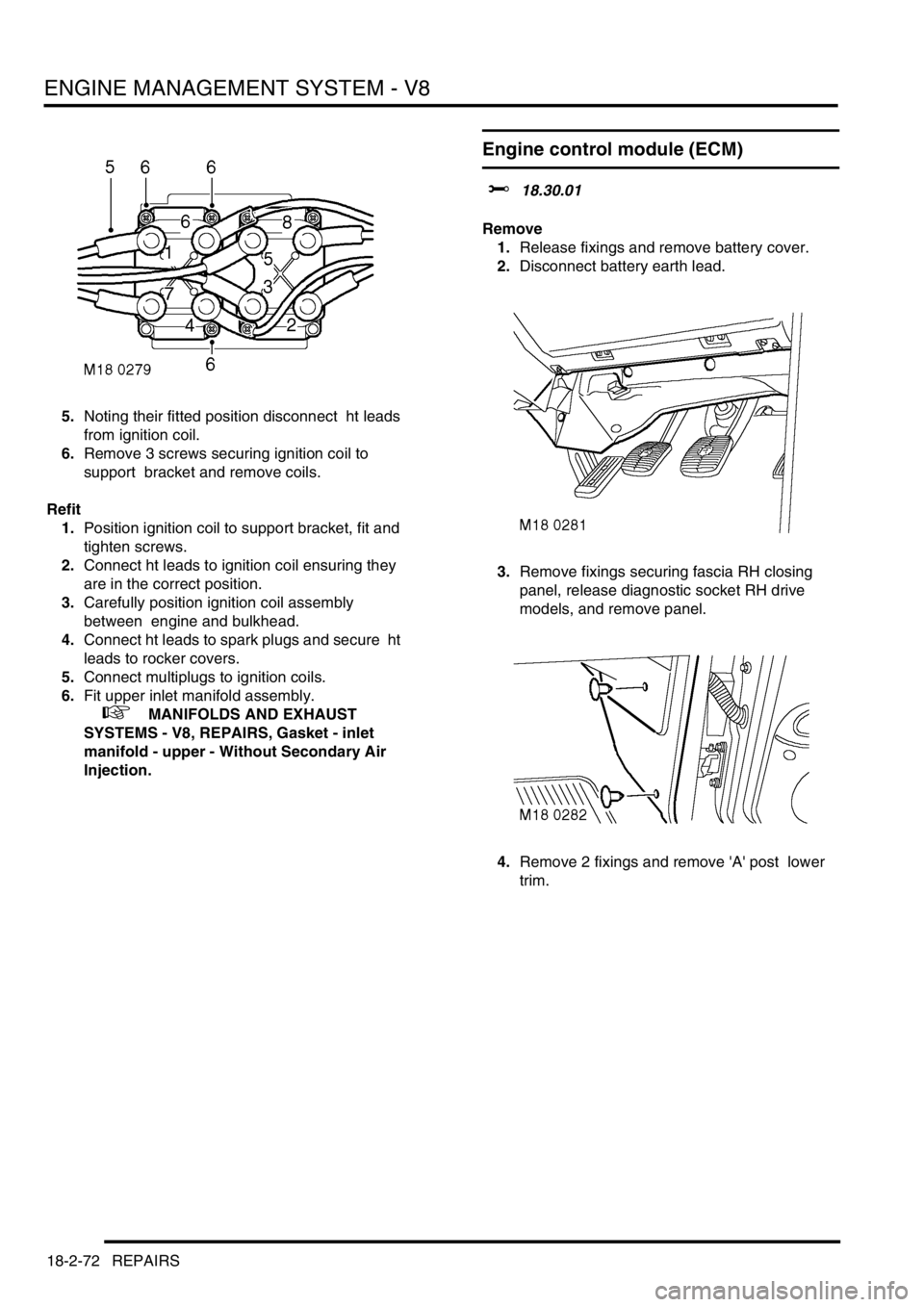
5.Noting their fitted position disconnect ht leads
from ignition coil.
6.Remove 3 screws securing ignition coil to
support bracket and remove coils.
Refit
1.Position ignition coil to support bracket, fit and
tighten screws.
2.Connect ht leads to ignition coil ensuring they
are in the correct position.
3.Carefully position ignition coil assembly
between engine and bulkhead.
4.Connect ht leads to spark plugs and secure ht
leads to rocker covers.
5.Connect multiplugs to ignition coils.
6.Fit upper inlet manifold assembly.
+ MANIFOLDS AND EXHAUST
SYSTEMS - V8, REPAIRS, Gasket - inlet
manifold - upper - Without Secondary Air
Injection.
Engine control module (ECM)
$% 18.30.01
Remove
1.Release fixings and remove battery cover.
2.Disconnect battery earth lead.
3.Remove fixings securing fascia RH closing
panel, release diagnostic socket RH drive
models, and remove panel.
4.Remove 2 fixings and remove 'A' post lower
trim.
Page 530 of 1672
ENGINE MANAGEMENT SYSTEM - V8
REPAIRS 18-2-73
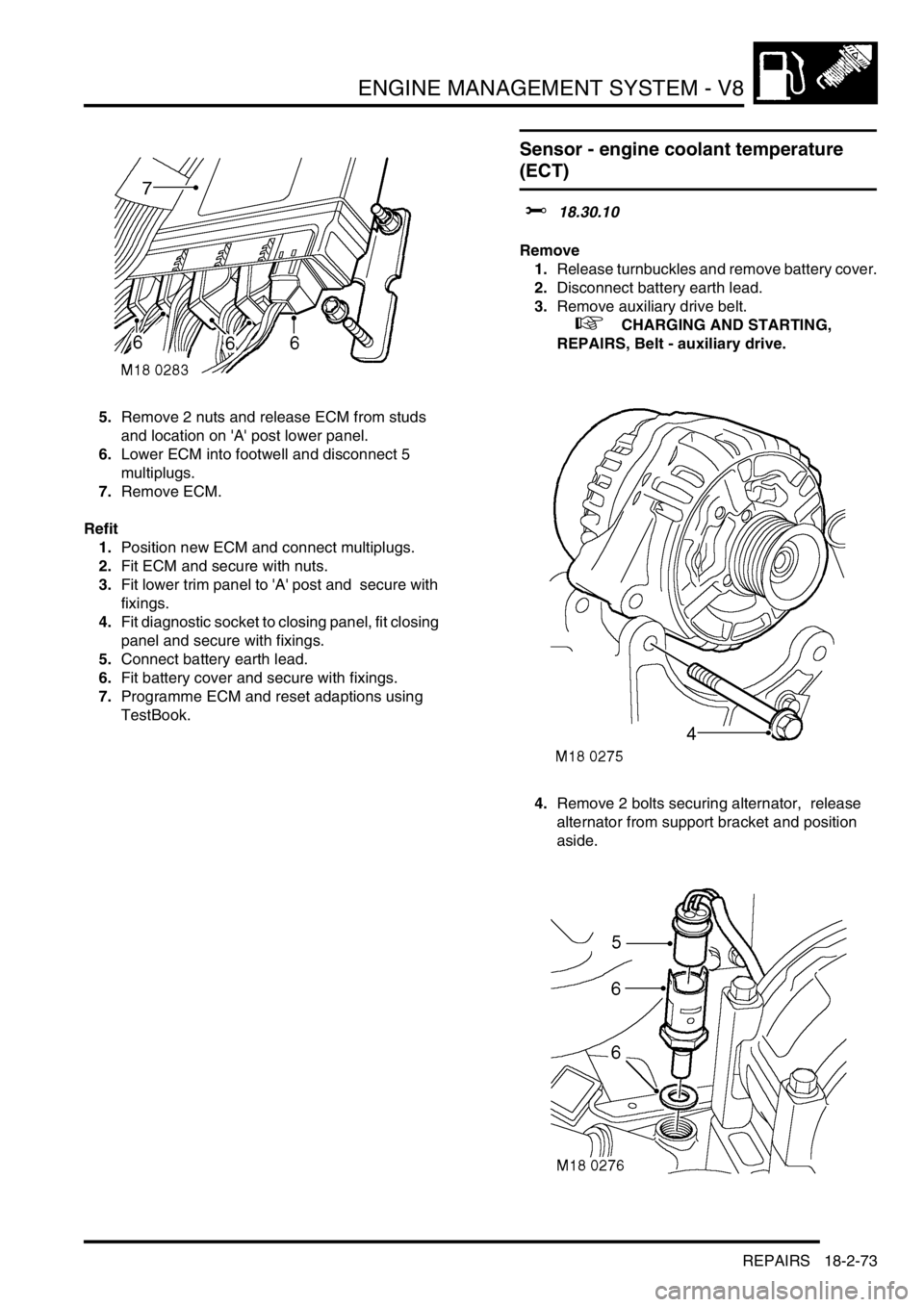
5.Remove 2 nuts and release ECM from studs
and location on 'A' post lower panel.
6.Lower ECM into footwell and disconnect 5
multiplugs.
7.Remove ECM.
Refit
1.Position new ECM and connect multiplugs.
2.Fit ECM and secure with nuts.
3.Fit lower trim panel to 'A' post and secure with
fixings.
4.Fit diagnostic socket to closing panel, fit closing
panel and secure with fixings.
5.Connect battery earth lead.
6.Fit battery cover and secure with fixings.
7.Programme ECM and reset adaptions using
TestBook.
Sensor - engine coolant temperature
(ECT)
$% 18.30.10
Remove
1.Release turnbuckles and remove battery cover.
2.Disconnect battery earth lead.
3.Remove auxiliary drive belt.
+ CHARGING AND STARTING,
REPAIRS, Belt - auxiliary drive.
4.Remove 2 bolts securing alternator, release
alternator from support bracket and position
aside.
Page 531 of 1672
ENGINE MANAGEMENT SYSTEM - V8
18-2-74 REPAIRS
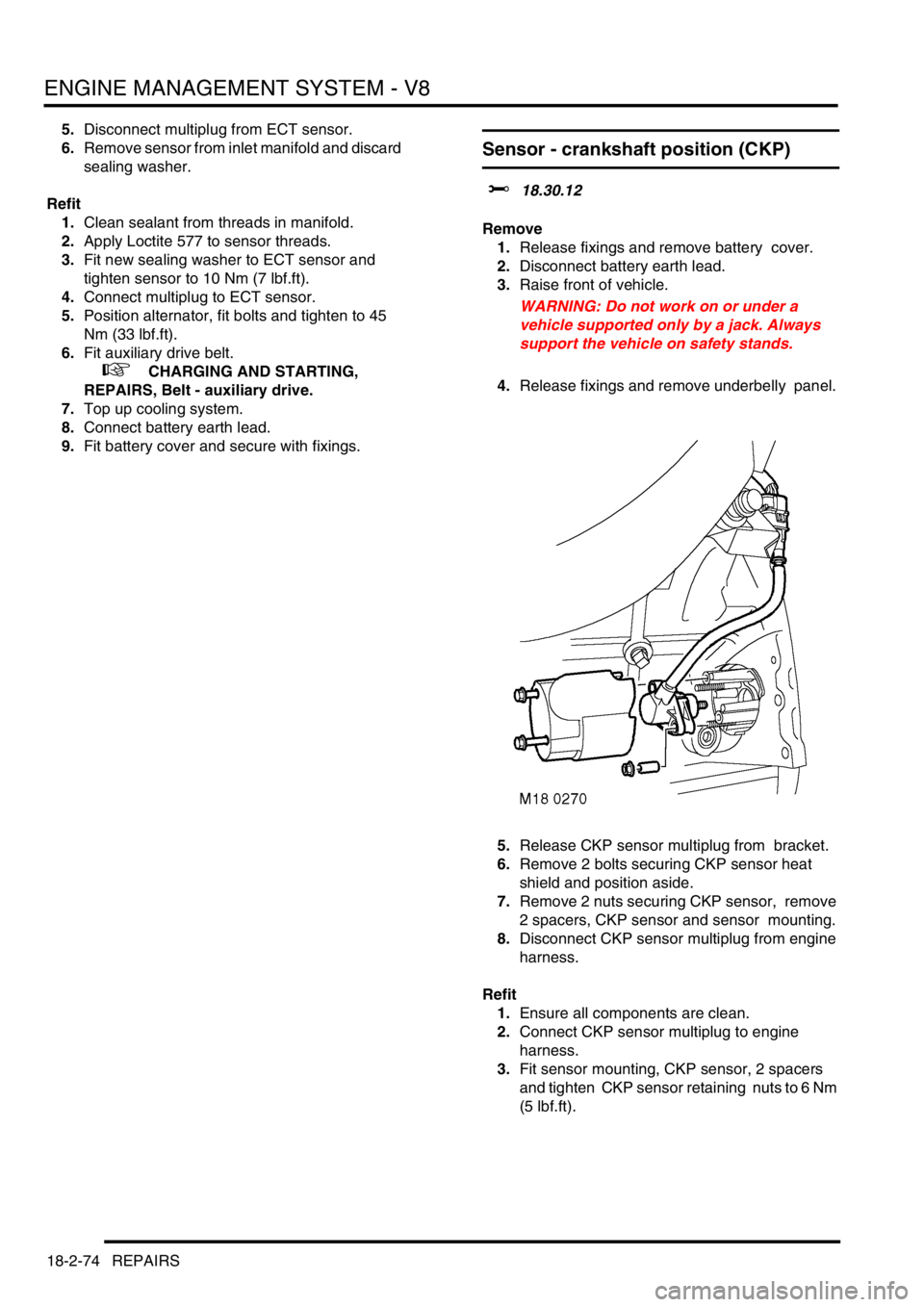
5.Disconnect multiplug from ECT sensor.
6.Remove sensor from inlet manifold and discard
sealing washer.
Refit
1.Clean sealant from threads in manifold.
2.Apply Loctite 577 to sensor threads.
3.Fit new sealing washer to ECT sensor and
tighten sensor to 10 Nm (7 lbf.ft).
4.Connect multiplug to ECT sensor.
5.Position alternator, fit bolts and tighten to 45
Nm (33 lbf.ft).
6.Fit auxiliary drive belt.
+ CHARGING AND STARTING,
REPAIRS, Belt - auxiliary drive.
7.Top up cooling system.
8.Connect battery earth lead.
9.Fit battery cover and secure with fixings.
Sensor - crankshaft position (CKP)
$% 18.30.12
Remove
1.Release fixings and remove battery cover.
2.Disconnect battery earth lead.
3.Raise front of vehicle.
WARNING: Do not work on or under a
vehicle supported only by a jack. Always
support the vehicle on safety stands.
4.Release fixings and remove underbelly panel.
5.Release CKP sensor multiplug from bracket.
6.Remove 2 bolts securing CKP sensor heat
shield and position aside.
7.Remove 2 nuts securing CKP sensor, remove
2 spacers, CKP sensor and sensor mounting.
8.Disconnect CKP sensor multiplug from engine
harness.
Refit
1.Ensure all components are clean.
2.Connect CKP sensor multiplug to engine
harness.
3.Fit sensor mounting, CKP sensor, 2 spacers
and tighten CKP sensor retaining nuts to 6 Nm
(5 lbf.ft).
Page 532 of 1672

ENGINE MANAGEMENT SYSTEM - V8
REPAIRS 18-2-75
4.Fit CKP sensor heat shield and secure with
bolts.
5.Fit underbelly panel and secure with fixings.
6.Remove stand(s) and lower vehicle.
7.Connect battery earth lead.
8.Fit battery cover and secure the fixings.
9.Reset adaptions using TestBook.
Sensor - radiator temperature
$% 18.30.20
Remove
1.Disconnect battery earth lead.
2.Position container to collect coolant spillage.
3.Disconnect multiplug from sensor.
4.Remove sensor and discard sealing washer.
Refit
1.Fit new sealing washer to sensor.
2.Fit and tighten sensor.
3.Connect multiplug to sensor.
4.Refill cooling system.
5.Connect battery earth lead.
Page 533 of 1672

ENGINE MANAGEMENT SYSTEM - V8
18-2-76 REPAIRS
Sensor - camshaft position (CMP)
$% 18.30.24
Remove
1.Release fixings and remove battery cover.
2.Disconnect battery earth lead.
3.Raise front of vehicle.
WARNING: Do not work on or under a
vehicle supported only by a jack. Always
support the vehicle on safety stands.
4.Release fixings and remove underbelly panel.
5.Remove engine oil filter.
+ ENGINE - V8, REPAIRS, Filter - oil.
6.Disconnect engine harness from CMP sensor
and release CMP sensor multiplug from
bracket.
7.Remove bolt from clamp securing CMP sensor
to timing gear cover.
8.Remove clamp and CMP sensor. Discard 'O'
ring from CMP sensor.
Refit
1.Ensure CMP sensor is clean, fit new 'O' ring
and sensor to cover.
2.Fit clamp to CMP sensor and tighten bolt to 8
Nm (6 lbf.ft).
3.Fit sensor multiplug to bracket and connect
engine harness to multiplug.
4.Fit engine oil filter.
+ ENGINE - V8, REPAIRS, Filter - oil.
5.Fit underbelly panel and secure with fixings.
6.Lower vehicle and connect battery earth lead.
7.Fit battery cover and secure with fixings.
Knock sensor (KS)
$% 18.30.28
Remove
1.Release fixings and remove battery cover.
2.Disconnect battery earth lead.
3.Raise front of vehicle.
WARNING: Do not work on or under a
vehicle supported only by a jack. Always
support the vehicle on safety stands.
4.Remove fixings securing underbelly panel and
remove panel.
5.Disconnect multiplug from KS.
6.Remove nut securing KS to cylinder block and
remove KS.
Refit
1.Clean mating faces of KS and cylinder block.
2.Fit KS to cylinder block and tighten nut to 22
Nm (16 lbf.ft).
3.Connect multiplug to KS.
4.Fit underbelly panel and secure with fixings.
5.Remove stand(s) and lower vehicle.
6.Connect battery earth lead.
7.Fit battery cover and secure the fixings.
Page 550 of 1672

FUEL DELIVERY SYSTEM - TD5
DESCRIPTION AND OPERATION 19-1-5
The fuel pump is a 'self priming', wet type, two stage pump which is immersed in fuel in the tank and operates at all
times when the ignition switch is in position II. If the engine is not started, the ECU will 'time-out' after three minutes
and de-energise the fuel pump relay. The pump receives a feed from the battery via fuse 10 in the engine
compartment fusebox and the fuel pump relay. The relay is energised by the ECM when the ignition switch is moved
to position II.
The fuel pump assembly is retained with a locking ring and sealed with a rubber seal. The locking ring requires a
special tool for removal and refitment. An access panel for the fuel pump is located in the loadspace floor below the
carpet. The access panel is sealed to the floor with a rubber seal and retained by six self-tapping screws. A four pin
electrical connector is located on the top cover and provides power feed and earth for the fuel pump and also inputs
and outputs for the fuel gauge sender operation.
The fuel gauge sender is integral with the fuel pump. The sender is submerged in the fuel and is operated by a float
which moves with the fuel level in the tank.
Fuel pump
The fuel pump assembly comprises a top cover which locates the electrical connector, fuel burning heater connection
and four fuel pipe couplings. The top cover is attached to a plastic cup shaped housing and retained on three sliding
clips. Two coil springs are located between the cover and the housing and ensure that the fuel pump remains seated
positively at the bottom of the tank when installed.
The housing locates the two stage fuel pump and also the fuel gauge sender unit. The lower part of the housing is the
swirl pot which maintains a constant level of fuel at the fuel pick-up. A coarse filter is located in the base of the housing
and prevents the ingress of contaminants into the pump and the fuel system from the fuel being drawn into the pump.
A fine filter is located in the intake to the low pressure stage to protect the pump from contaminants. Flexible pipes
connect the couplings on the top cover to the pump.
A non-return valve is located in the base of the housing. When the fuel tank is full, fuel pressure keeps the valve lifted
from its seat allowing fuel to flow into the swirl pot. As the tank level reduces, the fuel pressure in the tank reduces
causing the valve to close. When the valve is closed fuel is retained in the swirl pot, ensuring that the swirl pot remains
full and maintains a constant supply to the fuel pump.
The two stage pump comprises a high and a low pressure stage. The low pressure stage draws fuel from the swirl
pot through the filter. The low pressure stage pumps fluid at a pressure of 0.75 bar (10.9 lbf.in
2) and a flow of 30 litres/
hour (8 US Gallons/hour) to the fuel filter. A proportion of the fuel from the low pressure stage also passes, via a
restrictor, through a jet pump which keeps fuel circulating in the swirl pot. The high pressure stage draws the low
pressure fuel from the fuel filter and pressurises it to a pressure of 4.0 bar (58 lbf.in
2). The pressurised fuel is then
passed from the pump to the injectors at a flow of 180 litres/hour (47.6 US Gallons/hour). A fuel pressure regulator is
located at the rear of the engine and ensures that the delivery pressure remains at 4.0 bar (58 lbf.in
2) by controlling
the amount of fuel returning to the fuel tank.
The fuel pump has a maximum current draw of 15 Amps at 12.5 V and is protected by a 20 Amp fuse in the engine
compartment fusebox.
Page 555 of 1672

FUEL DELIVERY SYSTEM - TD5
19-1-10 DESCRIPTION AND OPERATION
Water sensor
The water sensor has a three pin electrical connector. When the sensor detects water in the filter it illuminates a
warning lamp in the instrument pack .
+ INSTRUMENTS, DESCRIPTION AND OPERATION, Description.
The water sensor attachment thread has a slot machined down one side. The filter can be purged of water by partially
unscrewing the sensor which aligns the slot in the threads with a corresponding hole in the sensor. When aligned,
water and fuel can flow down the slot and flows from a small cast tube on the side of the sensor. Re-tightening the
sensor misaligns the slot and stops the flow of fuel.
The water sensor receives a battery supply from the fuel pump relay in the engine compartment fusebox on one of
the electrical connector pins. The two remaining pins are connected to the instrument pack and an earth header joint.
The sensor operation uses the measurement of resistance between two electrodes submerged in the fuel and
activated by the presence of water.
When the ignition is moved to position II the warning lamp will illuminate for approximately two seconds to check
warning lamp functionality. TestBook can also illuminate the warning lamp to check its functionality.
When the filter is full with fuel and no water is present the resistance of the Diesel fuel will show a reading of 15 mA
maximum on the feed wire to the instrument pack. This current will not illuminate the water sensor warning lamp in
the instrument pack. When sufficient water surrounds both electrodes the resistance of the water will show a reading
of 130 mA maximum. This will supply sufficient voltage to the instrument pack to illuminate the warning lamp to alert
the driver to the presence of water in the fuel system.