ECU LAND ROVER FREELANDER 2001 User Guide
[x] Cancel search | Manufacturer: LAND ROVER, Model Year: 2001, Model line: FREELANDER, Model: LAND ROVER FREELANDER 2001Pages: 1007, PDF Size: 23.47 MB
Page 49 of 1007
GENERAL INFORMATION
03-18
Fuel handling precautions
Fuel vapour is highly inflammable and in confined
spaces is also explosive and toxic. The vapour is
heavier than air and will always fall to the lowest
level. The vapour can easily be distributed
throughout a workshop by air currents;
consequently, even a small spillage of fuel is
potentially very dangerous.
The following information provides basic precautions
which must be observed if petrol (gasoline) is to be
handled safely. It also outlines other areas of risk
which must not be ignored. This information is issued
for basic guidance only, if in doubt consult your local
Fire Officer.
General
Always have a fire extinguisher containing FOAM,
CO
2, GAS or POWDER close at hand when handling
or draining fuel or when dismantling fuel systems.
Fire extinguishers should also be located in areas
where fuel containers are stored.
Always disconnect the vehicle battery before
carrying out dismantling or draining work on a fuel
system.
Whenever fuel is being handled, drained or stored, or
when fuel systems are being dismantled, all forms of
ignition must be extinguished or removed; any
leadlamps must be flameproof and kept clear of
spillage.
WARNING: No one should be permitted to repair
components associated with fuel without first
having specialist training.
WARNING: Do not remove fuel system
components while the vehicle is over a pit.Fuel tank draining
Fuel tank draining should be carried out in
accordance with the procedure outlined in the FUEL
DELIVERY section of this manual and observing the
following precautions:
WARNING: Fuel must not be extracted or drained
from any vehicle while it is over a pit. Extraction
or draining of fuel must be carried out in a well
ventilated area.
The capacity of containers must be more than
adequate for the amount of fuel to be extracted or
drained. The container should be clearly marked
with its contents and placed in a safe storage
area which meets the requirements of local
authority regulations.
WARNING: When fuel has been drained from a
fuel tank the precautions governing naked lights
and ignition sources should be maintained.
Fuel tank removal
When the fuel line is secured to the fuel tank outlet by
a spring steel clip, the clip must be released before
the fuel line is disconnected or the fuel tank is
removed. This procedure will avoid the possibility of
residual petrol fumes in the fuel tank being ignited
when the clip is released.
As an added precaution, fuel tanks should have a
'FUEL VAPOUR' warning label attached to them as
soon as they are removed from the vehicle.
Fuel tank repairs
No attempt should be made to repair a plastic fuel
tank. If the structure of the tank is damaged, a new
tank must be fitted.
Body repairs
Plastic fuel pipes are particularly susceptible to heat,
even at relatively low temperature, and can be
melted by heat conducted from some distance away.
When body repairs involve the use of heat, all fuel
pipes which run in the vicinity of the repair area must
be removed, and the tank outlet plugged.
Page 50 of 1007

GENERAL INFORMATION
03-19
Electrical precautions
General
The following guidelines are intended to ensure the
safety of the operator and ensure the prevention of
damage to the electrical and electronic components
fitted to the vehicle. Where necessary, specific
precautions are detailed in the individual procedures
of this manual.
Equipment
Prior to commencing any test procedure on the
vehicle, ensure that the relevant test equipment is
working correctly and any harness or connectors are
in good condition. It is particularly important to check
the condition of the lead and plugs of mains operated
equipment.
Polarity
Never reverse connect the vehicle battery and
always ensure the correct polarity when connecting
test equipment.
High Voltage Circuits
Whenever disconnecting live ht circuits, always use
insulated pliers and never allow the open end of the
ht lead to contact other components, particularly
ECU's.
Exercise caution when measuring the voltage on the
coil terminals while the engine is running, high
voltage spikes can occur on these terminals.
Connectors and harnesses
The engine compartment of a vehicle is a particularly
hostile environment for electrical components and
connectors:
lAlways ensure electrically related items are dry
and oil free before disconnecting and
connecting test equipment.
lEnsure disconnected multiplugs and sensors
are protected from being contaminated with oil,
coolant or other solutions. Contamination could
impair performance or result in catastrophic
failure.
lNever force connectors apart using tools to
prise apart or by pulling on the wiring harness.
lAlways ensure locking tabs are disengaged
before disconnection, and match orientation to
enable correct reconnection.
lEnsure that any protection (covers, insulation
etc.) is replaced if disturbed.Having confirmed a component to be faulty:
lSwitch off the ignition and disconnect the
battery.
lRemove the component and support the
disconnected harness.
lWhen replacing the component, keep oily hands
away from electrical connection areas and push
connectors home until any locking tabs fully
engage.
Battery disconnection
Before disconnecting the battery, disable the alarm
system and switch off all electrical equipment. If the
radio is to be serviced, ensure the security code has
been deactivated.
CAUTION: To prevent damage to electrical
components, always disconnect the battery
when working on the vehicle's electrical system.
The ground lead must be disconnected first and
reconnected last.
CAUTION: Always ensure that battery leads are
routed correctly and are not close to any
potential chafing points.
Battery charging
Only recharge the battery with it removed from the
vehicle. Always ensure any battery charging area is
well ventilated and that every precaution is taken to
avoid naked flames and sparks.
Ignition system safety precautions
The vehicle's ignition system produces high voltages
and the following precautions should be observed
before carrying out any work on the system:
WARNING: Before commencing work on an
ignition system, ensure all high tension
terminals, adapters and diagnostic equipment
are adequately insulated and shielded to prevent
accidental personal contacts and minimise the
risk of shock. Wearers of surgically implanted
pacemaker devices should not be in close
proximity of ignition circuits or diagnostic
equipment.
Page 54 of 1007
GENERAL INFORMATION
03-23
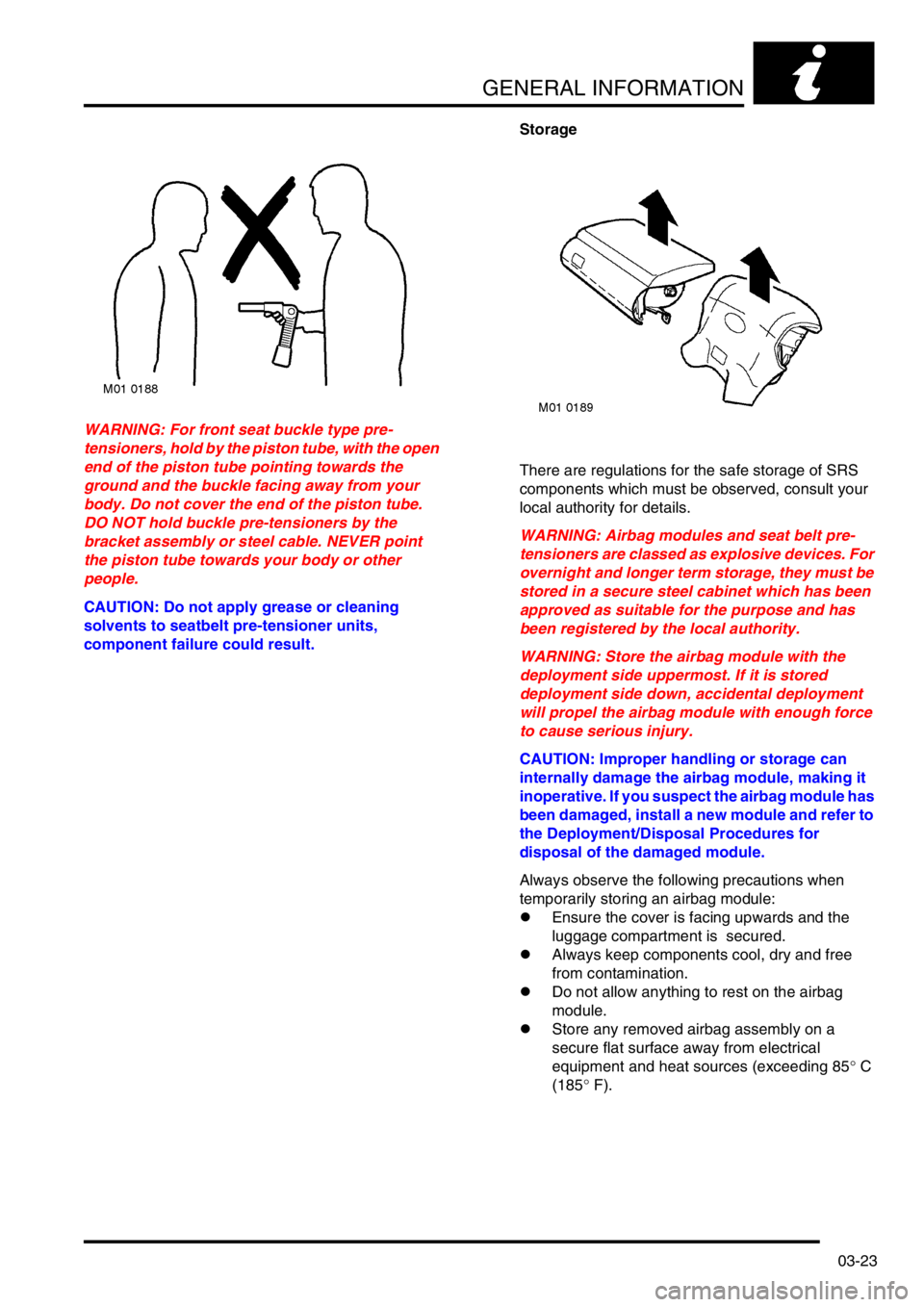
WARNING: For front seat buckle type pre-
tensioners, hold by the piston tube, with the open
end of the piston tube pointing towards the
ground and the buckle facing away from your
body. Do not cover the end of the piston tube.
DO NOT hold buckle pre-tensioners by the
bracket assembly or steel cable. NEVER point
the piston tube towards your body or other
people.
CAUTION: Do not apply grease or cleaning
solvents to seatbelt pre-tensioner units,
component failure could result.Storage
There are regulations for the safe storage of SRS
components which must be observed, consult your
local authority for details.
WARNING: Airbag modules and seat belt pre-
tensioners are classed as explosive devices. For
overnight and longer term storage, they must be
stored in a secure steel cabinet which has been
approved as suitable for the purpose and has
been registered by the local authority.
WARNING: Store the airbag module with the
deployment side uppermost. If it is stored
deployment side down, accidental deployment
will propel the airbag module with enough force
to cause serious injury.
CAUTION: Improper handling or storage can
internally damage the airbag module, making it
inoperative. If you suspect the airbag module has
been damaged, install a new module and refer to
the Deployment/Disposal Procedures for
disposal of the damaged module.
Always observe the following precautions when
temporarily storing an airbag module:
lEnsure the cover is facing upwards and the
luggage compartment is secured.
lAlways keep components cool, dry and free
from contamination.
lDo not allow anything to rest on the airbag
module.
lStore any removed airbag assembly on a
secure flat surface away from electrical
equipment and heat sources (exceeding 85° C
(185° F).
Page 55 of 1007
GENERAL INFORMATION
03-24
SRS Harnesses and Connectors
CAUTION: Always observe the following
precautions with regards to SRS system
electrical wiring:
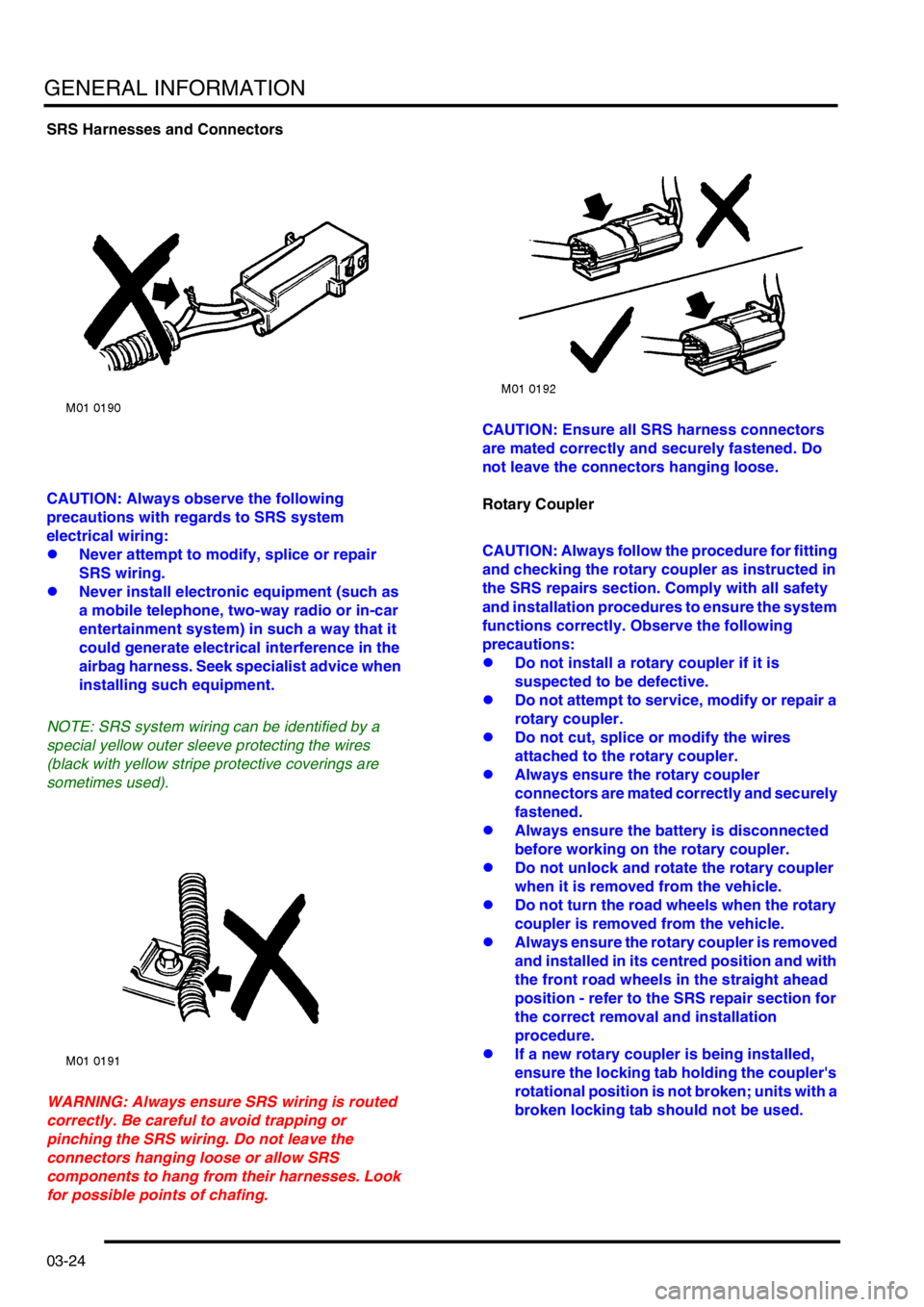
lNever attempt to modify, splice or repair
SRS wiring.
lNever install electronic equipment (such as
a mobile telephone, two-way radio or in-car
entertainment system) in such a way that it
could generate electrical interference in the
airbag harness. Seek specialist advice when
installing such equipment.
NOTE: SRS system wiring can be identified by a
special yellow outer sleeve protecting the wires
(black with yellow stripe protective coverings are
sometimes used).
WARNING: Always ensure SRS wiring is routed
correctly. Be careful to avoid trapping or
pinching the SRS wiring. Do not leave the
connectors hanging loose or allow SRS
components to hang from their harnesses. Look
for possible points of chafing.CAUTION: Ensure all SRS harness connectors
are mated correctly and securely fastened. Do
not leave the connectors hanging loose.
Rotary Coupler
CAUTION: Always follow the procedure for fitting
and checking the rotary coupler as instructed in
the SRS repairs section. Comply with all safety
and installation procedures to ensure the system
functions correctly. Observe the following
precautions:
lDo not install a rotary coupler if it is
suspected to be defective.
lDo not attempt to service, modify or repair a
rotary coupler.
lDo not cut, splice or modify the wires
attached to the rotary coupler.
lAlways ensure the rotary coupler
connectors are mated correctly and securely
fastened.
lAlways ensure the battery is disconnected
before working on the rotary coupler.
lDo not unlock and rotate the rotary coupler
when it is removed from the vehicle.
lDo not turn the road wheels when the rotary
coupler is removed from the vehicle.
lAlways ensure the rotary coupler is removed
and installed in its centred position and with
the front road wheels in the straight ahead
position - refer to the SRS repair section for
the correct removal and installation
procedure.
lIf a new rotary coupler is being installed,
ensure the locking tab holding the coupler's
rotational position is not broken; units with a
broken locking tab should not be used.
Page 58 of 1007
GENERAL INFORMATION
03-27
SRS component manual deployment
If a vehicle is to be scrapped and contains an
undeployed airbag module, the module must be
manually deployed. Always observe the following
precautions:
WARNING: Only personnel who have undergone
the appropriate training should undertake
deployment of airbag and seat belt pre-tensioner
modules.
WARNING: A deployed airbag or seatbelt pre-
tensioner is very hot, DO NOT return to a
deployed airbag module until at least 30 minutes
have elapsed since deployment.
WARNING: Only use approved deployment
equipment, and only deploy SRS components in
a well ventilated designated area. Ensure SRS
components are not damaged or ruptured before
deployment. Notify the relevant authorities.
WARNING: If a vehicle is to be scrapped,
undeployed airbag modules and pre-tensioner
units must be deployed in accordance with the
instructions in this manual.
WARNING: Contact with chemicals from
deployed and damaged SRS components could
present a health hazard, wear protective clothing
when handling. DO NOT eat, drink or smoke
when handling SRS components.
WARNING: Deployment of airbag modules and
seatbelt pre-tensioners can cause injury to
personnel in the close vicinity of the deploying
unit. In case of injury seek urgent medical advice.
Possible sources of injury include:
limpact - due to inflating airbag or pre-
tensioner operation causing component
'kick'.
l hearing - due to noise produced by
deploying airbags and seatbelt pre-
tensioner units.
l burns - hot component parts and gases.
l irritation to eyes and lungs - from deploying
gases or combustion residue.
WARNING: Ensure the SRS component to be
deployed is securely fastened to its mounting.WARNING: Deployment procedures detailed in
this manual should be strictly adhered to.
Compliance with the following precautions
MUST be ensured:
lOnly use deployment equipment approved
for the intended purpose.
lBefore commencing deployment procedure,
ensure the deployment tool functions
properly by performing the self test
procedure detailed in the SRS Repairs
section of this manual.
lDeployment of airbag/pre-tensioner
modules should be performed in a well
ventilated area which has been designated
for the purpose.
lEnsure airbag/pre-tensioner modules are
not damaged or ruptured before attempting
to deploy.
lNotify the relevant authorities of intention to
deploy airbag and pre-tensioner units.
lWhen deploying airbag and seatbelt pre-
tensioner units, ensure that all personnel are
at least 15 metres away from the deployment
zone.
lEnsure deployment tool is connected
correctly, in compliance with the
instructions detailed in this manual. In
particular, ensure deployment tool is NOT
connected to battery supply before
connecting to the airbag or seatbelt pre-
tensioner module connector.
lWhen deploying seatbelt pre-tensioners in
the vehicle, ensure the pre-tensioner unit is
fully secured to its fixing point.
lWhen removing deployed airbag and
seatbelt pre-tensioner modules, wear
protective clothing. Use gloves and seal
deployed units in a plastic bag.
lFollowing deployment of any component of
the SRS system within the vehicle, all SRS
components must be replaced. DO NOT re-
use or salvage any parts of the SRS system.
lDo not lean over airbag modules or seatbelt
pre-tensioner units when connecting
deployment equipment.
WARNING: During deployment parts of the
airbag module become hot enough to burn you.
Wait 30 minutes after deployment before
touching the airbag module.
Page 131 of 1007

TORQUE WRENCH SETTINGS
06-28
Brakes
1 Use NEW bolts
TORQUE DESCRIPTION METRIC IMPERIAL
ABS ECU pipe unions 17 Nm 12 lbf.ft
ABS modulator to mounting bracket bolts 9 Nm 7 lbf.ft
ABS modulator mounting bracket to inner wing:
⇒ Nuts
⇒ Bolts13 Nm
8 Nm10 lbf.ft
6 lbf.ft
Bleed screw - front calipers 10 Nm 7.5 lbf.ft
Brake servo to bulkhead nuts 22 Nm 16 lbf.ft
EGR cooler to mounting bolts 25 Nm 18 lbf.ft
EGR pipe support bracket to engine lifting bracket bolts 25 Nm 18 lbf.ft
Front caliper brake hose banjo bolt 28 Nm 21 lbf.ft
Front caliper guide pin bolts 27 Nm 20 lbf.ft
Front caliper mounting bolts 100 Nm 74 lbf.ft
Front disc shield to hub screw 8.5 Nm 6.3 lbf.ft
Front disc to drive flange screws 5 Nm 3.7 lbf.ft
Fuel rail to support bracket bolt 10 Nm 7.5 lbf.ft
Handbrake cable to body and subframe bolts 22 Nm 16 lbf.ft
Handbrake cable retaining plate bolts 22 Nm 16 lbf.ft
Handbrake lever assembly to body bolts 22 Nm 16 lbf.ft
Hill Descent Control (HDC) switch bolt 5 Nm 3.5 lbf.ft
Master cylinder to servo nuts 25 Nm 18 lbf.ft
PAS oil cooler pipe bolts 10 Nm 7.5 lbf.ft
Primary and secondary brake pipe union nuts 17 Nm 12 lbf.ft
Rear wheel cylinder pipe union nut 17 Nm 12 lbf.ft
Rear wheel cylinder to backplate bolts 8 Nm 6 lbf.ft
Reservoir to master cylinder (LHD) Torx bolt 8 Nm 6 lbf.ft
Reservoir to master cylinder (LHD) Torx bolt 6 Nm 4.5 lbf.ft
Road wheel nuts 115 Nm 85 lbf.ft
Turbocharger intercooler pipe to support bracket bolt 10 Nm 7.5 lbf.ft
Turbocharger pipe to coolant rail bolt 25 Nm 18 lbf.ft
Vacuum pump bolts
122 Nm 16 lbf.ft
Vacuum reservoir to mounting bracket nut 10 Nm 7.5 lbf.ft
Page 136 of 1007

TORQUE WRENCH SETTINGS
06-33
Air Conditioning
TORQUE DESCRIPTION METRIC IMPERIAL
A/C compressor to mounting bracket bolts (Td4 & K1.8) 25 Nm 18 lbf.ft
A/C compressor mounting bracket to cylinder block bolts (Td4 & K1.8) 45 Nm 33 lbf.ft
A/C compressor mounting bracket to cylinder block bolts (KV6) 45 Nm 33 lbf.ft
A/C compressor support bracket to sump bolt (Td4) 10 Nm 7.5 lbf.ft
A/C compressor drive belt tensioner clamp bolt (Td4) 24 Nm 18 lbf.ft
A/C compressor drive belt tensioner pivot bolt (Td4) 24 Nm 18 lbf.ft
A/C compressor upper and lower securing bolts (KV6) 25 Nm 18 lbf.ft
A/C pipe rail to condenser bolt (KV6) 8 Nm 6 lbf.ft
A/C pipe rail to condenser bolt (KV6) 8 Nm 6 lbf.ft
Condenser bracket to radiator bolts 8 Nm 6 lbf.ft
Receiver drier to condenser bolts 12 Nm 9 lbf.ft
Refrigerant pressure sensor 10 Nm 7.5 lbf.ft
TXV to bulkhead Allen screws 25 Nm 18 lbf.ft
Page 141 of 1007

LIFTING AND TOWING
08-2
Raising the front of a vehicle
Position the cup of the hydraulic arm under the
centre of the front body crossmember assembly.
Use jack to raise front road wheels to enable safety
stands to be installed under the front end of each
longitudinal member.
Carefully lower jack until vehicle sits securely on
safety stands.
Before working on the underside of a vehicle re-
check the stability of the vehicle on the stands.
Use the reverse procedure when removing a vehicle
from stands.
NOTE: For some repair operations it may be
necessary to use a jack to support the engine under
the sump. In this case, a block of wood should be
used on the jack to protect the sump.
Raising the rear of a vehicle
Position cup of hydraulic arm under the centre of the
rear subframe crossmember at the position
identified by the embossed arrows.
Use jack to raise rear road wheels to enable safety
stands to be installed under the rear ends of the
body longitudinal members.
Carefully lower jack until vehicle sits securely on
safety stands.
Before working on the underside of a vehicle, re-
check the stability of the vehicle on the stands.
Use the reverse procedure when removing a vehicle
from stands.
Wheel-free lift
Locate the lifting pads under the ends of the body
longitudinal members. Raise the ramp to support the
weight of the vehicle, ensure the vehicle is secure on
the lifting pads, then raise the ramp to the required
height.
Towing
General
The vehicle has permanent four wheel drive. The
following instructions must be adhered to:
Towing the vehicle on all four wheels with driver
operating steering and brakes
lTurn ignition key to position '1' to release
steering lock and then to position 'II' to enable
the brake lights, wipers and direction indicators
to be operated, if necessary.
l Select neutral in gearbox and ensure HDC (hill
descent control) is deselected.
lSecure tow rope, chain or cable to towing eye.
lRelease the parking brake.
CAUTION: The brake servo and power assisted
steering system will not be functional without the
engine running. Greater pedal pressure will be
required to apply the brakes and the steering
system will require greater effort to turn the front
road wheels. The vehicle tow connection should
only be used under normal road conditions,
'snatch' recovery should be avoided.
Suspended tow by breakdown vehicle
Mark propeller shaft drive flanges and mating flanges
with identification lines to enable the propeller shaft
to be refitted in its original position.
Remove the propeller shaft fixings then remove the
shaft from the vehicle.
CAUTION: To prevent vehicle damage, rear
propeller shaft MUST BE removed.
Page 142 of 1007
LIFTING AND TOWING
08-3
If the front of the vehicle is to be trailed, turn ignition
key to position 'I' to release steering lock.
WARNING: Do not turn the starter switch to
position '0' or remove the ignition key while the
vehicle is being towed.
CAUTION: If it is considered unsafe to turn the
starter switch to position '1' due to accident
damage or an electrical fault; disconnect the
battery before turning the ignition switch.
CAUTION: The steering wheel and/or linkage
must be secured in a straight ahead position. DO
NOT use the steering lock mechanism for this
purpose.
CAUTION: Under no circumstances should the
vehicle be towed or recovered by means of
lashing to the rear subframe. Serious damage to
the subframe and body could result.
CAUTION: Only use the rear towing eye for
towing another vehicle.
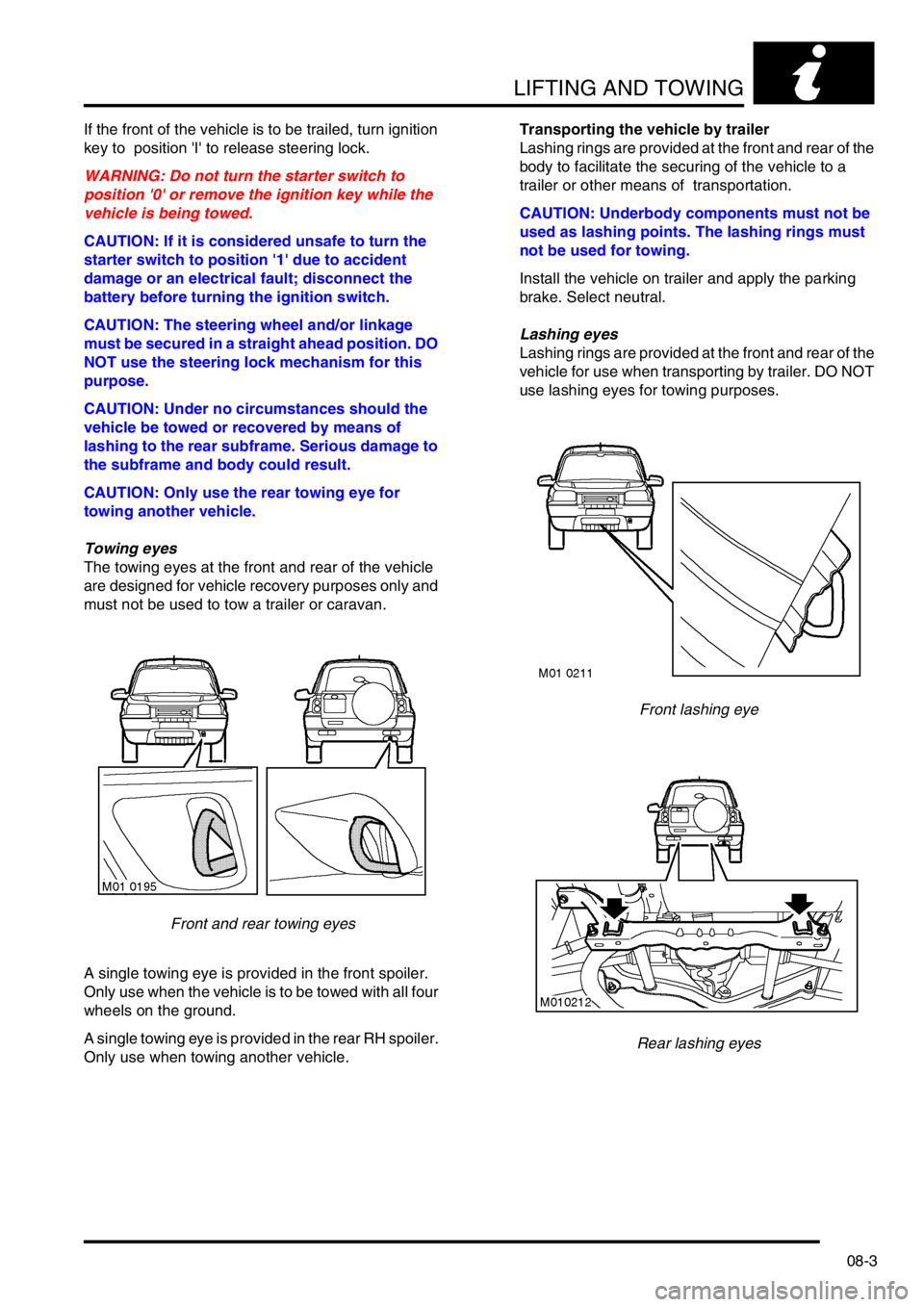
Towing eyes
The towing eyes at the front and rear of the vehicle
are designed for vehicle recovery purposes only and
must not be used to tow a trailer or caravan.
Front and rear towing eyes
A single towing eye is provided in the front spoiler.
Only use when the vehicle is to be towed with all four
wheels on the ground.
A single towing eye is provided in the rear RH spoiler.
Only use when towing another vehicle.Transporting the vehicle by trailer
Lashing rings are provided at the front and rear of the
body to facilitate the securing of the vehicle to a
trailer or other means of transportation.
CAUTION: Underbody components must not be
used as lashing points. The lashing rings must
not be used for towing.
Install the vehicle on trailer and apply the parking
brake. Select neutral.
Lashing eyes
Lashing rings are provided at the front and rear of the
vehicle for use when transporting by trailer. DO NOT
use lashing eyes for towing purposes.
Front lashing eye
Rear lashing eyes
Page 151 of 1007

MAINTENANCE
10-4 MAINTENANCE
Seats and Seat Belts
Check
1.Check seat frames are secured to floor and
show no signs of movement.
2.Check operation of seat slide and tilt
mechanisms, ensuring there is no excessive
play between seat cushion and seat back.
3.Check tightness of accessible seat fixings.
4.Fully extract seat belt and allow it to return
under its own recoil mechanism.
5.Check entire length of seat belt webbing for
signs of fraying or damage. Repeat for all belts.
6.Check security of seat belt upper mountings.
7.Check for correct operation of seat belt height
adjusters.
8.Check security of seat belt buckle mountings.
9.Connect each belt to the correct buckle, check
seat belt buckle and tongue are secure.
Release seat belt buckle and check for correct
operation.
10.Check tightness of accessible seat belt
mountings.
Lamps, Horns and Warning Indicators
Check
1.Switch on side, head and tail lights and check
operation.
2.Check headlamp dim/dip operation.
3.Check headlamp levelling operation.
4.Check turn signals and hazard warning lights
operation.
5.Press brake pedal and check operation of
brake lights.
6.Check all exterior lamp lenses for clarity and
condition. Pay particular attention to head lamp
lenses for signs of stone chips or damage.
7.Check horn for loud clear sound.
8.Check operation of all instrument pack warning
and indicator lights.
9.Check for correct operation of interior courtesy
lights.
10.Switch on headlamps (with ignition switch at 'O'
position) and check light reminder warning
operates when door is opened.