oil type LAND ROVER FREELANDER 2001 Owner's Manual
[x] Cancel search | Manufacturer: LAND ROVER, Model Year: 2001, Model line: FREELANDER, Model: LAND ROVER FREELANDER 2001Pages: 1007, PDF Size: 23.47 MB
Page 96 of 1007

GENERAL DATA
04-33
Heating and Ventilation
Air Conditioning
PTC heater - Td4 engine - if fitted
⇒ Make/Type Catem, 900 Watt output, 12 volt supply, located in Hevac unit
FBH - Td4 engine - if fitted
⇒ Make/Type Webasto Thermotop C, self-regulating, 5 kW output
System CFC free, sealed, closed-loop system
Refrigerant HFC - R134a
Refrigerant charge quantity:
All models except LHD KV6
LHD KV6 models540 ± 25 grammes
430 ± 25 grammes
Compressor, up to 04MY (some very early 04MY
vehicles may be fitted with this type of compressor):
⇒ Type Denso - variable displacement, 7-cylinder swash plate unit
⇒ High Pressure Blow-off valve 35.3 bar (3.53 MPa, 512 lbf/in
2)
⇒ Displacement (Min.) 5%
⇒ Displacement (Max.) 95%
Compressor, 04MY onwards
⇒ Type Sanden PXV16 - variable displacement, 7-cylinder swash plate unit
⇒ High Pressure Blow-off valve 35.3 bar (3.53 MPa, 512 lbf/in
2)
⇒ Displacement (Min.) 3%
⇒ Displacement (Max.) 100%
Lubricating oil Nippon Denso ND-8
Evaporator thermostat:
⇒ Opens
⇒ Closes+2 °C (+36 °F)
-4 °C (+25 °F)
Condenser fan control PWM signal from ECM to cooling fan control unit
Refrigerant Pressure Sensor
Low pressure limit:
⇒ A/C on (pressure rising) 2.25 ± 0.2 bar (32.6 ± 2.9 lbf/in
2)
⇒ A/C off (pressure falling) 1.96 ± 0.2 bar (28.4 ± 2.9 lbf/in
2)
High pressure limit:
⇒ A/C off (pressure rising) 31.4 ± 2.0 bar (455.3 ± 29 lbf/in
2)
⇒ A/C on (pressure falling) 25.5 ± 2.0 bar (369.8 ± 29 lbf/in
2)
Page 145 of 1007

CAPACITIES, FLUIDS, LUBRICANTS AND SEALANTS
09-2
Fluids
Fuel
Always use the following recommended fuels:
Petrol engines
Use unleaded petrol with a minimum octane rating of
95 RON to ENN 228 specification.
In an emergency (and only if the correct fuel is
unavailable), lower octane rated fuel can be used for
very limited periods of moderate, low speed
motoring, provided engine 'knocking' does not occur.
Fuels of 90 RON is used in certain markets; 90 RON
fuel can be used regularly ONLY if the engine has
been tuned specifically to suit low octane fuel.
Certain markets use fuel containing a 23% Ethanol
additive.
K1.8 and KV6 engines are also available for use with
a low octane leaded fuel specification in some
markets.
Diesel engines
Use a good quality diesel fuel or automotive gas oil
(AGO) conforming to EN 590 specification.
It is important that the sulphur content of diesel fuel
does not exceed 0.3%.
Ensure the fuel filter element is changed at the
recommended intervals.
+ MAINTENANCE, MAINTENANCE, Fuel
Filter - Diesel.
Brake Fluid
Use only DOT 4 brake fluid. DO NOT use brake fluid
of a different specification.
PAS fluid
Use Texaco 9226 fluid.Anti-freeze solutions
The overall anti-freeze concentration should not fall,
by volume, below 50% to ensure that the anti-
corrosion properties of the coolant are maintained.
Anti-freeze concentrations greater than 60% are not
recommended as cooling efficiency will be impaired.
Use Havoline Extended Life Coolant (XLC), or any
ethylene glycol based anti-freeze (containing no
methanol) with only Organic Acid Technology (OAT)
corrosion inhibitors, to protect the cooling system.
CAUTION: No other anti-freeze should be used
with Havoline Extended Life Coolant.
The cooling system should be drained, flushed and
refilled with the correct amount of anti-freeze
solution at the intervals given on the Service
Maintenance Check Sheet.
After filling with anti-freeze solution, attach a warning
label to a prominent position on the vehicle stating
the type of anti-freeze contained in the cooling
system to ensure that the correct type is used for
topping-up.
The following recommended quantities of anti-freeze
will provide frost protection to -36 °C (-33 °F):
Engine – Td4
Engine – K1.8
Engine – KV6
Concentration 50%
Amount of anti-freeze 3.75 litres
(6.625 imp. pts)
Concentration 50%
Amount of anti-freeze 2.9 litres
(5.125 imp. pts)
Concentration 50%
Amount of anti-freeze 3.9 litres
(6.875 imp. pts, )
Page 888 of 1007
AIR CONDITIONING
REFRIGERANT RECOVERY, RECYCLING AND RECHARGING 82-1
AIR CONDITIONING REFRIGERANT RECOVERY, RECYCLING AND RECHARGING
Refrigerant recovery - recycling and
recharge
$% 82.30.02
Refrigerant recovery
WARNING: Servicing must only be carried
out by personnel familiar with both the
vehicle system and the charging and testing
equipment. All operations must be carried
out in a well ventilated area away from open
flame and heat sources.
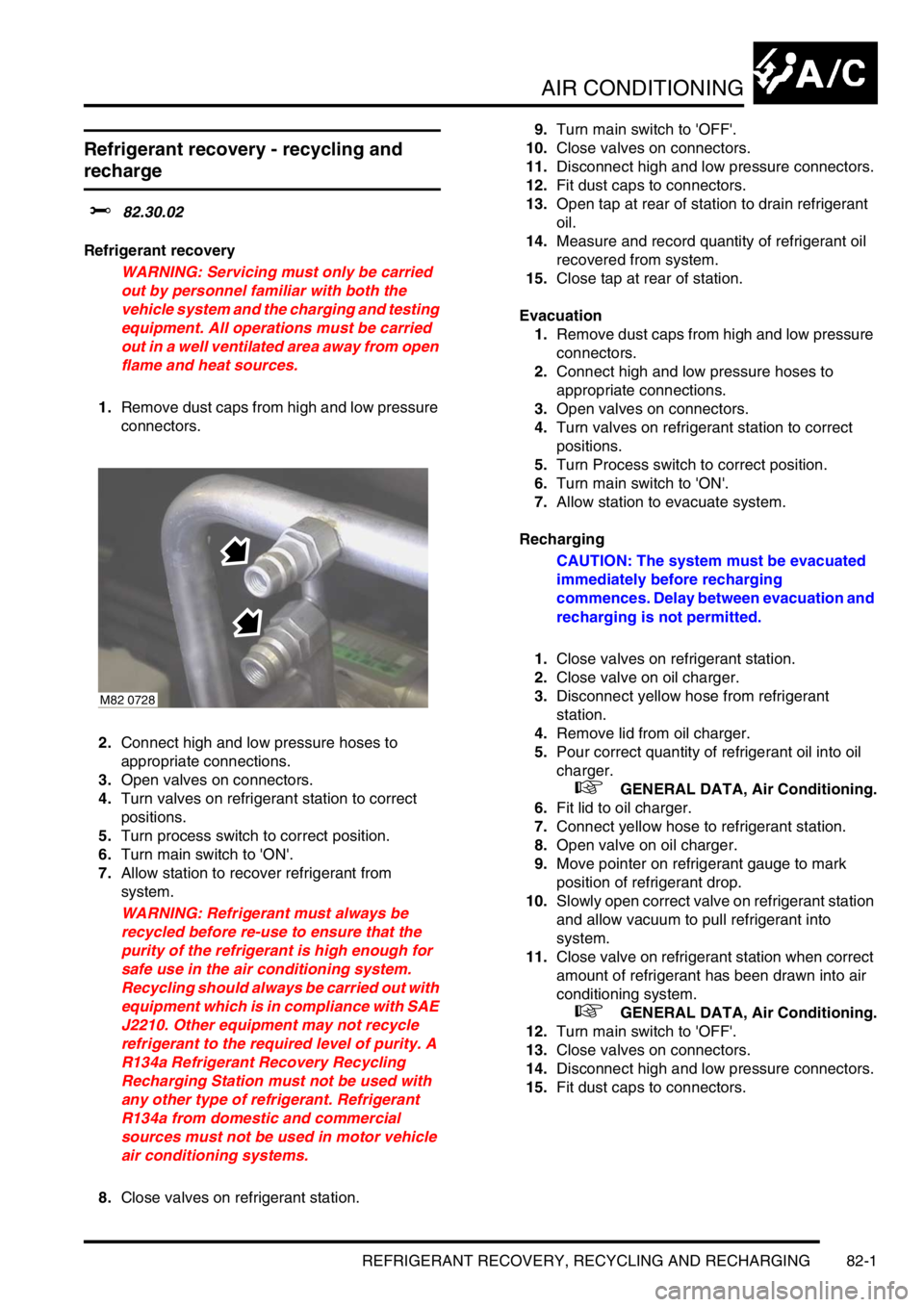
1.Remove dust caps from high and low pressure
connectors.
2.Connect high and low pressure hoses to
appropriate connections.
3.Open valves on connectors.
4.Turn valves on refrigerant station to correct
positions.
5.Turn process switch to correct position.
6.Turn main switch to 'ON'.
7.Allow station to recover refrigerant from
system.
WARNING: Refrigerant must always be
recycled before re-use to ensure that the
purity of the refrigerant is high enough for
safe use in the air conditioning system.
Recycling should always be carried out with
equipment which is in compliance with SAE
J2210. Other equipment may not recycle
refrigerant to the required level of purity. A
R134a Refrigerant Recovery Recycling
Recharging Station must not be used with
any other type of refrigerant. Refrigerant
R134a from domestic and commercial
sources must not be used in motor vehicle
air conditioning systems.
8.Close valves on refrigerant station.9.Turn main switch to 'OFF'.
10.Close valves on connectors.
11.Disconnect high and low pressure connectors.
12.Fit dust caps to connectors.
13.Open tap at rear of station to drain refrigerant
oil.
14.Measure and record quantity of refrigerant oil
recovered from system.
15.Close tap at rear of station.
Evacuation
1.Remove dust caps from high and low pressure
connectors.
2.Connect high and low pressure hoses to
appropriate connections.
3.Open valves on connectors.
4.Turn valves on refrigerant station to correct
positions.
5.Turn Process switch to correct position.
6.Turn main switch to 'ON'.
7.Allow station to evacuate system.
Recharging
CAUTION: The system must be evacuated
immediately before recharging
commences. Delay between evacuation and
recharging is not permitted.
1.Close valves on refrigerant station.
2.Close valve on oil charger.
3.Disconnect yellow hose from refrigerant
station.
4.Remove lid from oil charger.
5.Pour correct quantity of refrigerant oil into oil
charger.
+ GENERAL DATA, Air Conditioning.
6.Fit lid to oil charger.
7.Connect yellow hose to refrigerant station.
8.Open valve on oil charger.
9.Move pointer on refrigerant gauge to mark
position of refrigerant drop.
10.Slowly open correct valve on refrigerant station
and allow vacuum to pull refrigerant into
system.
11.Close valve on refrigerant station when correct
amount of refrigerant has been drawn into air
conditioning system.
+ GENERAL DATA, Air Conditioning.
12.Turn main switch to 'OFF'.
13.Close valves on connectors.
14.Disconnect high and low pressure connectors.
15.Fit dust caps to connectors.
M82 0728