steering LAND ROVER FREELANDER 2001 Owner's Manual
[x] Cancel search | Manufacturer: LAND ROVER, Model Year: 2001, Model line: FREELANDER, Model: LAND ROVER FREELANDER 2001Pages: 1007, PDF Size: 23.47 MB
Page 149 of 1007
MAINTENANCE
10-2 MAINTENANCE
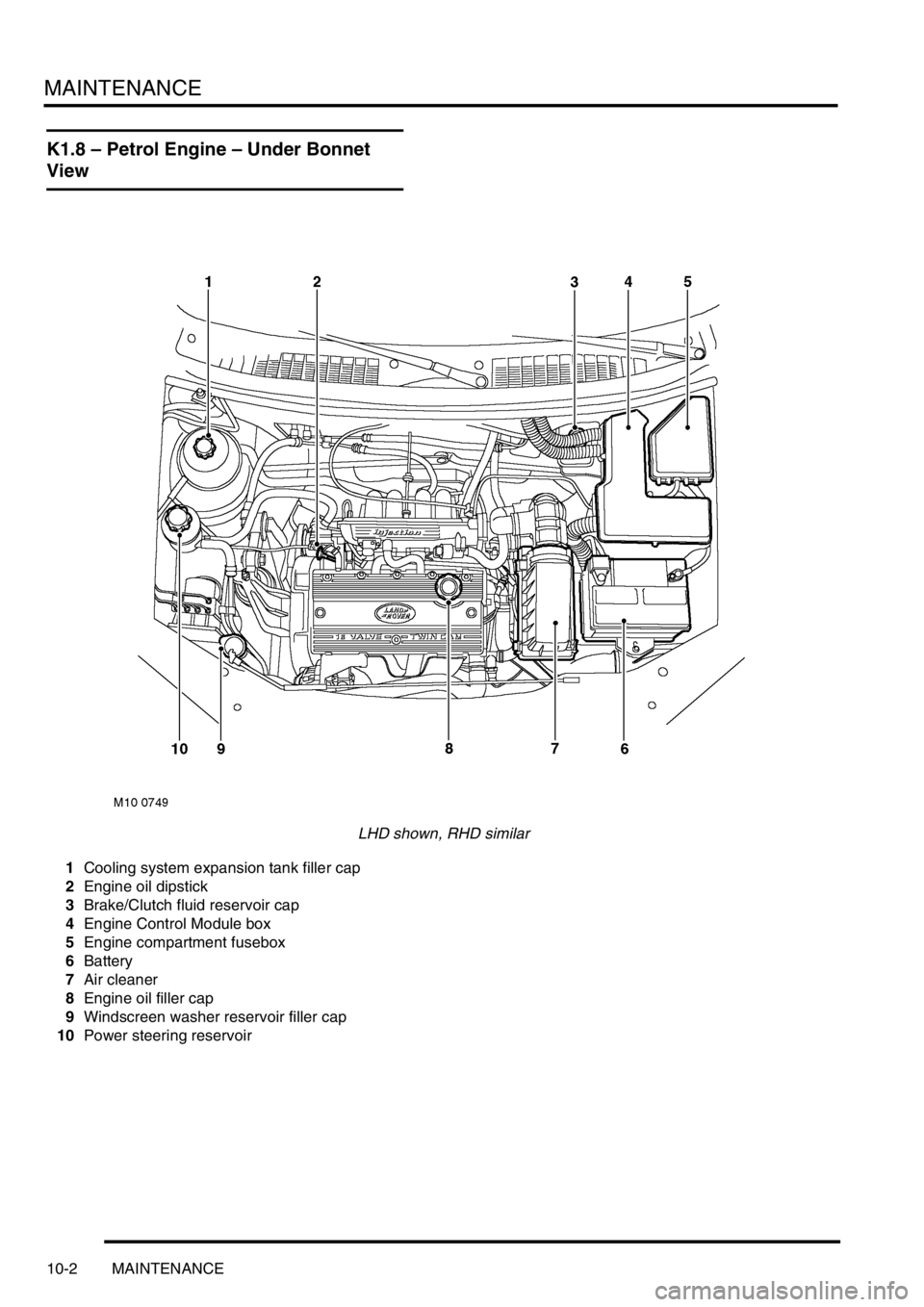
K1.8 – Petrol Engine – Under Bonnet
View
LHD shown, RHD similar
1Cooling system expansion tank filler cap
2Engine oil dipstick
3Brake/Clutch fluid reservoir cap
4Engine Control Module box
5Engine compartment fusebox
6Battery
7Air cleaner
8Engine oil filler cap
9Windscreen washer reservoir filler cap
10Power steering reservoir
Page 150 of 1007
MAINTENANCE
MAINTENANCE 10-3
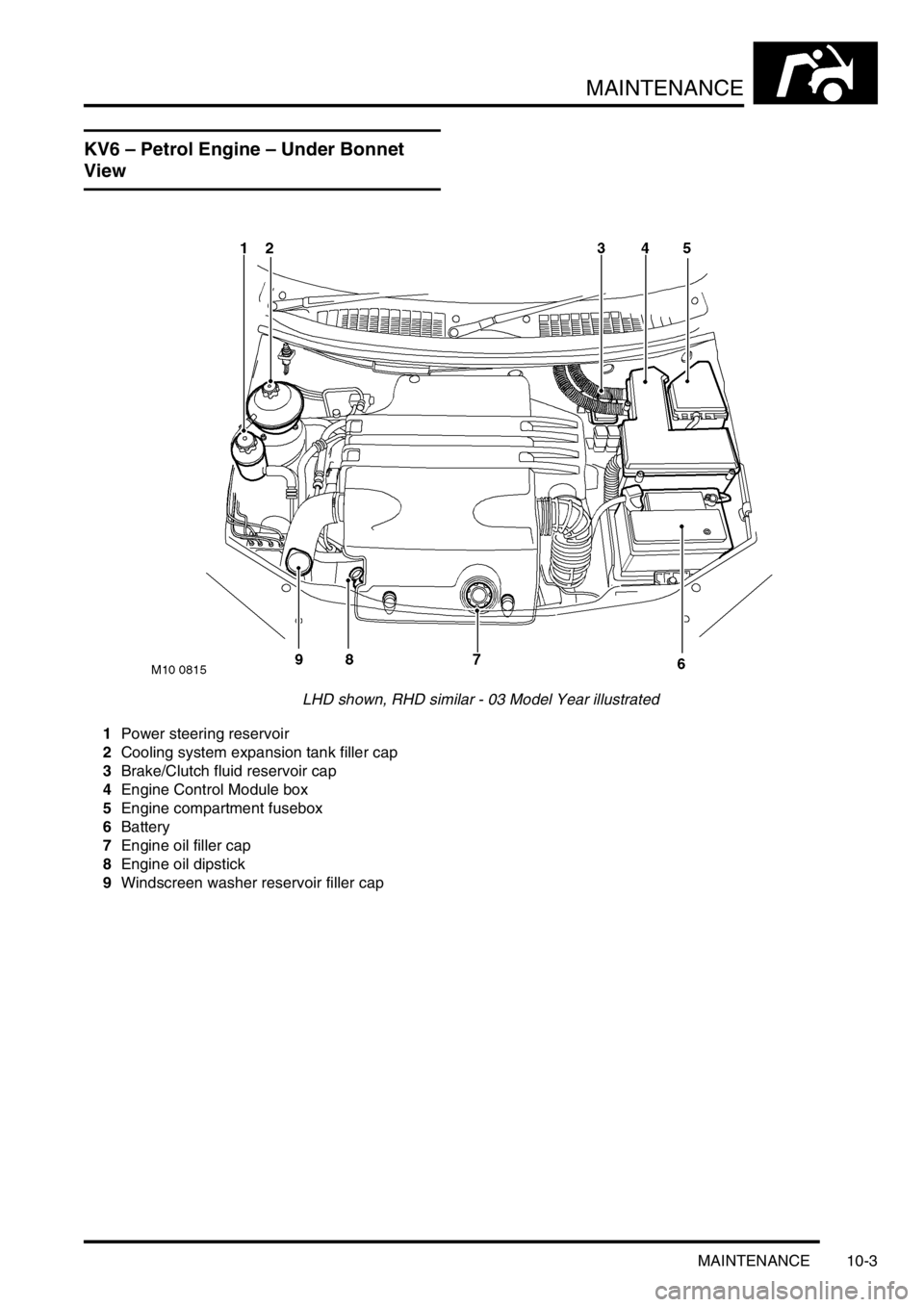
KV6 – Petrol Engine – Under Bonnet
View
LHD shown, RHD similar - 03 Model Year illustrated
1Power steering reservoir
2Cooling system expansion tank filler cap
3Brake/Clutch fluid reservoir cap
4Engine Control Module box
5Engine compartment fusebox
6Battery
7Engine oil filler cap
8Engine oil dipstick
9Windscreen washer reservoir filler cap
Page 154 of 1007
MAINTENANCE
MAINTENANCE 10-7
Tyres
Check
1.Check for any apparent damage to tyres,
paying particular attention to side walls.
2.Look at tyre treads and check for any unusual
wear patterns which may indicate out of
specification adjustment of steering or
suspension.
NOTE: Any adjustments to steering or
suspension will be subject to additional labour
and/or material cost and should not be carried
out without the authorisation of the customer.
3.Measure the tread depth across the width of the
tyre and around the circumference. Annotate
the maintenance check sheet with the lowest
figure obtained from each tyre.
NOTE: Any requirement to replace tyres should
be advised to the customer before any remedial
work is carried out. This will be subject to
additional labour and/or material cost and
should not be carried out without the
authorisation of the customer.
CAUTION: If new tyres are to be fitted,
ensure that they are fitted to the rear axle
only or to both front and rear axles. DO NOT
fit new tyres to front axle only.
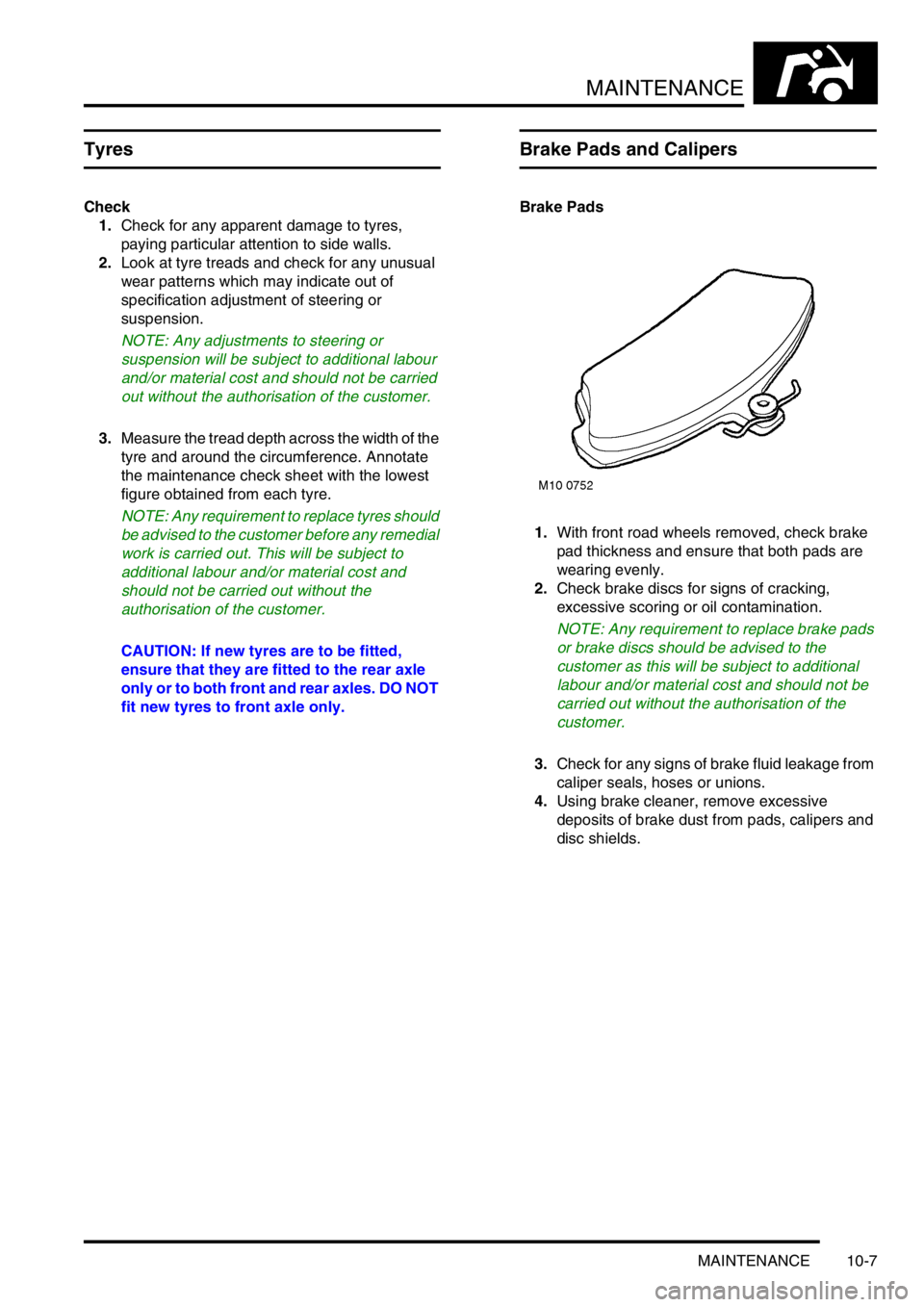
Brake Pads and Calipers
Brake Pads
1.With front road wheels removed, check brake
pad thickness and ensure that both pads are
wearing evenly.
2.Check brake discs for signs of cracking,
excessive scoring or oil contamination.
NOTE: Any requirement to replace brake pads
or brake discs should be advised to the
customer as this will be subject to additional
labour and/or material cost and should not be
carried out without the authorisation of the
customer.
3.Check for any signs of brake fluid leakage from
caliper seals, hoses or unions.
4.Using brake cleaner, remove excessive
deposits of brake dust from pads, calipers and
disc shields.
Page 164 of 1007
MAINTENANCE
MAINTENANCE 10-17
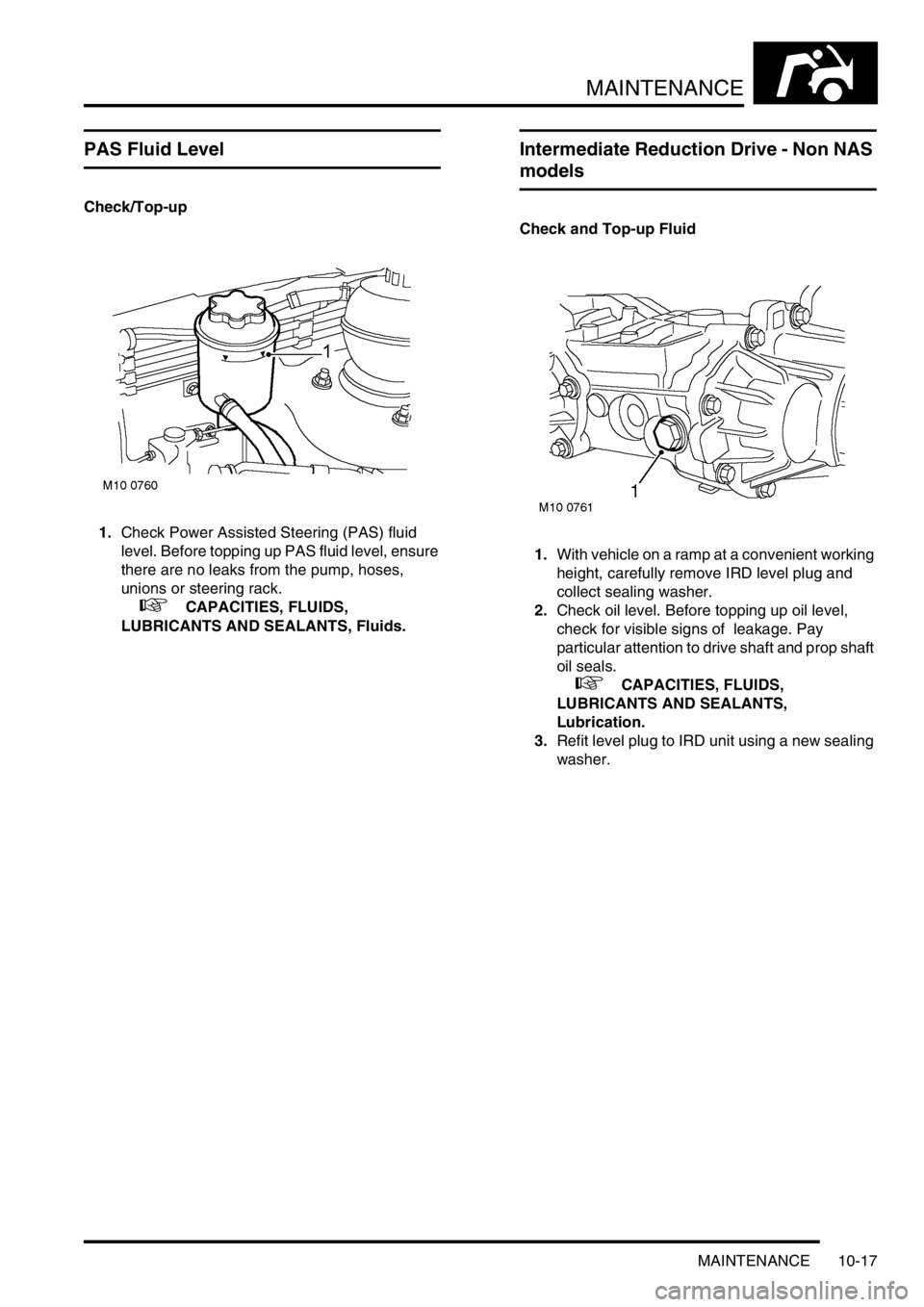
PAS Fluid Level
Check/Top-up
1.Check Power Assisted Steering (PAS) fluid
level. Before topping up PAS fluid level, ensure
there are no leaks from the pump, hoses,
unions or steering rack.
+ CAPACITIES, FLUIDS,
LUBRICANTS AND SEALANTS, Fluids.
Intermediate Reduction Drive - Non NAS
models
Check and Top-up Fluid
1.With vehicle on a ramp at a convenient working
height, carefully remove IRD level plug and
collect sealing washer.
2.Check oil level. Before topping up oil level,
check for visible signs of leakage. Pay
particular attention to drive shaft and prop shaft
oil seals.
+ CAPACITIES, FLUIDS,
LUBRICANTS AND SEALANTS,
Lubrication.
3.Refit level plug to IRD unit using a new sealing
washer.
Page 175 of 1007
MAINTENANCE
10-28 MAINTENANCE
Steering
Check
1.Check/tighten steering unit and steering rod
ball joint fixings.
2.Check condition of ball joints and dust covers.
3.Check steering rack bellows for any signs of
leakage.
Road Test
There are two purposes for conducting a road test.
Firstly, to ensure the work completed within the
dealership meets the standards required as laid
down by dealership processes. Secondly, for a
skilled technician to assess the general condition of
the vehicle and report any conditions that the
customer should be made aware of.
CAUTION: Two wheel dynamometer tests must
not be carried out. Four wheel dynamometer
tests must be restricted to 3 mph (5 kph).
Engine Start
1.Check for correct operation of starter switch.
Ensure the engine starts in a correct manner.
Leave the engine running.
Starter Inhibitor Switch – (Automatic only)
1.Select 'D' gear lever position.
2.Check that engine will not start.
3.Select 'R' gear lever position and repeat start
check.
4.Check that engine will start in 'P' and 'N'
positions.
Selector Cable – (Automatic only)
1.Check for correct setting of gear selector cable.
Engine Performance and Throttle Operation
1.Start engine and check that it starts easily.
2.Check that 'oil pressure' and 'no charge'
warning lamps extinguish.
3.Check that throttle pedal movement is free and
unrestricted.
4.Check that engine is responsive to throttle
movement.
Clutch and Gear Selection –
(Manual only, normal driving conditions)
1.Check that clutch engages smoothly without
judder, slipping or noise.
2.Check for abnormal transmission noise.
3.Check for smooth quiet gear changes and that
gear selected engages easily.
Page 176 of 1007

MAINTENANCE
MAINTENANCE 10-29
Gear Change and Parking Pawl Engagement –
(Automatic only, normal driving conditions)
1.Select 'R' and check for smooth take up.
2.Select 'D' and check for smooth up-changes of
ratio from rest.
3.Slow down vehicle and check for smooth down-
changes of ratio.
4.Stop vehicle on a slope.
5.Select 'P' and release handbrake.
6.Check that vehicle does not move and that
selector does not slip out of 'P'.
7.Carry out a similar check with vehicle facing in
the opposite direction.
Steering
1.With vehicle stationary, turn steering from lock
to lock. Check for smooth operation and ensure
there is no undue noise from the power steering
pump or drive belt.
Suspension
1.Check for noise, irregularity in ride (e.g.
dampers) and wheel imbalance.
Foot brake
1.Check for pedal effort, travel, braking
efficiency, pulling and binding.
Handbrake
1.Apply handbrake firmly, check travel and
ratchet hold and release.
Instruments
1.Check for correct operation of all instruments
and warning devices where practical.
Body
1.Check for abnormal body noise.
Seat Belts
1.Check for operation of inertia reels.Road Test
1.Drive vehicle on a short road test. Check all
vehicle systems for correct operation. Pay
particular attention to:
lEngine noise
lGearbox noise
lSuspension noise
lBody noise
lBraking system operation
lGear selection
lEngine performance
2.Where possible, check for correct operation of
Hill Descent Control (HDC) system. This should
not be carried out if excessive journey time is
required.
3.After road test, carry out a final inspection of the
vehicle on vehicle ramps.
4.Check all underbonnet fluid levels and top-up if
necessary.
Page 207 of 1007
ENGINE - K SERIES KV6
12-3-30 REPAIRS
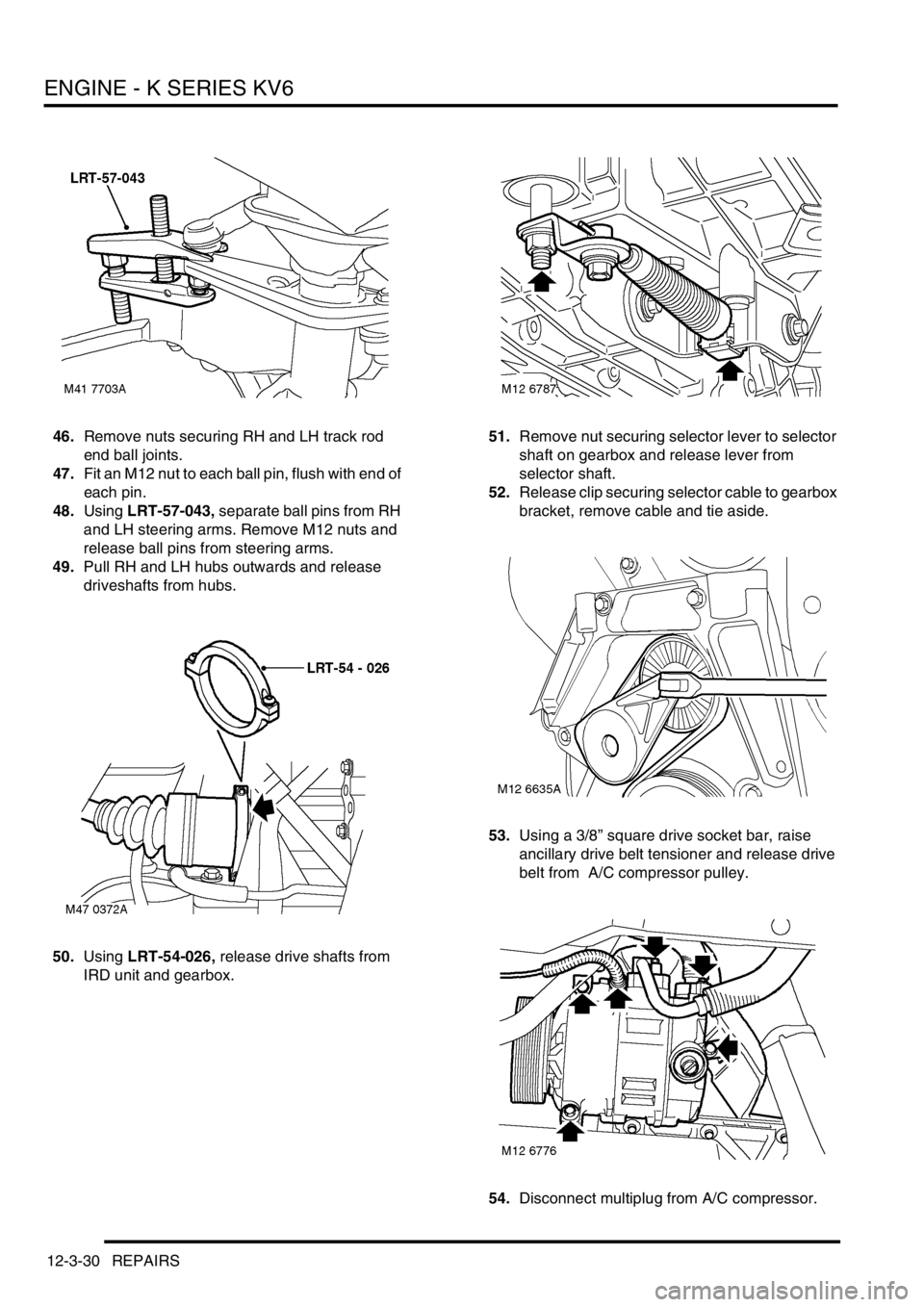
46.Remove nuts securing RH and LH track rod
end ball joints.
47.Fit an M12 nut to each ball pin, flush with end of
each pin.
48.Using LRT-57-043, separate ball pins from RH
and LH steering arms. Remove M12 nuts and
release ball pins from steering arms.
49.Pull RH and LH hubs outwards and release
driveshafts from hubs.
50.Using LRT-54-026, release drive shafts from
IRD unit and gearbox.51.Remove nut securing selector lever to selector
shaft on gearbox and release lever from
selector shaft.
52.Release clip securing selector cable to gearbox
bracket, remove cable and tie aside.
53.Using a 3/8” square drive socket bar, raise
ancillary drive belt tensioner and release drive
belt from A/C compressor pulley.
54.Disconnect multiplug from A/C compressor.
Page 210 of 1007
ENGINE - K SERIES KV6
REPAIRS 12-3-33
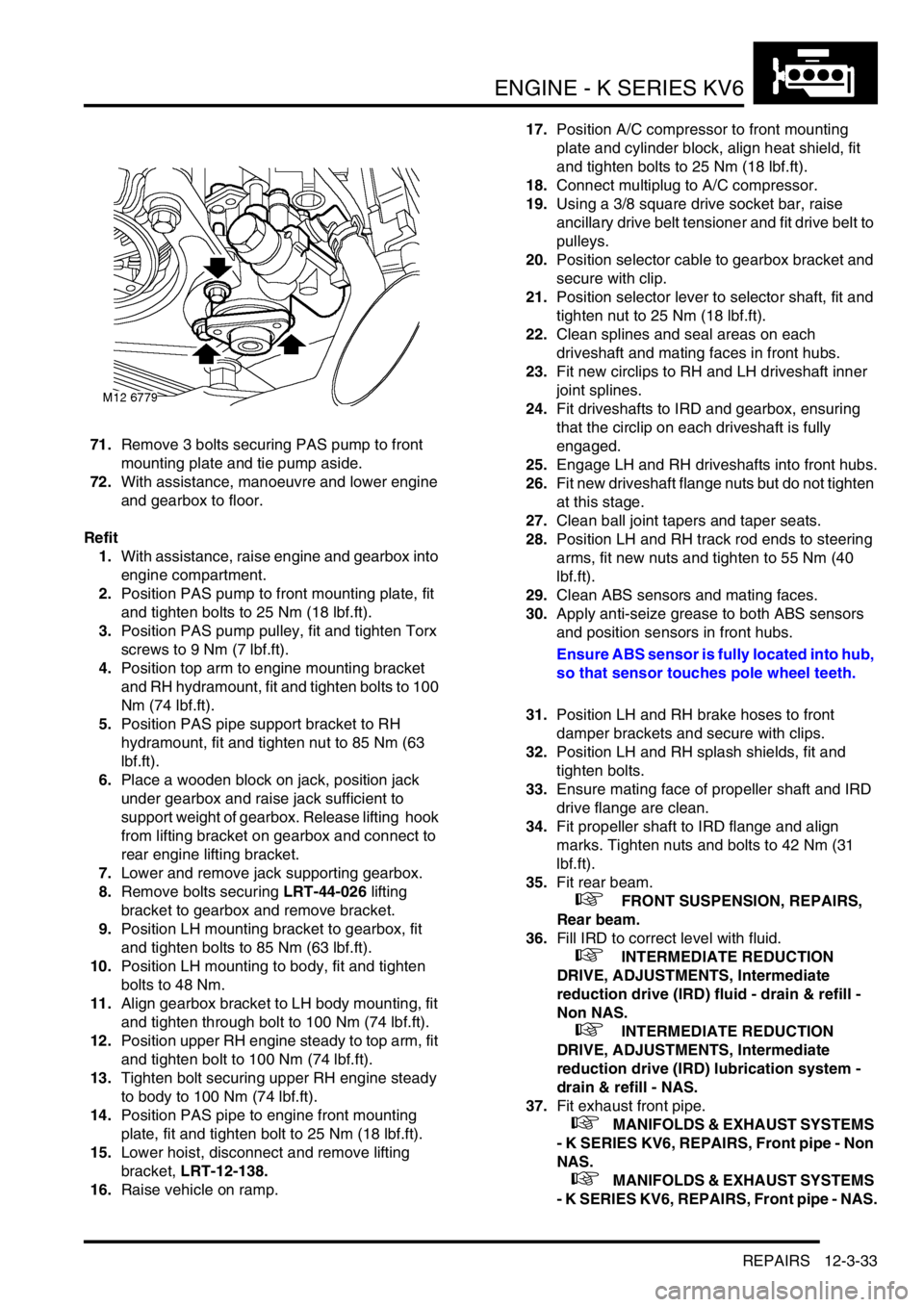
71.Remove 3 bolts securing PAS pump to front
mounting plate and tie pump aside.
72.With assistance, manoeuvre and lower engine
and gearbox to floor.
Refit
1.With assistance, raise engine and gearbox into
engine compartment.
2.Position PAS pump to front mounting plate, fit
and tighten bolts to 25 Nm (18 lbf.ft).
3.Position PAS pump pulley, fit and tighten Torx
screws to 9 Nm (7 lbf.ft).
4.Position top arm to engine mounting bracket
and RH hydramount, fit and tighten bolts to 100
Nm (74 lbf.ft).
5.Position PAS pipe support bracket to RH
hydramount, fit and tighten nut to 85 Nm (63
lbf.ft).
6.Place a wooden block on jack, position jack
under gearbox and raise jack sufficient to
support weight of gearbox. Release lifting hook
from lifting bracket on gearbox and connect to
rear engine lifting bracket.
7.Lower and remove jack supporting gearbox.
8.Remove bolts securing LRT-44-026 lifting
bracket to gearbox and remove bracket.
9.Position LH mounting bracket to gearbox, fit
and tighten bolts to 85 Nm (63 lbf.ft).
10.Position LH mounting to body, fit and tighten
bolts to 48 Nm.
11.Align gearbox bracket to LH body mounting, fit
and tighten through bolt to 100 Nm (74 lbf.ft).
12.Position upper RH engine steady to top arm, fit
and tighten bolt to 100 Nm (74 lbf.ft).
13.Tighten bolt securing upper RH engine steady
to body to 100 Nm (74 lbf.ft).
14.Position PAS pipe to engine front mounting
plate, fit and tighten bolt to 25 Nm (18 lbf.ft).
15.Lower hoist, disconnect and remove lifting
bracket, LRT-12-138.
16.Raise vehicle on ramp.17.Position A/C compressor to front mounting
plate and cylinder block, align heat shield, fit
and tighten bolts to 25 Nm (18 lbf.ft).
18.Connect multiplug to A/C compressor.
19.Using a 3/8 square drive socket bar, raise
ancillary drive belt tensioner and fit drive belt to
pulleys.
20.Position selector cable to gearbox bracket and
secure with clip.
21.Position selector lever to selector shaft, fit and
tighten nut to 25 Nm (18 lbf.ft).
22.Clean splines and seal areas on each
driveshaft and mating faces in front hubs.
23.Fit new circlips to RH and LH driveshaft inner
joint splines.
24.Fit driveshafts to IRD and gearbox, ensuring
that the circlip on each driveshaft is fully
engaged.
25.Engage LH and RH driveshafts into front hubs.
26.Fit new driveshaft flange nuts but do not tighten
at this stage.
27.Clean ball joint tapers and taper seats.
28.Position LH and RH track rod ends to steering
arms, fit new nuts and tighten to 55 Nm (40
lbf.ft).
29.Clean ABS sensors and mating faces.
30.Apply anti-seize grease to both ABS sensors
and position sensors in front hubs.
Ensure ABS sensor is fully located into hub,
so that sensor touches pole wheel teeth.
31.Position LH and RH brake hoses to front
damper brackets and secure with clips.
32.Position LH and RH splash shields, fit and
tighten bolts.
33.Ensure mating face of propeller shaft and IRD
drive flange are clean.
34.Fit propeller shaft to IRD flange and align
marks. Tighten nuts and bolts to 42 Nm (31
lbf.ft).
35.Fit rear beam.
+ FRONT SUSPENSION, REPAIRS,
Rear beam.
36.Fill IRD to correct level with fluid.
+ INTERMEDIATE REDUCTION
DRIVE, ADJUSTMENTS, Intermediate
reduction drive (IRD) fluid - drain & refill -
Non NAS.
+ INTERMEDIATE REDUCTION
DRIVE, ADJUSTMENTS, Intermediate
reduction drive (IRD) lubrication system -
drain & refill - NAS.
37.Fit exhaust front pipe.
+ MANIFOLDS & EXHAUST SYSTEMS
- K SERIES KV6, REPAIRS, Front pipe - Non
NAS.
+ MANIFOLDS & EXHAUST SYSTEMS
- K SERIES KV6, REPAIRS, Front pipe - NAS.
Page 217 of 1007
ENGINE - K SERIES KV6
12-3-40 REPAIRS
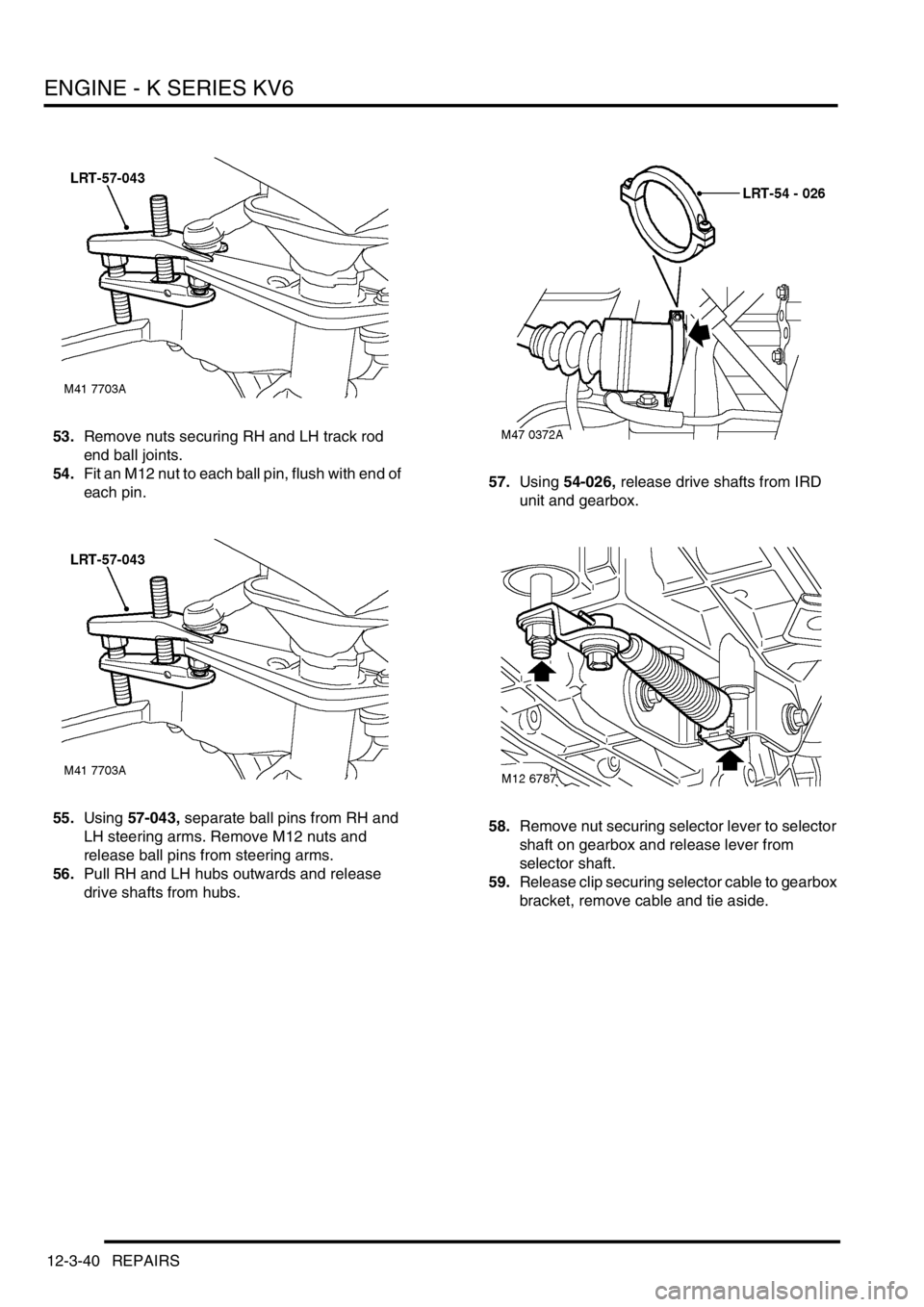
53.Remove nuts securing RH and LH track rod
end ball joints.
54.Fit an M12 nut to each ball pin, flush with end of
each pin.
55.Using 57-043, separate ball pins from RH and
LH steering arms. Remove M12 nuts and
release ball pins from steering arms.
56.Pull RH and LH hubs outwards and release
drive shafts from hubs.57.Using 54-026, release drive shafts from IRD
unit and gearbox.
58.Remove nut securing selector lever to selector
shaft on gearbox and release lever from
selector shaft.
59.Release clip securing selector cable to gearbox
bracket, remove cable and tie aside.
Page 220 of 1007
ENGINE - K SERIES KV6
REPAIRS 12-3-43
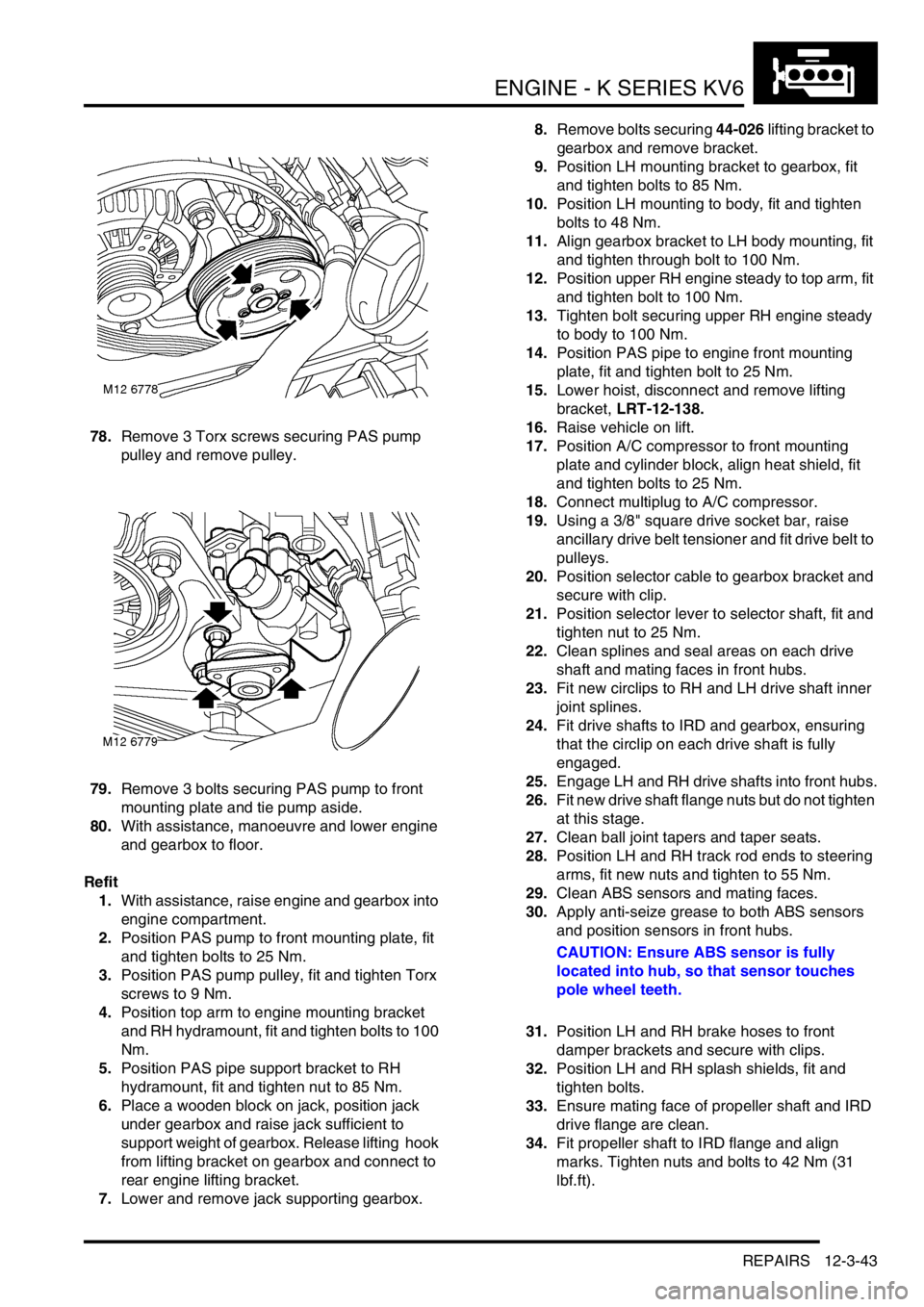
78.Remove 3 Torx screws securing PAS pump
pulley and remove pulley.
79.Remove 3 bolts securing PAS pump to front
mounting plate and tie pump aside.
80.With assistance, manoeuvre and lower engine
and gearbox to floor.
Refit
1.With assistance, raise engine and gearbox into
engine compartment.
2.Position PAS pump to front mounting plate, fit
and tighten bolts to 25 Nm.
3.Position PAS pump pulley, fit and tighten Torx
screws to 9 Nm.
4.Position top arm to engine mounting bracket
and RH hydramount, fit and tighten bolts to 100
Nm.
5.Position PAS pipe support bracket to RH
hydramount, fit and tighten nut to 85 Nm.
6.Place a wooden block on jack, position jack
under gearbox and raise jack sufficient to
support weight of gearbox. Release lifting hook
from lifting bracket on gearbox and connect to
rear engine lifting bracket.
7.Lower and remove jack supporting gearbox.8.Remove bolts securing 44-026 lifting bracket to
gearbox and remove bracket.
9.Position LH mounting bracket to gearbox, fit
and tighten bolts to 85 Nm.
10.Position LH mounting to body, fit and tighten
bolts to 48 Nm.
11.Align gearbox bracket to LH body mounting, fit
and tighten through bolt to 100 Nm.
12.Position upper RH engine steady to top arm, fit
and tighten bolt to 100 Nm.
13.Tighten bolt securing upper RH engine steady
to body to 100 Nm.
14.Position PAS pipe to engine front mounting
plate, fit and tighten bolt to 25 Nm.
15.Lower hoist, disconnect and remove lifting
bracket, LRT-12-138.
16.Raise vehicle on lift.
17.Position A/C compressor to front mounting
plate and cylinder block, align heat shield, fit
and tighten bolts to 25 Nm.
18.Connect multiplug to A/C compressor.
19.Using a 3/8" square drive socket bar, raise
ancillary drive belt tensioner and fit drive belt to
pulleys.
20.Position selector cable to gearbox bracket and
secure with clip.
21.Position selector lever to selector shaft, fit and
tighten nut to 25 Nm.
22.Clean splines and seal areas on each drive
shaft and mating faces in front hubs.
23.Fit new circlips to RH and LH drive shaft inner
joint splines.
24.Fit drive shafts to IRD and gearbox, ensuring
that the circlip on each drive shaft is fully
engaged.
25.Engage LH and RH drive shafts into front hubs.
26.Fit new drive shaft flange nuts but do not tighten
at this stage.
27.Clean ball joint tapers and taper seats.
28.Position LH and RH track rod ends to steering
arms, fit new nuts and tighten to 55 Nm.
29.Clean ABS sensors and mating faces.
30.Apply anti-seize grease to both ABS sensors
and position sensors in front hubs.
CAUTION: Ensure ABS sensor is fully
located into hub, so that sensor touches
pole wheel teeth.
31.Position LH and RH brake hoses to front
damper brackets and secure with clips.
32.Position LH and RH splash shields, fit and
tighten bolts.
33.Ensure mating face of propeller shaft and IRD
drive flange are clean.
34.Fit propeller shaft to IRD flange and align
marks. Tighten nuts and bolts to 42 Nm (31
lbf.ft).