audio LAND ROVER FRELANDER 2 2006 User Guide
[x] Cancel search | Manufacturer: LAND ROVER, Model Year: 2006, Model line: FRELANDER 2, Model: LAND ROVER FRELANDER 2 2006Pages: 3229, PDF Size: 78.5 MB
Page 586 of 3229
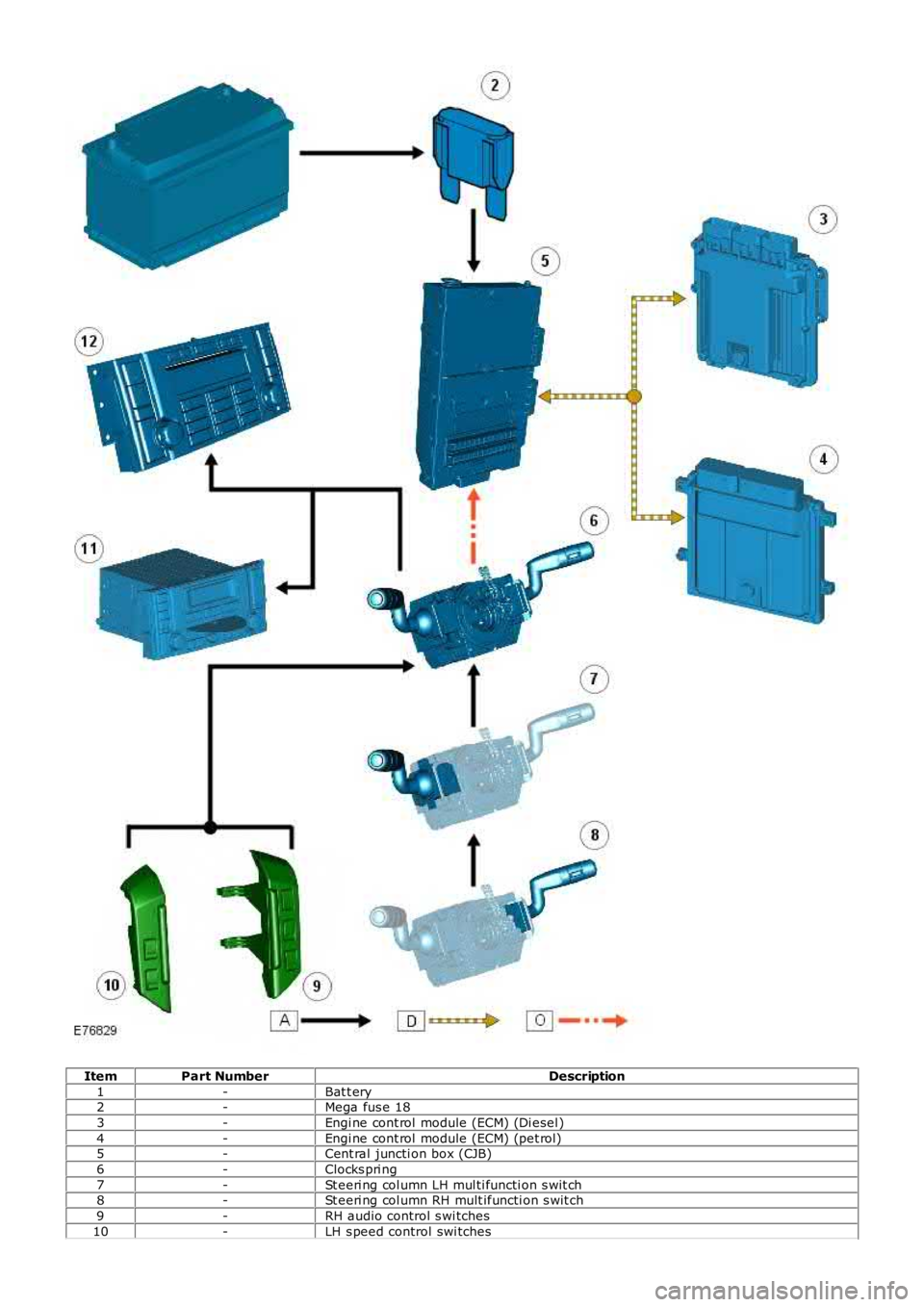
ItemPart NumberDescription
1-Bat t ery2-Mega fus e 18
3-Engi ne cont rol module (ECM) (Di esel )
4-Engi ne cont rol module (ECM) (pet rol)5-Cent ral juncti on box (CJB)
6-Clocks pri ng
7-St eeri ng col umn LH mul ti functi on s wit ch8-St eeri ng col umn RH mult ifuncti on s wit ch
9-RH audio control s wi tches
10-LH s peed control swi tches
Page 587 of 3229
11-Int egrated audio modul e
12-Int egrated control modul e
PRINCIPLES OF OPERATION
Windshield Wiper Switch
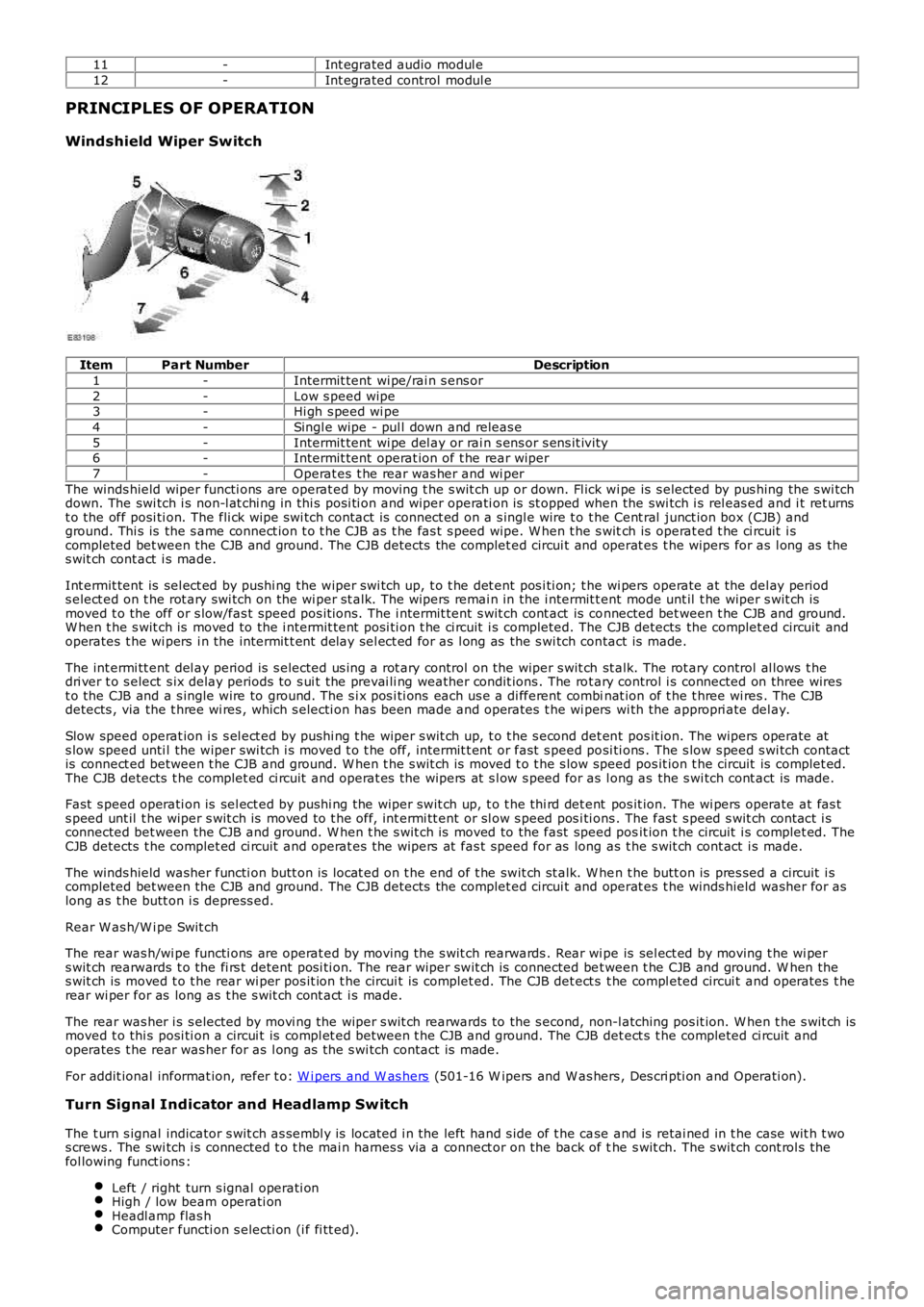
ItemPart NumberDescription
1-Intermit tent wi pe/rai n s ens or
2-Low s peed wipe3-Hi gh s peed wi pe
4-Singl e wipe - pul l down and releas e
5-Intermit tent wi pe del ay or rai n s ens or s ens it ivi ty6-Intermit tent operat ion of t he rear wiper
7-Operat es t he rear was her and wi per
The winds hield wiper functi ons are operat ed by moving t he s wit ch up or down. Fl ick wi pe is s elected by pus hing the s wi tchdown. The swi tch i s non-l at chi ng in thi s posi ti on and wiper operati on is st opped when the swi tch i s rel eas ed and i t ret urnst o the off posi ti on. The fli ck wipe s wi tch contact is connect ed on a s ingl e wire t o t he Cent ral junct ion box (CJB) andground. Thi s is the s ame connect ion t o t he CJB as t he fas t s peed wipe. W hen t he s witch is operat ed t he ci rcuit i scompleted bet ween the CJB and ground. The CJB detects the complet ed circui t and operat es t he wipers for as l ong as thes wit ch cont act i s made.
Int ermit tent is sel ect ed by pushi ng the wiper swi tch up, t o t he det ent pos i ti on; t he wi pers operate at the del ay periods elect ed on t he rot ary swi tch on the wi per st alk. The wipers remai n in the i ntermit tent mode unt il t he wiper s wit ch ismoved t o the off or s low/fas t speed pos it ions. The i ntermit tent s wit ch cont act is connected bet ween t he CJB and ground.W hen t he s wit ch is moved to the i ntermit tent posi ti on t he ci rcuit i s completed. The CJB detects the complet ed circuit andoperates t he wi pers i n the intermit t ent delay sel ect ed for as l ong as the s wi tch contact is made.
The int ermi tt ent del ay period is s elected us i ng a rot ary control on the wiper s wit ch st alk. The rot ary control al lows t hedri ver t o s elect s ix delay periods to s ui t the prevai li ng weather condit ions . The rot ary control i s connected on three wirest o the CJB and a s ingle wire to ground. The s i x pos i ti ons each us e a di fferent combinat ion of t he t hree wi res . The CJBdetects , via the t hree wi res , which s electi on has been made and operates t he wi pers wi th the appropri ate del ay.
Slow speed operat ion i s s el ect ed by pus hi ng t he wiper s wit ch up, t o t he s econd det ent pos it ion. The wipers operate ats low speed unti l the wiper swi tch i s moved t o t he off, intermit t ent or fast s peed posi ti ons . The s low s peed s wi tch contactis connect ed between t he CJB and ground. W hen t he s wit ch is moved t o t he s low speed pos it ion t he circuit is complet ed.The CJB detects t he complet ed ci rcuit and operat es the wipers at s l ow s peed for as long as the s wi tch cont act is made.
Fast s peed operati on is sel ect ed by pushi ng the wiper swit ch up, t o t he thi rd det ent pos it ion. The wi pers operate at fas ts peed unt il t he wiper s wit ch is moved to t he off, int ermi tt ent or sl ow s peed pos i ti ons . The fas t s peed s wit ch cont act i sconnected bet ween the CJB and ground. W hen t he s wit ch is moved to the fast speed posit ion t he circuit i s complet ed. TheCJB detects t he complet ed ci rcuit and operat es the wipers at fas t speed for as long as t he s wit ch cont act i s made.
The winds hield washer functi on butt on is locat ed on t he end of t he swit ch st alk. W hen t he butt on is pres sed a circuit i scompleted bet ween the CJB and ground. The CJB detects the complet ed circui t and operat es t he winds hield washer for aslong as t he butt on i s depress ed.
Rear W as h/W i pe Swit ch
The rear was h/wi pe functi ons are operat ed by moving t he s wit ch rearwards . Rear wi pe is sel ect ed by moving t he wi pers wit ch rearwards t o the fi rs t detent posi ti on. The rear wiper swit ch is connected bet ween t he CJB and ground. W hen thes wit ch is moved t o t he rear wi per pos it ion t he circui t is complet ed. The CJB det ect s t he compl eted circui t and operates t herear wi per for as long as t he s wit ch cont act i s made.
The rear was her i s s elected by movi ng the wiper s wit ch rearwards to the s econd, non-l atching pos it ion. W hen t he s wit ch ismoved t o thi s posi ti on a circui t is compl et ed between t he CJB and ground. The CJB det ect s t he completed ci rcuit andoperates t he rear was her for as l ong as the s wi tch contact is made.
For addit ional informat ion, refer t o: W i pers and W as hers (501-16 W ipers and W as hers , Des cri pti on and Operati on).
Turn Signal Indicator and Headlamp Switch
The t urn s ignal indicator s wit ch as sembl y is locat ed i n the left hand s ide of t he case and is retai ned in t he case wit h t wos crews . The swi tch i s connected t o t he mai n harnes s via a connect or on the back of the s wit ch. The s wit ch cont rol s thefol lowing funct ions :
Left / right turn s ignal operati onHigh / low beam operati onHeadl amp flas hComputer functi on s electi on (i f fi tt ed).
Page 588 of 3229
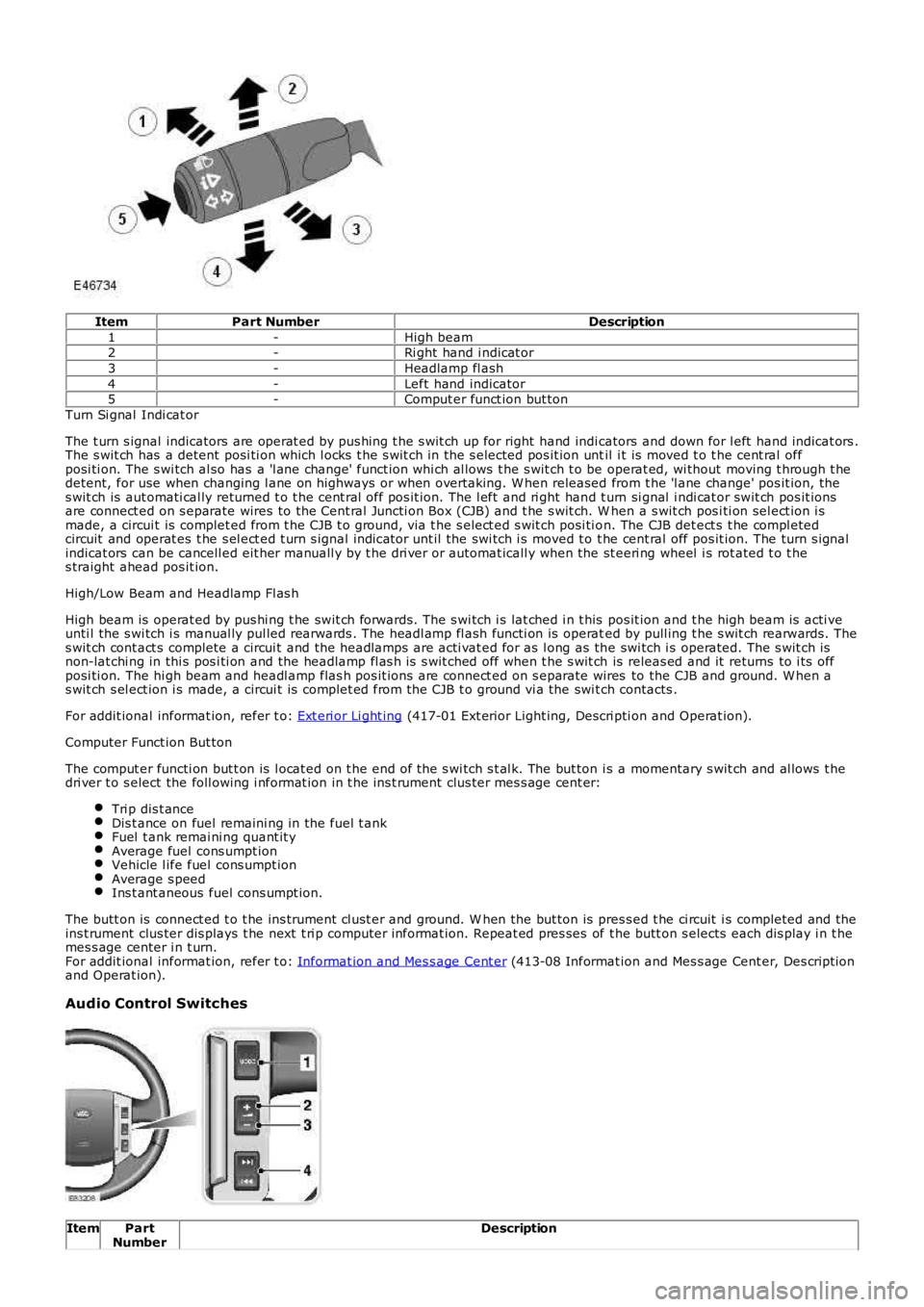
ItemPart NumberDescription
1-High beam2-Ri ght hand i ndicat or
3-Headlamp fl ash
4-Left hand indicator5-Comput er funct ion but ton
Turn Si gnal Indi cat or
The t urn s ignal indicators are operat ed by pus hing t he s wit ch up for right hand indicators and down for l eft hand indicat ors .The s wit ch has a detent posi ti on which l ocks t he s wit ch in the s elected pos it ion until i t is moved t o t he cent ral offposi ti on. The s wi tch al so has a 'l ane change' funct ion whi ch al lows t he s wit ch t o be operat ed, wi thout moving t hrough t hedetent, for use when changing l ane on highways or when overtaking. W hen released from t he 'l ane change' pos it ion, thes wit ch is aut omati cal ly returned t o t he cent ral off pos it ion. The l eft and ri ght hand t urn si gnal i ndi cat or swit ch pos it ionsare connect ed on s eparate wires to the Cent ral Juncti on Box (CJB) and t he s wit ch. W hen a s wit ch pos i ti on sel ect ion i smade, a circui t is complet ed from t he CJB t o ground, vi a t he s elect ed s wit ch posi ti on. The CJB det ect s t he compl etedcircuit and operat es t he s el ect ed t urn s ignal indicator unt il the swi tch i s moved t o t he cent ral off pos it ion. The turn s ignalindicat ors can be cancell ed eit her manuall y by t he dri ver or automat icall y when t he st eeri ng wheel i s rot ated t o t hes traight ahead pos it ion.
High/Low Beam and Headlamp Fl as h
High beam is operat ed by pus hi ng t he swit ch forwards. The s wi tch i s lat ched i n t his pos it ion and t he high beam is acti veunti l the s wi tch i s manual ly pul led rearwards . The headl amp fl ash functi on is operated by pull ing t he s wit ch rearwards. Thes wit ch cont act s complete a circui t and the headlamps are acti vat ed for as l ong as the swi tch i s operated. The s wit ch isnon-lat chi ng in thi s pos i ti on and the headlamp fl as h is s wit ched off when t he s wit ch is releas ed and it returns to i ts offposi ti on. The hi gh beam and headl amp flas h pos it ions are connect ed on s eparate wires to the CJB and ground. W hen as wit ch s el ect ion i s made, a circui t is complet ed from the CJB t o ground vi a the swi tch contacts .
For addit ional informat ion, refer t o: Ext eri or Li ght ing (417-01 Ext erior Light ing, Descri pti on and Operat ion).
Computer Funct ion But ton
The comput er functi on but t on is l ocat ed on t he end of the s wi tch s t al k. The but ton is a momentary s wit ch and al lows t hedri ver t o s elect the foll owing i nformat ion in t he ins t rument clus ter mes s age cent er:
Tri p dis t anceDis t ance on fuel remaini ng in the fuel t ankFuel t ank remai ni ng quant it yAverage fuel cons umpt ionVehicle l ife fuel cons umpt ionAverage s peedIns t ant aneous fuel cons umpt ion.
The butt on is connect ed t o t he ins trument cl ust er and ground. W hen the but ton is pres s ed t he ci rcuit i s completed and theins t rument clus ter dis plays t he next t ri p computer informat ion. Repeat ed pres ses of t he butt on s elects each dis play i n t hemes s age center i n t urn.For addit ional informat ion, refer t o: Informat ion and Mes s age Cent er (413-08 Informat ion and Mes s age Cent er, Des cript ionand Operat ion).
Audio Control Switches
ItemPartNumberDescription
Page 1748 of 3229
hands et OFF butt onConfirmat ion of s ucces sful pai ri ng is di spl ayed by t he remote hands et LED ill uminat ing i n a red col or for 2 s econds .
• NOTE: The pairing proces s rel ies on t he FFBH receiver havi ng the power s uppl y removed and t hen t he power s upplyre-ins tat ed. The fus e met hod is t he easi est method but it can al so be achi eved by bat tery dis connect ion or removal of t heharnes s connect or from t he receiver unit .
Receiver
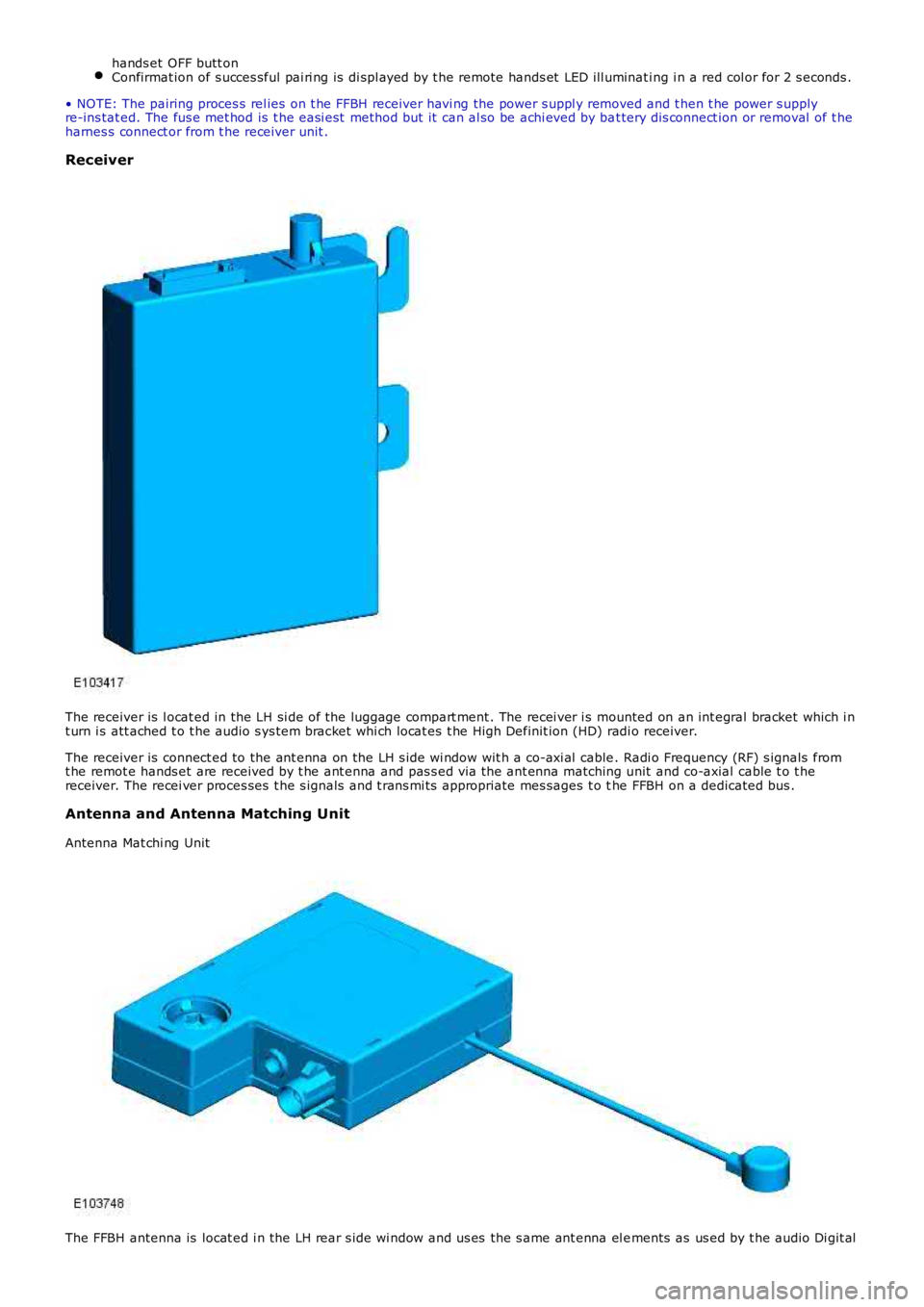
The receiver is l ocat ed in the LH si de of the luggage compart ment . The recei ver i s mounted on an int egral bracket which i nt urn i s att ached t o t he audio s ys tem bracket whi ch locat es t he High Definit ion (HD) radi o receiver.
The receiver is connect ed to the ant enna on the LH s ide wi ndow wit h a co-axi al cable. Radi o Frequency (RF) s ignals fromt he remot e hands et are received by t he ant enna and pas s ed via the ant enna matching unit and co-axial cable t o t hereceiver. The recei ver proces ses t he s ignals and t rans mi ts appropriate mes sages t o the FFBH on a dedicated bus .
Antenna and Antenna Matching Unit
Antenna Mat chi ng Unit
The FFBH antenna is locat ed i n the LH rear s ide wi ndow and us es the s ame ant enna el ements as us ed by t he audio Di git al
Page 1749 of 3229
Audio Broadcast (DAB) s yst em.
Sit uat ed above the DAB antenna unit , behi nd the headli ni ng, is an ant enna matching unit . A flying lead from this uni tconnects di rectl y t o a s t ud on the gl ass ant enna. The recei ver unit connect s to the matching unit vi a a co-axial cabl e.
The glas s mounted ant enna recei ves RF transmit ted s i gnals from t he remot e handset and t rans mi ts t hem, via t hemat chi ng uni t and co-axial cable, t o t he FFBH receiver.
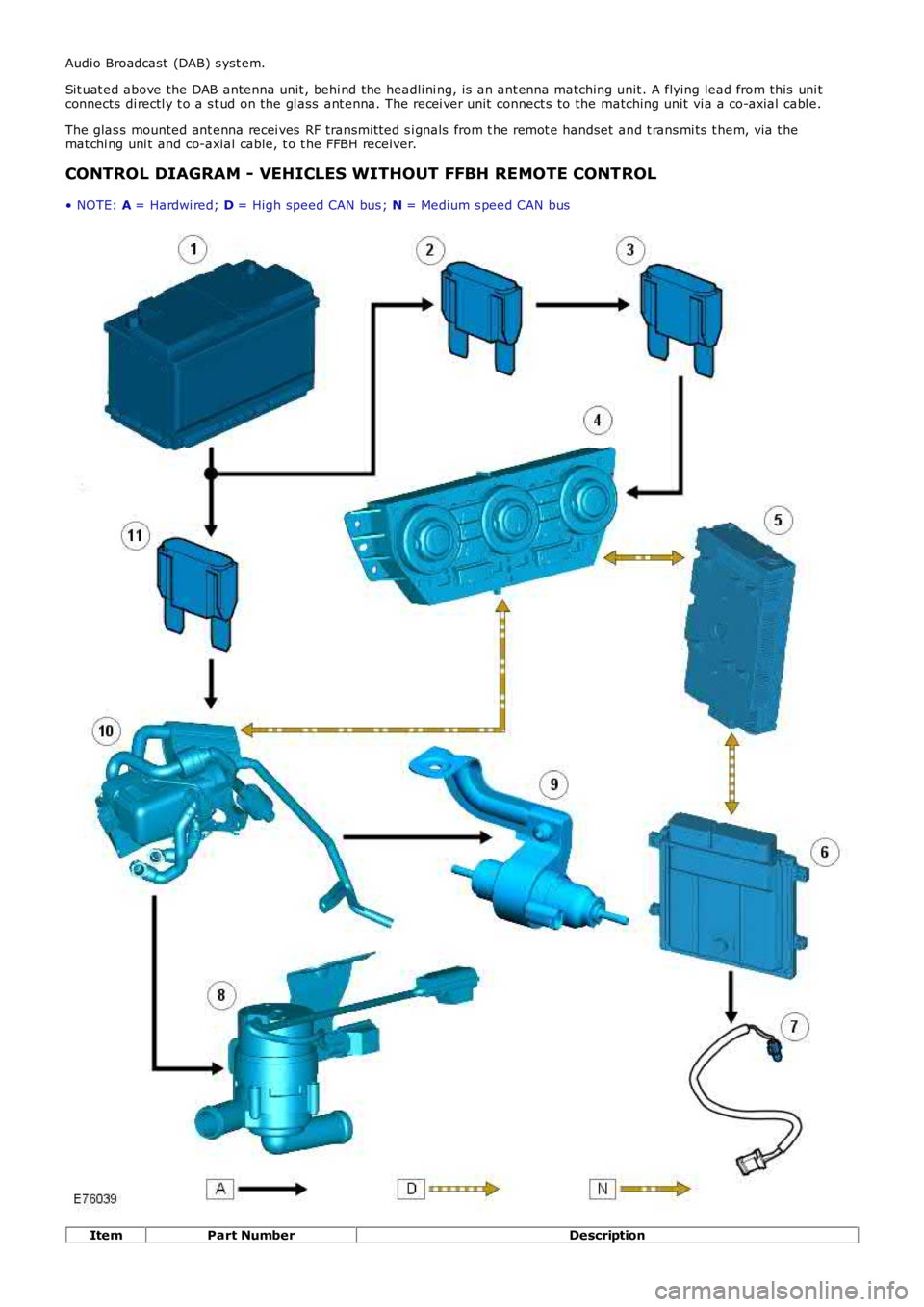
CONTROL DIAGRAM - VEHICLES WITHOUT FFBH REMOTE CONTROL
• NOTE: A = Hardwi red; D = High speed CAN bus ; N = Medium s peed CAN bus
ItemPart NumberDescription
Page 1799 of 3229
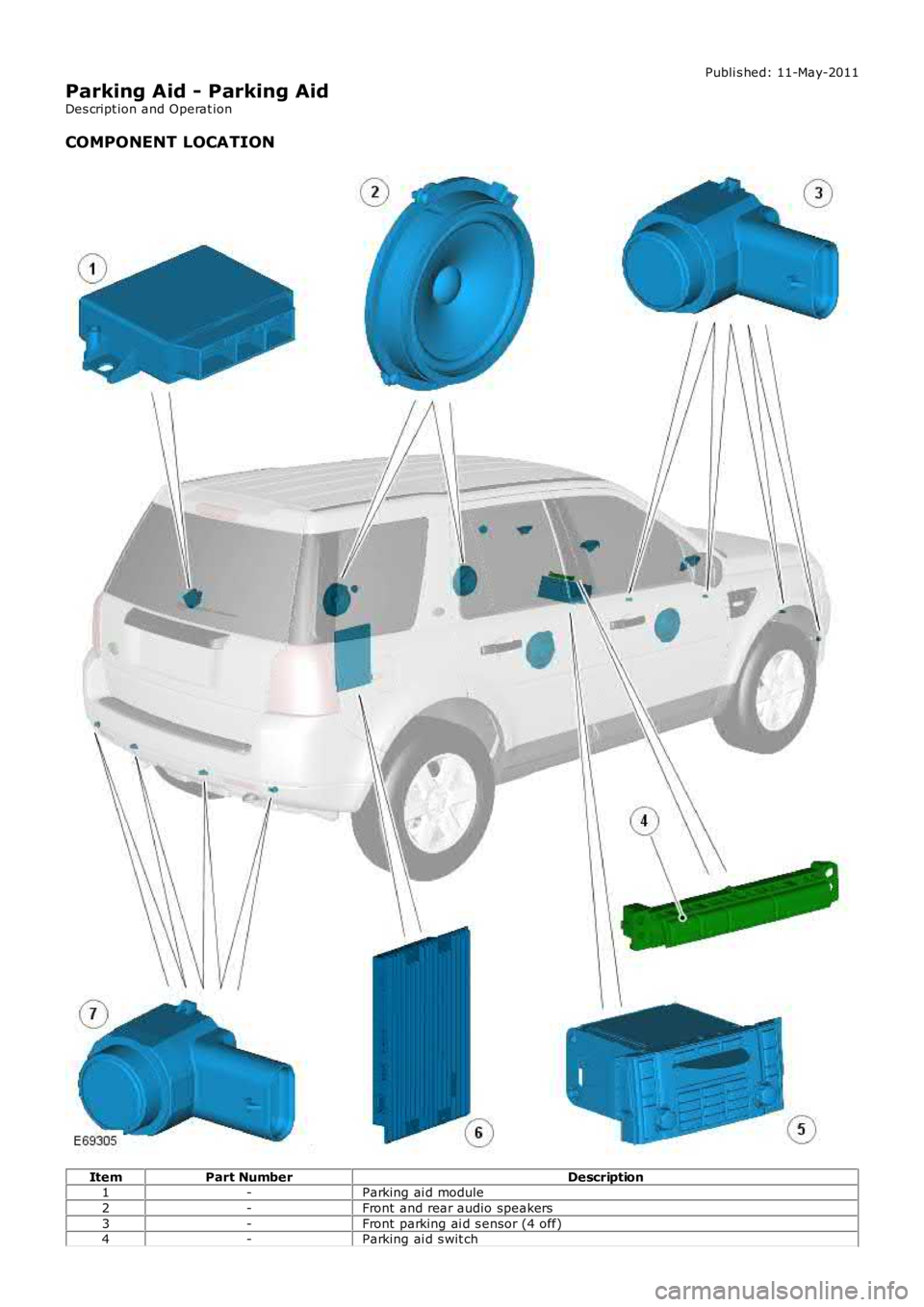
Publi s hed: 11-May-2011
Parking Aid - Parking Aid
Des cript ion and Operat ion
COMPONENT LOCATION
ItemPart NumberDescription1-Parking ai d module
2-Front and rear audio speakers
3-Front parking ai d s ensor (4 off)4-Parking ai d s wit ch
Page 1802 of 3229
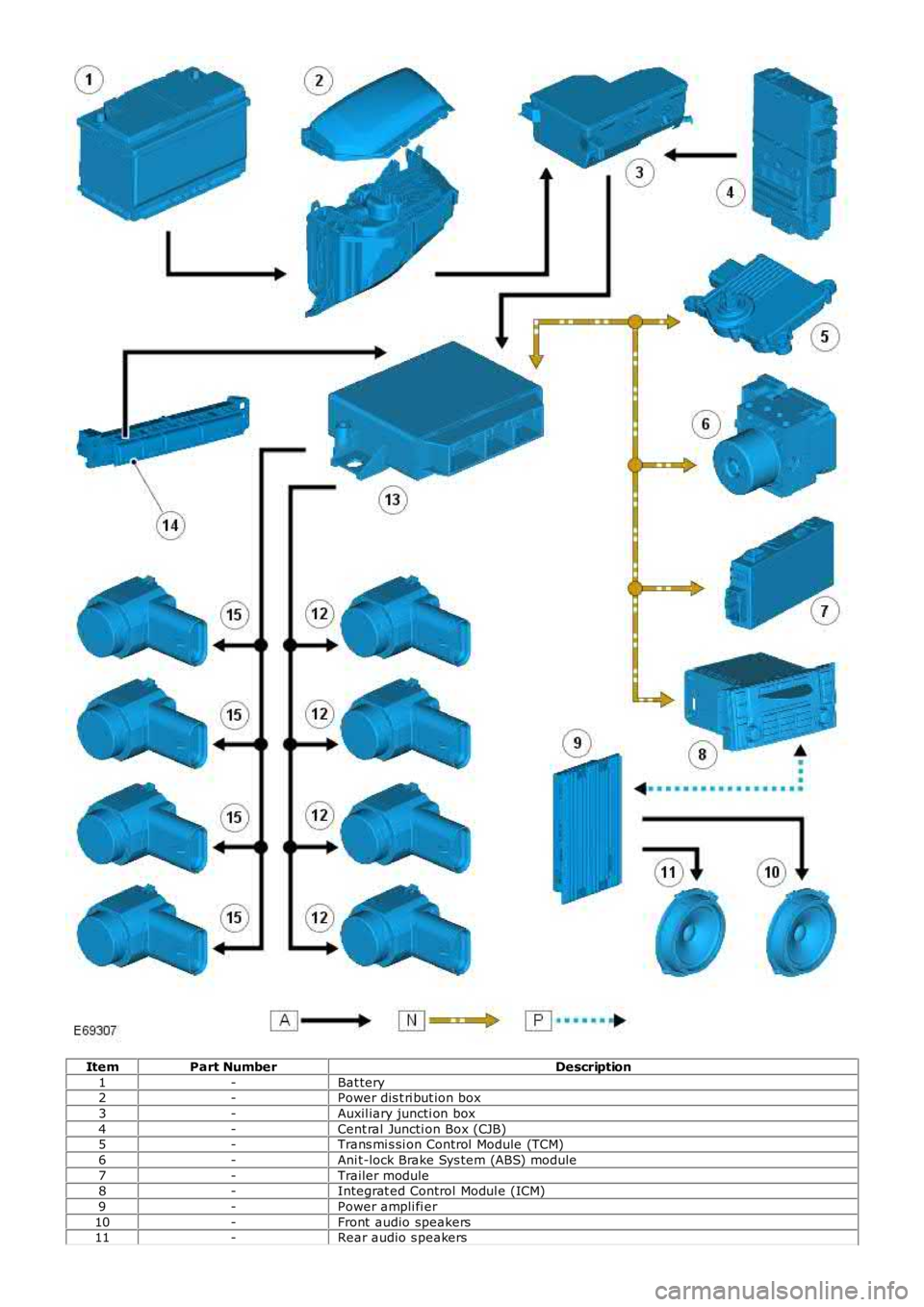
ItemPart NumberDescription
1-Bat tery2-Power dis t ri but ion box
3-Auxil iary juncti on box
4-Cent ral Juncti on Box (CJB)5-Trans mi s si on Control Module (TCM)
6-Ani t-lock Brake Sys tem (ABS) module
7-Trailer module8-Integrat ed Control Modul e (ICM)
9-Power ampli fi er
10-Front audio speakers11-Rear audio s peakers
Page 1803 of 3229
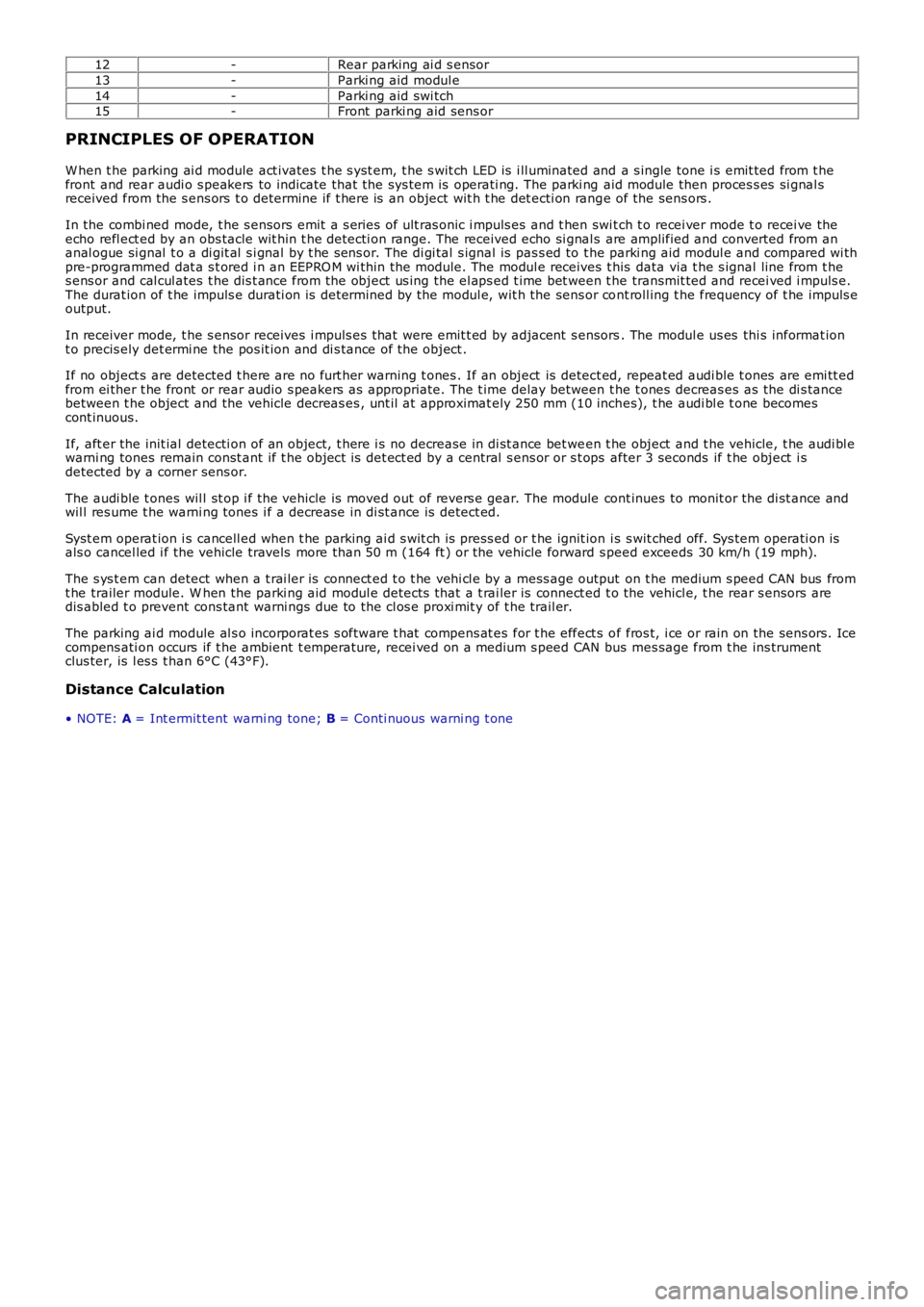
12-Rear parking ai d s ensor
13-Parki ng aid modul e
14-Parki ng aid swi tch15-Front parki ng aid sens or
PRINCIPLES OF OPERATION
W hen t he parking ai d module act ivates t he s yst em, t he s wit ch LED is i ll uminated and a s ingle tone i s emit ted from t hefront and rear audi o s peakers to indicate that the sys tem is operati ng. The parki ng aid module then proces s es si gnal sreceived from the s ens ors t o determine if t here is an object wit h t he det ecti on range of the sens ors .
In the combi ned mode, t he s ensors emit a s eries of ult ras onic i mpuls es and t hen swi tch t o recei ver mode t o recei ve theecho refl ect ed by an obs tacle wit hin t he detecti on range. The received echo si gnal s are amplified and converted from ananal ogue si gnal t o a di git al s i gnal by t he s ens or. The di gi tal s ignal is pas s ed to the parki ng aid modul e and compared wi thpre-programmed dat a s t ored i n an EEPRO M wi thin the modul e. The modul e receives t his data via t he s ignal line from t hes ens or and cal cul ates t he dis t ance from the object us ing the el aps ed t ime bet ween t he transmit ted and recei ved i mpuls e.The durat ion of t he impuls e durati on is det ermi ned by the modul e, wit h the sens or cont roll ing t he frequency of t he impuls eoutput.
In receiver mode, t he s ensor receives i mpuls es that were emit t ed by adjacent s ensors. The modul e us es thi s informat iont o precis ely det ermi ne the pos it ion and di s tance of the object .
If no object s are detected t here are no furt her warning t ones . If an object is detect ed, repeat ed audi ble t ones are emi tt edfrom ei ther t he front or rear audio s peakers as appropriate. The t ime delay between t he t ones decreas es as the di s tancebetween t he object and the vehicle decreas es , unt il at approximat ely 250 mm (10 inches), t he audi bl e t one becomescont inuous.
If, aft er the init ial detecti on of an object, t here i s no decrease in di st ance bet ween t he object and t he vehicle, t he audi bl ewarni ng tones remain const ant if t he object is det ect ed by a central s ens or or s t ops after 3 seconds if t he object i sdetected by a corner sens or.
The audi ble t ones wil l st op i f the vehicle is moved out of revers e gear. The module cont inues to monit or the di st ance andwil l res ume t he warni ng tones i f a decreas e in di st ance is detect ed.
Syst em operat ion i s cancell ed when t he parking ai d s wit ch is press ed or t he ignit ion i s s wit ched off. Sys tem operati on isals o cancel led i f the vehicle travels more than 50 m (164 ft ) or the vehicle forward s peed exceeds 30 km/h (19 mph).
The s ys t em can detect when a t rai ler is connect ed t o t he vehi cl e by a mess age output on t he medium s peed CAN bus fromt he trailer module. W hen the parki ng aid modul e detects that a t rai ler is connect ed t o the vehicl e, t he rear s ensors aredis abled t o prevent cons tant warni ngs due to the cl os e proxi mit y of t he trail er.
The parking ai d module al s o incorporat es s oftware t hat compens at es for t he effect s of fros t, i ce or rain on the sens ors . Icecompens ati on occurs if t he ambient t emperature, recei ved on a medium s peed CAN bus mes sage from t he ins trumentclus ter, is l es s t han 6°C (43°F).
Distance Calculation
• NOTE: A = Int ermit tent warni ng tone; B = Conti nuous warni ng t one
Page 1805 of 3229

Publi s hed: 11-May-2011
Parking Aid - Parking Aid
Diagnosi s and Tes ti ng
Principle of Operation
For a detail ed descripti on of the parki ng aid sys tem, refer t o t he rel evant Des cription and Operat ion s ecti on in theworks hop manual .REFER to: Parki ng Aid (413-13 Parki ng Aid, Descripti on and Operat ion).
Inspection and Verification
CAUTION: Di agnos is by s ubs ti tut ion from a donor vehicle is NO T acceptabl e. Subs ti tut ion of cont rol modules doesnot guarant ee confirmat ion of a faul t, and may als o caus e addit ional fault s i n t he vehi cl e being t est ed and/or t he donorvehi cl e.
1. Verify t he cus t omer concern.1.
2. Vis ually ins pect for obvious s igns of damage and s ys t em i ntegri ty.2.
• NOTE: Part icular att enti on s hould be paid t o t he fol lowi ng it ems where DTCs may not be logged:
Check for cont aminati on (e.g. dirt, gri me, fros ti ng, i ce) around t he parking ai d s ensors, i f s o refer to the parki ng aids ect ion i n t he vehi cl e handbook.Check for the correct ins tall ati on and ali gnment of t he s ens ors to t he bumper.Spurious det ect ion of t he ground may occur duri ng front s ys t em operat ion on an up-s lope, or down s l ope.
Visual Inspection
ElectricalFuse(s )Relay(s )W iri ng Harnes sElectrical connect or(s )Front parking ai d s ensor(s ) and holdersRear parking aid s ens or(s ) and hol dersAudio s ys tem.REFER to: Informati on and Entert ainment Syst em (415-01 Informati on and Entertainment Sys tem, Di agnos is andTes ti ng).Parking ai d s wit ch and LEDParking ai d module
3. If an obvious cause for an obs erved or report ed concern is found, correct t he caus e (if pos s ible) beforeproceeding t o t he next s t ep.3.
4. If t he caus e is not vis ually evi dent , check for Di agnos ti c Trouble Codes (DTCs) and refer t o t he DTC Index.4.
DTC Index
• NOTE: If the control modul e is sus pect and t he vehicle remains under manufact urer warranty, refer to the W arrant y Poli cyand Procedures manual (s ect ion B1.2), or determine i f any prior approval programme is i n operat ion, prior t o t heins t al lat ion of a new modul e.
• NOTE: Generic scan t ool s may not read the codes li st ed, or may read only fi ve digit codes . Mat ch the five di git s from t hes can tool to the firs t fi ve di git s of the seven digi t code l is ted to ident ify t he faul t (t he las t t wo digi ts gi ve addi ti onalinformat ion read by the manufact urer approved diagnos t ic s ys tem).
• NOTE: W hen performing volt age or res is t ance t est s , always use a digi tal mult imeter (DMM) accurat e t o t hree deci malplaces, and wi th an up-t o-date cal ibrat ion cert ificate. W hen tes ti ng res is t ance al ways take t he res is t ance of t he DMMleads i nt o account .
• NOTE: Check and recti fy bas ic faul ts before beginni ng diagnos t ic rout ines i nvol vi ng pinpoint t es t s.
• NOTE: Ins pect connect ors for s igns of water ingres s , and pins for damage and/or corros ion.
• NOTE: If DTCs are recorded and, aft er performi ng the pi npoi nt tes ts , a fault is not present , an int ermi tt ent concern maybe t he caus e. Always check for loose connect ions and corroded terminals .
• NOTE: W hen carrying out repair/di agnos is of t he s yst em, on removal of t he front or rear bumper ins pect t he s ensorconnectors to ens ure they were correct ly l atched and check fly l eads for si gns of chaffing or t rapped wi res .
For a compl ete lis t of all Di agnos ti c Trouble Codes (DTCs) t hat could be logged on this vehicle, pleas e refer to Sect ion100-00
REFER to: Di agnos ti c Trouble Code (DTC) Index - DTC: Parking Ai d Module (PAM) (100-00 General Informat ion, Des cri pti onand Operat ion).
Page 1835 of 3229
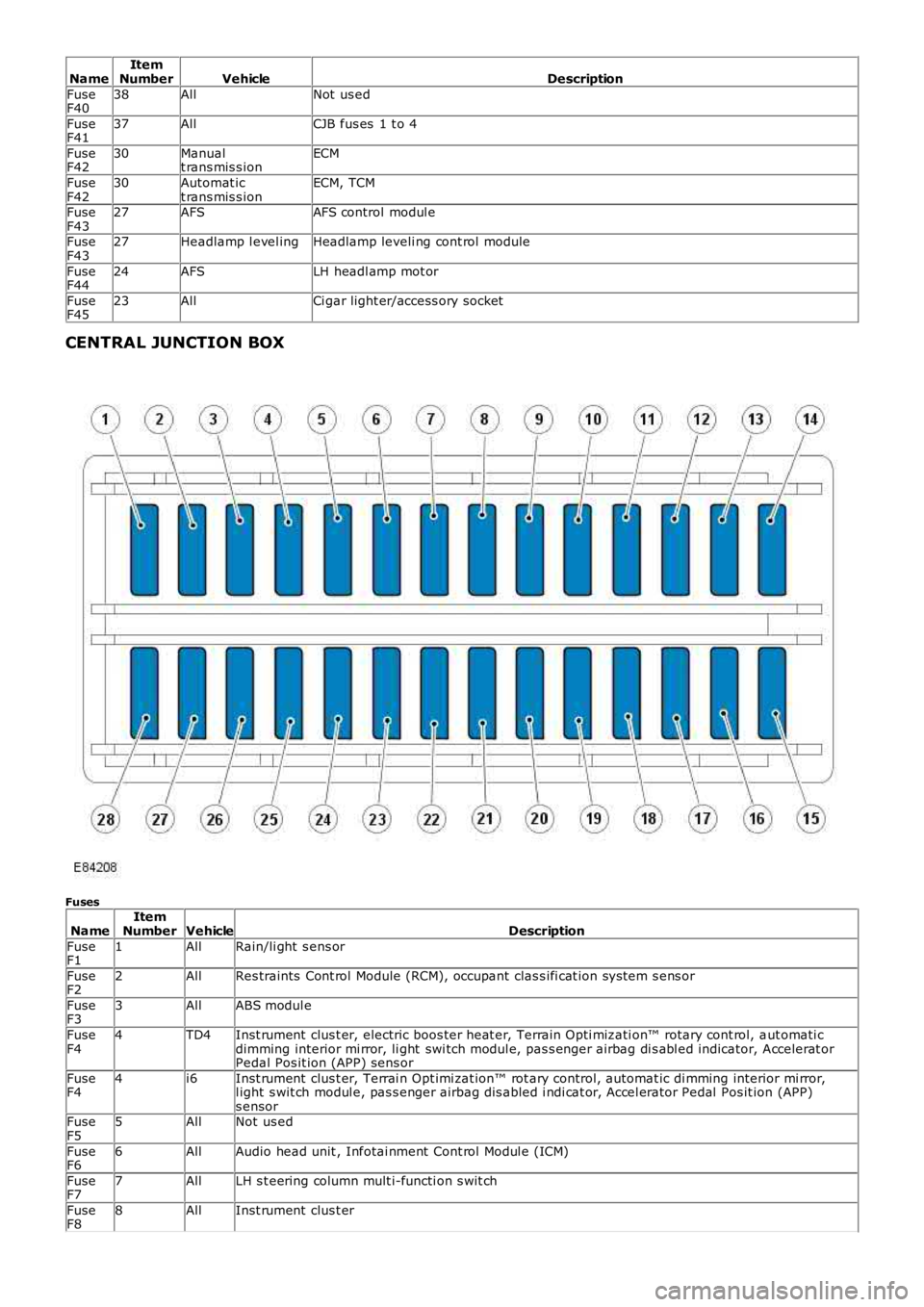
NameItemNumberVehicleDescription
FuseF4038AllNot us ed
FuseF4137AllCJB fus es 1 t o 4
FuseF4230Manualt rans mis s ionECM
FuseF4230Automat ict rans mis s ionECM, TCM
FuseF4327AFSAFS control modul e
FuseF4327Headlamp l evel ingHeadlamp leveli ng cont rol module
FuseF4424AFSLH headl amp mot or
FuseF4523AllCi gar light er/access ory socket
CENTRAL JUNCTION BOX
Fuses
NameItemNumberVehicleDescription
FuseF11AllRain/li ght s ens or
FuseF22AllRes traints Cont rol Module (RCM), occupant clas s ifi cat ion sys tem s ens or
FuseF33AllABS modul e
FuseF44TD4Inst rument clus t er, electric boos ter heat er, Terrain Opti mizati on™ rotary cont rol, aut omati cdimming interior mi rror, li ght swi tch modul e, pas s enger airbag di s abl ed indicator, Accelerat orPedal Pos it ion (APP) sens or
FuseF44i6Inst rument clus t er, Terrai n Opt imi zat ion™ rot ary control, automat ic di mming interior mi rror,l ight s wit ch modul e, pas s enger airbag dis abled i ndi cat or, Accel erator Pedal Pos it ion (APP)s ensorFuseF55AllNot us ed
FuseF66AllAudio head unit , Infotai nment Cont rol Modul e (ICM)
FuseF77AllLH s t eering column mult i-functi on s wit ch
FuseF88AllInst rument clus t er