warning light LAND ROVER FRELANDER 2 2006 User Guide
[x] Cancel search | Manufacturer: LAND ROVER, Model Year: 2006, Model line: FRELANDER 2, Model: LAND ROVER FRELANDER 2 2006Pages: 3229, PDF Size: 78.5 MB
Page 1927 of 3229
The s ys t em operat es by t he AFS cont rol module recei vi ng inputs from t he engine cont rol module for engine runni ng s ignal ,t he ABS module for st eeri ng angl e and vehi cle s peed and a reverse gear i nput from the trans mi ss i on.
The AFS cont rol module proces s es thes e s ignals and provi des an output t o the headlamp leveling motors to adjus t theheadl amp hori zont al ai m according t o vehicle speed and s teering angle.
• NOTE: In market s wit h Dayt ime Running Lamps (DRL), t he AFS s yst em will not operate when the DRL are act ive.
The AFS cont rol module is connect ed on the hi gh s peed CAN bus to receive i nformat ion from other vehicle s ys tems . Thecont rol module is connect ed to the AFS power module on a dedi cat ed Local Interconnect Net work (LIN) bus . The AFScont rol module cal culat es, us ing input dat a from other s ys t ems , the requi red pos it ion of t he hori zont al adjus t ment of t heproject or modul es. The pos it ion i nformat ion is t hen output on t he LIN bus to t he AFS power module l ocat ed on eachheadl amp as sembl y. Thi s module t hen outputs the appropriate s ignal s t o power the AFS s t epper mot ors i n t he headl ampt o the appropriat e posi ti on.
The hori zont al pos it ion of t he project or modul es is dependant on a number of input vari abl es . The pos it ion i s determinedby vehi cle s peed and s teeri ng angl e. W hen reverse gear i s elected, the projector modules are moved t o t he st rai ght aheadposi ti on t o avoi d glare t o other road us ers .
The angl es of each projector module di ffer to gi ve the correct spread of light , for example, when turning l eft , the l eft handproject or modul e wi ll have a great er s wi vel ling angl e than t he right hand projector module.
In the event of a fai lure of the AFS sys tem, a warning indicator in the ins trument cl us t er flas hes t o warn the driver. TheAFS warni ng indicator i lluminates when t he i gni ti on s wit ch is i n power mode 6 and will flas h cont inuousl y unti l the faul t isrect ifi ed.
Illumi nati on of the AFS warning i ndi cat or does not neces s aril y mean t hat there is a fault wit h the AFS sys tem. The faultmay be caus ed by a fai lure of anot her sys tem s uch as st eeri ng angl e s ens or or the vehicle s peed s i gnal mi ss i ng,preventi ng the AFS s ys tem operati ng correctl y.
HEADLAMP LEVELING
Headl amp l evel ing provides for the adjus t ment of the vert ical aim of the headlamps to minimi ze glare to other road us erswhen t he vehi cl e att it ude changes due t o vehi cle l oadi ng.
Two t ypes of headlamp l evel ing are avai lable dependant on the t ype of headlamps fit ted to the vehicle:
Manual headlamp l evel ing - Hal ogen headlamps only (ROW vehicles only)Automat ic headlamp level ing - Xenon headlamps only.
Manual Headlamp Leveling - ROW Halogen Headlamps Only
Manual headlamp l evel li ng is only avai lable on RO W vehicles wit h halogen headl amps .
• NOTE: Headlamp l evel ling is not avai lable on NAS vehicles wi th hal ogen headlamps .
The manual s ys tem compris es t he fol lowing components :
Two headlamp l evel ling motorsHeadl amp l evel ing rheos tat rotary cont rol .
W hen t he i gni ti on is i n i gni ti on power mode 6, power i s s uppli ed t o t he li ght control modul e via t he i gni ti on rel ay in t heBJB and a fuse in t he CJB. Power i s als o s uppl ied vi a the ignit ion relay i n the BJB to t he headlamp l evel ing mot or in eachheadl amp as sembl y.
Movement of t he leveli ng rot ary control produces a variable volt age output, whi ch is s ens ed by the motors. The mot orsreact to the suppli ed vol tage and move the headlamp t o t he reques ted pos it ion whi ch rel at es t o t he suppli ed volt age fromt he leveling rotary cont rol . The headlamps can onl y be lowered from t heir unladen posi ti on t o compens ate for changes invehi cl e at ti tude due t o l oading.
The manual headlamp level ing rotary cont rol has no defi ned pos i ti ons whi ch rel at e t o t he vehi cle l oadi ng. The approximat erot ary t humbwheel control pos it ion for a given l oadi ng is s hown i n t he fol lowing t able:
R otary Control RotationVehicle Load
0Driver only or Driver and front s eat pass enger1/4Driver and pass engers i n all s eats
½Maxi mum gross vehicle weight
FullMaxi mum rear axl e load
Automatic Headlamp Leveling - Xenon Headlamps Only
Automat ic headlamp level ing i s only avail abl e on vehicles wi th xenon headlamps . The sys tem is not a Dynami c headl amplevell ing s yst em and changes in vehicle inclinat ion due t o pos it ive and negat ive accelerat ion are not compens ated.
Automat ic headlamp level ing provi des for t he st ati c, periodic adjus t ment of the vertical aim of the headlamps t o mi nimi s eglare to other road us ers when the vehicle at t it ude changes due to loading.
Automat ic headlamp level ing i s cont rol led by a headlamp leveli ng modul e whi ch is l ocat ed on the bul khead, adjacent t ot he ins trument panel on t he pas s enger s ide 'A' pill ar.
• NOTE: On vehicles wit h the AFS sys tem, the headlamp l evel ing s oft ware is i ncorporated i nto the AFS control modul e andt he modul e i s known as the AFS control modul e.
The headl amp l eveli ng s ys t em compri s es the foll owing component s and informat ion from other vehi cl e s yst ems :
Front and rear vehicle height s ensorsTwo headlamp l evel ing, verti cal adjus t ment motors
Page 1930 of 3229
If a bulb fails , t he remai ning t urn s i gnal indi cat or l amp bulb on that s ide of t he vehicle flas hes at normal s peed. Theappl icable t urn si gnal i ndi cat or in t he i ns t rument clus ter wi ll fl ash at double s peed t o al ert t he driver t o t he bul b fai lure.
Reversing Lamp
The revers i ng lamp is l ocat ed adjacent t o t he turn s ignal lamp and us es a 21W bayonet fit ti ng bul b.
The revers i ng lamp is acti ve when the ignit ion i s in the i gnit ion power mode 6 and the CJB receives a revers e s el ect eds ignal on the medi um s peed Control ler Area Network (CAN) bus . The aut omati c t rans miss ion has a revers e s wit ch whichs ens es when reverse is s elect ed.
Rear Fog Lamp
The rear fog lamp is l ocat ed at the bot tom of the rear lamp and us es a 21W bayonet fit ti ng bul b.
The rear fog lamp is controlled by the l ight cont rol module. W hen the i gni ti on s wit ch is i n t he ignit ion power mode 6 andt he li ght control modul e is in t he s ide l amp or headl amp pos it ion, the rear fog l amp s wit ch on t he li ght control modul e canbe pres s ed t o act ivat e the rear fog l amps . A rear fog lamp warning i ndicat or is ill uminat ed in t he i ns t rument clus ter whent he rear fog lamps are act ive.
Side Marker Lamp (NAS only)
The s ide marker l amp i s located i n t he outer part of t he rear lamp, adjacent to rear fog lamp and us es a W 5W wedgefi tt ing bul b.
The s ide marker l amp bulb, whi ch is fit ted i n a hol der l ocat es in an aperture in the rear lamp hous ing and i s rot ated t o l ockin pos i ti on. The s ide marker lamp is acti ve at all ti mes when t he s ide l amps are select ed on us ing t he li ght controlmodule. The s ide marker l amps wi ll als o be i ll uminated when the l ight cont rol module rot ary s wit ch is in t he 'AUTO'posi ti on and a 'light s on' s i gnal is received by t he CJB from t he li ght sens or.
HAZARD FLASHERS
The hazard flas hers are cont roll ed by a non-l atching s wi tch i n the cent re of t he inst rument panel . The hazard fl as hersoperate at al l ti mes when s elected and are not dependant on the ignit ion power mode.
W hen t he hazard flas hers are s el ect ed on, all of the front , rear and s ide t urn s i gnal indi cat or l amps operate as previous lydescribed and both left and right t urn s ignal indicators in the ins trument cl us t er al s o fl ash. The hazard warning flas hersfl ash at a rat e of 360ms on and 360ms off. W hen the hazard flas hers are act ive, t hey override any reques t for t urn si gnallamp operati on.
If a trail er i s fit ted, the trailer t urn s i gnal lamps wil l flas h at t he s ame frequency as t he vehi cle i ndi cat ors . The t rail erwarni ng indicator i n t he ins trument cl ust er wil l al s o fl ash. If a t rail er bul b i s defect ive, t he trail er warning i ndi cat or wil l notfl ash.
The hazard flas hers can als o be acti vat ed by a crash si gnal from the Res t raint s Control modul e (RCM). This i s received byt he CJB which act ivat es the hazard flas hers . The hazard flas hers can be cancell ed by changing t he i gni ti on power mode tot he auxi liary power mode 4 or t he off power mode 0 or t he cras h mode i s cancelled by the res trai nts control modul e.
LICENSE PLATE LAMPS
Two l icens e pl ate l amps are fi tt ed in the t ail gat e handle, above t he l icens e pl ate in t he upper t ail gat e. Each l amp us es a5W caples s t ype bul b.
The lamps are s ecured in the upper li ft gat e handle wi th int egral cl ips . The lamps can be released from t he handl e us ing as mall , fl at bl ade screwdriver. The l icense pl ate lamps are act ive at al l ti mes when t he si de lamps or headlamps ares wit ched on.
HIGH MOUNTED STOP LAMP
The high mount ed s top l amp i s located i n t he li ft gat e. Acces s t o the lamp i s by removal of t he upper li ft gate interior t rimpanel . Aft er releas ing t he lamp ret aining cl ips , the l amp can be removed from outs ide the vehicle.
The lamp compris es a pl ast ic hous ing wi th a red col ored l ens . The lamp is i ll uminated by a s ingle 16W caples s type bulb.
The high mount ed s top l amp i s act ivat ed, along wit h the tail l amp s t op lamps , when the ignit ion i s in ignit ion power mode6 and t he brake pedal swi tch i s acti ve (by pres s ing the brake pedal).
The high mount ed s top l amp and t he s top l amps can als o be acti vat ed by t he ABS when Hi ll Des cent Control (HDC) isact ive. A s i gnal on t he high s peed CAN bus from the ABS modul e i s pass ed t o t he CJB which s uppl ies power to the st oplamps .
SIDE TURN SIGNAL LAMPS
The s ide t urn si gnal l amps are l ocat ed in the front fender air vents . On vehicles from 2009MY , t he s ide t urn si gnal l ampshave cl ear l enses and orange colored bulbs . The lamps are clipped i nt o an aperture in the vent panel and can be removedby s li di ng rearwards and releasi ng t he front edge of t he lamp from t he vent .
The s ide t urn si gnal l amps use a 5W caples s bulb which is locat ed i n a holder. The lamps have the same functi onal it y ast he front and rear turn s ignal i ndicat or lamps and are operat ed by the left hand s t eering column mult ifunct ion s wit ch or byt he hazard fl asher s wit ch. The s t eering column mult ifunct ion s wit ch is onl y acti ve wit h t he ignit ion i n t he ignit ion powermode 6, t he hazard fl asher s wit ch is act ive at all t imes , regardl ess of t he power mode. W hen act ive, t he s ide t urn s i gnallamps will flas h at a frequency cycle of 360ms on and 360ms off. If a s ide t urn si gnal l amp bulb fail s, t he t urn s i gnalindicat or l amps cont inue t o flas h at t he normal rat e.
Page 1931 of 3229

TRAILER LIGHTING
Several di fferent types of trail er s ocket can be fit ted to the vehicle depending on market specificat ions . Refer t o theElectrical Reference Library for s peci fi c s ocket det ail s.
The CJB monit ors t he t urn s i gnal indicat or l amps and can det ect if more t han two lamps are fi tt ed (the s i de turn s ignallamps are not monit ored). W hen a t rai ler is det ect ed, t he t rai ler warning indicator in the ins trument cl us t er will flas h i ns ynchronis at ion wi th the t urn si gnal i ndi cat ors .
If one or more of t he turn s ignal indicator l amps on the vehicl e or the t rai ler are defect ive, t he trailer warning i ndi cat or willnot fl as h to al ert t he dri ver t o t he bulb failure.
DIAGNOSTICS
The diagnost ic s ocket i s located in t he lower i ns t rument panel clos ing panel, on the driver's si de, bel ow t he s teeri ngcol umn. Various l ighti ng s yst em funct ions are monit ored by di fferent sys t ems which can s tore faul t informati on. Thi s canbe ret rieved usi ng a Land Rover approved diagnost ic sys tem.
Page 2723 of 3229

Contents
3
R
Quick start
QUICK START ................................................... 7
Filling station information
FILLING STATION INFORMATION................... 33
Introduction
SYMBOLS GLOSSARY .................................... 35
LABEL LOCATIONS ......................................... 35
HEALTH AND SAFETY ..................................... 36
DATA RECORDING.......................................... 37
DISABILITY MODIFICATIONS ......................... 37
PARTS AND ACCESSORIES ............................ 37
Keys and remote controls
USING THE KEY .............................................. 40
GENERAL INFORMATION ON RADIO
FREQUENCIES ................................................ 40
USING THE REMOTE CONTROL ..................... 41
Locks
LOCKING AND UNLOCKING ............................ 44
Alarm
ARMING THE ALARM ..................................... 45
DISARMING THE ALARM ............................... 46
Seats
SITTING IN THE CORRECT POSITION ............ 47
MANUAL SEATS ............................................. 48
ELECTRIC SEATS ............................................ 49
HEAD RESTRAINTS ........................................ 51
REAR SEATS................................................... 51
HEATED SEATS............................................... 53
Seat belts
PRINCIPLE OF OPERATION ............................ 54
SEAT BELT REMINDER ................................... 55
FASTENING THE SEAT BELTS ........................ 56
SEAT BELT HEIGHT ADJUSTMENT................. 56
USING SEAT BELTS DURI NG PREGNANCY .... 57
Supplementary restraints system
PRINCIPLE OF OPERATION ............................ 58
AIRBAG WARNING LAMP ............................... 61
DISABLING THE PASSENGER AIRBAG ........... 62
AIRBAG SERVICE INFORMATION ................... 63
Child safety
CHILD SEATS ................................................. 64
BOOSTER CUSHIONS ..................................... 66
ISOFIX ANCHOR POINTS................................ 67
CHILD SAFETY LOCKS ................................... 69
Steering wheel
ADJUSTING THE STEERING WHEEL .............. 70
AUDIO CONTROL ........................................... 70
Lighting
LIGHTING CONTROL ...................................... 72
FRONT FOG LAMPS........................................ 72
REAR FOG LAMPS.......................................... 73
ADJUSTING THE HEADLAMPS....................... 73
HEADLAMP LEVELLING ................................. 73
HAZARD WARNING FLASHERS...................... 74
ADAPTIVE FRONT LIGHTING SYSTEM (AFS) . 74
DIRECTION INDICATORS ............................... 75
INTERIOR LAMPS .......................................... 76
APPROACH LAMPS ........................................ 76
CHANGING A BULB ........................................ 77
BULB SPECIFICATION CHART ........................ 86
Wipers and washers
WINDSCREEN WIPERS .................................. 87
RAIN SENSOR ................................................ 87
WINDSCREEN WASHERS............................... 88
HEADLAMP WASHERS................................... 88
REAR WINDOW WIPER AND WASHERS ........ 89
ADJUSTING THE WINDSCREEN WASHER JETS .
89
CHECKING THE WIPER BLADES .................... 90
CHANGING THE WIPER BLADES.................... 90
Windows and mirrors
ELECTRIC WINDOWS ..................................... 93
EXTERIOR MIRRORS ..................................... 94
ELECTRIC EXTERIOR MIRRORS .................... 95
INTERIOR MIRROR ........................................ 96
Instruments
INSTRUMENT PANEL OVERVIEW .................. 97
Information displays
TRIP COMPUTER ........................................... 99
INFORMATION MESSAGES ............................ 99
Page 2741 of 3229
21
Quick start
R
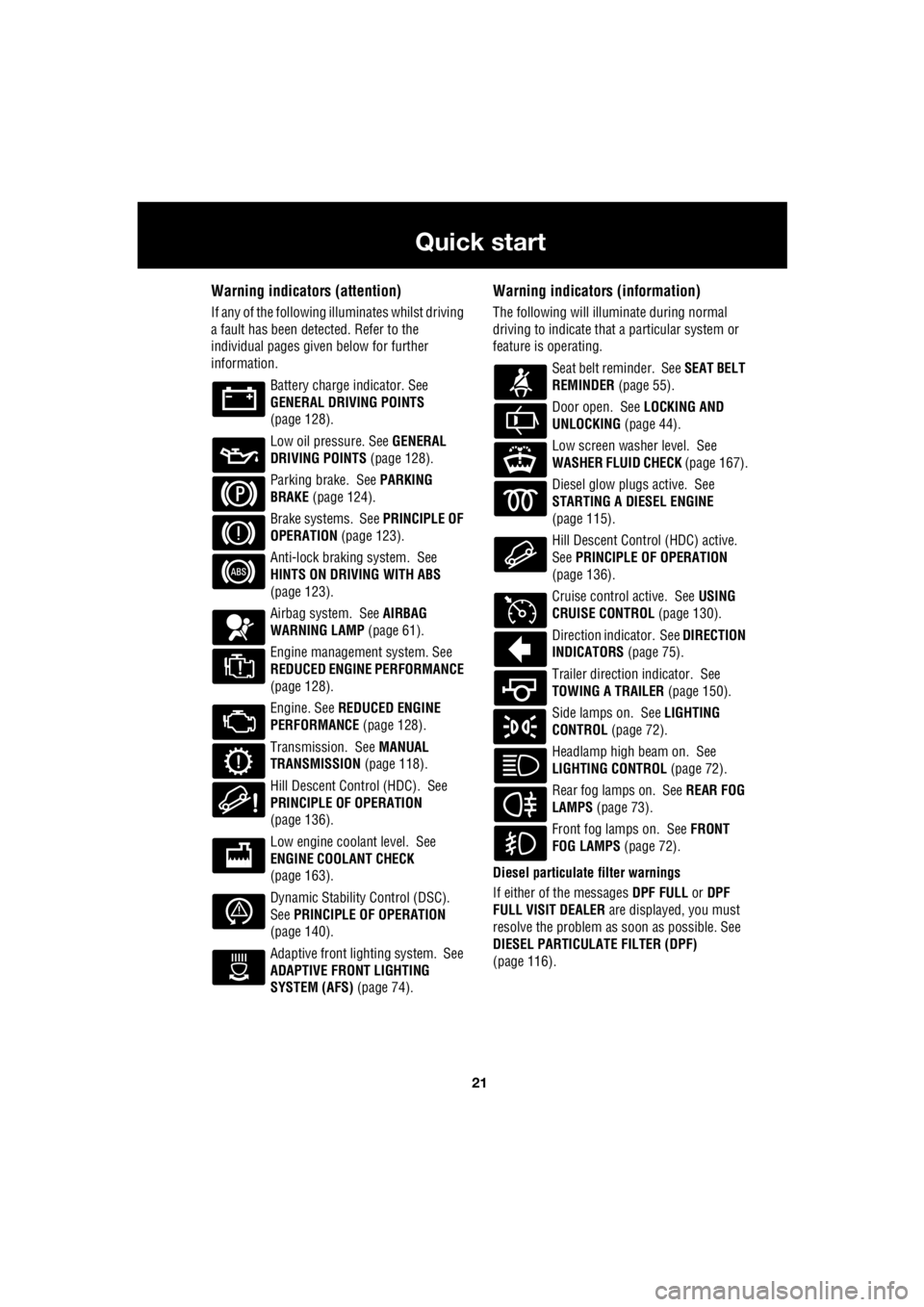
Warning indicators (attention)
If any of the following illuminates whilst driving
a fault has been detected. Refer to the
individual pages give n below for further
information.
Battery charge indicator. See
GENERAL DRIVING POINTS
(page 128).
Low oil pressure. See GENERAL
DRIVING POINTS (page 128).
Parking brake. See PARKING
BRAKE (page 124).
Brake systems. See PRINCIPLE OF
OPERATION (page 123).
Anti-lock braking system. See
HINTS ON DRIVING WITH ABS
(page 123).
Airbag system. See AIRBAG
WARNING LAMP (page 61).
Engine management system. See
REDUCED ENGINE PERFORMANCE
(page 128).
Engine. See REDUCED ENGINE
PERFORMANCE (page 128).
Transmission. See MANUAL
TRANSMISSION (page 118).
Hill Descent Control (HDC). See
PRINCIPLE OF OPERATION
(page 136).
Low engine coolant level. See
ENGINE COOLANT CHECK
(page 163).
Dynamic Stability Control (DSC).
See PRINCIPLE OF OPERATION
(page 140).
Adaptive front lighting system. See
ADAPTIVE FRONT LIGHTING
SYSTEM (AFS) (page 74).
Warning indicators (information)
The following will illuminate during normal
driving to indicate that a particular system or
feature is operating.
Seat belt reminder. See SEAT BELT
REMINDER (page 55).
Door open. See LOCKING AND
UNLOCKING (page 44).
Low screen washer level. See
WASHER FLUID CHECK (page 167).
Diesel glow plugs active. See
STARTING A DIESEL ENGINE
(page 115).
Hill Descent Control (HDC) active.
See PRINCIPLE OF OPERATION
(page 136).
Cruise control active. See USING
CRUISE CONTROL (page 130).
Direction indicator. See DIRECTION
INDICATORS (page 75).
Trailer direction indicator. See
TOWING A TRAILER (page 150).
Side lamps on. See LIGHTING
CONTROL (page 72).
Headlamp high beam on. See
LIGHTING CONTROL (page 72).
Rear fog lamps on. See REAR FOG
LAMPS (page 73).
Front fog lamps on. See FRONT
FOG LAMPS (page 72).
Diesel particulate filter warnings
If either of the messages DPF FULL or DPF
FULL VISIT DEALER are displayed, you must
resolve the problem as soon as possible. See
DIESEL PARTICULATE FILTER (DPF)
(page 116).
Page 2761 of 3229
41
Keys and remote controls
R
USING THE REMOTE CONTROL
Remote control
Note: The operational range of the remote
control will vary considerably depending on
atmospheric conditions and interference from
other transmitting devices.
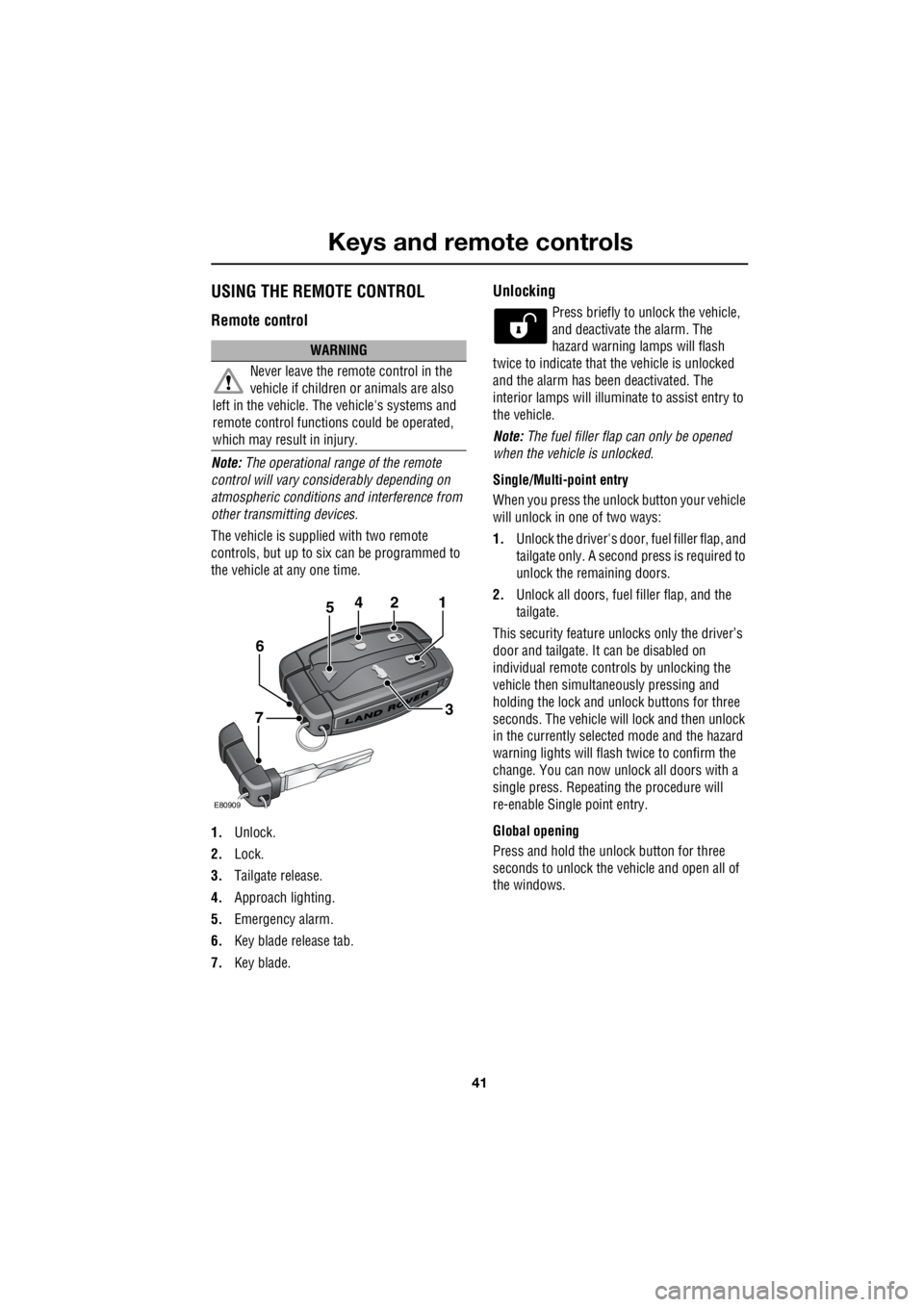
The vehicle is supplied with two remote
controls, but up to six can be programmed to
the vehicle at any one time.
1. Unlock.
2. Lock.
3. Tailgate release.
4. Approach lighting.
5. Emergency alarm.
6. Key blade release tab.
7. Key blade.
Unlocking
Press briefly to unlock the vehicle,
and deactivate the alarm. The
hazard warning lamps will flash
twice to indicate that the vehicle is unlocked
and the alarm has been deactivated. The
interior lamps will illuminate to assist entry to
the vehicle.
Note: The fuel filler flap can only be opened
when the vehicle is unlocked.
Single/Multi- point entry
When you press the unlock button your vehicle
will unlock in one of two ways:
1. Unlock the driver's door, fuel filler flap, and
tailgate only. A second press is required to
unlock the remaining doors.
2. Unlock all doors, fuel filler flap, and the
tailgate.
This security feature unlocks only the driver’s
door and tailgate. It can be disabled on
individual remote controls by unlocking the
vehicle then simultaneously pressing and
holding the lock and unlock buttons for three
seconds. The vehicle will lock and then unlock
in the currently selected mode and the hazard
warning lights will flas h twice to confirm the
change. You can now unlock all doors with a
single press. Repeating the procedure will
re-enable Single point entry.
Global opening
Press and hold the unlock button for three
seconds to unlock the ve hicle and open all of
the windows.
WARNING
Never leave the remote control in the
vehicle if children or animals are also
left in the vehicle. The vehicle's systems and
remote control functions could be operated,
which may result in injury.
2
E80909
451
3
6
7
Page 2762 of 3229
Keys and remote controls
42
L
Single and double locking
The vehicle can be locked in two ways.
Single locking
Single locking secures the vehicle and prevents
the doors being opened from outside of the
vehicle. The doors can be unlocked and opened
from inside the vehicle.
Double locking
Double locking secures the vehicle and
prevents the doors being opened from inside
or outside of the vehicle. The doors can not be
unlocked or opened from inside the vehicle.
This provides additional security if the vehicle
is left unattended. The vehicle cannot be
opened by breaking a window and operating
the door locks from inside the vehicle.
Locking
Press briefly to single lock the
vehicle, and partially activate the
alarm. The hazard warning lamps
will flash to indicate that the vehicle is locked.
A second press within three seconds will
double lock the vehicle and fully arm the alarm.
The hazard warning lamps will flash again to
indicate the enhanced lock/alarm state.
Note: The fuel filler flap can only be opened
when the vehicle is unlocked. Global closing
Press and hold the lock button for three
seconds to single lock the vehicle, fully arm the
alarm, and close all of the windows.
Note: For safety reasons, th e sunroof does not
close automatically. It sh ould be closed in the
normal way before exiting the vehicle.
Automatic relocking
If a door, or the tailgate, are not opened within
one minute of unlocking the vehicle, doors will
lock again automatically.
Approach lighting
When approaching the vehicle
during darkness press to switch on
the approach illumination. Press
again to turn the approach lamps off.
The approach ill umination period
set at the factory is thirty seconds.
This can be configured by a Land
Rover Dealer/Authorised Repairer to provide
illumination lasting between Zero and 120
seconds.
WARNING
Never double lock the vehicle with
people, children, or pets inside. In the
event of an emergency th ey would be unable to
escape, and the emergency services would be
unable to release them quickly.
WARNING
Ensure that no children, pets, or
obstructions are in any open aperture
before operating globa l closing. Safety
mechanisms are in place to prevent serious
injury, however, inju ries can still occur.
Page 2765 of 3229
45
Alarm
R
AlarmARMING THE ALARM
The engine is automatically
immobilised when the remote
control is removed from the starter
control unit. The alarm system is automatically
armed when the remote lock button is pressed.
The hazard lamps will flash to indicate that the
alarm is armed.
Full alarm
To set full alarm protection ensure that all the
windows and the sunroof are closed. Then
press the lock button twice within three
seconds. The hazard warn ing lights will flash
twice to confirm the alarm state.
Once fully armed the alarm will sound if :-
• the bonnet, tailgate, or a door are opened.
• movement is detected within the vehicle
interior.
• a window, front or rear windscreen, or
sunroof glass are broken.
• the vehicle is raised or tilted.
• the vehicle battery is disconnected.
• an attempt is made to disconnect the alarm
siren.
Note: If the alarm is armed and a window or the
sunroof are left open the alarm will sound due
to movement of air currents.
Partial alarm
To set partial alarm protection, briefly press the
lock button once. The hazard warning lights
will flash once to confirm the alarm state.
Once partially armed the alarm will sound if :-
• the bonnet, tailgate, or a door are opened.
• the vehicle battery is disconnected.
• an attempt is made to disconnect the alarm
siren. Note:
This setting should be used in
circumstances such as travelling on a ferry,
when pets are to be left in the vehicle, when a
window must be left open etc
Alarm indicator
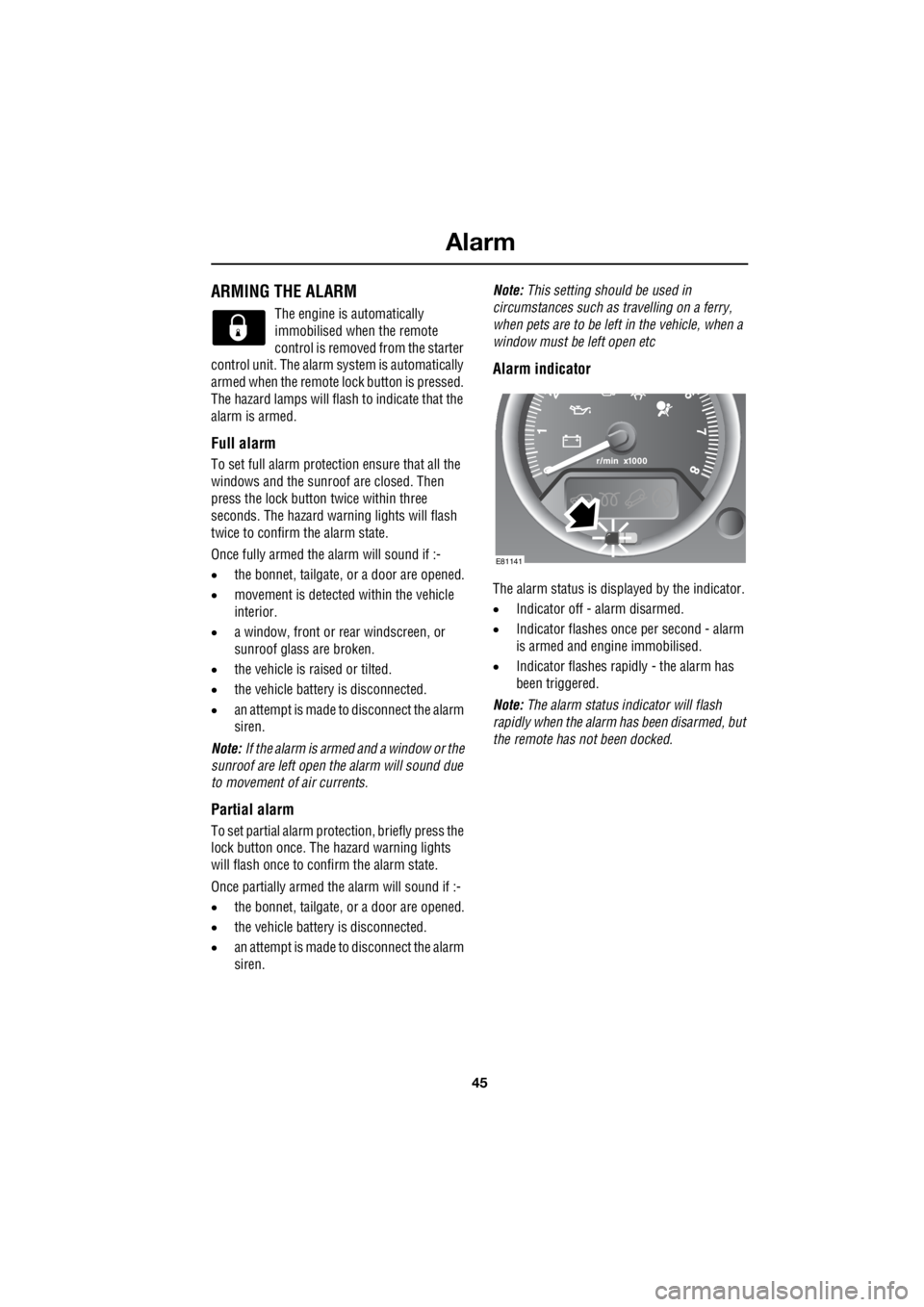
The alarm status is disp layed by the indicator.
• Indicator off - alarm disarmed.
• Indicator flashes once per second - alarm
is armed and engine immobilised.
• Indicator flashes rapidly - the alarm has
been triggered.
Note: The alarm status in dicator will flash
rapidly when the alarm has been disarmed, but
the remote has not been docked.
E81141
Page 2767 of 3229
47
Seats
R
SeatsSITTING IN THE CORRECT POSITION
The seat, head restraint, seat belt and airbags,
all contribute to the protection of the user.
Correct use of these components will give you
greater protection, therefore you should
observe the following points:
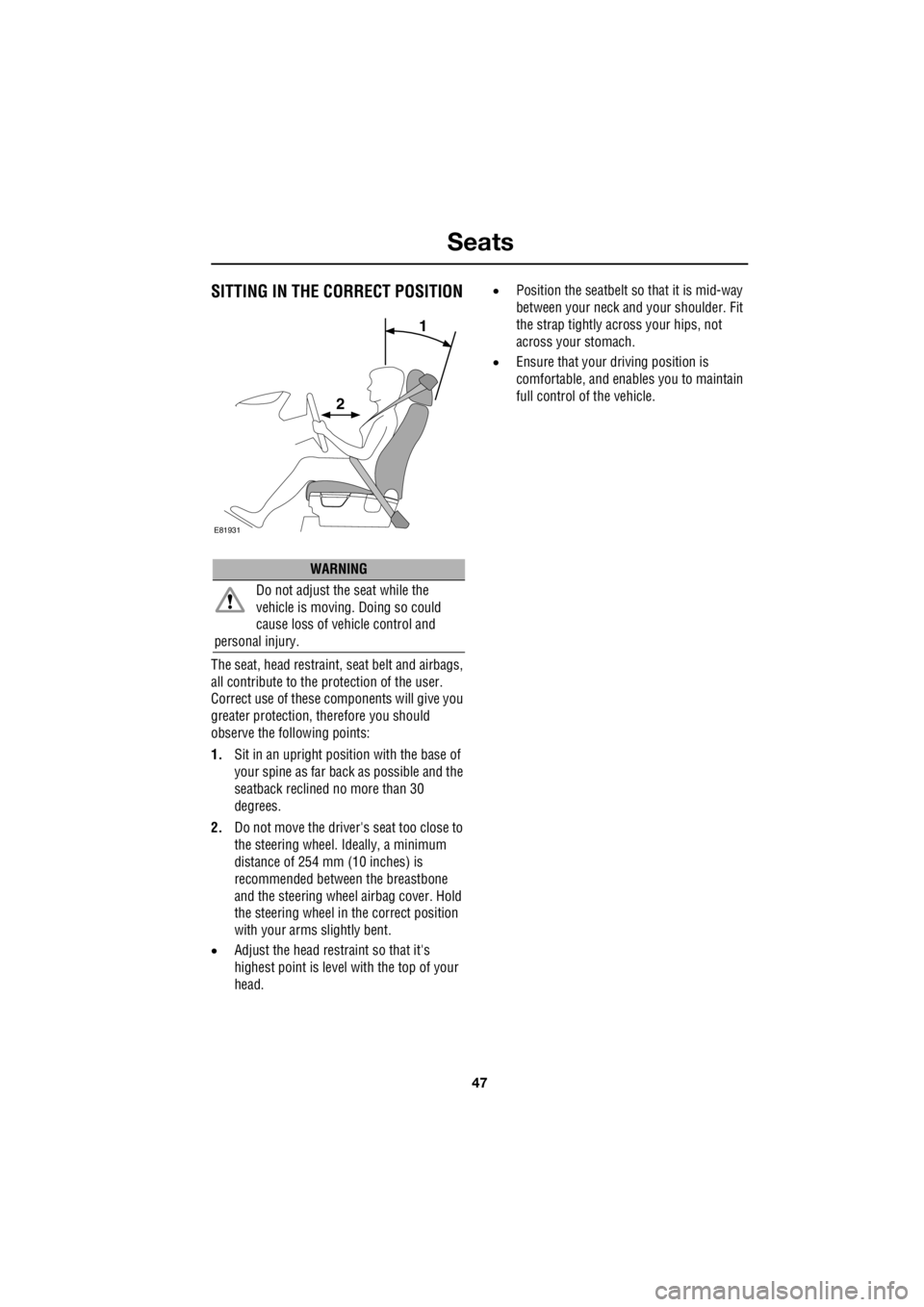
1. Sit in an upright position with the base of
your spine as far back as possible and the
seatback reclined no more than 30
degrees.
2. Do not move the driver's seat too close to
the steering wheel. Ideally, a minimum
distance of 254 mm (10 inches) is
recommended betwee n the breastbone
and the steering wheel airbag cover. Hold
the steering wheel in the correct position
with your arms slightly bent.
• Adjust the head restraint so that it's
highest point is level with the top of your
head. •
Position the seatbelt so that it is mid-way
between your neck an d your shoulder. Fit
the strap tightly across your hips, not
across your stomach.
• Ensure that your driving position is
comfortable, and enab les you to maintain
full control of the vehicle.
WARNING
Do not adjust the seat while the
vehicle is moving. Doing so could
cause loss of vehicle control and
personal injury.
1
E81931
2
Page 2782 of 3229
Supplementary restraints system
62
L
DISABLING THE PASSENGER AIRBAG
Note: The passenger airbag should be disabled
only when a rearward fa cing child restraint if
fitted to the front passenger seat.
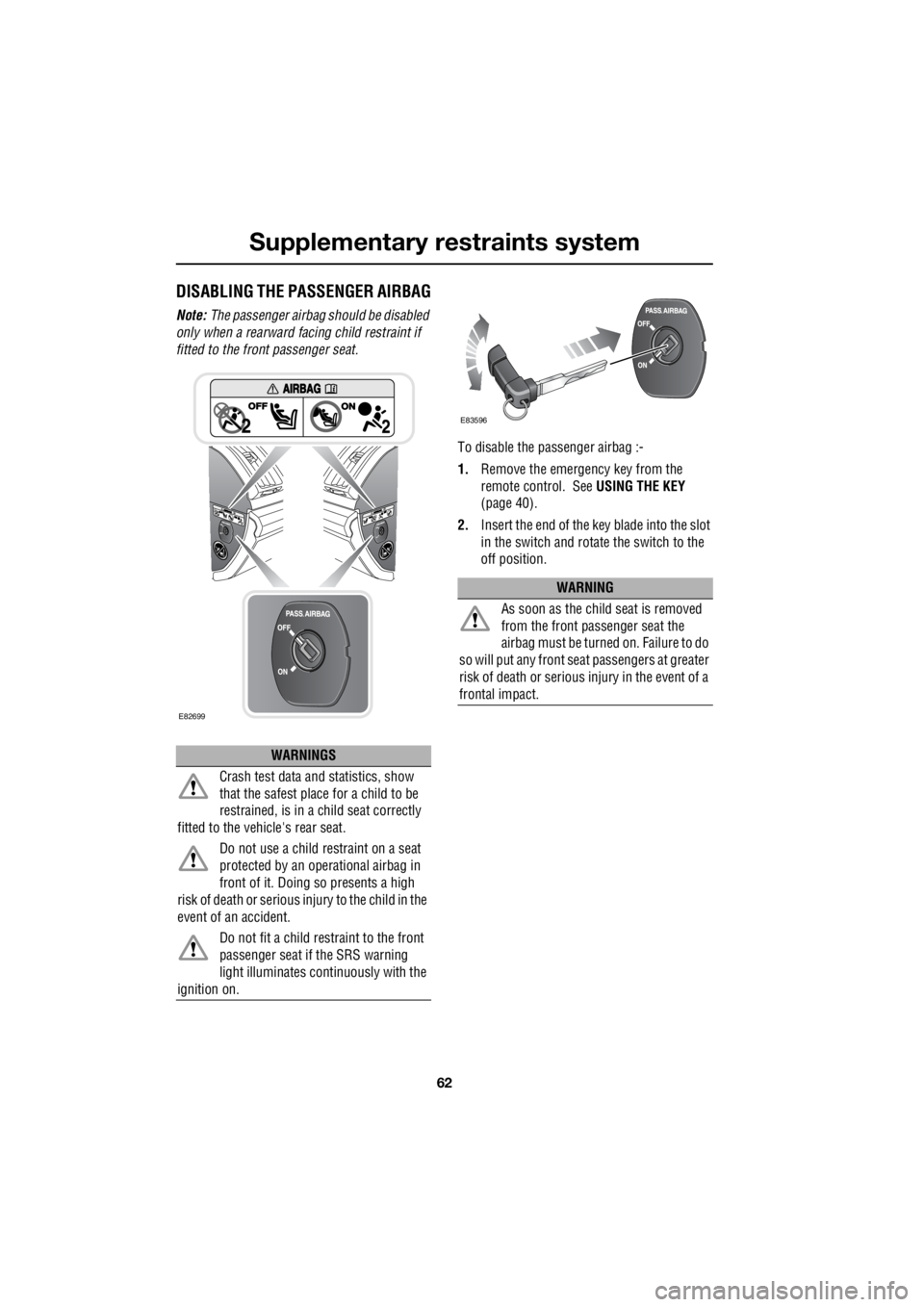
To disable the passenger airbag :-
1. Remove the emergency key from the
remote control. See USING THE KEY
(page 40).
2. Insert the end of the key blade into the slot
in the switch and rotate the switch to the
off position.
WARNINGS
Crash test data and statistics, show
that the safest place for a child to be
restrained, is in a child seat correctly
fitted to the vehicle's rear seat.
Do not use a child restraint on a seat
protected by an ope rational airbag in
front of it. Doing so presents a high
risk of death or serious injury to the child in the
event of an accident.
Do not fit a child restraint to the front
passenger seat if the SRS warning
light illuminates co ntinuously with the
ignition on.
E82699
WARNING
As soon as the child seat is removed
from the front passenger seat the
airbag must be turned on. Failure to do
so will put any front seat passengers at greater
risk of death or serious injury in the event of a
frontal impact.
E83596