engine LAND ROVER FRELANDER 2 2006 Repair Manual
[x] Cancel search | Manufacturer: LAND ROVER, Model Year: 2006, Model line: FRELANDER 2, Model: LAND ROVER FRELANDER 2 2006Pages: 3229, PDF Size: 78.5 MB
Page 2915 of 3229
195
Fuses
R
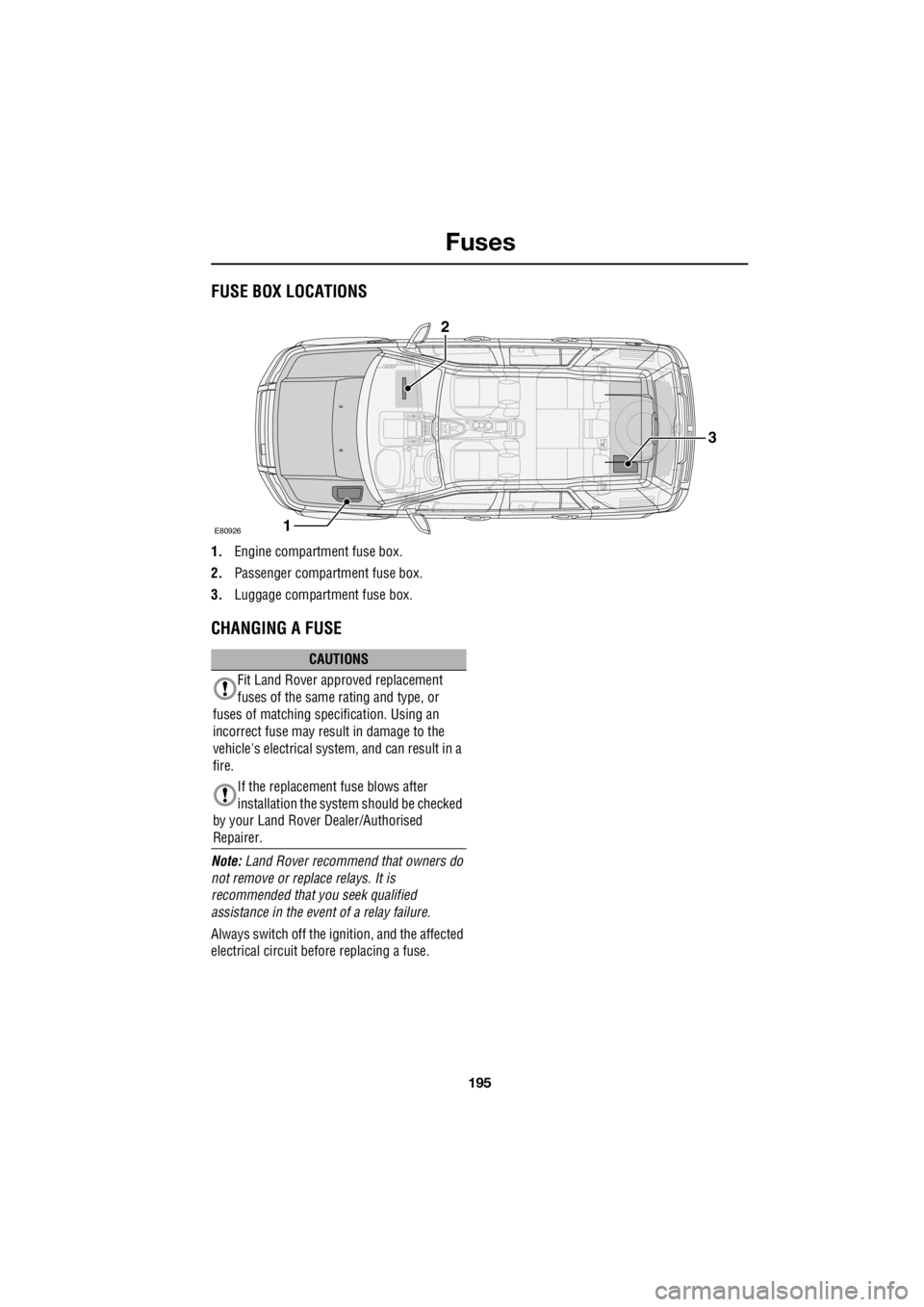
FusesFUSE BOX LOCATIONS
1. Engine compartment fuse box.
2. Passenger compartment fuse box.
3. Luggage compartment fuse box.
CHANGING A FUSE
Note: Land Rover recommend that owners do
not remove or repl ace relays. It is
recommended that you seek qualified
assistance in the event of a relay failure.
Always switch off the i gnition, and the affected
electrical circuit before replacing a fuse.
E80926
3
1
2
CAUTIONS
Fit Land Rover approved replacement
fuses of the same rating and type, or
fuses of matching spec ification. Using an
incorrect fuse may result in damage to the
vehicle's electrical system, and can result in a
fire.
If the replacement fuse blows after
installation the syst em should be checked
by your Land Rover Dealer/Authorised
Repairer.
Page 2916 of 3229
Fuses
196
L
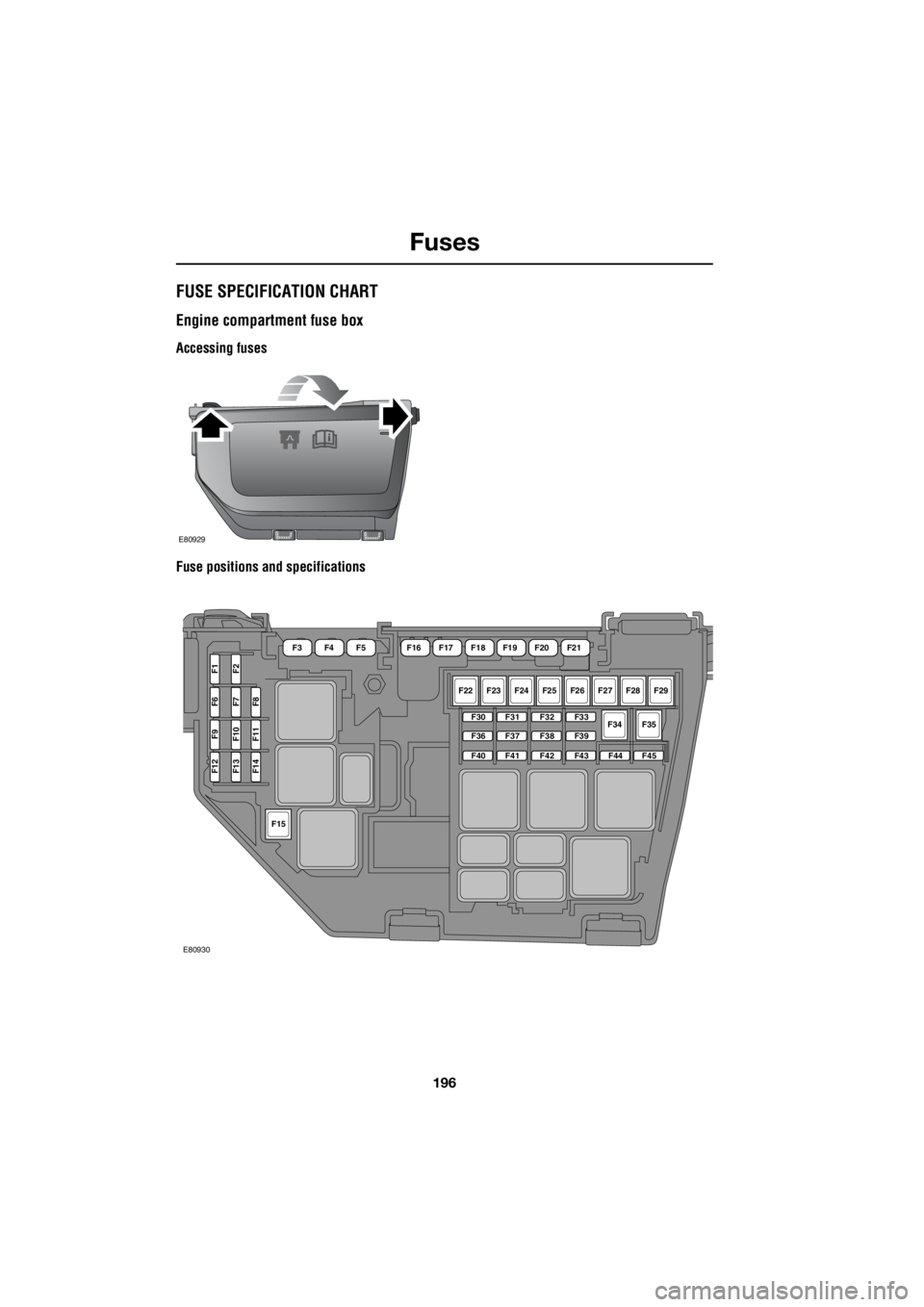
FUSE SPECIFICATION CHART
Engine compartment fuse box
Accessing fuses
Fuse positions and specifications
E80929
F22F23F24F25F26F27F28F29
F34F35F30
F36
F40
F31
F37
F41
F32
F38
F42
F33
F39
F43F44F45
F15
F12F13F14
F9F10F11
F6F7F8
F1F2
F16F17F18F19F20F21F3F4F5
E80930
Page 2917 of 3229

197
Fuses
R
Fuse number Rating (Amps) Fuse colour Circuits protected F1 5 tan Glow plugs
F2 15 blue Automatic transmission
F3 80 - Cooling fans
F4 60 - Glow plugs
F5 - - -
F6 (Diesel) 10 red Engine management F6 (Petrol) 15 blue Engine management F7 5 tan Relays
F8 (Diesel) 10 red Engine management F8 (Petrol) 15 blue Engine management
F9 (Diesel) 10 red Engine management
F9 (Petrol) 15 blue Engine management
F10 (Petrol) 10 red Engine management
F11 (Diesel) 10 red Engine management
F11 (Petrol) 10 red Engine management
F12 (Diesel) 10 red Engine management
F12 (Petrol) 20 yell ow Engine management
F13 15 blue Air Conditioning
F14 (Diesel) 15 blue Engine management
F15 40 green Starter motor
F16 (Diesel) 100 - Diesel PTC heater F17 60 - Passenger compartment fuse box supply
F18 60 - Passenger compartment fuse box supply
F19 60 - Luggage compartment fuse box supply
F20 60 - Luggage compartment fuse box supply
F21 60 - Luggage compartment fuse box supply - Audio unit
F22 30 pink Windscreen wipers
F23 - - -
Page 2918 of 3229

Fuses
198
L
F24 30 pink Headlamp washers
F25 30 pink ABS
F26 40 green ABS
F27 - - -
F28 40 green Heater blower
F29 - - -
F30 - - -
F31 15 blue Horns
F32 20 yellow Diesel auxiliary heater
F33 5 tan Relays
F34 40 green Heated windscreen(LH)
F35 40 green Heated windscreen (RH)
F36 - - -
F37 10 red Heated washer jets
F38 10 red AFS (RH lamp motors)
F39 10 red Climate control
F40 - - -
F41 20 yellow Passenger compartment fuse box supply
F42 15 blue Engine management
F43 5 tan Headlamp levelling control - AFS
F44 10 red AFS (LH lamp motors)
F45 15 blue Cigar lighter
Fuse number Rating (Amps) Fuse colour Circuits protected
Page 2925 of 3229

205
Status after a collision
R
Status after a collisionDRIVING AFTER A COLLISION
Before starting or driving
If the vehicle has been involved in an accident
it should be checke d thoroughly before
attempting to start the engine or drive the
vehicle.
Check for :-
• Fuel leaks.
• Fluid leaks.
• Battery damage.
• Damage to wiring.
• Damage to lights.
• Damage to steering, suspension, wheels
or tyres.
• Sharp or protruding bodywork.
• Operation of doors and locks.
• Condition and operation of seat belts and
SRS components.
• Condition of chil d seats and their
mounting/attach ment points.
Note: This list is not exhaustive.
Resetting the fuel cut-off
The fuel system cut-off forms part of the Safety
and Restraint System (SRS) fitted to your
vehicle. Following an im pact, and depending on
the severity, the fuel pump may be switched
off.
1. Switch the ignition off, and wait for one
minute.
2. Turn the ignition on for 30 seconds.
3. Check the vehicle thoroughly for fuel leaks.
If a leak is detected switch the ignition off
immediately.
• The vehicle must not be started if a leak
is present. Seek qualified advice, and
have the vehicle recovered.
4. If no leaks are detected, start the vehicle.
When driving
When driving a vehicle which has been
involved in a collision use caution and pay extra
attention to the operation of the vehicle. If any
changes in vehicle operati on after the collision
are noted when compared to it's operation
before the collision, do not continue to drive
the vehicle. Stop the vehicle as soon as it is
safe to do so, and have the vehicle recovered.
Pay particular attent ion to changes in :-
• Steering.
• Braking.
• Unusual noises.
• Warning lights or messages displayed.
• Problems with electrical systems.
WARNING
If the vehicle is involved in a collision it
should be checked by a Land Rover
Dealer/Authorised repairer, or suitably
qualified persons before starting or driving.
WARNING
The fuel cut-off s hould never be reset
if you can smell fuel , or a leak can be
seen. Doing so can lead to a fire which
may cause personal injury or death.
Page 2928 of 3229
Vehicle recovery
208
L
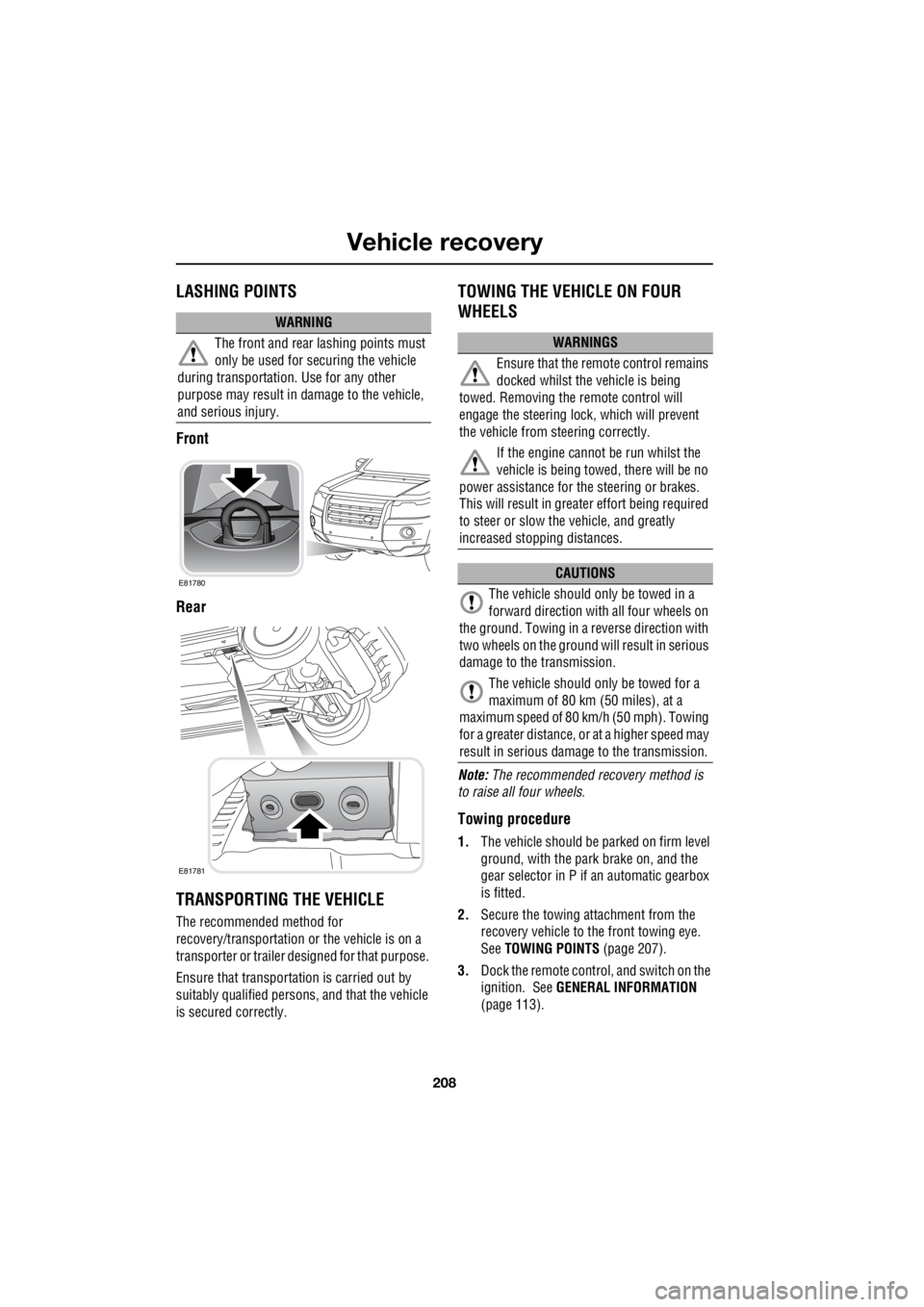
LASHING POINTS
Front
Rear
TRANSPORTING THE VEHICLE
The recommended method for
recovery/transportation or the vehicle is on a
transporter or trailer de signed for that purpose.
Ensure that transporta tion is carried out by
suitably qualified persons , and that the vehicle
is secured correctly.
TOWING THE VEHICLE ON FOUR
WHEELS
Note: The recommended recovery method is
to raise all four wheels.
Towing procedure
1. The vehicle should be parked on firm level
ground, with the park brake on, and the
gear selector in P if an automatic gearbox
is fitted.
2. Secure the towing attachment from the
recovery vehicle to the front towing eye.
See TOWING POINTS (page 207).
3. Dock the remote control, and switch on the
ignition. See GENERAL INFORMATION
(page 113).
WARNING
The front and rear lashing points must
only be used for securing the vehicle
during transportation. Use for any other
purpose may result in da mage to the vehicle,
and serious injury.
E81780
E81781
WARNINGS
Ensure that the remote control remains
docked whilst the vehicle is being
towed. Removing the remote control will
engage the steering lo ck, which will prevent
the vehicle from steering correctly.
If the engine cannot be run whilst the
vehicle is being towed, there will be no
power assistance for the steering or brakes.
This will result in grea ter effort being required
to steer or slow the vehicle, and greatly
increased stopping distances.
CAUTIONS
The vehicle should only be towed in a
forward direction with all four wheels on
the ground. Towing in a reverse direction with
two wheels on the ground will result in serious
damage to the transmission.
The vehicle should only be towed for a
maximum of 80 km (50 miles), at a
maximum speed of 80 k m/h (50 mph). Towing
for a greater distance, or at a higher speed may
result in serious dama ge to the transmission.
Page 2931 of 3229

211
Technical specifications
R
Technical specificationsENGINE SPECIFICATIONS
Data Petrol
Number of cylinders 6 Displacement cc's 3192
Firing order 1-5-3-6-2-4
Compression ratio 10.8:1
Power output kW (PS) 171 (233) at 6300 rpm
Maximum torque Nm 317 at 3200 rpm
Data Diesel Diesel with DPF
Number of cylinders 4 4 Displacement cc's 2179 2179 Firing order 1-3-4-2 1-3-4-2
Compression ratio 16.5:1 16.5:1
Power output kW (PS) 118 (160) at 4000 rpm Belgium 110 (150) at 4000
rpm 112 (152) at 4000 rpm
Belgium 110 (150) at 4000 rpm
Maximum torque Nm 400 at 2000 rpm 400 at 2000 rpm
Page 2943 of 3229

223
Audio unit operation
R
Audio unit operationON OR OFF CONTROL
Press the on or off control to switch the audio
unit on. Press again to switch off.
VOLUME CONTROL
Rotate the volume control to increase or
decrease the audio unit volume. The volume
can be set between 0 and 35.
When the audio unit is turned on, the
previously set volume level will be
implemented.
Note: The standard audio unit can be used with
the engine off, but the maximum volume level
will be restricted.
Automatic Volume Control (AVC)
The AVC feature adjusts the volume level to
compensate for the changes in road noise as
the vehicle speed increases or decreases.
Note: The AVC setting represents the volume
increase and not the volume level.
If the AVC level is set to Off, there will be no
volume increase. With a low level setting, the
volume increase at speed will be minimal. If a
high level setting is used, there will be a
noticeable increase of volume at speed.
The AVC setting required will depend upon the
expected speed and the expected road
conditions.
Use the following proce dure to set the AVC
level.
1. Press and hold the tone button to access
the volume settings menu.
2. Press the tone button repeatedly until AVC
Level is displayed.
3. Rotate the volume control to select the
required AVC setting.
Reset volume settings
The following procedure will reset all of the
volume settings to the original factory values.
1. Press and hold the tone button to access
the volume settings menu.
2. Repeatedly press the tone button to scroll
through the menu until the Reset volume
settings message is displayed.
3. Rotate the volume control to highlight YES
or NO as required.
4. On premium audio un its, press the tone
button to confirm your choice and exit the
menu. On standard audio units, your
choice is confirme d by pressing the MENU
button.
AUDIO CONTROL
Depending on the specification of the audio
system fitted to your vehicle, the following
audio control settings are available from the
tone menu.
Surround sound settings
1. Press and release th e tone button to
display the current surround sound
setting.
2. Rotate the volume control to highlight 3
Channel or Stereo as required.
Bass response adjustment
1.Press the tone button repeatedly until the
current Bass setting is displayed.
2. Rotate the volume control to increase or
decrease the level.
Treble response adjustment
1. Press the tone button repeatedly until the
current Treble setting is displayed.
2. Rotate the volume control to increase or
decrease the level.
Page 2973 of 3229

253
Rear passenger controls
R
If however, the audio unit is switched to
another source, e.g. radi o, all CD related rear
seat controls become operable. If the audio
source is subsequently switched back to CD,
the rear seat controls will again be limited to
volume control only.
The same logic applie s to radio functions.
Adjustments can be made to other functions of
the audio system.
For example, if a music CD is selected on the
audio unit, radio can be selected and controlled
using the rear seat cont rols. All radio related
rear seat controls become operable.
HEADPHONES
Note: Only headphones compatible with a 3.5
mm jack plug socket can be used. To obtain
optimum sound quality, use headphones with
an impedance of 32 ohms.
Note: When the headphones are not
connected, the rear se at controls remain
operational. It is still possible to select CD,
while the radio is playi ng on the audio unit. CD
play will remain opera tional until the mode
control is pressed again.
Note: The mode in use when the starter key is
removed will resume if the starter switch is
turned on again (position I or II) within two
minutes. If the starter switch is turned off for
longer than two minutes AUX mode will be
selected when the starter switch is next turned
on. For example, if a CD is playing when the key
is removed, play will restart when the starter
switch is next turned to position I, or the engine
is started, whether th e headphones are in use
or not.
Note: Adjusting the volume on the audio unit,
does not alter the headphone volume. The
volume of each controller can be adjusted
independently.
Page 2993 of 3229

Index
273
R
Driving after a collision . . . . . . . . . . . . . . 205 Before starting or driving . . . . . . . . . . 205
Resetting the fuel cut-off . . . . . . . . . . 205
When driving . . . . . . . . . . . . . . . . . . . 205
E
Economical driving . . . . . . . . . . . . . . . . . 129
Driving tips for economy . . . . . . . . . . 129
Maintenance and fuel economy . . . . . 129
Ejecting compact discs . . . . . . . . . . . . . . 246
Ejecting multiple compact discs . . . . . . . 246
Electric exterior mirrors . . . . . . . . . . . . . . 95 Adjusting and folding . . . . . . . . . . . . . . 95
Mirror dip when reversing . . . . . . . . . . 96
Electric seats . . . . . . . . . . . . . . . . . . . . . . . 49 Driving position memory . . . . . . . . . . . 50
Electric sunroof . . . . . . . . . . . . . . . . . . . . 105 Anti-trap mechanism . . . . . . . . . . . . . 105
Calibration . . . . . . . . . . . . . . . . . . . . . 106
Operation . . . . . . . . . . . . . . . . . . . . . . 105
Sunroof blinds . . . . . . . . . . . . . . . . . . 106
Electric windows . . . . . . . . . . . . . . . . . . . . 93
One shot operation . . . . . . . . . . . . . . . . 93
Overriding anti-trap protec tion . . . . . . . 93
Window isolator . . . . . . . . . . . . . . . . . . 94
Window reset . . . . . . . . . . . . . . . . . . . . 94
Engine compartment overview . . . . . . . . 161 1. Engine oil filler caps (Black) . . . . . . 161
2. Engine oil dipsticks (Yellow) . . . . . . 161
3. Brake fluid reservoi r cap (Black) . . . 161
4. Coolant reservoir ca p (Black) . . . . . 161
5. Washer fluid reserv oir cap (Blue) . . 161
6. Power steering flui d reservoir cap (Black)
161
Engine coolant check . . . . . . . . . . . . . . . 163 Checking the coolant level . . . . . . . . . 163
Topping up the coolant . . . . . . . . . . . . 164
Engine oil check . . . . . . . . . . . . . . . . . . . 162 Checking the oil level . . . . . . . . . . . . . 162
Engine oil specification . . . . . . . . . . . . 163
Topping up the oil . . . . . . . . . . . . . . . . 163
Engine specifications. . . . . . . . . . . . . . . . 211
Enhanced other network (RDS-EON). . . . 229
Essential towing checks . . . . . . . . . . . . . 151
Event data recording . . . . . . . . . . . . . . . . . 37 Exterior mirrors . . . . . . . . . . . . . . . . . . . . . 94
Proximity mirror (Japan only) . . . . . . . . 94
F
Fast forward/reverse . . . . . . . . . . . . . . . . . 247
Fastening the seat belts . . . . . . . . . . . . . . . 56 Releasing the seat belts . . . . . . . . . . . . . 56
Filling station information . . . . . . . . . . . . . . 33 Engine coolant specification. . . . . . . . . . 34
Engine oil specification . . . . . . . . . . . . . 34
Fuel filler flap . . . . . . . . . . . . . . . . . . . . . 33
Tyre pressures . . . . . . . . . . . . . . . . . . . . 34
Front fog lamps . . . . . . . . . . . . . . . . . . . . . 72
Fuel and refuelling Technical specifications . . . . . . . . . . . . 146
Fuel burning heater. . . . . . . . . . . . . . . . . . 104
Fuel consumption . . . . . . . . . . . . . . . . . . . 146
Fuel cut-off . . . . . . . . . . . . . . . . . . . . . . . . 144 Resetting the fuel cut-off . . . . . . . . . . . 144
Fuel filler flap . . . . . . . . . . . . . . . . . . . . . . 144
Fuel quality . . . . . . . . . . . . . . . . . . . . . . . . 142 Alternative fuels for petrol engines. . . . 143
Diesel engined vehicles . . . . . . . . . . . . 143
Petrol engined vehicles . . . . . . . . . . . . 142
Fuse box locations . . . . . . . . . . . . . . . . . . 195
Fuse specification chart . . . . . . . . . . . . . . 196 Engine compartment fuse box . . . . . . . 196
Luggage compartment fuse box . . . . . 201
Passenger compartment fuse box . . . . 199
G
General driving points . . . . . . . . . . . . . . . 128 Battery charging - red . . . . . . . . . . . . . 128
Low oil pressure - red . . . . . . . . . . . . . 128
General information on ra dio frequencies. . 40
H
Handbrake . . . . . . . . . . . . . . . . . . . . . . . . 124
Hazard warning flashers . . . . . . . . . . . 74, 204
HDC . . . . . . . . . . . . . . . . . . . . . . . . . . . . . 137
Head restraints . . . . . . . . . . . . . . . . . . . . . . 51
Headlamp adjustment . . . . . . . . . . . . . . . . . 73
Headlamp levelling . . . . . . . . . . . . . . . . . . . 73 Halogen headlamps . . . . . . . . . . . . . . . . 73
Xenon headlamps . . . . . . . . . . . . . . . . . 73
Headlamp washers . . . . . . . . . . . . . . . . . . . 88
Headphones . . . . . . . . . . . . . . . . . . . . . . . 253