engine LAND ROVER FRELANDER 2 2006 Repair Manual
[x] Cancel search | Manufacturer: LAND ROVER, Model Year: 2006, Model line: FRELANDER 2, Model: LAND ROVER FRELANDER 2 2006Pages: 3229, PDF Size: 78.5 MB
Page 2883 of 3229
163
Maintenance
R
Topping up the oil
1. Unscrew the oil filler cap.
2. Add oil to maintain the level between the
MIN and MAX marks or notches on the
dipstick. Clean up any oil spilled during
topping-up.
3. Check the oil level again after 5 minutes.
It is essential to use the correct specification
oil, and to ensure it is suitable for the climatic
conditions in which the vehicle is to be
operated.
Note: The approximate quantity of oil required
to raise the level from MIN to MAX on the
dipstick is 0.8 litres (1.4 pints) - petrol models
or 1.5 litres (2.6 pi nts) - diesel models.
Engine oil specification
Land Rover recommends Castrol oils.
ENGINE COOLANT CHECK
If the quantity of fluid in the coolant
reservoir drops below the
recommended level, an amber
warning indicator in the instrument pack will
illuminate. Stop the vehicle and check the
coolant level.
On vehicles with a message centre, the
message LOW COOLANT LEVEL or COOLING
SYSTEM FAULT MONITOR GAUGE will be
displayed in place of the warning indicator.
Checking the coolant level
The coolant level in the expansion tank should
be checked at least week ly (more frequently in
high mileage or arduous operating conditions).
Always check the level when the system is
cold.
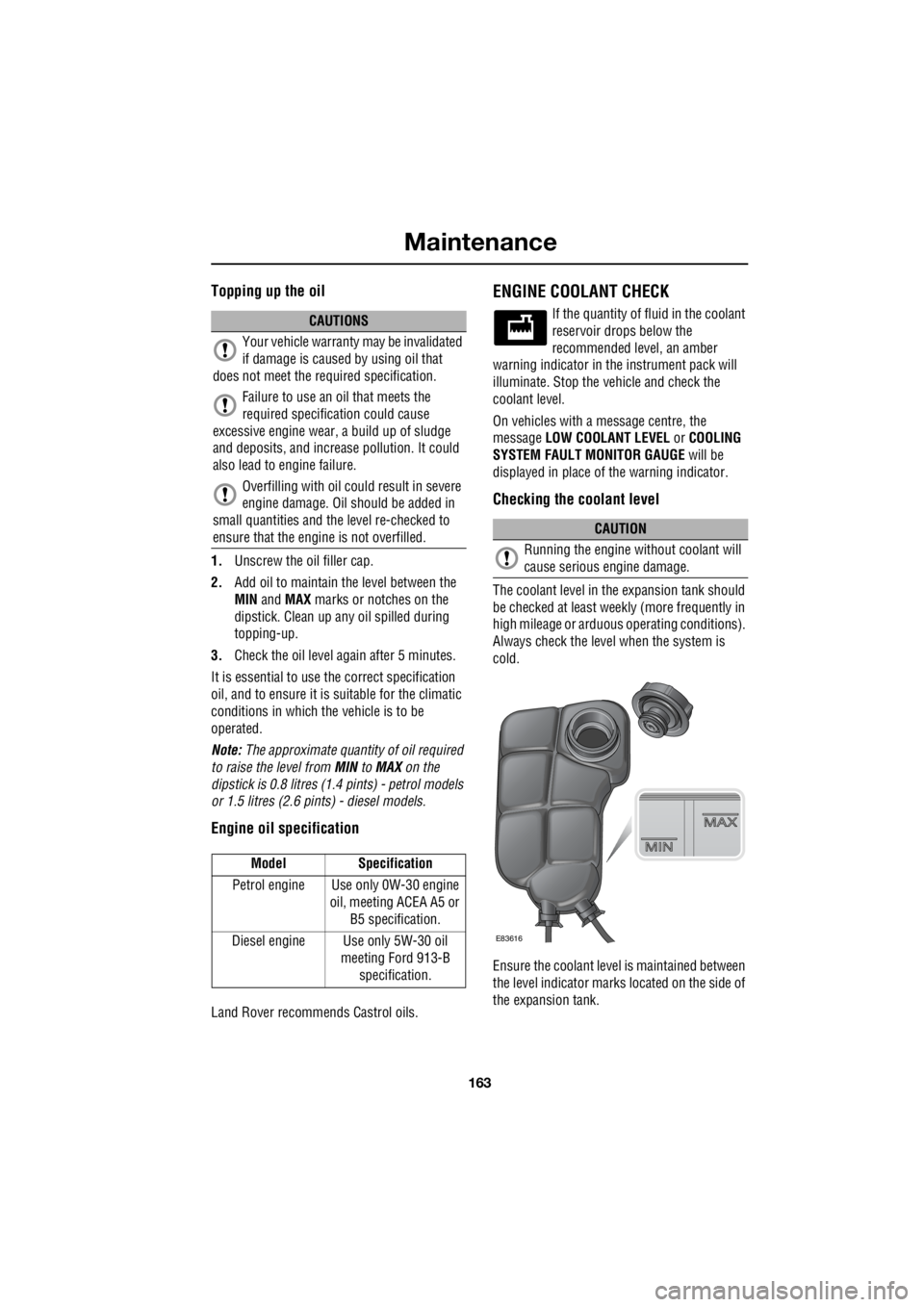
Ensure the coolant level is maintained between
the level indicator marks located on the side of
the expansion tank.
CAUTIONS
Your vehicle warranty may be invalidated
if damage is caused by using oil that
does not meet the required specification.
Failure to use an oil that meets the
required specification could cause
excessive engine wear, a build up of sludge
and deposits, and increase pollution. It could
also lead to engine failure.
Overfilling with oil could result in severe
engine damage. Oil should be added in
small quantities and the level re-checked to
ensure that the engine is not overfilled.
Model Specification
Petrol engine Use only 0W-30 engine oil, meeting ACEA A5 or
B5 specification.
Diesel engine Use only 5W-30 oil meeting Ford 913-B
specification.
CAUTION
Running the engine without coolant will
cause serious engine damage.
E83616
Page 2884 of 3229
Maintenance
164
L
If the level has fallen appreciably, suspect
leakage or overheatin g and arrange for the
vehicle to be exam ined by a qualified
technician.
Topping up the coolant
Top-up to the upper le vel indicator mark
located on the side of the expansion tank. Use
only a 50% mix of water and Texaco XLC
antifreeze.
Note: In an emergency - and only if the
approved antifreeze is unavailable - top-up the
cooling system with clea n water, but be aware
of the resultant reduction in frost protection.
Do not top-up or refill with conventional
antifreeze formulations. If in doubt consult a
qualified technician.
Ensure the cap is tightened fully after top-up is
completed by turning the cap until the ratchet
cap clicks. Antifreeze
Antifreeze contains important corrosion
inhibitors. The antifreeze content of the coolant
must be maintained at 50% ± 5% all year round
(not just in cold conditions). To ensure that the
anti-corrosion properties of the coolant are
retained, the antifreeze content should be
checked once a year and completely renewed
every ten years, regardless of distance
travelled. Failure to do so may cause corrosion
of the radiator and engine components.
The specific gravity of a 50% antifreeze
solution at 20°C (68°F) is 1.068 and protects
against frost down to -40°C (-40°F).
WARNINGS
Never remove the filler cap when the
engine is hot - escaping steam or
scalding water could ca use serious personal
injury.
Avoid spilling antifreeze onto a hot
engine - a fire may result.
Unscrew the filler cap slowly, allowing
the pressure to escape before removing
completely.
CAUTION
When travelling in territories where the
water supply contains salt, always
ensure you carry a supply of fresh (rain or
distilled) water. Topping up with salt water will
cause serious engine damage.
WARNINGS
Antifreeze is poisonous and can be fatal
if swallowed - keep containers sealed
and out of the reach of children. If accidental
consumption is suspec ted, seek medical
attention immediately.
If the fluid comes into contact with the
skin or eyes, rinse immediately with
plenty of water.
CAUTIONS
The use of non-approved antifreeze will
have an adverse ef fect on the engine
cooling system and therefore engine
durability.
Antifreeze will damage painted surfaces;
soak up any spillage with an absorbent
cloth immediately and wash the area with a
mixture of car shampoo and water.
Page 2885 of 3229
165
Maintenance
R
BRAKE AND CLUTCH FLUID CHECK
If the quantity of fluid in the
brake/clutch rese rvoir drops below
the recommended level, a red
warning indicator in the instrument pack will
illuminate or the message CHECK BRAKE
FLUID will be displayed in the message centre.
Note: If the warning indicator illuminates, or
the message is displayed while the vehicle is
being driven, stop the vehi cle as soon as safety
permits by gently applying the brakes.
Check and top-up the flui d level if necessary.
Checking the fluid level
With the vehicle on level ground, check the
fluid level at least every week (more frequently
in high mileage or arduous operating
conditions).
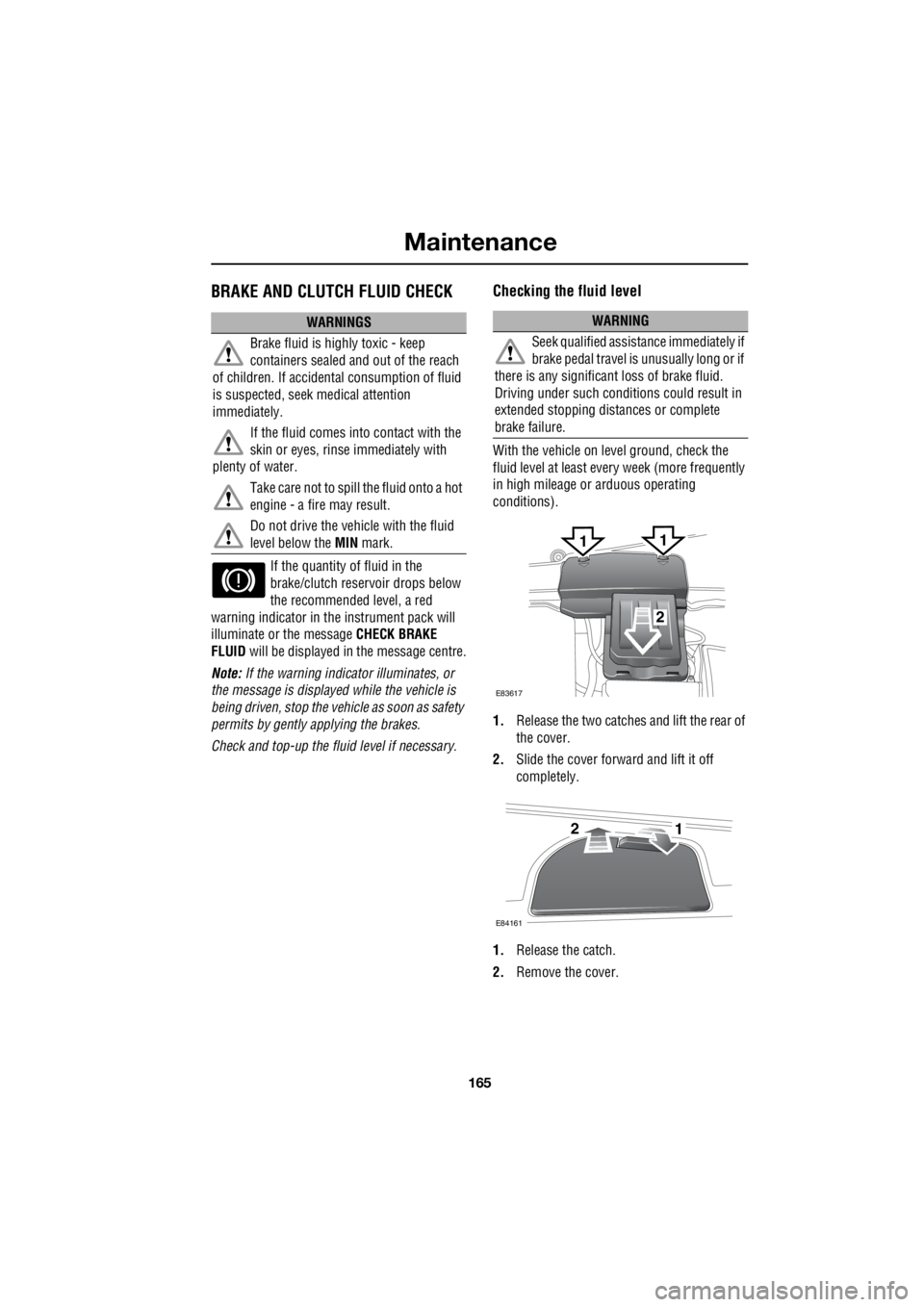
1. Release the two catches and lift the rear of
the cover.
2. Slide the cover forward and lift it off
completely.
1. Release the catch.
2. Remove the cover.
WARNINGS
Brake fluid is highly toxic - keep
containers sealed a nd out of the reach
of children. If accident al consumption of fluid
is suspected, seek medical attention
immediately.
If the fluid comes into contact with the
skin or eyes, rinse immediately with
plenty of water.
Take care not to spill the fluid onto a hot
engine - a fire may result.
Do not drive the vehicle with the fluid
level below the MIN mark.WARNING
Seek qualified assistance immediately if
brake pedal travel is unusually long or if
there is any significant loss of brake fluid.
Driving under such condi tions could result in
extended stopping distances or complete
brake failure.
E83617
2
11
E84161
21
Page 2886 of 3229
Maintenance
166
L
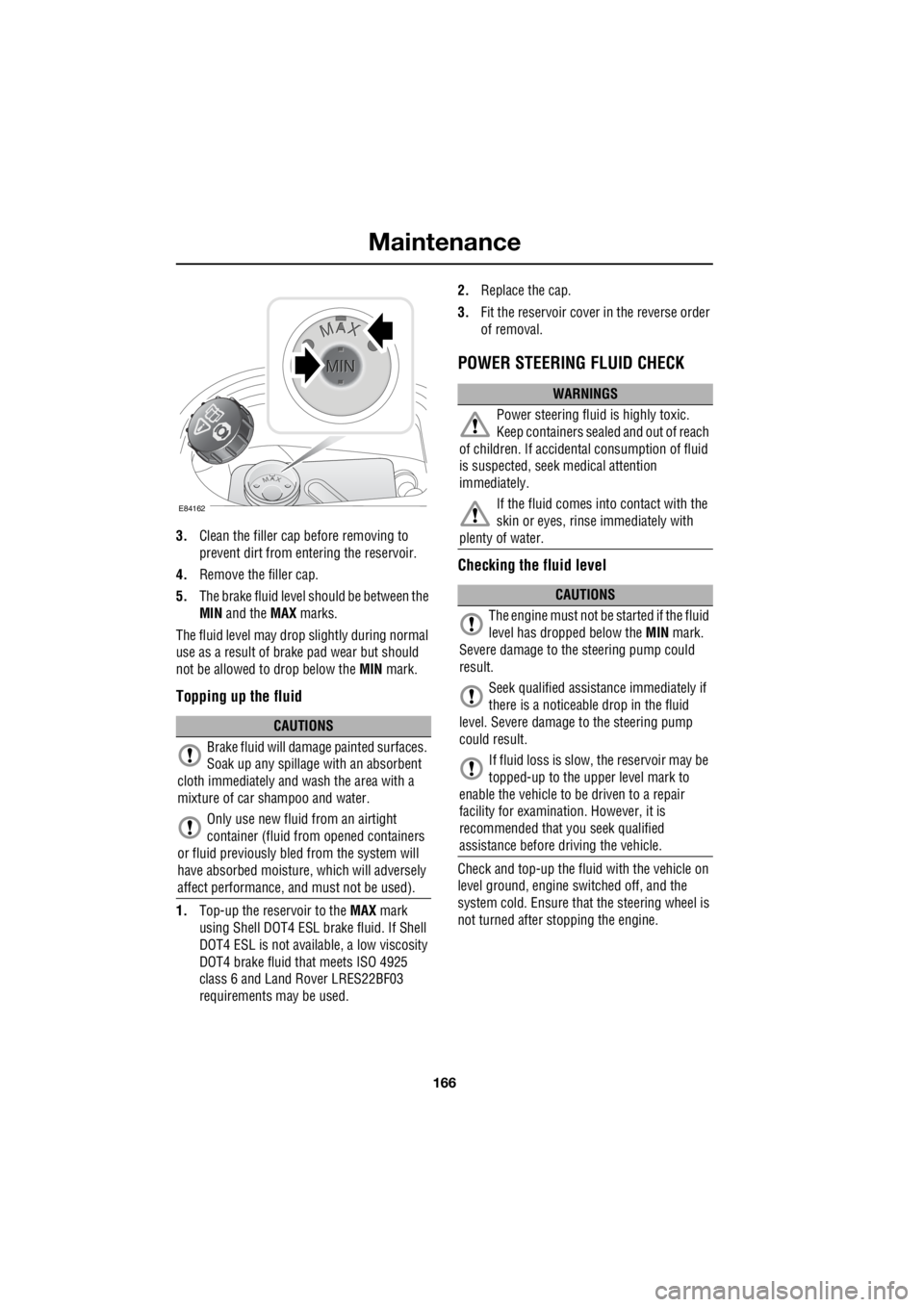
3. Clean the filler cap before removing to
prevent dirt from entering the reservoir.
4. Remove the filler cap.
5. The brake fluid level should be between the
MIN and the MAX marks.
The fluid level may drop slightly during normal
use as a result of brake pad wear but should
not be allowed to drop below the MIN mark.
Topping up the fluid
1.Top-up the reservoir to the MAX mark
using Shell DOT4 ESL brake fluid. If Shell
DOT4 ESL is not availa ble, a low viscosity
DOT4 brake fluid that meets ISO 4925
class 6 and Land Rover LRES22BF03
requirements ma y be used. 2.
Replace the cap.
3. Fit the reservoir cover in the reverse order
of removal.
POWER STEERING FLUID CHECK
Checking the fluid level
Check and top-up the fluid with the vehicle on
level ground, engine switched off, and the
system cold. Ensure that the steering wheel is
not turned after stopping the engine.
CAUTIONS
Brake fluid will damage painted surfaces.
Soak up any spillage with an absorbent
cloth immediately and wash the area with a
mixture of car sh ampoo and water.
Only use new fluid from an airtight
container (fluid from opened containers
or fluid previously bled from the system will
have absorbed moisture, which will adversely
affect performance, and must not be used).
E84162
WARNINGS
Power steering fluid is highly toxic.
Keep containers sealed and out of reach
of children. If accidental consumption of fluid
is suspected, seek medical attention
immediately.
If the fluid comes into contact with the
skin or eyes, rinse immediately with
plenty of water.
CAUTIONS
The engine must not be started if the fluid
level has dropped below the MIN mark.
Severe damage to th e steering pump could
result.
Seek qualified assistance immediately if
there is a noticeable drop in the fluid
level. Severe damage to the steering pump
could result.
If fluid loss is slow, the reservoir may be
topped-up to the uppe r level mark to
enable the vehicle to be driven to a repair
facility for examinatio n. However, it is
recommended that you seek qualified
assistance before driving the vehicle.
Page 2889 of 3229

169
Maintenance
R
TECHNICAL SPECIFICATIONS
Lubricants and fluids
¹ If Shell DOT4 ESL is not available, a low
viscosity DOT4 brake fl uid that meets ISO 4925
class 6 and Land Rover LRES22BF03
requirements may be used. Part Variant Specification
Engine oil Diesel vehicles SAE 5W-30 meeting Ford 913-B specification.
Engine oil Petrol vehicles SA E 0W-30 meeting ACEA A5
or B5 specification.
Main gearbox oil Manual tr ansmission Castrol MTF 97309
Main gearbox oil Automatic transmission Esso JWS3309US
Power transfer unit fluid Die sel vehicles Castrol BOT119
Power transfer unit fluid Petrol vehicles Castrol BOT118
Rear differential oil All vehicles Castrol EPX
Rear differential on demand
coupler fluid All vehicles STAT OIL SL01-301
Power steering fluid All vehicl es Pentosin CHF202 PAS fluid
Brake fluid All vehicles Shell DOT4 ESL ¹
Screen washer All vehicles Screen wash with frost protection
Coolant All vehicles 50% mixture of Texaco XLC antifreeze and water.
Page 2890 of 3229

Maintenance
170
L
Capacities
The quoted capacities are approximate and
provided as a guide only. All oil levels must be
checked using the dipsti ck or level plugs as
applicable. Item Variant Capacity
Fuel tank Diesel vehi cles 68 litres (15 gallons)
Petrol vehicles 70 litres (15.4 gallons)
Engine oil refill and filter change Di esel vehicles 5.86 litres (10.31 pints)
Petrol vehicles 7.7 litres (13.55 pints)
Engine oil MIN to MAX on
dipstick Diesel vehicles 1.5
litres (2.64 pints)
Petrol vehicles 0.8 litres (1.4 pints)
Manual gearbox All vehicles 2.0 litres (3.52 pints)
Automatic gearbox All vehicl es 7 litres (12.32 pints)
Power transfer unit All vehi cles 0.75 litres (1.32 pints)
Rear differential All vehi cles 0.7 litres (1.23 pints)
Rear differential coupling unit All vehicles 0.65 litres (1.14 pints)
Washer reservoir With headlamp wash 5.8 litres (10.2 pints)
Washer reservoir Without headla mp wash 3.1 litres (5.45 pints)
Cooling system (fill from dry) Al l vehicles 8.0 litres (14.07 pints)
Page 2893 of 3229
173
Vehicle battery
R
USING BOOSTER CABLES
Note: Before connecting boos ter cables ensure
that the battery connections on the disabled
vehicle are correct, and that all electrical
equipment has been switched off.
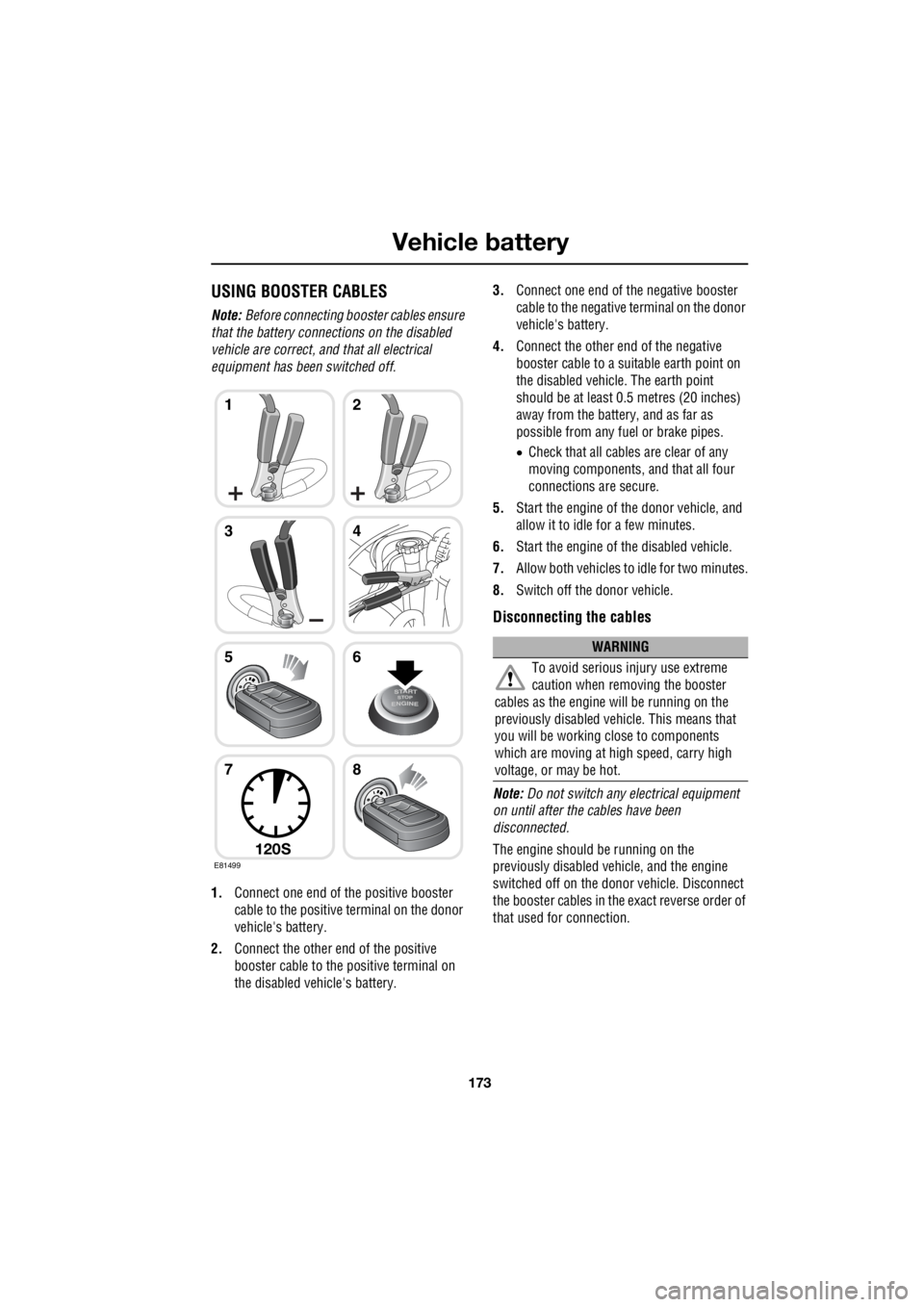
1. Connect one end of the positive booster
cable to the positive terminal on the donor
vehicle's battery.
2. Connect the other e nd of the positive
booster cable to the positive terminal on
the disabled vehicle's battery. 3.
Connect one end of the negative booster
cable to the negative terminal on the donor
vehicle's battery.
4. Connect the other en d of the negative
booster cable to a suit able earth point on
the disabled vehicle. The earth point
should be at least 0.5 metres (20 inches)
away from the battery, and as far as
possible from any fuel or brake pipes.
• Check that all cables are clear of any
moving components, and that all four
connections are secure.
5. Start the engine of the donor vehicle, and
allow it to idle for a few minutes.
6. Start the engine of the disabled vehicle.
7. Allow both vehicles to idle for two minutes.
8. Switch off the donor vehicle.
Disconnecting the cables
Note: Do not switch any electrical equipment
on until after the cables have been
disconnected.
The engine should be running on the
previously disabled ve hicle, and the engine
switched off on the donor vehicle. Disconnect
the booster cables in the exact reverse order of
that used for connection.
E81499
12
34
56
78
120S
WARNING
To avoid serious in jury use extreme
caution when removing the booster
cables as the engine will be running on the
previously disabled vehicle. This means that
you will be working close to components
which are moving at high speed, carry high
voltage, or may be hot.
Page 2894 of 3229
Vehicle battery
174
L
CHARGING THE VEHICLE BATTERY
1. Disconnect the battery and remove it from
the vehicle.
2. Connect the battery charger in accordance
with the charger manufacturer's
instructions.
3. Once the charge is complete switch off the
power to the charger.
4. Disconnect the charger cables from the
battery.
5. Allow the battery to stand for an hour
before connecting to the vehicle. This will
allow any explosive gasses to dissipate,
and reduce the risk of explosion.
CHANGING THE VEHICLE BATTERY
Disconnecting
1. Ensure that all electrical circuits are
switched off, all windows are closed, and
the alarm is disarmed.
2. Remove the remote control from the
vehicle and wait two minutes to allow the
systems to power down fully.
3. Undo the negative clam p, and lift the cable
and clamp clear of th e battery terminal.
4. Undo the positive clamp, and lift the cable
and clamp clear of th e battery terminal.
5. Undo the battery clamp and lift the battery
clear of the vehicle.
WARNINGS
Ensure that the charger used is of the
correct type and rating for the battery.
Using an unsuitable charger may damage the
battery, and could cause the battery to
explode.
Always charge the battery in a well
ventilated area away from any naked
flames, sparks or ot her ignition sources.
During charging the battery can produce a
highly explosive a nd flammable gas.
CAUTIONS
The battery must be disconnected and
removed from the vehicle before
charging. Failure to do so could result in
damage to the vehicle's electrical system.
Always follow the instructions supplied
with the battery charger. Failure to do so
may result in damage to the battery.
WARNINGS
Use caution when lifting the battery out
of, or into, the vehicl e. It is heavy, and
may cause injury when lifting, or if dropped.
Do not tip the battery when lifting or
moving as tilting the battery more than
45 degrees may damage the battery, and may
cause the electrolyte to leak out. Battery
electrolyte is highly corrosive, and toxic.
CAUTIONS
Do not rest the battery on any part of the
vehicle as it may ca use damage due to
it's weight.
Do not run the engine with the battery
disconnected. Doing so may damage the
charging system.
Page 2910 of 3229
Wheels and tyres
190
L
Using the Land Rover tyre repair kit
Note: All vehicle drivers and occupants should
be made aware that a temporary repair has
been made to a tyre fitted to the vehicle. They
should also be made aware of the special
driving conditions im posed when using a
repaired tyre. Repair procedure
1. Open the tyre repair kit and peel off the
maximum speed label. Attach the label to
the facia in the driver's field of view. Take
care not to obstruct any of the instruments
or warning lights.
2. Uncoil the compressor power cable and
the inflation hose.
3. Unscrew the orange cap from the sealant
bottle receiver, and the sealant bottle cap.
4. Screw the sealant bottle into the receiver
(clockwise) until tight.
• Screwing the bottle onto the receiver will
pierce the bottle's se al. Do not unscrew
a full, or partly us ed bottle from the
receiver. Doing so will result in the
sealant leaking from the bottle.
5. Remove the valve cap from the damaged
tyre.
6. Remove the protective cap from the
inflation hose, and c onnect the inflation
hose to the tyre valve. Ensure that the hose
is screwed on firmly.
7. Ensure that the compressor switch is in
the off ( O) position.
8. Insert the power cable connector into an
auxiliary power socket. See AUXILIARY
POWER SOCKETS (page 110).
9. Unless the vehicle is in an enclosed or
poorly ventilated area , start the engine.
10. Set the compressor switch to the on ( l)
position.
11. Inflate the tyre to a minimum of 1.8 bar (26
lb/in²) and a maximum of 3.5 bar (51
lb/in²).
†
WARNINGS
Avoid skin contact with the sealant
which contains natu ral rubber latex.
Do not unscrew the sealant bottle from the
receiver until it is empty, as sealant will leak
out.
If the tyre inflation pressure does not
reach 1.8 bar (26 lb/in²) within seven
minutes, the tyre may have suffered excessive
damage. A temporary repair will not be
possible, and the vehicle should not be driven
until the tyre has been replaced.
CAUTIONS
Before attempting a tyre repair, ensure
that the vehicle is parked safely, as far
away from passing traffic as possible.
Ensure that the parki ng brake is applied,
and P is selected if an automatic
transmission is fitted.
Do not attempt to remove foreign objects
such as nails, screws, etc from the tyre.
Always run the engine when using the
compressor, unless the vehicle is in an
enclosed, or poorly ventilated space.
To prevent overheating do not operate
the compressor continuously for longer
than ten minutes.
Page 2911 of 3229
191
Wheels and tyres
R
12. During the inflation, switch the
compressor off briefly to check the tyre
pressure using the gauge mounted on the
compressor.
• It should not take longer than seven
minutes to inflate the tyre. If after seven
minutes the tyre ha s not reached the
minimum pressure, the tyre should not
be used.
13. Once the tyre has been inflated switch off
the compressor. If desired the engine may
be turned off after the compressor has
been turned off.
14. Remove the power connector from the
auxiliary power socket.
15. Remove the inflation hose from the tyre
valve by unscrewing it as quickly as
possible (anti-clockwise).
16. Replace the inflation hose protective cap,
and the tyre valve cap.
17. Do not remove the sealant bottle from the
receiver.
18. Ensure that the tyre repair kit (including
the bottle, and receiver caps) are placed
securely in the vehicle. You will need to
use the kit to check the tyre pressure after
3km (2 miles) so ensure they are easily
accessible.
19. Immediately drive the vehicle for 3 km (2
miles) to allow the sealant to coat the inner
surface of the tyre and form a seal at the
puncture.
†When pumping the sealant through the tyre
valve, the pressure may rise up to 6 bar (87
lb/in²). The pressure will drop again after
approximately 30 seconds.
Checking the tyre pressure after a repair
1. Drive the vehicle for 3 km (2 miles) then
stop in a safe place. Carry out a visual
examination of the tyres condition.
2. Remove the protective cap from the
inflation hose.
3. Screw the inflation hos e connector firmly
onto the tyre valve.
4. Read the tyre pressure from the gauge.
5. If the pressure of the sealant filled tyre is
above 1.3 bar (19 lb/in²) adjust the
pressure to the correct value. See
TECHNICAL SPECIFICATIONS (page 194).
6. Ensure that the compressor switch is in
the off position ( O), and insert the power
cable connector into an auxiliary power
socket. See AUXILIARY POWER
SOCKETS (page 110).
7. If the vehicle is in a well ventilated area,
start the engine.
8. Switch on the compressor ( I), and inflate
the tyre to the correct pressure.
WARNINGS
When driving the vehicle, if you
experience vibr ations, abnormal
steering, or noises, re duce speed immediately.
Drive with extreme caution and reduced speed
to the first safe place to stop the vehicle.
Visually examine the tyre, and check it's
pressure. If there are any signs of damage or
deformity to the tyre, or the tyre pressure is
below 1.3 bar (19 lb/i n²) do not continue
driving.
Consult a tyre repair centre, or your
Land Rover Dealer/Authorised repairer
for advice concerning the replacement of a
tyre after using a tyre repair kit.