lights Lexus IS300h 2017 Owner's Guide
[x] Cancel search | Manufacturer: LEXUS, Model Year: 2017, Model line: IS300h, Model: Lexus IS300h 2017Pages: 692, PDF Size: 163.7 MB
Page 201 of 692
201
4Driving
IS300h_EE(OM53D89E)
4-1. Before driving
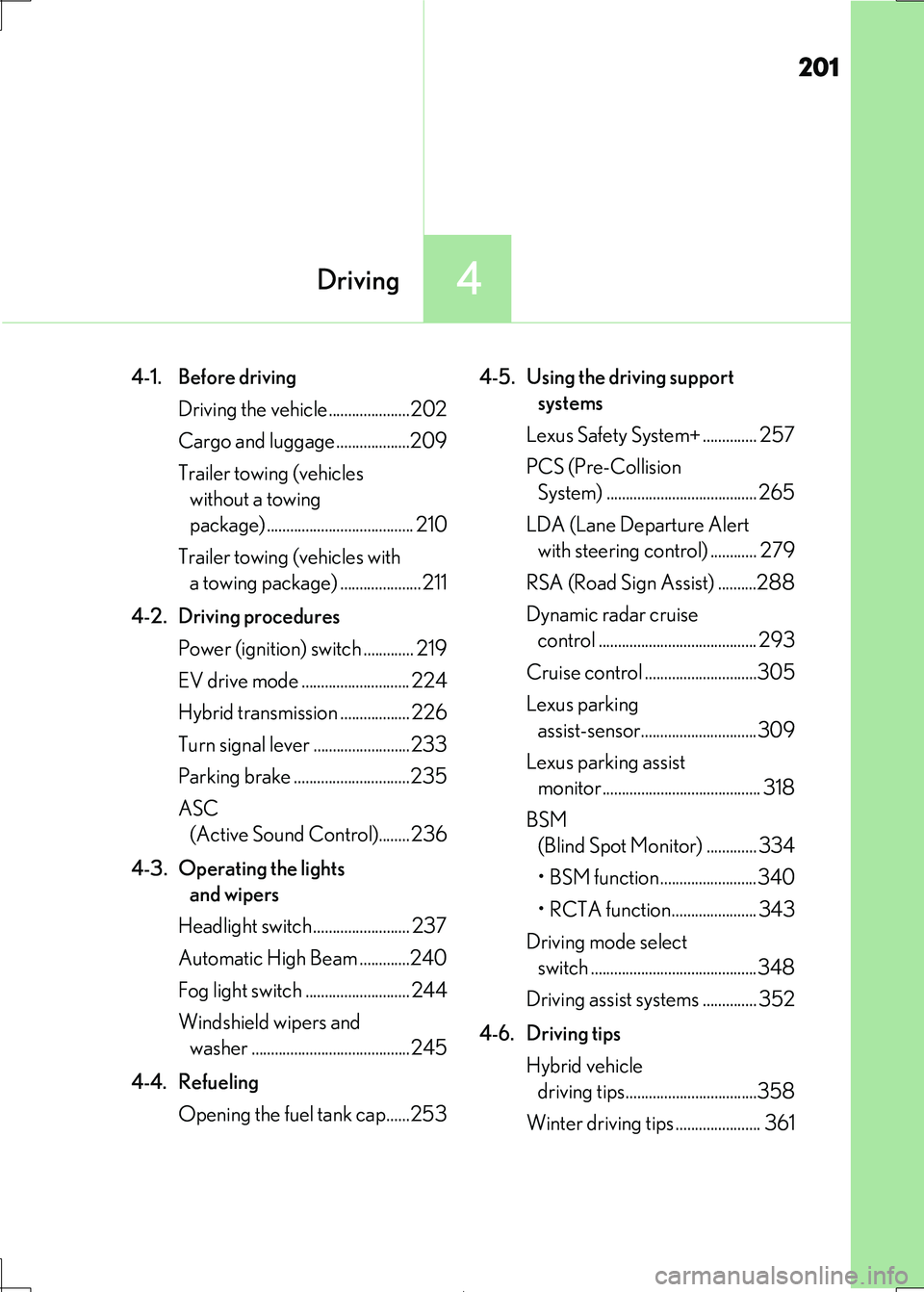
Driving the vehicle .....................202
Cargo and luggage ...................209
Trailer towing (vehicles
without a towing
package) ...................................... 210
Trailer towing (vehicles with
a towing package) ..................... 211
4-2. Driving procedures
Power (ignition) switch ............. 219
EV drive mode ............................ 224
Hybrid transmission .................. 226
Turn signal lever .........................233
Parking brake ..............................235
ASC
(Active Sound Control)........ 236
4-3. Operating the lights
and wipers
Headlight switch ......................... 237
Automatic High Beam .............240
Fog light switch ........................... 244
Windshield wipers and
washer .........................................245
4-4. Refueling
Opening the fuel tank cap......253
4-5. Using the driving support
systems
Lexus Safety System+ .............. 257
PCS (Pre-Collision
System) ....................................... 265
LDA (Lane Departure Alert
with steering control) ............ 279
RSA (Road Sign Assist) ..........288
Dynamic radar cruise
control ......................................... 293
Cruise control .............................305
Lexus parking
assist-sensor..............................309
Lexus parking assist
monitor ......................................... 318
BSM
(Blind Spot Moni tor) ............. 334
• BSM function.........................340
• RCTA function...................... 343
Driving mode select
switch ...........................................348
Driving assist systems .............. 352
4-6. Driving tips
Hybrid vehicle
driving tips..................................358
Winter driving tips ...................... 361
Page 216 of 692
2164-1. Before driving
IS300h_EE(OM53D89E)
Your vehicle will handle differently when towing a trailer. In order to avoid acci-
dent, death or serious injury, keep the following in mind when towing:
■Checking connections between trailer and lights
Stop the vehicle and check the operation of the connection between the
trailer and lights after driving for a brief period as well as before starting off.
■Practicing driving with a coupled trailer
●Get the feel for turning, stopping and reversing with the trailer coupled by
practicing in an area with no or light traffic.
●When reversing with a coupled traile r, hold the section of the steering
wheel nearest to you and rotate clockwis e to turn the trailer left or counter-
clockwise to turn it right. Always rotate a little at a time to prevent steering
error. Have someone guide you when reversing to lessen the risk of an
accident.
■Increasing vehicle-to-vehicle distance
At a speed of 10 km/h (6 mph), the di stance to the vehicle running ahead of
you should be equivalent to or greater than the combined length of your vehi-
cle and trailer. Avoid sudden braking th at may cause skidding. Otherwise, the
vehicle may spin out of control. This is especially true when driving on wet or
slippery road surfaces.
■Sudden acceleration/steering input/cornering
Executing sharp turns when towing may re sult in the trailer colliding with your
vehicle. Decelerate well in advance when approaching turns and take them
slowly and carefully to avoid sudden braking.
■Important points regarding turning
The wheels of the trailer will travel closer to the inside of the curve than the
wheels of the vehicle. To make allowance for this, take the turns wider than you
would normally do.
Guidance
Page 234 of 692
2344-2. Driving procedures
IS300h_EE(OM53D89E)
■Turn signals can be operated when
The power switch is in ON mode.
■If the indicator flashes faster than usual
Check that a light bulb in the front or rear turn signal lights has not burned out.
■If the turn signals stop flashing before a lane change has been performed
Operate the lever again.
■Customization
The number of times the turn signals flas h during a lane change can be changed.
(Customizable feature P. 657)
Page 237 of 692
237
4
Driving
IS300h_EE(OM53D89E)
4-3. Operating the lights and wipers
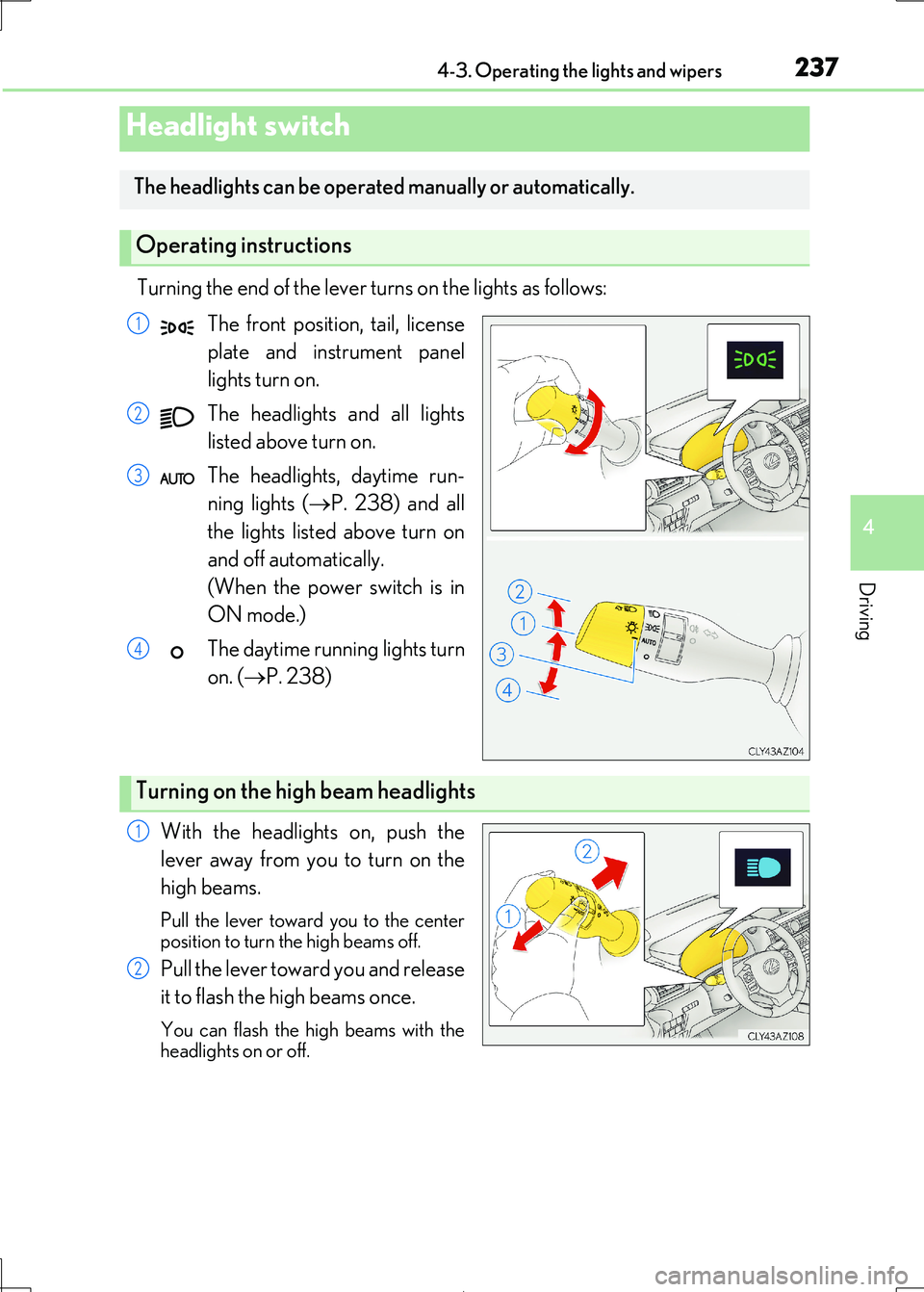
Turning the end of the lever turns on the lights as follows:
The front position, tail, license
plate and instrument panel
lights turn on.
The headlights and all lights
listed above turn on.
The headlights, daytime run-
ning lights ( P. 238) and all
the lights listed above turn on
and off automatically.
(When the power switch is in
ON mode.)
The daytime running lights turn
on. ( P. 238)
With the headlights on, push the
lever away from you to turn on the
high beams.
Pull the lever toward you to the center position to turn the high beams off.
Pull the lever toward you and release
it to flash the high beams once.
You can flash the high beams with the
headlights on or off.
Headlight switch
The headlights can be operated manually or automatically.
Operating instructions
1
2
3
4
Turning on the high beam headlights
1
2
Page 238 of 692
2384-3. Operating the lights and wipers
IS300h_EE(OM53D89E)
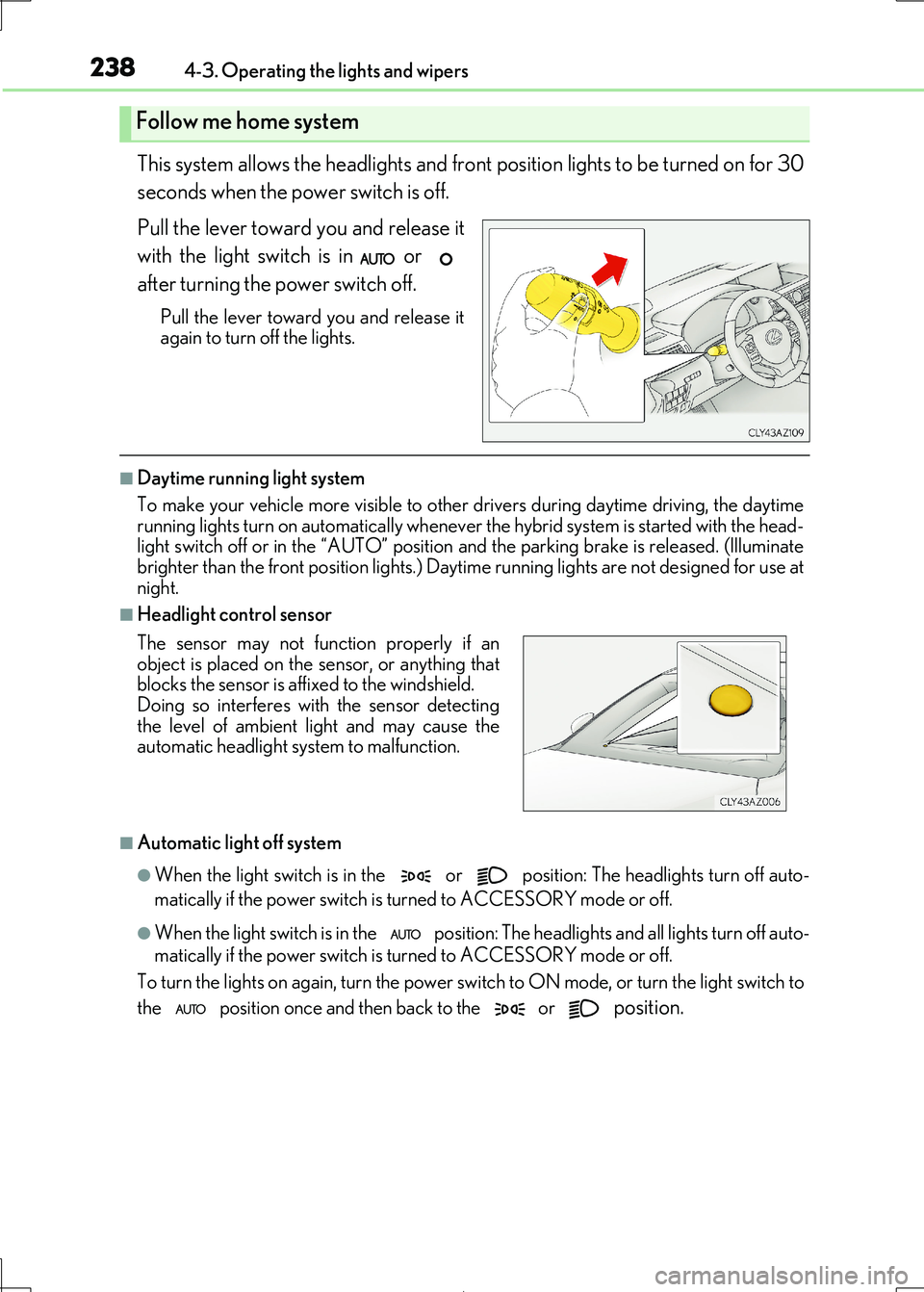
This system allows the headlights and front position lights to be turned on for 30
seconds when the power switch is off.
Pull the lever toward you and release it
with the light switch is in or
after turning the power switch off.
Pull the lever toward you and release it again to turn off the lights.
■Daytime running light system
To make your vehicle more visible to other drivers during daytime driving, the daytime
running lights turn on automatically whenever the hybrid system is started with the head-
light switch off or in the “AUTO” position and the parking brake is released. (Illuminate brighter than the front position lights.) Da ytime running lights are not designed for use at
night.
■Headlight control sensor
■Automatic light off system
●When the light switch is in the or position: The headlights turn off auto-
matically if the power switch is turned to ACCESSORY mode or off.
●When the light switch is in the position: The headlights and all lights turn off auto-
matically if the power switch is turned to ACCESSORY mode or off.
To turn the lights on again, turn the power switch to ON mode, or turn the light switch to
the position once and then back to the or position.
Follow me home system
The sensor may not function properly if an
object is placed on the sensor, or anything that blocks the sensor is affixed to the windshield.
Doing so interferes with the sensor detecting
the level of ambient li ght and may cause the automatic headlight syst em to malfunction.
Page 239 of 692
2394-3. Operating the lights and wipers
4
Driving
IS300h_EE(OM53D89E)
■Light reminder buzzer
A buzzer sounds when the power switch is turned off or turned to ACCESSORY mode and the driver’s door is opened while the lights are turned on.
■Automatic headlight leveling system
The level of the headlights is automatically adjusted according to the number of passen- gers and the loading condition of the vehicle to ensure that the headlights do not inter-
fere with other road users.
■Customization
Settings (e.g. light sensor se nsitivity) can be changed.
(Customizable features: P. 662)
NOTICE
■To prevent 12-volt battery discharge
Do not leave the lights on longer than ne cessary when the hybrid system is off.
Page 240 of 692
2404-3. Operating the lights and wipers
IS300h_EE(OM53D89E)
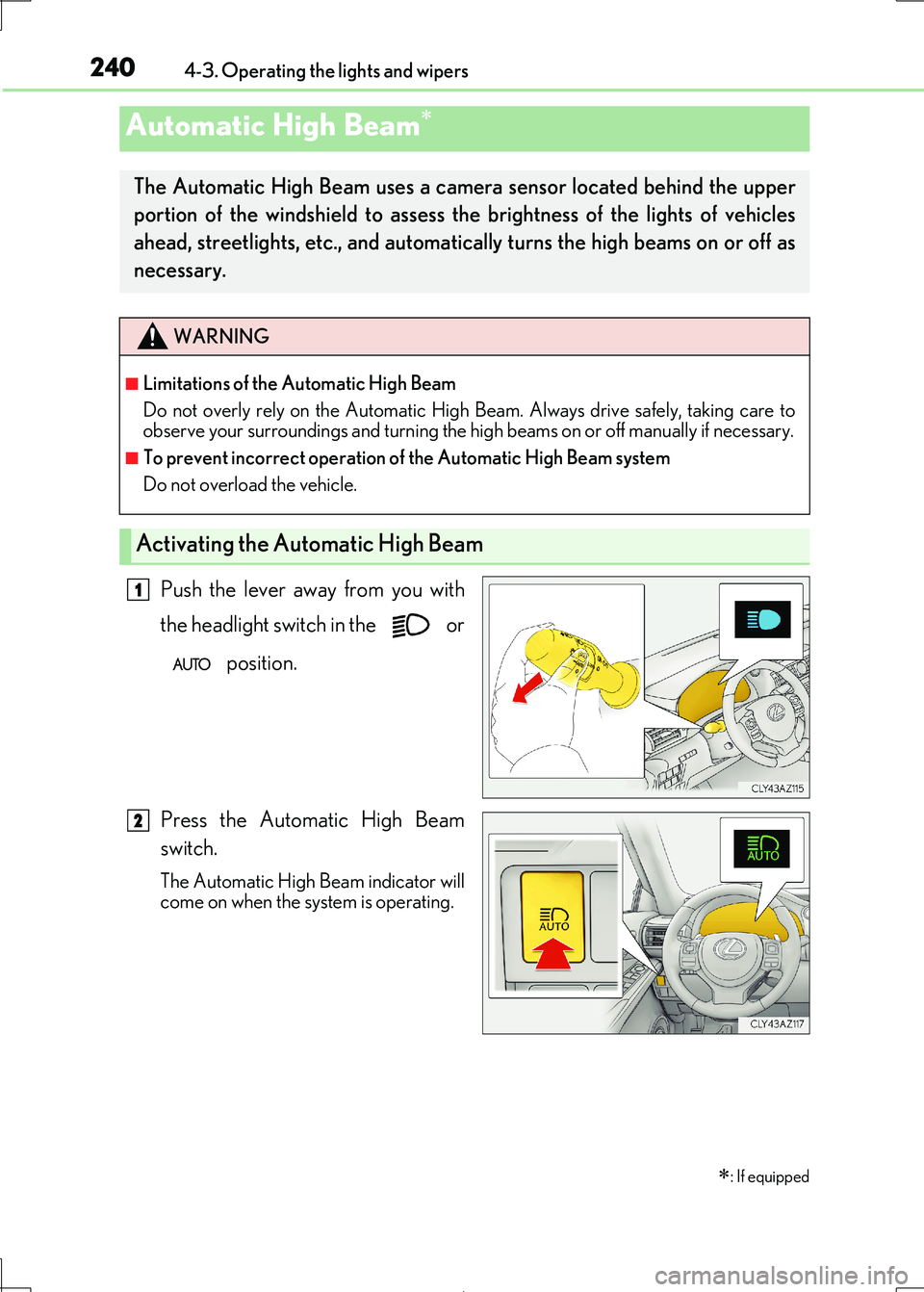
Push the lever away from you with
the headlight switch in the or
position.
Press the Automatic High Beam
switch.
The Automatic High Beam indicator will
come on when the system is operating.
Automatic High Beam
: If equipped
The Automatic High Beam uses a came ra sensor located behind the upper
portion of the windshield to assess the brightness of the lights of vehicles
ahead, streetlights, etc., and automatica lly turns the high beams on or off as
necessary.
WARNING
■Limitations of the Automatic High Beam
Do not overly rely on the Automatic High Beam. Always drive safely, taking care to observe your surroundings and turning the hi gh beams on or off manually if necessary.
■To prevent incorrect operation of the Automatic High Beam system
Do not overload the vehicle.
Activating the Automatic High Beam
1
2
Page 241 of 692
2414-3. Operating the lights and wipers
4
Driving
IS300h_EE(OM53D89E)
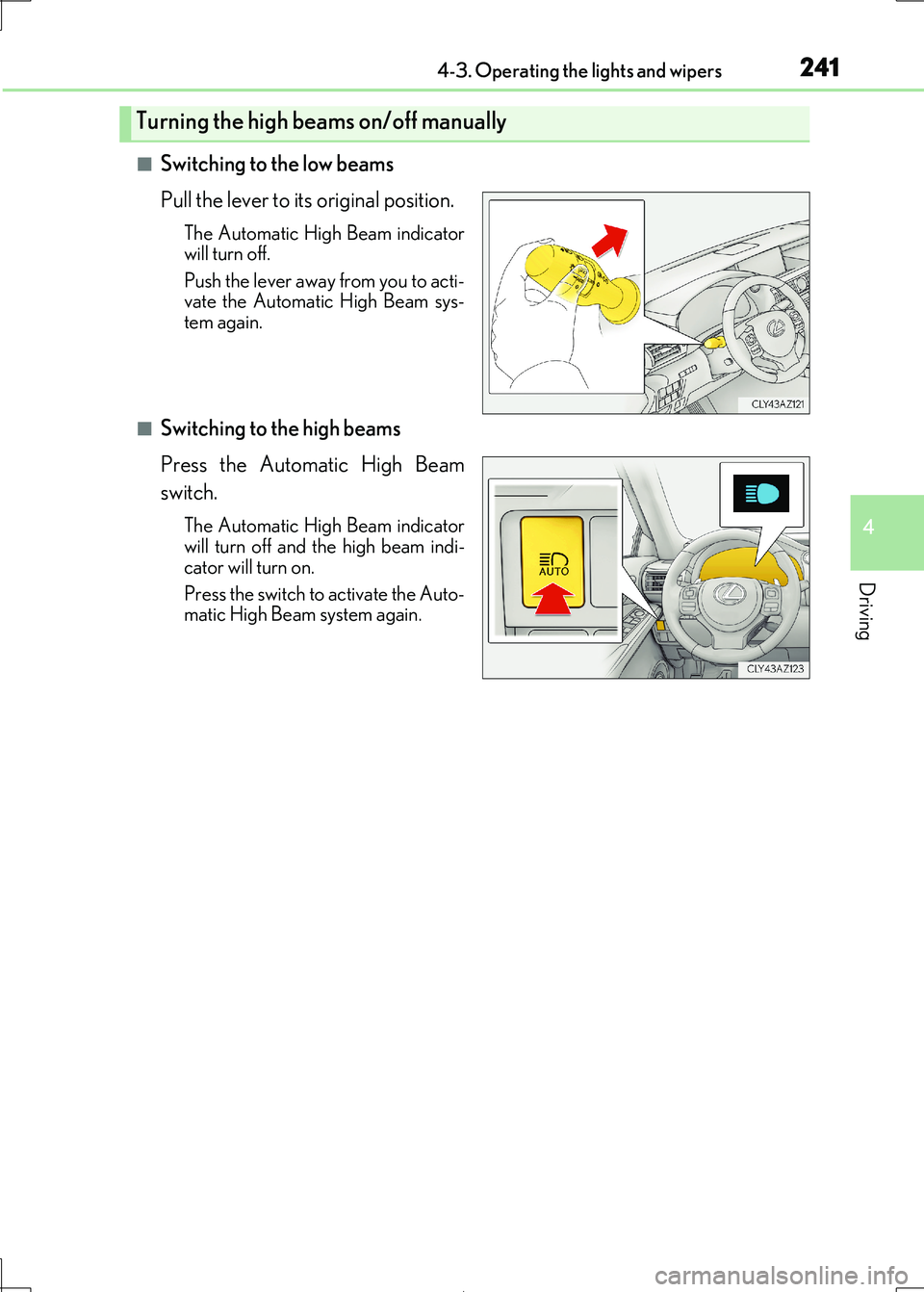
■Switching to the low beams
Pull the lever to its original position.
The Automatic High Beam indicator will turn off.
Push the lever away from you to acti-
vate the Automatic High Beam sys- tem again.
■Switching to the high beams
Press the Automatic High Beam
switch.
The Automatic High Beam indicator will turn off and the high beam indi-
cator will turn on.
Press the switch to activate the Auto- matic High Beam system again.
Turning the high beams on/off manually
Page 242 of 692
2424-3. Operating the lights and wipers
IS300h_EE(OM53D89E)
■Conditions to turn the high beams on/off automatically
●When all of the following conditions are met, the high beams will be turned on automat-
ically (after approximately 1 second):
• The vehicle speed is approximat ely 40 km/h (25 mph) or more.
• The area ahead of the vehicle is dark.
• There are no vehicles ahead with headlights or tail lights turned on. • There are few streetlights on the road ahead.
●If any of the following conditions is met, the high beams will turn off automatically:
• The vehicle speed is below approximately 30 km/h (19 mph).
• The area ahead of the vehicle is not dark.
• Vehicles ahead have their headli ghts or tail lights turned on. • There are many streetlights on the road ahead.
■Camera sensor dete ction information
●The high beams may not be automatically turned off in the following situations:
• When a vehicle suddenly appears from around a curve
• When the vehicle is cut in front of by another vehicle
• When vehicles ahead cannot be detected due to repeated curves, road dividers or roadside trees
• When vehicles ahead appear in a faraway lane on a wide road
• When the lights of vehicles ahead are not on
●The high beams may be turned off if a vehicle ahead that is using fog lights without its
headlights turned on is detected.
●House lights, street lights, traffic signals, and illuminated billboards or signs and other
reflective objects may cause the high beams to change to the low beams, or the low
beams to remain on.
●The following factors may affect the amount of time taken for the high beams to turn on
or off:
• The brightness of the head lights, fog lights, and tail lights of vehicles ahead • The movement and direction of vehicles ahead
• When a vehicle ahead only has operational lights on one side
• When a vehicle ahead is a two-wheeled vehicle • The condition of the road (gradient, cu rve, condition of the road surface, etc.)
• The number of passengers and am ount of luggage in the vehicle
●The high beams may turn on or off unexpectedly.
Page 243 of 692
2434-3. Operating the lights and wipers
4
Driving
IS300h_EE(OM53D89E)
●Bicycles or similar vehicles may not be detected.
●In the following situations the system may not be able to correctly detect the surround- ing brightness level. This may cause the lo w beams to remain on or the high beams to
flash or dazzle pedestrians or vehicles ahead. In such a case, it is necessary to manually
switch between the high and low beams.
• When driving in inclement weather (hea vy rain, snow, fog, sandstorms, etc.)
• When the windshield is obscured by fog, mist, ice, dirt, etc.
• When the windshield is cracked or damaged • When the camera sensor is deformed or dirty
• When the temperature of the camera sensor is extremely high
• When the surrounding brightness level is equal to that of headlights, tail lights or fog lights
• When headlights or tail lights of vehicles ahead are turned off, dirty, changing color,
or not aimed properly • When the vehicle is hit by water, snow , dust, etc. from a preceding vehicle
• When driving through an area of interm ittently changing brightness and darkness
• When frequently and repeatedly driving as cending/descending roads, or roads with rough, bumpy or uneven surfaces (such as stone-paved roads, gravel roads, etc.)
• When frequently and repeatedly taking curves or driving on a winding road
• When there is a highly reflective object ahea d of the vehicle, such as a sign or mirror • When the back of a preceding vehicle is highly reflective, such as a container on a
truck
• When the vehicle's headlights are damage d or dirty, or are not aimed properly • When the vehicle is listing or titling due to a flat tire, a trailer being towed, etc.
• When the headlights are changed between the high beams and low beams repeat-
edly in an abnormal manner • When the driver believes that the high beams may be flashing or dazzling pedestri-
ans or other drivers
• When the vehicle is used in an area in which vehicles travel on the opposite side of
the road of the country for which the vehicle was designed, for example using a vehi- cle designed for right-hand traffic in a left-hand traffic area, or vice versa