radio LEXUS LS430 2003 Factory User Guide
[x] Cancel search | Manufacturer: LEXUS, Model Year: 2003, Model line: LS430, Model: LEXUS LS430 2003Pages: 4500, PDF Size: 87.45 MB
Page 644 of 4500
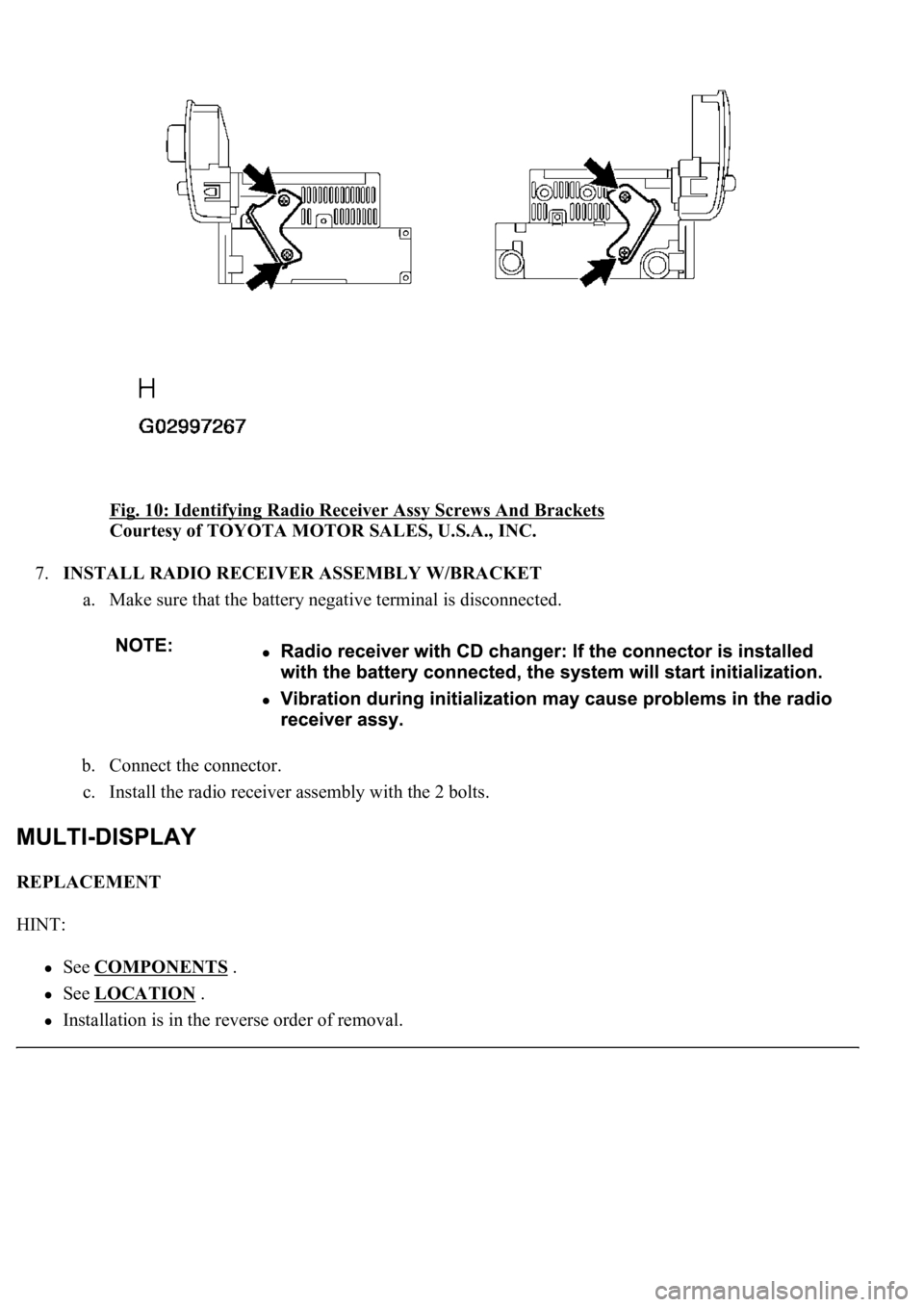
Fig. 10: Identifying Radio Receiver Assy Screws And Brackets
Courtesy of TOYOTA MOTOR SALES, U.S.A., INC.
7.INSTALL RADIO RECEIVER ASSEMBLY W/BRACKET
a. Make sure that the battery negative terminal is disconnected.
b. Connect the connector.
c. Install the radio receiver assembly with the 2 bolts.
REPLACEMENT
HINT:
See COMPONENTS .
See LOCATION .
Installation is in the reverse order of removal.
Page 645 of 4500
1.SHIP MODE SETTING (See REPLACEMENT )
2.REMOVE INSTRUMENT PANEL FINISH PANEL LOWER CENTER (See step 26 on
REPLACEMENT
)
3.REMOVE PANEL INSTRUMENT CLUSTER FINISH LOWER (See step 27 on
REPLACEMENT
)
4.REMOVE RADIO RECEIVER ASSEMBLY W/BRACKET (See REPLACEMENT
)
5.SHIP MODE CONFIRMATION (See REPLACEMENT
)
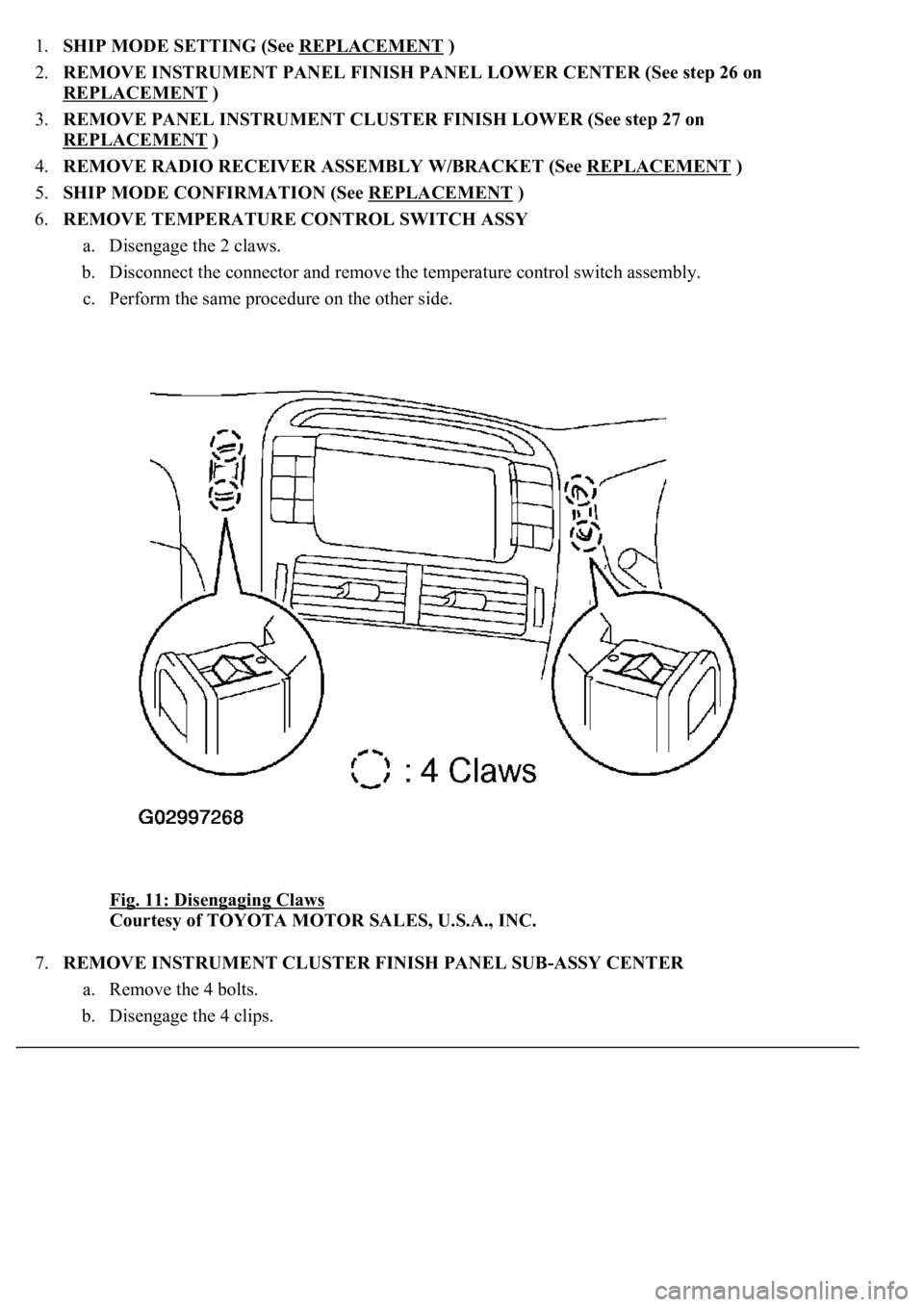
6.REMOVE TEMPERATURE CONTROL SWITCH ASSY
a. Disengage the 2 claws.
b. Disconnect the connector and remove the temperature control switch assembly.
c. Perform the same procedure on the other side.
Fig. 11: Disengaging Claws
Courtesy of TOYOTA MOTOR SALES, U.S.A., INC.
7.REMOVE INSTRUMENT CLUSTER FINISH PANEL SUB-ASSY CENTER
a. Remove the 4 bolts.
b.Disengage the 4 clips.
Page 653 of 4500
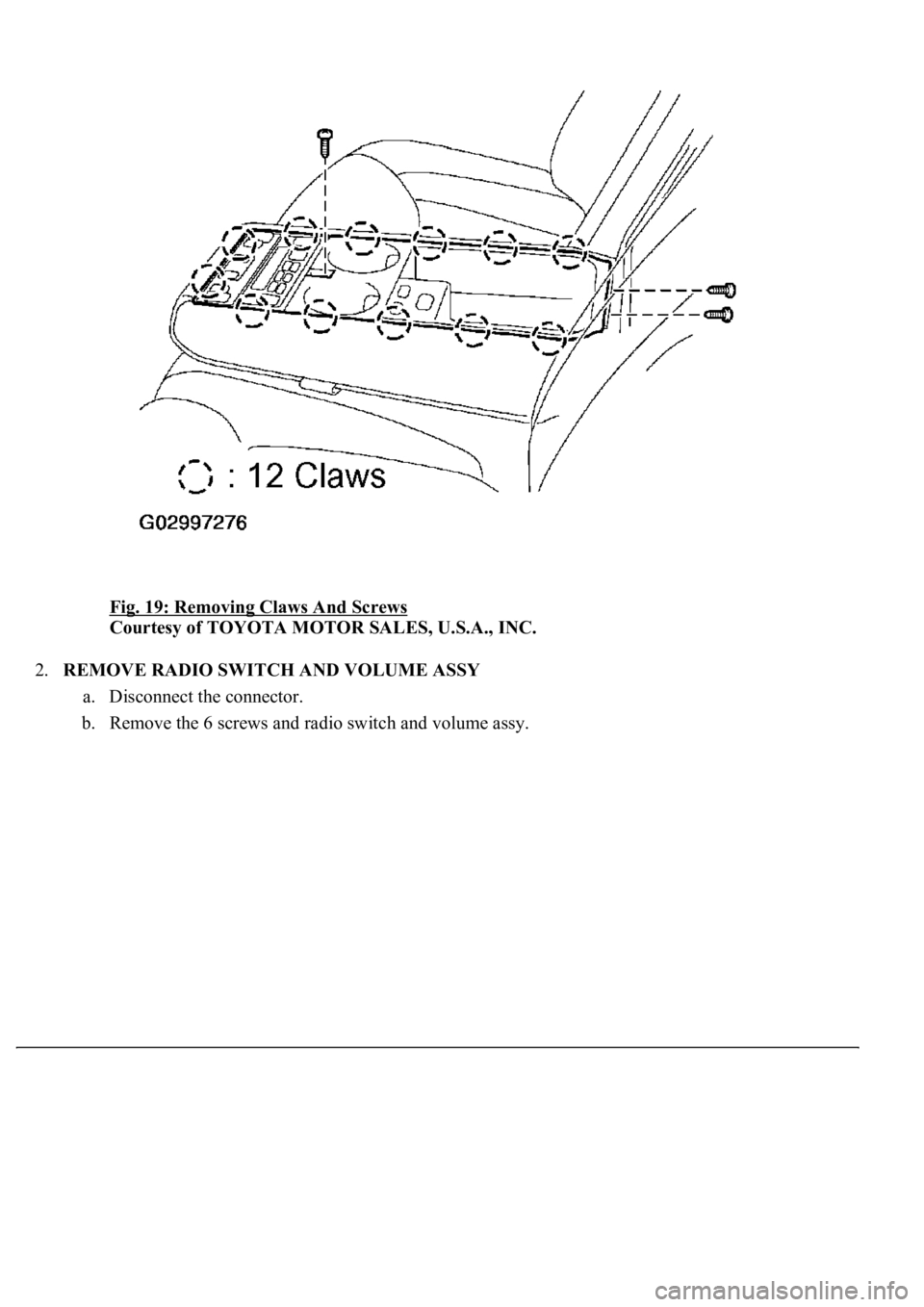
Fig. 19: Removing Claws And Screws
Courtesy of TOYOTA MOTOR SALES, U.S.A., INC.
2.REMOVE RADIO SWITCH AND VOLUME ASSY
a. Disconnect the connector.
b. Remove the 6 screws and radio switch and volume assy.
Page 704 of 4500
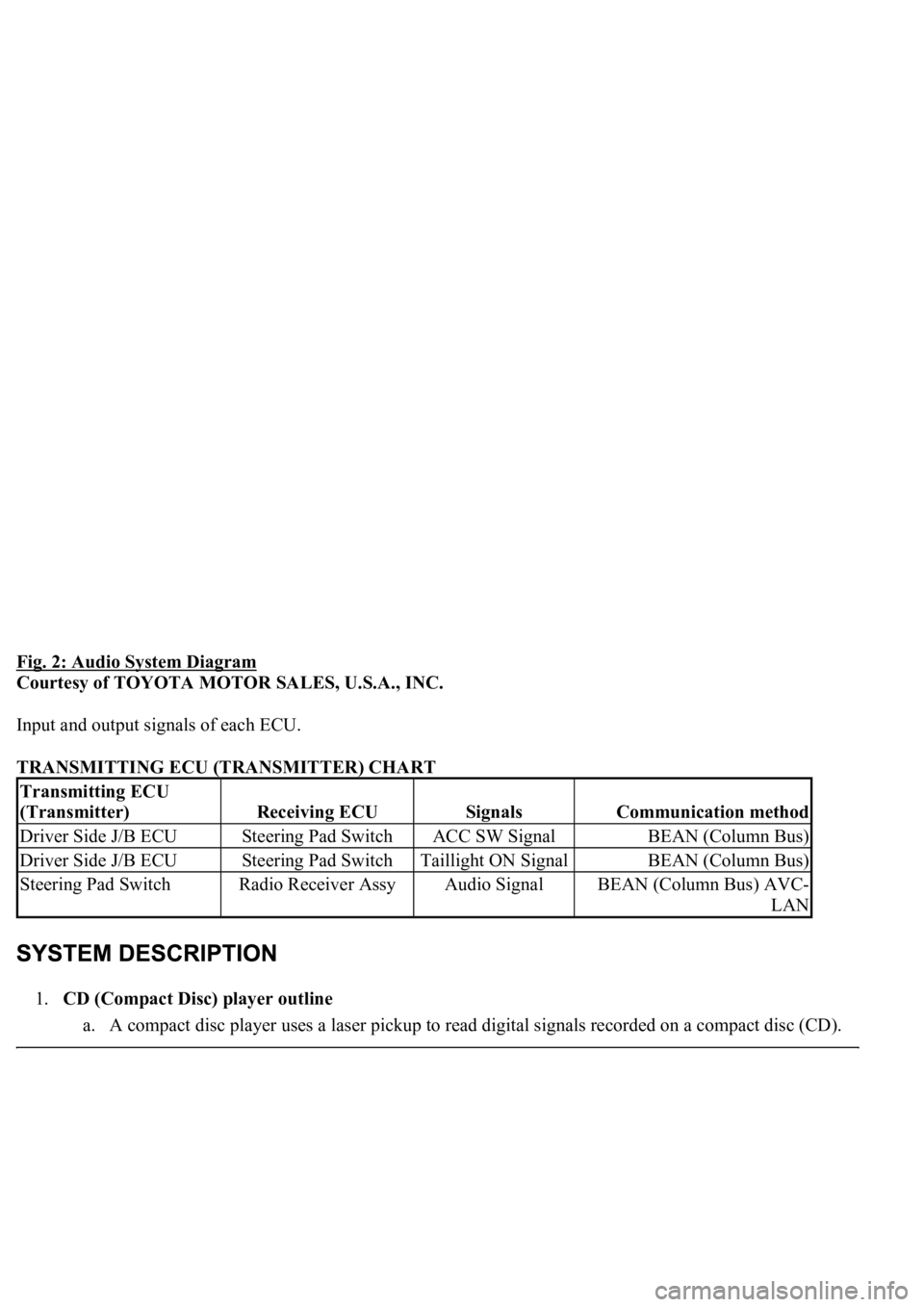
Fig. 2: Audio System Diagram
Courtesy of TOYOTA MOTOR SALES, U.S.A., INC.
Input and output signals of each ECU.
TRANSMITTING ECU (TRANSMITTER) CHART
1.CD (Compact Disc) player outline
a. A compact disc player uses a laser pickup to read digital signals recorded on a compact disc (CD).
Transmitting ECU
(Transmitter)
Receiving ECUSignalsCommunication method
Driver Side J/B ECUSteering Pad SwitchACC SW SignalBEAN (Column Bus)
Driver Side J/B ECUSteering Pad SwitchTaillight ON SignalBEAN (Column Bus)
Steering Pad SwitchRadio Receiver AssyAudio SignalBEAN (Column Bus) AVC-
LAN
Page 706 of 4500
2. To allow each manufacturer to concentrate on developing products they do best. From this,
reasonably priced products can be produced.
HINT:
If a +B or GND short is detected in the AVC-LAN circuit, communication is interrupted and the
audio system will stop functioning.
If an audio system is equipped with a navigation system, the multi-display unit acts as the master
unit. If the navigation system is not equipped, the audio head unit acts as the master unit instead. If
the radio and navigation assy is equipped, it is the master unit.
The radio and navigation assy provides resistance to make communication possible.
The car audio system with an AVC-LAN circuit has a diagnostic function.
Each component has a specified number (3-digit) called a physical address. Each function has a
number (2-digit) called a logical address.
3.Communication system outline
a. Components of the audio system communicate with each other via the AVC-LAN.
b. The master component of the AVC-LAN is a radio receiver assy with a 60 to 80 ohms resistor. This
is essential for communication.
c. If a short circuit or open circuit occurs in the AVC-LAN circuit, communication is interrupted and
the audio system will stop functioning.
4.Diagnostic function outline
a. The audio system has a diagnostic function (the result is indicated on the master unit).
b. A 3-digit hexadecimal component code (physical address) is allocated to each component on the
AVC-LAN. Using this code, the component in the diagnostic function can be displayed.
1.Vehicle brought into a workshop
2.Diagnostic questioning and symptom confirmation (SEE CUSTOMER PROBLEM ANALYSIS
CHECK )
Ask the customer about symptoms and confirm malfunctions. Fill out the Customer Problem Analysis
check sheet.
Pressing PWR switch does not turn on system (SEE PROBLEM SYMPTOMS TABLE
)
Other symptoms (go to step 3)
3.Check the diagnostic trouble codes (SEE SYSTEM CHECK MODE (DTC CHECK)
)
HINT:
If the audio system is equipped with a multi-display, check DTCs in the LEXUS NAVIGATION
SYSTEM section (SEE PRECAUTION
).
Page 707 of 4500
If the system cannot enter the diagnosis mode, inspect each AVC-LAN communication signal and
repair or replace problem parts (SEE AVC
-LAN CIRCUIT (STEREO COMPONENT
AMPLIFIER ASSY - STEREO COMPONENT TUNER) - AVC-LAN CIRCUIT (RADIO
RECEIVER ASSY - STEREO COMPONENT TUNER) ).
Even if the malfunction symptom is not confirmed, check the diagnostic trouble codes. This is
because the system stores past diagnostic trouble codes.
A code is output (go to step 4)
A code is not output (go to step 5)
4.(SEE DIAGNOSTIC TROUBLE CODE CHART
)
Find the output code on the diagnostic trouble code chart.
Output the diagnostic trouble code (go to step 7)
5.(SEE PROBLEM SYMPTOMS TABLE
)
Find the applicable symptom code in the problem symptoms table.
HINT:
If the symptom does not recur and no code is output, perform the symptom reproduction method (SEE
HOW TO PROCEED WITH TROUBLESHOOTING
).
There is an applicable symptom code in the table (go to step 7)
There is no applicable symptom code in the table (go to step 6)
6.Check the ECU terminal arrangement based on the malfunction symptom (SEE TERMINALS OF
ECU )
7.Check the circuit
Adjust, repair or replace as necessary.
8.Recheck the diagnostic trouble code (SEE SYSTEM CHECK MODE (DTC CLEAR/RECHECK)
)
HINT:
After deleting the DTC, recheck the diagnostic trouble code.
9.Perform confirmation test
END
Page 709 of 4500
1.Radio Description
a. Radio frequency band
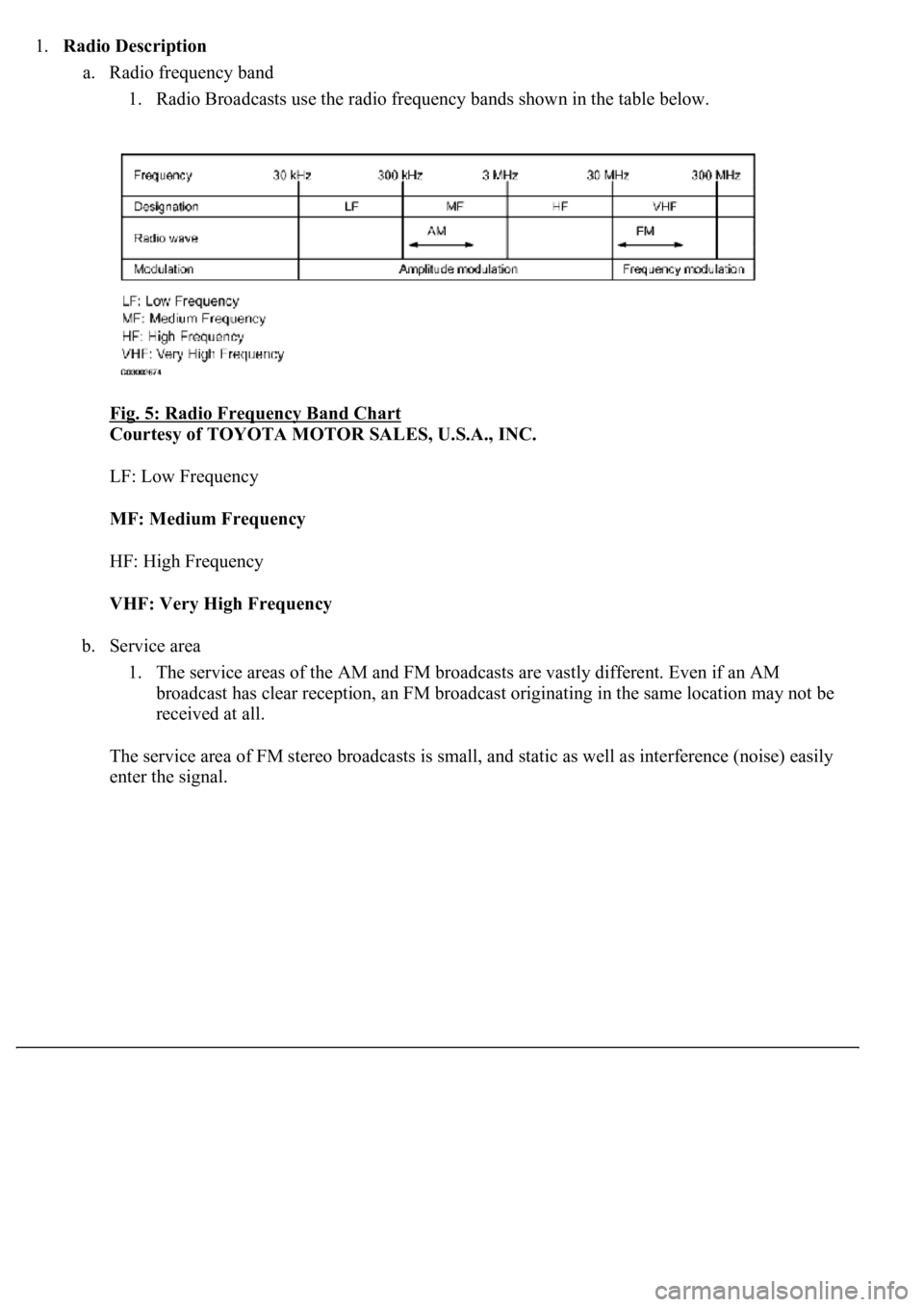
1. Radio Broadcasts use the radio frequency bands shown in the table below.
Fig. 5: Radio Frequency Band Chart
Courtesy of TOYOTA MOTOR SALES, U.S.A., INC.
LF: Low Frequency
MF: Medium Frequency
HF: High Frequency
VHF: Very High Frequency
b. Service area
1. The service areas of the AM and FM broadcasts are vastly different. Even if an AM
broadcast has clear reception, an FM broadcast originating in the same location may not be
received at all.
The service area of FM stereo broadcasts is small, and static as well as interference (noise) easily
enter the si
gnal.
Page 710 of 4500
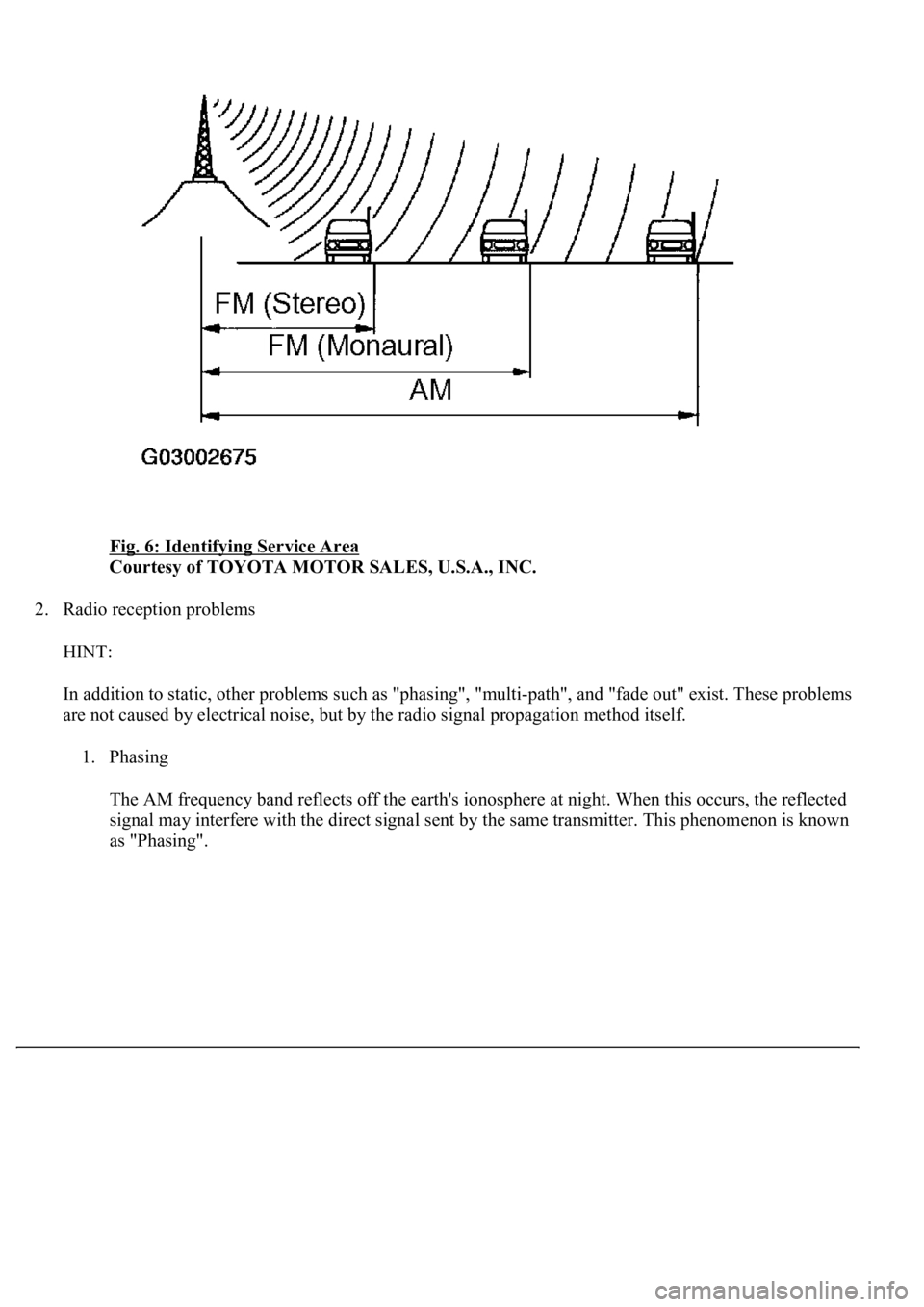
Fig. 6: Identifying Service Area
Courtesy of TOYOTA MOTOR SALES, U.S.A., INC.
2. Radio reception problems
HINT:
In addition to static, other problems such as "phasing", "multi-path", and "fade out" exist. These problems
are not caused by electrical noise, but by the radio signal propagation method itself.
1. Phasing
The AM frequency band reflects off the earth's ionosphere at night. When this occurs, the reflected
signal may interfere with the direct signal sent by the same transmitter. This phenomenon is known
as "Phasing".
Page 711 of 4500
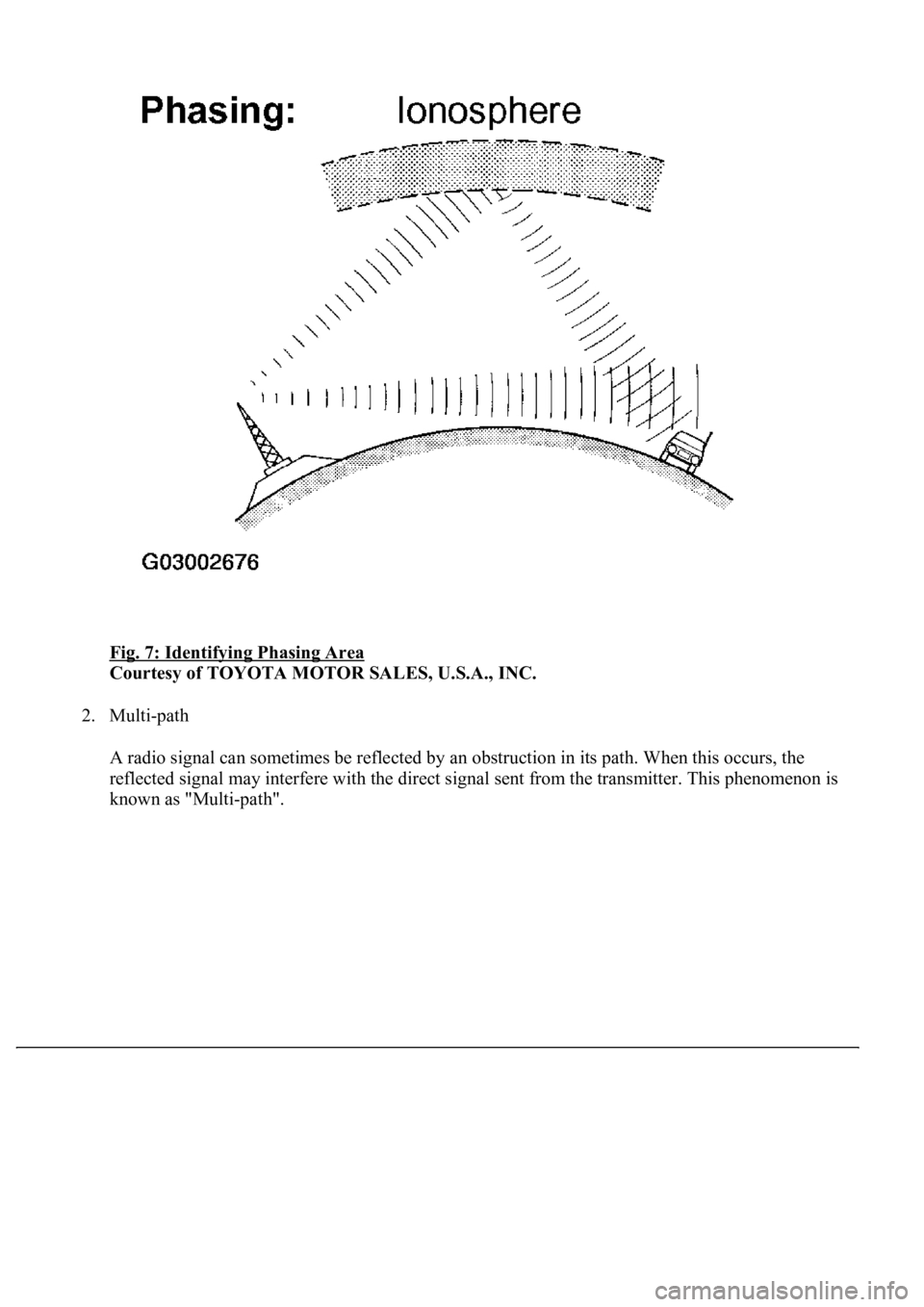
Fig. 7: Identifying Phasing Area
Courtesy of TOYOTA MOTOR SALES, U.S.A., INC.
2. Multi-path
A radio signal can sometimes be reflected by an obstruction in its path. When this occurs, the
reflected signal may interfere with the direct signal sent from the transmitter. This phenomenon is
known as "Multi-path".
Page 712 of 4500
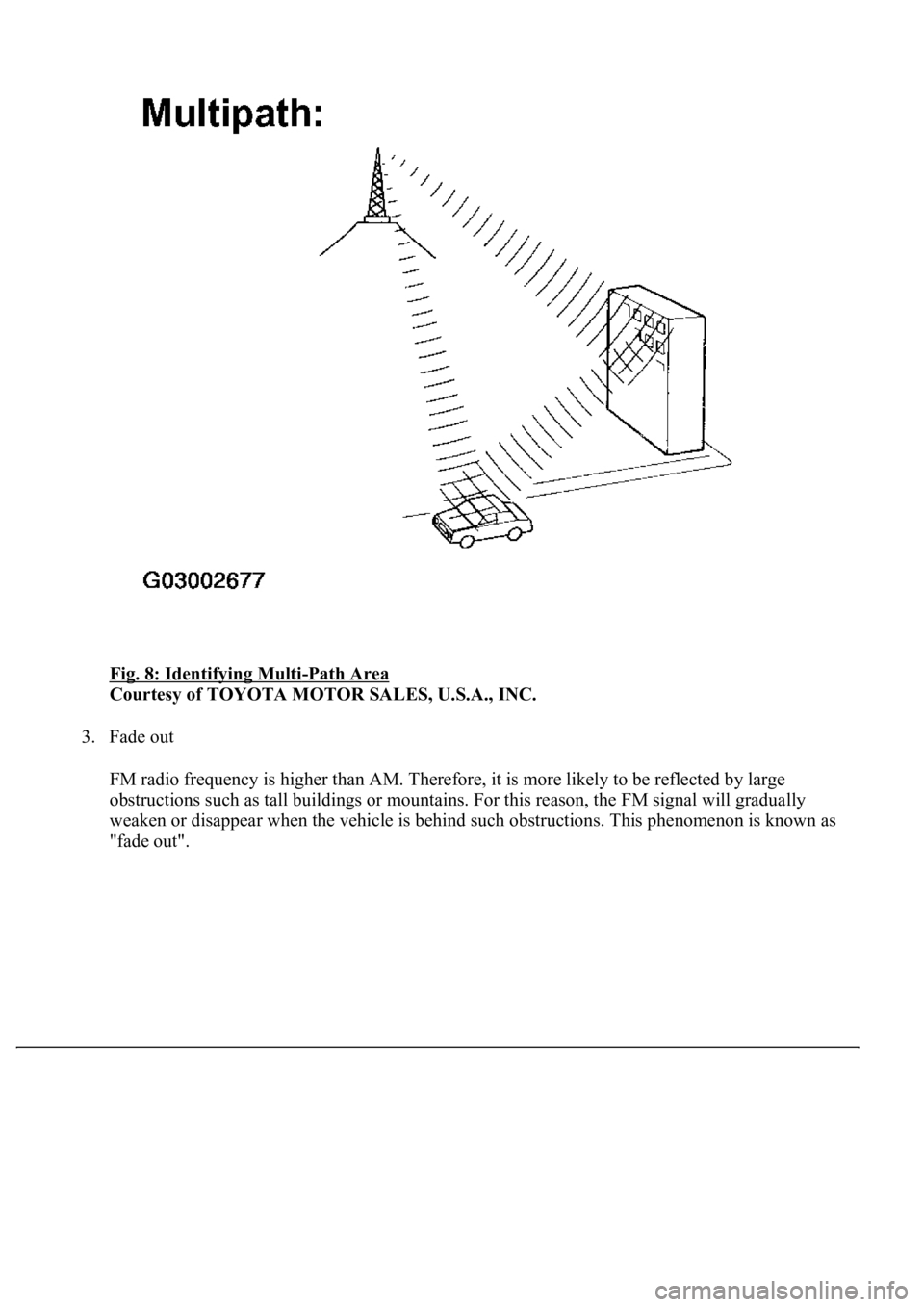
Fig. 8: Identifying Multi-Path Area
Courtesy of TOYOTA MOTOR SALES, U.S.A., INC.
3. Fade out
FM radio frequency is higher than AM. Therefore, it is more likely to be reflected by large
obstructions such as tall buildings or mountains. For this reason, the FM signal will gradually
weaken or disappear when the vehicle is behind such obstructions. This phenomenon is known as
"fade out".