wheel LEXUS RX350 2011 Owners Manual
[x] Cancel search | Manufacturer: LEXUS, Model Year: 2011, Model line: RX350, Model: LEXUS RX350 2011Pages: 821, PDF Size: 13.27 MB
Page 672 of 821
602
6-1. Specifications
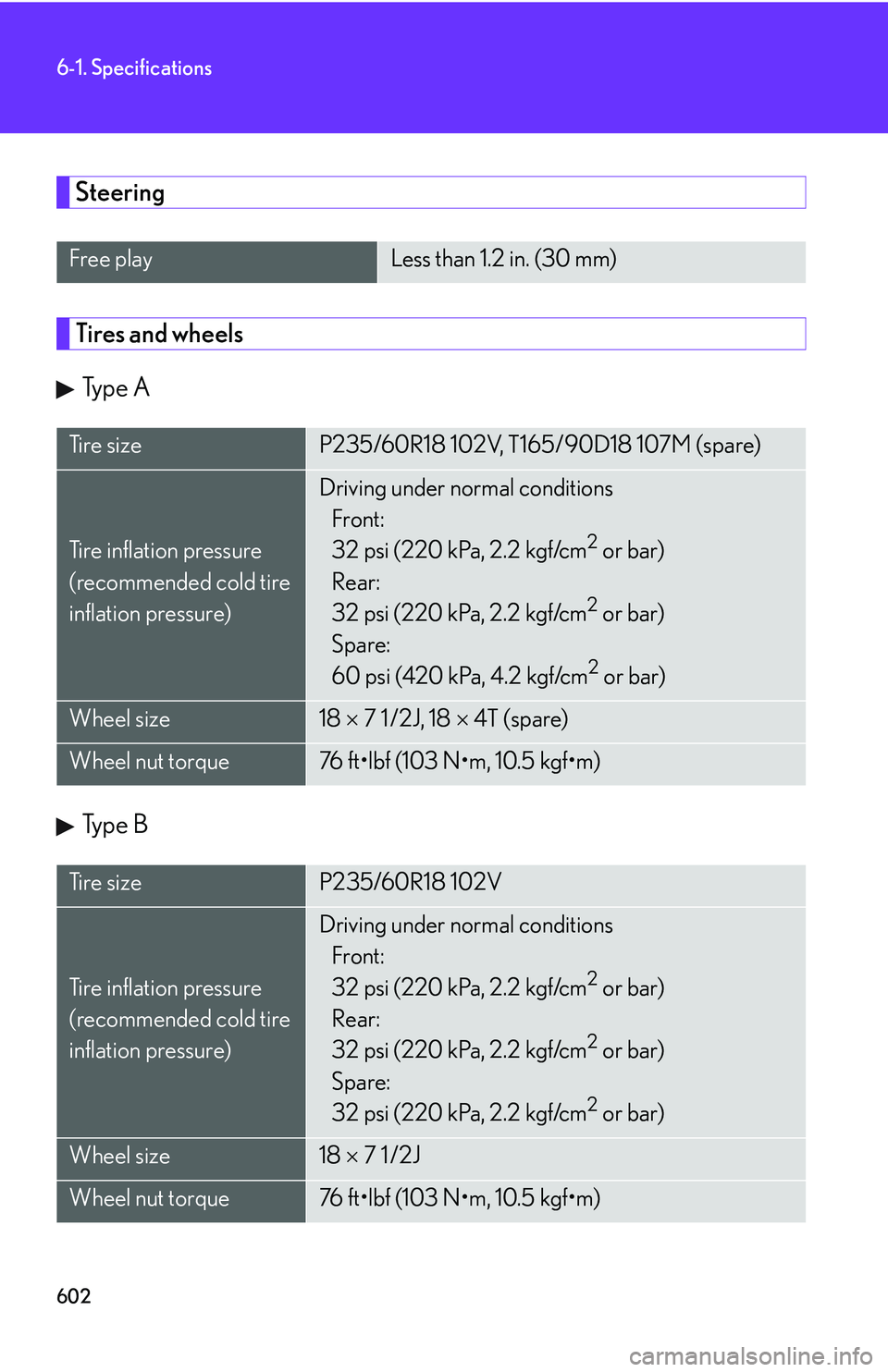
Steering
Tires and wheels
Typ e A
Ty p e B
Free playLess than 1.2 in. (30 mm)
Ti r e s i z eP235/60R18 102V, T165/90D18 107M (spare)
Tire inflation pressure
(recommended cold tire
inflation pressure)
Driving under normal conditions
Front:
32 psi (220 kPa, 2.2 kgf/cm2 or bar)
Rear:
32 psi (220 kPa, 2.2 kgf/cm2 or bar)
Spare:
60 psi (420 kPa, 4.2 kgf/cm2 or bar)
Wheel size18 × 7 1/2J, 18 × 4T (spare)
Wheel nut torque76 ft
Page 673 of 821
603
6-1. Specifications
6
Vehicle specifications
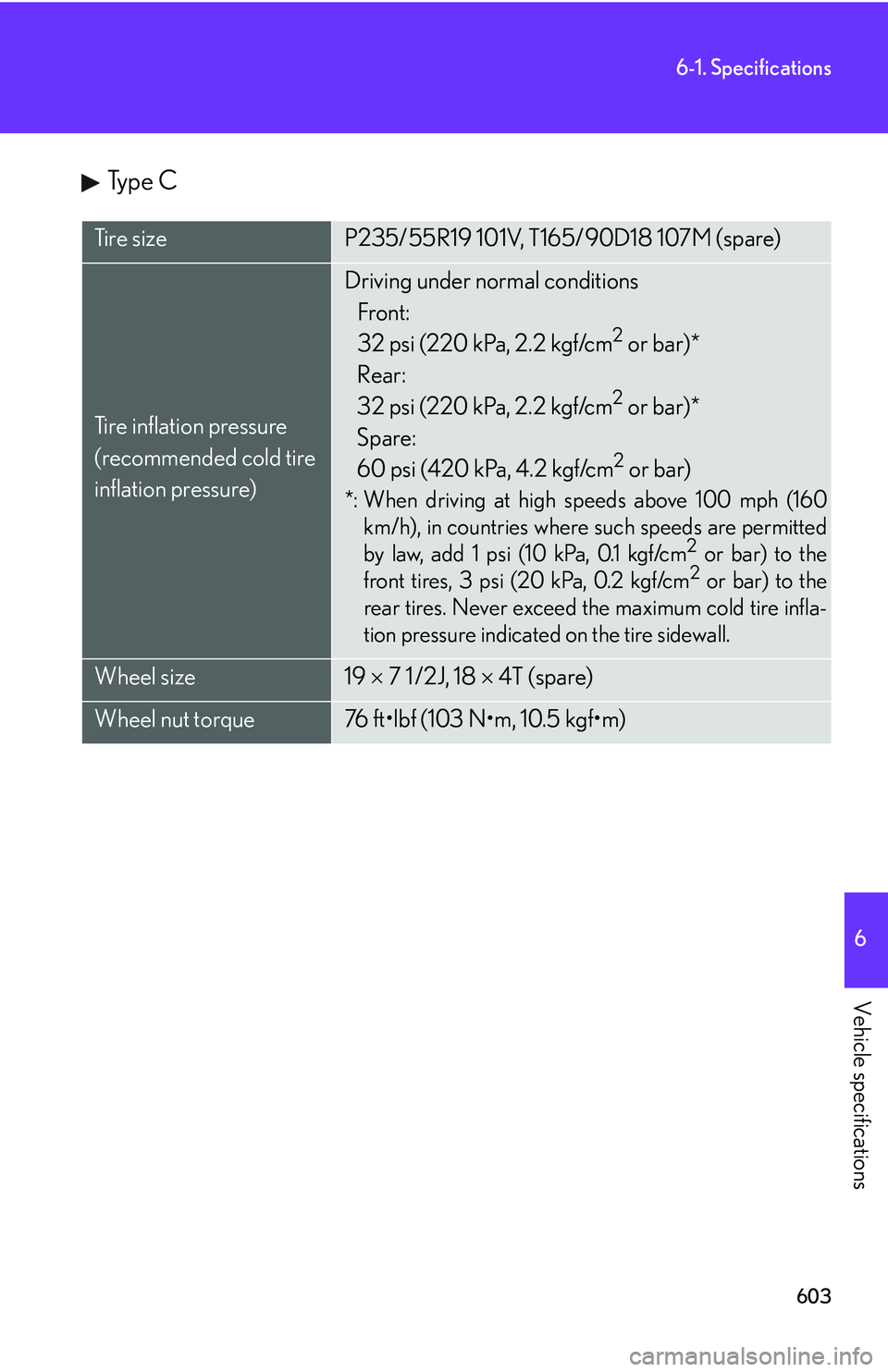
Type C
Ti r e s i z eP235/55R19 101V, T165/90D18 107M (spare)
Tire inflation pressure
(recommended cold tire
inflation pressure)
Driving under normal conditions
Front:
32 psi (220 kPa, 2.2 kgf/cm2 or bar)*
Rear:
32 psi (220 kPa, 2.2 kgf/cm2 or bar)*
Spare:
60 psi (420 kPa, 4.2 kgf/cm2 or bar)
*: When driving at high speeds above 100 mph (160
km/h), in countries where such speeds are permitted
by law, add 1 psi (10 kPa, 0.1 kgf/cm2 or bar) to the
front tires, 3 psi (20 kPa, 0.2 kgf/cm2 or bar) to the
rear tires. Never exceed the maximum cold tire infla-
tion pressure indicated on the tire sidewall.
Wheel size19 × 7 1/2J, 18 × 4T (spare)
Wheel nut torque76 ft
Page 674 of 821
604
6-1. Specifications
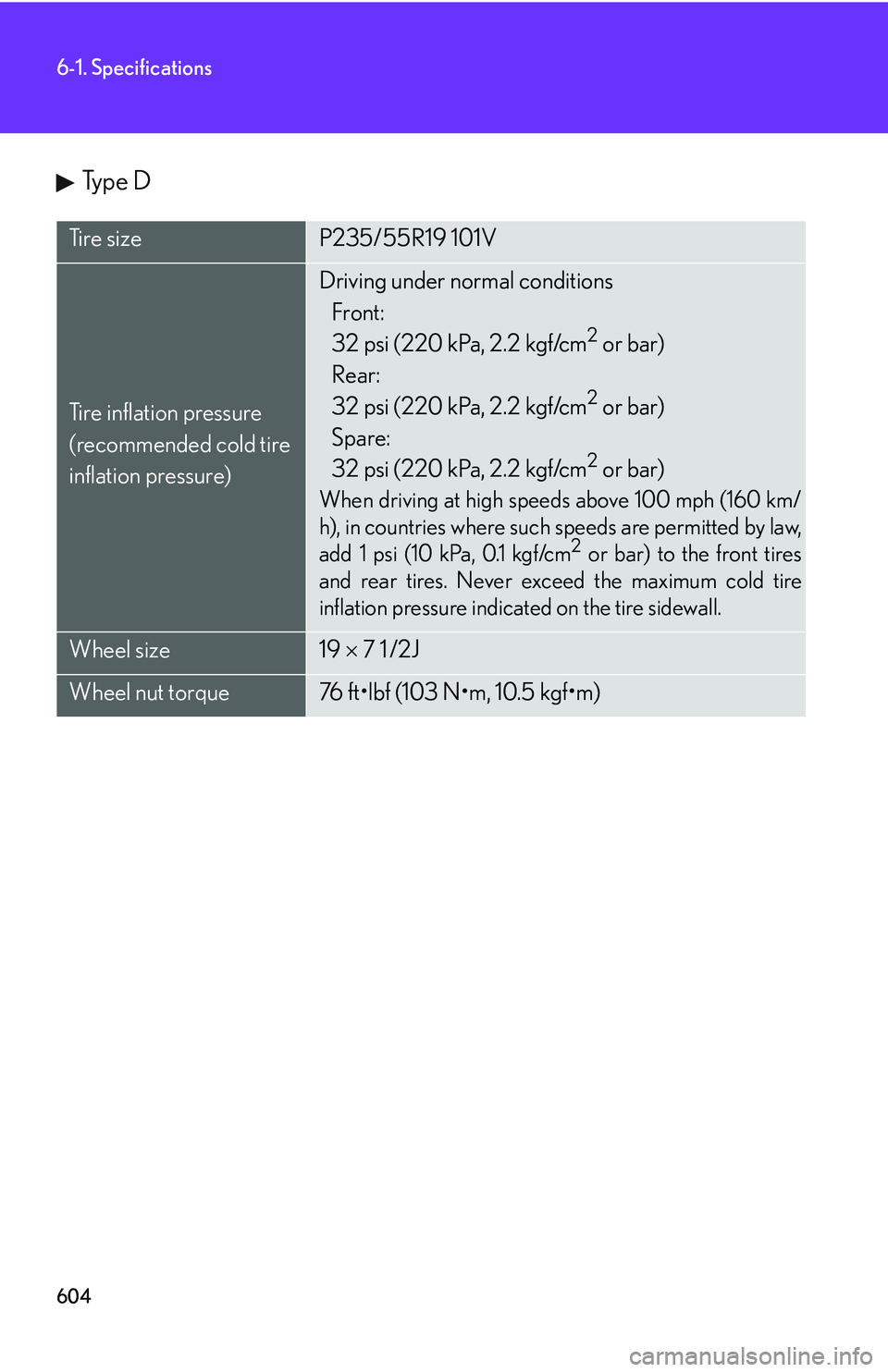
Ty p e D
Ti r e s i z eP235/55R19 101V
Tire inflation pressure
(recommended cold tire
inflation pressure)
Driving under normal conditions
Front:
32 psi (220 kPa, 2.2 kgf/cm2 or bar)
Rear:
32 psi (220 kPa, 2.2 kgf/cm2 or bar)
Spare:
32 psi (220 kPa, 2.2 kgf/cm2 or bar)
When driving at high speeds above 100 mph (160 km/
h), in countries where such speeds are permitted by law,
add 1 psi (10 kPa, 0.1 kgf/cm2 or bar) to the front tires
and rear tires. Never exceed the maximum cold tire
inflation pressure indicated on the tire sidewall.
Wheel size19 × 7 1/2J
Wheel nut torque76 ft
Page 682 of 821
612
6-1. Specifications
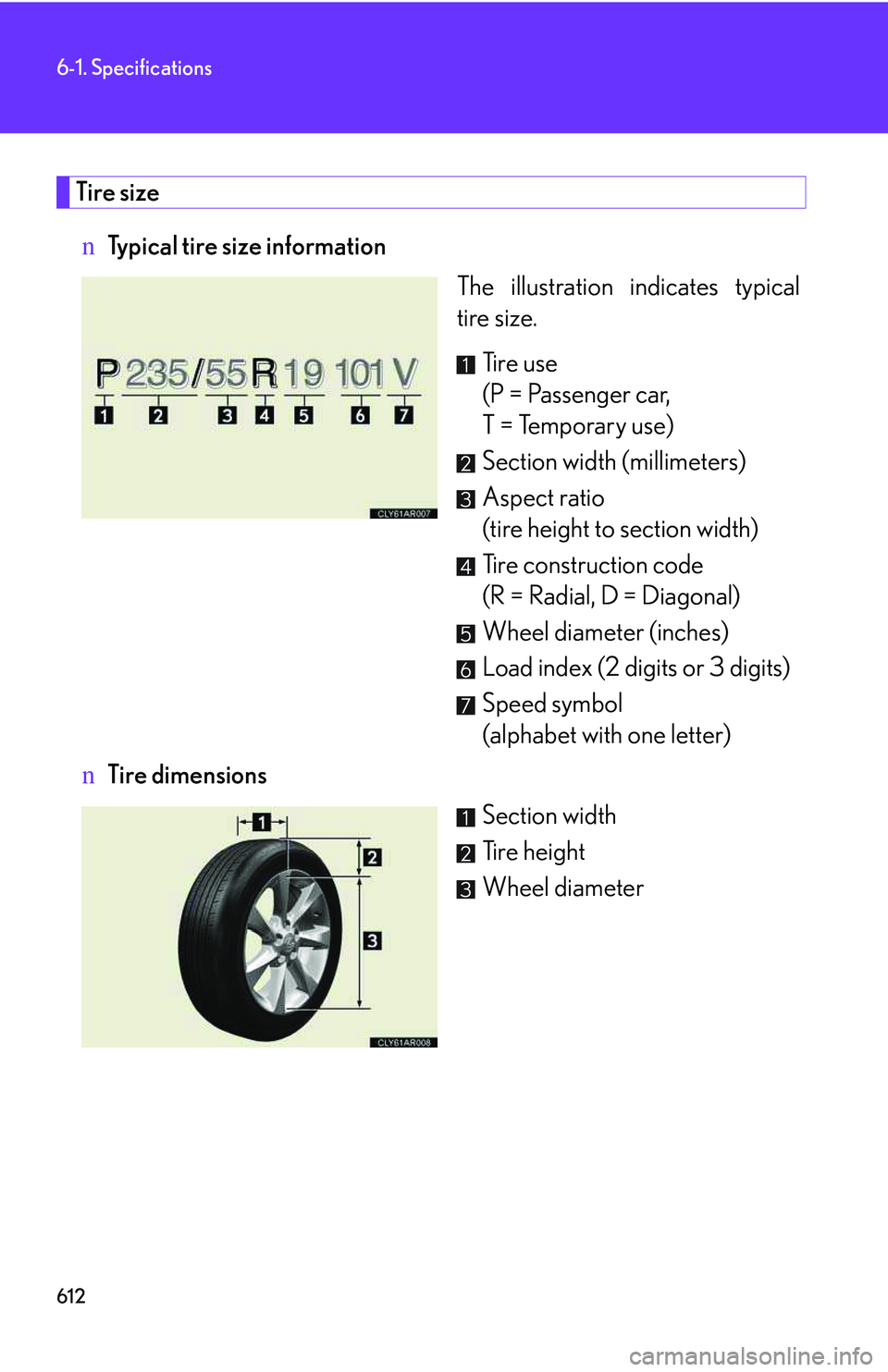
Tire size
nTypical tire size information
The illustration indicates typical
tire size.
Ti r e u s e
(P = Passenger car,
T = Temporary use)
Section width (millimeters)
Aspect ratio
(tire height to section width)
Tire construction code
(R = Radial, D = Diagonal)
Wheel diameter (inches)
Load index (2 digits or 3 digits)
Speed symbol
(alphabet with one letter)
nTire dimensions
Section width
Ti r e h e i g h t
Wheel diameter
Page 684 of 821
614
6-1. Specifications
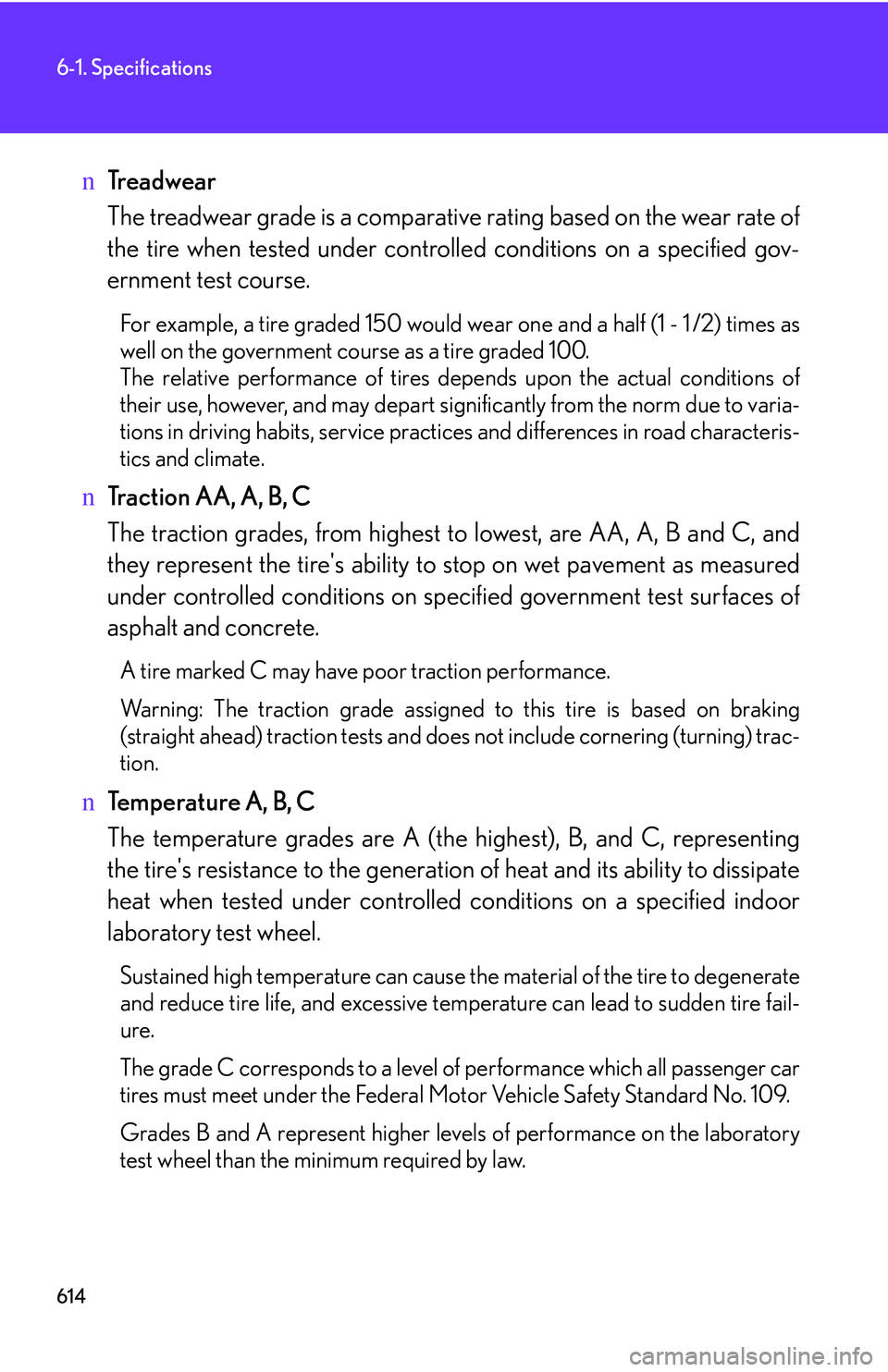
nTreadwear
The treadwear grade is a comparative rating based on the wear rate of
the tire when tested under controlled conditions on a specified gov-
ernment test course.
For example, a tire graded 150 would wear one and a half (1 - 1 /2) times as
well on the government course as a tire graded 100.
The relative performance of tires depends upon the actual conditions of
their use, however, and may depart significantly from the norm due to varia-
tions in driving habits, service practices and differences in road characteris-
tics and climate.
nTraction AA, A, B, C
The traction grades, from highest to lowest, are AA, A, B and C, and
they represent the tire's ability to stop on wet pavement as measured
under controlled conditions on specified government test surfaces of
asphalt and concrete.
A tire marked C may have poor traction performance.
Warning: The traction grade assigned to this tire is based on braking
(straight ahead) traction tests and does not include cornering (turning) trac-
tion.
nTemperature A, B, C
The temperature grades are A (the highest), B, and C, representing
the tire's resistance to the generation of heat and its ability to dissipate
heat when tested under controlled conditions on a specified indoor
laboratory test wheel.
Sustained high temperature can cause the material of the tire to degenerate
and reduce tire life, and excessive temperature can lead to sudden tire fail-
ure.
The grade C corresponds to a level of performance which all passenger car
tires must meet under the Federal Motor Vehicle Safety Standard No. 109.
Grades B and A represent higher levels of performance on the laboratory
test wheel than the minimum required by law.
Page 686 of 821
616
6-1. Specifications
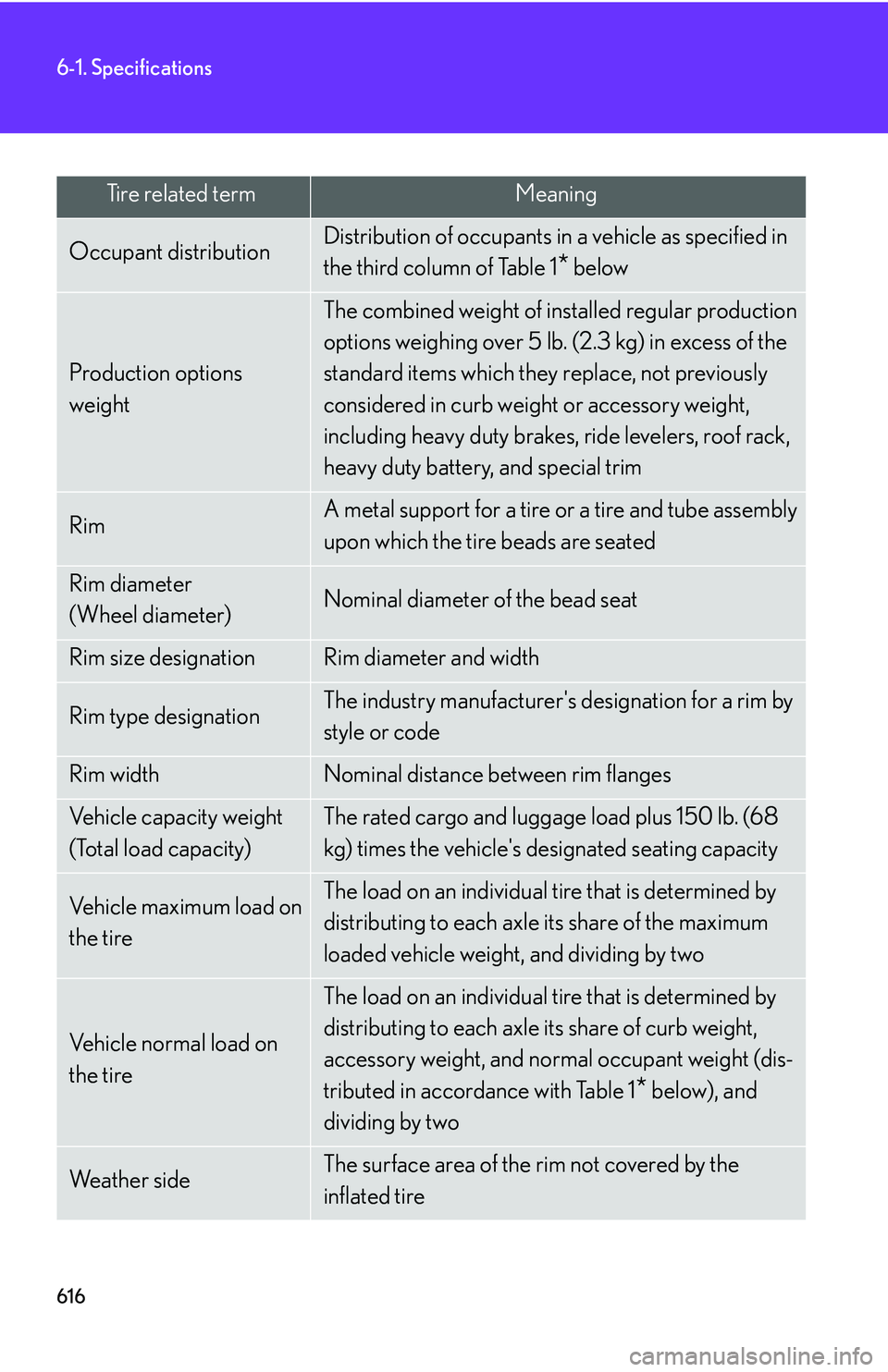
Tire related termMeaning
Occupant distributionDistribution of occupants in a vehicle as specified in
the third column of Table 1* below
Production options
weight
The combined weight of installed regular production
options weighing over 5 lb. (2.3 kg) in excess of the
standard items which they replace, not previously
considered in curb weight or accessory weight,
including heavy duty brakes, ride levelers, roof rack,
heavy duty battery, and special trim
RimA metal support for a tire or a tire and tube assembly
upon which the tire beads are seated
Rim diameter
(Wheel diameter)Nominal diameter of the bead seat
Rim size designationRim diameter and width
Rim type designationThe industry manufacturer's designation for a rim by
style or code
Rim widthNominal distance between rim flanges
Vehicle capacity weight
(Total load capacity)
The rated cargo and luggage load plus 150 lb. (68
kg) times the vehicle's designated seating capacity
Vehicle maximum load on
the tire
The load on an individual tire that is determined by
distributing to each axle its share of the maximum
loaded vehicle weight, and dividing by two
Vehicle normal load on
the tire
The load on an individual tire that is determined by
distributing to each axle its share of curb weight,
accessory weight, and normal occupant weight (dis-
tributed in accordance with Table 1* below), and
dividing by two
We a t h e r s i d eThe surface area of the rim not covered by the
inflated tire
Page 689 of 821
619
6-1. Specifications
6
Vehicle specifications
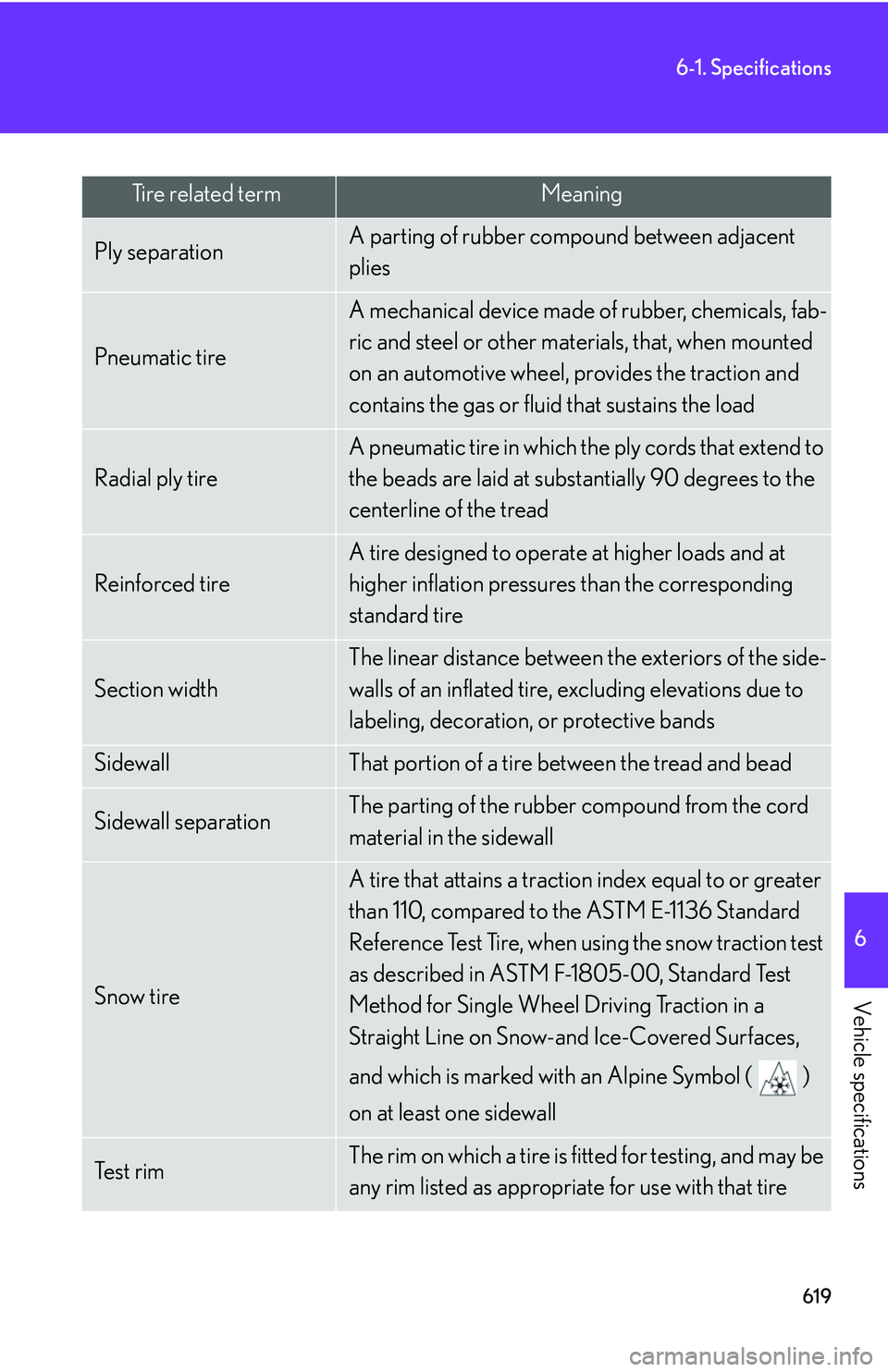
Tire related termMeaning
Ply separationA parting of rubber compound between adjacent
plies
Pneumatic tire
A mechanical device made of rubber, chemicals, fab-
ric and steel or other materials, that, when mounted
on an automotive wheel, provides the traction and
contains the gas or fluid that sustains the load
Radial ply tire
A pneumatic tire in which the ply cords that extend to
the beads are laid at substantially 90 degrees to the
centerline of the tread
Reinforced tire
A tire designed to operate at higher loads and at
higher inflation pressures than the corresponding
standard tire
Section width
The linear distance between the exteriors of the side-
walls of an inflated tire, excluding elevations due to
labeling, decoration, or protective bands
SidewallThat portion of a tire between the tread and bead
Sidewall separationThe parting of the rubber compound from the cord
material in the sidewall
Snow tire
A tire that attains a traction index equal to or greater
than 110, compared to the ASTM E-1136 Standard
Reference Test Tire, when using the snow traction test
as described in ASTM F-1805-00, Standard Test
Method for Single Wheel Driving Traction in a
Straight Line on Snow-and Ice-Covered Surfaces,
and which is marked with an Alpine Symbol ( )
on at least one sidewall
Te s t r i mThe rim on which a tire is fitted for testing, and may be
any rim listed as appropriate for use with that tire
Page 690 of 821
620
6-1. Specifications
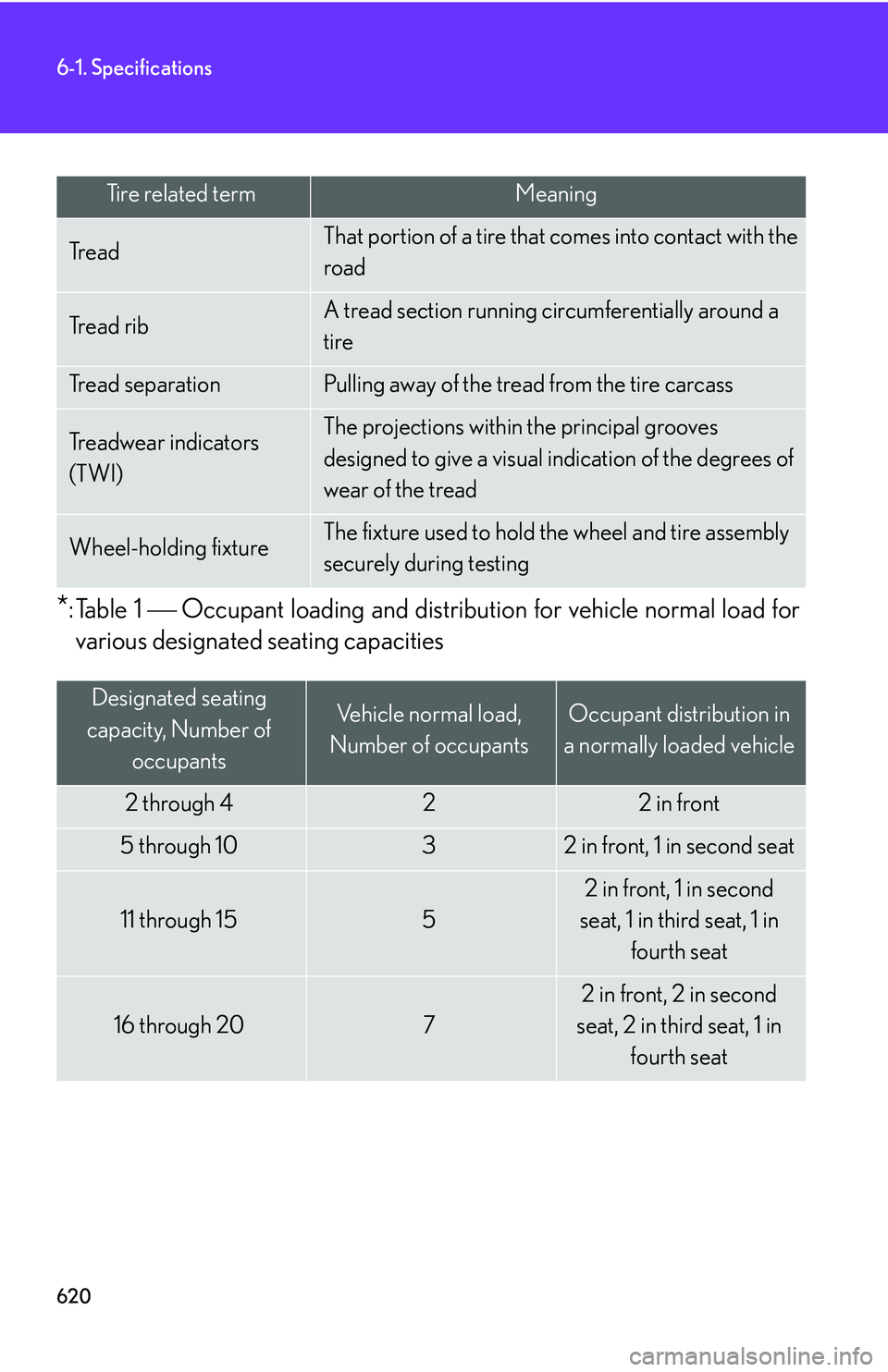
*:Table 1 ⎯ Occupant loading and distribution for vehicle normal load for
various designated seating capacities
Tire related termMeaning
Tr e a dThat portion of a tire that comes into contact with the
road
Tr e a d r i bA tread section running circumferentially around a
tire
Tr e a d s e p a r a t i o nPulling away of the tread from the tire carcass
Treadwear indicators
(TWI)
The projections within the principal grooves
designed to give a visual indication of the degrees of
wear of the tread
Wheel-holding fixtureThe fixture used to hold the wheel and tire assembly
securely during testing
Designated seating
capacity, Number of
occupants
Vehicle normal load,
Number of occupants
Occupant distribution in
a normally loaded vehicle
2 through 422 in front
5 through 1032 in front, 1 in second seat
11 through 155
2 in front, 1 in second
seat, 1 in third seat, 1 in
fourth seat
16 through 207
2 in front, 2 in second
seat, 2 in third seat, 1 in
fourth seat
Page 717 of 821
648
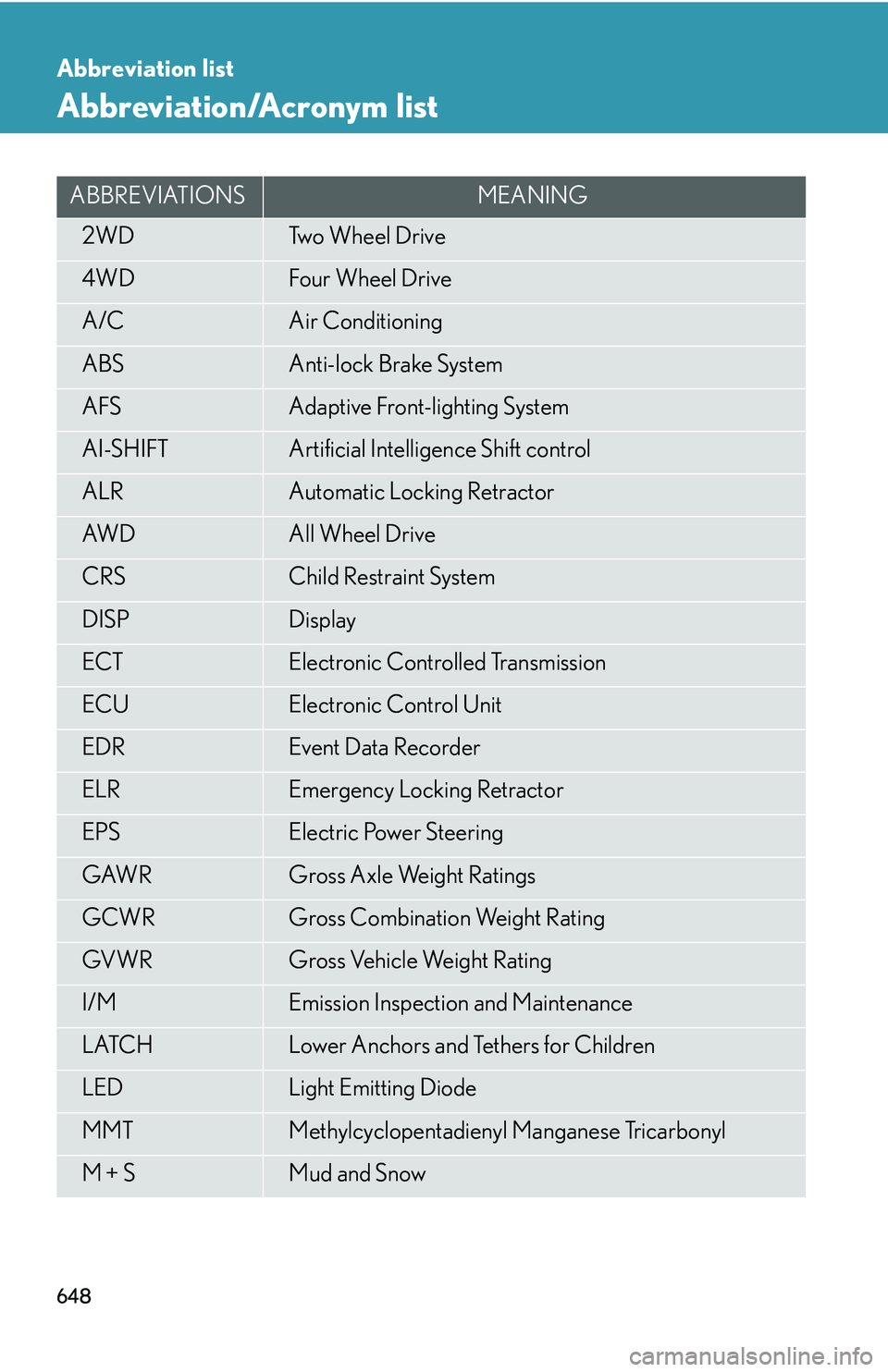
Abbreviation list
Abbreviation/Acronym list
ABBREVIATIONSMEANING
2WDTwo Wheel Drive
4WDFour Wheel Drive
A/CAir Conditioning
ABSAnti-lock Brake System
AFSAdaptive Front-lighting System
AI-SHIFTArtificial Intelligence Shift control
ALRAutomatic Locking Retractor
AW DAll Wheel Drive
CRSChild Restraint System
DISPDisplay
ECTElectronic Controlled Transmission
ECUElectronic Control Unit
EDREvent Data Recorder
ELREmergency Locking Retractor
EPSElectric Power Steering
GAWRGross Axle Weight Ratings
GCWRGross Combination Weight Rating
GVWRGross Vehicle Weight Rating
I/MEmission Inspection and Maintenance
LATCHLower Anchors and Tethers for Children
LEDLight Emitting Diode
MMTMethylcyclopentadienyl Manganese Tricarbonyl
M + SMud and Snow
Page 720 of 821
651
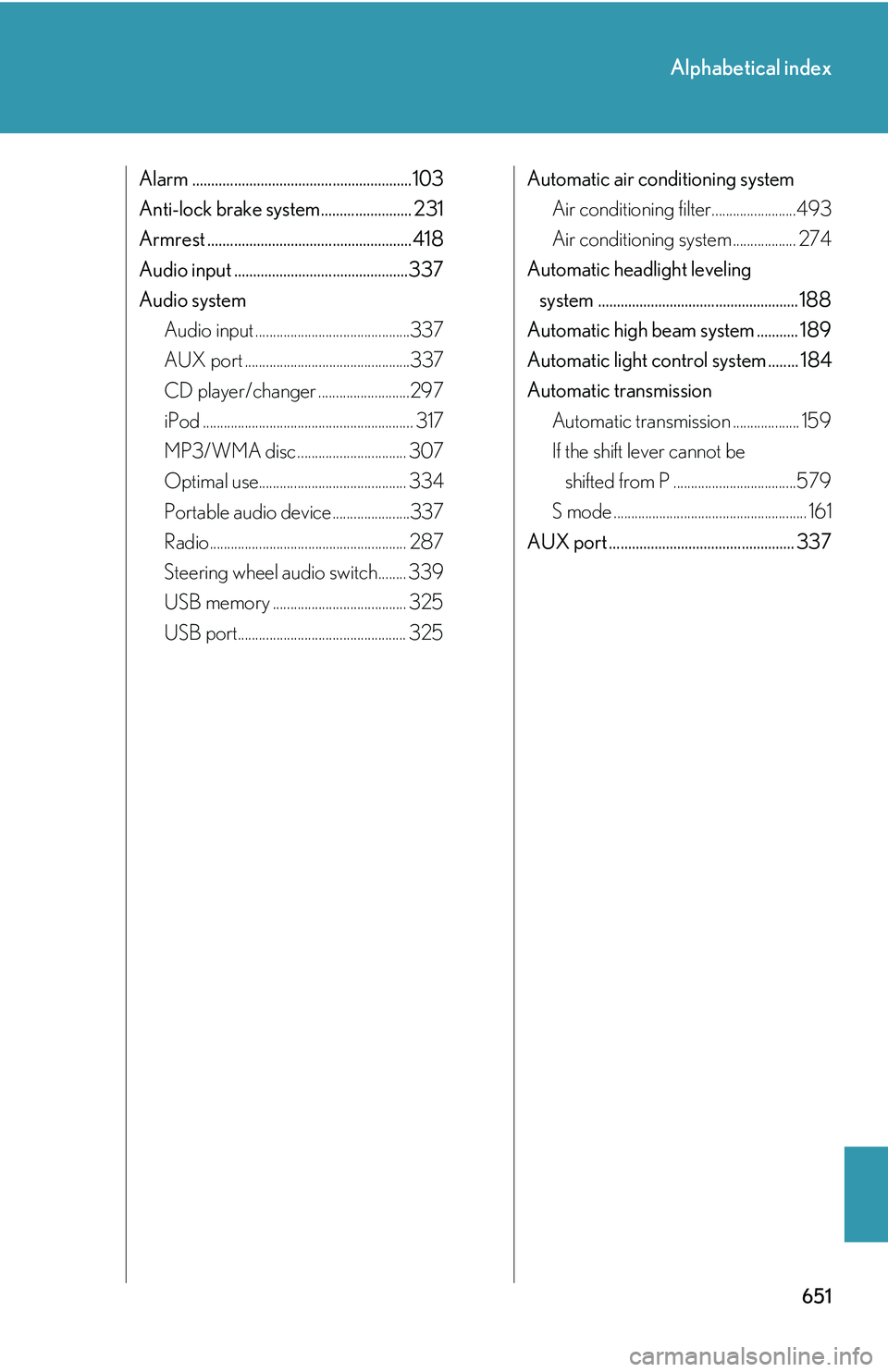
Alphabetical index
Alarm ..........................................................103
Anti-lock brake system........................ 231
Armrest ......................................................418
Audio input ..............................................337
Audio system
Audio input ............................................337
AUX port ...............................................337
CD player/changer ..........................297
iPod ............................................................ 317
MP3/WMA disc ............................... 307
Optimal use.......................................... 334
Portable audio device......................337
Radio........................................................ 287
Steering wheel audio switch........ 339
USB memory ...................................... 325
USB port................................................ 325
Automatic air conditioning system
Air conditioning filter........................493
Air conditioning system .................. 274
Automatic headlight leveling
system ..................................................... 188
Automatic high beam system ........... 189
Automatic light control system ........ 184
Automatic transmission
Automatic transmission ................... 159
If the shift lever cannot be
shifted from P ...................................579
S mode ....................................................... 161
AUX port ................................................. 337