wheel LEXUS RX350 2011 Owners Manual
[x] Cancel search | Manufacturer: LEXUS, Model Year: 2011, Model line: RX350, Model: LEXUS RX350 2011Pages: 821, PDF Size: 13.27 MB
Page 639 of 821
570
5-2. Steps to take in an emergency
Replacing a flat tire
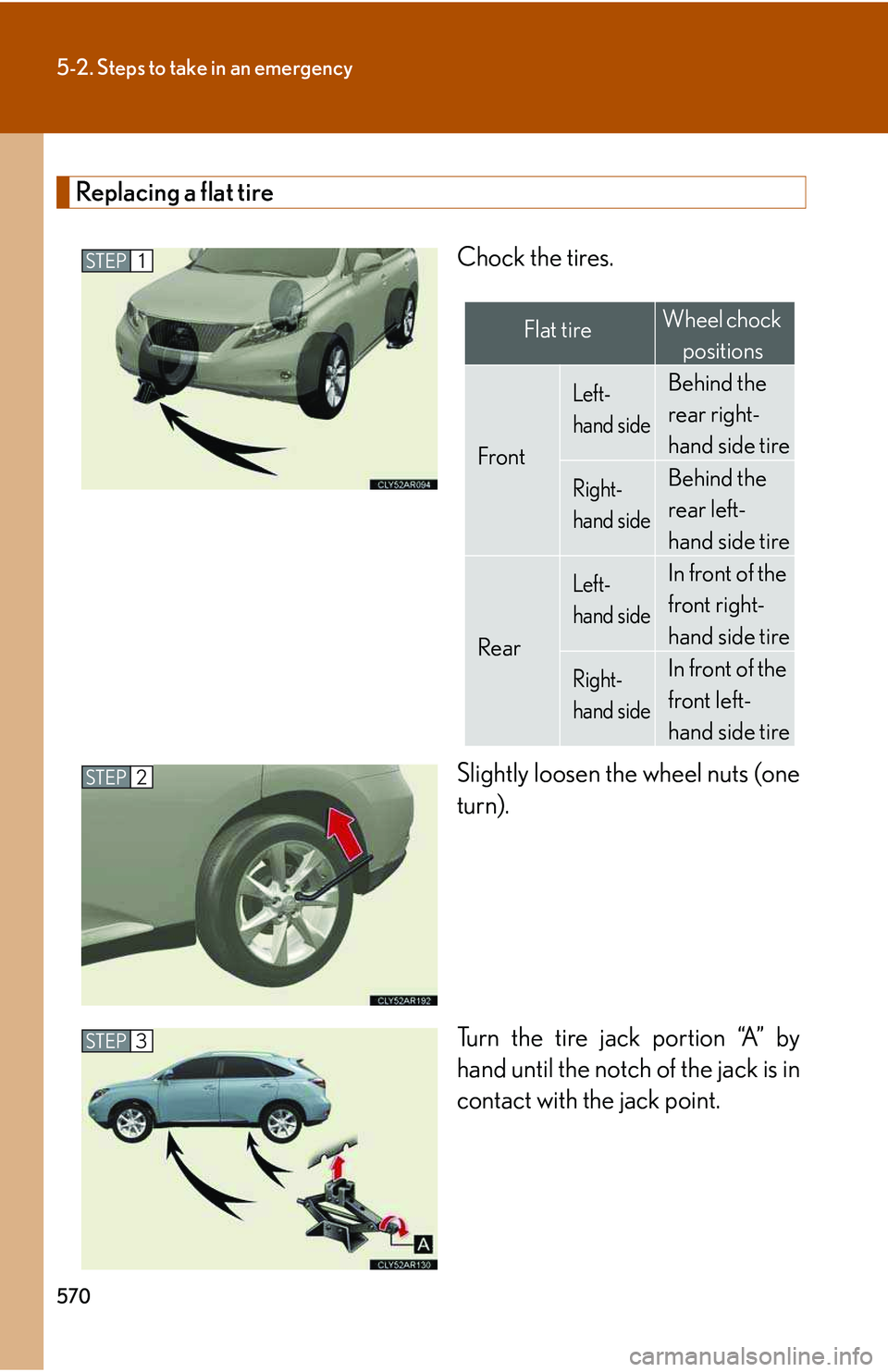
Chock the tires.
Slightly loosen the wheel nuts (one
turn).
Turn the tire jack portion “A” by
hand until the notch of the jack is in
contact with the jack point.
STEP1
Flat tireWheel chock
positions
Front
Left-
hand side
Behind the
rear right-
hand side tire
Right-
hand side
Behind the
rear left-
hand side tire
Rear
Left-
hand side
In front of the
front right-
hand side tire
Right-
hand side
In front of the
front left-
hand side tire
STEP2
STEP3
Page 640 of 821
5
When trouble arises
571
5-2. Steps to take in an emergency
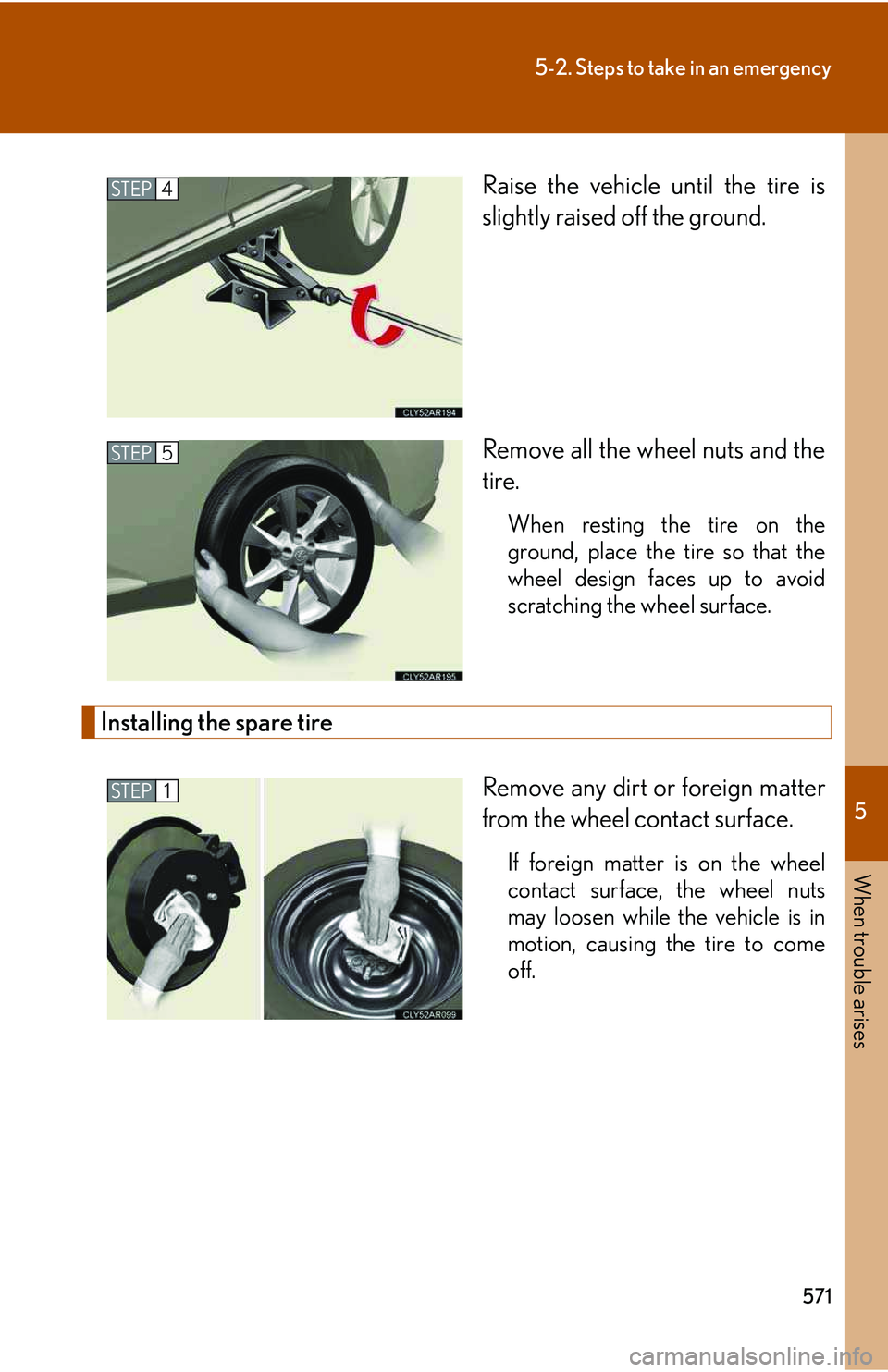
Raise the vehicle until the tire is
slightly raised off the ground.
Remove all the wheel nuts and the
tire.
When resting the tire on the
ground, place the tire so that the
wheel design faces up to avoid
scratching the wheel surface.
Installing the spare tire
Remove any dirt or foreign matter
from the wheel contact surface.
If foreign matter is on the wheel
contact surface, the wheel nuts
may loosen while the vehicle is in
motion, causing the tire to come
off.
STEP4
STEP5
STEP1
Page 641 of 821
572
5-2. Steps to take in an emergency
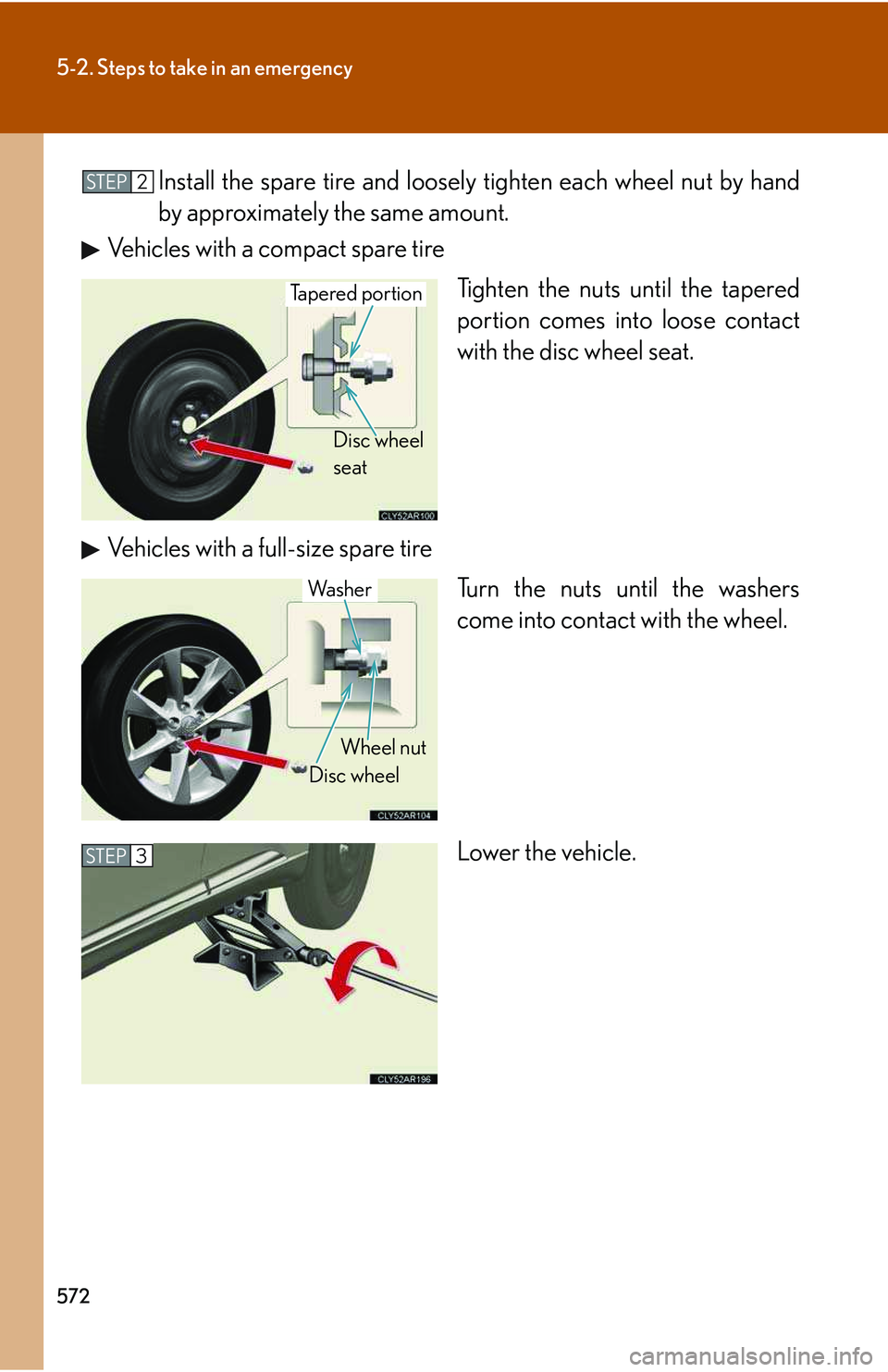
Install the spare tire and loosely tighten each wheel nut by hand
by approximately the same amount.
Vehicles with a compact spare tire
Tighten the nuts until the tapered
portion comes into loose contact
with the disc wheel seat.
Vehicles with a full-size spare tire
Turn the nuts until the washers
come into contact with the wheel.
Lower the vehicle.
STEP2
Disc wheel
seat
Tapered portion
Wheel nut
Was h e r
Disc wheel
STEP3
Page 642 of 821
5
When trouble arises
573
5-2. Steps to take in an emergency
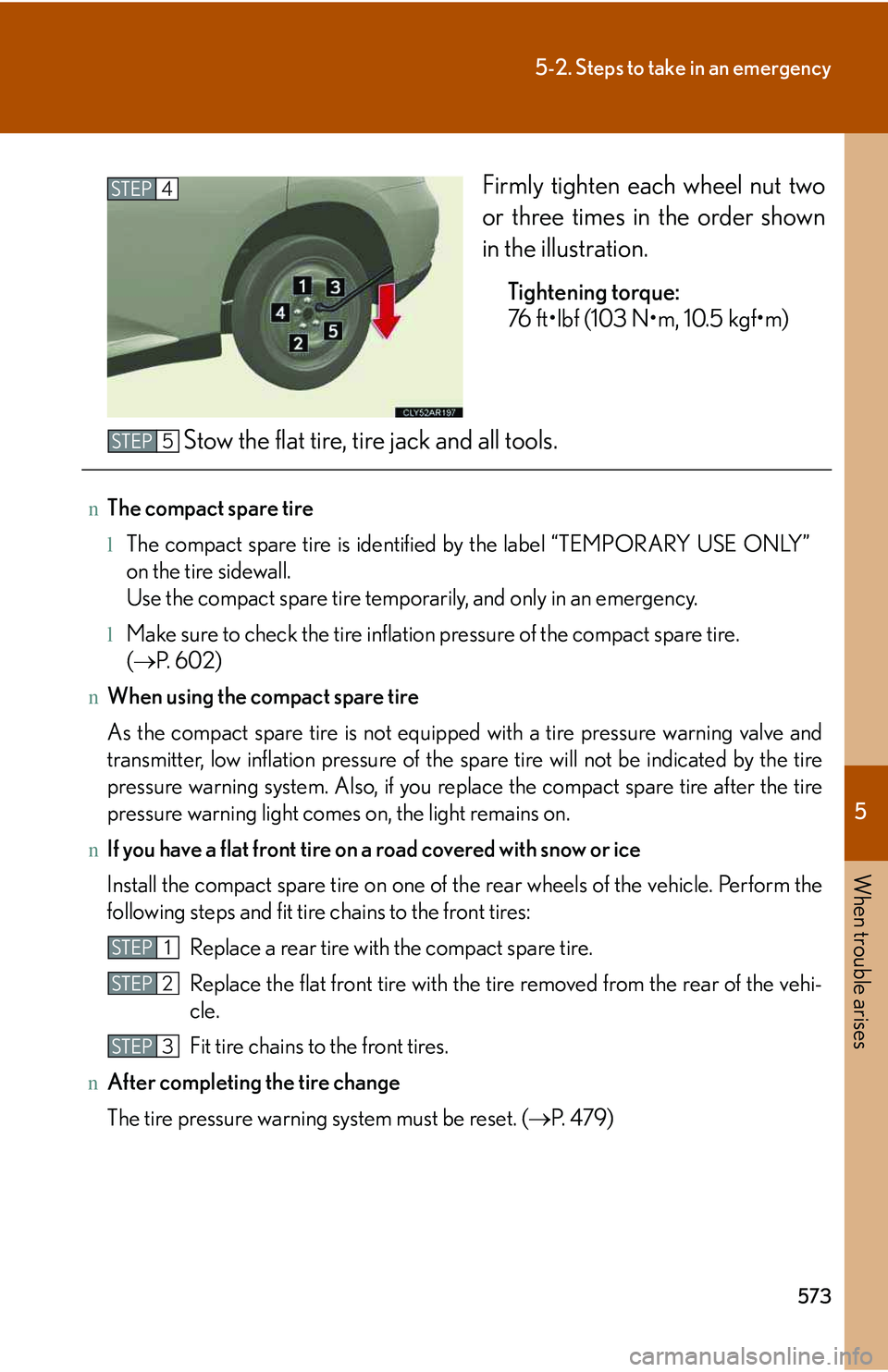
Firmly tighten each wheel nut two
or three times in the order shown
in the illustration.
Tightening torque:
76 ft
Page 643 of 821
574
5-2. Steps to take in an emergency
CAUTION
nUsing the tire jack
Improper use of the tire jack may cause the vehicle to suddenly fall off the jack,
leading to death or serious injury.
lDo not use the tire jack for any purpose other than replacing tires or installing and
removing tire chains.
lOnly use the tire jack that comes with this vehicle for replacing a flat tire.
Do not use it on other vehicles, and do not use other tire jacks for replacing tires
on this vehicle.
lAlways check that the tire jack is securely set to the jack point.
lDo not put any part of your body under the vehicle is supported by the jack.
lDo not start or run the engine while your vehicle while it is supported by the jack.
lDo not raise the vehicle while someone is in it.
lWhen raising the vehicle, do not put an object on or under the jack.
lDo not raise the vehicle to a height greater than that required to replace the tire.
lUse a jack stand if it is necessary to get under the vehicle.
Take particular care when lowering the vehicle to ensure that no one working on or
near the vehicle may be injured.
nReplacing a flat tire
Observe the following precautions to reduce the risk of death or serious injury:
lDo not touch the disc wheels or the area around the brakes immediately after the
vehicle has been driven.
After the vehicle has been driven the disc wheels and the area around the brakes
will be extremely hot. Touching these areas with hands, feet or other body parts
while changing a tire, etc. may result in burns.
lNever use oil or grease on the wheel bolts or wheel nuts.
Oil and grease may cause the wheel nuts to be excessively tightened, leading to
bolt or disc wheel damage. In addition, the oil or grease can cause the wheel nuts
to loosen and the wheel may fall off, causing a serious accident. Remove any oil or
grease from the wheel bolts or wheel nuts.
Page 644 of 821
5
When trouble arises
575
5-2. Steps to take in an emergency
CAUTION
lHave the wheel nuts tightened with a torque wrench to 76 ft
Page 645 of 821
576
5-2. Steps to take in an emergency
CAUTION
Also, not only can the following system not be utilized fully, but it may even nega-
tively affect the drive-train components:
lAWD system (if equipped)
nSpeed limit when using the compact spare tire
Do not drive at speeds in excess of 50 mph (80 km/h) when a compact spare tire is
installed on the vehicle.
The compact spare tire is not designed for driving at high speeds. Failure to observe
this precaution may lead to an accident causing death or serious injury.
NOTICE
nDo not drive the vehicle with a flat tire
Do not continue driving with a flat tire.
Driving even a short distance with a flat tire can damage the tire and the wheel
beyond repair.
nBe careful when driving over bumps with the compact spare tire installed on the
vehicle.
The vehicle becomes lower when driving with the compact spare tire compared to
when driving with standard tires. Be careful when driving over uneven road sur-
faces.
nDriving with tire chains and the compact spare tire
Do not fit tire chains to the compact spare tire.
Tire chains may damage the vehicle body and adversely affect driving performance.
nWhen replacing the tires
When removing or fitting the wheels, tires or the tire pressure warning valve and
transmitter, contact your Lexus dealer as the tire pressure warning valve and trans-
mitter may be damaged if not handled correctly.
nTo avoid damage to the tire pressure warning valves and transmitters
When a tire is repaired with liquid sealants, the tire pressure warning valve and
transmitter may not operate properly. If a liquid sealant is used, contact your Lexus
dealer or other qualified service shop as soon as possible. Make sure to replace the
tire pressure warning valve and transmitter when replacing the tire. (→P. 4 7 9 )
Page 659 of 821
590
5-2. Steps to take in an emergency
If the vehicle becomes stuck
CAUTION
nWhen attempting to free a stuck vehicle
If you choose to push the vehicle back and forth to free it, make sure the surround-
ing area is clear to avoid striking other vehicles, objects or people. The vehicle may
also lunge forward or lunge back suddenly as it becomes free. Use extreme cau-
tion.
nWhen shifting the shift lever
Be careful not to shift the shift lever with the accelerator pedal depressed.
This may lead to unexpected rapid acceleration of the vehicle that may cause an
accident and resulting in death or serious injury.
NOTICE
nTo avoid damage to the transmission and other components
lAvoid spinning the wheels.
lIf the vehicle remains stuck even after these procedures are performed, the vehi-
cle may require towing to be freed.
Carry out the following procedures if the tires spin or the vehicle becomes
stuck in mud, dirt, or snow:
Stop the engine. Set the parking brake and shift the shift lever
to P.
Remove the mud, snow, or sand from around the stuck tire.
Place wood, stones or some other material under the tires to
help provide traction.
Restart the engine.
AWD models: Active all-wheel drive lock mode (→P. 237)
Shift the shift lever to the D or R position and carefully apply
the accelerator to free the vehicle.
Turn off the TRAC and VSC systems if these functions are hamper-
ing your attempts to free the vehicle. (→ P. 2 3 3 )
STEP1
STEP2
STEP3
STEP4
STEP5
STEP6
Page 660 of 821
5
When trouble arises
591
5-2. Steps to take in an emergency
If your vehicle has to be stopped in an emergency
CAUTION
nIf the engine has to be turned off while driving
Power assist for the brakes and steering wheel will be lost, making the brake pedal
harder to depress and the steering wheel heavier to turn. Decelerate as much as
possible before turning off the engine.
Only in an emergency, such as if it becomes impossible to stop the vehicle
in the normal way, stop the vehicle using the following procedure:
Steadily step on the brake pedal with both feet and firmly
depress it.
Do not pump the brake pedal repeatedly as this will increase the
effort required to slow the vehicle.
Shift the shift lever to N.
If the shift lever is shifted to N
After slowing down, stop the vehicle in a safe place by the road.
Stop the engine.
If the shift lever cannot be shifted to N
Keep depressing the brake pedal with both feet to reduce vehi-
cle speed as much as possible.
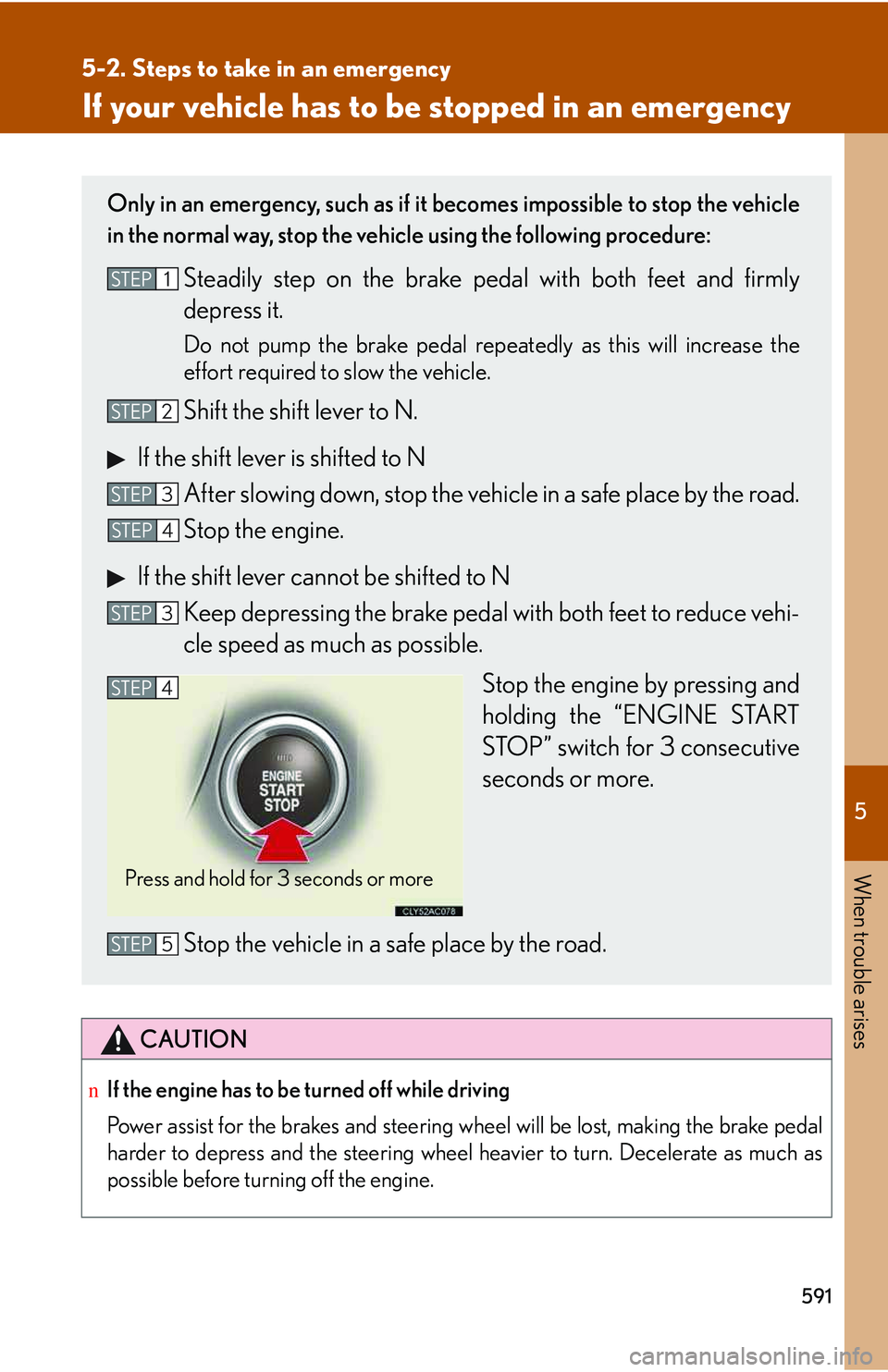
Stop the engine by pressing and
holding the “ENGINE START
STOP” switch for 3 consecutive
seconds or more.
Stop the vehicle in a safe place by the road.
STEP1
STEP2
STEP3
STEP4
STEP3
Press and hold for 3 seconds or more
STEP4
STEP5
Page 664 of 821
594
6-1. Specifications
Maintenance data (fuel, oil level, etc.)
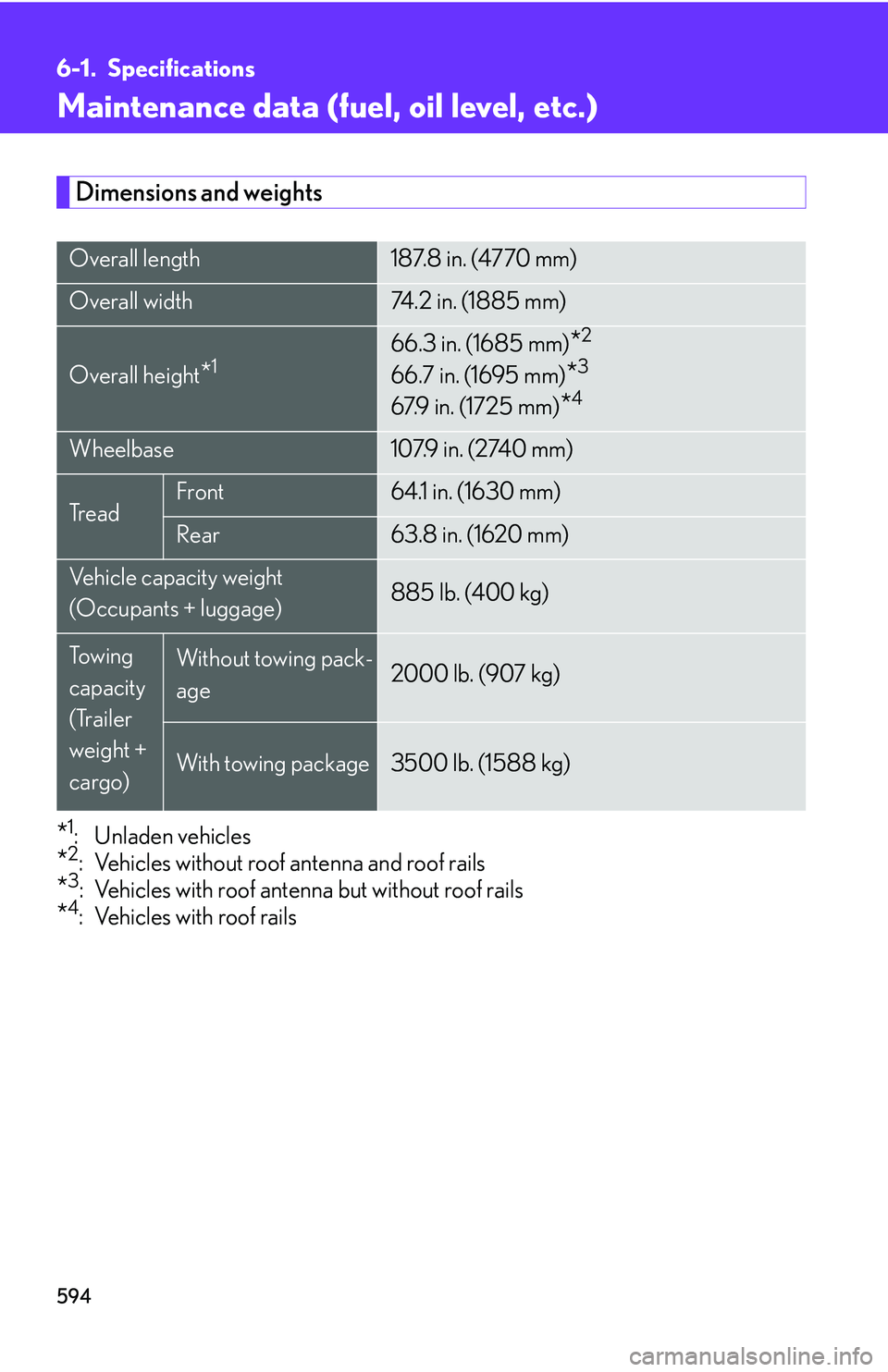
Dimensions and weights
*1:Unladen vehicles
*2: Vehicles without roof antenna and roof rails
*3: Vehicles with roof antenna but without roof rails
*4: Vehicles with roof rails
Overall length187.8 in. (4770 mm)
Overall width74.2 in. (1885 mm)
Overall height*166.3 in. (1685 mm)*2
66.7 in. (1695 mm)*3
67.9 in. (1725 mm)*4
Wheelbase107.9 in. (2740 mm)
Tr e a dFront64.1 in. (1630 mm)
Rear63.8 in. (1620 mm)
Vehicle capacity weight
(Occupants + luggage)885 lb. (400 kg)
To w i n g
capacity
(Trailer
weight +
cargo)
Without towing pack-
age2000 lb. (907 kg)
With towing package3500 lb. (1588 kg)