maintenance LEXUS RX350 2011 Manual Online
[x] Cancel search | Manufacturer: LEXUS, Model Year: 2011, Model line: RX350, Model: LEXUS RX350 2011Pages: 821, PDF Size: 13.27 MB
Page 586 of 821
516
4-3. Do-it-yourself maintenance
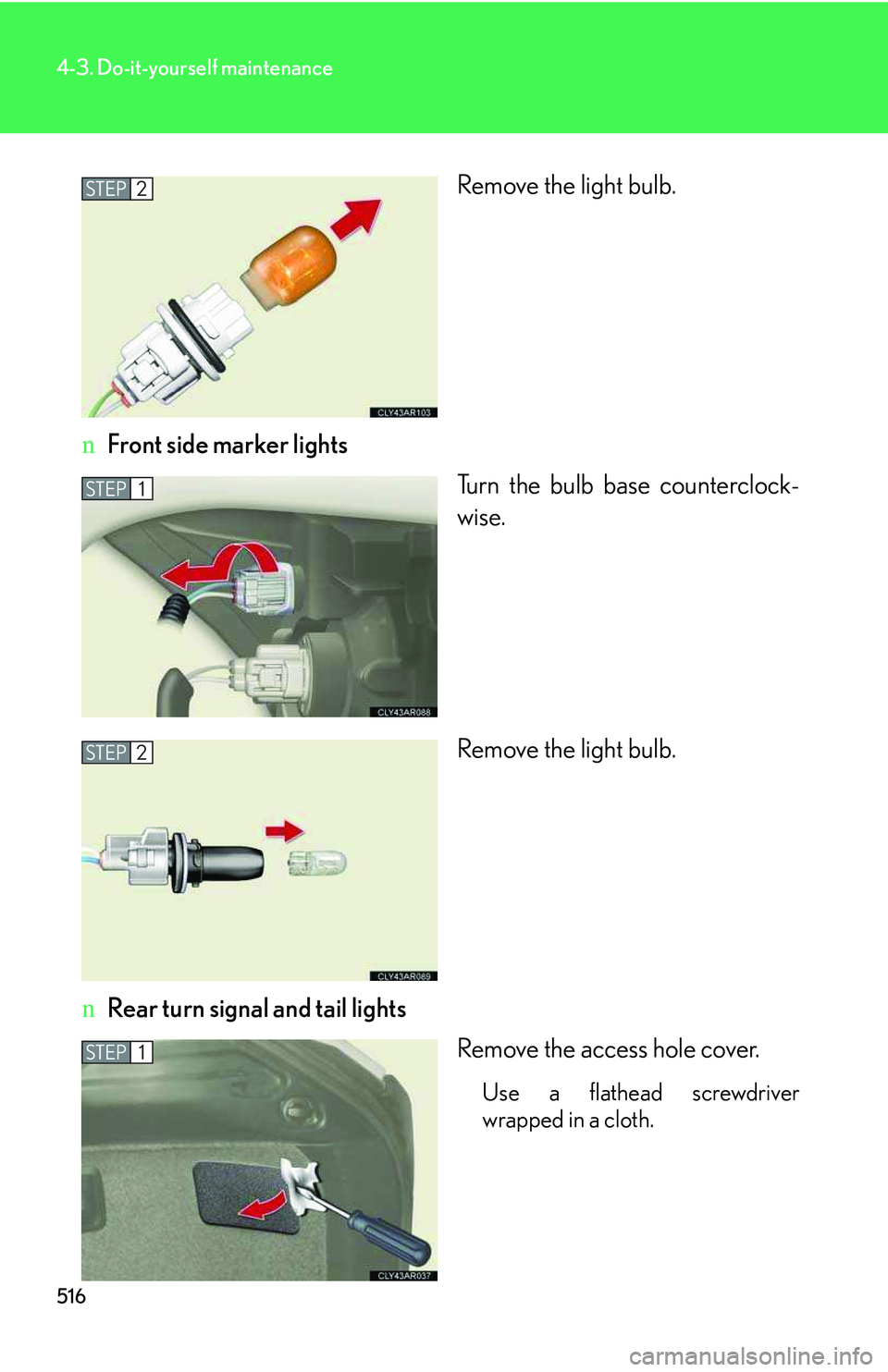
Remove the light bulb.
nFront side marker lights
Turn the bulb base counterclock-
wise.
Remove the light bulb.
nRear turn signal and tail lights
Remove the access hole cover.
Use a flathead screwdriver
wrapped in a cloth.
STEP2
STEP1
STEP2
STEP1
Page 587 of 821
517
4-3. Do-it-yourself maintenance
4
Maintenance and care
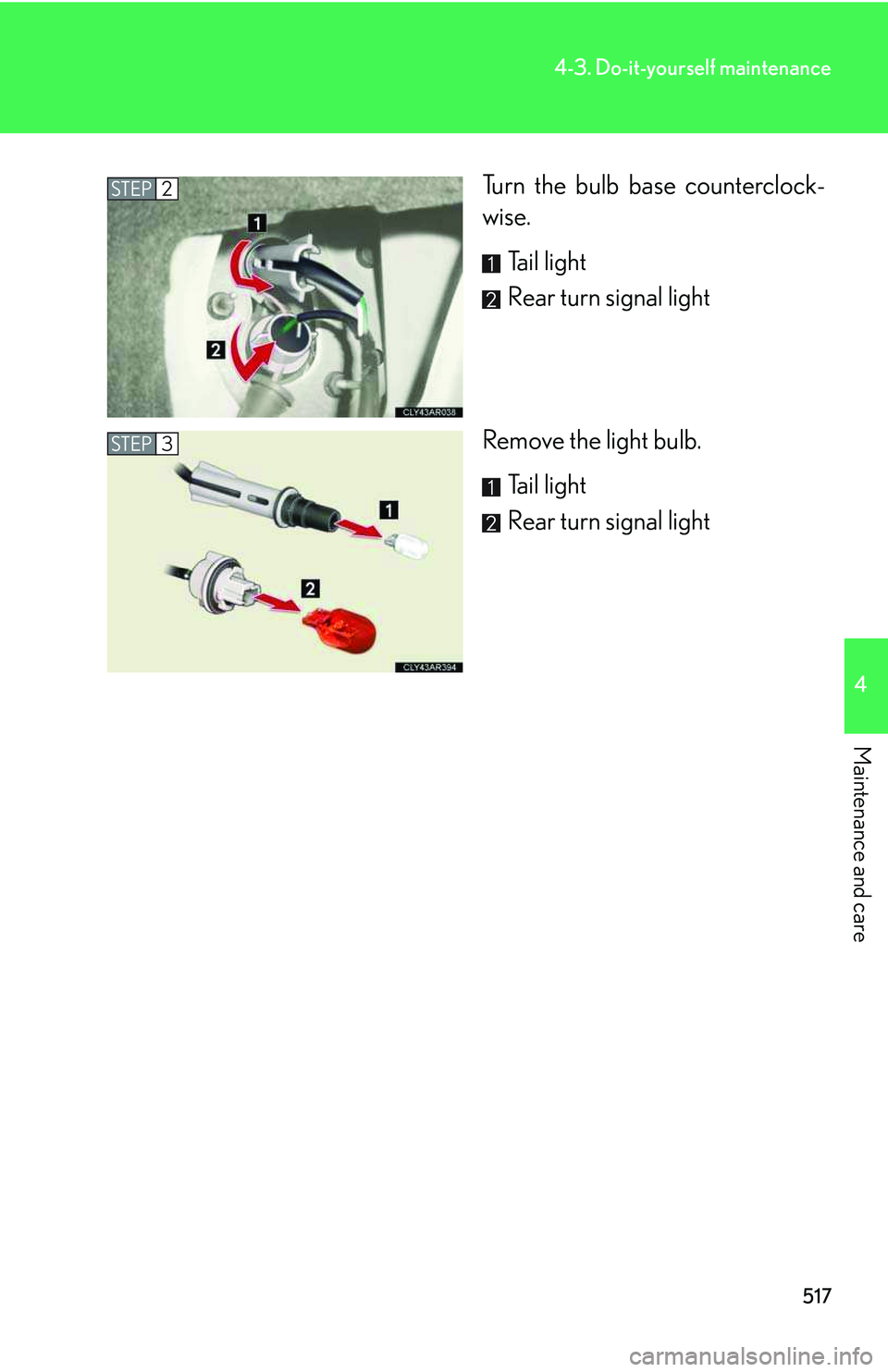
Turn the bulb base counterclock-
wise.
Tail light
Rear turn signal light
Remove the light bulb.
Tail light
Rear turn signal light
STEP2
STEP3
Page 588 of 821
518
4-3. Do-it-yourself maintenance
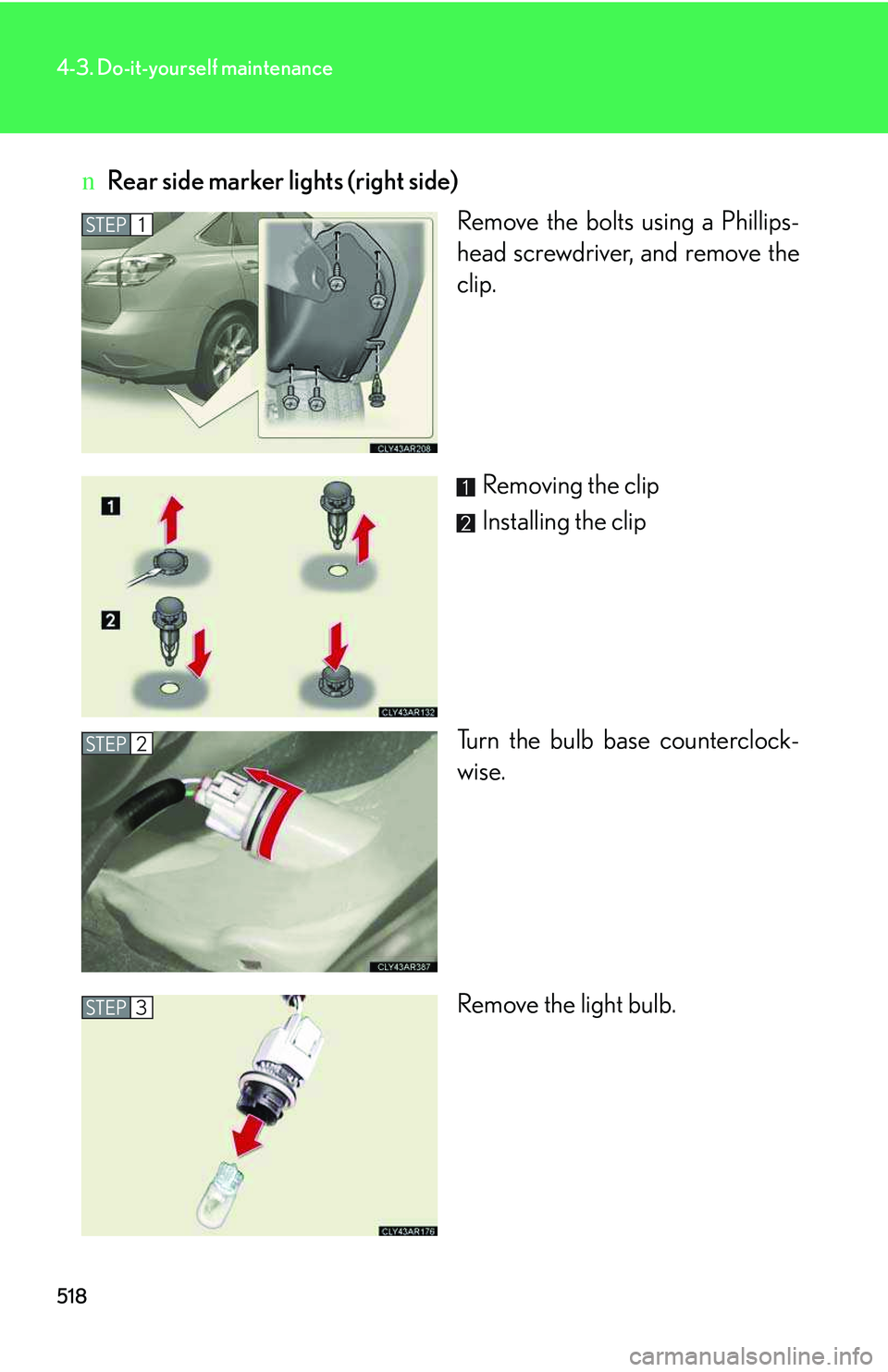
nRear side marker lights (right side)
Remove the bolts using a Phillips-
head screwdriver, and remove the
clip.
Removing the clip
Installing the clip
Turn the bulb base counterclock-
wise.
Remove the light bulb.
STEP1
STEP2
STEP3
Page 589 of 821
519
4-3. Do-it-yourself maintenance
4
Maintenance and care
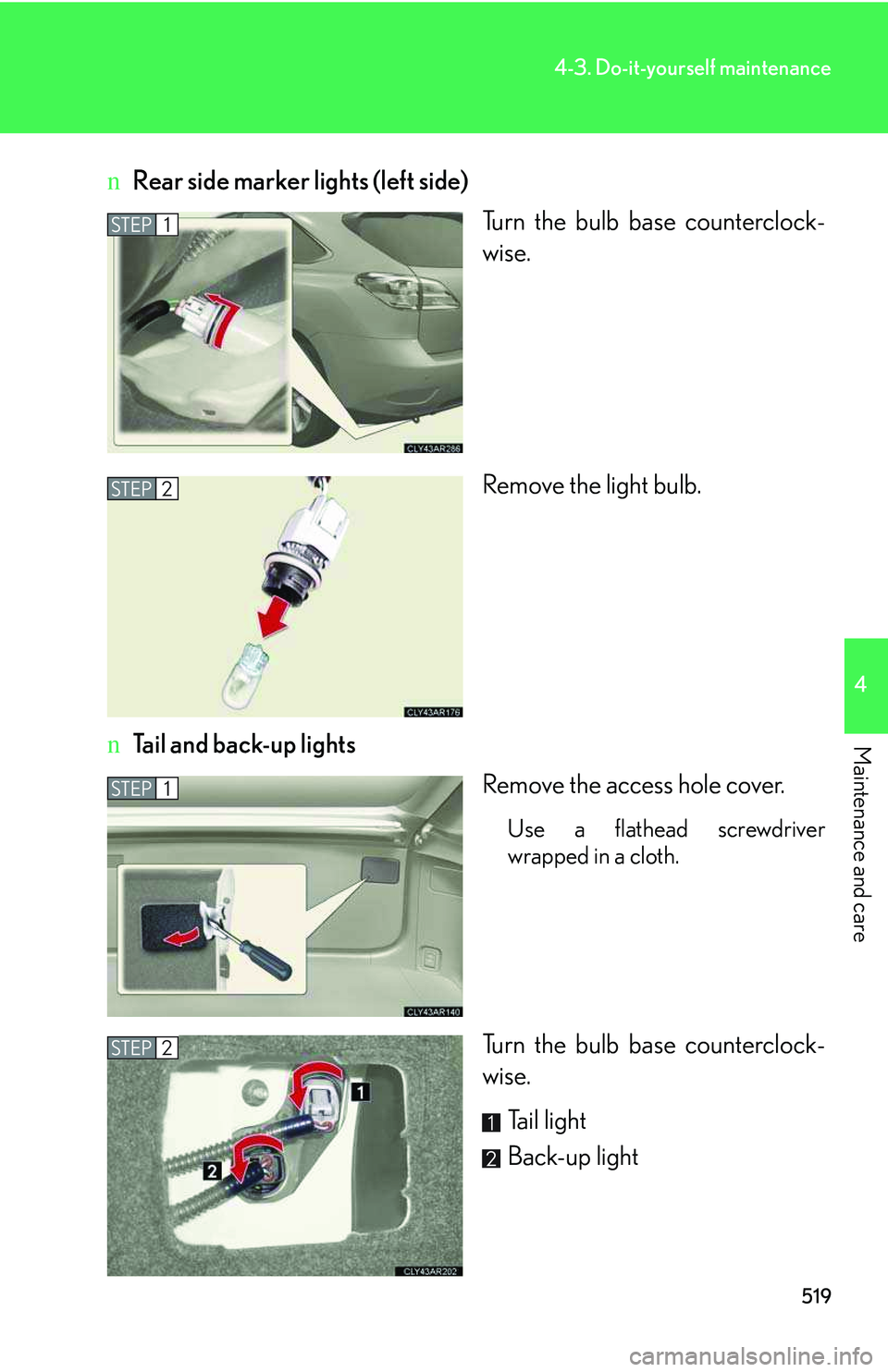
nRear side marker lights (left side)
Turn the bulb base counterclock-
wise.
Remove the light bulb.
nTail and back-up lights
Remove the access hole cover.
Use a flathead screwdriver
wrapped in a cloth.
Turn the bulb base counterclock-
wise.
Tail light
Back-up light
STEP1
STEP2
STEP1
STEP2
Page 590 of 821
520
4-3. Do-it-yourself maintenance
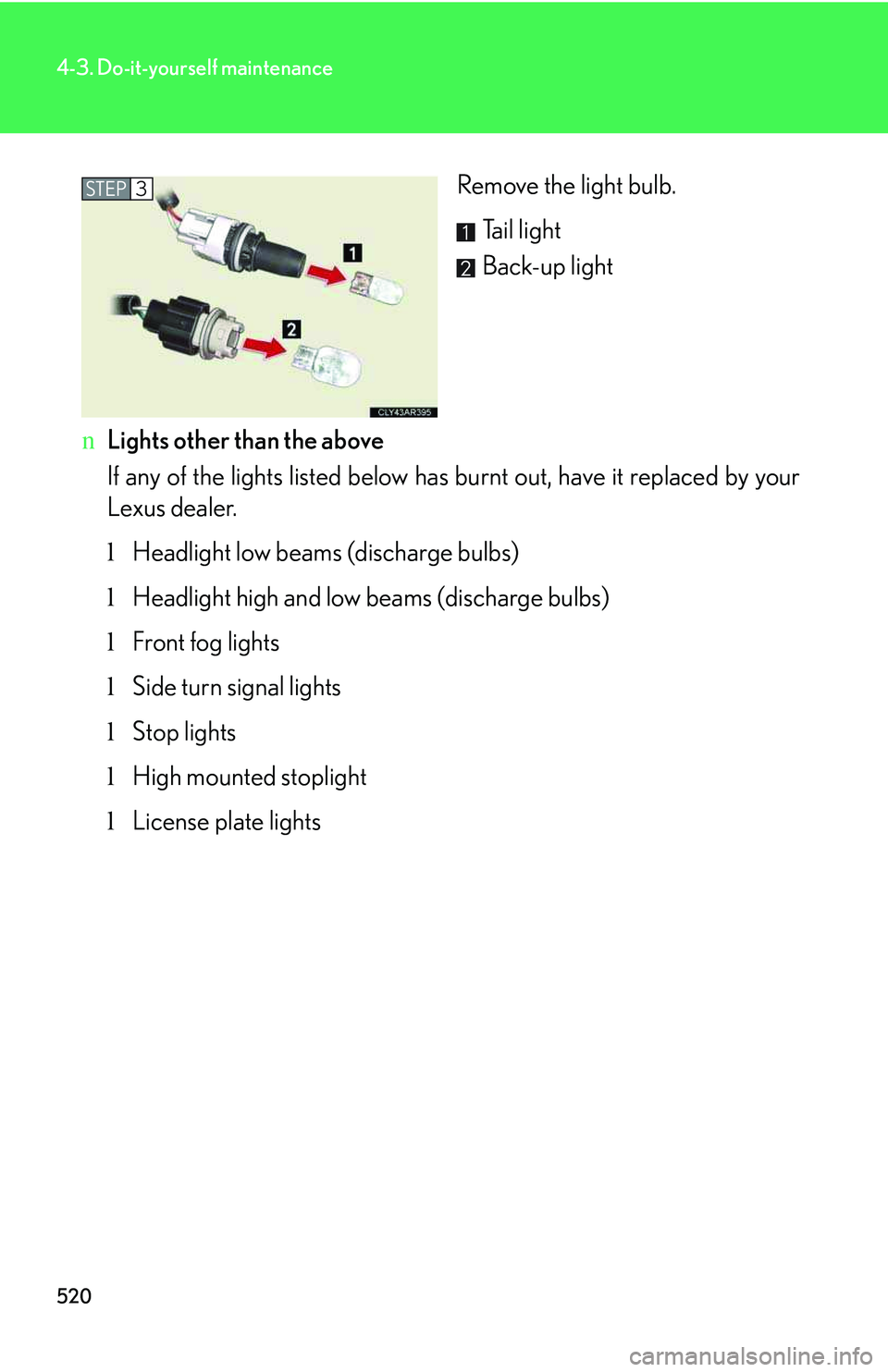
Remove the light bulb.
Tail light
Back-up light
nLights other than the above
If any of the lights listed below has burnt out, have it replaced by your
Lexus dealer.
lHeadlight low beams (discharge bulbs)
lHeadlight high and low beams (discharge bulbs)
lFront fog lights
lSide turn signal lights
lStop lights
lHigh mounted stoplight
lLicense plate lights
STEP3
Page 591 of 821
521
4-3. Do-it-yourself maintenance
4
Maintenance and care
nDischarge headlights (if equipped)
If voltage to the discharge bulbs is insufficient, the bulbs may not come on, or may
go out temporarily. The discharge bulbs will come on when normal power is
restored.
nLED bulbs
The stop lights, side turn signal lights, license plate lights and high mounted stoplight
consist of a number of LEDs. If any of the LEDs burn out, take your vehicle to your
Lexus dealer to have the light replaced.
nCondensation build-up on the inside of the lens
Contact your Lexus dealer for more information in the following situations. Tempo-
rary condensation build-up on the inside of the headlight lens does not indicate a
malfunction.
lLarge drops of water are built up on the inside of the lens.
lWater has built up inside the headlight.
Page 592 of 821
522
4-3. Do-it-yourself maintenance
CAUTION
nReplacing light bulbs
lTurn off the lights. Do not attempt to replace the bulb immediately after turning
off the lights.
The bulbs become very hot and may cause burns.
lDo not touch the glass portion of the light bulb with bare hands. Hold the bulb by
the plastic or metal portion.
If the bulb is scratched or dropped it may blow out or crack.
lFully install light bulbs and any parts used to secure them. Failing to do so may
result in heat damage, fire, or water entering the headlight unit. This may damage
the headlights or cause condensation to build up on the lens.
nDischarge headlights (if equipped)
lContact your Lexus dealer before replacing discharge headlights (including light
bulbs).
lDo not touch the discharge headlight’s high voltage socket when the headlights
are turned on.
An extremely high voltage of 20000 V will be discharged and could result in
serious injury or death by electric shock.
lDo not attempt to take apart or repair the low beam discharge headlight bulbs,
connectors, power supply circuits, or related components.
Doing so could result in electric shock and serious injury or death.
nTo prevent damage or fire
Make sure bulbs are fully seated and locked.
Page 612 of 821
5
When trouble arises
543
5-2. Steps to take in an emergency
CAUTION
nMaintenance of the tires
Each tire, including the spare (if provided), should be checked monthly when cold
and inflated to the inflation pressure recommended by the vehicle manufacturer on
the vehicle placard or tire inflation pressure label (tire and load information label).
(If your vehicle has tires of a different size than the size indicated on the vehicle
placard or tire inflation pressure label [tire and load information label], you should
determine the proper tire inflation pressure for those tires.)
As an added safety feature, your vehicle has been equipped with a tire pressure
monitoring system (TPMS-tire pressure warning system) that illuminates a low tire
pressure telltale (tire pressure warning light) when one or more of your tires is sig-
nificantly under-inflated. Accordingly, when the low tire pressure telltale (tire pres-
sure warning light) illuminates, you should stop and check your tires as soon as
possible, and inflate them to the proper pressure. Driving on a significantly under-
inflated tire causes the tire to overheat and can lead to tire failure. Under-inflation
also reduces fuel efficiency and tire tread life, and may affect the vehicle's handling
and stopping ability.
Please note that the TPMS (tire pressure warning system) is not a substitute for
proper tire maintenance, and it is the driver's responsibility to maintain correct tire
pressure, even if under-inflation has not reached the level to trigger illumination of
the TPMS low tire pressure telltale (tire pressure warning light).
Your vehicle has also been equipped with a TPMS (tire pressure warning system)
malfunction indicator to indicate when the system is not operating properly. The
TPMS (tire pressure warning system) malfunction indicator is combined with the
low tire pressure telltale (tire pressure warning light). When the system detects a
malfunction, the telltale will flash for approximately one minute and then remain
continuously illuminated. This sequence will continue upon subsequent vehicle
start-ups as long as the malfunction exists. When the malfunction indicator is illumi-
nated, the system may not be able to detect or signal low tire pressure as intended.
TPMS (tire pressure warning system) malfunctions may occur for a variety of rea-
sons, including the installation of replacement or alternate tires or wheels on the
vehicle that prevent the TPMS (tire pressure warning system) from functioning
properly. Always check the TPMS (tire pressure warning system) malfunction tell-
tale after replacing one or more tires or wheels on your vehicle to ensure that the
replacement or alternate tires and wheels allow the TPMS (tire pressure warning
system) to continue to function properly.
Page 632 of 821
5
When trouble arises
563
5-2. Steps to take in an emergency
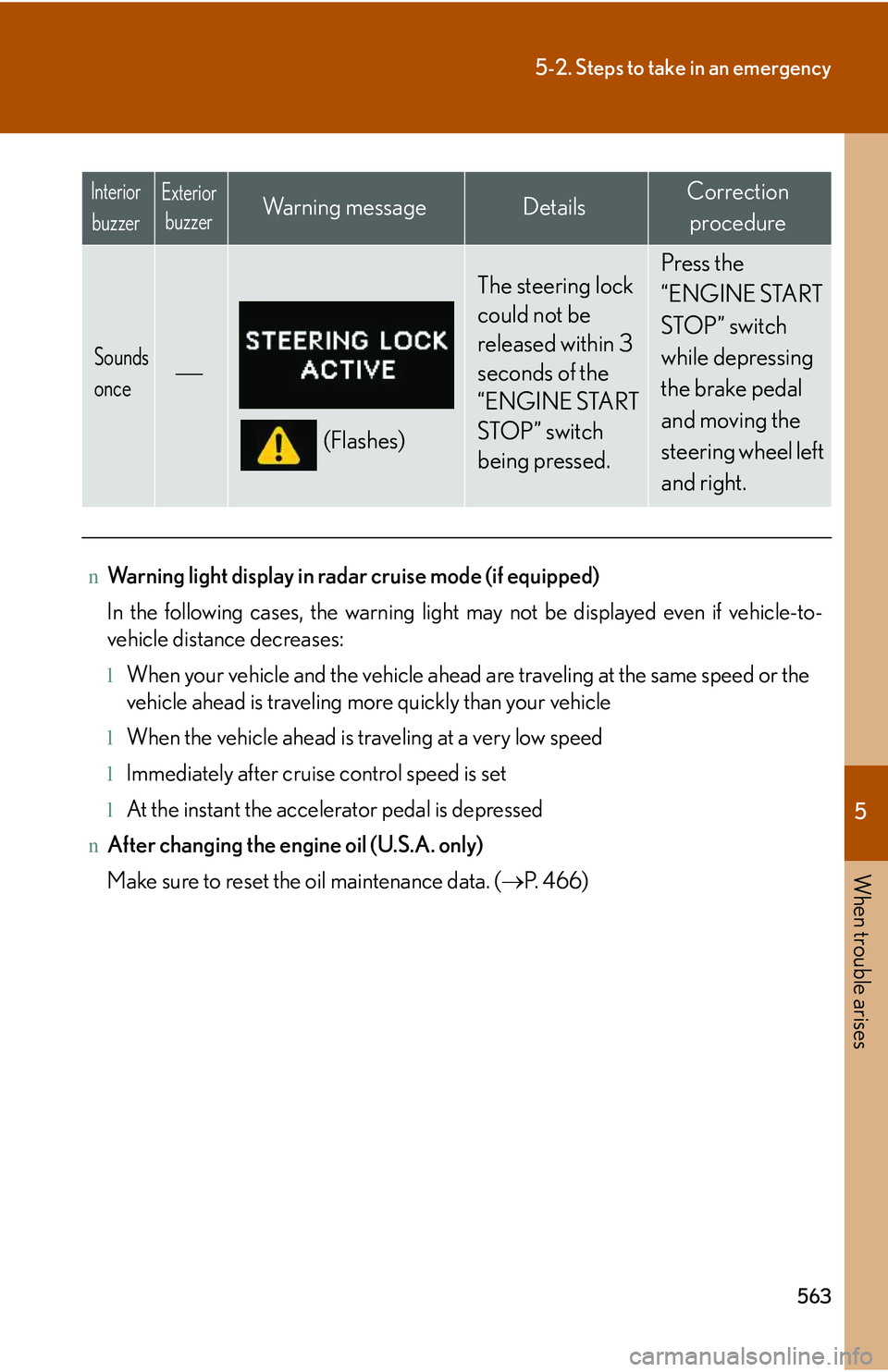
Sounds
once
⎯
(Flashes)
The steering lock
could not be
released within 3
seconds of the
“ENGINE START
STOP” switch
being pressed.
Press the
“ENGINE START
STOP” switch
while depressing
the brake pedal
and moving the
steering wheel left
and right.
nWarning light display in radar cruise mode (if equipped)
In the following cases, the warning light may not be displayed even if vehicle-to-
vehicle distance decreases:
lWhen your vehicle and the vehicle ahead are traveling at the same speed or the
vehicle ahead is traveling more quickly than your vehicle
lWhen the vehicle ahead is traveling at a very low speed
lImmediately after cruise control speed is set
lAt the instant the accelerator pedal is depressed
nAfter changing the engine oil (U.S.A. only)
Make sure to reset the oil maintenance data. (→P. 4 6 6 )
Interior
buzzer Exterior
buzzer
Wa r n i n g m e s s a g eDetailsCorrection
procedure
Page 664 of 821
594
6-1. Specifications
Maintenance data (fuel, oil level, etc.)
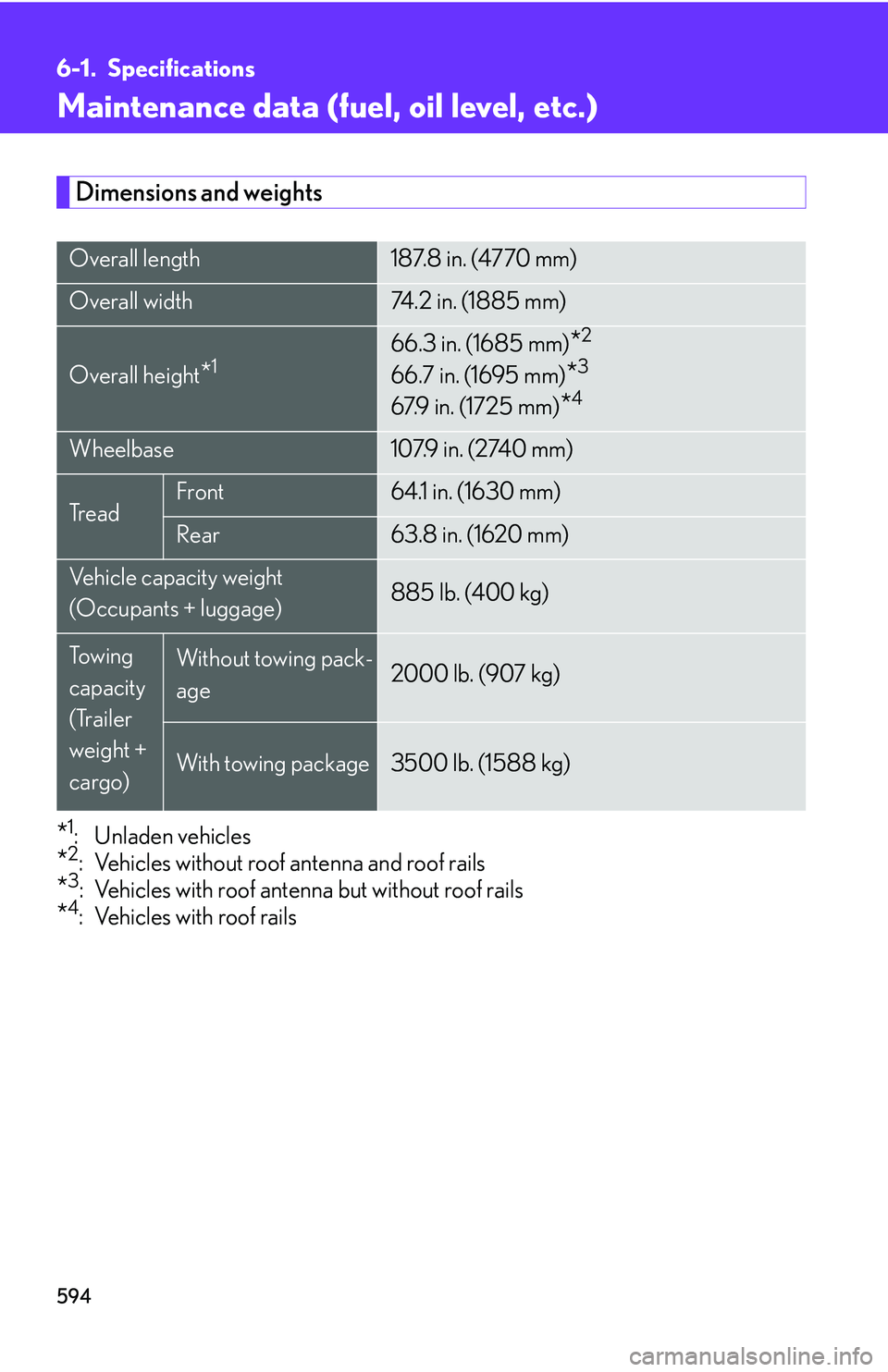
Dimensions and weights
*1:Unladen vehicles
*2: Vehicles without roof antenna and roof rails
*3: Vehicles with roof antenna but without roof rails
*4: Vehicles with roof rails
Overall length187.8 in. (4770 mm)
Overall width74.2 in. (1885 mm)
Overall height*166.3 in. (1685 mm)*2
66.7 in. (1695 mm)*3
67.9 in. (1725 mm)*4
Wheelbase107.9 in. (2740 mm)
Tr e a dFront64.1 in. (1630 mm)
Rear63.8 in. (1620 mm)
Vehicle capacity weight
(Occupants + luggage)885 lb. (400 kg)
To w i n g
capacity
(Trailer
weight +
cargo)
Without towing pack-
age2000 lb. (907 kg)
With towing package3500 lb. (1588 kg)