ignition switch LEXUS SC400 1991 Service Repair Manual
[x] Cancel search | Manufacturer: LEXUS, Model Year: 1991, Model line: SC400, Model: LEXUS SC400 1991Pages: 4087, PDF Size: 75.75 MB
Page 2543 of 4087
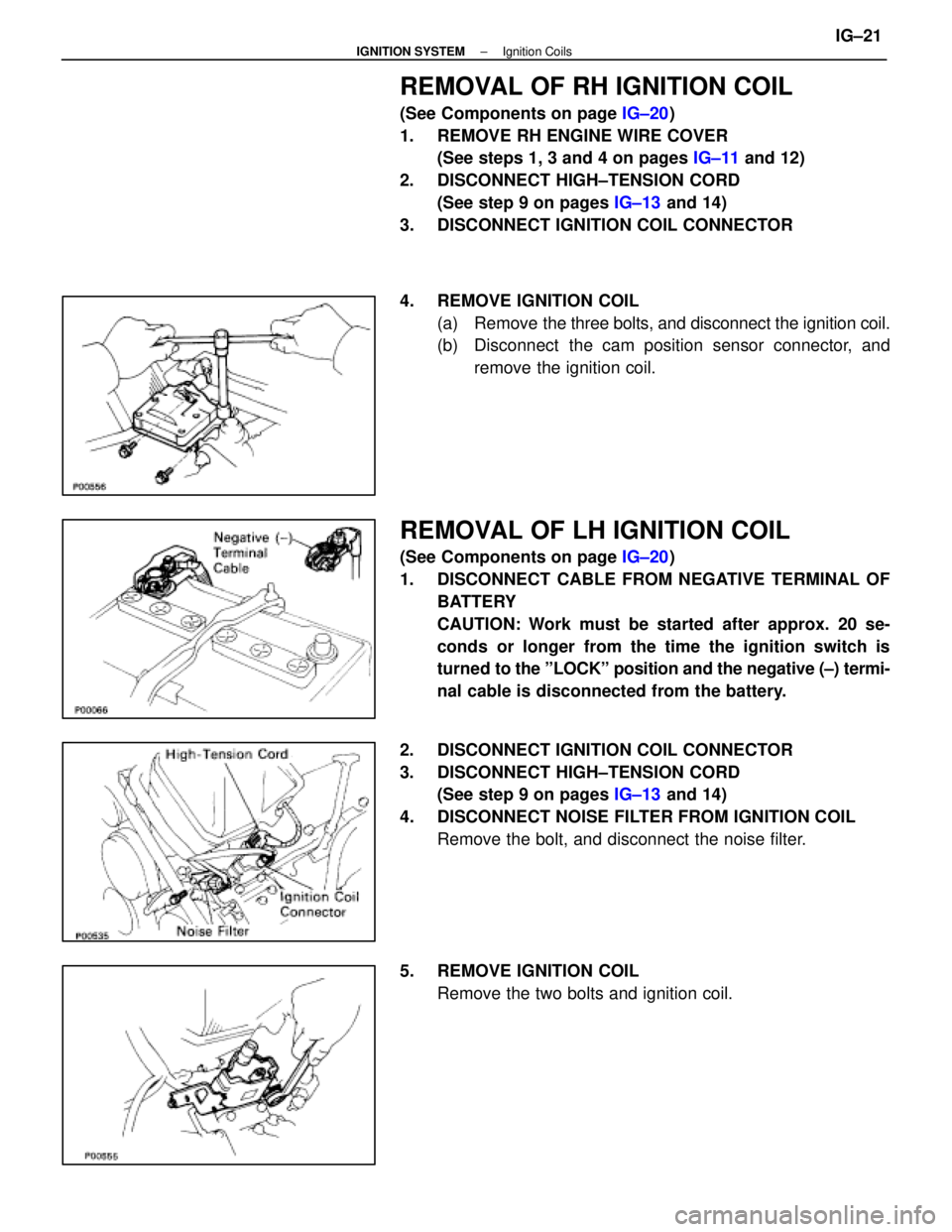
REMOVAL OF RH IGNITION COIL
(See Components on page IG±20)
1. REMOVE RH ENGINE WIRE COVER (See steps 1, 3 and 4 on pages IG±11 and 12)
2. DISCONNECT HIGH±TENSION CORD (See step 9 on pages IG±13 and 14)
3. DISCONNECT IGNITION COIL CONNECTOR
4. REMOVE IGNITION COIL (a) Remove the three bolts, and disconnect the ignition coil.
(b) Disconnect the cam position sensor connector, and
remove the ignition coil.
REMOVAL OF LH IGNITION COIL
(See Components on page IG±20)
1. DISCONNECT CABLE FROM NEGATIVE TERMINAL OF BATTERY
CAUTION: Work must be started after approx. 20 se-
conds or longer from the time the ignition switch is
turned to the ºLOCKº position and the negative (±) termi-
nal cable is disconnected from the battery.
2. DISCONNECT IGNITION COIL CONNECTOR
3. DISCONNECT HIGH±TENSION CORD (See step 9 on pages IG±13 and 14)
4. DISCONNECT NOISE FILTER FROM IGNITION COIL Remove the bolt, and disconnect the noise filter.
5. REMOVE IGNITION COIL Remove the two bolts and ignition coil.
±
IGNITION SYSTEM Ignition CoilsIG±21
WhereEverybodyKnowsYourName
Page 2552 of 4087
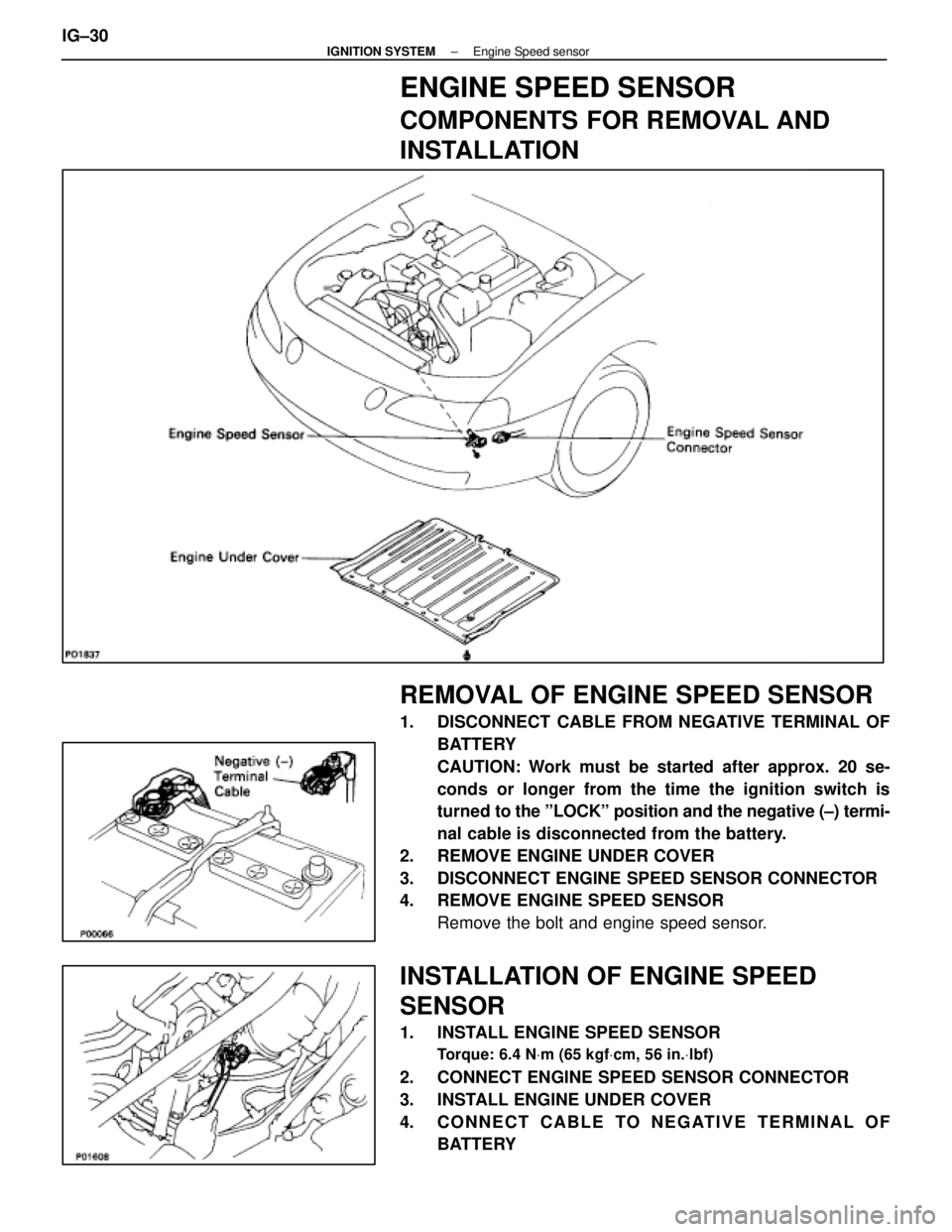
ENGINE SPEED SENSOR
COMPONENTS FOR REMOVAL AND
INSTALLATION
REMOVAL OF ENGINE SPEED SENSOR
1. DISCONNECT CABLE FROM NEGATIVE TERMINAL OFBATTERY
CAUTION: Work must be started after approx. 20 se-
conds or longer from the time the ignition switch is
turned to the ºLOCKº position and the negative (±) termi-
nal cable is disconnected from the battery.
2. REMOVE ENGINE UNDER COVER
3. DISCONNECT ENGINE SPEED SENSOR CONNECTOR
4. REMOVE ENGINE SPEED SENSOR Remove the bolt and engine speed sensor.
INSTALLATION OF ENGINE SPEED
SENSOR
1. INSTALL ENGINE SPEED SENSOR
Torque: 6.4 N Vm (65 kgf Vcm, 56 in. Vlbf)
2. CONNECT ENGINE SPEED SENSOR CONNECTOR
3. INSTALL ENGINE UNDER COVER
4. CONNECT CABLE TO NEGATIVE TERMINAL OF
BATTERY
IG±30
±
IGNITION SYSTEM Engine Speed sensor
WhereEverybodyKnowsYourName
Page 2553 of 4087
IGNITION MAIN RELAY
INSPECTION OF IGNITION MAIN RELAY
1. DISCONNECT CABLE FROM NEGATIVE TERMINAL OFBATTERY
CAUTION: Work must be started after approx. 20 se-
conds or longer from the time the ignition switch is
turned to the ºLOCKº position and the negative (±) termi-
nal cable is disconnected from the battery.
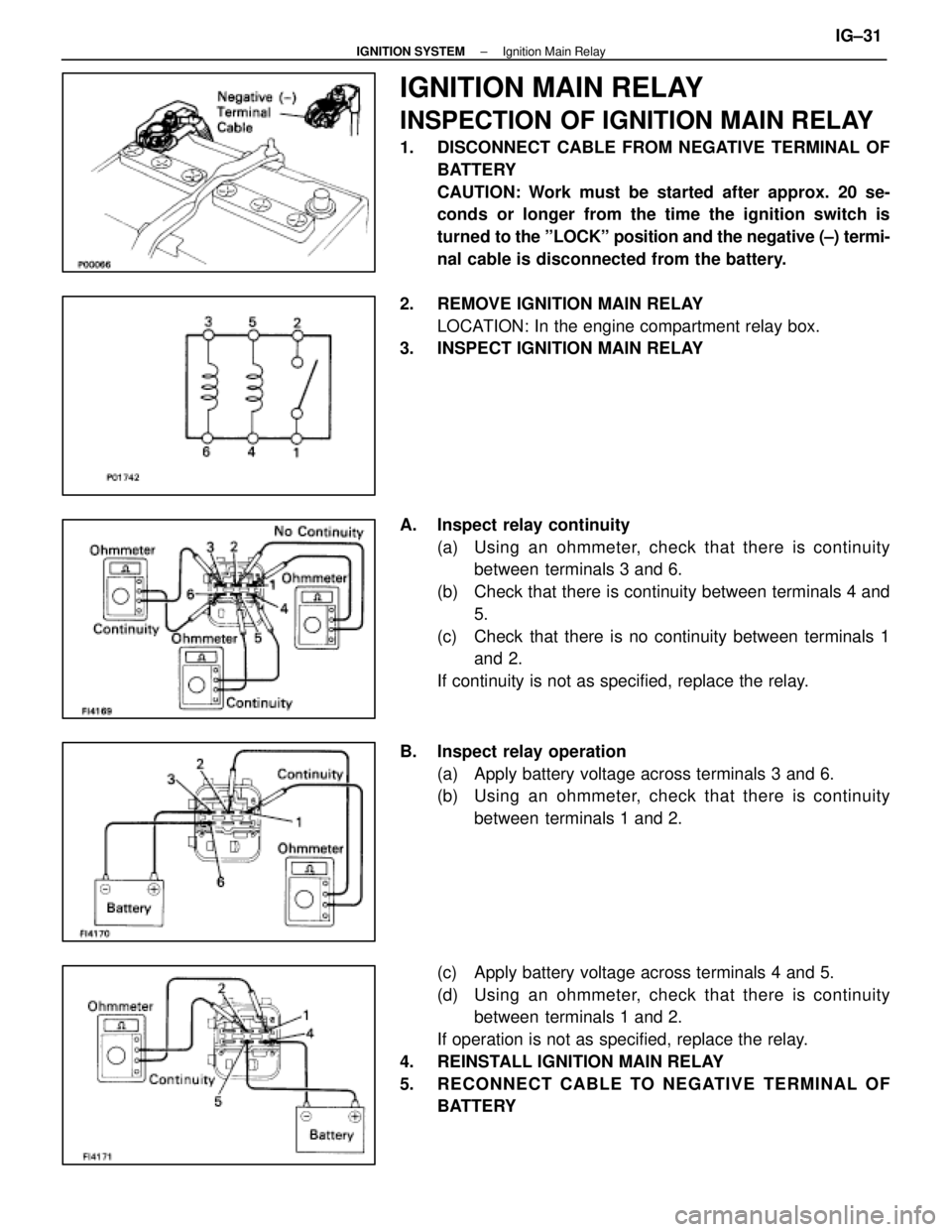
2. REMOVE IGNITION MAIN RELAY LOCATION: In the engine compartment relay box.
3. INSPECT IGNITION MAIN RELAY
A. Inspect relay continuity
(a) Using an ohmmeter, check that there is continuitybetween terminals 3 and 6.
(b) Check that there is continuity between terminals 4 and 5.
(c) Check that there is no continuity between terminals 1 and 2.
If continuity is not as specified, replace the relay.
B. Inspect relay operation (a) Apply battery voltage across terminals 3 and 6.
(b) Using an ohmmeter, check that there is continuitybetween terminals 1 and 2.
(c) Apply battery voltage across terminals 4 and 5.
(d) Using an ohmmeter, check that there is continuity between terminals 1 and 2.
If operation is not as specified, replace the relay.
4. REINSTALL IGNITION MAIN RELAY
5. RECONNECT CABLE TO NEGATIVE TERMINAL OF BATTERY
±
IGNITION SYSTEM Ignition Main RelayIG±31
WhereEverybodyKnowsYourName
Page 2578 of 4087
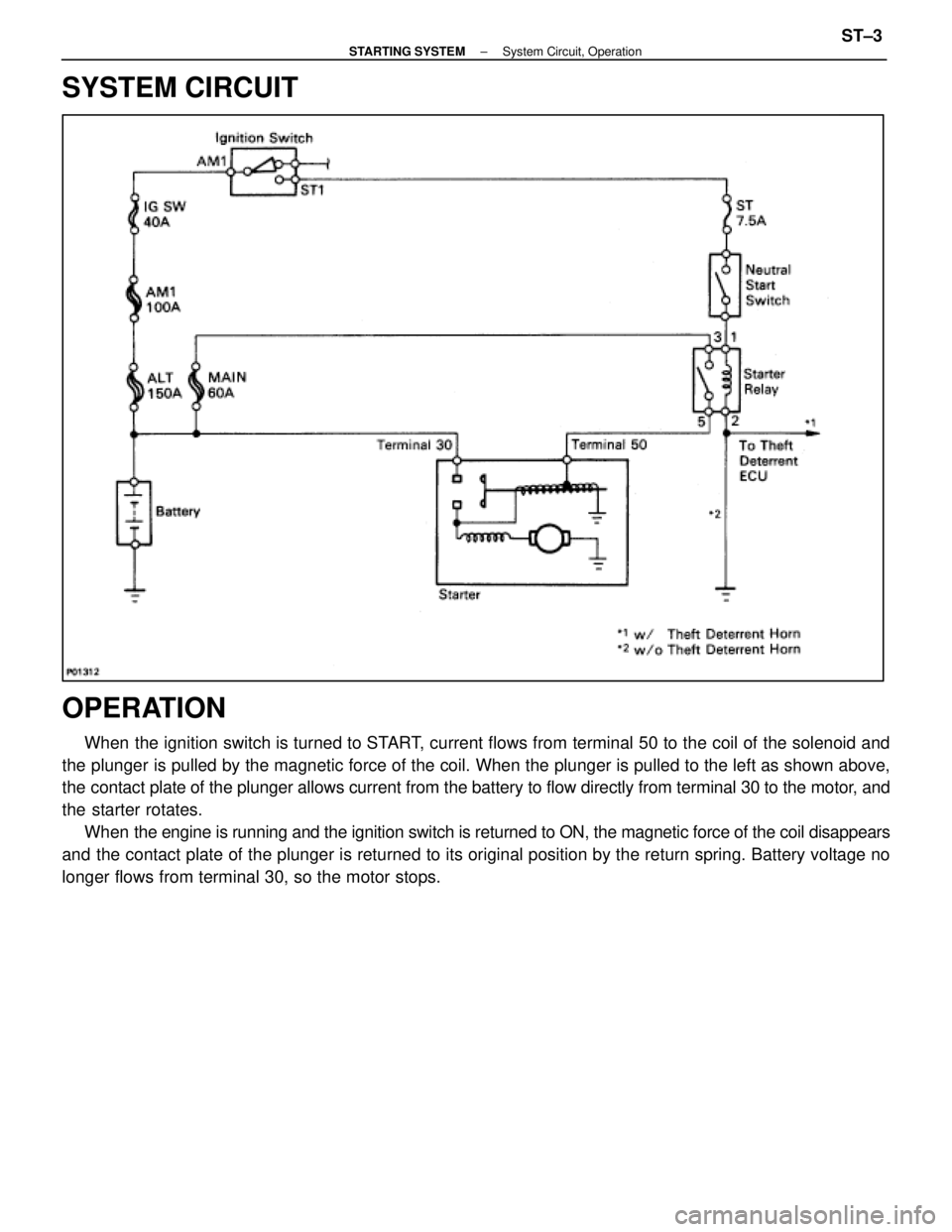
SYSTEM CIRCUIT
OPERATION
When the ignition switch is turned to START, current flows from terminal 50 to the coil of the solenoid and
the plunger is pulled by the magnetic force of the coil. When the plunger is pulled \
to the left as shown above,
the contact plate of the plunger allows current from the battery to flow di\
rectly from terminal 30 to the motor, and
the starter rotates. When the engine is running and the ignition switch is returned to ON, the ma\
gnetic force of the coil disappears
and the contact plate of the plunger is returned to its original position by the return spring. Battery voltage no
longer flows from terminal 30, so the motor stops.
±
STARTING SYSTEM System Circuit, OperationST±3
WhereEverybodyKnowsYourName
Page 2581 of 4087
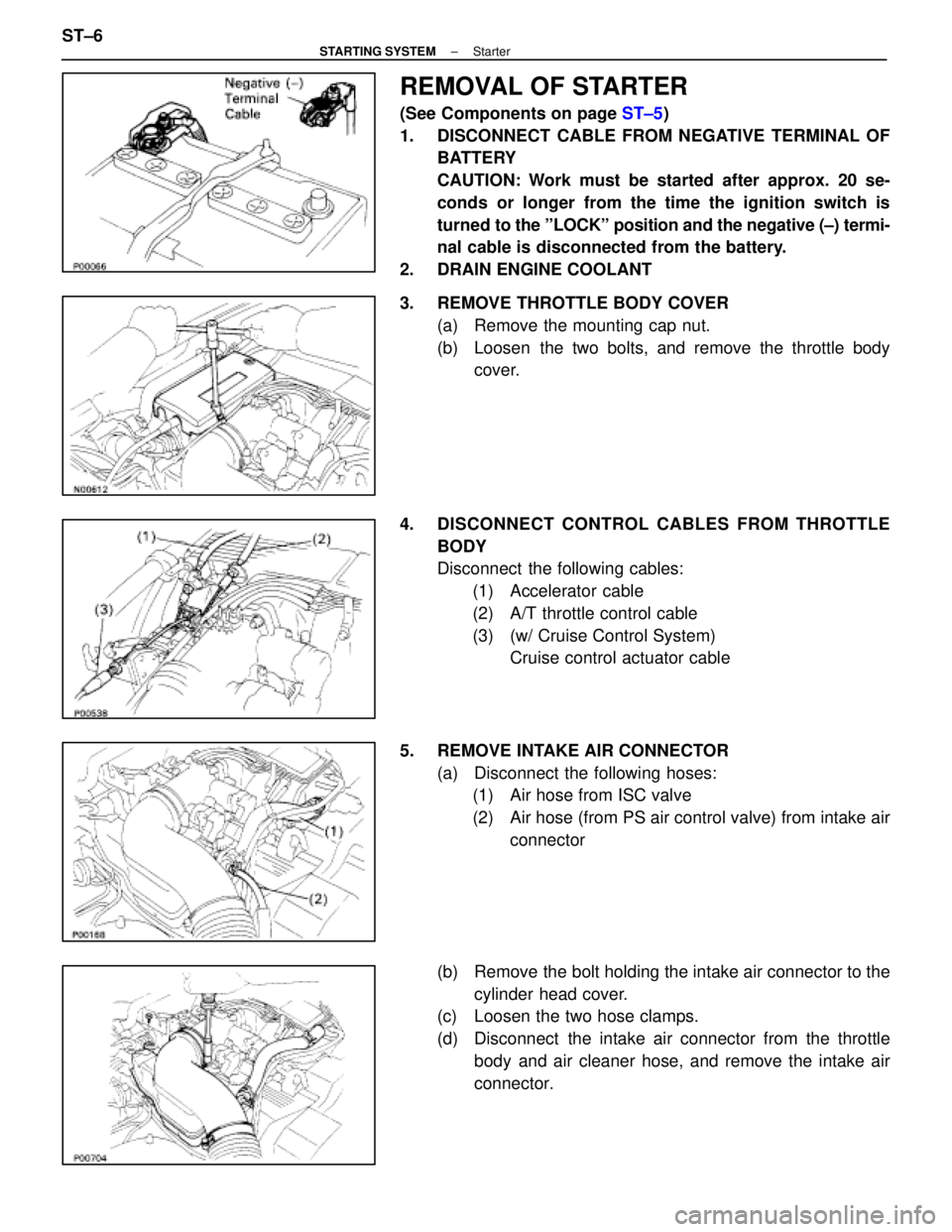
REMOVAL OF STARTER
(See Components on page ST±5)
1. DISCONNECT CABLE FROM NEGATIVE TERMINAL OF BATTERY
CAUTION: Work must be started after approx. 20 se-
conds or longer from the time the ignition switch is
turned to the ºLOCKº position and the negative (±) termi-
nal cable is disconnected from the battery.
2. DRAIN ENGINE COOLANT
3. REMOVE THROTTLE BODY COVER (a) Remove the mounting cap nut.
(b) Loosen the two bolts, and remove the throttle bodycover.
4. DISCONNECT CONTROL CABLES FROM THROTTLE BODY
Disconnect the following cables:(1) Accelerator cable
(2) A/T throttle control cable
(3) (w/ Cruise Control System) Cruise control actuator cable
5. REMOVE INTAKE AIR CONNECTOR (a) Disconnect the following hoses:(1) Air hose from ISC valve
(2) Air hose (from PS air control valve) from intake air
connector
(b) Remove the bolt holding the intake air connector to the cylinder head cover.
(c) Loosen the two hose clamps.
(d) Disconnect the intake air connector from the throttle
body and air cleaner hose, and remove the intake air
connector.
ST±6
±
STARTING SYSTEM Starter
WhereEverybodyKnowsYourName
Page 2610 of 4087
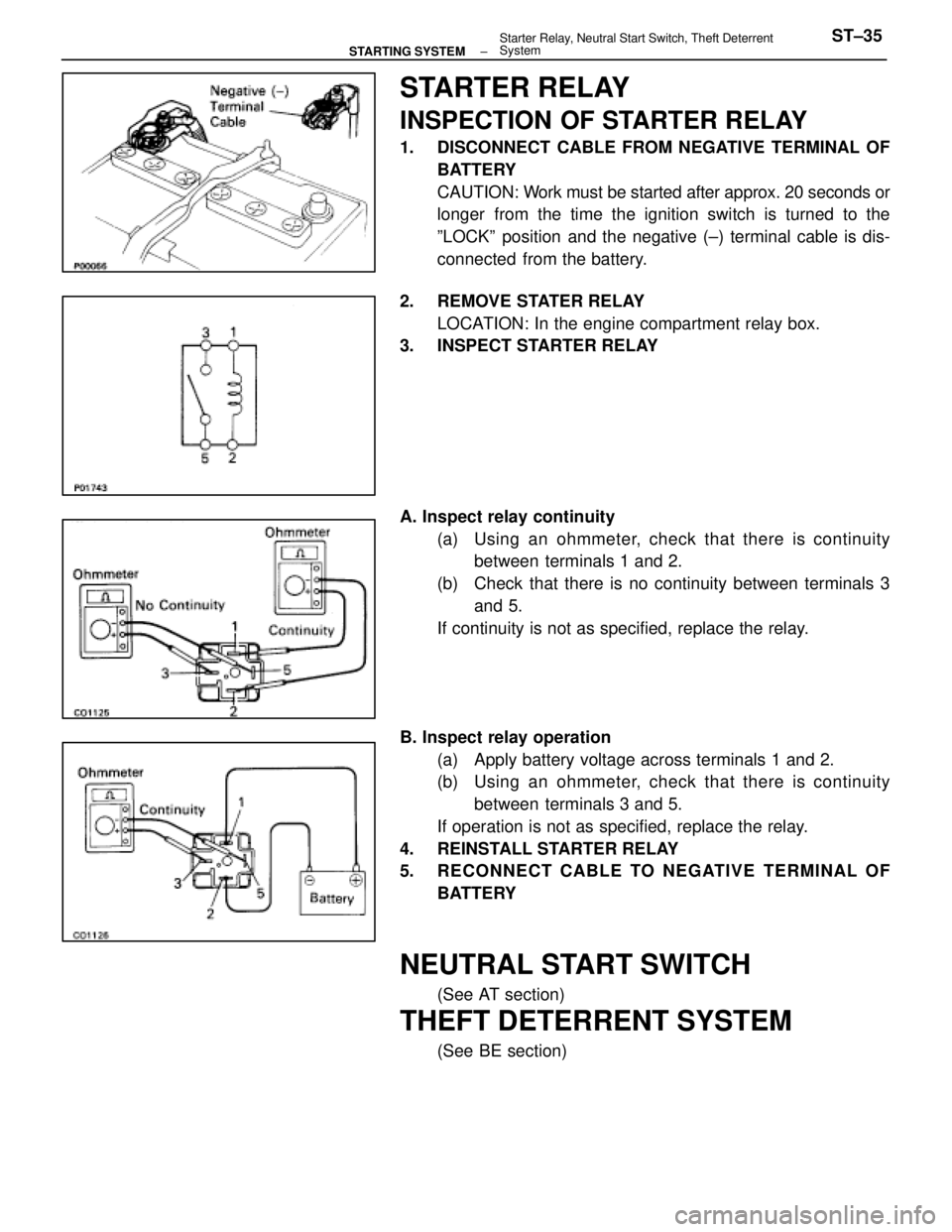
STARTER RELAY
INSPECTION OF STARTER RELAY
1. DISCONNECT CABLE FROM NEGATIVE TERMINAL OFBATTERY
CAUTION: Work must be started after approx. 20 seconds or
longer from the time the ignition switch is turned to the
ºLOCKº position and the negative (±) terminal cable is dis-
connected from the battery.
2. REMOVE STATER RELAY LOCATION: In the engine compartment relay box.
3. INSPECT STARTER RELAY
A. Inspect relay continuity
(a) Using an ohmmeter, check that there is continuitybetween terminals 1 and 2.
(b) Check that there is no continuity between terminals 3 and 5.
If continuity is not as specified, replace the relay.
B. Inspect relay operation (a) Apply battery voltage across terminals 1 and 2.
(b) Using an ohmmeter, check that there is continuitybetween terminals 3 and 5.
If operation is not as specified, replace the relay.
4. REINSTALL STARTER RELAY
5. RECONNECT CABLE TO NEGATIVE TERMINAL OF BATTERY
NEUTRAL START SWITCH
(See AT section)
THEFT DETERRENT SYSTEM
(See BE section)
±
STARTING SYSTEM Starter Relay, Neutral Start Switch, Theft Deterrent
SystemST±35
WhereEverybodyKnowsYourName
Page 2621 of 4087
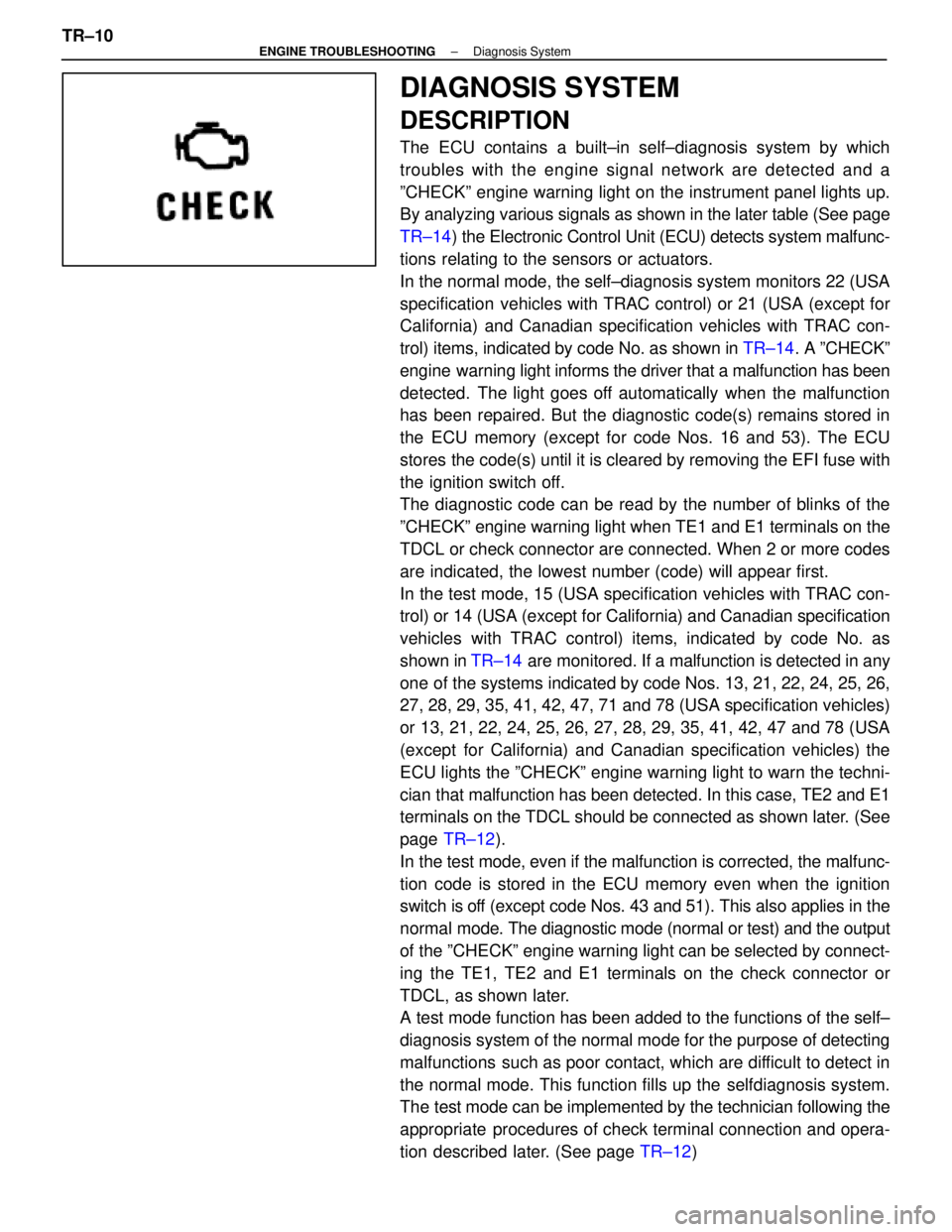
DIAGNOSIS SYSTEM
DESCRIPTION
The ECU contains a built±in self±diagnosis system by which
troubles with the engine signal network are detected and a
ºCHECKº engine warning light on the instrument panel lights up.
By analyzing various signals as shown in the later table (See page
TR±14) the Electronic Control Unit (ECU) detects system malfunc-
tions relating to the sensors or actuators.
In the normal mode, the self±diagnosis system monitors 22 (USA
specification vehicles with TRAC control) or 21 (USA (except for
California) and Canadian specification vehicles with TRAC con-
trol) items, indicated by code No. as shown in TR±14. A ºCHECKº
engine warning light informs the driver that a malfunction has been
detected. The light goes off automatically when the malfunction
has been repaired. But the diagnostic code(s) remains stored in
the ECU memory (except for code Nos. 16 and 53). The ECU
stores the code(s) until it is cleared by removing the EFI fuse with
the ignition switch off.
The diagnostic code can be read by the number of blinks of the
ºCHECKº engine warning light when TE1 and E1 terminals on the
TDCL or check connector are connected. When 2 or more codes
are indicated, the lowest number (code) will appear first.
In the test mode, 15 (USA specification vehicles with TRAC con-
trol) or 14 (USA (except for California) and Canadian specification
vehicles with TRAC control) items, indicated by code No. as
shown in TR±14 are monitored. If a malfunction is detected in any
one of the systems indicated by code Nos. 13, 21, 22, 24, 25, 26,
27, 28, 29, 35, 41, 42, 47, 71 and 78 (USA specification vehicles)
or 13, 21, 22, 24, 25, 26, 27, 28, 29, 35, 41, 42, 47 and 78 (USA
(except for California) and Canadian specification vehicles) the
ECU lights the ºCHECKº engine warning light to warn the techni-
cian that malfunction has been detected. In this case, TE2 and E1
terminals on the TDCL should be connected as shown later. (See
page TR±12 ).
In the test mode, even if the malfunction is corrected, the malfunc-
tion code is stored in the ECU memory even when the ignition
switch is off (except code Nos. 43 and 51). This also applies in the
normal mode. The diagnostic mode (normal or test) and the output
of the ºCHECKº engine warning light can be selected by connect-
ing the TE1, TE2 and E1 terminals on the check connector or
TDCL, as shown later.
A test mode function has been added to the functions of the self±
diagnosis system of the normal mode for the purpose of detecting
malfunctions such as poor contact, which are difficult to detect in
the normal mode. This function fills up the selfdiagnosis system.
The test mode can be implemented by the technician following the
appropriate procedures of check terminal connection and opera-
tion described later. (See page TR±12)
TR±10
±
ENGINE TROUBLESHOOTING Diagnosis System
WhereEverybodyKnowsYourName
Page 2622 of 4087
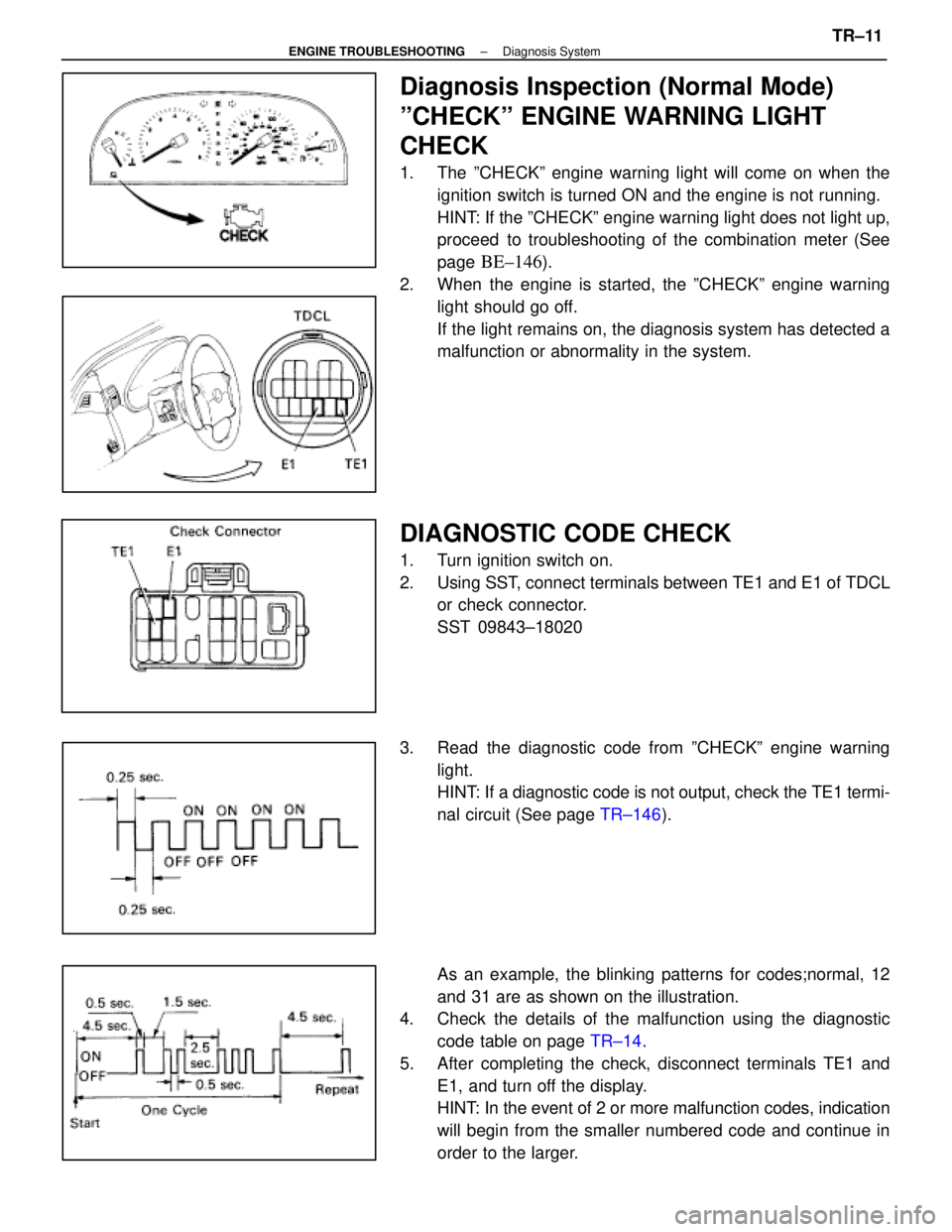
Diagnosis Inspection (Normal Mode)
ºCHECKº ENGINE WARNING LIGHT
CHECK
1. The ºCHECKº engine warning light will come on when theignition switch is turned ON and the engine is not running.
HINT: If the ºCHECKº engine warning light does not light up,
proceed to troubleshooting of the combination meter (See
page
BE±146).
2. When the engine is started, the ºCHECKº engine warning light should go off.
If the light remains on, the diagnosis system has detected a
malfunction or abnormality in the system.
DIAGNOSTIC CODE CHECK
1. Turn ignition switch on.
2. Using SST, connect terminals between TE1 and E1 of TDCLor check connector.
SST 09843±18020
3. Read the diagnostic code from ºCHECKº engine warning light.
HINT: If a diagnostic code is not output, check the TE1 termi-
nal circuit (See page TR±146).
As an example, the blinking patterns for codes;normal, 12
and 31 are as shown on the illustration.
4. Check the details of the malfunction using the diagnostic
code table on page TR±14.
5. After completing the check, disconnect terminals TE1 and E1, and turn off the display.
HINT: In the event of 2 or more malfunction codes, indication
will begin from the smaller numbered code and continue in
order to the larger.
±
ENGINE TROUBLESHOOTING Diagnosis SystemTR±11
WhereEverybodyKnowsYourName
Page 2623 of 4087
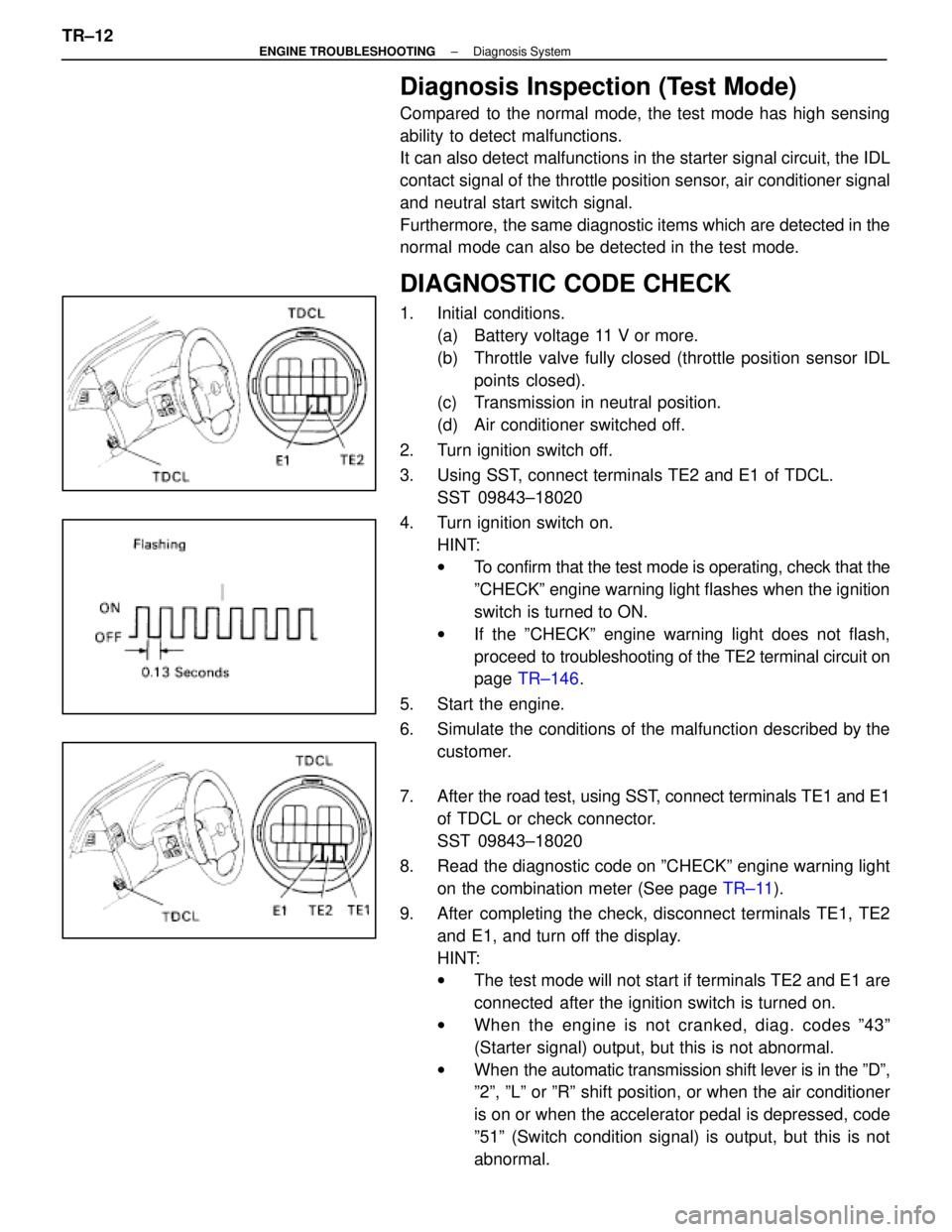
Diagnosis Inspection (Test Mode)
Compared to the normal mode, the test mode has high sensing
ability to detect malfunctions.
It can also detect malfunctions in the starter signal circuit, the IDL
contact signal of the throttle position sensor, air conditioner signal
and neutral start switch signal.
Furthermore, the same diagnostic items which are detected in the
normal mode can also be detected in the test mode.
DIAGNOSTIC CODE CHECK
1. Initial conditions.(a) Battery voltage 11 V or more.
(b) Throttle valve fully closed (throttle position sensor IDLpoints closed).
(c) Transmission in neutral position.
(d) Air conditioner switched off.
2. Turn ignition switch off.
3. Using SST, connect terminals TE2 and E1 of TDCL. SST 09843±18020
4. Turn ignition switch on. HINT:
wTo confirm that the test mode is operating, check that the
ºCHECKº engine warning light flashes when the ignition
switch is turned to ON.
w If the ºCHECKº engine warning light does not flash,
proceed to tro ubleshooting of the TE2 terminal circuit on
page TR±146 .
5. Start the engine.
6. Simulate the conditions of the malfunction described by the customer.
7. After the road test, using SST, connect terminals TE1 and E1
of TDCL or check connector.
SST 09843±18020
8. Read the diagnostic code on ºCHECKº engine warning light on the combination meter (See page TR±11).
9. After completing the check, disconnect terminals TE1, TE2 and E1, and turn off the display.
HINT:
wThe test mode will not start if terminals TE2 and E1 are
connected after the ignition switch is turned on.
w When the engine is not cranked, diag. codes º43º
(Starter signal) output, but this is not abnormal.
w When the automatic transmission shift lever is in the ºDº,
º2º, ºLº or ºRº shift position, or when the air conditioner
is on or when the accelerator pedal is depressed, code
º51º (Switch condition signal) is output, but this is not
abnormal.
TR±12
±
ENGINE TROUBLESHOOTING Diagnosis System
WhereEverybodyKnowsYourName
Page 2624 of 4087
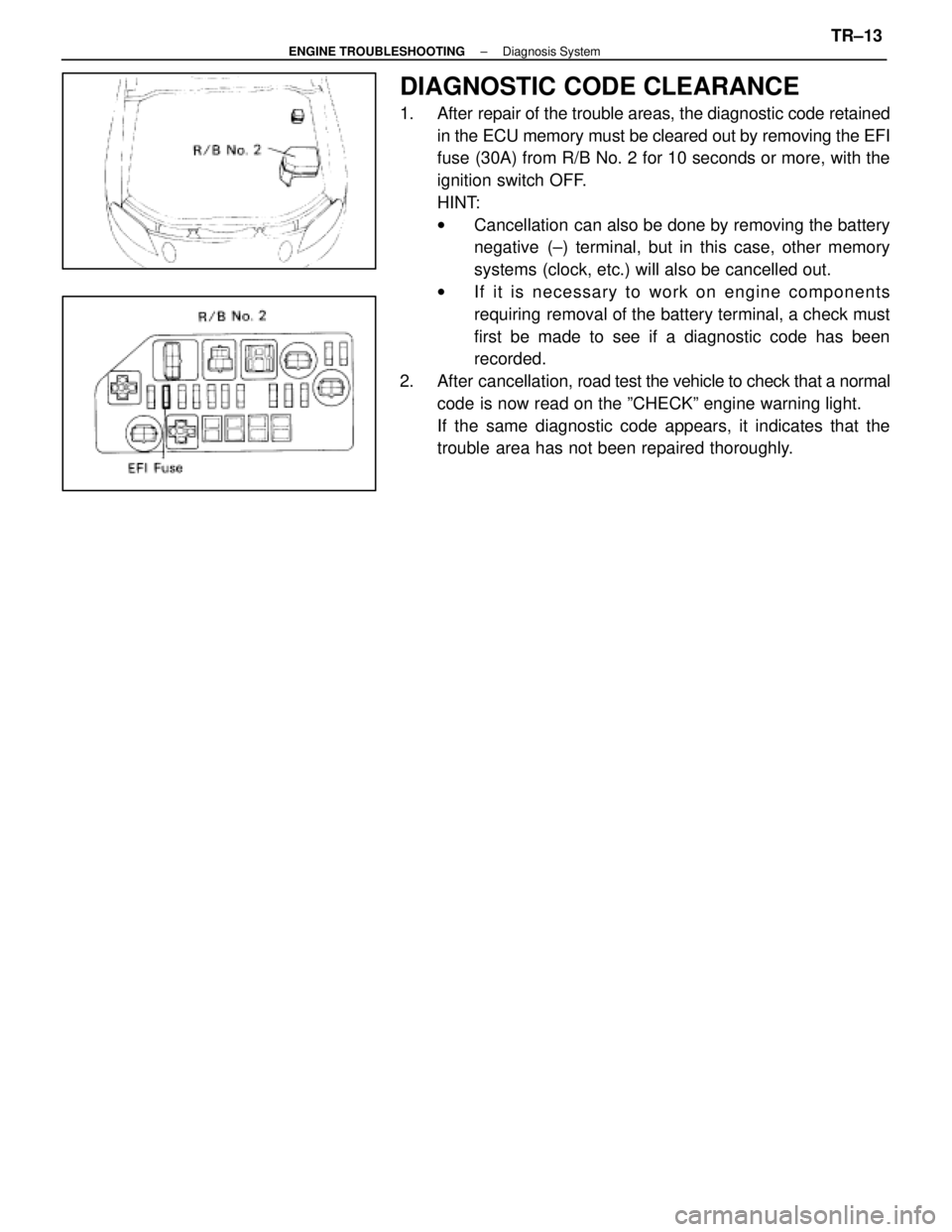
DIAGNOSTIC CODE CLEARANCE
1. After repair of the trouble areas, the diagnostic code retainedin the ECU memory must be cleared out by removing the EFI
fuse (30A) from R/B No. 2 for 10 seconds or more, with the
ignition switch OFF.
HINT:
wCancellation can also be done by removing the battery
negative (±) terminal, but in this case, other memory
systems (clock, etc.) will also be cancelled out.
w If it is necessary to work on engine components
requiring removal of the battery terminal, a check must
first be made to see if a diagnostic code has been
recorded.
2. After cancellation, road test the vehicle to check that a normal
code is now read on the ºCHECKº engine warning light.
If the same diagnostic code appears, it indicates that the
trouble area has not been repaired thoroughly.
±
ENGINE TROUBLESHOOTING Diagnosis SystemTR±13
WhereEverybodyKnowsYourName