ECO mode LINCOLN AVIATOR 2023 Owner's Guide
[x] Cancel search | Manufacturer: LINCOLN, Model Year: 2023, Model line: AVIATOR, Model: LINCOLN AVIATOR 2023Pages: 681, PDF Size: 9.33 MB
Page 222 of 681
• Keep the tires properly inflated and only
use the recommended size.
• Aggressive driving increases the amount
of energy required to move your vehicle.
In general, you can achieve better fuel
economy with mild to moderate
acceleration and deceleration. Moderate
braking is particularly important since it
allows you to maximize the energy
captured by the regenerative braking
system.
Additional Tips:
• Do not carry extra loads.
• Be mindful of adding external
accessories that may increase
aerodynamic drag.
• Observe posted speed limits.
• Perform all scheduled maintenance.
• There is no need to wait for your engine
to warm up. The vehicle is ready to drive
immediately after starting.PLUG-IN HYBRID VEHICLE
OPERATION
Regularly plug in your vehicle to get optimal
electric-only range capability from the high
voltage battery. Charging your vehicle adds
electrical energy. This energy propels the
vehicle.
Estimated electric-only driving range shows
in blue next to the gasoline range on the
information display.
The system maximizes the use of
electric-only operation in normal drive mode.
System conditions could require the engine
to operate, however, the system uses the
available electric range whenever possible.
In Pure EV drive mode, your vehicle only
uses electric power unless you enable the
engine, or system conditions require the
engine to operate.Preserve EV drive mode saves the electric
range for later use. If you select this mode
and the battery is at full or near full charge,
it uses some electric-only range to discharge
the battery. This allows the regenerative
braking system to fully operate. If the battery
charge is low when selecting Preserve EV
mode, the engine charges the high voltage
battery to a minimum level. This provides
additional electric driving range. When the
battery charges to this level, Preserve EV
saves the electric range for later use.
Other drive modes appropriately make use
of electric power to help deliver the selected
drive mode experience. It could use available
electric-only range, if needed. See What Is
Drive Mode Control (page 343).
219
Unique Driving Characteristics
Page 223 of 681
When the electric-only range reaches zero,
the powertrain system switches to hybrid
operation. This means the energy you gain
from plugging in and charging your vehicle
is now gone. Both the gasoline engine and
electric motor power your vehicle and
maximize fuel economy during hybrid
operation. Hybrid operation provides some
electric-only driving as the powertrain system
maintains the high voltage battery charge
level within functional limits.Low Engine Use
The low engine use mode properly lubricates
the engine at sufficient temperature and
activates when you drive your vehicle with
limited engine operation. When in low engine
use mode, your vehicle runs the engine as
necessary. When low engine use mode
begins, a message appears in the information
display. If low engine use mode does not
complete before you switch your vehicle off,
it continues the next time you start your
vehicle and the message reappears. See
Information Messages (page 142).Pure EV mode is not available during low
engine use mode.
Note:Cold temperatures affect the engine
warm up time and the low engine use mode
could operate more frequently.
Note:An oil change is not required but gives
you the option of not running a low engine
use cycle. Resetting the oil life monitoring
system suspends the low engine use mode.
220
Unique Driving Characteristics
Page 254 of 681
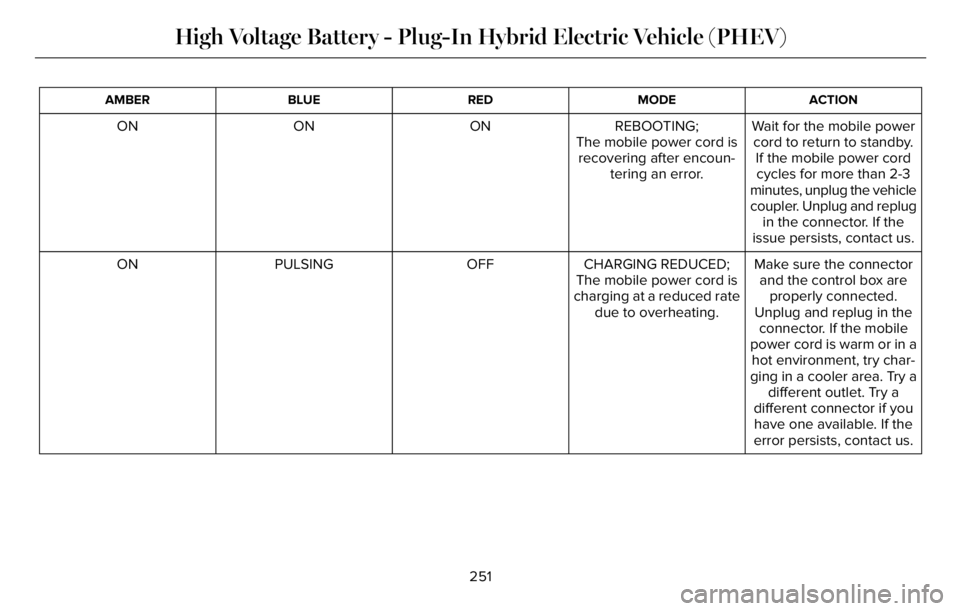
ACTION MODE RED BLUE AMBER
Wait for the mobile power
cord to return to standby.
If the mobile power cord
cycles for more than 2-3
minutes, unplug the vehicle
coupler. Unplug and replug
in the connector. If the
issue persists, contact us. REBOOTING;
The mobile power cord is
recovering after encoun-
tering an error. ON ON ON
Make sure the connector
and the control box are
properly connected.
Unplug and replug in the
connector. If the mobile
power cord is warm or in a CHARGING REDUCED;
The mobile power cord is
charging at a reduced rate
due to overheating. OFF PULSING ON
hot environment, try char-
ging in a cooler area. Try a
different outlet. Try a
different connector if you
have one available. If the
error persists, contact us.
251
High Voltage Battery - Plug-In Hybrid Electric Vehicle (PHEV)
Page 256 of 681
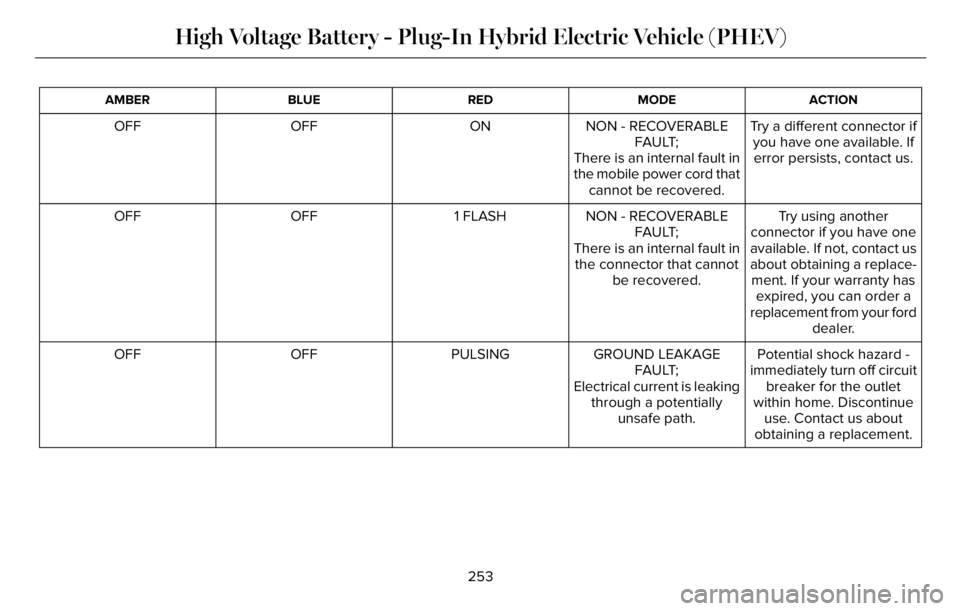
ACTION MODE RED BLUE AMBER
Try a different connector if
you have one available. If
error persists, contact us. NON - RECOVERABLE
FAULT;
There is an internal fault in
the mobile power cord that
cannot be recovered. ON OFF OFF
Try using another
connector if you have one
available. If not, contact us
about obtaining a replace-
ment. If your warranty has
expired, you can order a
replacement from your ford
dealer. NON - RECOVERABLE
FAULT;
There is an internal fault in
the connector that cannot
be recovered. 1 FLASH OFF OFF
Potential shock hazard -
immediately turn off circuit
breaker for the outlet
within home. Discontinue
use. Contact us about
obtaining a replacement. GROUND LEAKAGE
FAULT;
Electrical current is leaking
through a potentially
unsafe path. PULSING OFF OFF
253
High Voltage Battery - Plug-In Hybrid Electric Vehicle (PHEV)
Page 263 of 681
Note:A warning tone sounds if you open the
driver door and you have not shifted the
transmission selector to park (P).
Reverse (R)
With the transmission selector in reverse (R),
your vehicle moves backward. Always come
to a complete stop before shifting into and
out of reverse (R).
Neutral (N)
With the transmission selector in neutral (N),
you can start your vehicle and it is free to
roll. Hold the brake pedal down when in this
position.
Drive (D)
Drive (D) is the normal driving position for
the best fuel economy and smoothness. Shift
the transmission selector to drive (D) to allow
your vehicle to move forward and shift
through the forward gears.
The transmission shifts to the appropriate
gear for optimum performance based on
ambient temperature, road slope, vehicle
load and your input.Automatic Return to Park
Your vehicle shifts into park (P) when your
vehicle is stationary and any of the following
occur:
• You switch the vehicle off.
• You open the driver door with your
seatbelt unlatched.
• You unlatch the driver seatbelt when the
driver door is open.
Note:Do not use automatic return to park
(P) when your vehicle is moving, except in
an emergency.
Automatic return to park (P) may not work if
the door ajar switch is malfunctioning.See an authorized dealer if any of the
following occur:
• Door ajar indicator does not illuminate
with the driver door open.
• Door ajar indicator illuminates with the
driver door closed.
• Transmission not in park message
appears with the driver door closed, after
you shift out of park (P). You unlatch the
driver seatbelt when the driver door is
open.
Stay in Neutral Mode
This mode keeps your vehicle in neutral (N)
when you switch your vehicle off. Use this
mode at an automatic car wash if you exit
your vehicle, or switch your vehicle off.
Note:Automatic return to park (P) is delayed
when your vehicle is in this mode.
Your vehicle could shift to park (P) after 30
minutes, or when the vehicle battery charge
level is low. Prolonged use of this mode can
cause the vehicle battery to run out of
charge.
260
Transmission
Page 264 of 681
Do not tow your vehicle in this mode. Failure
to follow these instructions could result in
vehicle damage not covered by the vehicle
warranty.
Entering Temporary Neutral Mode
1. Power your vehicle on.
2. Bring your vehicle to a complete stop.
3. Press and hold the brake pedal.
4. Shift into neutral (N).
Note:An instructional message appears.
5. Press the neutral (N) button.
Note:A confirmation message appears
when your vehicle enters the mode.
6. Release the brake pedal.
Note:Your vehicle is free to roll.
7. Switch your vehicle off.
Note:Do not tow your vehicle in this mode.
Note:The neutral (N) indicator on the
transmission selector may flash in this mode.
Exiting Temporary Neutral Mode
1. Press the brake pedal.2. Shift into park (P), or power your vehicle
on and shift into drive (D) or reverse (R).
Manually Shifting Gears
The instrument cluster displays the current
gear. The current gear flashes when your
vehicle cannot shift into the requested gear.
Your vehicle will not shift if the requested
gear raises or lowers the engine speed
beyond the limit.
Your vehicle could shift when you fully press
the accelerator or brake pedal.
Note:Prolonged driving with high engine
speed could cause vehicle damage not
covered by vehicle warranty.
Note:Drive modes could affect when the
vehicle shifts into the requested gear.
E144821
Manually Shifting Gears in Drive (D)
Use this feature to temporarily change gear.
Note:We recommend using this feature for
engine braking or driving on hilly or
mountainous roads.
• Pull any paddle to switch the feature on.
• Pull the right (+) paddle to upshift.
• Pull the left (-) paddle to downshift.
• Hold the + paddle for a few seconds to
switch the feature off.
Note:The feature switches off after a short
period of time if neither paddle is pulled.
Manual Park Release
WARNING: When doing this
procedure, you need to take the
transmission out of park (P) which means
your vehicle can roll freely. To avoid
unwanted vehicle movement, apply the
parking brake prior to doing this
procedure. Use wheel chocks if
appropriate.
261
Transmission
Page 266 of 681
Note:A screwdriver tool longer than 4.7 in
(120 mm) could hit the underside of the
armrest console before you achieve full
travel of the detent.
6. With your foot still fully applied on the
brake pedal, disengage the parking
brake. See Electric Parking Brake (page
272).
7. Your vehicle remains in neutral (N) for
emergency towing purposes.
8. Switch off the ignition.
9. Once it is safe to do so, and there is no
risk of your vehicle rolling, disconnect
the negative, black, battery cable from
the battery.
Returning Your Vehicle to Normal Mode
1. Once it is safe to do so, reconnect the
negative, black, battery cable to the
battery.
2. Apply the parking brake. See Electric
Parking Brake (page 272).
Note: If the vehicle battery is dead, you
could require an external power source to
apply the parking brake.3. Fully apply the brake pedal and hold, do
not release.
4. Insert the screwdriver fully into the
Manual Park Release lever slot. Push the
tool downwards. The system detent
releases and the Manual Park Release
lever moves forward, allowing the vehicle
to go back into the park (P) position.
Remove the screwdriver.
5. Install the access cover.
6. With your foot fully applied on the brake
pedal, start your vehicle. Confirm that
your vehicle is in the park (P) position and
that the instrument cluster indicates park
(P).
7. If the instrument cluster does not display
the park (P) position or there is a
message stating Park Not Available,
Transmission Not In Park or Shift System
Fault, apply the parking brake before
exiting your vehicle. Contact an
authorized dealer.If Your Vehicle Gets Stuck in Mud or
Snow
If your vehicle gets stuck in the mud or snow,
you can rock it out by shifting between
forward and reverse gears, stopping
between shifts in a steady pattern. Press
lightly on the accelerator in each gear.
Note:Do not rock the vehicle if the engine
is not at normal operating temperature or
damage to the transmission could occur.
Note:Do not rock the vehicle for more than
a minute or damage to the transmission and
tires could occur, or the engine could
overheat.
263
Transmission
Page 267 of 681
USING ALL-WHEEL DRIVE
WARNING: Vehicles with a higher
center of gravity (utility and four-wheel
drive vehicles) handle differently than
vehicles with a lower center of gravity
(passenger cars). Avoid sharp turns,
excessive speed and abrupt steering in
these vehicles. Failure to drive cautiously
increases the risk of losing control of your
vehicle, vehicle rollover, personal injury
and death.
WARNING: Do not become
overconfident in the ability of all-wheel
drive vehicles. Although an all-wheel drive
vehicle may accelerate better than a
two-wheel drive vehicle in low traction
situations, it won't stop any faster than
two-wheel drive vehicles. Always drive at
a safe speed.The intelligent AWD system continuously
monitors vehicle conditions and adjusts the
power distribution between the front and
rear wheels. It combines transparent
all-surface operation with highly capable
all-wheel drive.
The AWD system is always active and
requires no driver input. It is capable of
handling all road conditions including street
and highway driving as well as off-road and
winter driving. You can optimize more AWD
control by selecting different drive modes.
See Selecting a Drive Mode (page 343).
Note:A warning message displays in the
information display when an AWD system
fault is present. See Information Messages
(page 142). A AWD system fault causes the
AWD system to default to rear-wheel drive
only mode. When this warning message
displays, have your vehicle serviced.Note:A warning message displays in the
information display if the AWD system
overheats. See Information Messages
(page 142). This condition could occur if you
operate your vehicle in extreme conditions
with excessive wheel slip, such as deep
sand. To resume normal AWD function as
soon as possible, stop the vehicle in a safe
location and stop the engine for at least 10
minutes. After you restart the engine and the
AWD system adequately cools, the warning
message turns off and normal AWD function
returns.Operating All-Wheel Drive (AWD)
Vehicles With Spare Tires
Do not use a different size spare tire other
than the tire provided. If the mini-spare tire
is installed, the AWD system will disable and
enter rear-wheel drive only mode to protect
driveline components. Some limited AWD
traction could be provided if the mini-spare
is installed on one of the front wheels. If you
are in driving conditions where limited AWD
traction is needed while the mini-spare is
installed, it is recommended the mini-spare
be installed on the front axle.
264
All-Wheel Drive (If Equipped)
Page 296 of 681
WARNING: Do not use the system
with accessories that extend beyond the
front or rear of your vehicle, for example a
trailer hitch, bike rack or side mirror
extensions such as telescoping mirrors or
towing mirrors. The system is not able to
make corrections for the additional length
of the accessories.
The system assists parking into and out of
parking spaces. Sensors are used to detect
parking spaces. The system then steers,
accelerates, brakes and shifts gear as
required to maneuver into or out of a parking
space.
Using Active Park Assist
E301E301111212
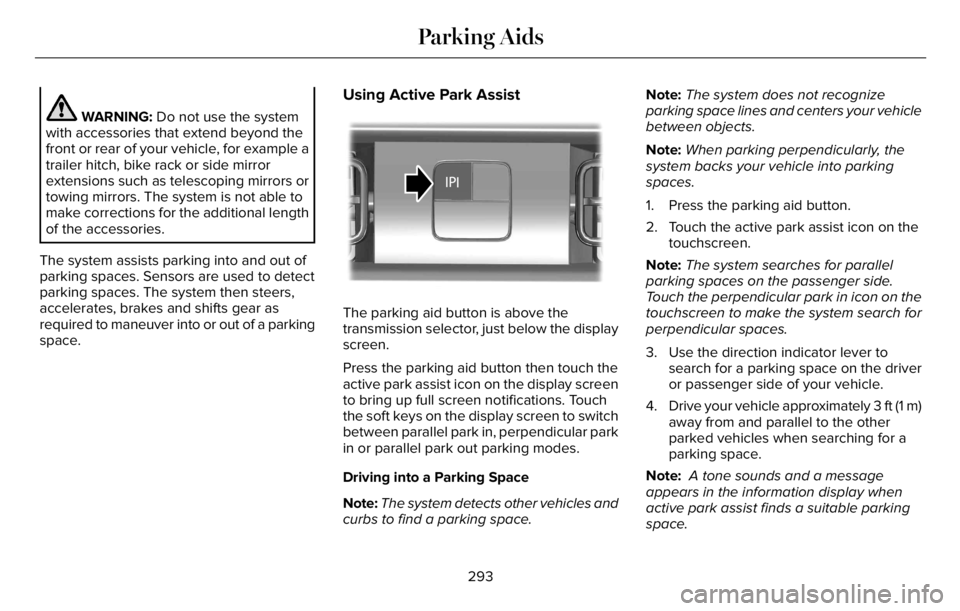
The parking aid button is above the
transmission selector, just below the display
screen.
Press the parking aid button then touch the
active park assist icon on the display screen
to bring up full screen notifications. Touch
the soft keys on the display screen to switch
between parallel park in, perpendicular park
in or parallel park out parking modes.
Driving into a Parking Space
Note:The system detects other vehicles and
curbs to find a parking space.Note:The system does not recognize
parking space lines and centers your vehicle
between objects.
Note:When parking perpendicularly, the
system backs your vehicle into parking
spaces.
1. Press the parking aid button.
2. Touch the active park assist icon on the
touchscreen.
Note:The system searches for parallel
parking spaces on the passenger side.
Touch the perpendicular park in icon on the
touchscreen to make the system search for
perpendicular spaces.
3. Use the direction indicator lever to
search for a parking space on the driver
or passenger side of your vehicle.
4. Drive your vehicle approximately 3 ft (1 m)
away from and parallel to the other
parked vehicles when searching for a
parking space.
Note: A tone sounds and a message
appears in the information display when
active park assist finds a suitable parking
space.
293
Parking Aids
Page 318 of 681
Note:There are instances where the system
can cancel without displaying a message in
the information display.
E281472
If your vehicle starts to slow down,
you must provide steering input to
the wheel and press and release
the button to regain full system performance.
Automatic cancellation can also occur if:
• The lane becomes too wide or too
narrow.
• The system cannot detect valid lane
markings.
• Lane markings are crossed.
Note:The system disables until the next key
cycle if your vehicle slows down due to driver
inactivity twice within a key cycle.
SWITCHING INTELLIGENT MODE
ON AND OFF
WARNING: You are responsible for
controlling your vehicle at all times. The
system is designed to be an aid and does
not relieve you of your responsibility to
drive with due care and attention. Failure
to follow this instruction could result in the
loss of control of your vehicle, personal
injury or death.
1. Press Settings on the touchscreen.
2. Press Driver Assistance.
3. Press Cruise Control.
4. Press Intelligent.
Changing the Set Speed with
Intelligent Adaptive Cruise Control
When intelligent mode is on, the system
adjusts the set speed to the speed limit
detected by the camera and the speed limit
information provided by the navigation
system.Note:The set speed adjusts when the
system detects a different maximum speed
limit.
Note:The speed limit information provided
by the navigation map data may be
inaccurate or out of date. See Navigation
(page 538).
Note:The system alerts you if the set speed
increases beyond the speed limit. See
Adaptive Cruise Control Indicators (page
312).
If the system does not detect a speed limit,
the vehicle speed remains at the current set
speed.
You can override the set speed at any time.
You may need to override or cancel the
system in certain situations such as inclement
weather or if an incorrect speed is set.
Note:The system may not detect and read
speed limit signs with conditional
information, for example, when a sign is
flashing, during specific time ranges, or when
children are present.
315
Adaptive Cruise Control (If Equipped)