fuel filter LINCOLN AVIATOR 2023 Owners Manual
[x] Cancel search | Manufacturer: LINCOLN, Model Year: 2023, Model line: AVIATOR, Model: LINCOLN AVIATOR 2023Pages: 681, PDF Size: 9.33 MB
Page 10 of 681
Driving Hints
Reduced Engine Performance ..................361
Cold Weather Precautions .........................361
Breaking-In .....................................................361
Driving Economically ...................................361
Driving Through Shallow Water ..............362
Floor Mats .....................................................362
Roadside Emergencies
Roadside Assistance ..................................364
Hazard Flashers ..........................................365
Fuel Shutoff ..................................................365
Jump Starting the Vehicle .........................366
Collision, Damage or Fire Event ..............368
Post-Crash Alert System ............................370
Transporting the Vehicle ...........................370
Crash and Breakdown
Information
Post Impact Braking ....................................372
Customer Assistance
Getting the Services You Need ...............373In California (U.S. Only) ..............................374
The Better Business Bureau (BBB) Auto
Line Program (U.S. Only) .......................375
Utilizing the Mediation/Arbitration Program
(Canada Only) ..........................................376
Getting Assistance Outside the U.S. and
Canada .......................................................377
Ordering Additional Owner's Literature
......................................................................3 7 9
Reporting Safety Defects (U.S. Only) ......380
Reporting Safety Defects (Canada Only)
......................................................................380
Fuses
Fuse Specification Chart ...........................382
Changing a Fuse .........................................395
Maintenance
General Information ....................................398
Opening and Closing the Hood ..............398
Under Hood Overview ..............................400
Engine Oil Dipstick ......................................401
Engine Oil Check .........................................401
Oil Change Indicator Reset ......................402Changing the Engine Air Filter ................402
Engine Coolant Check ...............................404
Automatic Transmission Fluid Check ......408
Brake Fluid Check ......................................409
Power Steering Fluid Check ....................409
Changing the 12V Battery - Gasoline ......410
Changing the 12V Battery - Plug-In Hybrid
Electric Vehicle (PHEV) ...........................413
Adjusting the Headlamps ..........................416
Washer Fluid Check .....................................417
Fuel Filter ........................................................418
Checking the Wiper Blades .......................418
Changing the Front Wiper Blades -
Vehicles Without: Heated Wiper Blades
.......................................................................418
Changing the Front Wiper Blades -
Vehicles With: Heated Wiper Blades
.......................................................................419
Changing the Rear Wiper Blades ............419
Changing a Bulb ..........................................420
Vehicle Care
General Information .....................................421
Cleaning Products .......................................421
7
Table of Contents
Page 15 of 681
E231157
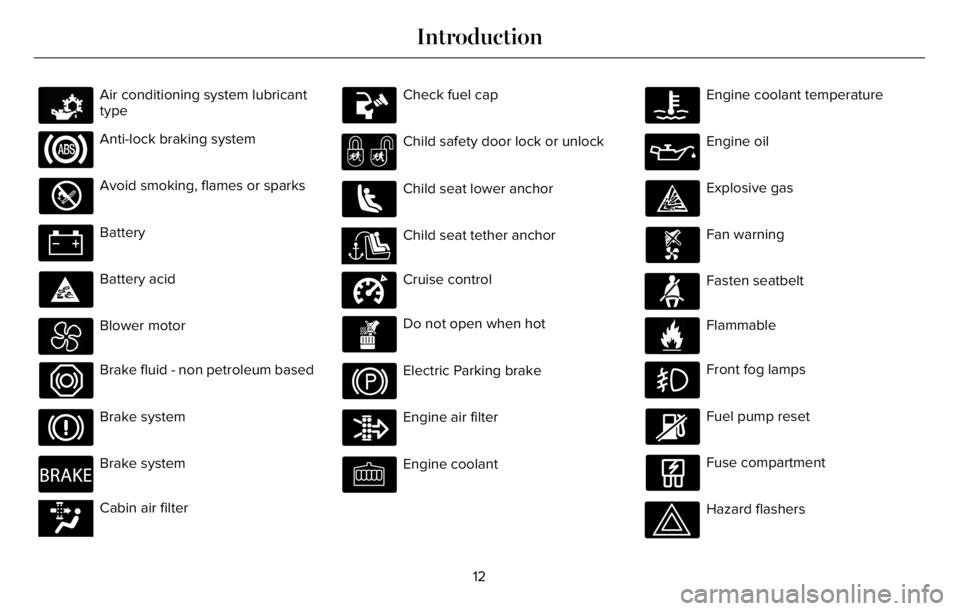
Air conditioning system lubricant
type
Anti-lock braking system
Avoid smoking, flames or sparks
Battery
Battery acid
Blower motor
Brake fluid - non petroleum based
Brake system
E270480
Brake system
E139223E139223Cabin air filter
Check fuel cap
Child safety door lock or unlock
Child seat lower anchor
E141E141128128Child seat tether anchor
E332905
Cruise control
Do not open when hot
Electric Parking brake
Engine air filter
Engine coolant
Engine coolant temperature
Engine oil
Explosive gas
Fan warning
E71880
Fasten seatbelt
E231160
Flammable
Front fog lamps
Fuel pump reset
Fuse compartment
Hazard flashers
12
Introduction
Page 237 of 681
EMISSION LAW
WARNING: Do not remove or alter
the original equipment floor covering or
insulation between it and the metal floor
of the vehicle. The floor covering and
insulation protect occupants of the vehicle
from the engine and exhaust system heat
and noise. On vehicles with no original
equipment floor covering insulation, do not
carry passengers in a manner that permits
prolonged skin contact with the metal floor.
Failure to follow these instructions may
result in fire or personal injury.
U.S. federal laws and certain state laws
prohibit removing or rendering inoperative
emission control system components. Similar
federal or provincial laws may apply in
Canada. We do not approve of any vehicle
modification without first determining
applicable laws.
Tampering with emissions control
systems including related sensors
or the Diesel Exhaust Fluid system
can result in reduced engine power and the
illumination of the service engine soon light.
Tampering With a Noise Control
System
Federal laws prohibit the following acts:
• Removal or rendering inoperative by any
person other than for purposes of
maintenance.
• Repair or replacement of any device or
element of the design incorporated into
a new vehicle for the purpose of noise
control prior to its sale or delivery to the
ultimate purchaser or while it is in use.
• The use of the vehicle after any person
removes or renders inoperative any
device or element of the design.The U.S. Environmental Protection Agency
may presume to constitute tampering as
follows:
• Removal of hood blanket, fender apron
absorbers, fender apron barriers,
underbody noise shields or acoustically
absorptive material.
• Tampering or rendering inoperative the
engine speed governor, to allow engine
speed to exceed manufacturer
specifications.
If the engine does not start, runs rough,
experiences a decrease in engine
performance, experiences excess fuel
consumption or produces excessive exhaust
smoke, check for the following:
• A plugged or disconnected air inlet
system hose.
• A plugged engine air filter element.
• Water in the fuel filter and water
separator.
• A clogged fuel filter.
• Contaminated fuel.
• Air in the fuel system, due to loose
connections.
234
Engine Emission Control
Page 238 of 681
• An open or pinched sensor hose.
• Incorrect engine oil level.
• Incorrect fuel for climatic conditions.
• Incorrect engine oil viscosity for climactic
conditions.
Note:Some vehicles have a lifetime fuel filter
that is integrated with the fuel tank. Regular
maintenance or replacement is not needed.
Note:If these checks do not help you correct
the concern, have your vehicle checked as
soon as possible.
Noise Emissions Warranty, Prohibited
Tampering Acts and Maintenance
On January 1, 1978, Federal regulation
became effective governing the noise
emission on trucks over 10,000 lb (4,536 kg)
Gross Vehicle Weight Rating (GVWR). The
preceding statements concerning prohibited
tampering acts and maintenance, and the
noise warranty found in the Warranty Guide,
are applicable to complete chassis cabs over
10,000 lb (4,536 kg) GVWR.
CATALYTIC CONVERTER
WARNING: Do not park, idle or drive
your vehicle on dry grass or other dry
ground cover. The emission system heats
up the engine compartment and exhaust
system, creating the risk of fire.
WARNING: The normal operating
temperature of the exhaust system is very
high. Never work around or attempt to
repair any part of the exhaust system until
it has cooled. Use special care when
working around the catalytic converter.
The catalytic converter heats up to a very
high temperature after only a short period
of engine operation and stays hot after the
engine is switched off.
WARNING: Exhaust leaks may result
in entry of harmful and potentially lethal
fumes into the passenger compartment. If
you smell exhaust fumes inside your
vehicle, have your vehicle inspected
immediately. Do not drive if you smell
exhaust fumes.Your vehicle has various emission control
components and a catalytic converter that
enables it to comply with applicable exhaust
emission standards.
To make sure that the catalytic converter and
other emission control components continue
to work properly:
• Do not crank the engine for more than
10 seconds at a time.
• Do not run the engine with a spark plug
lead disconnected.
• Do not push-start or tow-start your
vehicle. Use booster cables. See Jump
Starting the Vehicle (page 366).
• Use only the specified fuel listed.
• Do not switch the ignition off when your
vehicle is moving.
• Avoid running out of fuel.
• Have the items listed in scheduled
maintenance information performed
according to the specified schedule.
Note:Resulting component damage may
not be covered by the vehicle Warranty.
235
Engine Emission Control
Page 421 of 681
State or local regulations on volatile organic
compounds may restrict the use of methanol,
a common windshield washer antifreeze
additive. Washer fluids containing
non-methanol antifreeze agents should be
used only if they provide cold weather
protection without damaging the vehicle’s
paint finish, wiper blades or washer system.
FUEL FILTER
Your vehicle is equipped with a lifetime fuel
filter that is integrated with the fuel tank.
Regular maintenance or replacement is not
needed.
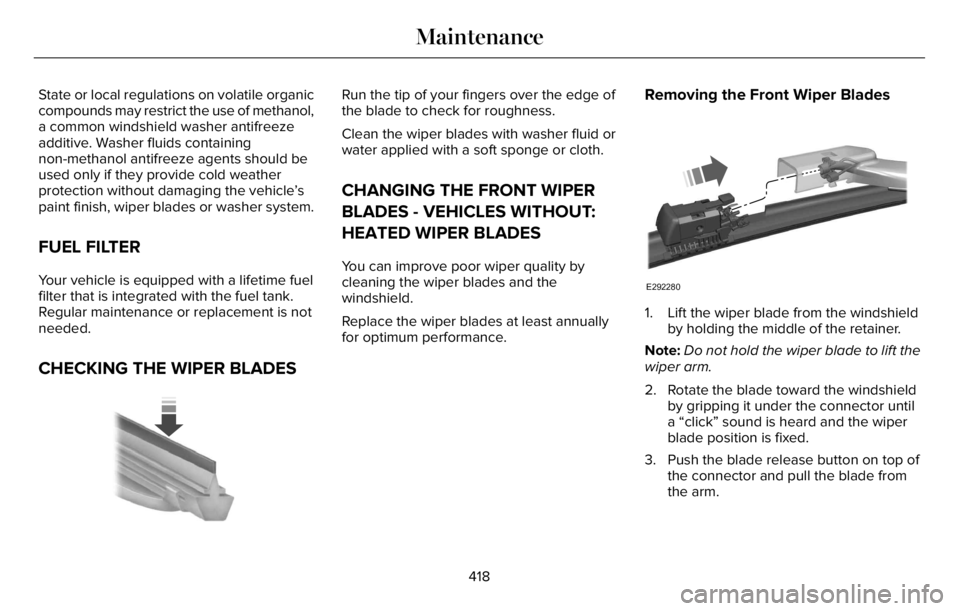
CHECKING THE WIPER BLADES
E142463
Run the tip of your fingers over the edge of
the blade to check for roughness.
Clean the wiper blades with washer fluid or
water applied with a soft sponge or cloth.
CHANGING THE FRONT WIPER
BLADES - VEHICLES WITHOUT:
HEATED WIPER BLADES
You can improve poor wiper quality by
cleaning the wiper blades and the
windshield.
Replace the wiper blades at least annually
for optimum performance.
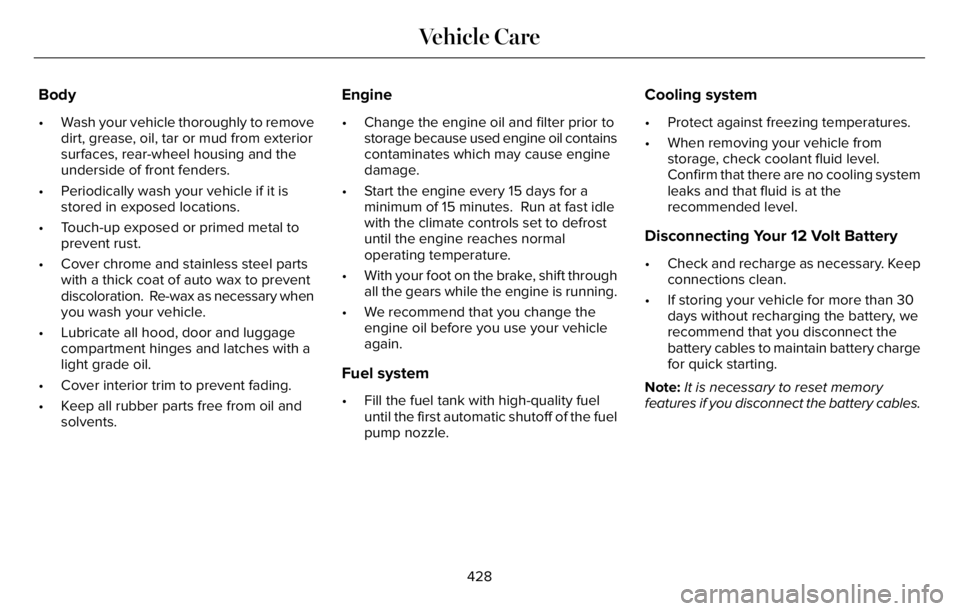
Removing the Front Wiper Blades
E292280
1. Lift the wiper blade from the windshield
by holding the middle of the retainer.
Note:Do not hold the wiper blade to lift the
wiper arm.
2. Rotate the blade toward the windshield
by gripping it under the connector until
a “click” sound is heard and the wiper
blade position is fixed.
3. Push the blade release button on top of
the connector and pull the blade from
the arm.
418
Maintenance
Page 431 of 681
Body
• Wash your vehicle thoroughly to remove
dirt, grease, oil, tar or mud from exterior
surfaces, rear-wheel housing and the
underside of front fenders.
• Periodically wash your vehicle if it is
stored in exposed locations.
• Touch-up exposed or primed metal to
prevent rust.
• Cover chrome and stainless steel parts
with a thick coat of auto wax to prevent
discoloration. Re-wax as necessary when
you wash your vehicle.
• Lubricate all hood, door and luggage
compartment hinges and latches with a
light grade oil.
• Cover interior trim to prevent fading.
• Keep all rubber parts free from oil and
solvents.
Engine
• Change the engine oil and filter prior to
storage because used engine oil contains
contaminates which may cause engine
damage.
• Start the engine every 15 days for a
minimum of 15 minutes. Run at fast idle
with the climate controls set to defrost
until the engine reaches normal
operating temperature.
• With your foot on the brake, shift through
all the gears while the engine is running.
• We recommend that you change the
engine oil before you use your vehicle
again.
Fuel system
• Fill the fuel tank with high-quality fuel
until the first automatic shutoff of the fuel
pump nozzle.
Cooling system
• Protect against freezing temperatures.
• When removing your vehicle from
storage, check coolant fluid level.
Confirm that there are no cooling system
leaks and that fluid is at the
recommended level.
Disconnecting Your 12 Volt Battery
• Check and recharge as necessary. Keep
connections clean.
• If storing your vehicle for more than 30
days without recharging the battery, we
recommend that you disconnect the
battery cables to maintain battery charge
for quick starting.
Note:It is necessary to reset memory
features if you disconnect the battery cables.
428
Vehicle Care
Page 472 of 681
Engine Oil
E142732
An oil that displays this symbol conforms to
current engine, emission system and fuel
economy performance standards of ILSAC.
We recommend Motorcraft® motor oil for
your vehicle. If Motorcraft® oil is not available,
use motor oils of the recommended viscosity
grade that display the API Certification Mark
for gasoline engines.
Do not use supplemental engine oil additives
because they are unnecessary and could
lead to engine damage that your vehicle
warranty does not cover.
Capacities
Including the Oil Filter Variant
6.0 qt (5.7 L) All.
469
Capacities and Specifications
Page 592 of 681
Operating in Dusty or Sandy Conditions - Such as Unpaved or Dusty Roads
Replace cabin air filter. Inspect frequently, service
as required
Replace engine air filter.
Inspect the wheels and related components for abnormal noise, wear, looseness or drag. Every 5,000 mi (8,000 km)
Rotate tires, inspect tires for wear and measure tread depth.
Change engine oil and filter.
1Every 5,000 mi (8,000 km)
or six months
Perform multi-point inspection.
1Reset your Intelligent Oil-Life Monitor after engine oil and filter changes. See Oil Change Indicator Reset (page 402).
Exclusive use of E85 - Flex Fuel Vehicles Only
If ran exclusively on E85, fill the fuel tank full with regular unleaded fuel. Every oil change
Exceptions
There are several exceptions to the Normal
Schedule:Axle and PTU maintenance: The Power
Transfer Unit (PTU) and rear axle (four wheel
drive only) in your vehicle does not require
any normal scheduled maintenance. Vehicles
are electronically monitored and notify the
driver required service by displaying a
message in the information display. The PTU
589
Scheduled Maintenance
Page 593 of 681
lubricant will be more likely to require a
change if the vehicle has experienced
extended periods of extreme/severe duty
cycle driving. Changing or checking the PTU
lubricant is not necessary unless the unit has
been submerged in water, shows signs of
leakage or a message indicating required
service is displayed. Contact your authorized
dealer for service.
California fuel filter replacement: If you
register your vehicle in California, the
California Air Resources Board has
determined that the failure to perform this
maintenance item does not nullify the
emission warranty or limit recall liability
before the completion of your vehicle's
useful life. Ford Motor Company, however,
urges you to have all recommended
maintenance services performed at the
specified intervals and to record all vehicle
service.Engine air filter and cabin air filter
replacement: The life of the engine air filter
and cabin air filter is dependent on exposure
to dusty and dirty conditions. Vehicles
operated in these conditions require frequent
inspection and replacement of the engine
air filter and cabin air filter.
590
Scheduled Maintenance
Page 673 of 681
Engine Oil Dipstick.......................................401
Engine Specifications - Excluding: Plug-In
Hybrid Electric Vehicle (PHEV)..............460
Engine Specifications - Plug-In Hybrid
Electric Vehicle (PHEV).............................461
Entertainment.................................................521
Environment.....................................................23
EPB
See: Electric Parking Brake..............................272
Essential Towing Checks............................357
Event Data.........................................................19
Export Unique Options...................................16
Exterior Mirrors..............................................122
F
Fastening the Seatbelts................................47
Flat Tire
See: Changing a Road Wheel..........................451
Floor Mats......................................................362
Fog Lamps - Front
See: Front Fog Lamps.........................................113
Front Fog Lamps............................................113
Front Parking Aid.........................................288
Front Passenger Sensing System..............58Front Wiper Blades
See: Changing the Front Wiper Blades - Vehicles
With: Heated Wiper Blades..........................419
See: Changing the Front Wiper Blades - Vehicles
Without: Heated Wiper Blades....................418
Fuel and Refueling.......................................223
Fuel Consumption........................................233
Fuel Filler Funnel Location........................224
Fuel Filter.........................................................418
Fuel Quality....................................................224
Fuel Shutoff...................................................365
Fuses...............................................................382
Fuse Specification Chart............................382
G
Garage Door Opener...................................195
Garage Door Opener Introduction...........195
Garage Door Opener Precautions and
Frequencies.................................................195
Gauges.............................................................128
Gearbox
See: Transmission..............................................259
General Information on Radio
Frequencies..................................................68
General Maintenance Information...........579
Getting Assistance Outside the U.S. and
Canada..........................................................377Getting the Services You Need.................373
Global Opening and Closing......................122
H
Hazard Flashers............................................365
Headlamp Adjusting
See: Adjusting the Headlamps........................416
Headlamp Exit Delay.....................................113
Headrest
See: Head Restraints..........................................177
Head Restraints..............................................177
Heated Exterior Mirrors................................171
Heated Rear Window....................................171
Heated Seats...................................................191
Heated Steering Wheel...............................106
Heating
See: Climate Control..........................................165
High Voltage Battery...................................238General Information...........................................238
Hill Descent Control....................................284
Hill Descent Control Indicator...................285
Hill Start Assist..............................................274
Hints on Controlling the Interior
Climate..........................................................168
Hints on Driving With Anti-Lock
Brakes...........................................................272
670
Index