tire pressure LINCOLN AVIATOR 2023 Owners Manual
[x] Cancel search | Manufacturer: LINCOLN, Model Year: 2023, Model line: AVIATOR, Model: LINCOLN AVIATOR 2023Pages: 681, PDF Size: 9.33 MB
Page 11 of 681
Cleaning the Exterior .................................422
Waxing ...........................................................423
Cleaning the Engine ...................................424
Cleaning the Windows and Wiper Blades
......................................................................4 2 4
Cleaning the Interior ..................................425
Cleaning the Instrument Panel and
Instrument Cluster Lens ........................425
Cleaning Leather Seats .............................426
Repairing Minor Paint Damage ................427
Cleaning the Wheels ..................................427
Vehicle Storage ............................................427
Body Styling Kits ..........................................429
Wheels and Tires
General Information ....................................430
Tire Care ........................................................432
Using Summer Tires ...................................444
Using Snow Chains .....................................445
Tire Pressure Monitoring System ............447
Changing a Road Wheel ............................451
Technical Specifications ............................458
Capacities and Specifications
Engine Specifications - Excluding: Plug-In
Hybrid Electric Vehicle (PHEV) ............460
Engine Specifications - Plug-In Hybrid
Electric Vehicle (PHEV) ...........................461
Motorcraft Parts - Excluding: Plug-In Hybrid
Electric Vehicle (PHEV) ..........................462
Motorcraft Parts - Plug-In Hybrid Electric
Vehicle (PHEV) .........................................464
Vehicle Identification Number .................465
Capacities and Specifications - Excluding:
Plug-In Hybrid Electric Vehicle (PHEV)
......................................................................465
Capacities and Specifications - Plug-In
Hybrid Electric Vehicle (PHEV) ............477
Bulb Specification Chart ............................488
Vehicle Identification
Installing the Vehicle Identification Card
......................................................................489
Network Connectivity
Connecting the Vehicle to a Mobile
Network .....................................................490Network Connectivity – Troubleshooting
.......................................................................491
Vehicle Wi-Fi Hotspot
Creating a Vehicle Wi-Fi Hotspot ............494
Changing the Vehicle Wi-Fi Hotspot Name
or Password ..............................................494
Audio System
General Information ...................................496
Audio Unit ......................................................497
Digital Radio .................................................499
Satellite Radio ..............................................502
USB Port ........................................................505
SYNC™ 3
General Information ....................................507
Using Voice Recognition ...........................509
Entertainment ................................................521
Climate ...........................................................533
Phone .............................................................536
Navigation .....................................................538
Electric Vehicle Information ......................546
8
Table of Contents
Page 16 of 681
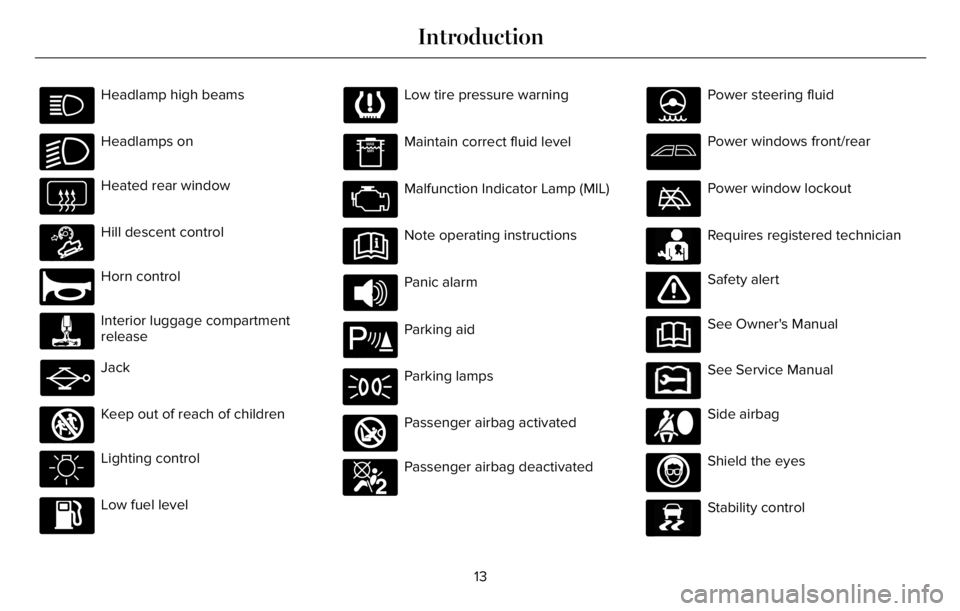
Headlamp high beams
E270968
Headlamps on
Heated rear window
E163171
Hill descent control
E270945
Horn control
Interior luggage compartment
release
Jack
E161353
Keep out of reach of children
Lighting control
Low fuel level
Low tire pressure warning
Maintain correct fluid level
Malfunction Indicator Lamp (MIL)
Note operating instructions
Panic alarm
E139213
Parking aid
Parking lamps
E270849
Passenger airbag activated
E270850
Passenger airbag deactivated
Power steering fluid
Power windows front/rear
Power window lockout
E231159
Requires registered technician
E65963E65963Safety alert
See Owner's Manual
E231158
See Service Manual
Side airbag
Shield the eyes
E138639
Stability control
13
Introduction
Page 21 of 681
WARNING: Do not connect wireless
plug-in devices to the data link connector.
Unauthorized third parties could gain
access to vehicle data and impair the
performance of safety related systems.
Only allow repair facilities that follow our
service and repair instructions to connect
their equipment to the data link connector.
We respect your privacy and are committed
to protecting it. The information contained
in this publication was correct at the time of
release, but as technology rapidly changes,
we recommend that you visit the local Ford
website for the latest information.
Your vehicle has electronic control units that
have data recording functionality and the
ability to permanently or temporarily store
data. This data could include information on
the condition and status of your vehicle,
vehicle maintenance requirements, events
and malfunctions. The types of data that can
be recorded are described in this section.
Some of the data recorded is stored in event
logs or error logs.Note:Error logs are reset following a service
or repair.
Note:We may provide information in
response to requests from law enforcement,
other government authorities and third
parties acting with lawful authority or through
a legal process. Such information could be
used by them in legal proceedings.
Data recorded includes, for example:
• Operating states of system components,
for example fuel level, tire pressure and
battery charge level.
• Vehicle and component status, for
example wheel speed, deceleration,
lateral acceleration and seatbelt status.
• Events or errors in essential systems, for
example headlamps and brakes.
• System responses to driving situations,
for example airbag deployment and
stability control.
• Environmental conditions, for example
temperature.Some of this data, when used in combination
with other information, for example an
accident report, damage to a vehicle or
eyewitness statements, could be associated
with a specific person.
Services That We Provide
If you use our services, we collect and use
data, for example account information,
vehicle location and driving characteristics,
that could identify you. We transmit this data
through a dedicated, protected connection.
We only collect and use data to enable your
use of our services to which you have
subscribed, with your consent or where
permitted by law. For additional information,
see the terms and conditions of the services
to which you have subscribed.
For additional information about our privacy
policy, refer to the local Ford website.
18
Data Privacy
Page 137 of 681
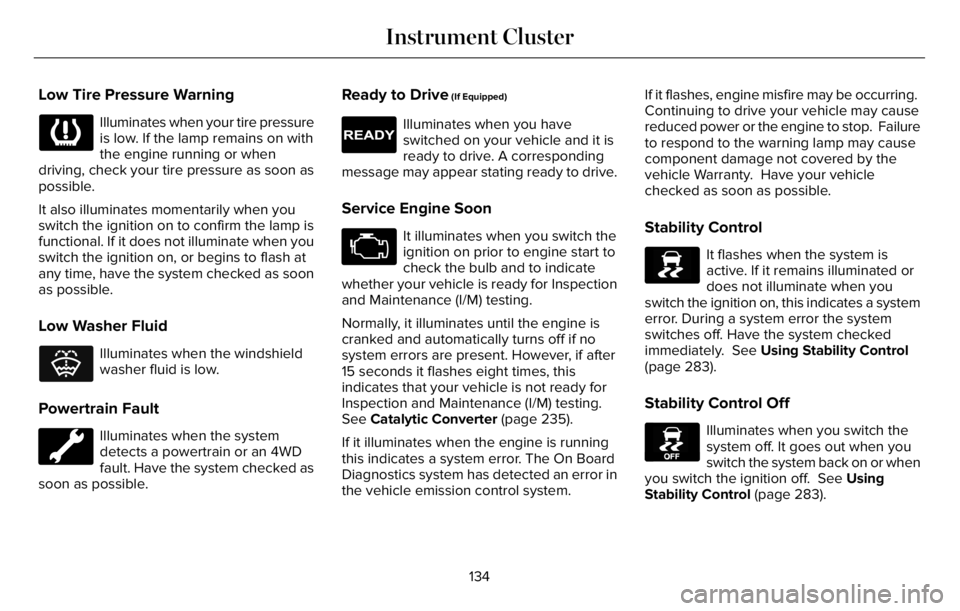
Low Tire Pressure Warning
Illuminates when your tire pressure
is low. If the lamp remains on with
the engine running or when
driving, check your tire pressure as soon as
possible.
It also illuminates momentarily when you
switch the ignition on to confirm the lamp is
functional. If it does not illuminate when you
switch the ignition on, or begins to flash at
any time, have the system checked as soon
as possible.
Low Washer Fluid
E132353
Illuminates when the windshield
washer fluid is low.
Powertrain Fault
Illuminates when the system
detects a powertrain or an 4WD
fault. Have the system checked as
soon as possible.
Ready to Drive (If Equipped)
E224090
Illuminates when you have
switched on your vehicle and it is
ready to drive. A corresponding
message may appear stating ready to drive.
Service Engine Soon
It illuminates when you switch the
ignition on prior to engine start to
check the bulb and to indicate
whether your vehicle is ready for Inspection
and Maintenance (I/M) testing.
Normally, it illuminates until the engine is
cranked and automatically turns off if no
system errors are present. However, if after
15 seconds it flashes eight times, this
indicates that your vehicle is not ready for
Inspection and Maintenance (I/M) testing.
See Catalytic Converter (page 235).
If it illuminates when the engine is running
this indicates a system error. The On Board
Diagnostics system has detected an error in
the vehicle emission control system.If it flashes, engine misfire may be occurring.
Continuing to drive your vehicle may cause
reduced power or the engine to stop. Failure
to respond to the warning lamp may cause
component damage not covered by the
vehicle Warranty. Have your vehicle
checked as soon as possible.Stability Control
E138639
It flashes when the system is
active. If it remains illuminated or
does not illuminate when you
switch the ignition on, this indicates a system
error. During a system error the system
switches off. Have the system checked
immediately. See Using Stability Control
(page 283).
Stability Control Off
E130458
Illuminates when you switch the
system off. It goes out when you
switch the system back on or when
you switch the ignition off. See Using
Stability Control (page 283).
134
Instrument Cluster
Page 143 of 681
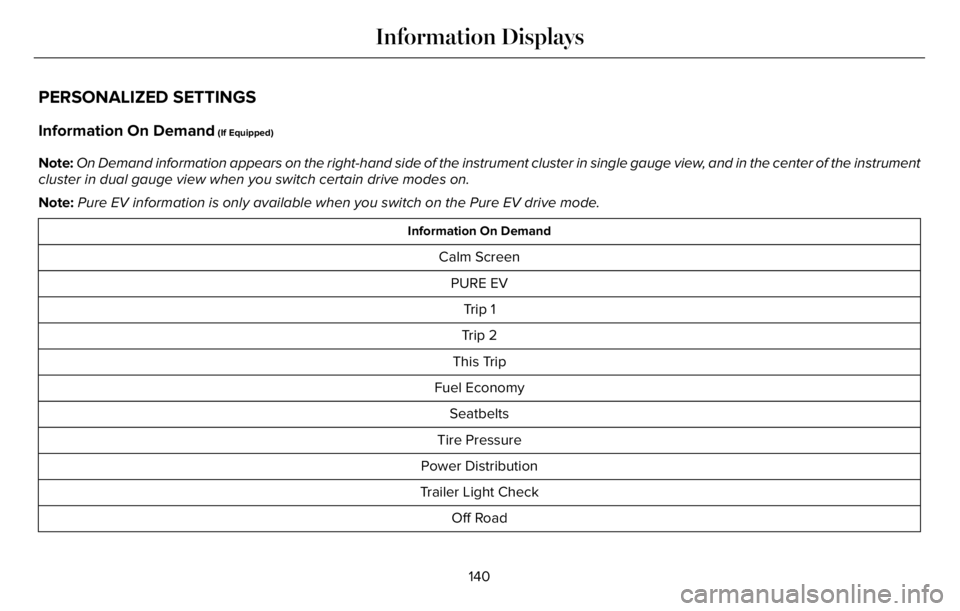
PERSONALIZED SETTINGS
Information On Demand (If Equipped)
Note:On Demand information appears on the right-hand side of the instrument cluster in single gauge view, and in the center of the instrument
cluster in dual gauge view when you switch certain drive modes on.
Note:Pure EV information is only available when you switch on the Pure EV drive mode.
Information On Demand
Calm Screen
PURE EV
Trip 1
Trip 2
This Trip
Fuel Economy
Seatbelts
Tire Pressure
Power Distribution
Trailer Light Check
Off Road
140
Information Displays
Page 164 of 681
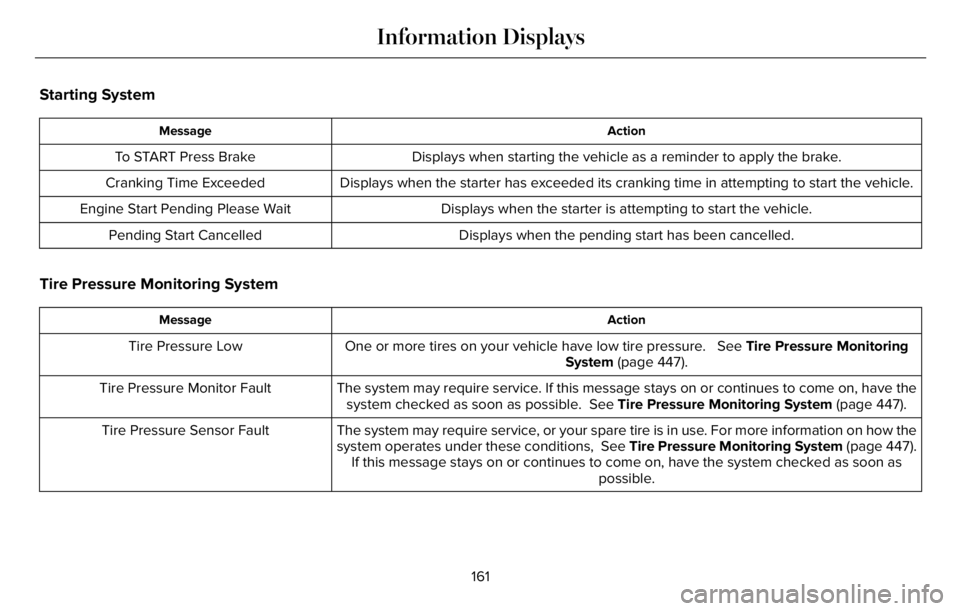
Starting System
Action Message
Displays when starting the vehicle as a reminder to apply the brake. To START Press Brake
Displays when the starter has exceeded its cranking time in attempting to start the vehicle. Cranking Time Exceeded
Displays when the starter is attempting to start the vehicle. Engine Start Pending Please Wait
Displays when the pending start has been cancelled. Pending Start Cancelled
Tire Pressure Monitoring System
Action Message
One or more tires on your vehicle have low tire pressure. See Tire Pressure Monitoring
System (page 447). Tire Pressure Low
The system may require service. If this message stays on or continues to come on, have the
system checked as soon as possible. See Tire Pressure Monitoring System (page 447). Tire Pressure Monitor Fault
The system may require service, or your spare tire is in use. For more information on how the
system operates under these conditions, See Tire Pressure Monitoring System (page 447).
If this message stays on or continues to come on, have the system checked as soon as
possible. Tire Pressure Sensor Fault
161
Information Displays
Page 270 of 681
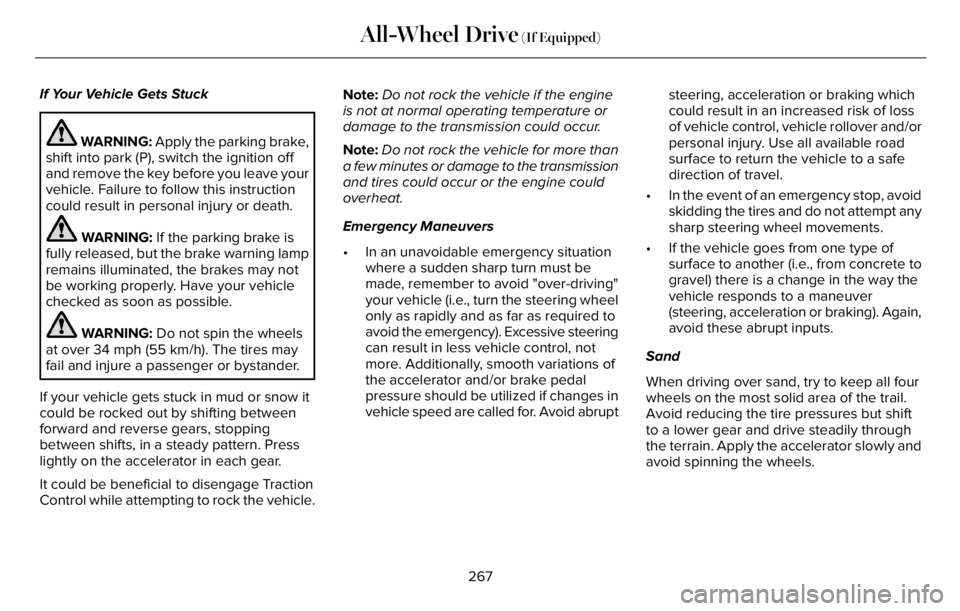
If Your Vehicle Gets Stuck
WARNING: Apply the parking brake,
shift into park (P), switch the ignition off
and remove the key before you leave your
vehicle. Failure to follow this instruction
could result in personal injury or death.
WARNING: If the parking brake is
fully released, but the brake warning lamp
remains illuminated, the brakes may not
be working properly. Have your vehicle
checked as soon as possible.
WARNING: Do not spin the wheels
at over 34 mph (55 km/h). The tires may
fail and injure a passenger or bystander.
If your vehicle gets stuck in mud or snow it
could be rocked out by shifting between
forward and reverse gears, stopping
between shifts, in a steady pattern. Press
lightly on the accelerator in each gear.
It could be beneficial to disengage Traction
Control while attempting to rock the vehicle.Note:Do not rock the vehicle if the engine
is not at normal operating temperature or
damage to the transmission could occur.
Note:Do not rock the vehicle for more than
a few minutes or damage to the transmission
and tires could occur or the engine could
overheat.
Emergency Maneuvers
• In an unavoidable emergency situation
where a sudden sharp turn must be
made, remember to avoid "over-driving"
your vehicle (i.e., turn the steering wheel
only as rapidly and as far as required to
avoid the emergency). Excessive steering
can result in less vehicle control, not
more. Additionally, smooth variations of
the accelerator and/or brake pedal
pressure should be utilized if changes in
vehicle speed are called for. Avoid abruptsteering, acceleration or braking which
could result in an increased risk of loss
of vehicle control, vehicle rollover and/or
personal injury. Use all available road
surface to return the vehicle to a safe
direction of travel.
• In the event of an emergency stop, avoid
skidding the tires and do not attempt any
sharp steering wheel movements.
• If the vehicle goes from one type of
surface to another (i.e., from concrete to
gravel) there is a change in the way the
vehicle responds to a maneuver
(steering, acceleration or braking). Again,
avoid these abrupt inputs.
Sand
When driving over sand, try to keep all four
wheels on the most solid area of the trail.
Avoid reducing the tire pressures but shift
to a lower gear and drive steadily through
the terrain. Apply the accelerator slowly and
avoid spinning the wheels.
267
All-Wheel Drive (If Equipped)
Page 271 of 681
Avoid excessive speed because vehicle
momentum can work against you and cause
the vehicle to become stuck to the point that
assistance could be required from another
vehicle. Remember, you could be able to
back out the way you came if you proceed
with caution.
Mud and Water
If you must drive through high water, drive
slowly. Traction or brake capability could be
limited.
Note:Driving through deep water could
damage your vehicle.
When driving through water, determine the
depth; avoid water higher than the bottom
of the hubs (if possible) and proceed slowly.
If the ignition system gets wet, the vehicle
could stall.
Once through water, always try the brakes.
Wet brakes do not stop the vehicle as
effectively as dry brakes. Drying can be
improved by moving your vehicle slowly
while applying light pressure on the brake
pedal.Be cautious of sudden changes in vehicle
speed or direction when you are driving in
mud. Even AWD vehicles can lose traction
in slick mud. As when you are driving over
sand, apply the accelerator slowly and avoid
spinning your wheels. If the vehicle does
slide, steer in the direction of the slide until
you regain control of the vehicle.
After driving through mud, clean off residue
stuck to rotating driveshafts and tires. Excess
mud stuck on tires and rotating driveshafts
causes an imbalance that could damage
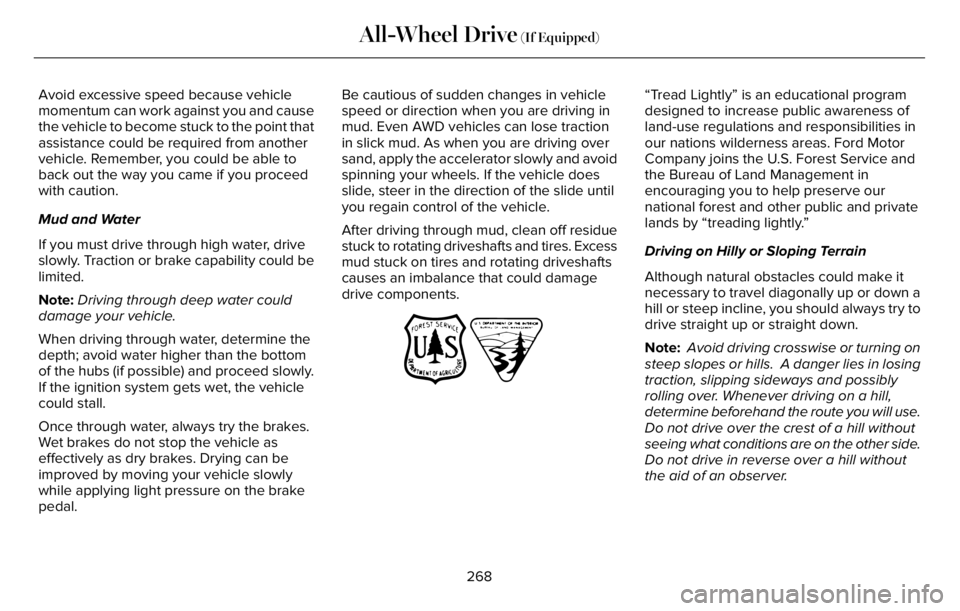
drive components.“Tread Lightly” is an educational program
designed to increase public awareness of
land-use regulations and responsibilities in
our nations wilderness areas. Ford Motor
Company joins the U.S. Forest Service and
the Bureau of Land Management in
encouraging you to help preserve our
national forest and other public and private
lands by “treading lightly.”
Driving on Hilly or Sloping Terrain
Although natural obstacles could make it
necessary to travel diagonally up or down a
hill or steep incline, you should always try to
drive straight up or straight down.
Note: Avoid driving crosswise or turning on
steep slopes or hills. A danger lies in losing
traction, slipping sideways and possibly
rolling over. Whenever driving on a hill,
determine beforehand the route you will use.
Do not drive over the crest of a hill without
seeing what conditions are on the other side.
Do not drive in reverse over a hill without
the aid of an observer.
268
All-Wheel Drive (If Equipped)
Page 328 of 681
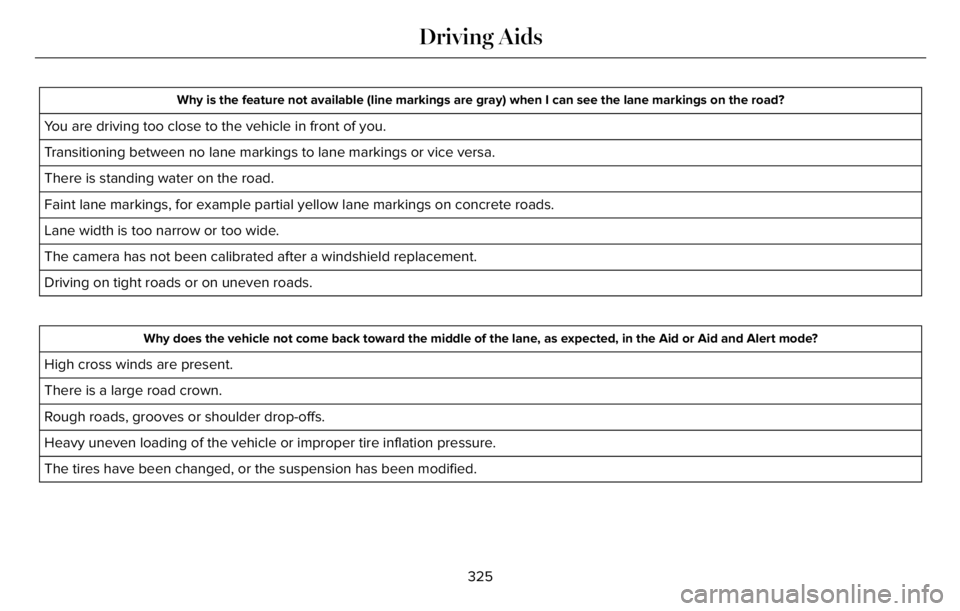
Why is the feature not available (line markings are gray) when I can see the lane markings on the road?
You are driving too close to the vehicle in front of you.
Transitioning between no lane markings to lane markings or vice versa.
There is standing water on the road.
Faint lane markings, for example partial yellow lane markings on concrete roads.
Lane width is too narrow or too wide.
The camera has not been calibrated after a windshield replacement.
Driving on tight roads or on uneven roads.
Why does the vehicle not come back toward the middle of the lane, as expected, in the Aid or Aid and Alert mode?
High cross winds are present.
There is a large road crown.
Rough roads, grooves or shoulder drop-offs.
Heavy uneven loading of the vehicle or improper tire inflation pressure.
The tires have been changed, or the suspension has been modified.
325
Driving Aids
Page 340 of 681
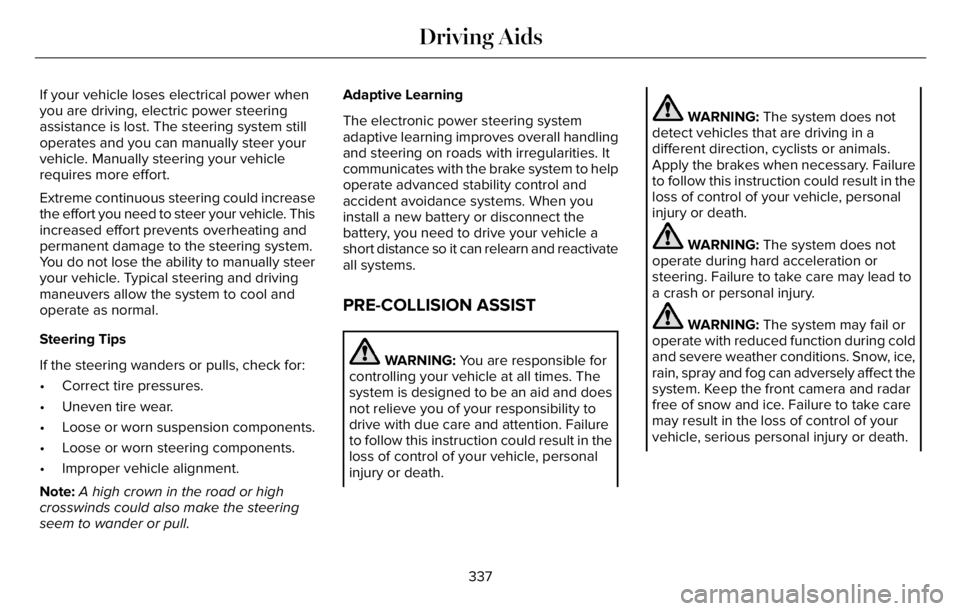
If your vehicle loses electrical power when
you are driving, electric power steering
assistance is lost. The steering system still
operates and you can manually steer your
vehicle. Manually steering your vehicle
requires more effort.
Extreme continuous steering could increase
the effort you need to steer your vehicle. This
increased effort prevents overheating and
permanent damage to the steering system.
You do not lose the ability to manually steer
your vehicle. Typical steering and driving
maneuvers allow the system to cool and
operate as normal.
Steering Tips
If the steering wanders or pulls, check for:
• Correct tire pressures.
• Uneven tire wear.
• Loose or worn suspension components.
• Loose or worn steering components.
• Improper vehicle alignment.
Note:A high crown in the road or high
crosswinds could also make the steering
seem to wander or pull.Adaptive Learning
The electronic power steering system
adaptive learning improves overall handling
and steering on roads with irregularities. It
communicates with the brake system to help
operate advanced stability control and
accident avoidance systems. When you
install a new battery or disconnect the
battery, you need to drive your vehicle a
short distance so it can relearn and reactivate
all systems.
PRE-COLLISION ASSIST
WARNING: You are responsible for
controlling your vehicle at all times. The
system is designed to be an aid and does
not relieve you of your responsibility to
drive with due care and attention. Failure
to follow this instruction could result in the
loss of control of your vehicle, personal
injury or death.
WARNING: The system does not
detect vehicles that are driving in a
different direction, cyclists or animals.
Apply the brakes when necessary. Failure
to follow this instruction could result in the
loss of control of your vehicle, personal
injury or death.
WARNING: The system does not
operate during hard acceleration or
steering. Failure to take care may lead to
a crash or personal injury.
WARNING: The system may fail or
operate with reduced function during cold
and severe weather conditions. Snow, ice,
rain, spray and fog can adversely affect the
system. Keep the front camera and radar
free of snow and ice. Failure to take care
may result in the loss of control of your
vehicle, serious personal injury or death.
337
Driving Aids