ESP LINCOLN CONTINENTAL 1996 Customer Assistance Guide
[x] Cancel search | Manufacturer: LINCOLN, Model Year: 1996, Model line: CONTINENTAL, Model: LINCOLN CONTINENTAL 1996Pages: 320, PDF Size: 1.8 MB
Page 126 of 320

Road Calibrated Suspension
Your Continental is equipped with a ride control
system that is designed to read disturbances in the
road surface every six inches at 60 mph (100 km/h)
to provide you with optimal driving response.
Ride control allows you to chose both a ride feel
and steering effort that best flts your personal
driving style. These options may be selected by
using the RIDE/STEER Message Center button.Pressing this button once will allow you to adjust
your RIDE CONTROL settings, between
NORMAL, PLUSH and FIRM. The settings are
changed by pressing the SELECT button while
RIDE CONTROL is displayed.
Pressing the RIDE/STEER button a second time
will allow you to adjust the STEERING
EFFORT settings between NORMAL, LOW,
and HIGH. The settings are changed by pressing
the SELECT button while STEERING EFFORT
is displayed.
123
Page 148 of 320

Quick Summary To utilize your vehicle's assistance request
feature, YOUR CELLULAR PHONE MUST BE
ACTIVATED. Roadside or emergency assistance can be
requested whenever your key is in the
RUN/START position and for two minutes after
the vehicle is turned off. An assistance request is initiated by pressing
either the tow truck or ambulance button located
in the overhead console. When a button is pressed, a warning lamp located
in the overhead console begins to flash and status
messages are displayed on the vehicle's message
center. (Messages are only displayed when your
key is in the RUN/START position.) The vehicle's cellular phone automatically
places a call to a 24 hour emergency
response center. When contact is made, the vehicle sends an
electronic data message to the response center's
computer. This data message includes latitude
and longitude coordinates obtained from the
vehicle's positioning system. Once the data transmission is complete, the
call is forwarded to a response center
operator who confirms your location using a
computerized map. The vehicle's cellular handset is locked-out,
the phone is automatically placed in "hands
free" mode and voice communication is
established with the operator through the
"hands free" microphone. Typically, voice communication with an
operator is established within one minute
after an assistance button is pressed.
145
Page 149 of 320
The operator verbally obtains details of Your
situation and, if necessary, ties your vehicle into a
three-way phone call with the United States Auto
Club or local 911 or other emergency services to
dispatch the appropriate assistance to your
location. Once the situation has been appropriately
handled, the operator will terminate the call, the
system warning light will stop flashing and the
system will be reset. In most situations, ONLY
the response center can terminate an assistance
request.
General Description
Lincoln's Remote Emergency Satellite Cellular
Unit (RESCU) is designed to expedite roadside or
emergency assistance to distressed motorists who
are uncertain of their location and/or are uncertain
of who to contact for assistance.
The Lincoln RESCU System utilizes Global
Positioning System (GPS) technology and the
146nation's cellular phone network to track vehicle
location and, at the touch of a button, put you in
voice contact with the Lincoln Security
Response Center.
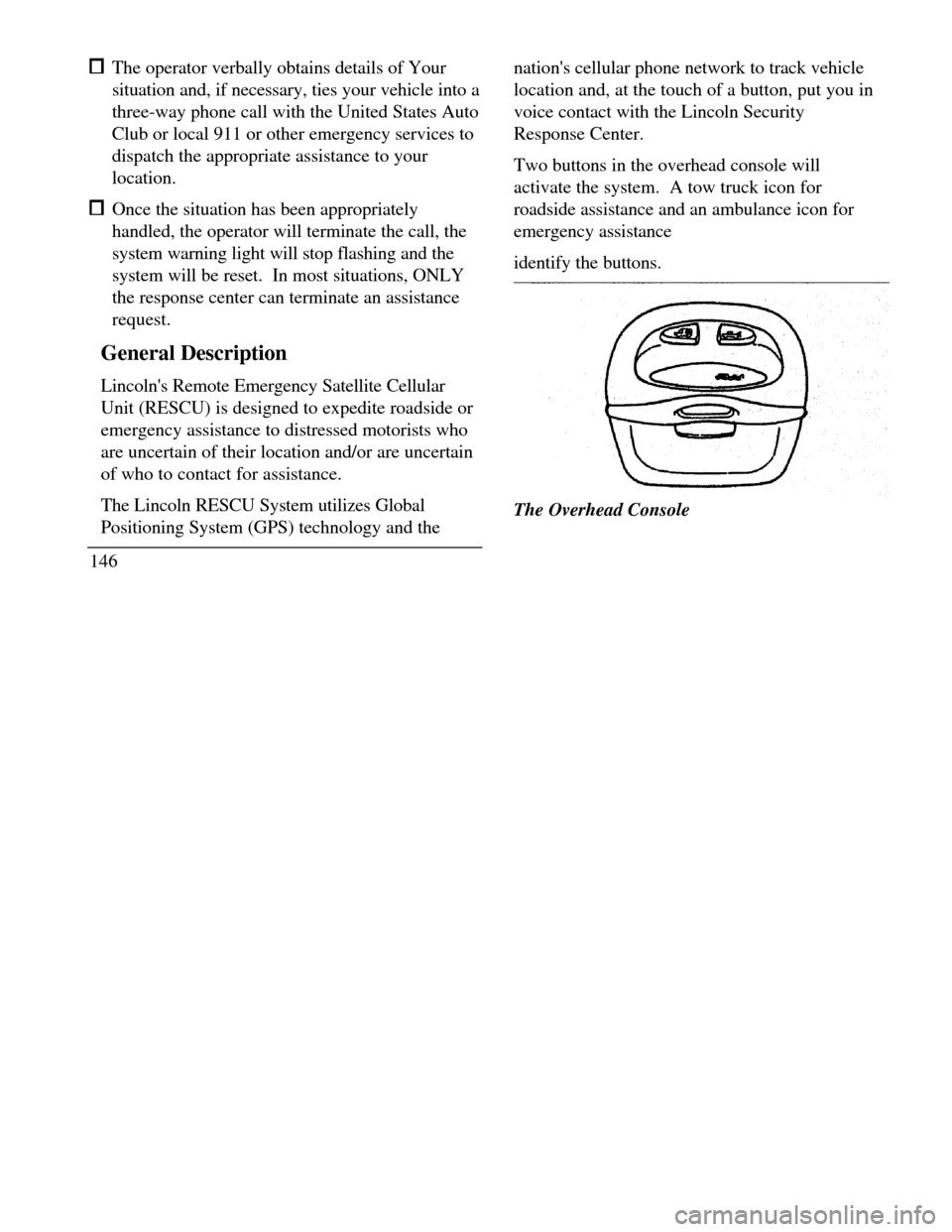
Two buttons in the overhead console will
activate the system. A tow truck icon for
roadside assistance and an ambulance icon for
emergency assistance
identify the buttons.The Overhead Console
Page 150 of 320
When you select a button, the vehicle's cellular
phone will automatically place a call to the response
center's central computer. Once contact is made, an
electronic data message will be transmitted. This
data message will include: Type of alarm (roadside or emergency) Vehicle Identification Number (VIN) Latitude and longitude coordinates Last recorded speed and direction of the vehicle Time tag identifying when last position was taken Call-back phone number
After the transmission is complete, the call is
forwarded to an operator who will verify the details
of the request and confirm the vehicle's location
using computerized map.Tow Truck Button
(Roadside Assistance)
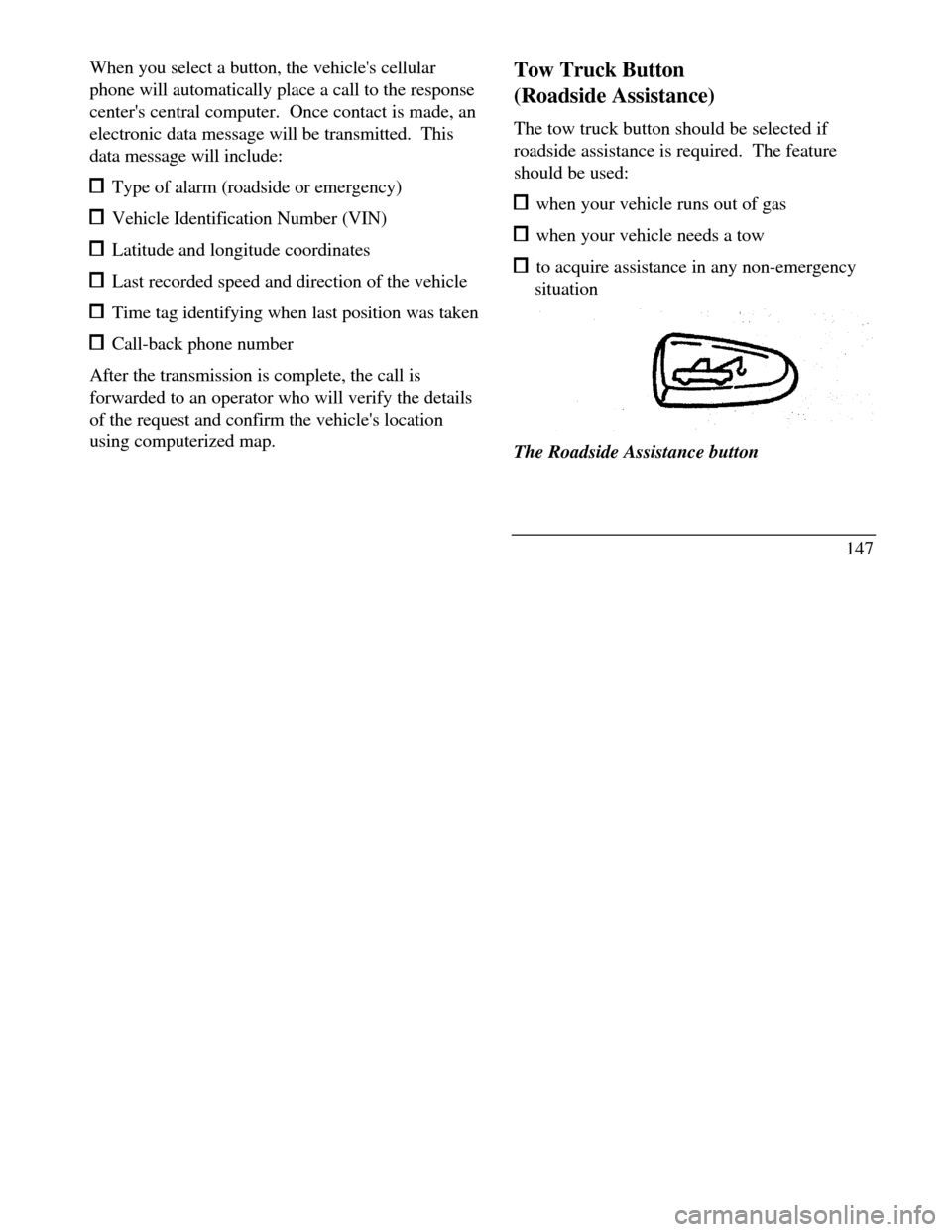
The tow truck button should be selected if
roadside assistance is required. The feature
should be used: when your vehicle runs out of gas when your vehicle needs a tow to acquire assistance in any non-emergency
situationThe Roadside Assistance button
147
Page 151 of 320
When this button is pressed, the Lincoln Security
Response Center relays details of your situation and
your location to the United States Auto Club
(USAC) via a three-way phone call. The response
center/USAC will: dispatch the appropriate service vehicle to your
location. provide the service vehicle's estimated time of
arrival. call back approximately three minutes after the
service vehicle's estimated time of arrival to
confirm that assistance has arrived.
Ambulance Button
(Emergency Assistance)
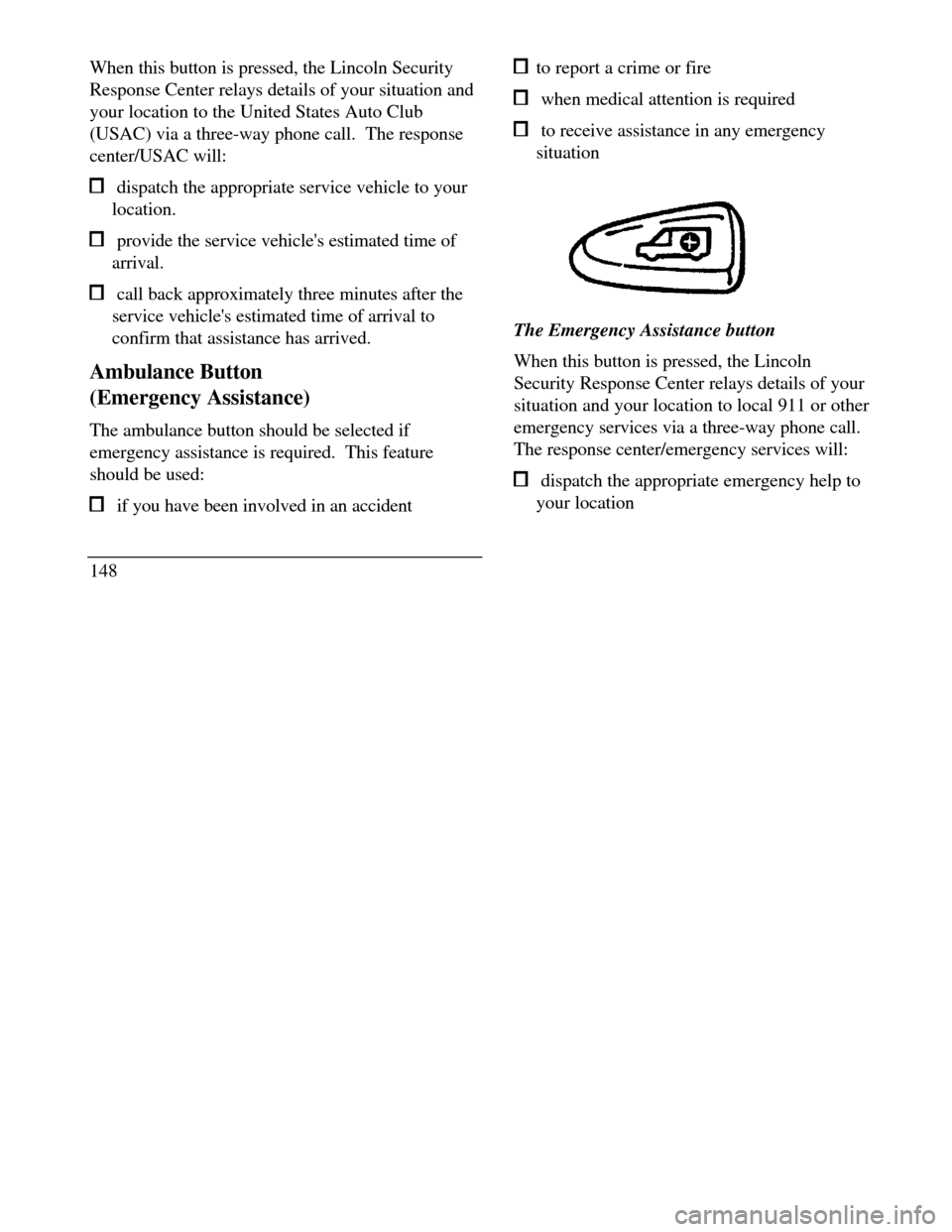
The ambulance button should be selected if
emergency assistance is required. This feature
should be used: if you have been involved in an accident
148 to report a crime or fire when medical attention is required to receive assistance in any emergency
situationThe Emergency Assistance button
When this button is pressed, the Lincoln
Security Response Center relays details of your
situation and your location to local 911 or other
emergency services via a three-way phone call.
The response center/emergency services will: dispatch the appropriate emergency help to
your location
Page 152 of 320

when appropriate, stay in direct phone contact
with you until emergency help arrives notify pre-designated family contacts or friends
of the emergency situation, if requested, or if no
response is received from the vehicle.
NOTE: If You are certain of your location, a direct
phone call to 911 or other emergency services may
provide a faster response.
Activation and Deactivation
When either of the two Lincoln RESCU buttons is
pressed, a warning light, located in the overhead
console, will begin to flash and status messages will
be displayed on the vehicle's message center,
confirming an assistance request has been made.
The warning light will continue to flash throughout
the activation.The RESCU Warning light
The system can be activated whenever your
ignition key is in the RUN/START Position and
for two Minutes after your vehicle is turned off.
In most situations, the assistance request can
ONLY be terminated and the system reset when
a special tone is sent to the vehicle by the
Lincoln Security Response Center. (See
Automatic Redial later in this chapter for
exceptions.) Operation will continue even if the
vehicle is turned off during an activation
(although visual feedback via the Message
Center will not be available in this situation).
149
Page 153 of 320

Cellular Phone Interface
During an activation, Lincoln RESCU takes control
of the vehicle's cellular phone. If the phone is in
use, THE CALL WILL BE TERMINATED and the
Lincoln Security Response Center will automatically
be dialed. The cellular handset becomes inoperative
and all voice communication with the operator is
accomplished via the cellular phone's "hands-free"
microphone.
NOTE: When an activation is terminated, your
phone is left unlocked, in the "ON" state and may
not return to its previous system selection setting. It
can be reprogrammed to your previous setting as
desired.
Message Center Interface
During an activation, Lincoln RESCU
communicates with the vehicle's Message Center.
Status messages describing the sequence of steps
being executed are displayed, allowing you to
visually follow the activation process. The
following messages are
150typical of those displayed during an assistance
request. They are shown in the order in which
they would appear: ROADSIDE REQUEST or EMERGNCY
REQUEST CALL IN PROGRESS RINGING RESPONSE CENTER SENDING LOCATION DATA DATA RECEIVED WAITING FOR OPERATOR
Once an assistance request is made, it will
typically take less than one minute until contact
is made with an operator. During voice
communication the following messages will
alternately toggle on the display: CID XXXXXXXXXX LAT XXXXXXXXXX
Page 154 of 320

LON HDG XX
These messages respectively are the customer
identification number, vehicle latitude, vehicle
longitude and heading. Under special
circumstances, the operator may ask you to read the
information being displayed on the Message Center.
If vehicle messages are being displayed on the
Message Center (low washer fluid, low oil, door
ajar, etc.), they must be cleared in order to view the
LINCOLN RESCU messages. To clear the vehicle
messages, press the Message Center RESET button,
which is located to the right of the display.
Continue pressing the button until all vehicle
messages are cleared.
Automatic Redial
As described previously, when an assistance request
is made, the vehicle's cellular phone automatically
dials the Lincoln Security Response Center's central
computer and attempts to send an electronic datamessage. Occasionally, it can be difficult for the
computer to recognize the message if the
cellular connection is weak or noisy. If the
transmission of the message is unsuccessful, the
data call will be terminated and the message
"REDIAL IN PROGRESS" will be displayed on
the Message Center. A second call will
automatically be placed which bypasses the
response center's computer and is forwarded
directly to an operator.
Similarly, if the cellular call is disconnected by the
network prior to receipt of the termination tone,
another call to the response center will also
automatically be dialed. The message "REDIAL
IN PROGRESS" will be displayed on the Message
Center and voice communication with an operator
will be restored.
NOTE: During redial calls, full control of the
cellular phone is returned to you. Pressing
either the "PWR" or "END" button on the
cellular handset will terminate the assistance
request and reset the system.
151
Page 155 of 320

Location Data Retransmit Capability
During an activation, the Lincoln Security Response
Center operator has the capability to initiate a
retransmission of the electronic data message. This
may be necessary to ensure a more precise
determination of vehicle location or to track a
vehicle that is moving. To accomplish the
retransmit, a special tone is sent to the vehicle by the
response center. In this situation you will
temporarily lose voice contact with the operator and
the messages "SENDING LOCATION DATA" and
"DATA RECEIVED" will respectively be displayed
on the Message Center. After the data
retransmission is complete, voice communication
will be restored and the CID, LAT, LON and HDG
message will again alternately toggle on the
Message Center display.
152Global Positioning System
Vehicle location is continuously updated via
Global Positioning System (GPS) technology.
GPS was developed by the U.S. Department of
Defense for worldwide navigational and
positioning purposes. It utilizes a constellation
of 24 orbiting satellites located more than 20
thousand kilometers above the earth. At any
given time, several of the 24 satellites should be
visible to the vehicle's GPS receiver. Based on
the time for signals emitted by these satellites to
reach the receiver, an on-board computer will
determine the vehicle's location, typically within
100 feet. In addition to latitude and longitude,
the system also determines heading and speed.
Vehicle positioning information is relayed to the
Lincoln Security Response Center ONLY
during roadside or emergency requests. The
response center will not be able to track your
location while in an inactive state.
Page 156 of 320

Lincoln RESCU System Limitations
Service restricted to 48 contiguous states
Your Lincoln RESCU System can be activated
anywhere within the 48 contiguous states. If an
activation occurs outside of this region, the Lincoln
Security Response Center will not be able to assist
you.
Inoperative if cellular phone inactive or
inoperative
Lincoln RESCU utilizes your vehicle's cellular
phone and will not operate if cellular service has not
been activated or if the phone is inoperative.
Inoperative if battery discharged or disconnected
Lincoln RESCU is powered by the vehicle's battery
and will not operate if the battery is discharged or
disconnected.Potentially inoperative if vehicle involved in
accident
If the vehicle is involved in an accident, some
components could be damaged, rendering your
Lincoln RESCU System inoperative.
Positioning capability degraded if satellite
signals obstructed
Vehicle positioning is accomplished by receiving and
interpreting signals transmitted by satellites. If the
signals are obstructed, positioning capability could
be degraded or lost. This situation will be most
prevalent in urban areas populated with tall
buildings. Tunnels, underpasses, parking garages,
trees, and similar structures could also adversely
affect positioning performance. Under these
conditions, the system will operate but the response
center could have difficulty identifying your current
location. (The last valid position obtained before the
obstruction is retained, however, and will be sent.)
The operator may depend on you to provide verbal
information regarding vehicle location.
153