belt LINCOLN CONTINENTAL 1996 Customer Assistance Guide
[x] Cancel search | Manufacturer: LINCOLN, Model Year: 1996, Model line: CONTINENTAL, Model: LINCOLN CONTINENTAL 1996Pages: 320, PDF Size: 1.8 MB
Page 23 of 320
The Importance of Being Properly
Seated
In a collision, the air bag must inflate extremely
fast to help provide additional protection for
you. In order to do this, the air bag must inflate
with considerable force. If you are not seated in
a normal riding position with your back against
the seatback, the air bag may not protect you
properly and could possibly hurt you as it
inflates./!\ WARNINGIf a passenger is not properly seated andrestrained, an inflating air bag couldcause serious injury.In rear-facing infant seats, the infant's head is closer
to the air bag. The force of the rapidly inflating air
bag could push the top of the rear-facing seat
against the vehicle seatback or center armrests (if so
equipped), or center console (if so equipped).
Children weighing less than 40 lbs. (18 kg.) should
use child or infant seats. Forward facing child seats
must have the passenger seat moved as far back
from the instrument panel as possible.
Your vehicle is equipped with a right front
passenger air bag. Front passengers, especially
children and small adults, should never sit on the
edge of the seat, stand near the glove compartment
of the instrument panel, or lean over with their
faces near the glove compartment when the vehicle
is moving. All occupants should sit with their backs
against the seatback and use the safety belts.
19
Page 24 of 320
/!\ WARNINGREAR-FACING INFANT SEATSSHOULD NEVER BE USED IN THEFRONT SEAT. REAR-FACINGINFANT SEATS MUST ALWAYS BEPLACED IN THE REAR SEAT. Failureto follow these instructions could result inserious injury./!\ WARNINGDo not place objects or mount equipmenton or near the air bag cover on thesteering wheel or in front seat areas thatmay come in contact with a deploying airbag. Failure to follow this instructionmay increase the risk of personal injury inthe event of a collision.20For further information about the proper mounting
of equipment in the front seat of this vehicle, please
refer to Ford's brochure entitled Some Important
Information About Air Bag Supplemental Restraint
System which can be obtained by calling Helm Inc.
at 1-800-782-4356. Ask for brochure FPS-8602.
For additional important safety information on the
proper use of seat belts, child seats, and infant seats,
please read the other sections of this part of the
Owner Guide, especially sections entitled Safety
Belts for Children and Safety Seats for Children.
How the Air Bag Supplemental Restraint
System Operates
The Air Bag Supplemental Restraint System
consists of the Driver and Passenger air bags,
impact sensors, a system diagnostic module, a
readiness light and tone, and the electrical wiring
which connects the components.
Page 29 of 320
If any of these things happen, have the air bag
system serviced at your Ford or Lincoln-
Mercury dealer immediately. Unless serviced,
the air bag supplemental restraint system may
not function properly in the event of a collision./!\ WARNINGDo not attempt to service, repair, or modifythe Air Bag Supplemental Restraint Systemor its fuses. See your Ford or Lincoln-Mercury dealer.Disposal of air bags or air bag equipped
vehicles
For disposal of air bags or air bag equipped
vehicles, see your local Ford or Lincoln-Mercury
dealer. Air bags MUST be disposed of by qualified
personnel.Safety Restraints for Children
In the U.S. and Canada, you are required by
law to use safety restraints for children. If
small children ride in your vehicle - this
generally includes children who are four years
old or younger and who weigh 40 pounds (18
kg) or less - you must put them in safety seats
that are made specially for children. Safety
belts alone do not provide maximum protection
for these children. Check your local and state
laws for specific requirements./!\ WARNINGNever let a passenger hold a child on his orher lap while the vehicle is moving. Thepassenger cannot protect the child frominjury in a collision.25
Page 30 of 320
/!\ WARNINGPassengers should not be allowed to ride inthe cargo area. Persons not riding in a seatwith a fastened seat belt are much more likelyto suffer serious injury in a collision. Cargoshould always be secured to prevent it fromshifting and causing damage to the vehicle orharm to passengers.When possible, put children in the rear seat, of
your vehicle. Accident statistics suggest that
children are safer when properly restrained in the
rear seating positions than in the front seating
positions.
26/!\ WARNINGCarefully follow all of the manufacturer'sinstructions included with the safety seat youput in your vehicle. if you do not install and usethe safety seat properly, the child may beinjured in a sudden stop or collision./!\ WARNINGSafety belts and seats can become hot in avehicle that has been closed up in sunnyweather; they could bum a small child. Checkseat covers and buckles before you place a childanywhere near them./!\ WARNINGNever leave a child unattended in your vehicle.
Page 31 of 320
Safety Seats for Children
Use a safety seat that is recommended for the size
and weight of the child. Always follow the safety
seat manufacturer's instructions when installing
and using the safety seat.
Ford recommends the use of a child safety seat
having a top tether strap. Install the child safety
seat in a seating position which is capable of
providing a tether anchorage. For more
information on top tether straps see Attaching
Safety Seats With Tether Straps in this chapter.
When installing a child safety seat, be sure to use
the correct safety belt buckle for that seating
position, and make sure the tongue is securely
fastened in the buckle./!\WARNINGREAR-FACING INFANT SEATSSHOULD NEVER BE USED IN THEFRONT SEAT. REAR-FACING INFANTSEATS MUST ALWAYS BE PLACED INTHE REAR SEAT. Failure to follow theseinstructions could result in serious injury.When using forward-facing child seats inthe front seat, always move the passengerseat as far back from the instrument panelas possible. Failure to follow thesewarnings could result in injury to thechild.All child restraint systems are designed to be
secured in vehicle seats by lap belts or by the lap
portion of a lap-shoulder belt.
27
Page 33 of 320
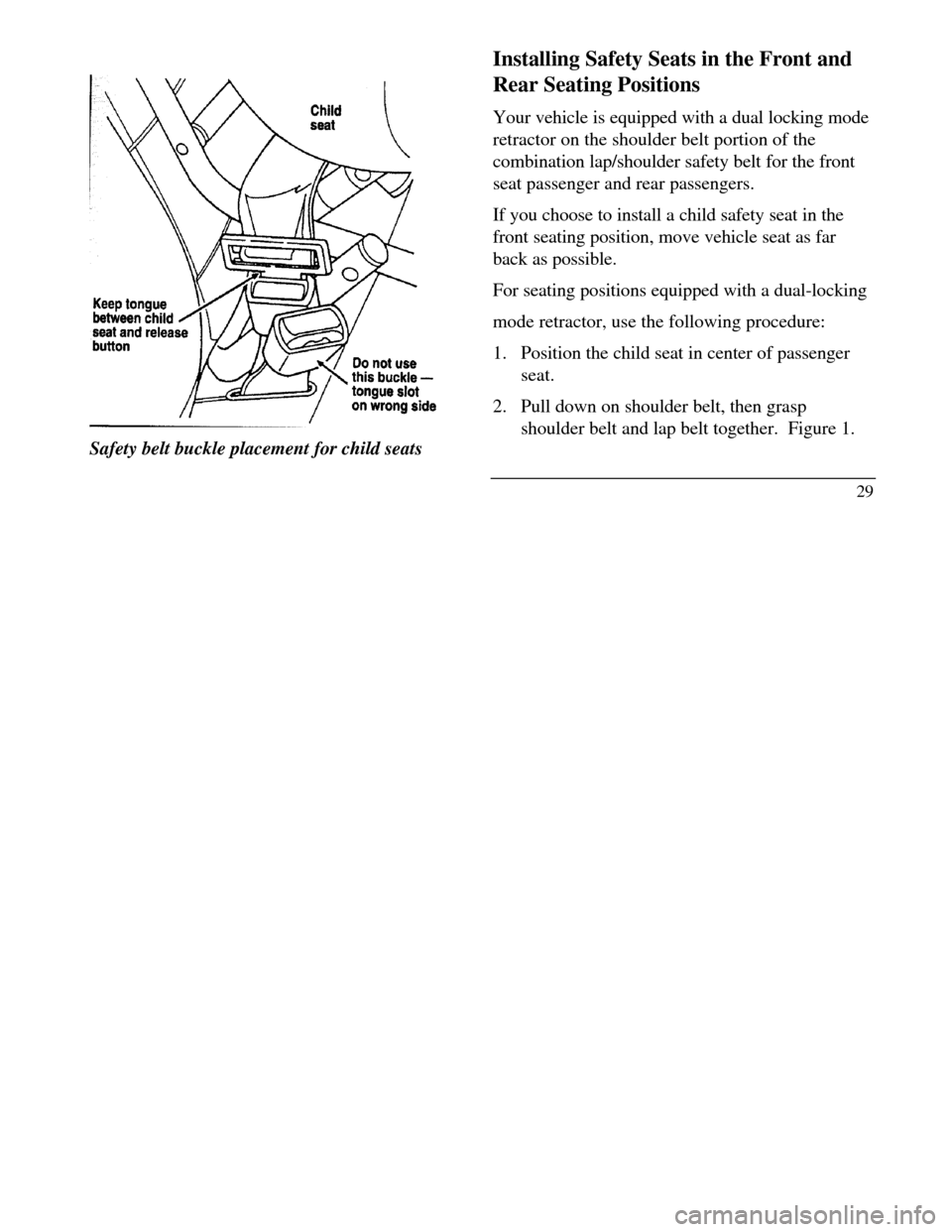
Safety belt buckle placement for child seatsInstalling Safety Seats in the Front and
Rear Seating Positions
Your vehicle is equipped with a dual locking mode
retractor on the shoulder belt portion of the
combination lap/shoulder safety belt for the front
seat passenger and rear passengers.
If you choose to install a child safety seat in the
front seating position, move vehicle seat as far
back as possible.
For seating positions equipped with a dual-locking
mode retractor, use the following procedure:
1. Position the child seat in center of passenger
seat.
2. Pull down on shoulder belt, then grasp
shoulder belt and lap belt together. Figure 1.
29
Page 34 of 320
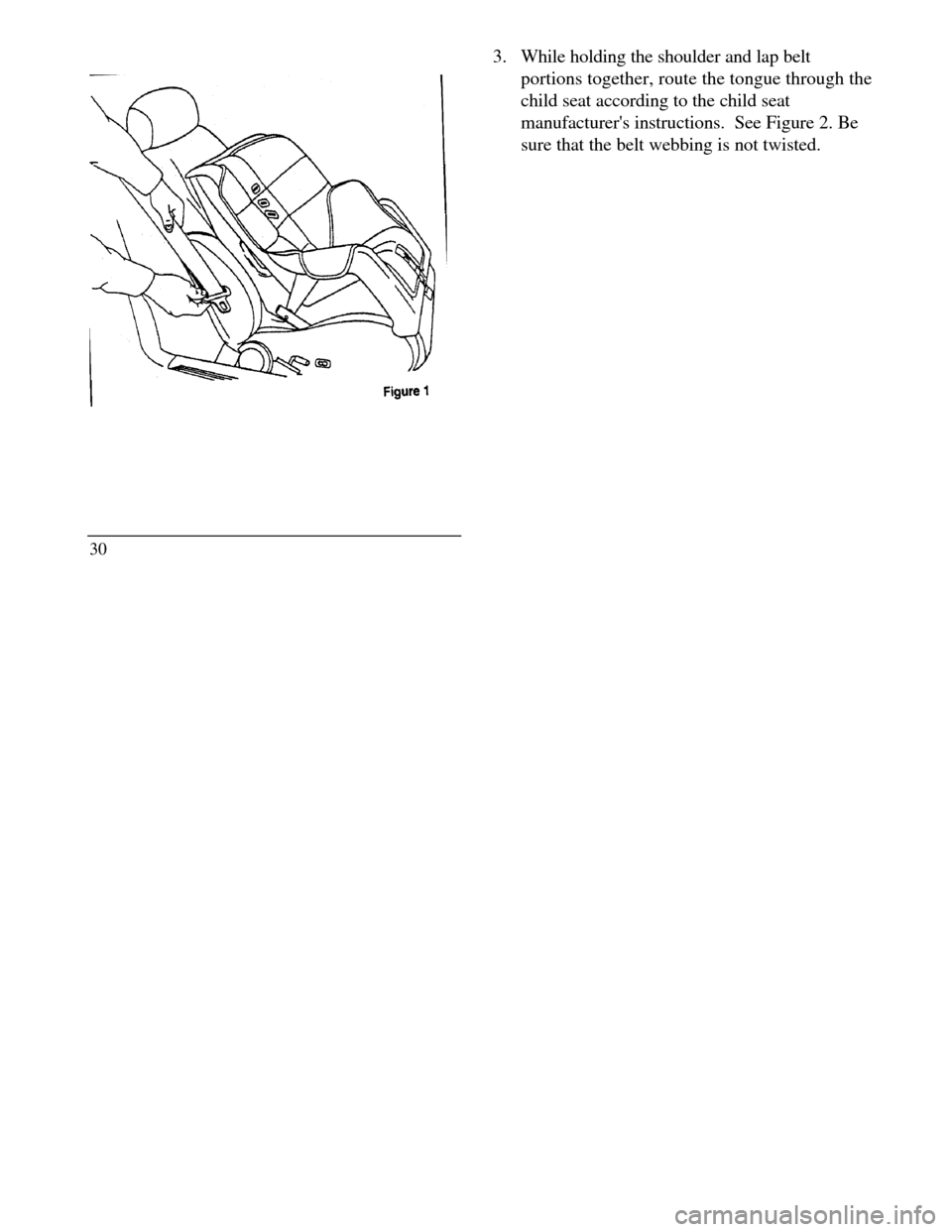
303. While holding the shoulder and lap belt
portions together, route the tongue through the
child seat according to the child seat
manufacturer's instructions. See Figure 2. Be
sure that the belt webbing is not twisted.
Page 35 of 320
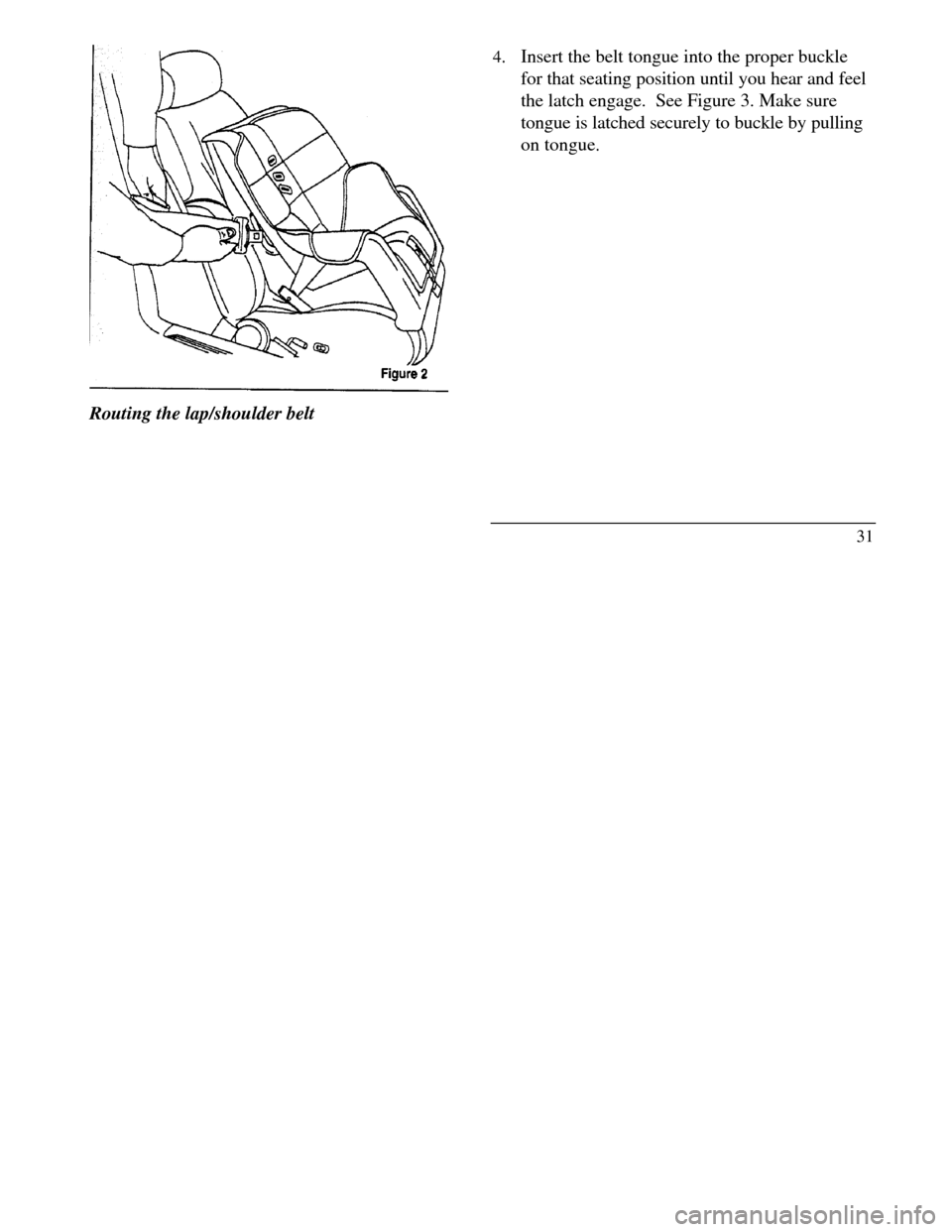
Routing the lap/shoulder belt4. Insert the belt tongue into the proper buckle
for that seating position until you hear and feel
the latch engage. See Figure 3. Make sure
tongue is latched securely to buckle by pulling
on tongue.
31
Page 36 of 320
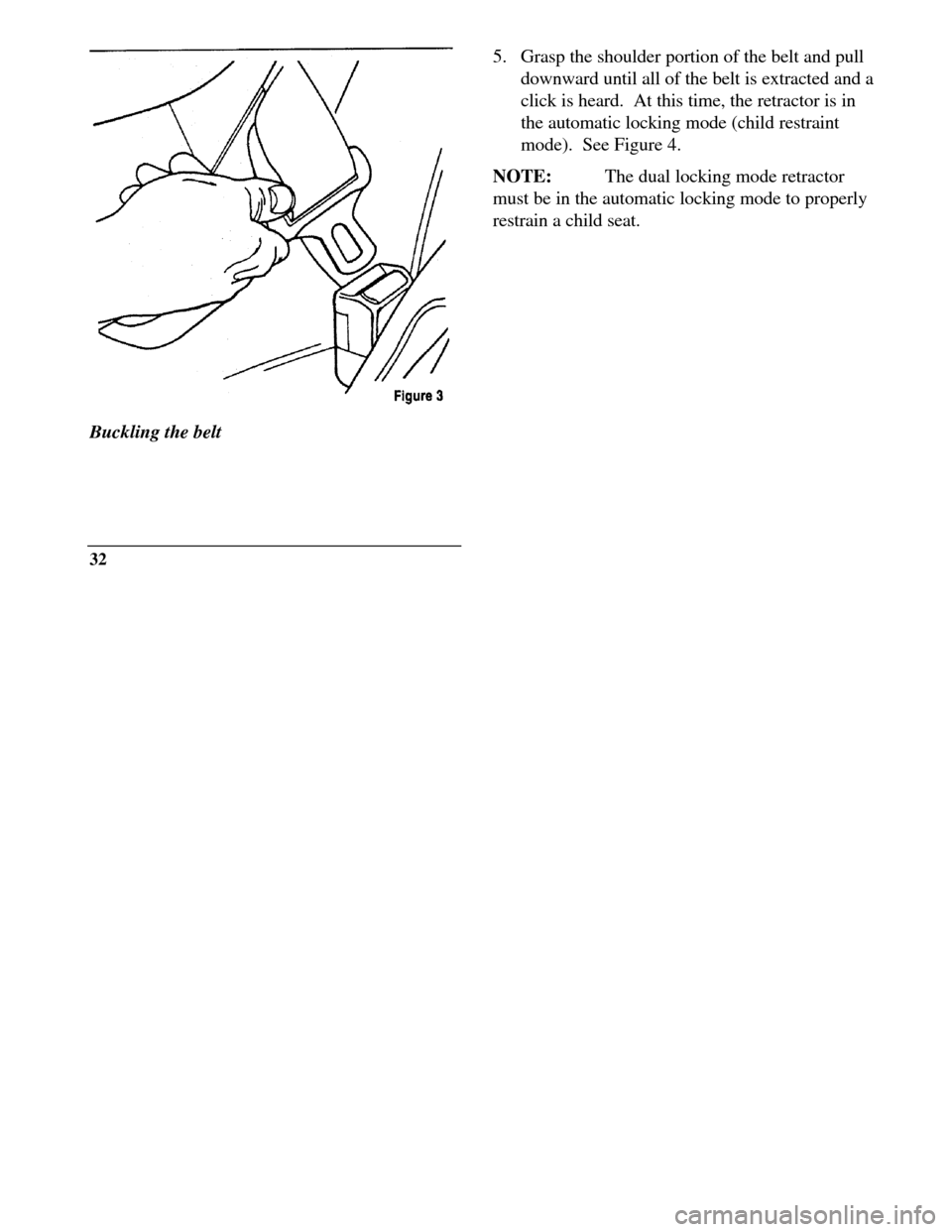
Buckling the belt
325. Grasp the shoulder portion of the belt and pull
downward until all of the belt is extracted and a
click is heard. At this time, the retractor is in
the automatic locking mode (child restraint
mode). See Figure 4.
NOTE:The dual locking mode retractor
must be in the automatic locking mode to properly
restrain a child seat.
Page 37 of 320
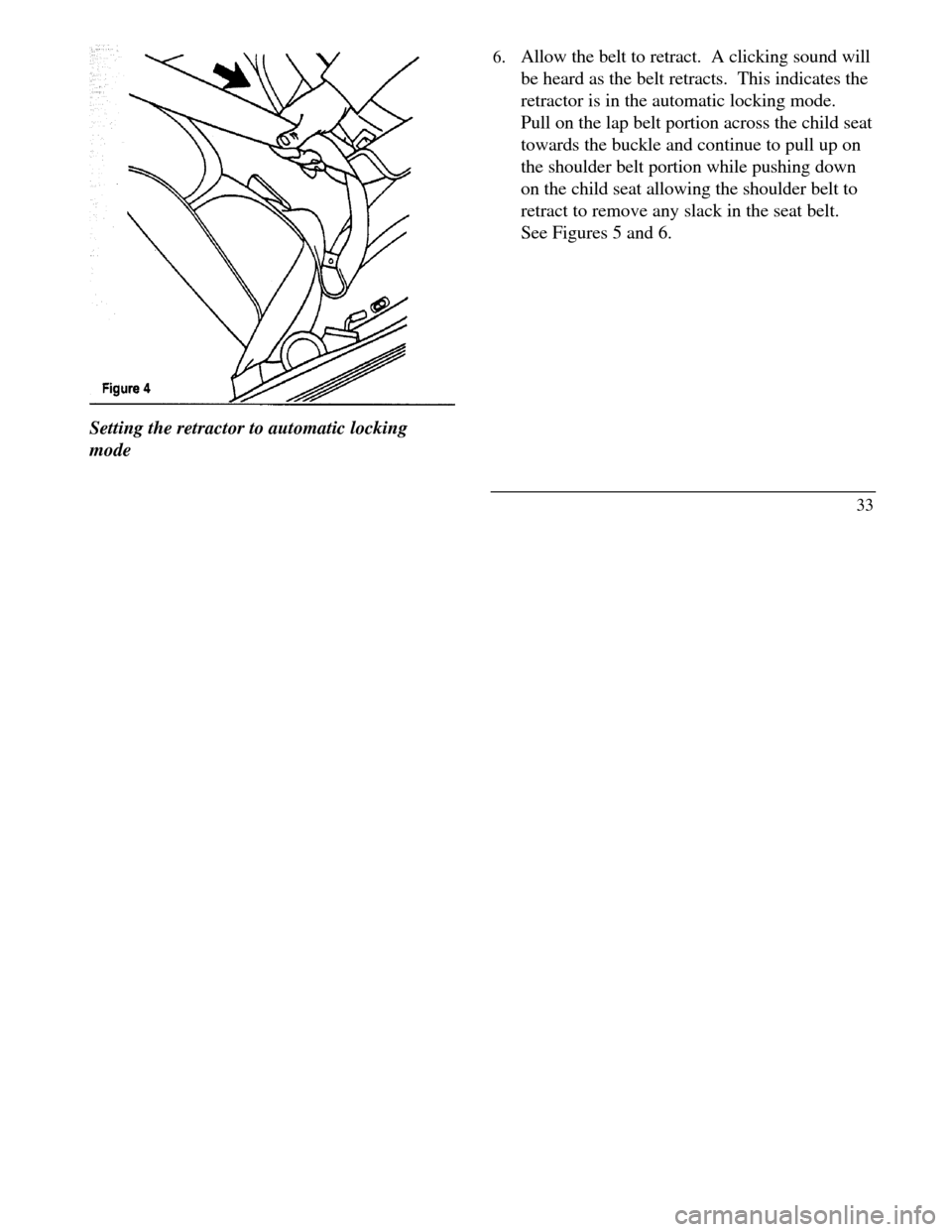
Setting the retractor to automatic locking
mode6. Allow the belt to retract. A clicking sound will
be heard as the belt retracts. This indicates the
retractor is in the automatic locking mode.
Pull on the lap belt portion across the child seat
towards the buckle and continue to pull up on
the shoulder belt portion while pushing down
on the child seat allowing the shoulder belt to
retract to remove any slack in the seat belt.
See Figures 5 and 6.
33