belt LINCOLN CONTINENTAL 1996 Customer Assistance Guide
[x] Cancel search | Manufacturer: LINCOLN, Model Year: 1996, Model line: CONTINENTAL, Model: LINCOLN CONTINENTAL 1996Pages: 320, PDF Size: 1.8 MB
Page 40 of 320
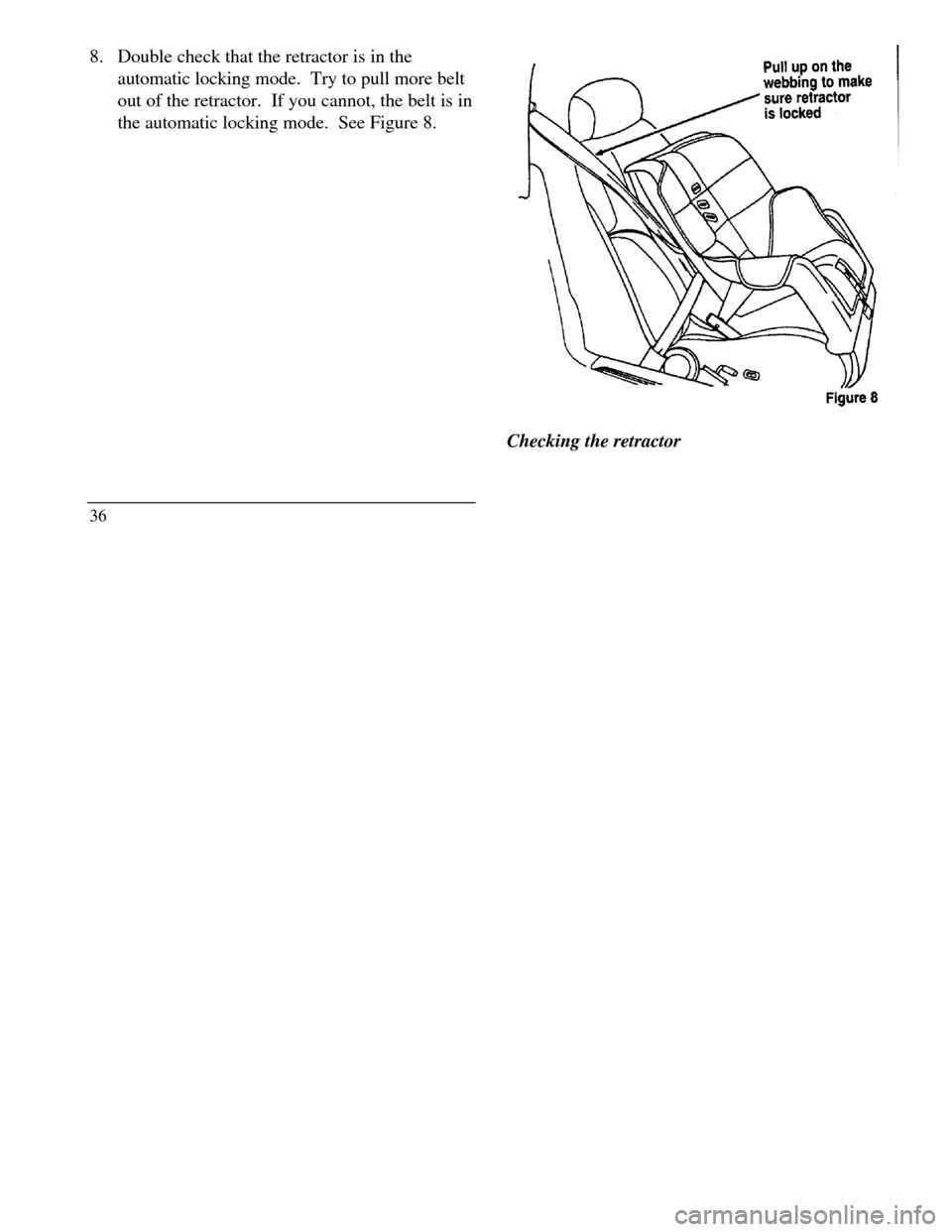
8. Double check that the retractor is in the
automatic locking mode. Try to pull more belt
out of the retractor. If you cannot, the belt is in
the automatic locking mode. See Figure 8.
36Checking the retractor
Page 41 of 320

9. Check to make sure that the child seat is
properly secured prior to each use. If the
retractor is not locked, repeat steps 6 through
8.
NOTE:To remove the retractor from
automatic lock mode, allow seat belt to retract fully
to its stowed position and the retractor will
automatically switch back to the vehicle sensitive
locking mode for normal adult usage.
Installing a Child Safety, Seat at the
Front Center Seating Position with
Adjustable Lap Belt-
1.Lengthen the lap belt. To lengthen the belt,
hold the tongue so that its bottom is
perpendicular to the direction of webbing
while sliding the tongue up the webbing.
2. Place the child safety seat in the center seating
position.3.Route the tongue and webbing through the
child seat according to the child seat
manufacturer's instructions.
4. Insert the belt tongue into the proper buckle
for the center seating position until you hear
a snap and feel it latch. Make sure the
tongue is m securely fastened to the buckle
by pulling on tongue.
5. Push down on the child seat while pulling on
the loose end of the lap belt webbing to
tighten the belt.
6. Before placing the child into the child seat,
forcibly tilt the child seat from side-to-side
and in forward directions to ensure that the
seat is held securely in place. If the child seat
moves excessively, repeat steps 5 through 6,
or properly install the child seat in a different
seating position.
37
Page 42 of 320
/!\WARNINGCarefully follow all of the manufacturer'sinstructions included with the safety seat youput in your vehicle. If you do not install anduse the safety seat properly, the child may beinjured in a sudden stop or collision.Attaching Safety Seats With Tether Straps
Some manufacturers make safety seats that include
a tether strap that goes over the back of the vehicle
seat and attaches to an anchoring point. Other
manufacturers offer the tether strap as an
accessory. Contact the manufacturer of your child
safety seat for information about ordering a tether
strap.
Tether anchorage hardware
All vehicles include a tether anchor installed at the
rear center seating position for use with child safety
seats. Attachment holes (at each rear outboard
38seating position) have been provided in your
vehicle to attach anchor hardware, if required.
Additional kits can be obtained at no charge from
any Ford or Lincoln-Mercury dealer.
Safety Belts for Children
Children who are too large for child safety seats
should always wear safety belts. (See instructions
with your child seat, or contact its manufacturer,
to determine maximum size of child that will
safely fit in the seat.)/!\ WARNINGIf safety belts are not properly worn andadjusted as described, the risk of seriousinjury to the child in a collision will bemuch greater.
Page 43 of 320
If the shoulder belt portion of the lap/shoulder belt
can be positioned so that it does not cross or rest in
front of the child's face or neck, the child should
wear the lap/shoulder belt. Moving the child closer
to the seat belt buckle may help provide a good
shoulder belt fit.
To improve the fit of lap and shoulder belts on
children who have outgrown child safety seats,
Ford recommends use of a belt-positioning booster
seat that is labelled as conforming to all Federal
motor vehicle safety standards. Belt-positioning
booster seats raise the child and provide a shorter,
firmer seating cushion that encourages safer seating
posture and better fit of lap and shoulder belts on
the child. A belt-positioning booster should be
used if the shoulder belt rests in front of the child's
face or neck, or if the lap belt does not fit snugly on
both thighs, or if the thighs are too short to let the
child sit all the way back on the seat cushion when
the lower legs hang over the edge of the seat
cushion. You may wish to discuss the specific
needs of your child with your pediatrician./!\ WARNINGDo not use a belt-positioning booster witha lap-only belt.Lap belts and the lap belt portion of lap and
shoulder belts should always be worn snugly and
below the hips, touching the child's thighs./!\ WARNINGTo reduce the risk of serious injury incollision, children should always ride withthe seatback upright.39
Page 46 of 320
/! WARNINGDo not leave children, unreliable adults,or pets alone in your vehicle. They couldaccidentally injure themselves or othersthrough inadvertent operation of thevehicle. Further, on hot, sunny days,temperatures in a closed vehicle couldquickly become high enough to causesevere and possibly fatal injuries to peopleas well as animals.Fuel-Injected Engines
When starting a fuel-injected engine, the most
important thing to remember is to avoid pressing
down on the accelerator before or during starting.
Only use the accelerator when you have problems
getting your vehicle started. See Starting Your Engine
in this chapter for details about when to use the
accelerator while you start your vehicle.Staring Your Vehicle
Preparing to Start Your Vehicle/!\WARNINGDo not start your vehicle in a closed garage orother enclosed area. Never sit in a stoppedvehicle for more than a short period of timewith the engine running. Exhaust fumes aretoxic. See Guarding Against Exhaust Fumesin this chapter for more instructions.Before you start your vehicle, do the following:
1. Make sure you and all your passengers buckle
your safety belts. See Safety Restraints in the
Index for more details.
2. Make sure the headlamps and other accessories
are turned off when starting.
43
Page 55 of 320
The following warning lights and gauges are on
the instrument cluster. AD of the warning
lights and gauges alert you to possible
problems with your vehicle.
Indicator Lights and Chimes
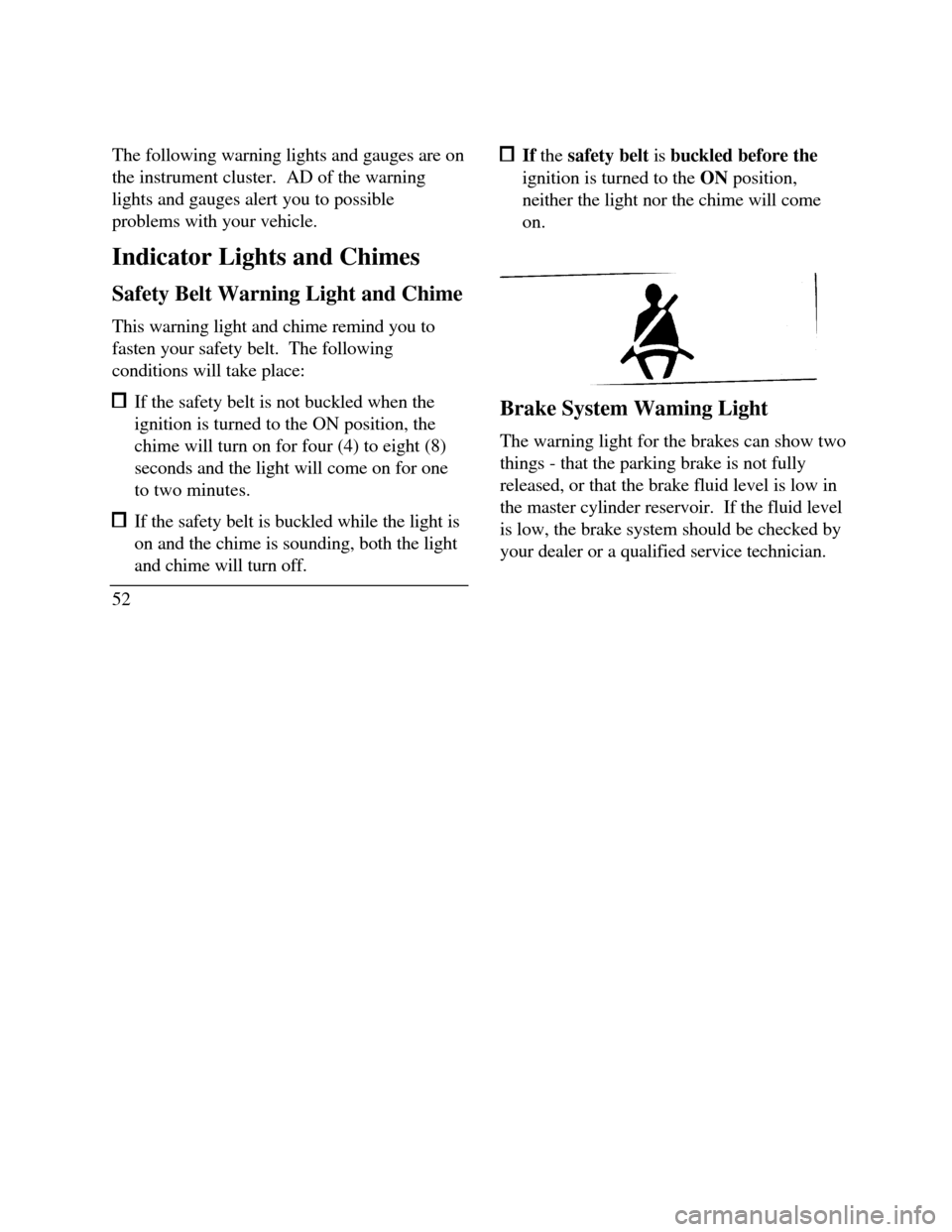
Safety Belt Warning Light and Chime
This warning light and chime remind you to
fasten your safety belt. The following
conditions will take place: If the safety belt is not buckled when the
ignition is turned to the ON position, the
chime will turn on for four (4) to eight (8)
seconds and the light will come on for one
to two minutes. If the safety belt is buckled while the light is
on and the chime is sounding, both the light
and chime will turn off.
52 If the safety belt is buckled before the
ignition is turned to the ON position,
neither the light nor the chime will come
on.Brake System Waming Light
The warning light for the brakes can show two
things - that the parking brake is not fully
released, or that the brake fluid level is low in
the master cylinder reservoir. If the fluid level
is low, the brake system should be checked by
your dealer or a qualified service technician.
Page 63 of 320

The Instrument Cluster
In addition to warning lights, the instrument
cluster has a message center/odometer, a
speedometer, tachometer, fuel and coolant
temperature gauges.
The Electronic Message Center (M/C)
The Electronic Message Center only works
when the ignition is in the ON position.
Each time the WC is powered the display goes
through a self test by displaying the PLEASE
FASTEN SEATBELT message. This self test
is used to stabilize the systems before reporting
the status to you.
60The message center tells you about the
condition of your vehicle by two methods: operator selectable features continuous warning reporting of
monitored systems
You can select different features for the M/C to
display by using the message center control
buttons located to the right of the instrument
cluster. You will hear a tone when you press one
of these buttons. However, if the M/C detects a
warning from any of the monitored systems, then
the M/C will display the appropriate warning
message.
Page 118 of 320
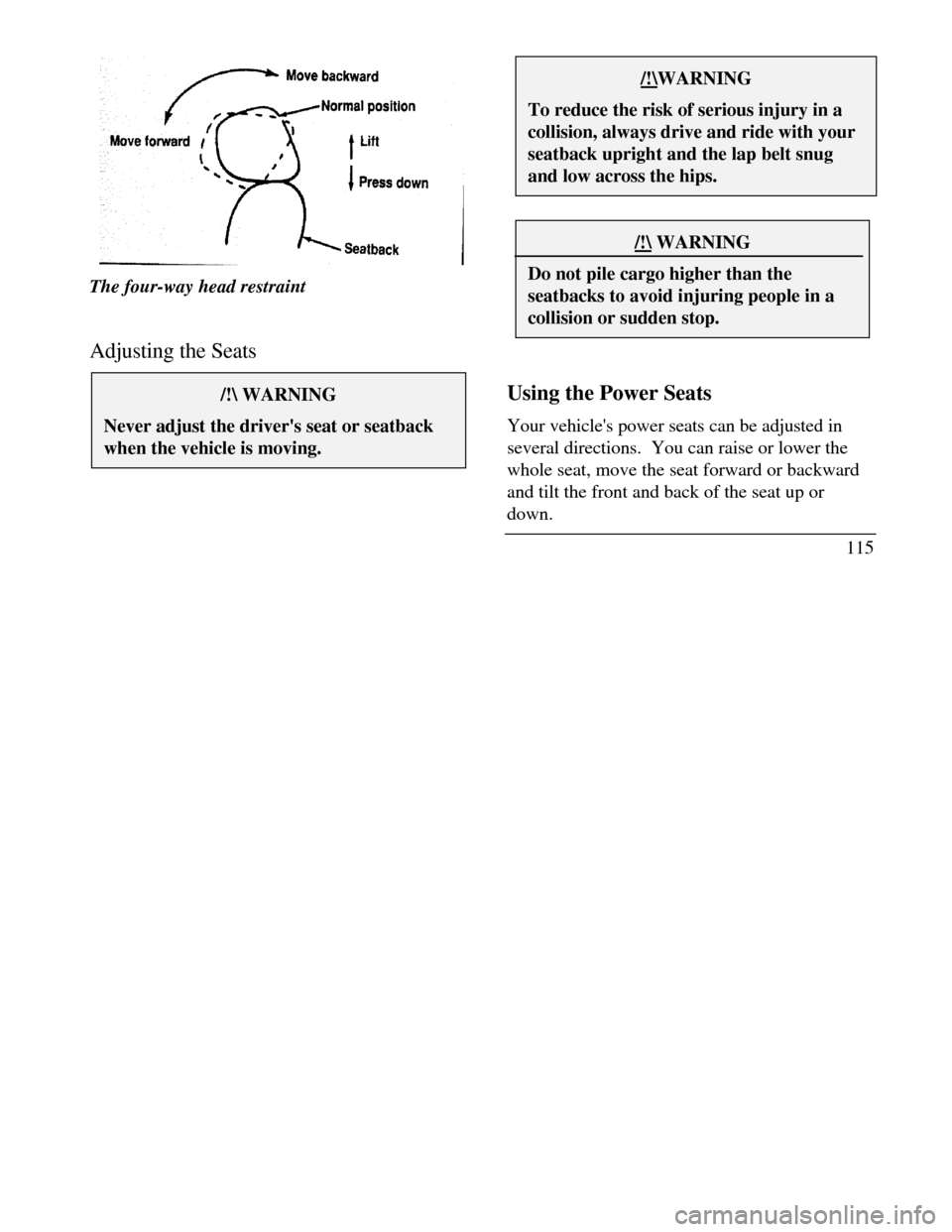
The four-way head restraint
Adjusting the Seats/! WARNINGNever adjust the driver's seat or seatbackwhen the vehicle is moving./!\WARNINGTo reduce the risk of serious injury in acollision, always drive and ride with yourseatback upright and the lap belt snugand low across the hips./!\ WARNINGDo not pile cargo higher than theseatbacks to avoid injuring people in acollision or sudden stop.Using the Power Seats
Your vehicle's power seats can be adjusted in
several directions. You can raise or lower the
whole seat, move the seat forward or backward
and tilt the front and back of the seat up or
down.
115
Page 253 of 320
Engine coolant drain and flush
Proper procedures for a complete coolant drain and
flush of the cooling system can be found in the Car
Service Manual. Following these recommended
procedures will ensure that the specified coolant
level and a 50/50 or appropriate mixture of coolant
and water is maintained.
Engine coolant refill procedure
When the entire cooling system is drained and
refilled, the following procedure should be used to
ensure a complete fill:
NOTE: It is imperative the following procedure
be adhered to. Failure to do so could result in
damage to your engine. Remove coolant reservoir pressure cap. Remove the engine coolant outlet tube fill plug
on the engine. With the engine off and cool, add a 50/50 mixture
of recommended cooling system fluid and water
to the coolant outlet tube fill neck until the
reservoir is full.
NOTE: DO NOT FILL COOLANT SYSTEM
THROUGH COOLANT RESERVOIR. COOLANT
WILL NOT ENTER ENGINE, WHICH CAN
LEAD TO ENGINE DAMAGE.
NOTE: Avoid spilling coolant on the front end
accessory drive belt, as this will allow the belt to slip
and become noisy. Reinstall the pressure cap to the coolant
reservoir. Continue filling at the engine coolant tube fill
neck slowly while allowing air to escape. Reinstall the engine coolant tube fill plug when
the system is full.
251
Page 260 of 320

/!\ WARNINGWhen replacing full size tires, never mixradial, bias-belted, or bias-type tires. Use onlythe tire sizes that are listed on the tirepressure decal. Make sure that all tires arethe same size, speed rating, and load-carryingcapacity. Use only the tire combinationsrecommended on the decal. If you do notfollow these precautions, your vehicle may notdrive properly and safely.Tires that are larger or smaller than your vehicle's
original tires may also affect the accuracy of your
speedometer.
258Information About Tire Quality Grades
New vehicles are fitted with tires that have their Tire
Quality Grade (described below) molded into the
tire's sidewall. These Tire Quality Grades are
determined by standards that the United States
Department of Transportation has set.
Tire Quality Grades apply to new pneumatic tires for
use on passenger cars. They do not apply to deep
tread, winter-type snow tires, space-saver or
temporary use spare tires, tires with nominal rim
diameters of 10 to 12 inches or limited production
tires as defined in Title 49 Code of Federal
Regulations Part 575.104(c)(2).
U.S. Department of Transportation - Tire quality
grades: The U.S. Department of Transportation
requires Ford to give you the following information
about tire grades exactly as the government has
written it.