wheel LINCOLN LS 2000 Owner's Manual
[x] Cancel search | Manufacturer: LINCOLN, Model Year: 2000, Model line: LS, Model: LINCOLN LS 2000Pages: 272, PDF Size: 2.36 MB
Page 211 of 272
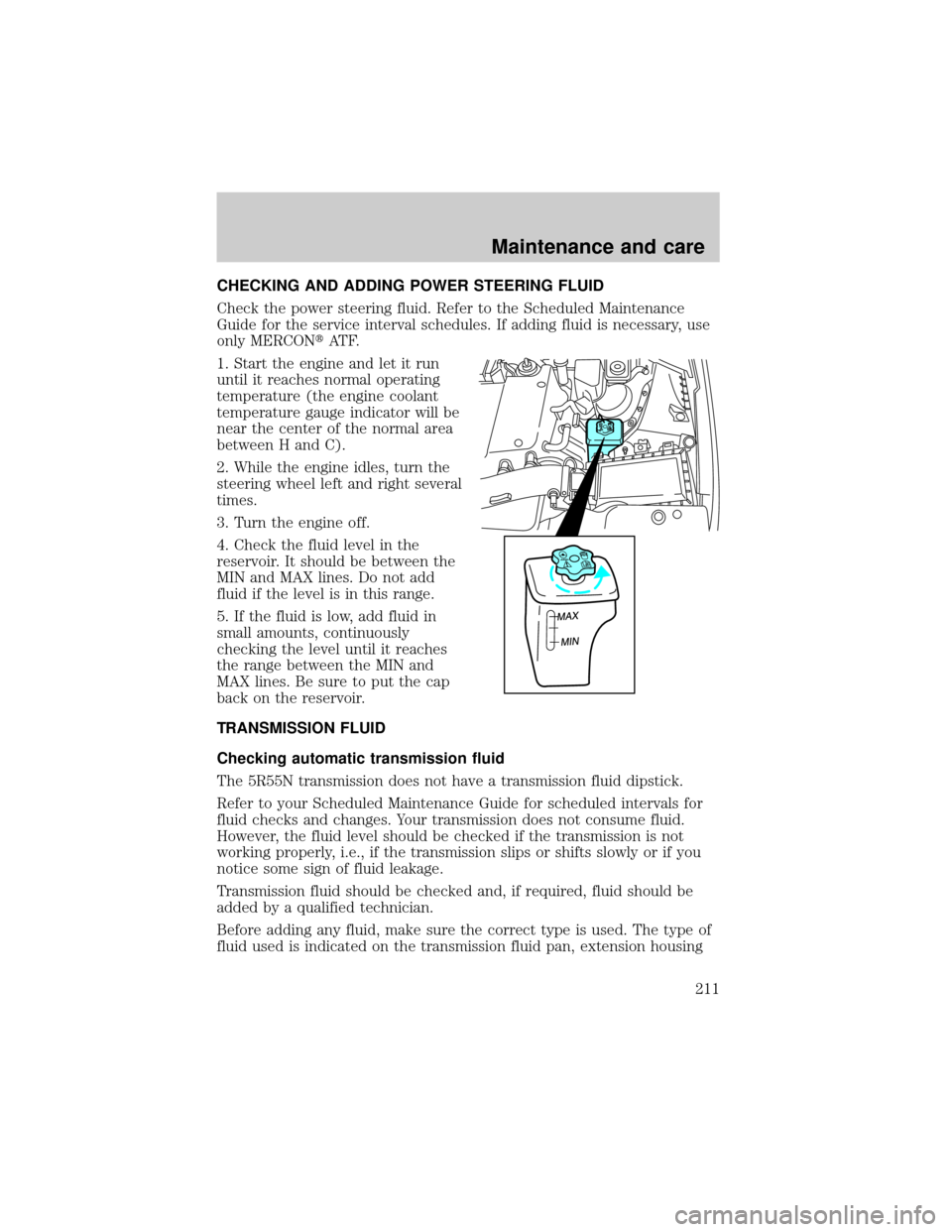
CHECKING AND ADDING POWER STEERING FLUID
Check the power steering fluid. Refer to the Scheduled Maintenance
Guide for the service interval schedules. If adding fluid is necessary, use
only MERCONtAT F.
1. Start the engine and let it run
until it reaches normal operating
temperature (the engine coolant
temperature gauge indicator will be
near the center of the normal area
between H and C).
2. While the engine idles, turn the
steering wheel left and right several
times.
3. Turn the engine off.
4. Check the fluid level in the
reservoir. It should be between the
MIN and MAX lines. Do not add
fluid if the level is in this range.
5. If the fluid is low, add fluid in
small amounts, continuously
checking the level until it reaches
the range between the MIN and
MAX lines. Be sure to put the cap
back on the reservoir.
TRANSMISSION FLUID
Checking automatic transmission fluid
The 5R55N transmission does not have a transmission fluid dipstick.
Refer to your Scheduled Maintenance Guide for scheduled intervals for
fluid checks and changes. Your transmission does not consume fluid.
However, the fluid level should be checked if the transmission is not
working properly, i.e., if the transmission slips or shifts slowly or if you
notice some sign of fluid leakage.
Transmission fluid should be checked and, if required, fluid should be
added by a qualified technician.
Before adding any fluid, make sure the correct type is used. The type of
fluid used is indicated on the transmission fluid pan, extension housing
MAX
MIN
MAX
MIN
Maintenance and care
211
Page 223 of 272
conditions of their use, however, and may depart significantly from the
norm due to variations in driving habits, service practices, and
differences in road characteristics and climate.
Traction AA A B C
The traction grades, from highest to lowest are AA, A, B, and C. Those
grades represent the tire's ability to stop on wet pavement as measured
under controlled conditions on specified government test surfaces of
asphalt and concrete. A tire marked C may have poor traction
performance.
The traction grade assigned to this tire is based on
straight-ahead braking traction tests, and does not include
acceleration, cornering, hydroplaning or peak traction characteristics.
Temperature A B C
The temperature grades are A (the highest), B, and C, representing the tire's
resistance to the generation of heat and its ability to dissipate heat when
tested under controlled conditions on a specified indoor laboratory test
wheel. Sustained high temperature can cause the material of the tire to
degenerate and reduce tire life, and excessive temperature can lead to
sudden tire failure. The grade C corresponds to a level of performance which
all passenger car tires must meet under the Federal Motor Vehicle Safety
Standard No. 109. Grades B and A represent higher levels of performance on
the laboratory test wheel than the minimum required by law.
The temperature grade for this tire is established for a tire that
is properly inflated and not overloaded. Excessive speed,
underinflation, or excessive loading, either separately or in
combination, can cause heat buildup and possible tire failure.
SERVICING YOUR TIRES
Checking the tire pressure
²Use an accurate tire pressure gauge.
²
Check the tire pressure when tires are cold, after the vehicle has been
parked for at least one hour or has been driven less than 5 km (3 miles).
²Adjust tire pressure to recommended specifications found on the
Certification Label.
Maintenance and care
223
Page 225 of 272
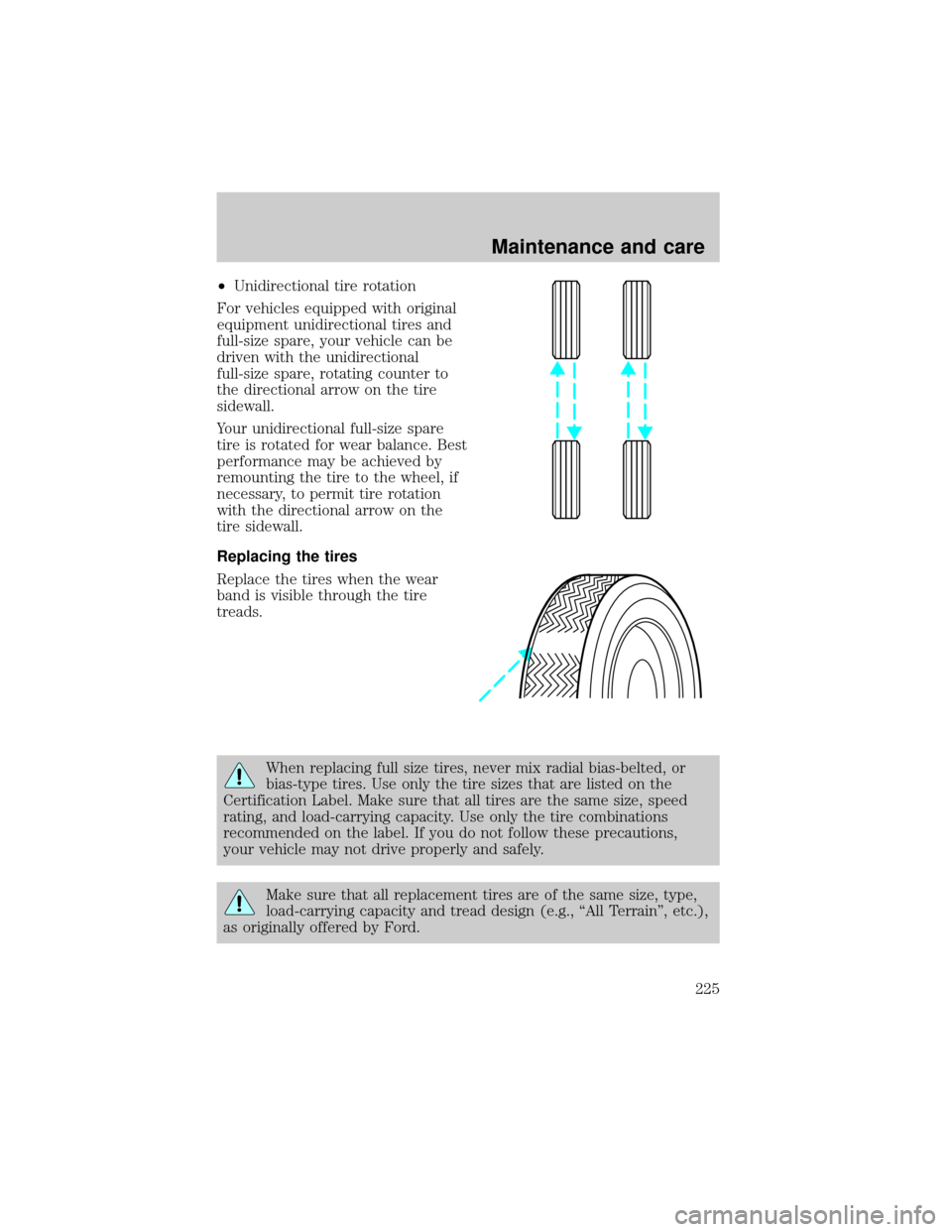
²Unidirectional tire rotation
For vehicles equipped with original
equipment unidirectional tires and
full-size spare, your vehicle can be
driven with the unidirectional
full-size spare, rotating counter to
the directional arrow on the tire
sidewall.
Your unidirectional full-size spare
tire is rotated for wear balance. Best
performance may be achieved by
remounting the tire to the wheel, if
necessary, to permit tire rotation
with the directional arrow on the
tire sidewall.
Replacing the tires
Replace the tires when the wear
band is visible through the tire
treads.
When replacing full size tires, never mix radial bias-belted, or
bias-type tires. Use only the tire sizes that are listed on the
Certification Label. Make sure that all tires are the same size, speed
rating, and load-carrying capacity. Use only the tire combinations
recommended on the label. If you do not follow these precautions,
your vehicle may not drive properly and safely.
Make sure that all replacement tires are of the same size, type,
load-carrying capacity and tread design (e.g., ªAll Terrainº, etc.),
as originally offered by Ford.
Maintenance and care
225
Page 226 of 272
Failure to follow these precautions may adversely affect the
handling of the vehicle and make it easier for the driver to lose
control and roll over.
Tires that are larger or smaller than your vehicle's original tires may also
affect the accuracy of your speedometer.
SNOW TIRES AND CHAINS
Snow tires must be the same size and grade as the tires you
currently have on your vehicle.
The tires on your vehicle have all weather treads to provide traction in
rain and snow. However, in some climates, you may need to use snow
tires or chains. If you need to use chains, it is recommended that steel
wheels (of the same size and specifications) be used as chains may chip
aluminum wheels.
Follow these guidelines when using snow tires and chains:
²Use only SAE Class S chains with P215/60R16 tires.
²Do not use tire chains with size P235/50R17 tires. Use of SAE Class S
chains or other chain types may damage your vehicle.
²Install chains securely, verifying that the chains do not touch any
wiring, brake lines or fuel lines.
²Drive cautiously. If you hear the chains rub or bang against your
vehicle, stop and re-tighten the chains. If this does not work, remove
the chains to prevent damage to your vehicle.
²If possible, avoid fully loading your vehicle.
²Remove the tire chains when they are no longer needed. Do not use
tire chains on dry roads.
²The suspension insulation and bumpers will help prevent vehicle
damage. Do not remove these components from your vehicle when
using snow tires or chains.
Maintenance and care
226
Page 234 of 272

²Using the air conditioner or defroster may reduce fuel economy.
²You may want to turn off the speed control in hilly terrain if
unnecessary shifting between third and fourth gear occurs.
Unnecessary shifting of this type could result in reduced fuel
economy.
²Warming up a vehicle on cold mornings is not required and may
reduce fuel economy.
²Resting your foot on the brake pedal while driving may reduce fuel
economy.
²Combine errands and minimize stop-and-go driving.
Maintenance
²Keep tires properly inflated and use only recommended size.
²Operating a vehicle with the wheels out of alignment will reduce fuel
economy.
²Use recommended engine oil. Refer toLubricant Specifications.
²Perform all regularly scheduled maintenance items. Follow the
recommended maintenance schedule and owner maintenance checks
found in your vehicle Scheduled Maintenance Guide.
Conditions
²Heavily loading a vehicle or towing a trailer may reduce fuel economy
at any speed.
²Carrying unnecessary weight may reduce fuel economy (approximately
0.4 km/L [1 mpg] is lost for every 180 kg [400 lb] of weight carried).
²Adding certain accessories to your vehicle (for example bug
deflectors, rollbars/light bars, running boards, ski/luggage racks) may
reduce fuel economy.
²Using fuel blended with alcohol may lower fuel economy.
²Fuel economy may decrease with lower temperatures during the first
12±16 km (8±10 miles) of driving.
²Driving on flat terrain offers improved fuel economy as compared to
driving on hilly terrain.
²Transmissions give their best fuel economy when operated in the top
cruise gear and with steady pressure on the gas pedal.
²Close windows for high speed driving.
Maintenance and care
234
Page 243 of 272

Cleaning the wheels
Wash with the same detergent as the body of your vehicle. Do not use
acid-based or alcohol-based wheel cleaners, steel wool, fuel or strong
detergents. Never use abrasives that will damage the finish of special
wheel surfaces. Use a tar remover to remove grease and tar.
The brushes used in some automatic car washes may damage the finish
on your wheels. Before going to a car wash, find out if the brushes are
abrasive.
Cleaning non-painted plastic exterior parts
Use vinyl cleaner for routine cleaning. Clean with a tar remover if
necessary. Do not clean plastic parts with thinners, solvents or
petroleum-based cleaners.
Underbody
Flush the complete underside of vehicle frequently. Keep body drain
holes unplugged. Inspect for road damage.
Cleaning mirrors
Do not clean your mirrors with a dry cloth or abrasive materials. Use a
soft cloth and mild detergent and water. Be careful when removing ice
from outside mirrors because you may damage the reflective surface.
Cleaning the exterior lamps
Wash with the same detergent as the exterior of your vehicle. If
necessary, use a tar remover such as Ford Extra Strength Tar and Road
Oil Remover (B7A-19520±AA).
To avoid scratching the lamps, do not use a dry paper towel, chemical
solvents or abrasive cleaners.
Cleaning the wiper blades, windshield and rear window
If the wiper blades do not wipe properly, clean the wiper blade rubber
element with undiluted windshield washer solution or a mild detergent.
To avoid damaging the blades, do not use fuel, kerosene, paint thinner or
other solvents.
If the wiper still does not wipe properly, this could be caused by
substances on the windshield or rear window such as tree sap and some
hot wax treatments used by commercial car washes. Clean the outside of
the windshield or rear window with a non-abrasive cleaner such as Ford
Maintenance and care
243
Page 245 of 272
²Never wash or rinse the engine while it is running; water in the
running engine may cause internal damage.
Cleaning the instrument panel
Clean with a damp cloth, then dry with a dry cloth.
Avoid cleaner or polish that increases the gloss of the upper portion of
the instrument panel. The dull finish in this area helps protect the driver
from undesirable windshield reflection.
Do not use chemical solvents or strong detergents when cleaning
the steering wheel or instrument panel to avoid contamination of
the air bag system.
Cleaning the instrument cluster lens
Clean with a damp cloth, then dry with a dry cloth.
Do not use household or glass cleaners as these may damage the lens.
Cleaning seats equipped with side air bags
Remove dust and loose dirt with a whisk broom or a vacuum cleaner.
Remove fresh spots immediately. Follow the directions that come with
the cleaner. Do not saturate the seat cover with upholstery cleaner.
Do not use chemical solvents or strong detergents when cleaning
the seat mounted side air bag. Such products could contaminate
the side air bag system and affect performance of the side air bag in a
collision.
Woodtone trim
Wipe stains with a soft cloth and a multi-purpose cleaning solution.
Inside windows
Use Ultra-Clear Spray Glass Cleaner (E4AZ-19C507±AA) for the inside
windows if they become fogged.
Cleaning and maintaining the safety belts
Clean the safety belts with a mild soap solution recommended for
cleaning upholstery or carpets. Do not bleach or dye the belts, because
these actions may weaken the belt webbing.
Maintenance and care
245
Page 251 of 272
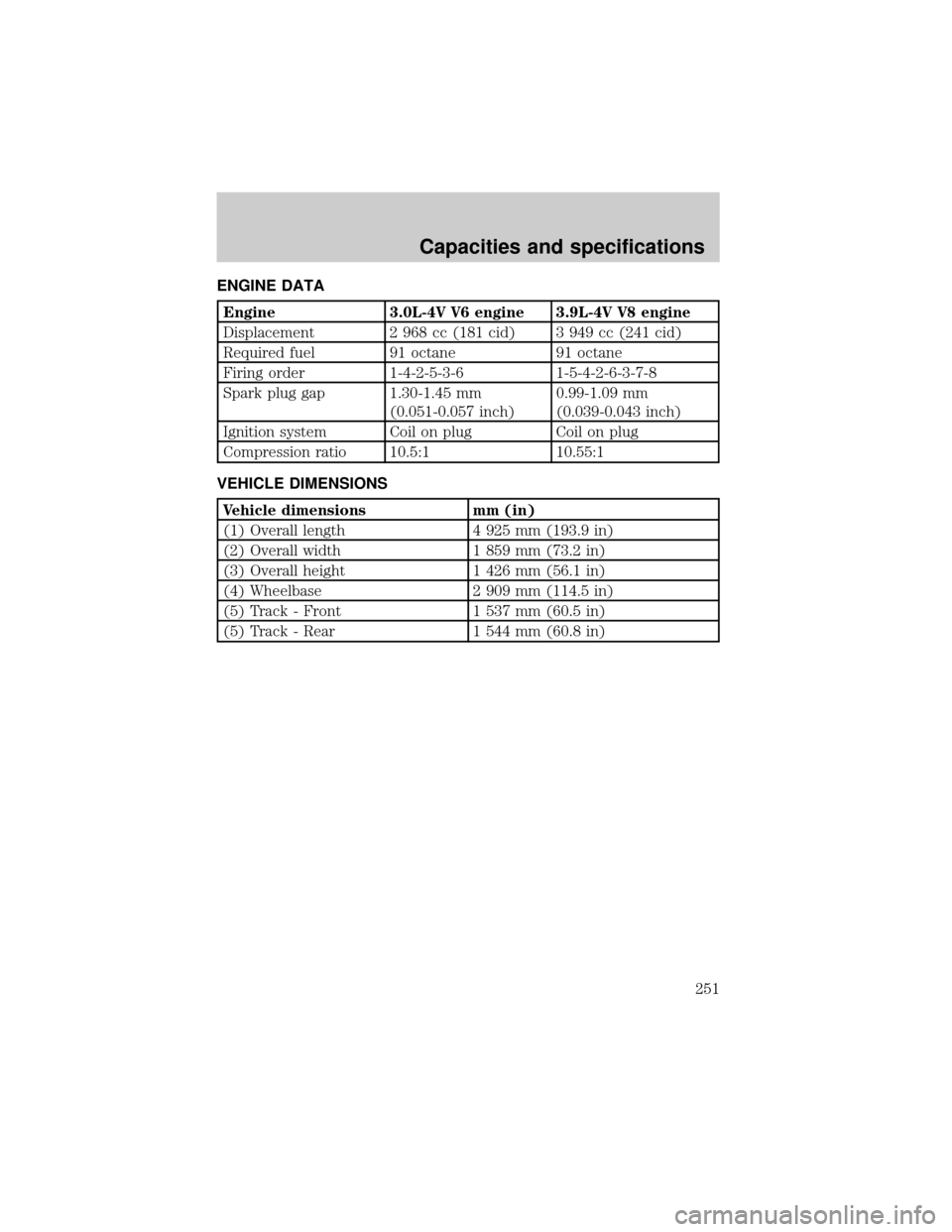
ENGINE DATA
Engine 3.0L-4V V6 engine 3.9L-4V V8 engine
Displacement 2 968 cc (181 cid) 3 949 cc (241 cid)
Required fuel 91 octane 91 octane
Firing order 1-4-2-5-3-6 1-5-4-2-6-3-7-8
Spark plug gap 1.30-1.45 mm
(0.051-0.057 inch)0.99-1.09 mm
(0.039-0.043 inch)
Ignition system Coil on plug Coil on plug
Compression ratio 10.5:1 10.55:1
VEHICLE DIMENSIONS
Vehicle dimensions mm (in)
(1) Overall length 4 925 mm (193.9 in)
(2) Overall width 1 859 mm (73.2 in)
(3) Overall height 1 426 mm (56.1 in)
(4) Wheelbase 2 909 mm (114.5 in)
(5) Track - Front 1 537 mm (60.5 in)
(5) Track - Rear 1 544 mm (60.8 in)
Capacities and specifications
251
Page 262 of 272

Ford Multi-Purpose Cleaner*
Motorcraft Car Wash Concentrate
Motorcraft Carlite Glass Cleaner
Ford Spot and Stain Remover*
Ford Super Premium Tire and Trim Dressing
Ford Triple Clean
Ford Ultra-Clear Spray Glass Cleaner
* May be sold with the Motorcraft name
FORD ACCESSORIES FOR YOUR VEHICLE
A wide selection of Ford accessories are available for your vehicle
through your local authorized Lincoln Mercury dealer. These quality
accessories have been specifically engineered to fulfill your automotive
needs; they are custom designed to complement the style and
aerodynamic appearance of your vehicle. In addition, each accessory is
made from high quality materials and meets or exceeds Ford's rigid
engineering and safety specifications. Ford accessories are warranted for
up to 12 months or 20,000 km (12,000 miles) on all cars unless the
accessory is installed on a new vehicle, then the warranty becomes the
balance of the new vehicle's warranty or the accessories warranty,
whichever is greater. See your dealer for complete warranty information
and availability.
Not all accessories are available for all models.
Vehicle Security
Styled wheel protector locks
Vehicle security systems
Comfort and convenience
Cargo nets
Cargo organizers (trunk)
Cargo trays
Electrochromic compass inside mirror
Engine block heaters
Gear shift knob (woodgrain) Ð manual transmission
Customer assistance
262
Page 266 of 272

Accessory delay ..........................99
AdvanceTrac ..............................153
Air bag supplemental
restraint system ..........128,129,133
and child safety seats ............130
description .......................129,133
disposal ....................................136
driver air bag ...................131,134
indicator light .............11,132,135
operation ..........................131,134
passenger air bag ............131,134
side air bag ..............................133
Air cleaner filter ................215,247
Air conditioning ..........................31
automatic temperature
control system ..........................31
Air filter, cabin ..........................217
Antifreeze
(see Engine coolant) ................204
Anti-lock brake system
(see Brakes) .......................149,150
Anti-theft system ......................106
arming the system ..................107
disarming a
triggered system .....................107
Audio system (see Radio) .........42
Automatic transmission ............155
driving an automatic
overdrive .................................156
fluid, adding ............................211
fluid, checking ........................211
fluid, refill capacities ..............247
fluid, specification ..................251
Axle
lubricant specifications ...249,251
refill capacities ........................247
Battery .......................................213
acid, treating emergencies .....213
charging system
warning light .............................11
jumping a disabled battery ....188
maintenance-free ....................213replacement, specifications ...247
servicing ..................................213
Belt minder ...............................124
Brakes ........................................149
anti-lock ............................149,150
anti-lock brake system
(ABS) warning light ..........10,150
brake warning light ..................10
fluid, checking and adding ....202
fluid, refill capacities ..............247
fluid, specifications ..........249,251
lubricant specifications ...249,251
parking ....................................150
shift interlock ..........................155
Break-in period .............................3
Capacities for refilling fluids ....247
Cassette tape player ...................54
CD changer .................................66
Certification Label ....................253
Child safety restraints ..............136
child safety belts ....................136
Child safety seats ......................137
attaching with tether straps ..141
in front seat ............................139
in rear seat ..............................139
Cleaning your vehicle ...............241
engine compartment ..............244
exterior .............................242,243
exterior lamps .........................243
instrument panel ....................245
instrument panel lens ............245
interior ..............................245,246
mirrors .....................................243
plastic parts ............................243
safety belts ..............................245
washing ....................................241
waxing .....................................242
wheels ......................................243
windows ..................................245
wiper blades ............................243
woodtone trim ........................245
Index
266