position LINCOLN MARK VIII 1997 Workshop Manual
[x] Cancel search | Manufacturer: LINCOLN, Model Year: 1997, Model line: MARK VIII, Model: LINCOLN MARK VIII 1997Pages: 315, PDF Size: 2.18 MB
Page 181 of 315
176ignition switch is in the ON position and the
shutoff switch is in the OFF position. ªCHECK AIR
RIDEº will appear when a system fault has been
detected and the ignition switch is in the ON
position.
Normal vehicle operation does not require any
action by the driver.
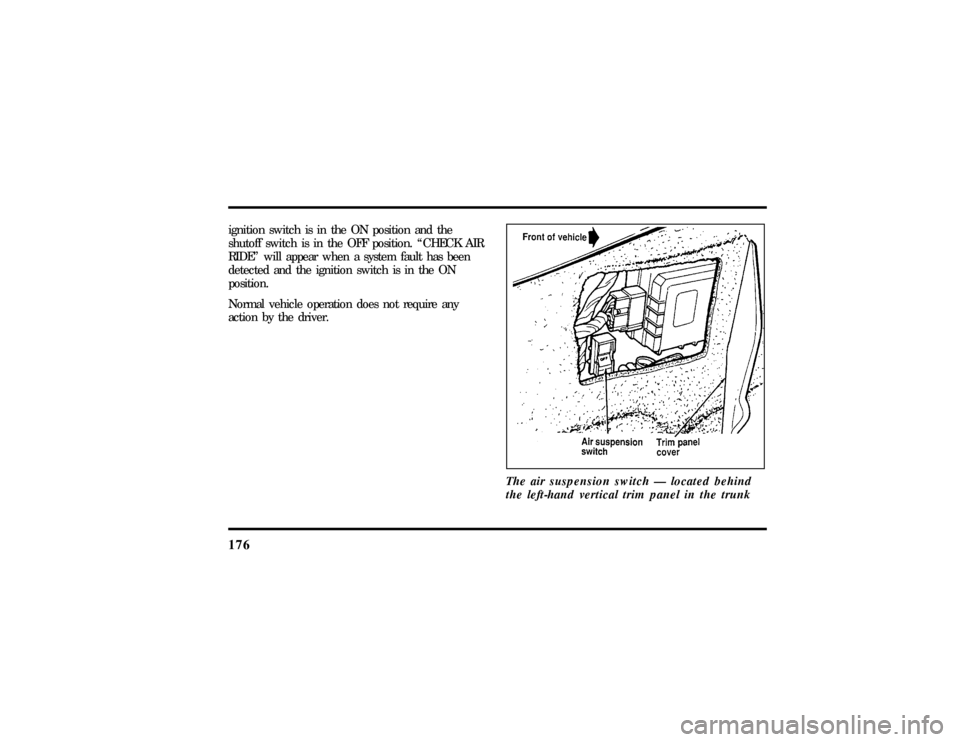
The air suspension switch Ð located behind
the left-hand vertical trim panel in the trunk
File:09fngf8.ex
Update:Wed Jun 19 10:45:23 1996
Page 183 of 315

178To move the shifter out of P (Park), the ignition
key must be turned to the ON position. This
vehicle is also equipped with the brake shift
interlock safety feature which prevents shifting the
transmission out of the P (Park) position without
the brake pedal being depressed if the key is in the
ON position.
To operate:
1. Start the engine.
2. Depress and hold the brake pedal.
3. Move the gearshift lever out of P (Park).
Your vehicle is equipped with a Brake Shift
Interlock safety feature. This feature prevents the
gearshift from being moved from the P (Park)
position until the brake pedal is depressed. Thisfeature is active when the ignition is in the ON
position. If the gearshift lever CANNOT be moved
from P (Park) with the brake pedal depressed:
1. Turn the engine off and remove the ignition
key.
2. Apply parking brake.
3. Reinsert the ignition key and turn clockwise to
the first position.
4. Depress the brake pedal, move the gearshift
lever to N (Neutral) and start the engine.
If you need to shift out of P (Park) by using the
alternate procedure described above, it is possible
that a fuse has blown and that your brakelamps
may also not be functional. Please refer to the
Servicing Your Mark VIIIchapter for instructions on
checking and replacing fuses.
File:09fngf8.ex
Update:Wed Jun 19 10:45:23 1996
Page 185 of 315

180R (Reverse)With the gearshift in the R (Reverse) position, the
vehicle will move backward. You should always
come to a complete stop before shifting into or out
of R (Reverse).N (Neutral)With the gearshift in the N (Neutral) position, the
vehicle can be started and is free to roll. Hold the
brake pedal down while in this position.DrivingYour vehicle's gearshift is console-mounted on the
floor. The Transmission Control Switch (TCS) is
located on the gearshift handle. The Transmission
Control Indicator Light is located on the instrument
panel. You can put the gearshift lever in any of the
several positions.The O/D OFF light is off (not illuminated) during
normal vehicle operation. This allows the
transmission to upshift and downshift from 1st
through 4th gears. When the TCS is pressed, the
Transmission Control Indicator Light will illuminate
(O/D OFF) on the instrument panel. When this
O/D OFF is illuminated, the transmission will
upshift and downshift from 1st through 3rd gears.
If O/D OFF light does not come ªONº when TCS
is depressed or if the light flashes when you are
driving, have your vehicle serviced at the first
opportunity. If this condition persists, damage could
occur to the transmission.
To return the transmission to normal operation (1st
through 4th gear) depress the TCS again. This
switch may be used to cancel overdrive any time
the vehicle is being driven. Each time your vehicle
is started, the overdrive system will automatically be
in the normal overdrive mode and the light will not
be illuminated.
File:09fngf8.ex
Update:Wed Jun 19 10:45:23 1996
Page 186 of 315

181
When to use D (Overdrive)Overdrive is the usual driving position for an
automatic overdrive transmission. It works the same
way Drive works, automatically upshifting or
downshifting as the vehicle speeds or slows.
However, Overdrive also shifts into a fourth gear Ð
an overdrive gear Ð when your vehicle cruises at
an appropriate consistent speed for any length of
time. This fourth gear will increase your fuel
economy when you travel at cruising speeds.When to use Drive (D Ð with
Transmission Control Switch activated)Overdrive may not be appropriate for certain
terrain. If the transmission shifts back and forth
between Third and Fourth gears while you are
driving on hilly roads or if your vehicle does not
have adequate power for climbing hills, depress the
TCS.
You can depress the TCS at any speed.
When to use 2 (Second)Use 2 (Second) for start-up on slippery roads or to
give you more engine braking to slow your vehicle
on downgrades.When to use 1 (Low)Use 1 (Low) when driving down steep grades. It
gives more engine braking to slow your vehicle than
2 (Second) on the downgrades. You can upshift
from 1 (Low) to 2 (Second) or from 1 (Low) to
Overdrive at any speed.P (Park)Always come to a complete stop before you shift
into P (Park). Make sure that the gearshift is
securely latched in P (Park). This locks the
transmission and prevents the rear wheels from
rotating.
Always set the parking brake fully and make sure
the gearshift is latched in P (Park). Turn off the
ignition whenever you leave your vehicle.
File:09fngf8.ex
Update:Wed Jun 19 10:45:23 1996
Page 228 of 315
223
Checking and Adding Engine OilSince the proper amount of engine oil is important
for safe engine operation, check the oil using the
dipstick each time you put fuel in your vehicle.
Remember the engine must be off, the oil must be
warm and the vehicle must be parked on level
ground.
Checking the engine oil level:
1. Turn the engine off after it has warmed up and
allow a few minutes for the engine oil to drain
back into the oil pan.
2. Set the parking brake, making sure the gearshift
is securely latched in P (Park).
3. Open the hood. Protect yourself from engine
heat.
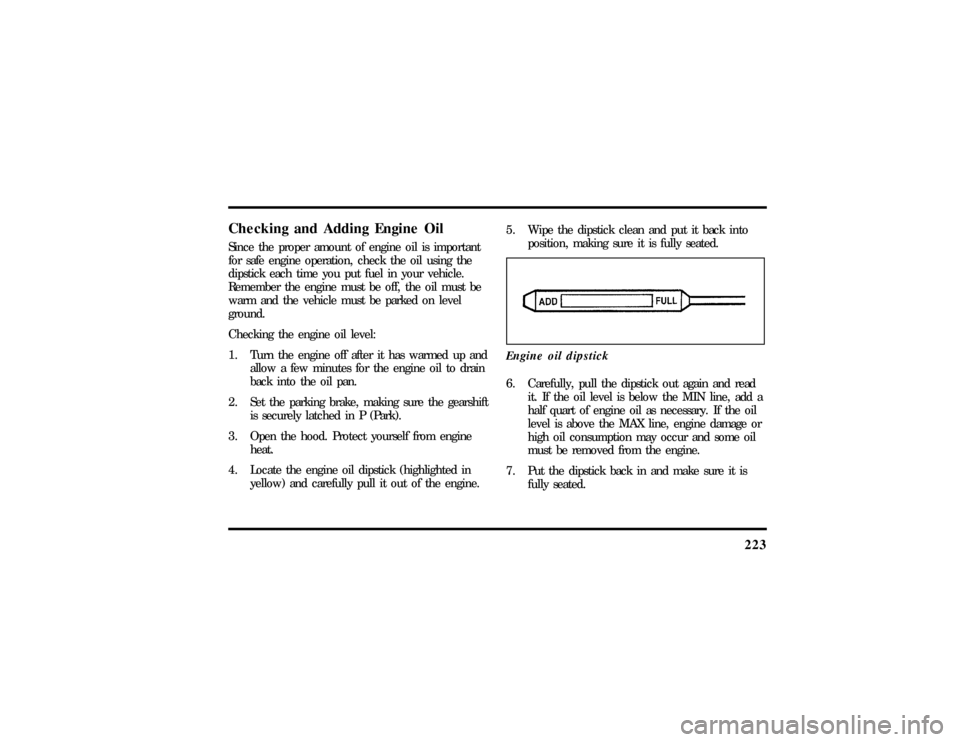
4. Locate the engine oil dipstick (highlighted in
yellow) and carefully pull it out of the engine.5. Wipe the dipstick clean and put it back into
position, making sure it is fully seated.
Engine oil dipstick
6. Carefully, pull the dipstick out again and read
it. If the oil level is below the MIN line, add a
half quart of engine oil as necessary. If the oil
level is above the MAX line, engine damage or
high oil consumption may occur and some oil
must be removed from the engine.
7. Put the dipstick back in and make sure it is
fully seated.
File:11fnmc8.ex
Update:Thu Jun 20 14:28:32 1996
Page 237 of 315

232q
Reinstall the engine coolant tube fill plug when
the system is full.
q
Select maximum heater temperature and fan
speed settings. Position control to discharge air
at A/C vents in instrument panel.
q
Start engine and allow to idle. While engine is
idling, feel for hot air at A/C vents.
NOTE:IF AIR DISCHARGE REMAINS COOL AND
ENGINE TEMPERATURE GAUGE DOES NOT
MOVE,SHUT ENGINE OFF IMMEDIATELY.
This is an indication of low coolant level and/or air
pockets in coolant system. Allow engine to cool and
repeat the previous steps.
q
Allow to idle until normal operating temperature
is reached. Hot air should discharge from A/C
vents. The engine temperature gauge should
maintain a stabilized reading in the middle of
the ªNORMALº range and the lower radiator
hose should feel hot to the touch.
q
Shut off the engine and allow to cool down.
q
After the engine cools down, recheck the
engine coolant level. Fill reservoir to the
COLD-FULL level as required.
q
Check for leaks at the draincock, block plug
and vent plug.
q
Recheck the engine coolant level, using the
recommended procedure, after one or two
occasions of vehicle use. Fill to COLD-FULL
level as required.
File:11fnmc8.ex
Update:Thu Jun 20 14:28:32 1996
Page 240 of 315

235
NOTE:If the vehicle has been operated for an
extended period at high speeds or in city traffic
during hot weather, or pulling a trailer, the vehicle
should be turned off for about 30 minutes to allow
the fluid to cool before checking.Checking the Automatic Transmission
FluidWith the vehicle on a level surface and the brake
fully applied, start the engine and move the gear
shift selector through all of the gears allowing
sufficient time for each position to engage. Securely
latch the gear shift selector in the P (Park) position.
Fully set the parking brake and leave the engine
running.
NOTE:Your vehicle should not be driven if the
fluid level does not appear on the dipstick tip and
outside temperatures are above50ÊF(10ÊC).
Wipe off the dipstick cap and pull the dipstick out.
Wipe the indicator end clean. Put the dipstick back
into the filler tube and make sure it is fully seated.Pull the dipstick out and read the fluid level.
When checking fluid at normal operating
temperatures150ÊF-170ÊF (66ÊC-77ÊC), thefluid
level should be within the ªHOTº notched area on
the dipstick. When the vehicle has not been driven,
and outside temperatures are above68ÊF(20ÊC),
the fluid levels should be between the ªHOTº
notch and the tip end of the dipstick.
Adding Automatic Transmission FluidBefore adding any fluid, be sure that the correct
type will be used. Use only MerconHFluid, as
shown on handle.
Add fluid in 1/2 pint (250ML) increments through
the filler tube to bring the level to the correct area
on the dipstick. DO NOT OVERFILL. If the level is
above the top hole on the dipstick, excess fluid
should be removed by a qualified technician.
File:11fnmc8.ex
Update:Thu Jun 20 14:28:32 1996
Page 260 of 315
255
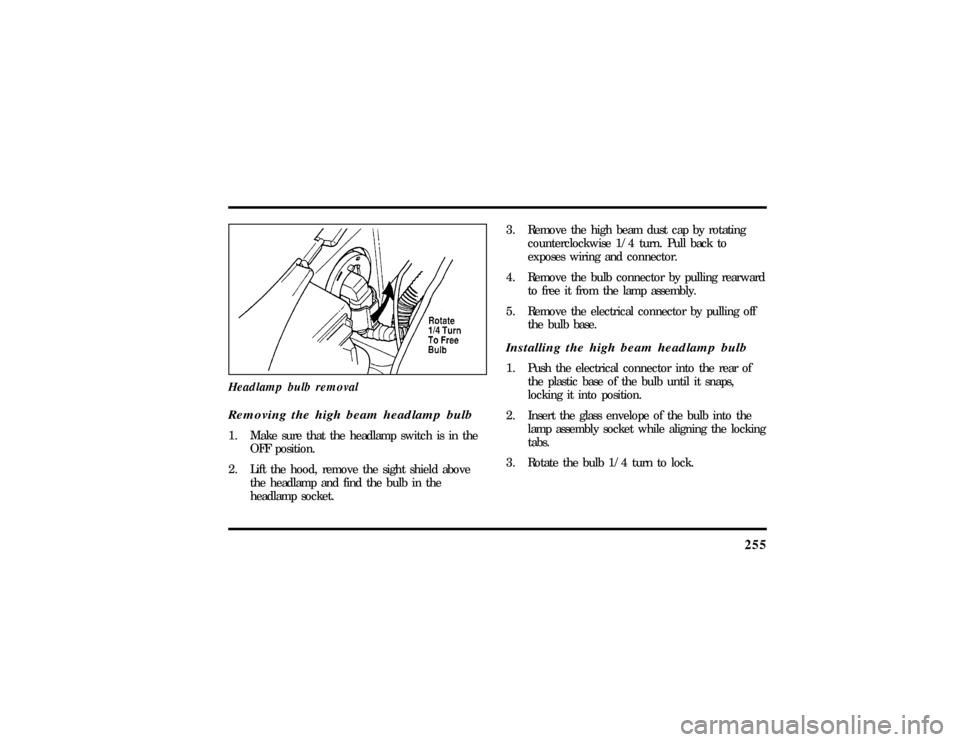
Headlamp bulb removalRemoving the high beam headlamp bulb1. Make sure that the headlamp switch is in the
OFF position.
2. Lift the hood, remove the sight shield above
the headlamp and find the bulb in the
headlamp socket.3. Remove the high beam dust cap by rotating
counterclockwise 1/4 turn. Pull back to
exposes wiring and connector.
4. Remove the bulb connector by pulling rearward
to free it from the lamp assembly.
5. Remove the electrical connector by pulling off
the bulb base.
Installing the high beam headlamp bulb1. Push the electrical connector into the rear of
the plastic base of the bulb until it snaps,
locking it into position.
2. Insert the glass envelope of the bulb into the
lamp assembly socket while aligning the locking
tabs.
3. Rotate the bulb 1/4 turn to lock.
File:11fnmc8.ex
Update:Thu Jun 20 14:28:32 1996
Page 261 of 315

2564. Replace the high beam dust cap by aligning
tabs and rotating clockwise 1/4 turn.
5. Replace the sight shield.Aiming HeadlampsYour vehicle is equipped with a Vehicle Headlamp
Aim Device (VHAD) on each headlamp body. Each
headlamp may be properly aimed in the horizontal
direction (left/right) and the vertical position
(up/down).
NOTE:A non-zero bubble reading does not
necessarily indicate out-of-aim headlamps. If your
vehicle is not positioned on a level surface, the
slope will be included in the level indicator.
Therefore, vertical headlamp adjustment should be
performed only when beam direction appears to be
incorrect or a level surface can be verified.Tools required: One 6mm socket and ratchet.
The Horizontal aim must be adjusted first.
NOTE:The following procedure assumes that the
vehicle's front structure is in factory alignment
condition. If the vehicle has been in an accident
requiring the front end of the vehicle to be
repaired, the horizontal indicator should be
recalibrated by the servicing facility.
File:11fnmc8.ex
Update:Thu Jun 20 14:28:32 1996
Page 262 of 315

257
Before adjusting your headlamps, you must make
sure that the air suspension has been adjusted to
the proper ride height. In order to do this:
1. Position the vehicle on a level surface.
2. Make sure the air suspension switch in the
luggage compartment is in the ON position.
3. Turn the ignition key to the ON position.
4. Open and close the driver's door to allow the
air suspension to fully level.
File:11fnmc8.ex
Update:Thu Jun 20 14:28:32 1996