position LINCOLN MARK VIII 1997 Service Manual
[x] Cancel search | Manufacturer: LINCOLN, Model Year: 1997, Model line: MARK VIII, Model: LINCOLN MARK VIII 1997Pages: 315, PDF Size: 2.18 MB
Page 139 of 315
134The rotating boot on the lap belt is designed to
allow both rear seat entry/exit and access to the
front seat passengers. To enter the rear seat:
1. Rotate the safety belt boot rearward.
2. Enter the rear seat in front of the safety belt.
3. Rotate the safety belt boot forward to allow use
by the front seat passengers.Using the Power SeatsYour vehicle's power seats can be adjusted in
several directions. You can raise or lower the whole
seat, move the seat forward or backward and tilt
the front and back of the seat up or down.
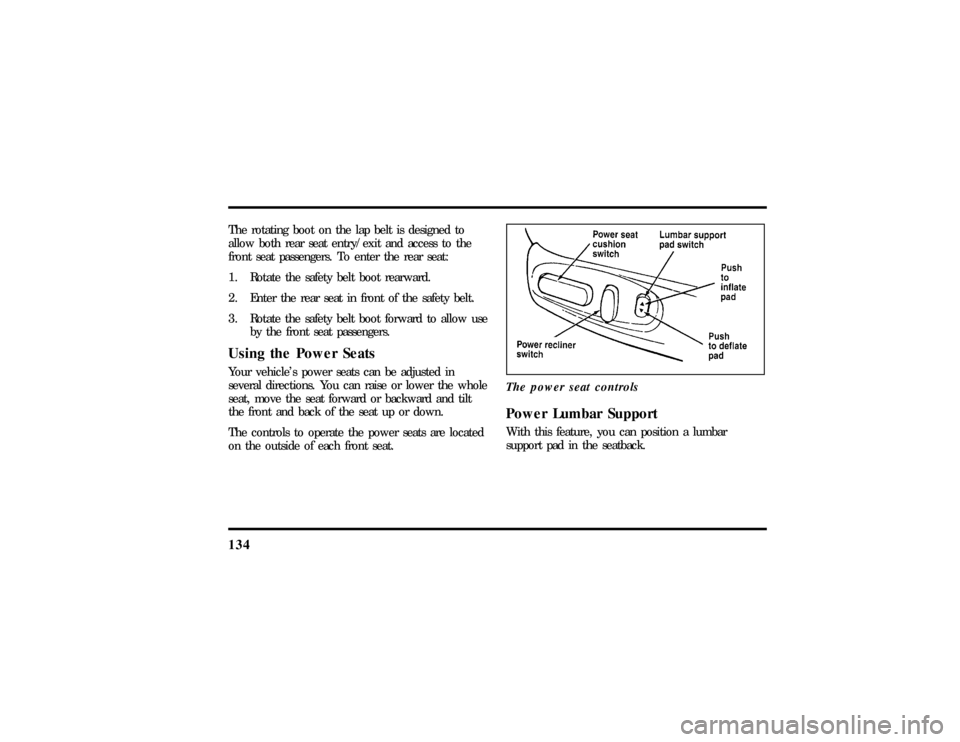
The controls to operate the power seats are located
on the outside of each front seat.The power seat controls
Power Lumbar SupportWith this feature, you can position a lumbar
support pad in the seatback.
File:06fnss8.ex
Update:Wed Jun 19 15:04:39 1996
Page 140 of 315
135
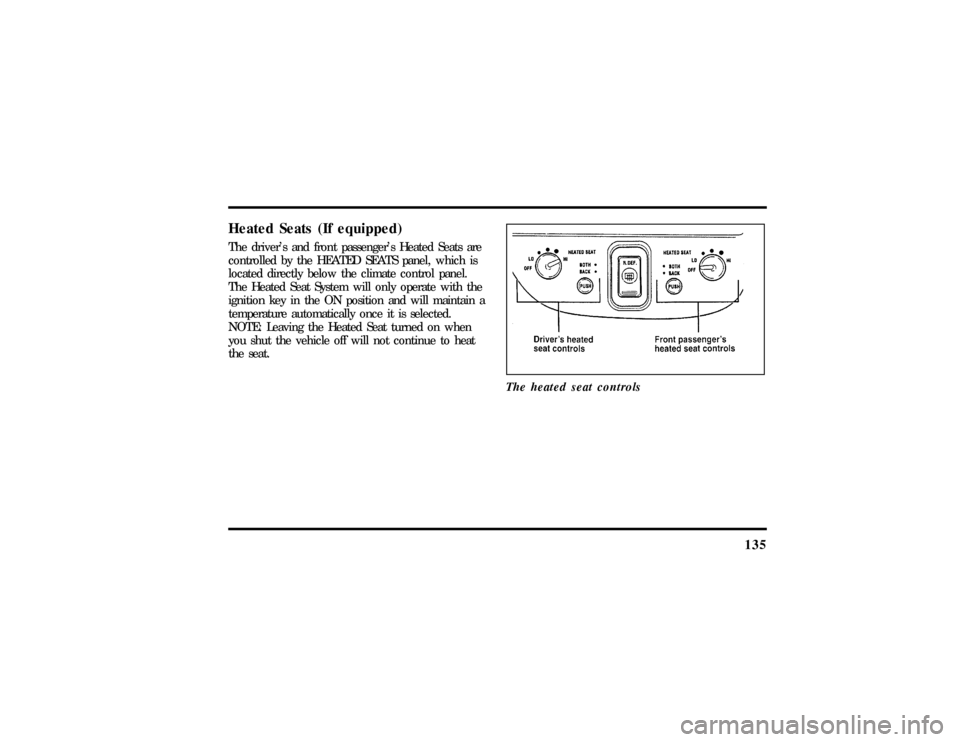
Heated Seats (If equipped)The driver's and front passenger's Heated Seats are
controlled by the HEATED SEATS panel, which is
located directly below the climate control panel.
The Heated Seat System will only operate with the
ignition key in the ON position and will maintain a
temperature automatically once it is selected.
NOTE: Leaving the Heated Seat turned on when
you shut the vehicle off will not continue to heat
the seat.
The heated seat controls
File:06fnss8.ex
Update:Wed Jun 19 15:04:39 1996
Page 142 of 315

137
If the seatback is moved from its forward stop angle
while the seat is traveling forward, the seat will
stop. If the seatback is returned to the forward stop
angle position, the seat will resume its forward
travel. If the seatback is returned to its upright
position, the seat will return to the original position.
If the transmission is shifted from N (Neutral) or P
(Park) while the driver's seat is moving, the seat
will stop where it is. Returning the gearshift to N
(Neutral) or P (Park) will allow seat movement to
continue. To allow movement without returning to
P (Park) or N (Neutral) will require the use of the
electric seat controls.
If you sit in the seat while the Auto-Glide is
moving rearward, the seat will continue to move.
If the seat stalls, or if any seat switch is
momentarily activated (excluding the lumbar switch)
while the seat is traveling forward, the seat will
stop. If the seatback is returned to its upright
position, the seat will return to the position it wasat when the ease of entry cycle was started. To
resume forward travel will require moving the
seatback off of its forward stop angle position and
returning it back to the same. Repositioning the seat
at this time using the seat controls will cancel
Auto-Glide.
If the ignition is off, and the last open door is
closed while a seat is moving, 30 seconds will be
allowed for the forward or rearward movement to
be completed.
Easy Access/Easy Out (driver side
only)The easy in/easy out feature of the driver seat
moves the seat two inches back when:q
the transmission is in N (Neutral) or P (Park)
q
the driver safety belt is buckled
q
the ignition switch is turned to OFF.
File:06fnss8.ex
Update:Wed Jun 19 15:04:39 1996
Page 147 of 315
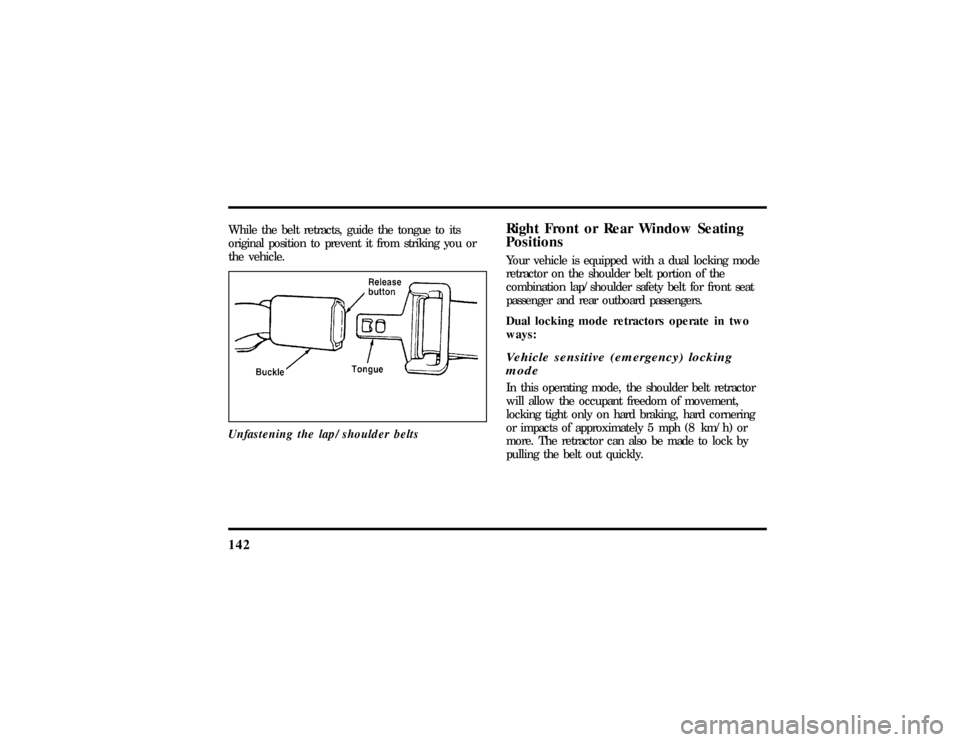
142While the belt retracts, guide the tongue to its
original position to prevent it from striking you or
the vehicle.
Unfastening the lap/shoulder belts
Right Front or Rear Window Seating
PositionsYour vehicle is equipped with a dual locking mode
retractor on the shoulder belt portion of the
combination lap/shoulder safety belt for front seat
passenger and rear outboard passengers.
Dual locking mode retractors operate in two
ways:Vehicle sensitive (emergency) locking
modeIn this operating mode, the shoulder belt retractor
will allow the occupant freedom of movement,
locking tight only on hard braking, hard cornering
or impacts of approximately 5 mph (8 km/h) or
more. The retractor can also be made to lock by
pulling the belt out quickly.
File:06fnss8.ex
Update:Wed Jun 19 15:04:39 1996
Page 162 of 315
157
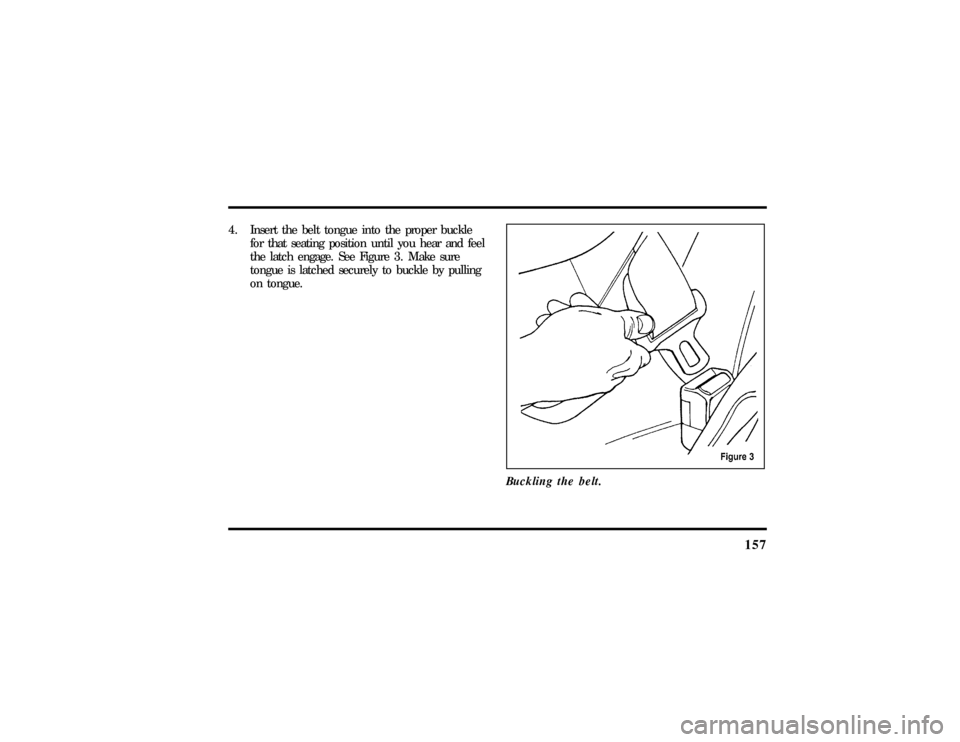
4. Insert the belt tongue into the proper buckle
for that seating position until you hear and feel
the latch engage. See Figure 3. Make sure
tongue is latched securely to buckle by pulling
on tongue.
Buckling the belt.
File:06fnss8.ex
Update:Wed Jun 19 15:04:39 1996
Page 167 of 315
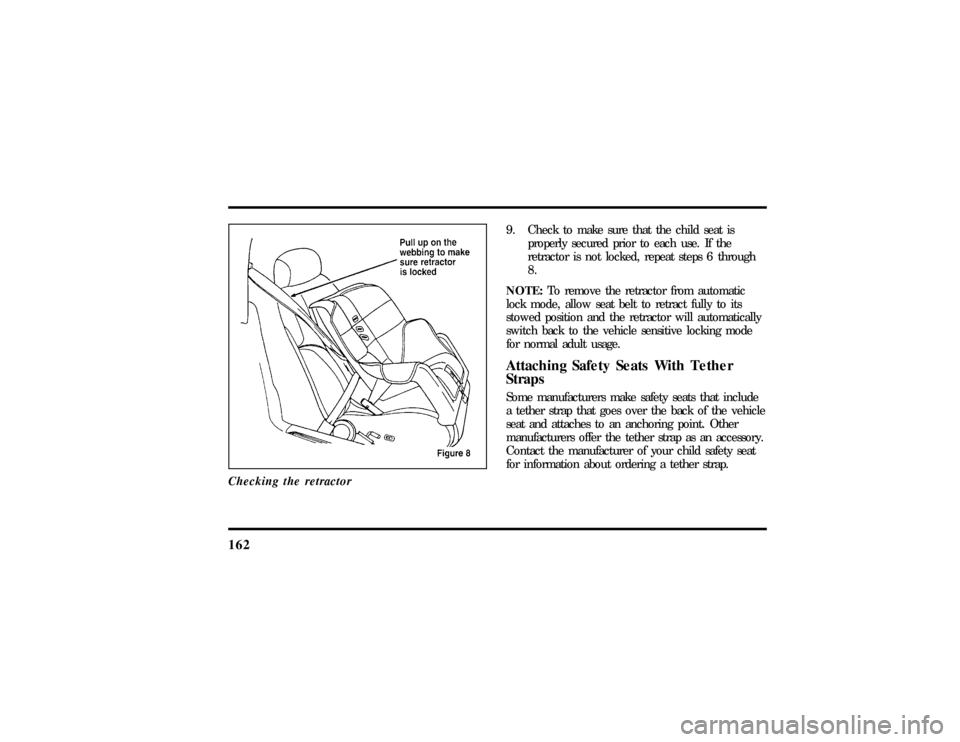
162Checking the retractor
9. Check to make sure that the child seat is
properly secured prior to each use. If the
retractor is not locked, repeat steps 6 through
8.
NOTE:To remove the retractor from automatic
lock mode, allow seat belt to retract fully to its
stowed position and the retractor will automatically
switch back to the vehicle sensitive locking mode
for normal adult usage.Attaching Safety Seats With Tether
StrapsSome manufacturers make safety seats that include
a tether strap that goes over the back of the vehicle
seat and attaches to an anchoring point. Other
manufacturers offer the tether strap as an accessory.
Contact the manufacturer of your child safety seat
for information about ordering a tether strap.
File:06fnss8.ex
Update:Wed Jun 19 15:04:39 1996
Page 169 of 315

164
To improv eth efi tof la pan dshoulde rbeltWARNING
Do no tus ea belt-positionin gbooster
Childre nshoul dalway srid ewit hthe
Page 171 of 315

1663. Make sure that the gearshift is in P (Park) and
the parking brake is set before you turn the
key.
Before you start your vehicle, you should test the
warning lights on the instrument panel to make
sure that they work. Refer to theInstrumentation
chapter.Starting Your EngineTo start your engine:
1. Follow the steps underPreparing to Start Your
Vehicleat the beginning of this section.
2. Turn the ignition key to the ON position.
3. DO NOT depress the accelerator pedal when
starting your engine. DO NOT use the
accelerator while the vehicle is parked.
4. Turn the key to the START position (cranking)
until the engine starts. Allow the key to return
to the ON position after the engine has started.For a cold engine:
q
At temperatures10ÊF(-12ÊC) andbelow:If
the engine does not start infifteen (15)
secondson the first try, turn the key to OFF,
wait approximately ten (10) seconds so you do
not flood the engine, then try again.
q
At temperaturesabove10ÊF(-12ÊC):If the
engine does not start infive (5) secondson
the first try, turn the key to OFF, wait
approximately ten (10) seconds so you do not
flood the engine, then try again.
For a warm engine:
q
Do not hold the key in the START position for
more thanfive (5) secondsat a time. If the
engine does not start within five (5) seconds on
the first try, turn the key to the OFF position.
Wait a few seconds after the starter stops, then
try again.
File:08fnto8.ex
Update:Wed Jun 19 15:04:46 1996
Page 172 of 315

167
Whenever you start your vehicle, release the key as
soon as the engine starts. Excessive cranking could
damage the starter.
After you start the engine, let it idle for a few
seconds. Keep your foot on the brake pedal and put
the gearshift lever in gear. Release the parking
brake. Slowly release the brake pedal and drive
away in the normal manner.
NOTE:Your vehicle has an interlock that prevents
you from shifting out of P (Park) unless your foot is
on the brake pedal.
If the engine does not start after two attempts:
1. Turn the ignition key to the OFF position.
2. Press the accelerator all the way to the floor
and hold it.
3. Turn the ignition key to the START position.4. Release the ignition key when the engine starts.
5. Release the accelerator gradually as the engine
speeds up.
If the engine still does not start, the fuel pump
shut-off switch may have been activated. For
directions on how to reset the switch seeFuel
Pump Shut-Off Switchin the index.
A computer system controls the engine's idle speed.
When you start your vehicle, the engine's idle
speed normally runs higher than when it is warmed
up. These faster engine speeds will make your
vehicle move slightly faster than its normal idle
speed. It should, however, slow down after a short
time. If it does not, have the idle speed checked.
If the engine idle speed does not slow down
automatically, do not allow your vehicle to idle for
more than 10 minutes. Have the vehicle checked.
File:08fnto8.ex
Update:Wed Jun 19 15:04:46 1996
Page 180 of 315

175
NOTE:Engine torque reduction isNOTactive
when engine coolant temperature is below-10ÊF
(-23ÊC).
During the Traction Control
TM
function, which most
often occurs during low speed acceleration on
slippery surfaces, a noise may be heard coming from
the engine compartment. This is normal and may
last for a few seconds during the acceleration of the
vehicle.
In general, this system improves your vehicle's
stability and acceleration performance when road
conditions warrant. Traction Control
TM
is fully
effective at all vehicle speeds.
If the Traction Control
TM
system is cycled
excessively, the brake portion of the system will
shut down to prevent the rear brakes from
overheating. A limited Traction Control
TM
function
using engine torque will still control wheels from
spinning. A cooling down period is required to
prevent damage to the brakes. This time periodvaries and depends on brake usage during the
cooling down period. Anti-Lock braking is not
affected and will function normally during the cool
down period.
After the cool down period, the full Traction
Control
TM
function is restored.
Air Suspension SystemYour vehicle is equipped with an automatic load
leveling air suspension system. This system
maintains the vehicle height at a constant level by
automatically adding air or releasing air from the air
springs to offset changes in vehicle loads.
A shutoff switch is located in the trunk behind the
left hand vertical trim panel. If this switch is in the
OFF position, the automatic leveling system will not
operate. The switch should be OFF whenever
jacking up the vehicle. ªAIR RIDE SWITCH OFFº
will appear in the Message Center when the
File:09fngf8.ex
Update:Wed Jun 19 10:45:23 1996