automatic transmission LINCOLN MKS 2015 User Guide
[x] Cancel search | Manufacturer: LINCOLN, Model Year: 2015, Model line: MKS, Model: LINCOLN MKS 2015Pages: 424, PDF Size: 3.96 MB
Page 144 of 424
1.
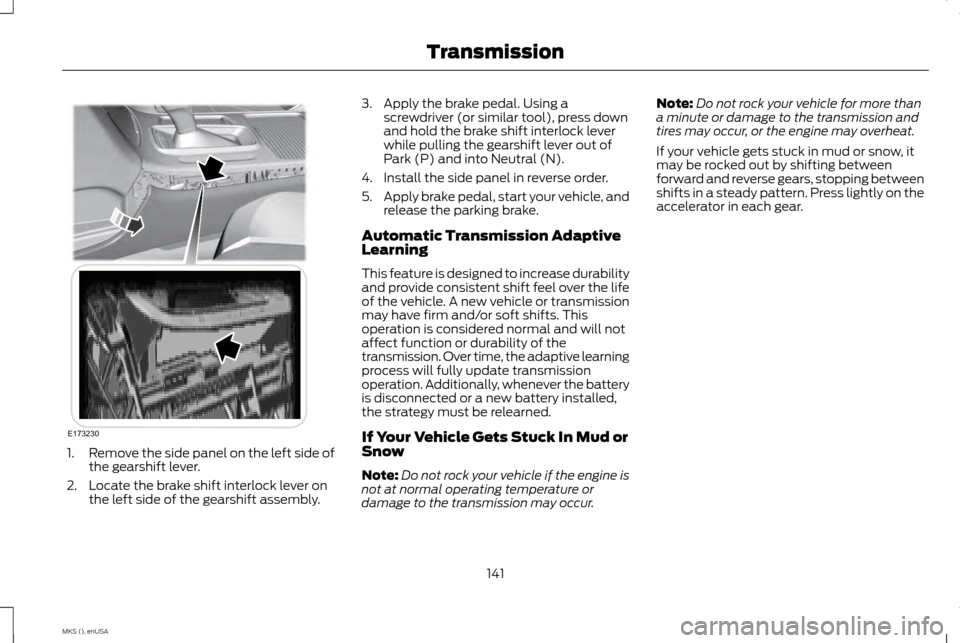
Remove the side panel on the left side of
the gearshift lever.
2. Locate the brake shift interlock lever on the left side of the gearshift assembly. 3. Apply the brake pedal. Using a
screwdriver (or similar tool), press down
and hold the brake shift interlock lever
while pulling the gearshift lever out of
Park (P) and into Neutral (N).
4. Install the side panel in reverse order.
5. Apply brake pedal, start your vehicle, and
release the parking brake.
Automatic Transmission Adaptive
Learning
This feature is designed to increase durability
and provide consistent shift feel over the life
of the vehicle. A new vehicle or transmission
may have firm and/or soft shifts. This
operation is considered normal and will not
affect function or durability of the
transmission. Over time, the adaptive learning
process will fully update transmission
operation. Additionally, whenever the battery
is disconnected or a new battery installed,
the strategy must be relearned.
If Your Vehicle Gets Stuck In Mud or
Snow
Note: Do not rock your vehicle if the engine is
not at normal operating temperature or
damage to the transmission may occur. Note:
Do not rock your vehicle for more than
a minute or damage to the transmission and
tires may occur, or the engine may overheat.
If your vehicle gets stuck in mud or snow, it
may be rocked out by shifting between
forward and reverse gears, stopping between
shifts in a steady pattern. Press lightly on the
accelerator in each gear.
141
MKS (), enUSA TransmissionE173230
Page 145 of 424
USING ALL-WHEEL DRIVE
All-wheel drive uses all four wheels to power
the vehicle. This increases traction, enabling
you to drive over terrain and road conditions
that a conventional two-wheel drive vehicle
cannot. The AWD system is active all the time
and requires no input from the operator.
Note:
Your AWD vehicle is not for off-road
use. The AWD feature gives your vehicle some
limited off-road capabilities in which driving
surfaces are relatively level, obstruction-free
and otherwise similar to normal on-road
driving conditions. Operating your vehicle
under other than those conditions could
subject the vehicle to excessive stress which
might result in damage not covered under your
warranty.
Note: When an AWD system fault is present,
the warning Check AWD displays in the
information display. See Information
Messages (page 94). An AWD system fault
causes the AWD system to default to
front-wheel drive only mode. If this warning
displays, have your vehicle serviced at an
authorized dealer. Note:
The AWD Off message displays in the
information display if the AWD system has
overheated
See Information Messages
(page 94). This condition may occur if the
vehicle operates in extreme conditions with
excessive wheel slip, such as deep sand. To
resume normal AWD function as soon as
possible, stop the vehicle in a safe location
and stop the engine for at least 10 minutes.
After the engine restarts and the AWD system
has adequately cooled, the AWD Off message
turns off and normal AWD function returns. In
the event you do not stop the engine, the AWD
Off message turns off when the system cools
and normal AWD function returns.
Do not use a spare tire of a different size
other than the tire provided. The AWD system
may disable automatically and enter
front-wheel drive only mode to protect
driveline components if you install the
mini-spare tire. A warning in the information
display indicates this condition.
See
Information Messages (page 94). If there
is an AWD Off message in the information
display from using the spare tire, this
indicator should turn off after reinstalling the
repaired or replaced normal road tire and
cycling the ignition off and on. Reinstall the repaired or replaced road tire as soon as
possible. Major dissimilar tire sizes between
the front and rear axles could cause the AWD
system to stop functioning and default to
front-wheel drive or damage the AWD
system.
Driving In Special Conditions With
All-Wheel Drive (AWD)
AWD vehicles are equipped for driving on
sand, snow, mud and rough roads and have
operating characteristics that are somewhat
different from conventional vehicles, both on
and off the highway.
When driving at slow speeds in deep sand
under high outside temperatures, use a low
gear when possible. Lower gear operation
maximizes the engine and transmission
cooling capability. Under severe operating
conditions, the A/C may cycle on and off to
protect overheating of the engine.
Basic operating principles in special
conditions
•
Drive slower in strong crosswinds which
can affect the normal steering
characteristics of your vehicle.
• Use extreme care when driving on
pavement made slippery by loose sand,
water, gravel, snow or ice.
142
MKS (), enUSA All-Wheel Drive
(If Equipped)
Page 151 of 424
PARKING BRAKE
WARNINGS
If the parking brake is fully released, but
the brake warning lamp remains
illuminated, then driving your vehicle
could result in reduced braking ability,
increased stopping distances and potential
loss of brakes. See your authorized dealer as
soon as possible. Always set the parking brake fully and
make sure the transmission is placed
in park (P). Failure to set the parking
brake and engage park could result in vehicle
roll-away, property damage or bodily injury.
Turn the ignition to the lock position and
remove the key whenever you leave your
vehicle. To set the parking brake, press the parking
brake pedal down to its fullest extent.
To release the parking brake, press the
parking brake pedal down again. HILL START ASSIST WARNINGS
The system does not replace the
parking brake. When you leave your
vehicle, always apply the parking brake.
Failure to leave your vehicle securely parked
may lead to a crash or injury. See
Parking
Brake (page 148). You must remain in your vehicle when
the system turns on. At all times, you
are responsible for controlling your
vehicle, supervising the system and
intervening, if required. Failure to take care
may result in the loss of control of your
vehicle, serious personal injury or death. The system will turn off if a malfunction
is apparent or if you rev the engine
excessively. Failure to take care may
result in the loss of control of your vehicle,
serious personal injury or death. The system makes it easier to pull away
when your vehicle is on a slope without the
need to use the parking brake.When the system is active, your vehicle
remains stationary on the slope for two to
three seconds after you release the brake
pedal. This allows time to move your foot
from the brake to the accelerator pedal. The
system releases the brakes automatically
once the engine has developed sufficient
drive to prevent your vehicle from rolling
down the slope. This is an advantage when
pulling away on a slope, for example from a
car park ramp, traffic lights or when reversing
uphill into a parking space.
Note:
The system only functions when you
bring your vehicle to a complete standstill.
Shift the gearshift lever to reverse (R) when
facing downhill and first gear (1) when facing
uphill.
Note: There is no warning light to indicate the
system is either on or off.
Using Hill Start Assist
1. Press the brake pedal to bring your vehicle to a complete standstill. Keep the
brake pedal pressed.
2. If the sensors detect that your vehicle is on a slope, the system activates
automatically.
148
MKS (), enUSA Brakes
Page 152 of 424
3. When you remove your foot from the
brake pedal, your vehicle remains on the
slope without rolling away for about two
to three seconds. This hold time
automatically extends if you are in the
process of driving off.
4. Drive off in the normal manner. The system releases the brakes
automatically.
Note: When you remove your foot from the
brake pedal and press the pedal again when
the system is active, you will experience
significantly reduced brake pedal travel. This
is normal.
Switching the System On and Off
When you switch the ignition on, the system
automatically turns on. You can switch the
system on or off in the information display.
See General Information (page 88). The
system remains off until you switch the
ignition off.
Note: For vehicles with a manual
transmission, the system can be switched on
or off.
Note: For vehicles with an automatic
transmission, the system cannot be switched
off.
149
MKS (), enUSA Brakes
Page 155 of 424
USING STABILITY CONTROL
AdvanceTrac®
The system automatically activates when
you start your vehicle. The AdvanceTrac
system cannot be completely turned off, but
the electronic stability control system is
disabled when the transmission selector lever
is in position R. You can turn off the traction
control portion of the system independently.
See
Using Traction Control (page 150).
152
MKS (), enUSA Stability Control
Page 156 of 424
PARKING AID (If Equipped)
WARNINGS
To help avoid personal injury, please
read and understand the limitations of
the system as contained in this section.
Sensing is only an aid for some (generally
large and fixed) objects when moving on a
flat surface at parking speeds. Certain objects
with surfaces that absorb ultrasonic waves,
traffic control systems, fluorescent lamps,
inclement weather, air brakes, and external
motors and fans may also affect the function
of the sensing system; this may include
reduced performance or a false activation. To help avoid personal injury, always
use caution when in reverse (R) and
when using the sensing system.
This system is not designed to prevent
contact with small or moving objects.
The system is designed to provide a
warning to assist the driver in detecting large
stationary objects to avoid damaging the
vehicle. The system may not detect smaller
objects, particularly those close to the
ground. WARNINGS
Certain add-on devices such as large
trailer hitches, bike or surfboard racks
and any device that may block the
normal detection zone of the system, may
create false beeps. Note:
Keep the sensors, located on the
bumper or fascia, free from snow, ice and large
accumulations of dirt. If the sensors are
covered, the system ’s accuracy can be
affected. Do not clean the sensors with sharp
objects.
Note: If your vehicle sustains damage to the
bumper or fascia, leaving it misaligned or bent,
the sensing zone may be altered causing
inaccurate measurement of obstacles or false
alarms.
Note: If your vehicle is equipped with
MyKey ™, it is possible to prevent turning the
sensing system off. See
MyKey ™ (page 50).
The sensing system warns the driver of
obstacles within a certain range of the
bumper area. The system turns on
automatically whenever you switch the
ignition on. When receiving a detection warning, the radio
volume reduces to a predetermined level.
After the warning goes away, the radio
volume returns to the previous level.
You can switch the system off through the
information display menu or from the pop-up
message that appears once you shift the
transmission into reverse (R). If your vehicle
is equipped with a front sensing system, you
can switch the system off using the parking
aid switch. See General Information (page
88
).
If a fault is present in the system, a warning
message appears in the information display
and you cannot switch the system on through
the pop-up message or parking aid switch.
See
Information Messages (page 94).
Rear Sensing System
The rear sensors are only active when the
transmission is in reverse (R). As the vehicle
moves closer to the obstacle, the rate of the
audible warning increases. When the
obstacle is less than
12 in (30 cm) away, the
warning sounds continuously. If the system
detects a stationary or receding object farther
than
12 in (30 cm) from the side of the
vehicle, the tone sounds for only three
seconds. Once the system detects an object
approaching, the warning sounds again.
153
MKS (), enUSA Parking Aids
Page 158 of 424
If the transmission is in reverse (R), the front
sensing system provides audio warnings
when the vehicle is moving and the detected
obstacle is moving towards the vehicle. Once
the vehicle reaches a standstill condition, the
audio warning stops after 2 seconds.
Additionally, the system provides obstacle
distance indication through the center stack
display (if equipped). The distance indication
is present when the transmission is in reverse
(R).
•
As the distance to the obstacle decreases
(obstacle becomes closer), the indicator
blocks illuminate and move towards the
vehicle icon.
• If there is no obstacle detected, the
distance indicator blocks show greyed
out.
For automatic transmissions, if the gearshift
is in neutral (N), the system provides obstacle
distance indication through the center stack
display (if equipped). The front sensing
system provides visual warnings when the
vehicle is moving at a speed below 5 mph
(8 km/h) and an obstacle is located inside
the front or rear sensing detection areas.
Once the vehicle reaches a standstill
condition, the visual warnings stop after 4
seconds. If the gearshift is in drive (D) or any other
forward gear (for example, low (L), sport (S),
manual transmissions), the front sensing
system provides audio warnings when the
vehicle is moving and the system detects an
obstacle inside the front sensing detection
area. Once the vehicle reaches a standstill
condition, the audio warning stops after 2
seconds.
Additionally, the system provides distance
indication through the center stack display
(if equipped). The distance indication is
present if the vehicle is moving and an
obstacle is located inside the front sensing
detection area. Once the vehicle reaches a
standstill condition, the visual warnings stop
after 4 seconds, unless the detected obstacle
is less than
12 in (30 cm) away from the
bumper.
For specific information on the reverse
sensing portion of the system, refer to that
section. ACTIVE PARK ASSIST
(If Equipped) WARNING
Designed to be a supplementary park
aid, this system may not work in all
conditions. This system cannot replace
the driver ’s attention and judgment. The
driver is responsible for avoiding hazards and
maintaining a safe distance and speed, even
when the system is in use. Note:
The driver is always responsible for
controlling the vehicle, supervising the system
and intervening if required.
Note: The sensors may not detect objects in
heavy rain or other conditions that cause
disruptive reflections.
Note: The sensors may not detect objects
with surfaces that absorb ultrasonic waves.
The system detects an available parallel
parking space and automatically steers the
vehicle into the space (hands-free) while you
control the accelerator, gearshift and brakes.
The system visually and audibly instructs you
to park the vehicle.
155
MKS (), enUSA Parking Aids
Page 160 of 424
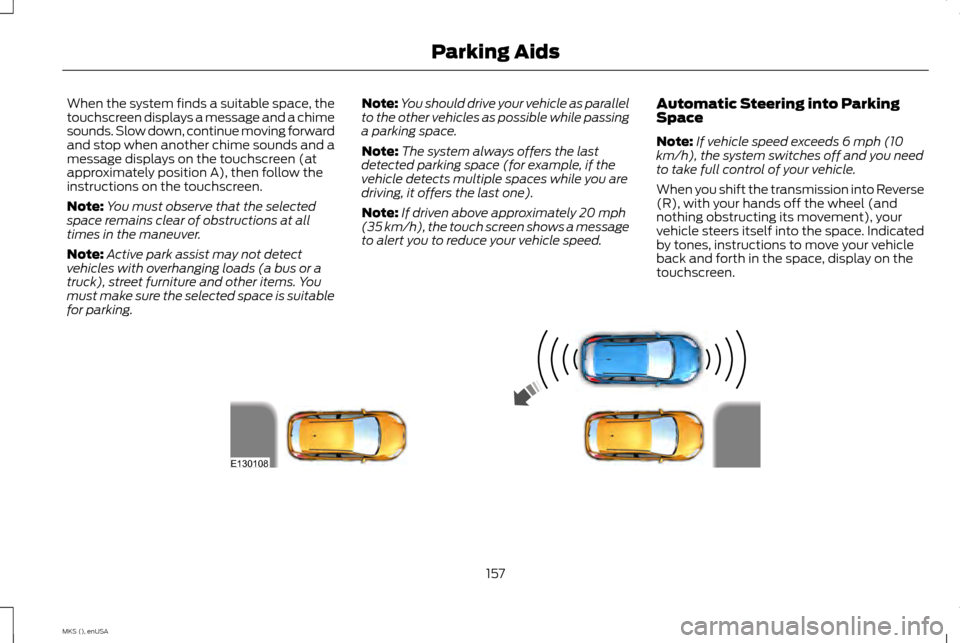
When the system finds a suitable space, the
touchscreen displays a message and a chime
sounds. Slow down, continue moving forward
and stop when another chime sounds and a
message displays on the touchscreen (at
approximately position A), then follow the
instructions on the touchscreen.
Note:
You must observe that the selected
space remains clear of obstructions at all
times in the maneuver.
Note: Active park assist may not detect
vehicles with overhanging loads (a bus or a
truck), street furniture and other items. You
must make sure the selected space is suitable
for parking. Note:
You should drive your vehicle as parallel
to the other vehicles as possible while passing
a parking space.
Note: The system always offers the last
detected parking space (for example, if the
vehicle detects multiple spaces while you are
driving, it offers the last one).
Note: If driven above approximately 20 mph
(35 km/h), the touch screen shows a message
to alert you to reduce your vehicle speed. Automatic Steering into Parking
Space
Note:
If vehicle speed exceeds 6 mph (10
km/h), the system switches off and you need
to take full control of your vehicle.
When you shift the transmission into Reverse
(R), with your hands off the wheel (and
nothing obstructing its movement), your
vehicle steers itself into the space. Indicated
by tones, instructions to move your vehicle
back and forth in the space, display on the
touchscreen. 157
MKS (), enUSA Parking AidsE130108
Page 161 of 424
When you think your vehicle has enough
space in front and behind it, or you hear a
solid tone from the parking aid (accompanied
by a touchscreen display message and a
chime), bring your vehicle to a complete stop.
When automatic steering is finished, the
touch screen displays a message and a chime
sounds, indicating that the active park assist
process is done. The driver is responsible for
checking the parking job and making any
necessary corrections before putting the
transmission in Park (P).
Deactivating the Park Assist Feature
Manually deactivate the system by:
•
Pressing the active park assist button.
• Grabbing the steering wheel.
• Driving above approximately 20 mph (35
km/h) for 30 seconds during an active
park search.
• Driving above 6 mph (10 km/h) during
automatic steering.
• Turning off the traction control system. Certain vehicle conditions can also deactivate
the system, such as:
•
Traction control has activated on a
slippery or loose surface.
• There is an anti-lock brake system
activation or failure.
• Something touches the steering wheel.
If a problem occurs with the system, a
warning message is displayed, followed by
a chime. Occasional system messages may
occur in normal operation. For recurring or
frequent system faults, contact an authorized
dealer to have your vehicle serviced.
Troubleshooting the System The system does not look for a space
The traction control system may be off
The transmission is in Reverse (R); your vehicle must be moving forward to detect a parking space The system does not offer a particular space
Something may be contacting the front bumper or side sensors
There is not enough room on both sides of your vehicle in order to park
There is not enough space for the parking maneuver on the opposite side of the parking space
158
MKS (), enUSA Parking Aids
Page 165 of 424
Note:
The reverse sensing system is not
effective at speeds above 3 mph (5 km/h) and
may not detect certain angular or moving
objects.
The system uses red, yellow and green
highlights that appear on top of the video
image when the reverse sensing system
detects an object. The alert highlights the
closest object detected. You can disable the
reverse sensing alert if you have visual park
aid alert enabled, you will still see the
displayed highlighted areas.
Selectable settings for this feature are ON
and OFF.
Manual Zoom WARNING
When manual zoom is on, the full area
behind your vehicle is not shown. Be
aware of your surroundings when using
the manual zoom feature. Note:
Manual zoom is only available when
the transmission is in Reverse (R).
Note: Only the centerline shows when you
enable manual zoom. This allows you to get a closer view of an
object behind your vehicle. The zoomed
image keeps the bumper in the image to
provide a reference. The zoom is only active
while the transmission is in Reverse (R).
When you shift the transmission out of
Reverse (R), the feature automatically turns
off and you must enable it to use it used
again.
Selectable settings for this feature are ON
and OFF.
Rear Camera Delay
When shifting the transmission out of
Reverse (R) and into any gear other than Park
(P), the camera image remains in the display
until your vehicle speed reaches 6 mph (10
km/h or until you select a radio button.
Selectable settings for this feature are ON
and OFF. The default setting for the rear
camera delay is OFF.
162
MKS (), enUSA Parking Aids