service LINCOLN MKS 2015 User Guide
[x] Cancel search | Manufacturer: LINCOLN, Model Year: 2015, Model line: MKS, Model: LINCOLN MKS 2015Pages: 424, PDF Size: 3.96 MB
Page 46 of 424
The design and development of the Safety
Canopy included recommended testing
procedures that were developed by a group
of automotive safety experts known as the
Side Airbag Technical Working Group. These
recommended testing procedures help
reduce the risk of injuries related to the
deployment of side airbags (including the
Safety Canopy).
CRASH SENSORS AND AIRBAG
INDICATOR
WARNING
Modifying or adding equipment to the
front end of the vehicle (including
frame, bumper, front end body
structure and tow hooks) may affect the
performance of the airbag system, increasing
the risk of injury. Do not modify the front end
of the vehicle. Your vehicle has a collection of crash and
occupant sensors which provide information
to the restraints control module. The
restraints control module deploys (activates)
the front safety belt pretensioners, driver
airbag, passenger airbag, seat mounted side
airbags and the Safety Canopy. Based on the
type of crash (frontal impact or side impact),
the restraints control module will deploy the
appropriate safety devices.
The restraints control module also monitors
the readiness of the above safety devices
plus the crash and occupant sensors. The
readiness of the safety system is indicated
by a warning indicator light in the instrument
cluster or by a backup tone if the warning
light is not working. Routine maintenance of
the airbag is not required.
A difficulty with the system is indicated by
one or more of the following:
The readiness light will not
illuminate immediately after the
ignition is turned on.
• The readiness light will either flash or stay
lit.
• A series of five beeps will be heard. The
tone pattern will repeat periodically until
the problem, the light or both are
repaired. If any of these things happen, even
intermittently, have the supplemental
restraint system serviced at an authorized
dealer immediately. Unless serviced, the
system may not function properly in the event
of a crash.
The safety belt pretensioners and the front
airbag supplemental restraint system are
designed to activate when the vehicle
sustains frontal deceleration sufficient to
cause the restraints control module to deploy
a safety device.
The fact that the safety belt pretensioners
or front airbags did not activate for both front
seat occupants in a crash does not mean that
something is wrong with the system. Rather,
it means the restraints control module
determined the accident conditions (crash
severity, belt usage) were not appropriate to
activate these safety devices.
•
The design of the front airbags is to
activate only in frontal and near-frontal
crashes (not rollovers, side impacts or
rear impacts) unless the crash causes
sufficient frontal deceleration.
• The design of the safety belt
pretensioners is to activate in frontal,
near-frontal and side crashes and in
rollovers.
43
MKS (), enUSA Supplementary Restraints System
Page 50 of 424
2. Insert a coin into the slot and twist to
separate the housing. 3. Remove the old battery.
4. Install a new batteries with the + facing
downward. Press the battery down to
make sure that it is fully in the housing. 5. Snap the battery cover back onto the
transmitter and install the mechanical
key blade.
Car Finder Press the button twice within three
seconds. The horn will sound and
the turn signals will flash. We
recommend you use this method to locate
your vehicle, rather than using the panic
alarm.
Sounding a Panic Alarm
Note: The panic alarm will only operate when
the ignition is off. Press the button to activate the
alarm. Press the button again or
switch the ignition on to deactivate.
Remote Start WARNING
To avoid exhaust fumes, do not use
remote start if your vehicle is parked
indoors or areas that are not well
ventilated. Note:
Do not use remote start if your vehicle
is low on fuel. The remote start button is on the
transmitter.
This feature allows you to start your vehicle
from outside the vehicle. The transmitter has
an extended operating range.
Vehicles with automatic climate control can
be configured to operate when the vehicle is
remote started. See
Remote Start (page
108). A manual climate control system will
run at the setting it was set to when you
switched the vehicle off.
Many states and provinces have restrictions
for the use of remote start. Check your local
and state or provincial laws for specific
requirements regarding remote start systems.
The remote start system will not work if:
• the ignition is on
• the alarm system is triggered
• you disable the feature
• the hood is open
• the transmission is not in
P
• the vehicle battery voltage is too low
• the service engine soon light is on.
47
MKS (), enUSA Keys and Remote ControlsE173601 E173602 E138623 E138624 E138625
Page 89 of 424
Parking Lamps
It will illuminate when you switch
the parking lamps on.
Powertrain Fault Illuminates when a powertrain or
an AWD fault has been detected.
Contact your authorized dealer as
soon as possible.
Service Engine Soon If the service engine soon indicator
light stays illuminated after the
engine is started, it indicates that
the On Board Diagnostics system (OBD) has
detected a malfunction of the vehicle
emissions control system. Refer to On board
diagnostics (OBD) in the Fuel and Refueling
chapter for more information about having
your vehicle serviced. See Emission Control
System (page 136).
If the light is blinking, engine misfire is
occurring which could damage your catalytic
converter. Drive in a moderate fashion (avoid
heavy acceleration and deceleration) and
have your vehicle serviced immediately. WARNING
Under engine misfire conditions,
excessive exhaust temperatures could
damage the catalytic converter, the
fuel system, interior floor coverings or other
vehicle components, possibly causing a fire.
Have an authorized dealer service your
vehicle immediately. The service engine soon indicator light
illuminates when the ignition is first turned
on prior to engine start to check the bulb and
to indicate whether the vehicle is ready for
Inspection/Maintenance (I/M) testing.
Normally, the service engine soon light will
stay on until the engine is cranked, then turn
itself off if no malfunctions are present.
However, if after 15 seconds the service
engine soon light blinks eight times, it means
that the vehicle is not ready for I/M testing.
See
Emission Control System (page 136).
Stability Control It will flash when the system is
active. If it remains illuminated or
does not illuminate when you
switch the ignition on, this indicates a
malfunction. During a malfunction the system
will switch off. Have the system checked by
your authorized dealer immediately. See
Using Stability Control
(page 152).
Stability Control Off It will illuminate when you switch
the system off. It will go out when
you switch the system back on or
when you switch the ignition off. See Using
Stability Control
(page 152).
AUDIBLE WARNINGS AND
INDICATORS
Key in Ignition Warning Chime
Sounds when you open the driver's door and
you have left the key in the ignition with it in
the off or accessory position.
86
MKS (), enUSA Instrument Cluster E138639
Page 98 of 424
Adaptive Cruise Control
Action
Message
A radar malfunction is preventing the adaptive cruise from engaging. See Using Adaptive Cruise Control (page 164).
Adaptive Cruise Malfunction
Conditions exist such that the adaptive cruise cannot function properly. See
Using Adaptive
Cruise Control (page 164).
Adaptive Cruise Not Available
The radar is blocked because of poor radar visibility due to bad weather or ice/mud/water in frontof radar. Driver can typically clean the sensor to resolve. See
Using Adaptive Cruise Control
(page 164).
Adaptive Cruise Not Available Sensor
Blocked See Manual
AdvanceTrac ™ Action
Message
The system detects a malfunction due to a blocked sensor.
Service AdvanceTrac
The traction control has been disabled or enabled by the driver.
AdvanceTrac Off On
Alarm Action
Message
The alarm has been triggered due to unauthorized entry. See
Anti-Theft Alarm (page 64).
Vehicle Alarm To Stop Alarm, Start Vehicle
95
MKS (), enUSA Information Displays
Page 103 of 424
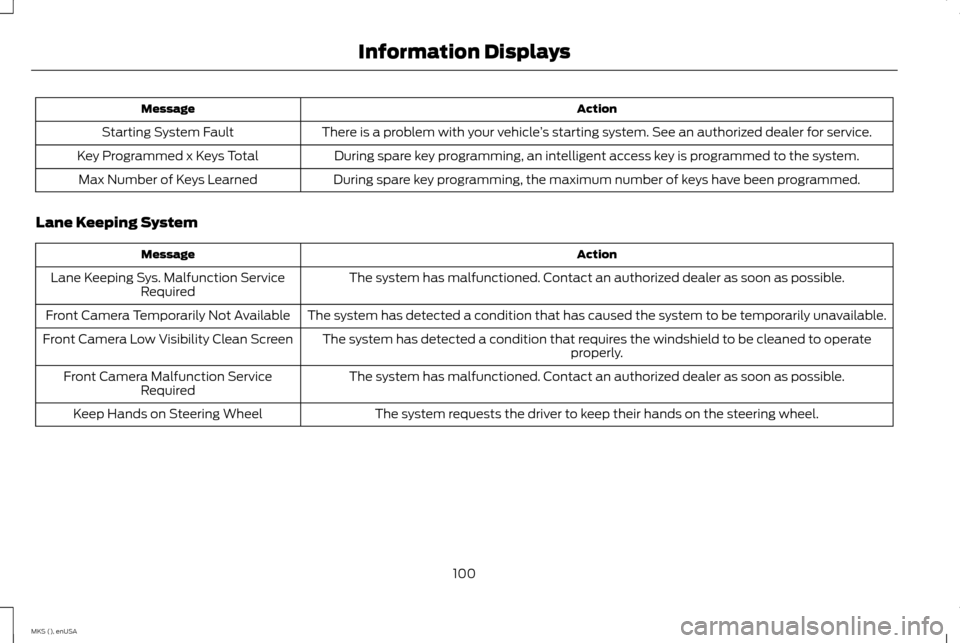
Action
Message
There is a problem with your vehicle ’s starting system. See an authorized dealer for service.
Starting System Fault
During spare key programming, an intelligent access key is programmed to the system.
Key Programmed x Keys Total
During spare key programming, the maximum number of keys have been programmed.
Max Number of Keys Learned
Lane Keeping System Action
Message
The system has malfunctioned. Contact an authorized dealer as soon as possible.
Lane Keeping Sys. Malfunction Service
Required
The system has detected a condition that has caused the system to be temporarily unavailable.
Front Camera Temporarily Not Available
The system has detected a condition that requires the windshield to be cleaned to operateproperly.
Front Camera Low Visibility Clean Screen
The system has malfunctioned. Contact an authorized dealer as soon as possible.
Front Camera Malfunction Service
Required
The system requests the driver to keep their hands on the steering wheel.
Keep Hands on Steering Wheel
100
MKS (), enUSA Information Displays
Page 105 of 424
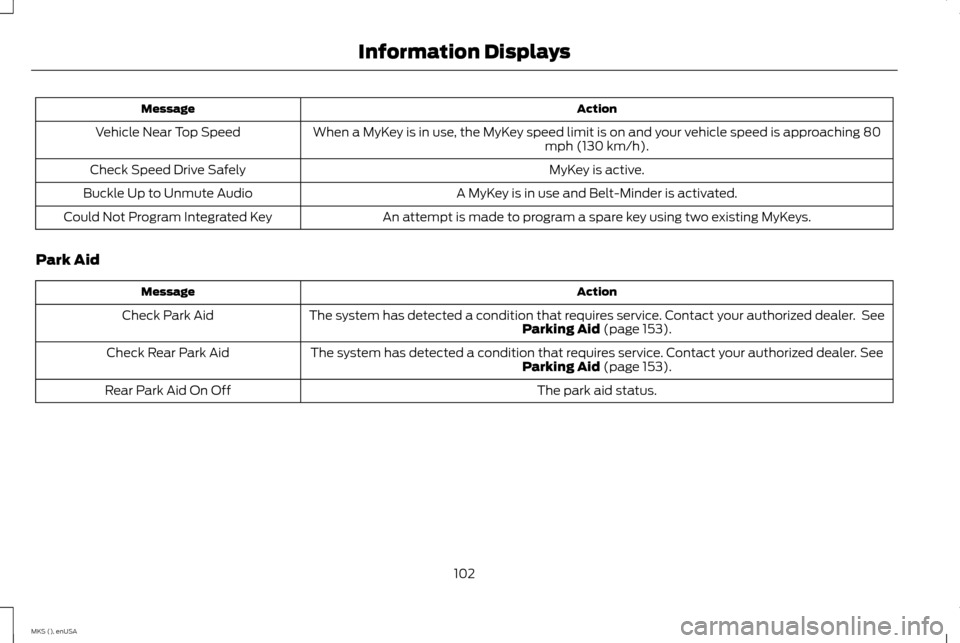
Action
Message
When a MyKey is in use, the MyKey speed limit is on and your vehicle speed is approaching 80 mph (130 km/h).
Vehicle Near Top Speed
MyKey is active.
Check Speed Drive Safely
A MyKey is in use and Belt-Minder is activated.
Buckle Up to Unmute Audio
An attempt is made to program a spare key using two existing MyKeys.
Could Not Program Integrated Key
Park Aid Action
Message
The system has detected a condition that requires service. Contact your authorized dealer. See Parking Aid (page 153).
Check Park Aid
The system has detected a condition that requires service. Contact your authorized dealer.
See
Parking Aid (page 153).
Check Rear Park Aid
The park aid status.
Rear Park Aid On Off
102
MKS (), enUSA Information Displays
Page 106 of 424
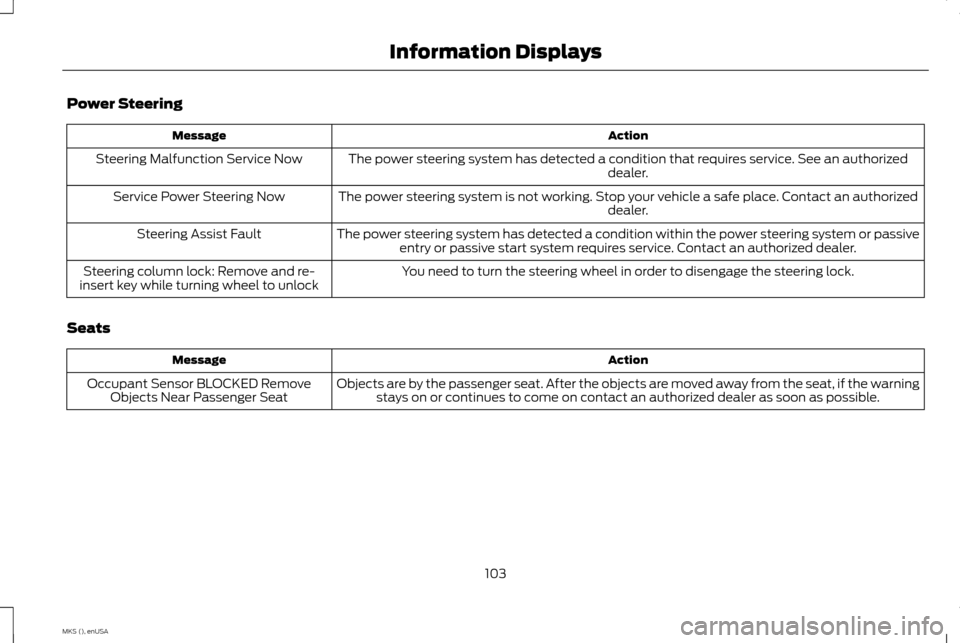
Power Steering
Action
Message
The power steering system has detected a condition that requires service. See an authorized dealer.
Steering Malfunction Service Now
The power steering system is not working. Stop your vehicle a safe place. Contact an authorized dealer.
Service Power Steering Now
The power steering system has detected a condition within the power steering system or passiveentry or passive start system requires service. Contact an authorized dealer.
Steering Assist Fault
You need to turn the steering wheel in order to disengage the steering lock.
Steering column lock: Remove and re-
insert key while turning wheel to unlock
Seats Action
Message
Objects are by the passenger seat. After the objects are moved away from the seat, if the warningstays on or continues to come on contact an authorized dealer as soon as possible.
Occupant Sensor BLOCKED Remove
Objects Near Passenger Seat
103
MKS (), enUSA Information Displays
Page 136 of 424
•
You may need to switch the ignition from
off to on several times after refueling to
allow the fuel system to pump the fuel
from the tank to the engine. On restarting,
cranking time will take a few seconds
longer than normal. With keyless ignition,
just start the engine. Crank time will be
longer than usual.
• Normally, adding 1 gal (3.8 L)of fuel is
enough to restart the engine. If your
vehicle is out of fuel and on a steep grade,
more than
1 gal (3.8 L)may be required.
• The service engine soon indicator may
turn on. For more information on the
service engine soon indicator, See
Warning Lamps and Indicators
(page
84).
Refilling With a Portable Fuel
Container WARNINGS
Do not insert the nozzle of portable fuel
containers or aftermarket funnels into
the capless fuel system. This could
damage the fuel system and its seal, and may
cause fuel to run onto the ground instead of
filling the tank, which could result in serious
personal injury. WARNINGS
Do not try to pry open or push open the
capless fuel system with foreign
objects. This could damage the fuel
system and its seal and cause injury to you
or others. Note:
Do not use aftermarket funnels, they
will not work with the capless fuel system and
can damage it. The included fuel funnel is
specially designed to work safely with your
vehicle.
When filling your vehicle ’s fuel tank from a
portable fuel container, use the funnel
included with your vehicle.
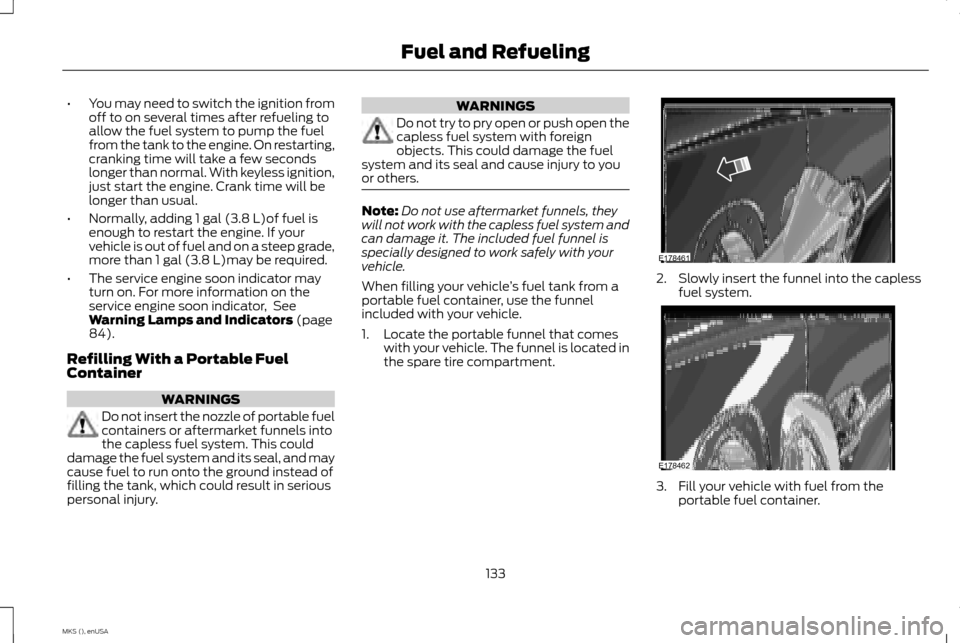
1. Locate the portable funnel that comes with your vehicle. The funnel is located in
the spare tire compartment. 2. Slowly insert the funnel into the capless
fuel system. 3. Fill your vehicle with fuel from the
portable fuel container.
133
MKS (), enUSA Fuel and RefuelingE178461 E178462
Page 138 of 424
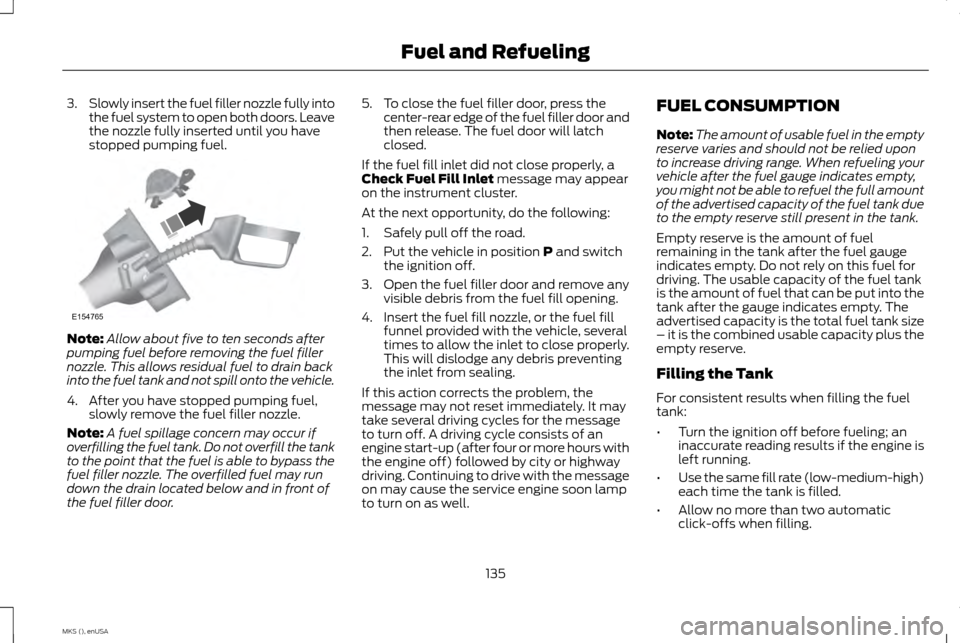
3.
Slowly insert the fuel filler nozzle fully into
the fuel system to open both doors. Leave
the nozzle fully inserted until you have
stopped pumping fuel. Note:
Allow about five to ten seconds after
pumping fuel before removing the fuel filler
nozzle. This allows residual fuel to drain back
into the fuel tank and not spill onto the vehicle.
4. After you have stopped pumping fuel, slowly remove the fuel filler nozzle.
Note: A fuel spillage concern may occur if
overfilling the fuel tank. Do not overfill the tank
to the point that the fuel is able to bypass the
fuel filler nozzle. The overfilled fuel may run
down the drain located below and in front of
the fuel filler door. 5. To close the fuel filler door, press the
center-rear edge of the fuel filler door and
then release. The fuel door will latch
closed.
If the fuel fill inlet did not close properly, a
Check Fuel Fill Inlet message may appear
on the instrument cluster.
At the next opportunity, do the following:
1. Safely pull off the road.
2. Put the vehicle in position
P and switch
the ignition off.
3. Open the fuel filler door and remove any visible debris from the fuel fill opening.
4. Insert the fuel fill nozzle, or the fuel fill funnel provided with the vehicle, several
times to allow the inlet to close properly.
This will dislodge any debris preventing
the inlet from sealing.
If this action corrects the problem, the
message may not reset immediately. It may
take several driving cycles for the message
to turn off. A driving cycle consists of an
engine start-up (after four or more hours with
the engine off) followed by city or highway
driving. Continuing to drive with the message
on may cause the service engine soon lamp
to turn on as well. FUEL CONSUMPTION
Note:
The amount of usable fuel in the empty
reserve varies and should not be relied upon
to increase driving range. When refueling your
vehicle after the fuel gauge indicates empty,
you might not be able to refuel the full amount
of the advertised capacity of the fuel tank due
to the empty reserve still present in the tank.
Empty reserve is the amount of fuel
remaining in the tank after the fuel gauge
indicates empty. Do not rely on this fuel for
driving. The usable capacity of the fuel tank
is the amount of fuel that can be put into the
tank after the gauge indicates empty. The
advertised capacity is the total fuel tank size
– it is the combined usable capacity plus the
empty reserve.
Filling the Tank
For consistent results when filling the fuel
tank:
• Turn the ignition off before fueling; an
inaccurate reading results if the engine is
left running.
• Use the same fill rate (low-medium-high)
each time the tank is filled.
• Allow no more than two automatic
click-offs when filling.
135
MKS (), enUSA Fuel and RefuelingE154765
Page 139 of 424
Results are most accurate when the filling
method is consistent.
Calculating Fuel Economy
Do not measure fuel economy during the first
1000 miles (1600 kilometers) of driving (this
is your engine
’s break-in period); a more
accurate measurement is obtained after
2000 miles - 3000 miles (3200 kilometers
- 4800 kilometers). Also, fuel expense,
frequency of fill ups or fuel gauge readings
are not accurate ways to measure fuel
economy.
1. Fill the fuel tank completely and record the initial odometer reading.
2. Each time you fill the tank, record the amount of fuel added.
3. After at least three to five tank fill ups, fill
the fuel tank and record the current
odometer reading.
4. Subtract your initial odometer reading from the current odometer reading.
5. Calculate fuel economy by dividing miles
traveled by gallons used (For Metric:
Multiply liters used by 100, then divide by
kilometers traveled). Keep a record for at least one month and
record the type of driving (city or highway).
This provides an accurate estimate of the
vehicle
’s fuel economy under current driving
conditions. Additionally, keeping records
during summer and winter show how
temperature impacts fuel economy. In
general, lower temperatures mean lower fuel
economy.
EMISSION CONTROL SYSTEM WARNINGS
Do not park, idle, or drive your vehicle
in dry grass or other dry ground cover.
The emission system heats up the
engine compartment and exhaust system,
which can start a fire. Exhaust leaks may result in entry of
harmful and potentially lethal fumes
into the passenger compartment. If you
smell exhaust fumes inside your vehicle, have
your dealer inspect your vehicle immediately.
Do not drive if you smell exhaust fumes. Your vehicle is equipped with various
emission control components and a catalytic
converter that will enable your vehicle to
comply with applicable exhaust emission
standards. To make sure that the catalytic
converter and other emission control
components continue to work properly:
•
Use only the specified fuel listed.
• Avoid running out of fuel.
• Do not turn off the ignition while your
vehicle is moving, especially at high
speeds.
• Have the items listed in scheduled
maintenance information performed
according to the specified schedule.
The scheduled maintenance items listed in
scheduled maintenance information are
essential to the life and performance of your
vehicle and to its emissions system.
If you use parts other than Ford, Motorcraft
or Ford-authorized parts for maintenance
replacements, or for service of components
affecting emission control, such non-Ford
parts should be the equivalent to genuine
Ford Motor Company parts in performance
and durability.
136
MKS (), enUSA Fuel and Refueling