power LINCOLN MKT 2013 Workshop Manual
[x] Cancel search | Manufacturer: LINCOLN, Model Year: 2013, Model line: MKT, Model: LINCOLN MKT 2013Pages: 494, PDF Size: 5.97 MB
Page 239 of 494
•High interior temperatures, which may deactivate the illumination or
the warning lamps until the interior temperature reduces (audible
warning still sounds).
Certain conditions may reduce the visibility of the warning lamp;
therefore, it is recommended to keep the audible warning on.
If the front end of the vehicle is hit or damaged, the radar sensing zone
may be altered causing missed or false collision warnings. See your
authorized dealer to have your collision warning radar checked for proper
coverage and operation.
LINCOLN DRIVE CONTROL (IF EQUIPPED)
The Lincoln driving experience is delivered through a suite of
sophisticated electronic vehicle systems that continuously monitor both
your inputs and the road conditions to optimize ride comfort, steering,
handling, and powertrain response and sound.
These systems include:
•Continuously Controlled Damping which dynamically adjusts the shock
absorbers in real time to match the road surface and your inputs.
•Electronically Power-Assisted Steering which adjusts steering effort
and feel based on vehicle speed and your inputs.
•Active Noise Control which utilizes vehicle electronics to enhance the
acoustic experience.
•Electronic Stability Control and Traction Control which maintain
vehicle control in adverse conditions or high performance driving.
•Electronic Throttle Control which enhances the powertrain response
to your inputs.
These systems have a range of modes which you can choose from in
order to customize your ideal driving experience:
•Normal – Delivers the best combination of comfortable, controlled ride
and confident handling and powerful yet quiet powertrain sound. This
mode provides an engaging drive experience and a direct connection
to the road without sacrificing any of the composure demanded from a
luxury vehicle. Unwanted noises from the powertrain are cancelled
while desired sounds are shaped to deliver a smooth powerful note.
This setting is ideal for everyday use and daily driving.
•Comfort – Provides a more relaxed driving experience. Steering effort
is decreased, suspension movement is more fluid. Comfort mode is
ideal for long road trips when enhanced traveling comfort is desired.
Driving Aids239
2013 MKT(mkt)
Owners Guide gf, 1st Printing
USA(fus)
Page 240 of 494
•Sport – Provides a sportier driving experience. Suspension stiffens,
with an emphasis on handling and control. The engine responds more
directly to your inputs and takes on a more powerful tone. Sport mode
is intended to be used during more spirited driving.
Setting up Lincoln Adaptive Drive
You can configure which of the Adaptive Drive modes is active when the
vehicle is in D (Drive) or in S (Sport). The configuration is retained until
modified from the main menu on the information display using the
following procedure:
1. Choose Settings.
2. Choose Driver Assist.
3. Choose Adaptive Drive.
4. Select the shift position you would like to configure, either D or S.
5. Choose from Comfort, Normal, or Sport modes as your preferred
setting in D.
6. Choose from Normal or Sport modes as your preferred setting in S.
STEERING
Electric Power Steering
WARNING:The electric power steering system has diagnostic
checks that continuously monitor the system to ensure proper
operation. When a system error is detected the following message
Service Power Steering, Service Power Steering Now or Power Steering
Assist Fault may appear in the information display.
WARNING:The electric power steering system has diagnostics
checks that continuously monitor the system to ensure proper
operation of the electronic system. When an electronic error is
detected, Power Steering Assist Fault will be displayed in the
information display. If this happens, stop the vehicle in a safe place, and
turn off the engine. After at least 10 seconds, reset the system by
restarting the engine, and watch the information display for Power
Steering Assist Fault. If the message returns, or returns while driving,
take the vehicle to your dealer to have it checked. With the message
displayed, the steering assist is turned off, making the vehicle harder to
steer.
240Driving Aids
2013 MKT(mkt)
Owners Guide gf, 1st Printing
USA(fus)
Page 241 of 494
WARNING:If Service Power Steering is displayed in the
information display, a problem with the system function has been
detected. On the next key cycle Service Power Steering Now will be
displayed and steering assist will be removed until the steering system
is serviced. Have your vehicle taken to the nearest dealer as soon as
possible.
WARNING:Obtain immediate service if a system error is
detected. You may not notice any difference in the feel of your
steering, but a serious condition may exist. Failure to do so may result
in loss of steering control.
Your vehicle is equipped with an electric power-assisted steering system.
There is no fluid reservoir to check or fill.
If your vehicle loses electrical power while you are driving (or if the
ignition is turned off), you can steer the vehicle manually, but it takes
more effort. Extreme continuous steering may increase the effort it takes
for you to steer. This occurs to prevent internal overheating and
permanent damage to your steering system. If this should occur, you will
neither lose the ability to steer the vehicle manually nor will it cause
permanent damage. Typical steering and driving maneuvers will allow the
system to cool and steering assist will return to normal.
When a steering system error is detected, the following messages may
appear in the information display:
•Service Power Steering
•Service Power Steering Now
•Power Steering Assist Fault
Steering Tips
If the steering wanders or pulls, check for:
•an improperly inflated tire
•uneven tire wear
•loose or worn suspension components
•loose or worn steering components
•improper vehicle alignment
A high crown in the road or high crosswinds may also make the steering
seem to wander/pull.
Driving Aids241
2013 MKT(mkt)
Owners Guide gf, 1st Printing
USA(fus)
Page 251 of 494
TOWING A TRAILER
WARNING:Do not exceed the GVWR or the GAWR specified on
the certification label.
WARNING:Towing trailers beyond the maximum recommended
gross trailer weight exceeds the limit of the vehicle and could
result in engine damage, transmission damage, structural damage, loss
of vehicle control, vehicle rollover and personal injury.
Your vehicle’s load capacity is designated by weight, not by volume, so
you cannot necessarily use all available space when loading a vehicle.
Towing a trailer places an additional load on your vehicle’s engine,
transmission, axle, brakes, tires and suspension. Inspect these
components periodically during, and after, any towing operation.
TRAILER SWAY CONTROL (IF EQUIPPED)
WARNING:Turning off the trailer sway control increases the risk
of loss of vehicle control, serious injury or death. Ford does not
recommend turning off this feature except in situations where reducing
vehicle speed may be dangerous (e.g. driving uphill) or the driver has
significant trailer towing experience and can control trailer sway and
maintain safe operation.
Note:This feature does not prevent trailer sway, but reduces it once it
begins.
Note:This feature cannot stop all trailers from swaying.
Note:In some cases, if vehicle speed is too high, the system may
activate multiple times, gradually reducing vehicle speed.
This feature applies the vehicle brakes at individual wheels and, if
necessary, reduces engine power. If the trailer begins to sway, the
traction control system light flashes andTRAILER SWAY REDUCE
SPEEDappears in the information display. The first thing to do is slow
the vehicle down, then pull safely to the side of the road and check for
proper tongue load and trailer load distribution. Refer toLoad Carrying
chapter for specific loading information.
Trailer sway control can be turned off by using the information display
control; refer to theInformation Displayschapter. The system turns
back on whenever the ignition is turned on.
Towing251
2013 MKT(mkt)
Owners Guide gf, 1st Printing
USA(fus)
Page 252 of 494
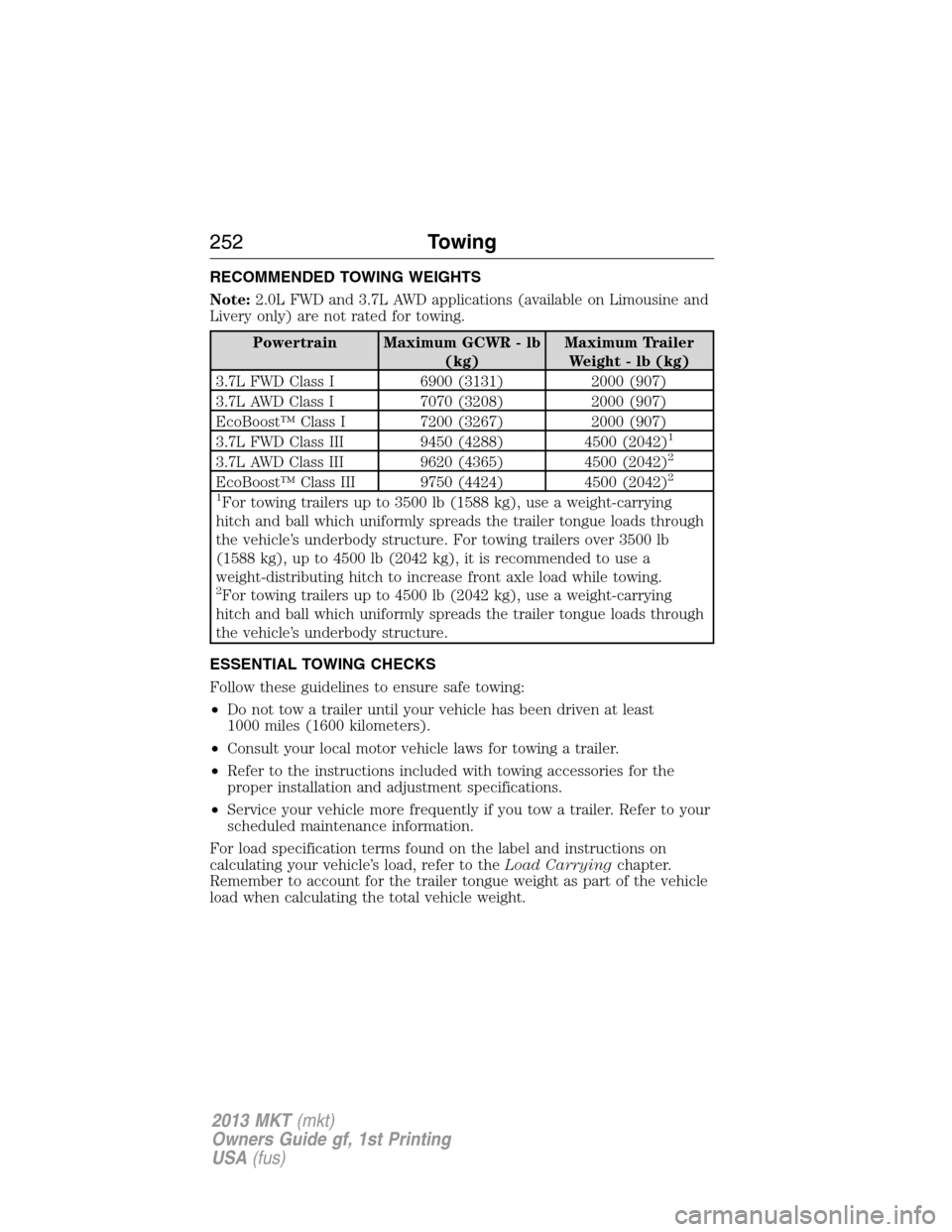
RECOMMENDED TOWING WEIGHTS
Note:2.0L FWD and 3.7L AWD applications (available on Limousine and
Livery only) are not rated for towing.
Powertrain Maximum GCWR - lb
(kg)Maximum Trailer
Weight - lb (kg)
3.7L FWD Class I 6900 (3131) 2000 (907)
3.7L AWD Class I 7070 (3208) 2000 (907)
EcoBoost™ Class I 7200 (3267) 2000 (907)
3.7L FWD Class III 9450 (4288) 4500 (2042)
1
3.7L AWD Class III 9620 (4365) 4500 (2042)2
EcoBoost™ Class III 9750 (4424) 4500 (2042)2
1
For towing trailers up to 3500 lb (1588 kg), use a weight-carrying
hitch and ball which uniformly spreads the trailer tongue loads through
the vehicle’s underbody structure. For towing trailers over 3500 lb
(1588 kg), up to 4500 lb (2042 kg), it is recommended to use a
weight-distributing hitch to increase front axle load while towing.
2For towing trailers up to 4500 lb (2042 kg), use a weight-carrying
hitch and ball which uniformly spreads the trailer tongue loads through
the vehicle’s underbody structure.
ESSENTIAL TOWING CHECKS
Follow these guidelines to ensure safe towing:
•Do not tow a trailer until your vehicle has been driven at least
1000 miles (1600 kilometers).
•Consult your local motor vehicle laws for towing a trailer.
•Refer to the instructions included with towing accessories for the
proper installation and adjustment specifications.
•Service your vehicle more frequently if you tow a trailer. Refer to your
scheduled maintenance information.
For load specification terms found on the label and instructions on
calculating your vehicle’s load, refer to theLoad Carryingchapter.
Remember to account for the trailer tongue weight as part of the vehicle
load when calculating the total vehicle weight.
252Towing
2013 MKT(mkt)
Owners Guide gf, 1st Printing
USA(fus)
Page 254 of 494
Trailer Brakes
WARNING:Do not connect a trailer’s hydraulic brake system
directly to your vehicle’s brake system. Your vehicle may not have
enough braking power and your chances of having a collision greatly
increase.
Electric brakes and manual, automatic or surge-type trailer brakes are
safe if installed properly and adjusted to the manufacturer’s
specifications. The trailer brakes must meet local and Federal
regulations.
The braking system of the tow vehicle is rated for operation at the
GVWR not GCWR.
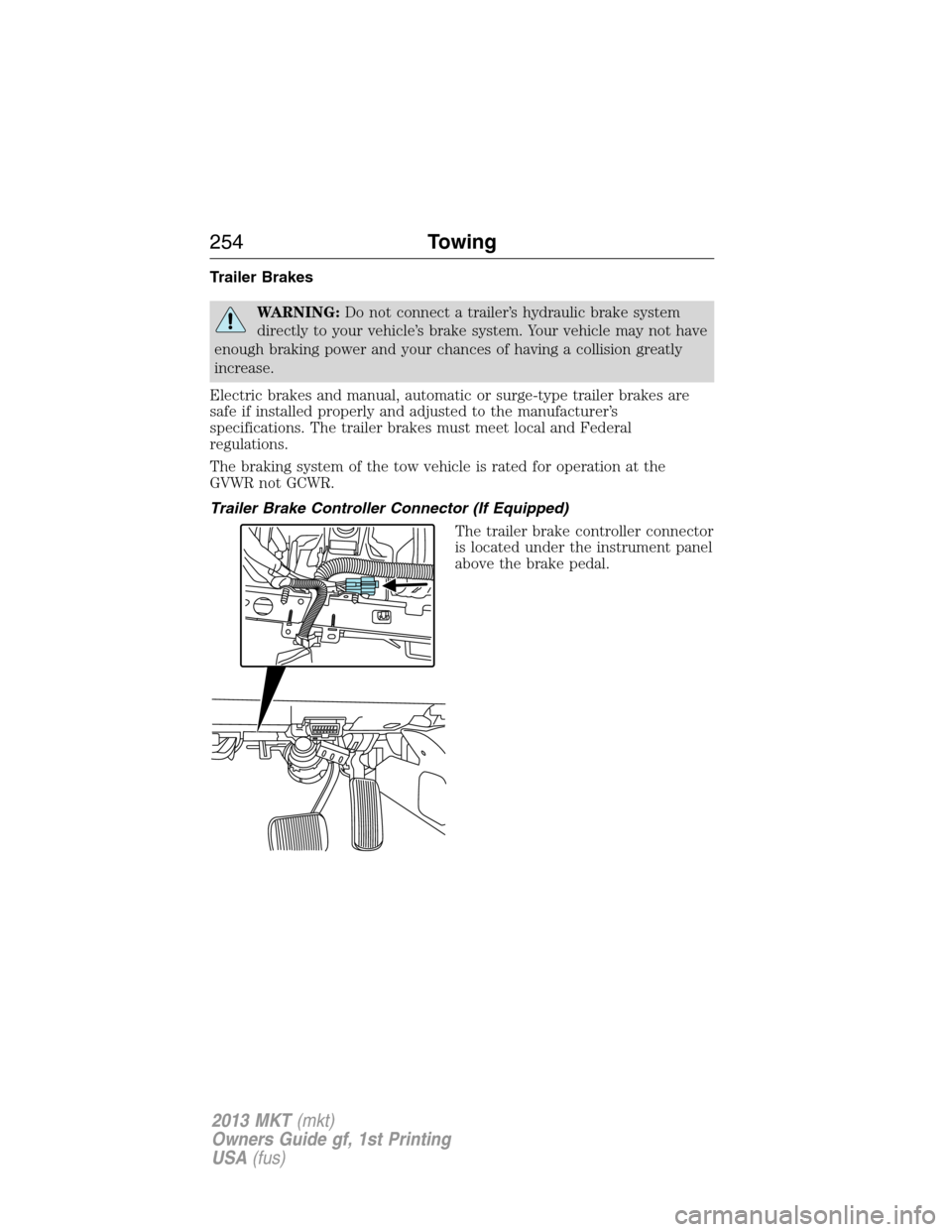
Trailer Brake Controller Connector (If Equipped)
The trailer brake controller connector
is located under the instrument panel
above the brake pedal.
254Towing
2013 MKT(mkt)
Owners Guide gf, 1st Printing
USA(fus)
Page 257 of 494
TOWING THE VEHICLE ON FOUR WHEELS
Emergency Towing
In the event your vehicle becomes disabled (without access to wheel
dollies, car-hauling trailer, or flatbed transport vehicle), it can be
flat-towed (all wheels on the ground, regardless of the
powertrain/transmission configuration) under the following conditions:
•The vehicle is facing forward so that it is towed in a forward direction.
•The transmission is placed in N (Neutral). Refer toAutomatic
transmissionin theTransmissionchapter if you cannot move the
transmission into N (Neutral).
•Maximum speed is 35 mph (56 km/h).
•Maximum distance is 50 miles (80 kilometers).
Recreational Towing
Vehicles Equipped with a 2.0L Engine
Follow these guidelines if you have a need for recreational (RV) towing.
An example of recreational towing would be towing your vehicle behind a
motorhome. These guidelines are designed to ensure that your
transmission is not damaged.
Do not tow your vehicle with any wheels on the ground, as vehicle or
transmission damage may occur. It is recommended to tow your vehicle
with all four (4) wheels off the ground such as when using a car-hauling
trailer. Otherwise, no recreational towing is permitted.
In case of a roadside emergency with a disabled vehicle, seeWrecker
towingearlier in this section.
Vehicles Not Equipped with a 2.0L Engine
Note:Put your climate control system in recirculated air mode to
prevent exhaust fumes from entering the vehicle. Refer to theClimate
Controlchapter.
Follow these guidelines for your specific powertrain combination to tow
your vehicle for personal travel (such as behind a motor home or a
truck). These guidelines are designed to prevent damage to your vehicle
after it is hooked-up to the RV or tow dolly.
Towing257
2013 MKT(mkt)
Owners Guide gf, 1st Printing
USA(fus)
Page 278 of 494
FUSE SPECIFICATION CHART
Power Distribution Box
WARNING:Always disconnect the battery before servicing high
current fuses.
WARNING:To reduce risk of electrical shock, always replace the
cover to the power distribution box before reconnecting the
battery or refilling fluid reservoirs.
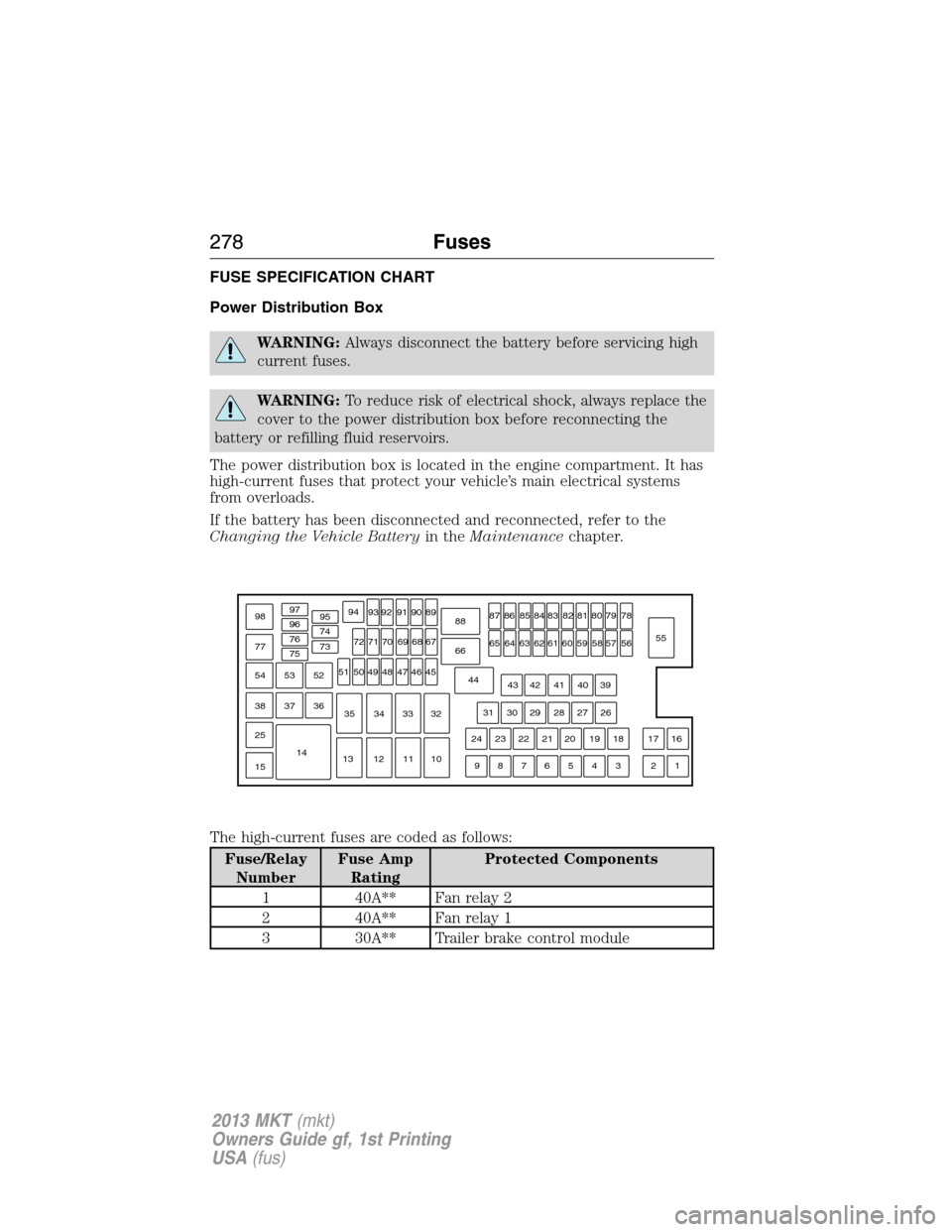
The power distribution box is located in the engine compartment. It has
high-current fuses that protect your vehicle’s main electrical systems
from overloads.
If the battery has been disconnected and reconnected, refer to the
Changing the Vehicle Batteryin theMaintenancechapter.
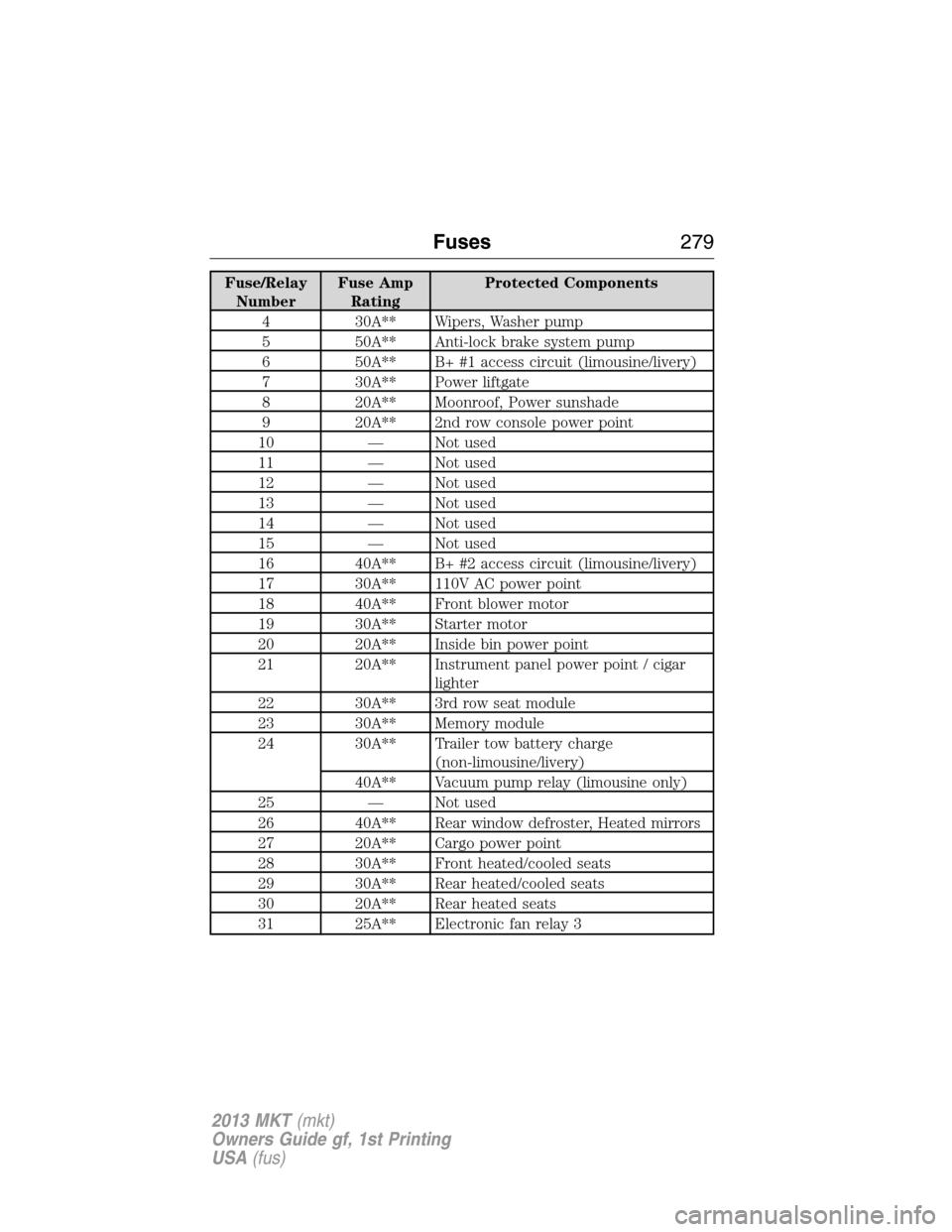
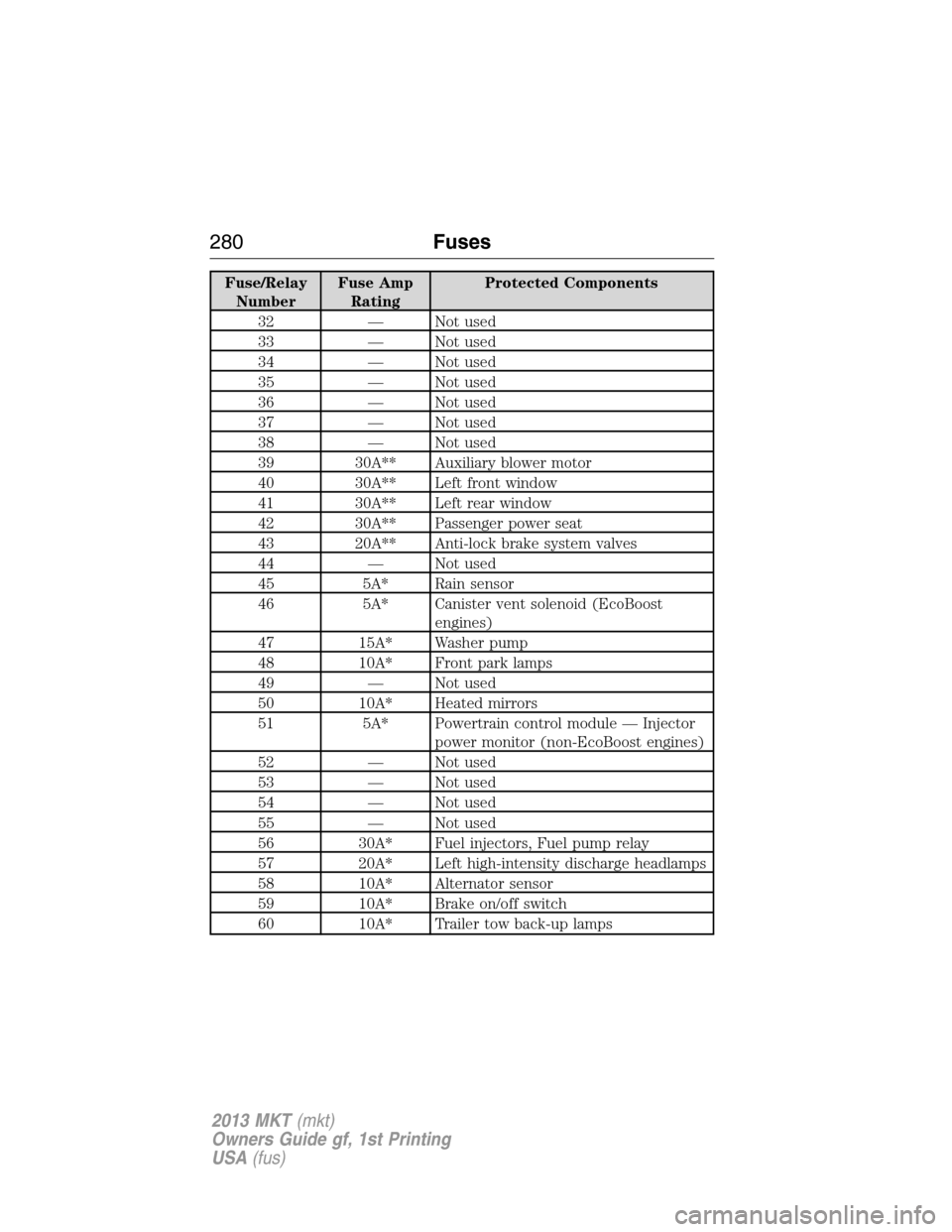
The high-current fuses are coded as follows:
Fuse/Relay
NumberFuse Amp
RatingProtected Components
1 40A** Fan relay 2
2 40A** Fan relay 1
3 30A** Trailer brake control module
97
98
77969594
93 92 91 90 89
88
66
4478
56
39
26
18 1617
312 4 5 6 7 8 919 20 21 22 23 2427 28 29 30 3140 41 42 4355
57 58 59 60 61 62 63 64 6579 80 81 82 83 84 85 86 87
67
45
32
10 11 12 1333 34 3546 47 48 49 50 5168 69 70 71 72 74
73 76
75
53
37 36 54
38
25
151452
278Fuses
2013 MKT(mkt)
Owners Guide gf, 1st Printing
USA(fus)
Page 279 of 494
Fuse/Relay
NumberFuse Amp
RatingProtected Components
4 30A** Wipers, Washer pump
5 50A** Anti-lock brake system pump
6 50A** B+ #1 access circuit (limousine/livery)
7 30A** Power liftgate
8 20A** Moonroof, Power sunshade
9 20A** 2nd row console power point
10 — Not used
11 — Not used
12 — Not used
13 — Not used
14 — Not used
15 — Not used
16 40A** B+ #2 access circuit (limousine/livery)
17 30A** 110V AC power point
18 40A** Front blower motor
19 30A** Starter motor
20 20A** Inside bin power point
21 20A** Instrument panel power point / cigar
lighter
22 30A** 3rd row seat module
23 30A** Memory module
24 30A** Trailer tow battery charge
(non-limousine/livery)
40A** Vacuum pump relay (limousine only)
25 — Not used
26 40A** Rear window defroster, Heated mirrors
27 20A** Cargo power point
28 30A** Front heated/cooled seats
29 30A** Rear heated/cooled seats
30 20A** Rear heated seats
31 25A** Electronic fan relay 3
Fuses279
2013 MKT(mkt)
Owners Guide gf, 1st Printing
USA(fus)
Page 280 of 494
Fuse/Relay
NumberFuse Amp
RatingProtected Components
32 — Not used
33 — Not used
34 — Not used
35 — Not used
36 — Not used
37 — Not used
38 — Not used
39 30A** Auxiliary blower motor
40 30A** Left front window
41 30A** Left rear window
42 30A** Passenger power seat
43 20A** Anti-lock brake system valves
44 — Not used
45 5A* Rain sensor
46 5A* Canister vent solenoid (EcoBoost
engines)
47 15A* Washer pump
48 10A* Front park lamps
49 — Not used
50 10A* Heated mirrors
51 5A* Powertrain control module — Injector
power monitor (non-EcoBoost engines)
52 — Not used
53 — Not used
54 — Not used
55 — Not used
56 30A* Fuel injectors, Fuel pump relay
57 20A* Left high-intensity discharge headlamps
58 10A* Alternator sensor
59 10A* Brake on/off switch
60 10A* Trailer tow back-up lamps
280Fuses
2013 MKT(mkt)
Owners Guide gf, 1st Printing
USA(fus)