belt LINCOLN MKX 2018 User Guide
[x] Cancel search | Manufacturer: LINCOLN, Model Year: 2018, Model line: MKX, Model: LINCOLN MKX 2018Pages: 603, PDF Size: 4.94 MB
Page 29 of 603
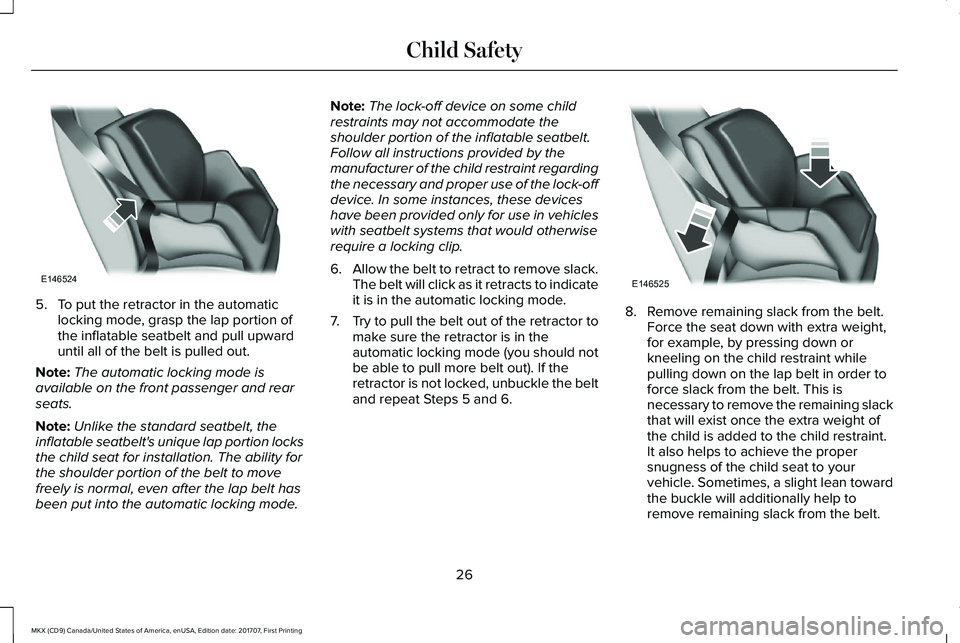
5. To put the retractor in the automaticlocking mode, grasp the lap portion ofthe inflatable seatbelt and pull upwarduntil all of the belt is pulled out.
Note:The automatic locking mode isavailable on the front passenger and rearseats.
Note:Unlike the standard seatbelt, theinflatable seatbelt's unique lap portion locksthe child seat for installation. The ability forthe shoulder portion of the belt to movefreely is normal, even after the lap belt hasbeen put into the automatic locking mode.
Note:The lock-off device on some childrestraints may not accommodate theshoulder portion of the inflatable seatbelt.Follow all instructions provided by themanufacturer of the child restraint regardingthe necessary and proper use of the lock-offdevice. In some instances, these deviceshave been provided only for use in vehicleswith seatbelt systems that would otherwiserequire a locking clip.
6.Allow the belt to retract to remove slack.The belt will click as it retracts to indicateit is in the automatic locking mode.
7.Try to pull the belt out of the retractor tomake sure the retractor is in theautomatic locking mode (you should notbe able to pull more belt out). If theretractor is not locked, unbuckle the beltand repeat Steps 5 and 6.
8. Remove remaining slack from the belt.Force the seat down with extra weight,for example, by pressing down orkneeling on the child restraint whilepulling down on the lap belt in order toforce slack from the belt. This isnecessary to remove the remaining slackthat will exist once the extra weight ofthe child is added to the child restraint.It also helps to achieve the propersnugness of the child seat to yourvehicle. Sometimes, a slight lean towardthe buckle will additionally help toremove remaining slack from the belt.
26
MKX (CD9) Canada/United States of America, enUSA, Edition date: 201707, First Printing
Child SafetyE146524 E146525
Page 30 of 603
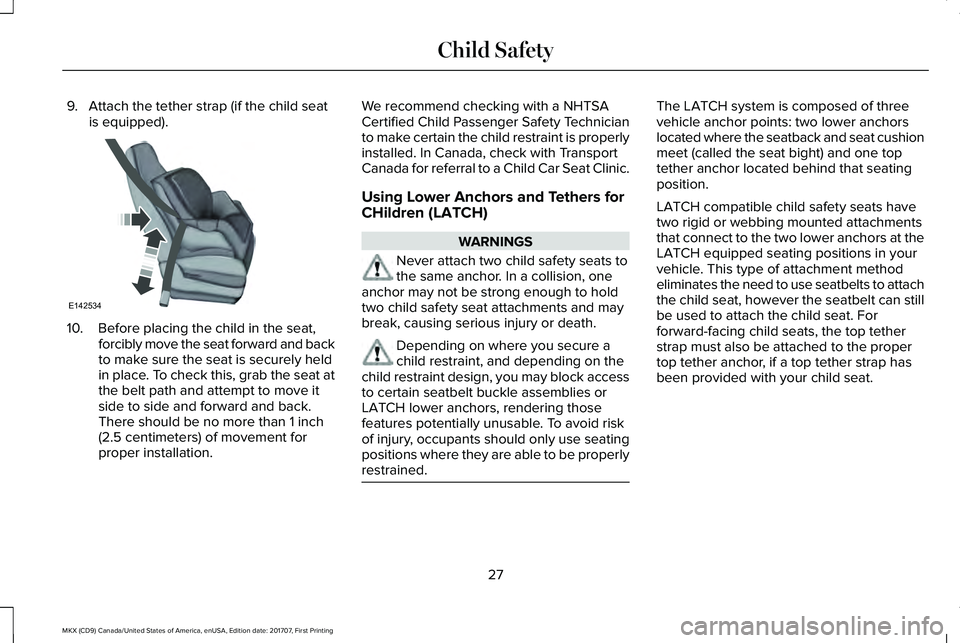
9. Attach the tether strap (if the child seatis equipped).
10. Before placing the child in the seat,forcibly move the seat forward and backto make sure the seat is securely heldin place. To check this, grab the seat atthe belt path and attempt to move itside to side and forward and back.There should be no more than 1 inch(2.5 centimeters) of movement forproper installation.
We recommend checking with a NHTSACertified Child Passenger Safety Technicianto make certain the child restraint is properlyinstalled. In Canada, check with TransportCanada for referral to a Child Car Seat Clinic.
Using Lower Anchors and Tethers for
CHildren (LATCH)
WARNINGS
Never attach two child safety seats tothe same anchor. In a collision, oneanchor may not be strong enough to holdtwo child safety seat attachments and maybreak, causing serious injury or death.
Depending on where you secure achild restraint, and depending on thechild restraint design, you may block accessto certain seatbelt buckle assemblies orLATCH lower anchors, rendering thosefeatures potentially unusable. To avoid riskof injury, occupants should only use seatingpositions where they are able to be properlyrestrained.
The LATCH system is composed of threevehicle anchor points: two lower anchorslocated where the seatback and seat cushionmeet (called the seat bight) and one toptether anchor located behind that seatingposition.
LATCH compatible child safety seats havetwo rigid or webbing mounted attachmentsthat connect to the two lower anchors at theLATCH equipped seating positions in yourvehicle. This type of attachment methodeliminates the need to use seatbelts to attachthe child seat, however the seatbelt can stillbe used to attach the child seat. Forforward-facing child seats, the top tetherstrap must also be attached to the propertop tether anchor, if a top tether strap hasbeen provided with your child seat.
27
MKX (CD9) Canada/United States of America, enUSA, Edition date: 201707, First Printing
Child SafetyE142534
Page 31 of 603
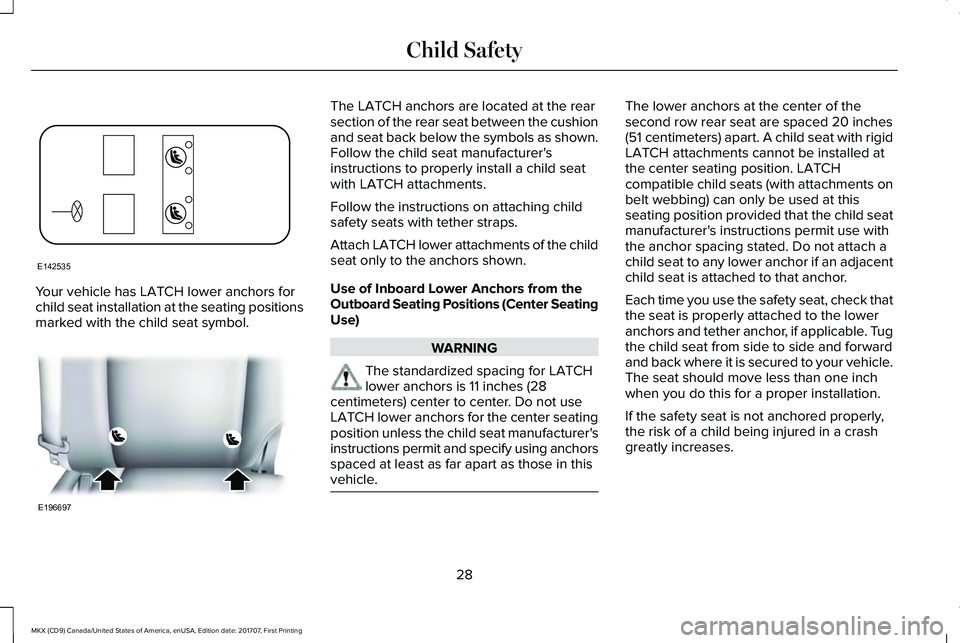
Your vehicle has LATCH lower anchors forchild seat installation at the seating positionsmarked with the child seat symbol.
The LATCH anchors are located at the rearsection of the rear seat between the cushionand seat back below the symbols as shown.Follow the child seat manufacturer'sinstructions to properly install a child seatwith LATCH attachments.
Follow the instructions on attaching childsafety seats with tether straps.
Attach LATCH lower attachments of the childseat only to the anchors shown.
Use of Inboard Lower Anchors from theOutboard Seating Positions (Center SeatingUse)
WARNING
The standardized spacing for LATCHlower anchors is 11 inches (28centimeters) center to center. Do not useLATCH lower anchors for the center seatingposition unless the child seat manufacturer'sinstructions permit and specify using anchorsspaced at least as far apart as those in thisvehicle.
The lower anchors at the center of thesecond row rear seat are spaced 20 inches(51 centimeters) apart. A child seat with rigidLATCH attachments cannot be installed atthe center seating position. LATCHcompatible child seats (with attachments onbelt webbing) can only be used at thisseating position provided that the child seatmanufacturer's instructions permit use withthe anchor spacing stated. Do not attach achild seat to any lower anchor if an adjacentchild seat is attached to that anchor.
Each time you use the safety seat, check thatthe seat is properly attached to the loweranchors and tether anchor, if applicable. Tugthe child seat from side to side and forwardand back where it is secured to your vehicle.The seat should move less than one inchwhen you do this for a proper installation.
If the safety seat is not anchored properly,the risk of a child being injured in a crashgreatly increases.
28
MKX (CD9) Canada/United States of America, enUSA, Edition date: 201707, First Printing
Child SafetyE142535 E196697
Page 32 of 603
Combining Seatbelt and LATCH LowerAnchors for Attaching Child Safety Seats
When used in combination, either theseatbelt or the LATCH lower anchors maybe attached first, provided a properinstallation is achieved. Attach the tetherstrap afterward, if included with the childseat.
Using Tether Straps
Many forward-facing child safetyseats include a tether strap whichextends from the back of the childsafety seat and hooks to an anchoring pointcalled the top tether anchor. Tether strapsare available as an accessory for many oldersafety seats.
Contact the manufacturer of your child seatfor information about ordering a tether strap,or to obtain a longer tether strap if the tetherstrap on your safety seat does not reach theappropriate top tether anchor in your vehicle.
Once the child safety seat has been installedusing either the seatbelt, the lower anchorsof the LATCH system, or both, you can attachthe top tether strap.
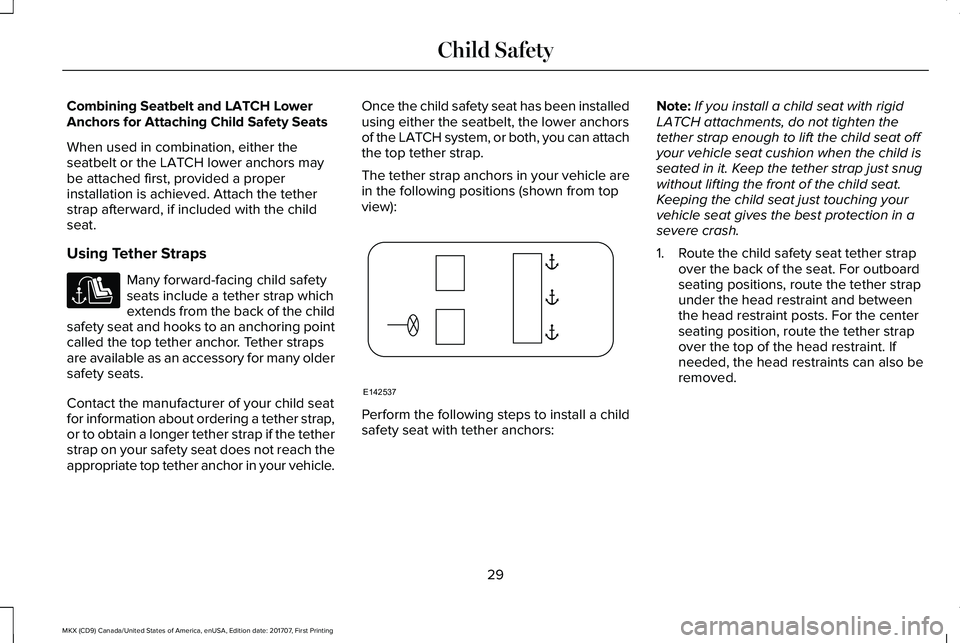
The tether strap anchors in your vehicle arein the following positions (shown from topview):
Perform the following steps to install a childsafety seat with tether anchors:
Note:If you install a child seat with rigidLATCH attachments, do not tighten thetether strap enough to lift the child seat offyour vehicle seat cushion when the child isseated in it. Keep the tether strap just snugwithout lifting the front of the child seat.Keeping the child seat just touching yourvehicle seat gives the best protection in asevere crash.
1. Route the child safety seat tether strapover the back of the seat. For outboardseating positions, route the tether strapunder the head restraint and betweenthe head restraint posts. For the centerseating position, route the tether strapover the top of the head restraint. Ifneeded, the head restraints can also beremoved.
29
MKX (CD9) Canada/United States of America, enUSA, Edition date: 201707, First Printing
Child Safety E142537
Page 33 of 603
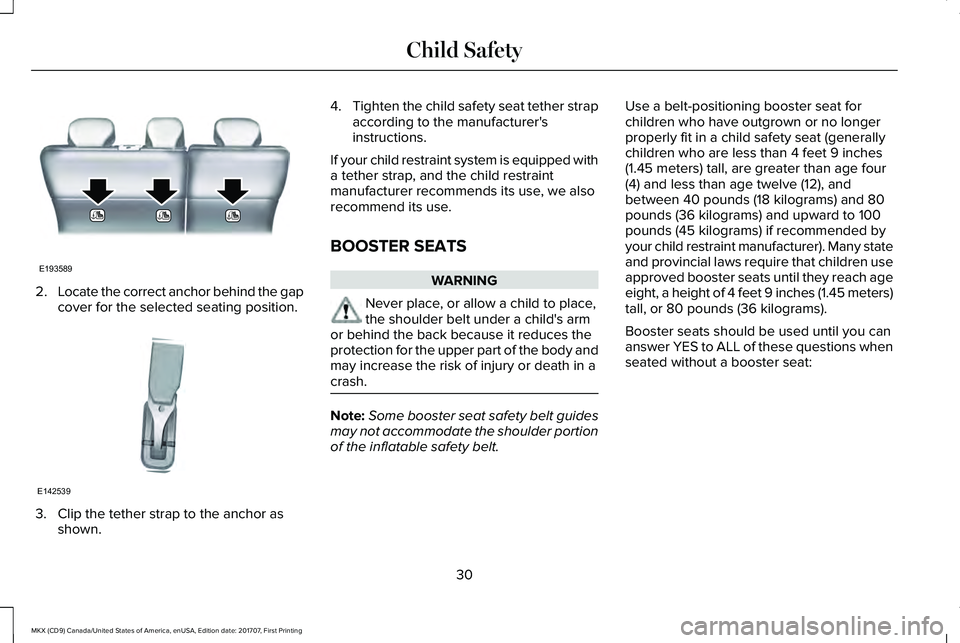
2.Locate the correct anchor behind the gapcover for the selected seating position.
3. Clip the tether strap to the anchor asshown.
4.Tighten the child safety seat tether strapaccording to the manufacturer'sinstructions.
If your child restraint system is equipped witha tether strap, and the child restraintmanufacturer recommends its use, we alsorecommend its use.
BOOSTER SEATS
WARNING
Never place, or allow a child to place,the shoulder belt under a child's armor behind the back because it reduces theprotection for the upper part of the body andmay increase the risk of injury or death in acrash.
Note:Some booster seat safety belt guidesmay not accommodate the shoulder portionof the inflatable safety belt.
Use a belt-positioning booster seat forchildren who have outgrown or no longerproperly fit in a child safety seat (generallychildren who are less than 4 feet 9 inches(1.45 meters) tall, are greater than age four(4) and less than age twelve (12), andbetween 40 pounds (18 kilograms) and 80pounds (36 kilograms) and upward to 100pounds (45 kilograms) if recommended byyour child restraint manufacturer). Many stateand provincial laws require that children useapproved booster seats until they reach ageeight, a height of 4 feet 9 inches (1.45 meters)tall, or 80 pounds (36 kilograms).
Booster seats should be used until you cananswer YES to ALL of these questions whenseated without a booster seat:
30
MKX (CD9) Canada/United States of America, enUSA, Edition date: 201707, First Printing
Child SafetyE193589 E142539
Page 34 of 603
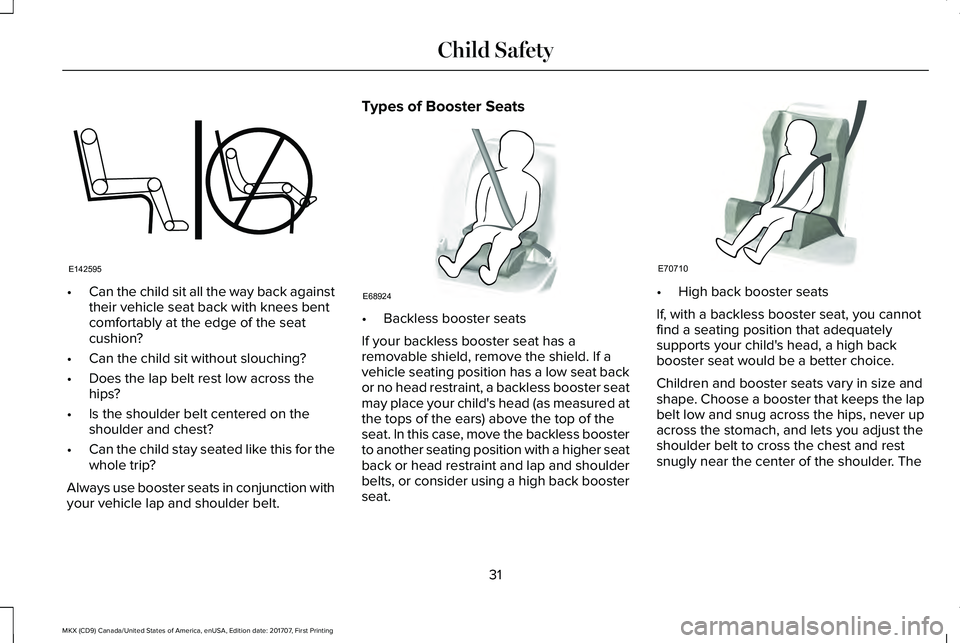
•Can the child sit all the way back againsttheir vehicle seat back with knees bentcomfortably at the edge of the seatcushion?
•Can the child sit without slouching?
•Does the lap belt rest low across thehips?
•Is the shoulder belt centered on theshoulder and chest?
•Can the child stay seated like this for thewhole trip?
Always use booster seats in conjunction withyour vehicle lap and shoulder belt.
Types of Booster Seats
•Backless booster seats
If your backless booster seat has aremovable shield, remove the shield. If avehicle seating position has a low seat backor no head restraint, a backless booster seatmay place your child's head (as measured atthe tops of the ears) above the top of theseat. In this case, move the backless boosterto another seating position with a higher seatback or head restraint and lap and shoulderbelts, or consider using a high back boosterseat.
•High back booster seats
If, with a backless booster seat, you cannotfind a seating position that adequatelysupports your child's head, a high backbooster seat would be a better choice.
Children and booster seats vary in size andshape. Choose a booster that keeps the lapbelt low and snug across the hips, never upacross the stomach, and lets you adjust theshoulder belt to cross the chest and restsnugly near the center of the shoulder. The
31
MKX (CD9) Canada/United States of America, enUSA, Edition date: 201707, First Printing
Child SafetyE142595 E68924 E70710
Page 35 of 603
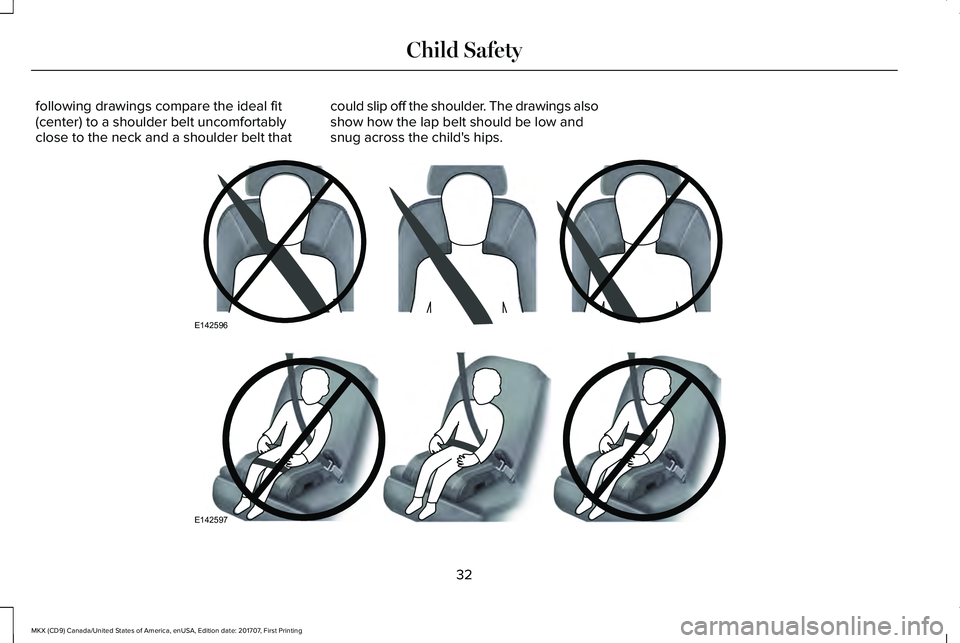
following drawings compare the ideal fit(center) to a shoulder belt uncomfortablyclose to the neck and a shoulder belt that
could slip off the shoulder. The drawings alsoshow how the lap belt should be low andsnug across the child's hips.
32
MKX (CD9) Canada/United States of America, enUSA, Edition date: 201707, First Printing
Child SafetyE142596 E142597
Page 36 of 603
If the booster seat slides on the vehicle seatupon which it is being used, placing arubberized mesh sold as shelf or carpet linerunder the booster seat may improve thiscondition. Do not introduce any item thickerthan this under the booster seat. Check withthe booster seat manufacturer's instructions.
CHILD RESTRAINT POSITIONING
WARNINGS
Airbags can kill or injure a child in achild seat. Never place a rear-facingchild seat in front of an active airbag. If youmust use a forward-facing child seat in thefront seat, move the vehicle seat upon whichthe child seat is installed all the way back.When possible, all children age 12 and undershould be properly restrained in a rearseating position. If all children cannot beseated and restrained properly in a rearseating position, properly restrain the largestchild in the front seat.
WARNINGS
Always carefully follow the instructionsand warnings provided by themanufacturer of any child restraint todetermine if the restraint device isappropriate for your child's size, height,weight, or age. Follow the child restraintmanufacturer's instructions and warningsprovided for installation and use inconjunction with the instructions andwarnings provided by your vehiclemanufacturer. A safety seat that is improperlyinstalled or utilized, is inappropriate for yourchild's height, age, or weight or does notproperly fit the child may increase the risk ofserious injury or death.
Never let a passenger hold a child onhis or her lap while your vehicle ismoving. The passenger cannot protect thechild from injury in a crash, which may resultin serious injury or death.
WARNINGS
Never use pillows, books, or towels toboost a child. They can slide aroundand increase the likelihood of injury or deathin a crash.
Always restrain an unoccupied childseat or booster seat. These objectsmay become projectiles in a crash or suddenstop, which may increase the risk of seriousinjury.
Never place, or allow a child to place,the shoulder belt under a child's armor behind the back because it reduces theprotection for the upper part of the body andmay increase the risk of injury or death in acrash.
To avoid risk of injury, do not leavechildren or pets unattended in yourvehicle.
33
MKX (CD9) Canada/United States of America, enUSA, Edition date: 201707, First Printing
Child Safety
Page 37 of 603
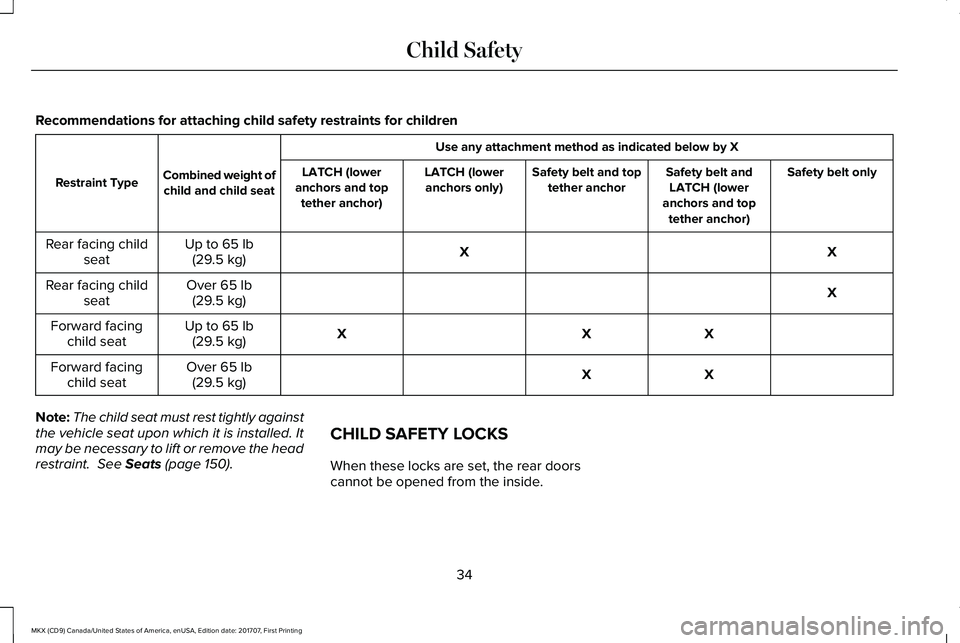
Recommendations for attaching child safety restraints for children
Use any attachment method as indicated below by X
Combined weight ofchild and child seatRestraint TypeSafety belt onlySafety belt andLATCH (loweranchors and toptether anchor)
Safety belt and toptether anchorLATCH (loweranchors only)LATCH (loweranchors and toptether anchor)
XXUp to 65 lb(29.5 kg)Rear facing childseat
XOver 65 lb(29.5 kg)Rear facing childseat
XXXUp to 65 lb(29.5 kg)Forward facingchild seat
XXOver 65 lb(29.5 kg)Forward facingchild seat
Note:The child seat must rest tightly againstthe vehicle seat upon which it is installed. Itmay be necessary to lift or remove the headrestraint. See Seats (page 150).
CHILD SAFETY LOCKS
When these locks are set, the rear doorscannot be opened from the inside.
34
MKX (CD9) Canada/United States of America, enUSA, Edition date: 201707, First Printing
Child Safety
Page 39 of 603
PRINCIPLE OF OPERATION
WARNINGS
Always drive and ride with yourseatback upright and the lap belt snugand low across the hips.
To reduce the risk of injury, make surechildren sit where they can be properlyrestrained.
Never let a passenger hold a child onhis or her lap while your vehicle ismoving. The passenger cannot protect thechild from injury in a crash.
All occupants of your vehicle, includingthe driver, should always properly weartheir safety belts, even when an airbagsupplemental restraint system is provided.Failure to properly wear your safety beltcould seriously increase the risk of injury ordeath.
WARNINGS
It is extremely dangerous to ride in acargo area, inside or outside of avehicle. In a crash, people riding in theseareas are more likely to be seriously injuredor killed. Do not allow people to ride in anyarea of your vehicle that is not equipped withseats and safety belts. Be sure everyone inyour vehicle is in a seat and using a safetybelt properly.
In a rollover crash, an unbelted personis significantly more likely to die thana person wearing a safety belt.
Each seating position in your vehiclehas a specific safety belt assemblywhich is made up of one buckle and onetongue that are designed to be used as apair. 1) Use the shoulder belt on the outsideshoulder only. Never wear the shoulder beltunder the arm. 2) Never swing the safety beltaround your neck over the inside shoulder.3) Never use a single belt for more than oneperson.
WARNINGS
When possible, all children 12 years oldand under should be properlyrestrained in a rear seating position. Failureto follow this could seriously increase therisk of injury or death.
Safety belts and seats can become hotin a vehicle that has been closed up insunny weather; they could burn a small child.Check seat covers and buckles before youplace a child anywhere near them.
Front and rear seat occupants,including pregnant women, shouldwear safety belts for optimum protection inan accident.
All seating positions in your vehicle have lapand shoulder safety belts. All occupants ofthe vehicle should always properly wear theirsafety belts, even when an airbagsupplemental restraint system is provided.
The safety belt system consists of:
•Lap and shoulder safety belts.
•Shoulder safety belt with automaticlocking mode, (except driver safety belt).
36
MKX (CD9) Canada/United States of America, enUSA, Edition date: 201707, First Printing
Seatbelts