engine LINCOLN MKZ 2013 Owners Manual
[x] Cancel search | Manufacturer: LINCOLN, Model Year: 2013, Model line: MKZ, Model: LINCOLN MKZ 2013Pages: 474, PDF Size: 3.79 MB
Page 289 of 474
CLEANING THE ENGINE
Engines are more efficient when they
are clean because grease and dirt
buildup keep the engine warmer than
normal.
When washing:
•
Take care when using a power
washer to clean the engine. The
high-pressure fluid could penetrate
the sealed parts and cause
damage.
• Do not spray a hot engine with cold
water to avoid cracking the engine
block or other engine components.
• Spray Motorcraft® Engine
Shampoo and Degreaser on all
parts that require cleaning and
pressure rinse clean. In Canada,
use Motorcraft® Engine Shampoo.
• Never wash or rinse the engine
while it is hot or running; water in
the running engine may cause
internal damage.
• Never wash or rinse any ignition
coil, spark plug wire or spark plug
well, or the area in and around
these locations.
• Cover the battery, power
distribution box, and air filter
assembly to prevent water
damage when cleaning the engine. CLEANING THE WINDOWS
AND WIPER BLADES
The windows and wiper blades should
be cleaned regularly. If the wipers do
not wipe properly, substances on the
vehicle
’s glass or the wiper blades
may cause squeaking or chatter noise
from the blades, and streaking and
smearing of the windshield.
To clean these items, follow these
tips:
• The windows may be cleaned with
a non-abrasive cleaner such as
Motorcraft® Ultra-Clear Spray
Glass Cleaner.
• The wiper blades can be cleaned
with isopropyl (rubbing) alcohol or
Motorcraft® Premium Windshield
Washer Concentrate in the U.S., or
Premium Quality Windshield
Washer Fluid in Canada. Be sure
to replace wiper blades when they
appear worn or do not function
properly.
• Do not use abrasives, as they may
cause scratches
• Do not use fuel, kerosene, or paint
thinner to clean any parts.
286
Vehicle Care
Page 293 of 474
All motor vehicles and their
components were engineered and
tested for reliable, regular driving.
Long term storage under various
conditions may lead to component
degradation or failure unless specific
precautions are taken to preserve the
components.
General
•
Store all vehicles in a dry,
ventilated place.
• Protect from sunlight, if possible.
• If vehicles are stored outside, they
require regular maintenance to
protect against rust and damage.
Body
• Wash vehicle thoroughly to
remove dirt, grease, oil, tar or mud
from exterior surfaces, rear-wheel
housing and underside of front
fenders.
• Periodically wash vehicles stored
in exposed locations.
• Touch-up raw or primed metal to
prevent rust
• Cover chrome and stainless steel
parts with a thick coat of auto wax
to prevent discoloration. Re-wax
as necessary when the vehicle is
washed.
• Lubricate all hood, door and trunk
lid hinges, and latches with a light
grade oil.
• Cover interior trim to prevent
fading.
• Keep all rubber parts free from oil
and solvents. Engine
•
The engine oil and filter should be
changed prior to storage, as used
engine oil contain contaminates
that may cause engine damage.
• Start the engine every 15 days. Run
at fast idle until it reaches normal
operating temperature
• With your foot on the brake, shift
through all the gears while the
engine is running.
Fuel system
• Fill the fuel tank with high-quality
fuel until the first automatic
shutoff of the fuel pump nozzle.
Note: During extended periods of
vehicle storage (30 days or more), fuel
may deteriorate due to oxidation. Add
a quality gas stabilizer product to the
vehicle fuel system whenever actual or
expected storage periods exceed 30
days. Follow the instructions on the
additive label. The vehicle should then
be operated at idle speed to circulate
the additive throughout the fuel
system.
Cooling system
• Protect against freezing
temperatures.
• When removing vehicle from
storage, check coolant fluid level.
Confirm there are no cooling
system leaks, and fluid is at the
recommended level.
290
Vehicle Care
Page 296 of 474
General Information
WARNING
Failure to follow these guidelines
could result in an increased risk
of loss of vehicle control, injury or
death. Note:
Do not use the kit if a tire has
become severely damaged by driving
the vehicle with a tire that has
insufficient air pressure. Only punctured
areas located within the tire tread can
be sealed with the kit.
Do not attempt to repair punctures
larger than 1.4 inch (6.4 mm) or
damage to the tire's sidewall. The tire
may not completely seal.
Loss of air pressure may adversely
affect tire performance. For this
reason:
Note: Do not drive the vehicle above
50 mph (80 km/h).
Note: Do not drive further than 120
miles (200 km). Drive only to the
closest Ford Motor Company
authorized dealer or tire repair shop to
have your tire inspected.
• Drive carefully and avoid abrupt
steering maneuvers.
• Periodically monitor tire inflation
pressure in the affected tire; if the
tire is losing pressure, have the
vehicle towed.
• Read the information in the Tips
for Use of the Kit section to ensure
safe operation of the kit and your
vehicle. Tips for Use of the Kit
Read the following list of tips to
ensure safe operation of the kit:
•
Before operating the kit, make sure
your vehicle is safely off the road
and away from moving traffic. Turn
on the hazard lights.
• Always set the parking brake to
ensure the vehicle doesn't move
unexpectedly.
• Do not remove any foreign objects,
such as nails or screws, from the
tire.
• When using the kit, leave the
engine running (only if the vehicle
is outdoors or in a well-ventilated
area) so the compressor doesn't
drain the vehicle's battery.
• Do not allow the compressor to
operate continuously for more
than 15 minutes; this will help
prevent the compressor from
overheating.
• Never leave the kit unattended
when it is operating.
• Sealant compound contains latex.
Make sure that you use the
non-latex gloves provided to avoid
an allergic reaction.
• Keep the kit away from children.
• Only use the kit when the ambient
temperature is between -22°F
(–30°C) and 158°F (70°C).
293
Wheels and Tires
Page 297 of 474
•
Only use the sealing compound
before the use by date. The use by
date is on the lower right hand
corner of the label located on the
sealant canister (bottle). Check
the use by date regularly and
replace the canister after four
years.
• Do not store the kit unsecured
inside the passenger compartment
of the vehicle as it may cause injury
during a sudden stop or collision.
Always store the kit in its original
location.
• After sealant use, the tire pressure
monitoring system sensor and
valve stem on the wheel must be
replaced by an authorized Ford
dealer.
• When inflating a tire or other
objects, use the black air hose only.
Do not use the transparent hose
which is designed for sealant
application only.
• Operating the kit could cause an
electrical disturbance in radio, CD,
and DVD player operation.
What to do when a Tire Is
Punctured
A tire puncture within the tire's tread
area can be repaired in two stages
with the kit. •
In the first stage, the tire will be
reinflated with a sealing
compound and air. After the tire
has been reinflated, you will need
to drive the vehicle a short
distance (approximately 4 miles
[6 km]) to distribute the sealant
in the tire.
• In the second stage, you will need
to check the tire pressure and
adjust, if necessary, to the vehicle's
tire inflation pressure.
First Stage: Reinflating the Tire
with Sealing Compound and Air WARNINGS
Do not stand directly over the kit
while inflating the tire. If you
notice any unusual bulges or
deformations in the tire's sidewall
during inflation, stop and call roadside
assistance. If the tire doesn't inflate to the
recommended tire pressure
within 15 minutes, stop and call
roadside assistance. Preparation: Park the vehicle in a safe,
level and secure area, away from
moving traffic. Turn the hazard lights
on. Apply the parking brake and turn
the engine off. Inspect the flat tire for
visible damage.
Sealant compound contains latex. To
avoid any allergic reactions, use the
non-latex gloves located in the
accessory box on the underside of the
kit housing.
294
Wheels and Tires
Page 298 of 474
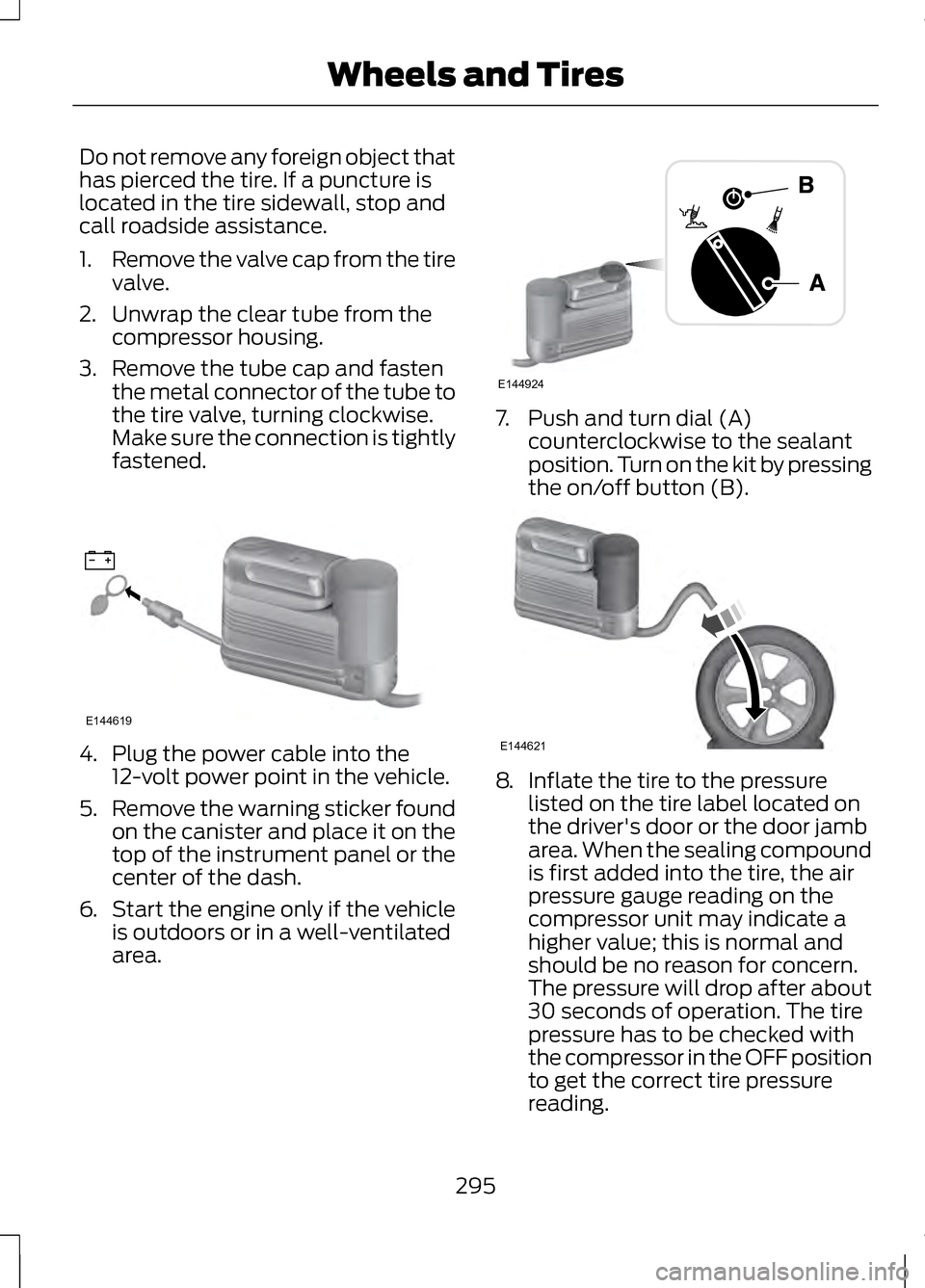
Do not remove any foreign object that
has pierced the tire. If a puncture is
located in the tire sidewall, stop and
call roadside assistance.
1.
Remove the valve cap from the tire
valve.
2. Unwrap the clear tube from the compressor housing.
3. Remove the tube cap and fasten the metal connector of the tube to
the tire valve, turning clockwise.
Make sure the connection is tightly
fastened. 4. Plug the power cable into the
12-volt power point in the vehicle.
5. Remove the warning sticker found
on the canister and place it on the
top of the instrument panel or the
center of the dash.
6. Start the engine only if the vehicle
is outdoors or in a well-ventilated
area. 7. Push and turn dial (A)
counterclockwise to the sealant
position. Turn on the kit by pressing
the on/off button (B). 8.
Inflate the tire to the pressure
listed on the tire label located on
the driver's door or the door jamb
area. When the sealing compound
is first added into the tire, the air
pressure gauge reading on the
compressor unit may indicate a
higher value; this is normal and
should be no reason for concern.
The pressure will drop after about
30 seconds of operation. The tire
pressure has to be checked with
the compressor in the OFF position
to get the correct tire pressure
reading.
295
Wheels and TiresE144619 E144924 E144621
Page 325 of 474
WARNINGS
Do not attempt to change a tire
on the side of the vehicle close
to moving traffic. Pull far enough off
the road to avoid the danger of being
hit when operating the jack or
changing the wheel. Always use the jack provided as
original equipment with your
vehicle. If using a jack other than the
one provided as original equipment
with your vehicle, make sure the jack
capacity is adequate for the vehicle
weight, including any vehicle cargo or
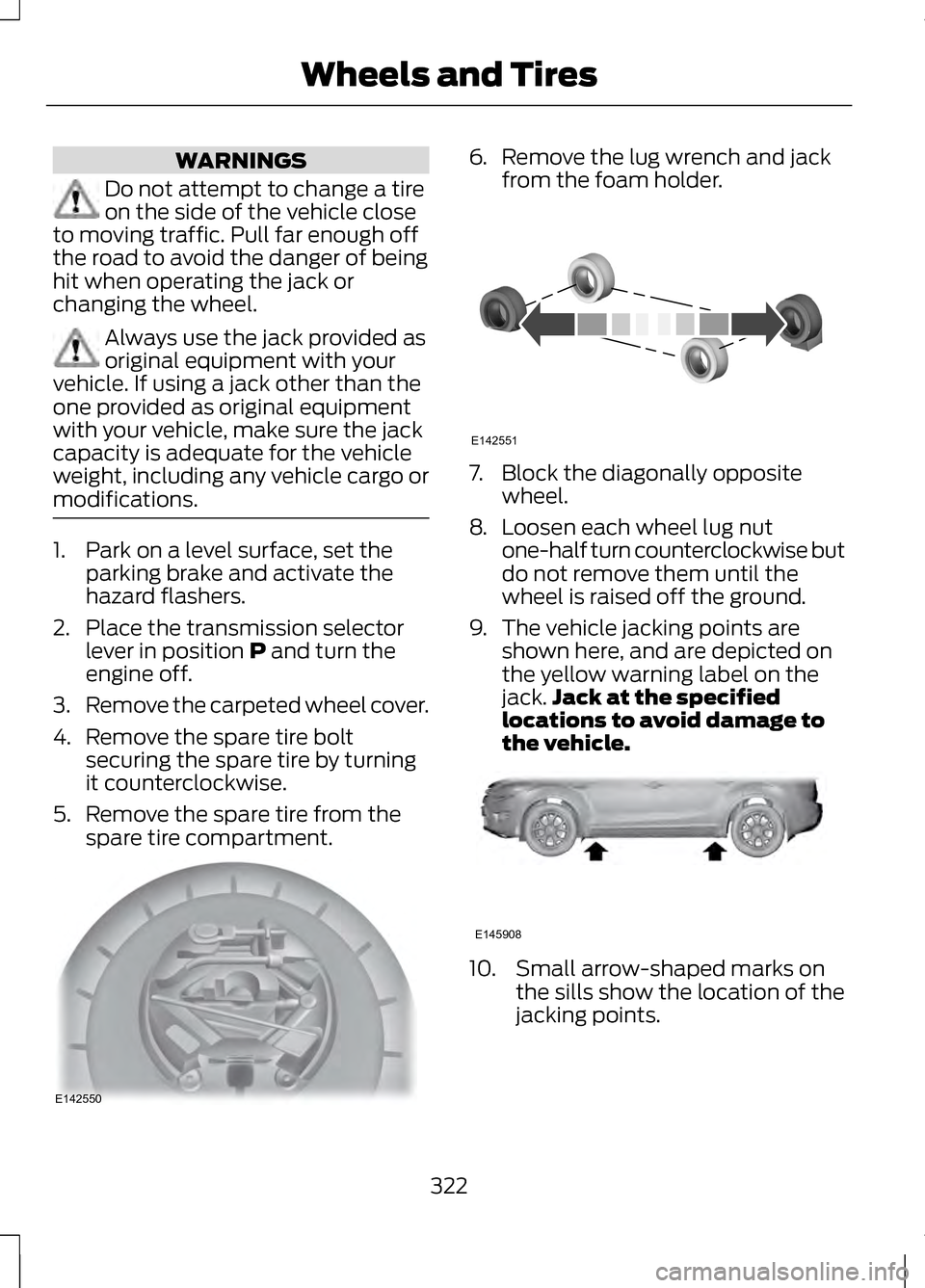
modifications. 1. Park on a level surface, set the
parking brake and activate the
hazard flashers.
2. Place the transmission selector lever in position P and turn the
engine off.
3. Remove the carpeted wheel cover.
4. Remove the spare tire bolt securing the spare tire by turning
it counterclockwise.
5. Remove the spare tire from the spare tire compartment. 6.
Remove the lug wrench and jack
from the foam holder. 7. Block the diagonally opposite
wheel.
8. Loosen each wheel lug nut
one-half turn counterclockwise but
do not remove them until the
wheel is raised off the ground.
9. The vehicle jacking points are shown here, and are depicted on
the yellow warning label on the
jack. Jack at the specified
locations to avoid damage to
the vehicle. 10. Small arrow-shaped marks on
the sills show the location of the
jacking points.
322
Wheels and TiresE142550 E142551 E145908
Page 328 of 474
ENGINE SPECIFICATIONS
3.7L V6 Engine
2.0L EcoBoost engine
Engine
227
122
Cubic inches
Minimum 87 octane
Minimum 87 octane
Required fuel
10.5:1
9.3:1
Compression ratio
0.049-0.053 in. (1.25-1.35mm)
0.027-0.031 in. (0.70-0.80
mm)
Spark plug gap
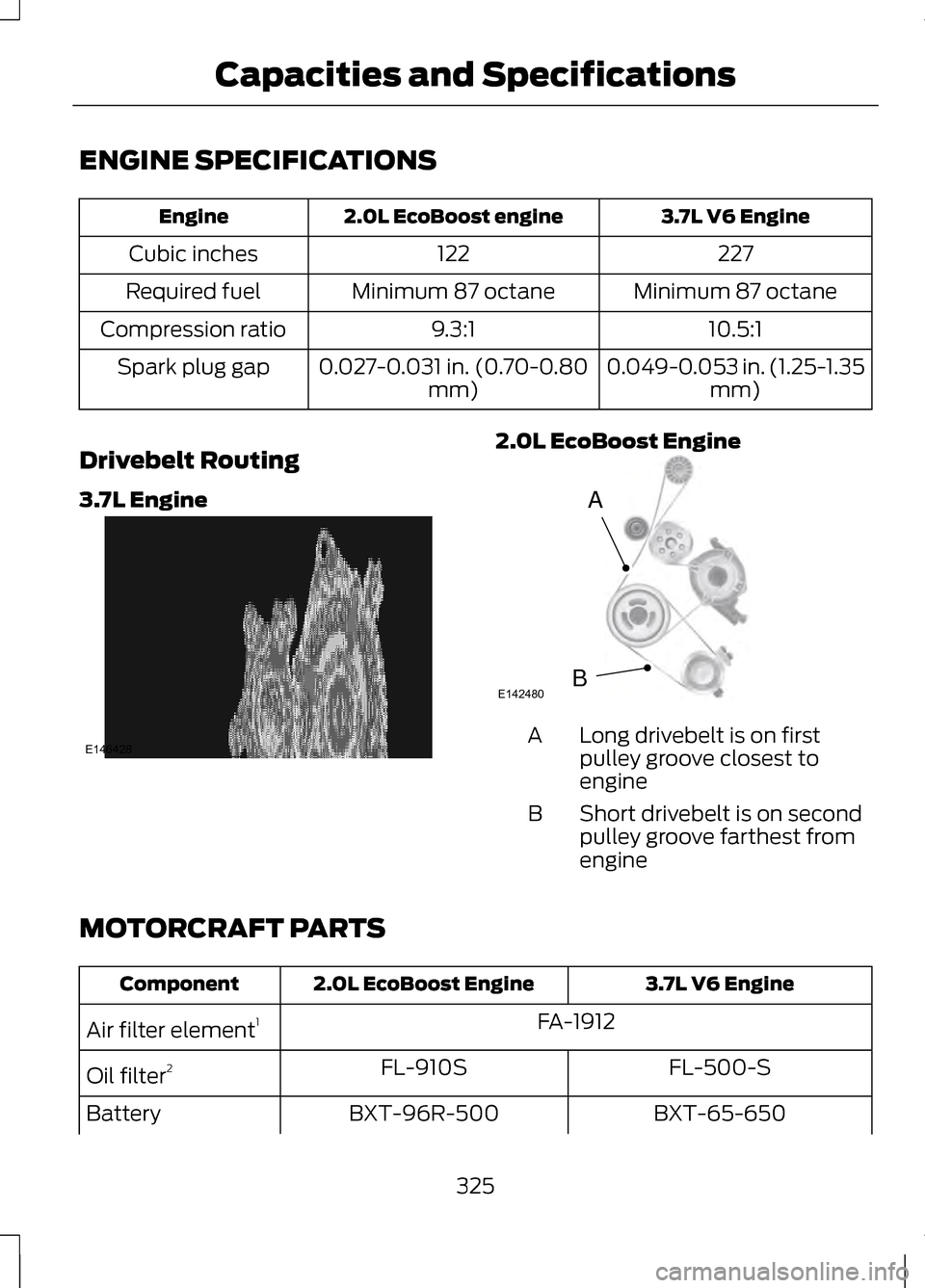
Drivebelt Routing
3.7L Engine 2.0L EcoBoost Engine
Long drivebelt is on first
pulley groove closest to
engine
A
Short drivebelt is on second
pulley groove farthest from
engine
B
MOTORCRAFT PARTS 3.7L V6 Engine
2.0L EcoBoost Engine
Component
FA-1912
Air filter element 1
FL-500-S
FL-910S
Oil filter 2
BXT-65-650
BXT-96R-500
Battery
325
Capacities and SpecificationsE146428 A
BE142480
Page 329 of 474
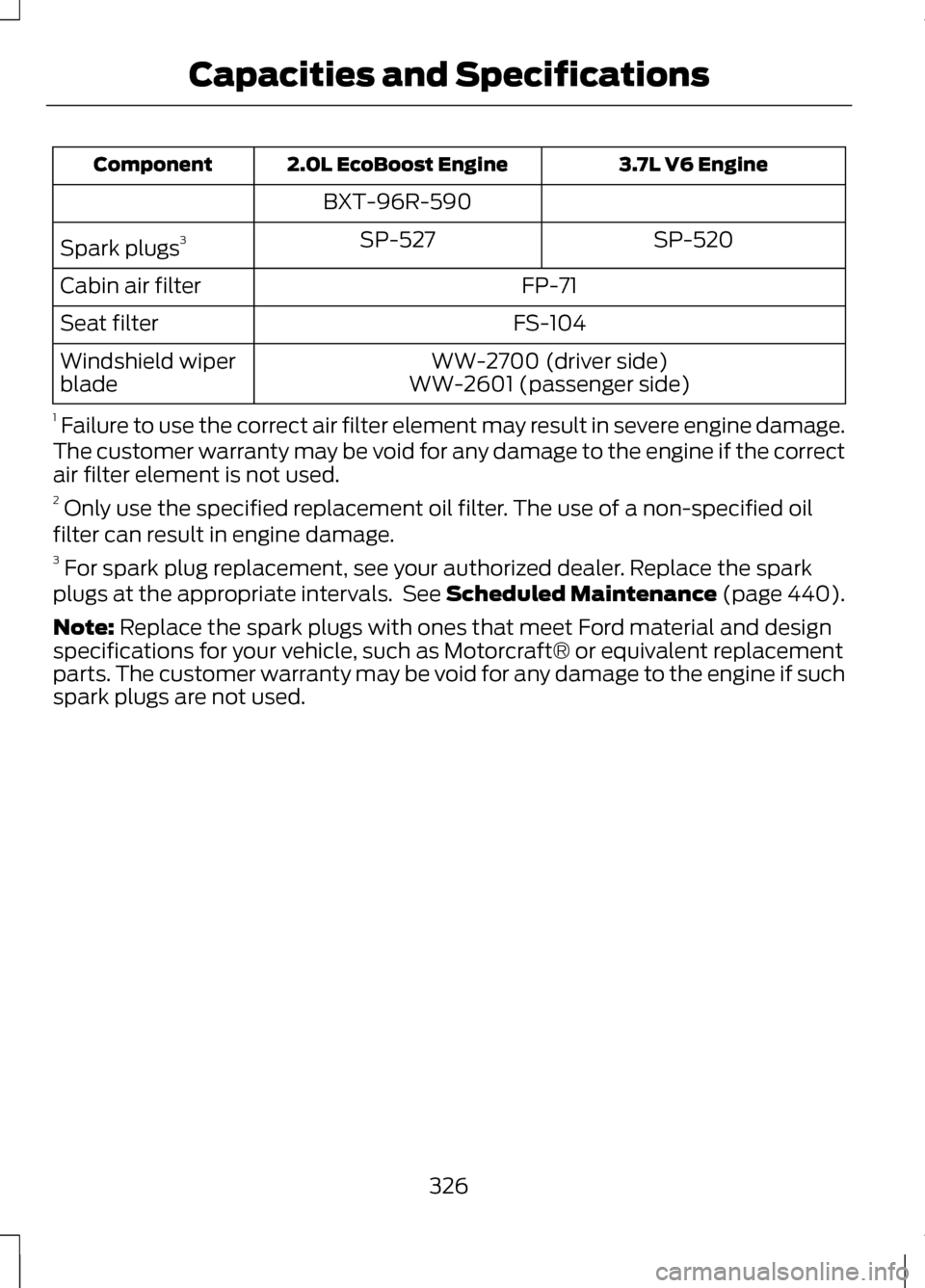
3.7L V6 Engine
2.0L EcoBoost Engine
Component
BXT-96R-590 SP-520
SP-527
Spark plugs 3
FP-71
Cabin air filter
FS-104
Seat filter
WW-2700 (driver side)
Windshield wiper
blade WW-2601 (passenger side)
1 Failure to use the correct air filter element may result in severe engine damage.
The customer warranty may be void for any damage to the engine if the correct
air filter element is not used.
2 Only use the specified replacement oil filter. The use of a non-specified oil
filter can result in engine damage.
3 For spark plug replacement, see your authorized dealer. Replace the spark
plugs at the appropriate intervals. See Scheduled Maintenance (page 440).
Note: Replace the spark plugs with ones that meet Ford material and design
specifications for your vehicle, such as Motorcraft® or equivalent replacement
parts. The customer warranty may be void for any damage to the engine if such
spark plugs are not used.
326
Capacities and Specifications
Page 330 of 474
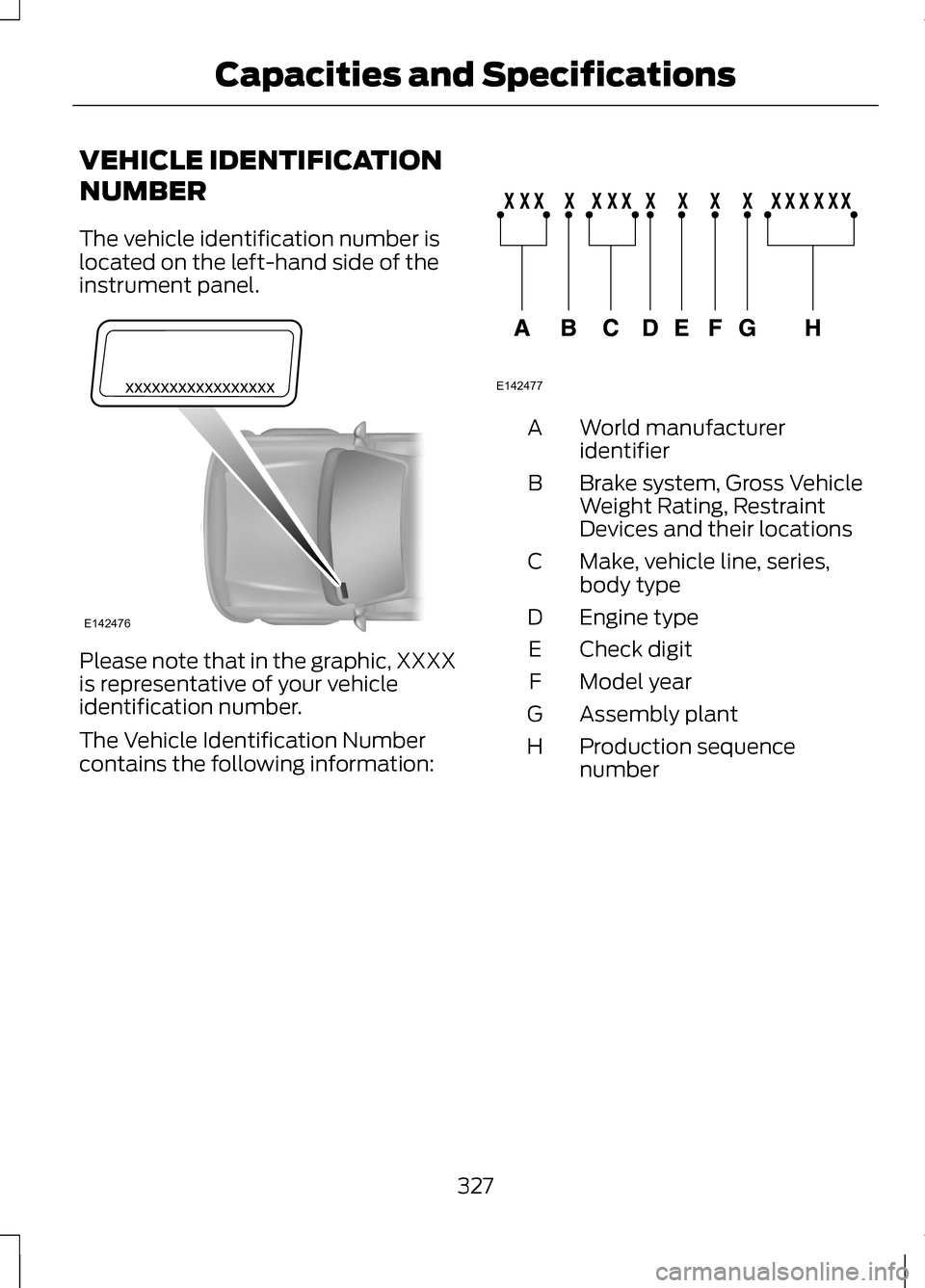
VEHICLE IDENTIFICATION
NUMBER
The vehicle identification number is
located on the left-hand side of the
instrument panel.
Please note that in the graphic, XXXX
is representative of your vehicle
identification number.
The Vehicle Identification Number
contains the following information: World manufacturer
identifier
A
Brake system, Gross Vehicle
Weight Rating, Restraint
Devices and their locations
B
Make, vehicle line, series,
body type
C
Engine type
D
Check digit
E
Model year
F
Assembly plant
G
Production sequence
number
H
327
Capacities and SpecificationsE142476 E142477
Page 332 of 474
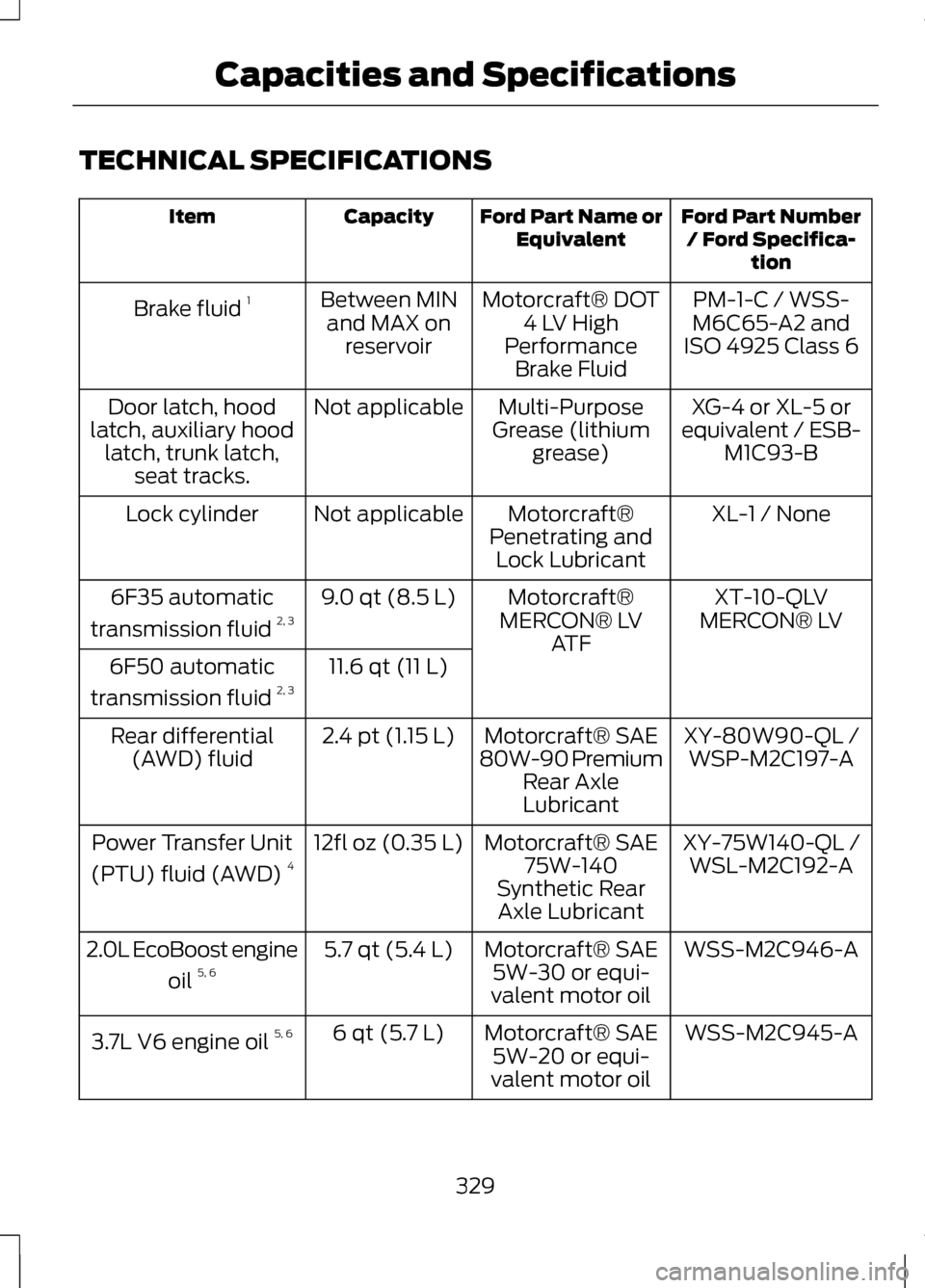
TECHNICAL SPECIFICATIONS
Ford Part Number
/ Ford Specifica- tion
Ford Part Name or
Equivalent
Capacity
Item
PM-1-C / WSS-
M6C65-A2 and
ISO 4925 Class 6
Motorcraft® DOT
4 LV High
Performance Brake Fluid
Between MIN
and MAX on reservoir
Brake fluid
1
XG-4 or XL-5 or
equivalent / ESB- M1C93-B
Multi-Purpose
Grease (lithium grease)
Not applicable
Door latch, hood
latch, auxiliary hood latch, trunk latch, seat tracks.
XL-1 / None
Motorcraft®
Penetrating and Lock Lubricant
Not applicable
Lock cylinder
XT-10-QLV
MERCON® LV
Motorcraft®
MERCON® LV ATF
9.0 qt (8.5 L)
6F35 automatic
transmission fluid 2, 3
11.6 qt (11 L)
6F50 automatic
transmission fluid 2, 3
XY-80W90-QL /WSP-M2C197-A
Motorcraft® SAE
80W-90 Premium Rear Axle
Lubricant
2.4 pt (1.15 L)
Rear differential
(AWD) fluid
XY-75W140-QL /WSL-M2C192-A
Motorcraft® SAE
75W-140
Synthetic Rear Axle Lubricant
12fl oz (0.35 L)
Power Transfer Unit
(PTU) fluid (AWD) 4
WSS-M2C946-A
Motorcraft® SAE
5W-30 or equi-
valent motor oil
5.7 qt (5.4 L)
2.0L EcoBoost engine
oil 5, 6
WSS-M2C945-A
Motorcraft® SAE
5W-20 or equi-
valent motor oil
6 qt (5.7 L)
3.7L V6 engine oil 5, 6
329
Capacities and Specifications