engine LINCOLN MKZ 2013 Workshop Manual
[x] Cancel search | Manufacturer: LINCOLN, Model Year: 2013, Model line: MKZ, Model: LINCOLN MKZ 2013Pages: 474, PDF Size: 3.79 MB
Page 175 of 474
Driving In Special Conditions
With All-Wheel Drive (AWD)
AWD vehicles are equipped for driving
on sand, snow, mud and rough roads
and have operating characteristics
that are somewhat different from
conventional vehicles, both on and off
the highway.
Under severe operating conditions,
the A/C may cycle on and off to
protect overheating of the engine.
Basic operating principles in
special conditions
•
Drive slower in strong crosswinds
which can affect the normal
steering characteristics of your
vehicle.
• Be extremely careful when driving
on pavement made slippery by
loose sand, water, gravel, snow or
ice. If Your Vehicle Goes Off the Edge of
the Pavement
•
If your vehicle goes off the edge of
the pavement, slow down, but
avoid severe brake application,
ease the vehicle back onto the
pavement only after reducing your
speed. Do not turn the steering
wheel too sharply while returning
to the road surface.
• It may be safer to stay on the
apron or shoulder of the road and
slow down gradually before
returning to the pavement. You
may lose control if you do not slow
down or if you turn the steering
wheel too sharply or abruptly.
• It often may be less risky to strike
small objects, such as highway
reflectors, with minor damage to
your vehicle rather than attempt a
sudden return to the pavement
which could cause the vehicle to
slide sideways out of control or
rollover. Remember, your safety
and the safety of others should be
your primary concern.
If Your Vehicle Gets Stuck WARNINGS
Always set the parking brake
fully and make sure the gearshift
is latched in P (Park). Turn the ignition
to the lock position and remove the
key whenever you leave your vehicle. If the parking brake is fully
released, but the brake warning
lamp remains illuminated, the brakes
may not be working properly. See your
authorized dealer.
172
All-Wheel Drive (If Equipped)
Page 176 of 474
WARNINGS
Do not spin the wheels at over
35 mph (56 km/h). The tires may
fail and injure a passenger or
bystander. Note:
Do not rock the vehicle if the
engine is not at normal operating
temperature or damage to the
transmission may occur.
Note: Do not rock the vehicle for more
than a few minutes or damage to the
transmission and tires may occur or the
engine may overheat.
If your vehicle gets stuck in mud or
snow it may be rocked out by shifting
between forward and reverse gears,
stopping between shifts, in a steady
pattern. Press lightly on the
accelerator in each gear.
If your vehicle is equipped with
AdvanceTrac® with Roll Stability
Control ™, it may be beneficial to
disengage the AdvanceTrac® with
Roll Stability Control ™ system while
attempting to rock the vehicle.
Emergency Maneuvers
• In an unavoidable emergency
situation where a sudden sharp
turn must be made, remember to
avoid "over-driving" your vehicle
(i.e., turn the steering wheel only
as rapidly and as far as required to
avoid the emergency). Excessive
steering will result in less vehicle
control, not more. Additionally,
smooth variations of the
accelerator and/or brake pedal
pressure should be utilized if changes in vehicle speed are called
for. Avoid abrupt steering,
acceleration or braking which
could result in an increased risk of
loss of vehicle control, vehicle
rollover and/or personal injury. Use
all available road surface to return
the vehicle to a safe direction of
travel.
• In the event of an emergency stop,
avoid skidding the tires and do not
attempt any sharp steering wheel
movements.
• If the vehicle goes from one type
of surface to another (i.e., from
concrete to gravel) there will be a
change in the way the vehicle
responds to a maneuver (steering,
acceleration or braking). Again,
avoid these abrupt inputs.
Sand
When driving over sand, try to keep all
four wheels on the most solid area of
the trail. Avoid reducing the tire
pressures but shift to a lower gear and
drive steadily through the terrain.
Apply the accelerator slowly and
avoid spinning the wheels.
Do not drive your AWD vehicle in deep
sand. This will cause the AWD system
to overheat. After the system has
cooled down, normal AWD function
will return.
Under severe operating conditions,
the A/C may cycle on and off to
protect overheating of the engine.
173
All-Wheel Drive (If Equipped)
Page 178 of 474
Driving on Hilly or Sloping Terrain
Note:
Avoid driving crosswise or
turning on steep slopes or hills. A
danger lies in losing traction, slipping
sideways and possibly rolling over.
Whenever driving on a hill, determine
beforehand the route you will use. Do
not drive over the crest of a hill without
seeing what conditions are on the other
side. Do not drive in reverse over a hill
without the aid of an observer.
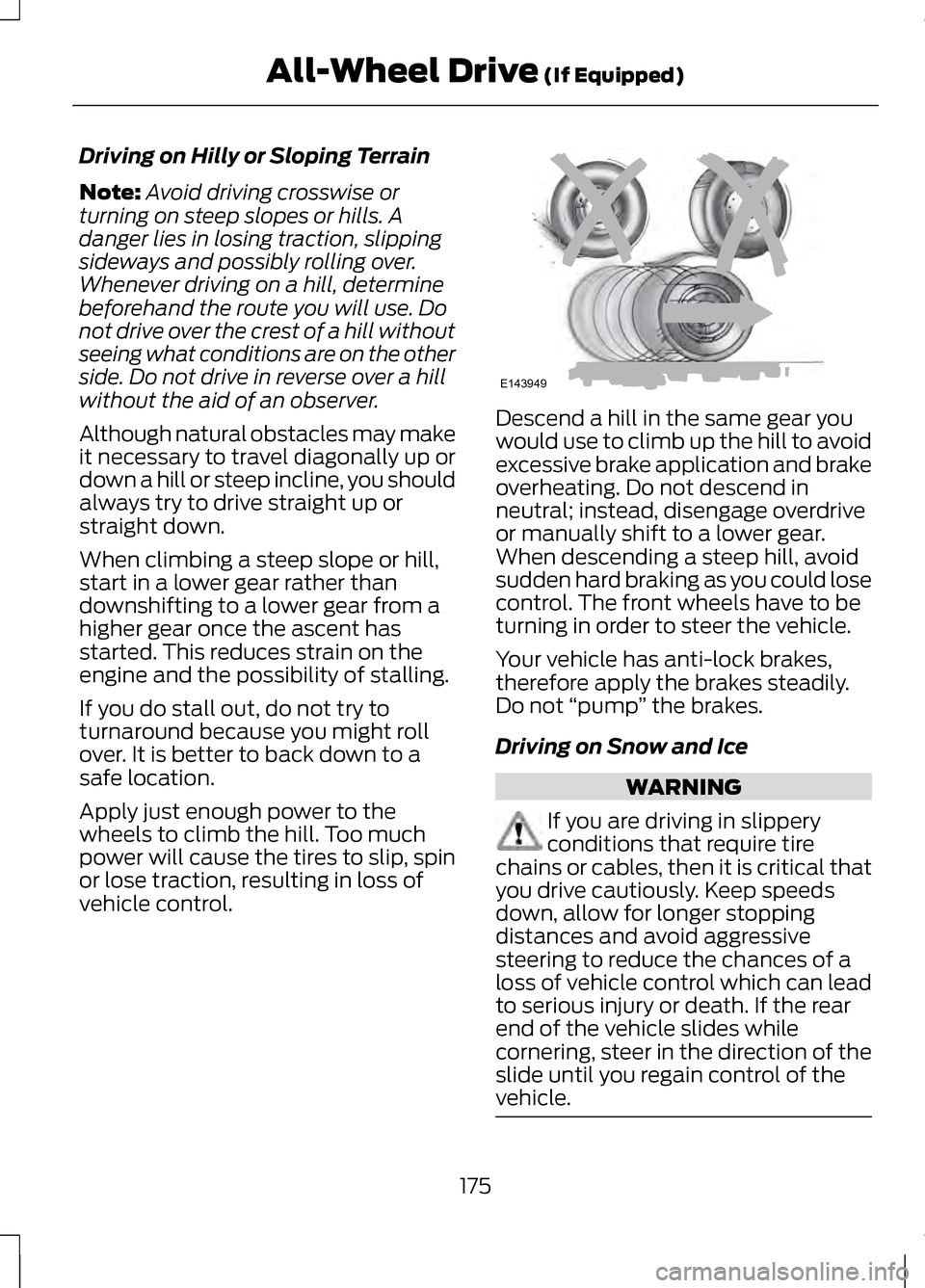
Although natural obstacles may make
it necessary to travel diagonally up or
down a hill or steep incline, you should
always try to drive straight up or
straight down.
When climbing a steep slope or hill,
start in a lower gear rather than
downshifting to a lower gear from a
higher gear once the ascent has
started. This reduces strain on the
engine and the possibility of stalling.
If you do stall out, do not try to
turnaround because you might roll
over. It is better to back down to a
safe location.
Apply just enough power to the
wheels to climb the hill. Too much
power will cause the tires to slip, spin
or lose traction, resulting in loss of
vehicle control. Descend a hill in the same gear you
would use to climb up the hill to avoid
excessive brake application and brake
overheating. Do not descend in
neutral; instead, disengage overdrive
or manually shift to a lower gear.
When descending a steep hill, avoid
sudden hard braking as you could lose
control. The front wheels have to be
turning in order to steer the vehicle.
Your vehicle has anti-lock brakes,
therefore apply the brakes steadily.
Do not
“pump” the brakes.
Driving on Snow and Ice WARNING
If you are driving in slippery
conditions that require tire
chains or cables, then it is critical that
you drive cautiously. Keep speeds
down, allow for longer stopping
distances and avoid aggressive
steering to reduce the chances of a
loss of vehicle control which can lead
to serious injury or death. If the rear
end of the vehicle slides while
cornering, steer in the direction of the
slide until you regain control of the
vehicle. 175
All-Wheel Drive (If Equipped)E143949
Page 180 of 474
GENERAL INFORMATION
Note:
Occasional brake noise is
normal. If a metal-to-metal,
continuous grinding or continuous
squeal sound is present, the brake
linings may be worn-out and should be
inspected by an authorized dealer. If
the vehicle has continuous vibration or
shudder in the steering wheel while
braking, the vehicle should be
inspected by an authorized dealer.
Note: Brake dust may accumulate on
the wheels, even under normal driving
conditions. Some dust is inevitable as
the brakes wear and does not
contribute to brake noise. See
Warning Lamps and Indicators (page
95). See
Warning Lamps and
Indicators (page 95).
Wet brakes result in reduced braking
efficiency. Gently press the brake
pedal a few times when driving from
a car wash or standing water to dry
the brakes. Brake Over Accelerator
In the event the accelerator pedal
becomes stuck or entrapped, apply
steady and firm pressure to the brake
pedal to slow the vehicle and reduce
engine power. If you experience this
condition, apply the brakes and bring
your vehicle to a safe stop. Turn the
engine off, shift to position
P and
apply the parking brake, and then
inspect the accelerator pedal for any
interferences. If none are found and
the condition persists, have your
vehicle towed to the nearest
authorized dealer.
Brake Assist
Brake assist detects when you brake
rapidly by measuring the rate at which
you press the brake pedal. It provides
maximum braking efficiency as long
as you press the pedal, and can
reduce stopping distances in critical
situations.
Anti-lock Brake System
This system helps you maintain
steering control during emergency
stops by keeping the brakes from
locking. This lamp momentarily
illuminates when the ignition
is turned on. If the light does
not illuminate during start up, remains
on or flashes, the anti-lock braking
system may be disabled and may
need to be serviced.
177
BrakesE144522
Page 183 of 474
You can manually release the electric
parking brake by turning the ignition
on, pressing the brake pedal and then
pressing the electric parking brake
switch.
When the electric parking brake is
released, the brake system warning
lamp will turn off.
Driving with a Trailer
Depending on the grade and the
weight of the trailer, your vehicle and
trailer may roll backwards slightly
when you start on a slope. To prevent
this from happening, do the following:
1. Pull the switch up and hold it in
this position.
2. Drive your vehicle, then release the
switch when you notice that the
engine has developed sufficient
driving force.
Automatic release - drive away
release
Note: The driver's door must be closed
and the driver's safety belt must be
fastened before this feature will
operate.
Note: If the electric parking brake
warning lamp stays illuminated, the
electric parking brake will not
automatically release. You must
release the electric parking brake using
the electric parking brake switch.
Note: The engine must be running and
the accelerator pedal must be pressed
before the drive away release feature
will operate. The brake system warning lamp will
go off to confirm that the electric
parking brake has been released.
Note:
The electric parking brake drive
away release makes starting on a hill
easier. This feature will release the
parking brake automatically when the
vehicle has sufficient drive force to
move up the hill. To assure drive away
release when starting uphill, press the
accelerator pedal quickly.
Battery With No Charge WARNING
You will not be able to apply or
release the electric parking brake
if the battery is low or has no charge. If the battery is low or has no charge,
use jumper cables and a booster
battery.
180
Brakes
Page 184 of 474
PRINCIPLE OF OPERATION
The traction control system helps
avoid drive wheel spin and loss of
traction.
If your vehicle begins to slide, the
system applies the brakes to
individual wheels and, when needed,
reduces engine power at the same
time. If the wheels spin when
accelerating on slippery or loose
surfaces, the system reduces engine
power in order to increase traction.
USING TRACTION
CONTROL
In certain situations (e.g. stuck in snow
or mud), turning the traction control
off may be beneficial as this allows
the wheels to spin with full engine
power. Turn off the traction control
system through the information
display. See General Information
(page 100). System Indicator Lights and
Messages WARNING
If a failure has been detected
within the AdvanceTrac system,
the stability control light will
illuminate steadily. Verify that the
AdvanceTrac system was not
manually disabled through the
information display. If the stability
control light still illuminates steadily,
have the system serviced by an
authorized dealer immediately.
Operating your vehicle with
AdvanceTrac disabled could lead to
an increased risk of loss of vehicle
control, vehicle rollover, personal
injury and death. The stability control light
temporarily illuminates on
engine start-up and flashes
when a driving condition activates the
stability system. The stability control off light
temporarily illuminates on
engine start-up and stays on
when the traction control system is
turned off.
When the traction control system is
turned off or on, a message appears
in the information display showing
system status.
181
Traction ControlE138639
Page 186 of 474
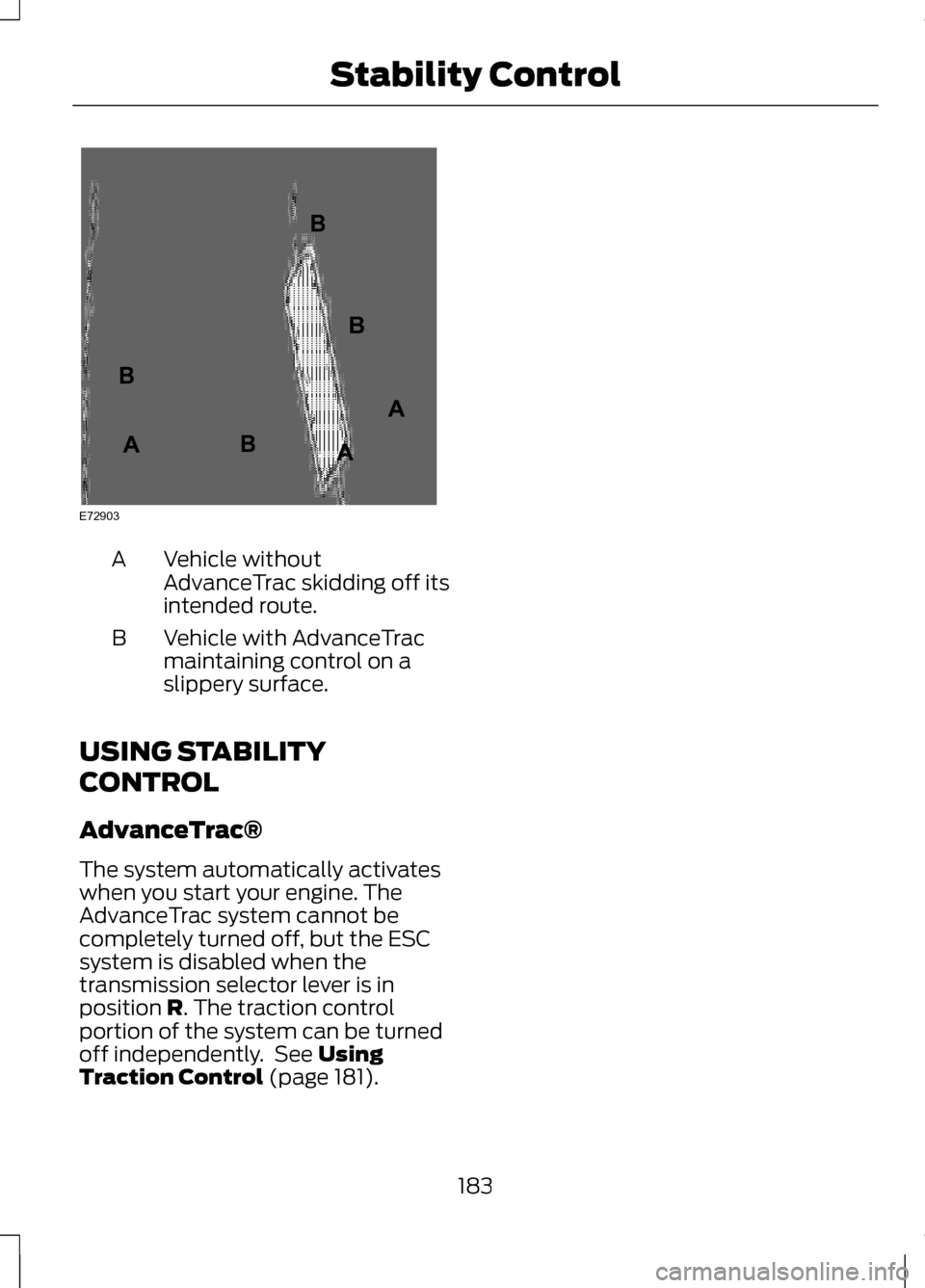
Vehicle without
AdvanceTrac skidding off its
intended route.
A
Vehicle with AdvanceTrac
maintaining control on a
slippery surface.
B
USING STABILITY
CONTROL
AdvanceTrac®
The system automatically activates
when you start your engine. The
AdvanceTrac system cannot be
completely turned off, but the ESC
system is disabled when the
transmission selector lever is in
position R. The traction control
portion of the system can be turned
off independently. See
Using
Traction Control (page 181).
183
Stability ControlE72903A
AA
B
BB
B
Page 203 of 474
Resuming the Set Speed
Note:
Resume should only be used if
you are aware of the set speed and
intend to return to it.
Press and release RES. The vehicle
will return to the previously set speed.
The set speed will display
continuously in the information
display while the system is active.
Low Speed Automatic
Cancellation
The system is not functional at vehicle
speeds below 12 mph (20 km/h). An
audible alarm will sound and the
automatic braking will be released if
the vehicle drops below this speed.
Hilly Condition Usage
Note: An audible alarm will sound and
the system will shut down if it is
applying brakes for an extended period
of time. This allows the brakes to cool
down. The system will function
normally again when the brakes have
cooled down.
You should select a lower gear
position when the system is active in
situations such as prolonged downhill
driving on steep grades (i.e., driving in
mountainous areas). Additional
engine braking is needed in these
situations to reduce the load on the
vehicle ’s regular brake system to
prevent them from overheating.
Switching the System Off
Note: The set speed memory is erased
when you switch off the system. Press and release
OFF or turn off the
ignition.
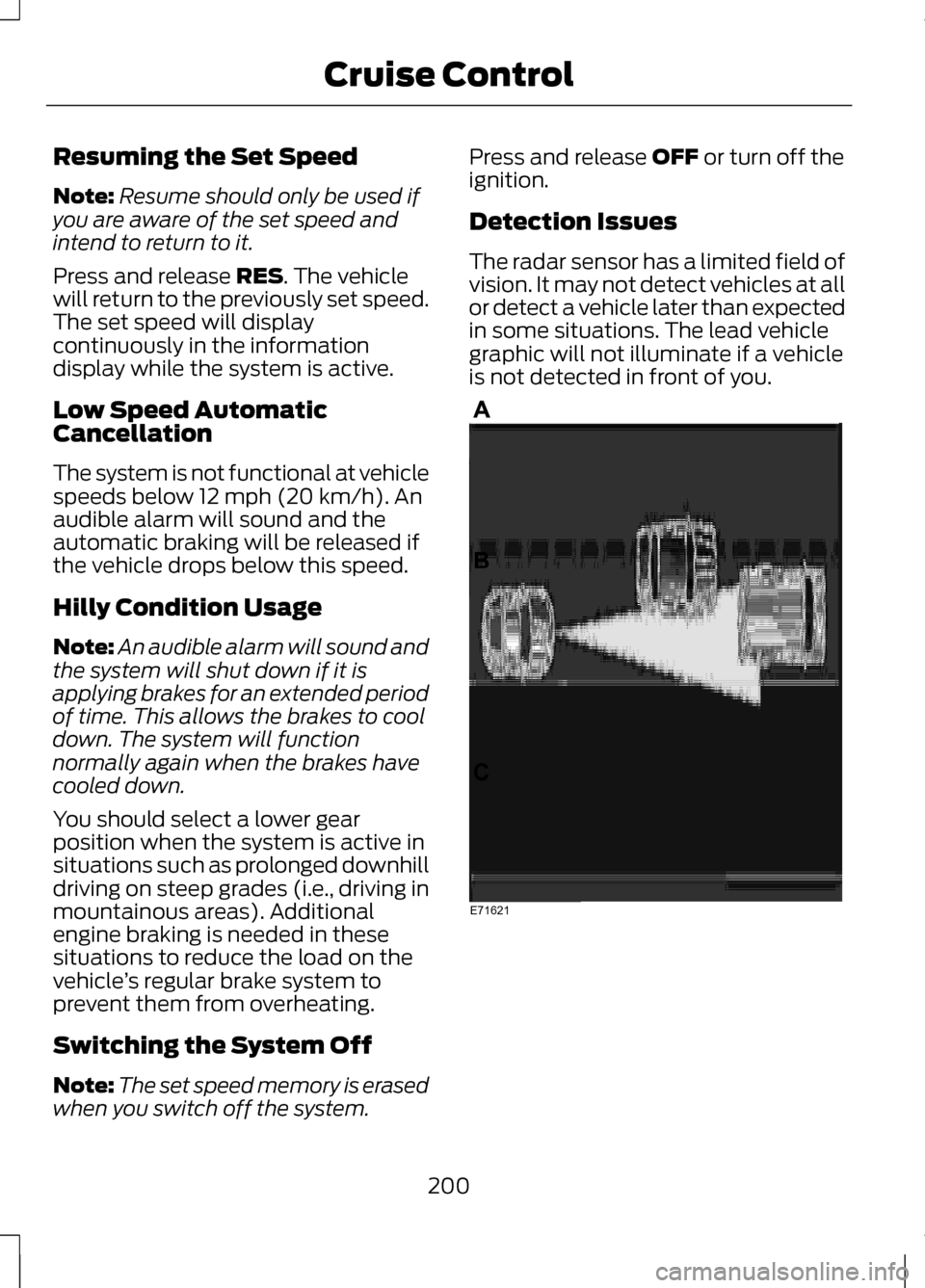
Detection Issues
The radar sensor has a limited field of
vision. It may not detect vehicles at all
or detect a vehicle later than expected
in some situations. The lead vehicle
graphic will not illuminate if a vehicle
is not detected in front of you. 200
Cruise ControlE71621
Page 205 of 474
Action
Cause
Clean the grille surface in front of the
radar or remove the object causing the obstruction.
The surface of the radar in the grille is
dirty or obstructed in some way.
Wait a short time. It may take several
minutes for the radar to detect that it is no longer obstructed
The surface of the radar in the grille is
clean but the message remains in the display.
Do not use the system in these condi-tion because it may not detect, warn, or respond to potential collisions.
Heavy rain or snow is interfering with
the radar signals.
Do not use the system in these condi-tion because it may not detect, warn, or respond to potential collisions.
Swirling water, or snow or ice on the
surface of the road may interfere with the radar signals.
Wait a short time or switch to normalcruise control.
You are in a desert or remote area with
no other vehicles and no roadside objects.
Due to the nature of radar technology,
it is possible to get a blockage warning
and not be blocked. This can happen,
for example, when driving in sparse
rural or desert environments. A false
blocked condition will either self clear
or clear after a key cycle.
Switching to Normal Cruise
Control WARNING
Normal cruise control will not
brake due to slower vehicles.
Always be aware of which mode is
selected and apply the brakes when
necessary. You can manually change from
adaptive cruise control to normal
cruise control through the information
display.
The cruise control indicator
light will replace the adaptive
cruise control indicator light
if normal cruise control is selected.
The gap setting will not be displayed,
the system will not automatically
respond to lead vehicles and
automatic braking will not be
activated. The system will default to
adaptive cruise control when the
engine is started.
202
Cruise ControlE71340
Page 211 of 474
These systems have a range of modes
which you can choose from in order
to customize your ideal driving
experience:
•
Comfort – Provides a more relaxed
driving experience. Steering effort
is decreased, suspension
movement is more fluid. Comfort
mode is ideal when enhanced
traveling comfort is desired.
• Normal – Delivers a balanced
combination of comfortable,
controlled ride and confident
handling and powerful yet quiet
powertrain sound. This mode
provides an engaging drive
experience and a direct connection
to the road without sacrificing any
of the composure demanded from
a luxury vehicle. Unwanted noises
from the powertrain are cancelled
while desired sounds are shaped
to deliver a smooth powerful note.
This setting is ideal for everyday
use and daily driving.
• Sport – Provides a sportier driving
experience. Suspension stiffens,
with an emphasis on handling and
control. The engine responds more
directly to your inputs and takes
on a more powerful tone. Sport
mode is intended to be used during
more spirited driving.
You can configure which of the
Adaptive Drive modes is active when
the vehicle is in D (Drive) or in S
(Sport). The configuration is retained
until modified from the main menu on
the information display. See General
Information (page 100). LANE KEEPING SYSTEM WARNING
The system is designed to aid the
driver. It is not intended to
replace the driver ’s attention and
judgment. The driver is still
responsible to drive with due care and
attention. Note:
The system needs to be
activated by the driver at each key
cycle.
Note: The system works above 40
mph (64 km/h).
Note: The system works as long as one
lane marking can be detected by the
camera.
Note: If the camera is blocked or if the
windshield is damaged, the system
may not function.
Note: When Aid mode is on and the
system detects no driver steering
activity for a short continuous period
of time, the system alerts the driver to
put their hands on the steering wheel.
The system may detect a light
grip/touch on the steering wheel as
hands off driving.
The system detects unintentional
drifting toward the outside of the lane
and alerts and/or aids the driver to
stay in the lane through the steering
system and instrument cluster display.
The system automatically detects and
tracks the road lane markings using a
camera that is mounted behind the
interior rear view mirror.
208
Driving Aids