Scheduled maintenance LINCOLN MKZ 2013 User Guide
[x] Cancel search | Manufacturer: LINCOLN, Model Year: 2013, Model line: MKZ, Model: LINCOLN MKZ 2013Pages: 474, PDF Size: 3.79 MB
Page 276 of 474
![LINCOLN MKZ 2013 User Guide Note:
Automatic transmission fluid
expands when warmed. To obtain an
accurate fluid check, drive the vehicle
until it is warmed up (approximately
20 miles [30 kilometers]). If your
vehicle has been op](/img/15/6980/w960_6980-275.png "LINCOLN MKZ 2013 User Guide Note:
Automatic transmission fluid
expands when warmed. To obtain an
accurate fluid check, drive the vehicle
until it is warmed up (approximately
20 miles [30 kilometers]). If your
vehicle has been op")
Note:
Automatic transmission fluid
expands when warmed. To obtain an
accurate fluid check, drive the vehicle
until it is warmed up (approximately
20 miles [30 kilometers]). If your
vehicle has been operated for an
extended period at high speeds, in city
traffic during hot weather or pulling a
trailer, the vehicle should be turned off
until normal operating temperatures
are reached to allow the fluid to cool
before checking. Depending on vehicle
use, cooling times could take up to 30
minutes or longer.
Refer to your scheduled maintenance
information for scheduled intervals
for fluid checks and changes. Your
transmission does not consume fluid.
However, the fluid level should be
checked if the transmission is not
working properly. For example, if the
transmission slips or shifts slowly or
if you notice some sign of fluid
leakage.
1. Drive the vehicle 20 miles (30 kilometers) or until it reaches
normal operating temperature
2. Park the vehicle on a level surface and engage the parking brake.
3. With the parking brake engaged and your foot on the brake pedal,
start the engine and move the
gearshift lever through all of the
gear ranges. Allow a minimum of
10 seconds for each gear to
engage.
4. Put the gearshift lever in P (Park)
and leave the engine running. Note:
You will need to move the air
filter assembly to access the
transmission dipstick.
5. Remove the dipstick, wiping it clean with a clean, dry lint free rag.
If necessary, refer to Under hood
overview in this chapter for the
location of the dipstick.
6. Install the dipstick making sure it
is fully seated in the filler tube by
turning it to the locked position.
7. Remove the dipstick and inspect the fluid level. The fluid should be
in the designated areas for normal
operating temperature.
Moving the Air Filter Assembly
(Accessing the Dipstick) WARNING
Do not run engine with the air
filter disconnected.
273
Maintenance
Page 283 of 474
Poor wiper quality can be improved
by cleaning the wiper blades and the
windshield.
CHANGING THE ENGINE AIR
FILTER - 2.0L
ECOBOOST™/3.7L
WARNING
To reduce the risk of vehicle
damage and/or personal burn
injuries do not start your engine with
the air cleaner removed and do not
remove it while the engine is running. When changing the air filter element,
use only the air filter element listed.
See Capacities and Specifications
(page 325).
For EcoBoost equipped vehicles:
When servicing the air cleaner, it is
important that no foreign material
enter the air induction system. The
engine and turbocharger are
susceptible to damage from even
small particles.
Change the air filter element at the
proper interval. See
Scheduled
Maintenance (page 440).
Note: Failure to use the correct air filter
element may result in severe engine
damage. The customer warranty may
be void for any damage to the engine
if the correct air filter element is not
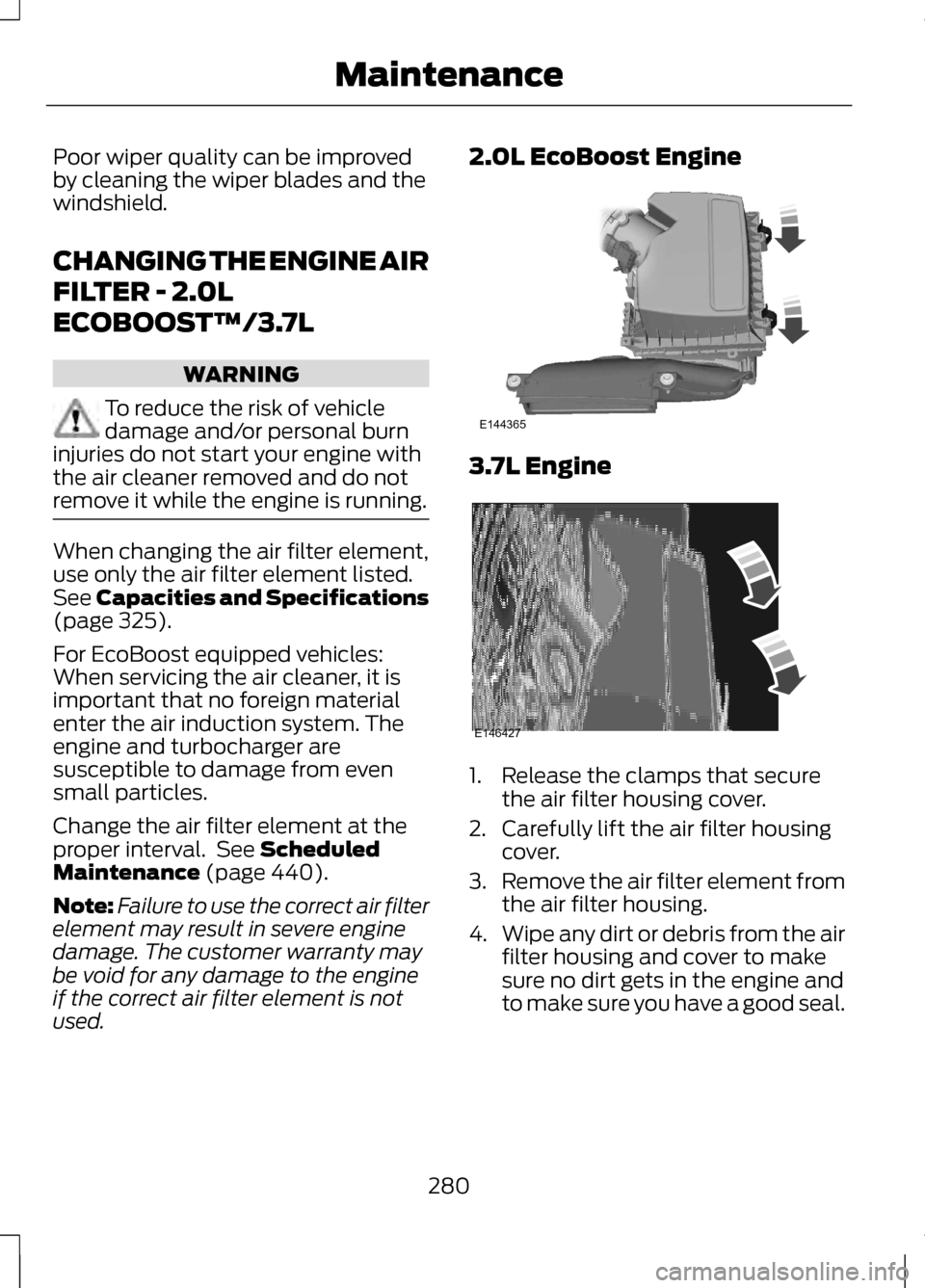
used. 2.0L EcoBoost Engine
3.7L Engine
1. Release the clamps that secure
the air filter housing cover.
2. Carefully lift the air filter housing cover.
3. Remove the air filter element from
the air filter housing.
4. Wipe any dirt or debris from the air
filter housing and cover to make
sure no dirt gets in the engine and
to make sure you have a good seal.
280
MaintenanceE144365 E146427
Page 321 of 474
Tire Rotation
Note:
If your tires show uneven wear
ask an authorized dealer to check for
and correct any wheel misalignment,
tire imbalance or mechanical problem
involved before tire rotation.
Note: Your vehicle may be equipped
with a dissimilar spare wheel and tire
assembly. A dissimilar spare wheel and
tire assembly is defined as a spare
wheel and tire assembly that is
different in brand, size or appearance
from the road tires and wheels. If you
have a dissimilar spare wheel and tire
assembly it is intended for temporary
use only and should not be used in a
tire rotation.
Note: After having your tires rotated,
inflation pressure must be checked and
adjusted to the vehicle requirements.
Rotating your tires at the
recommended interval (as indicated
in the Scheduled Maintenance
chapter) will help your tires wear more
evenly, providing better tire
performance and longer tire life.
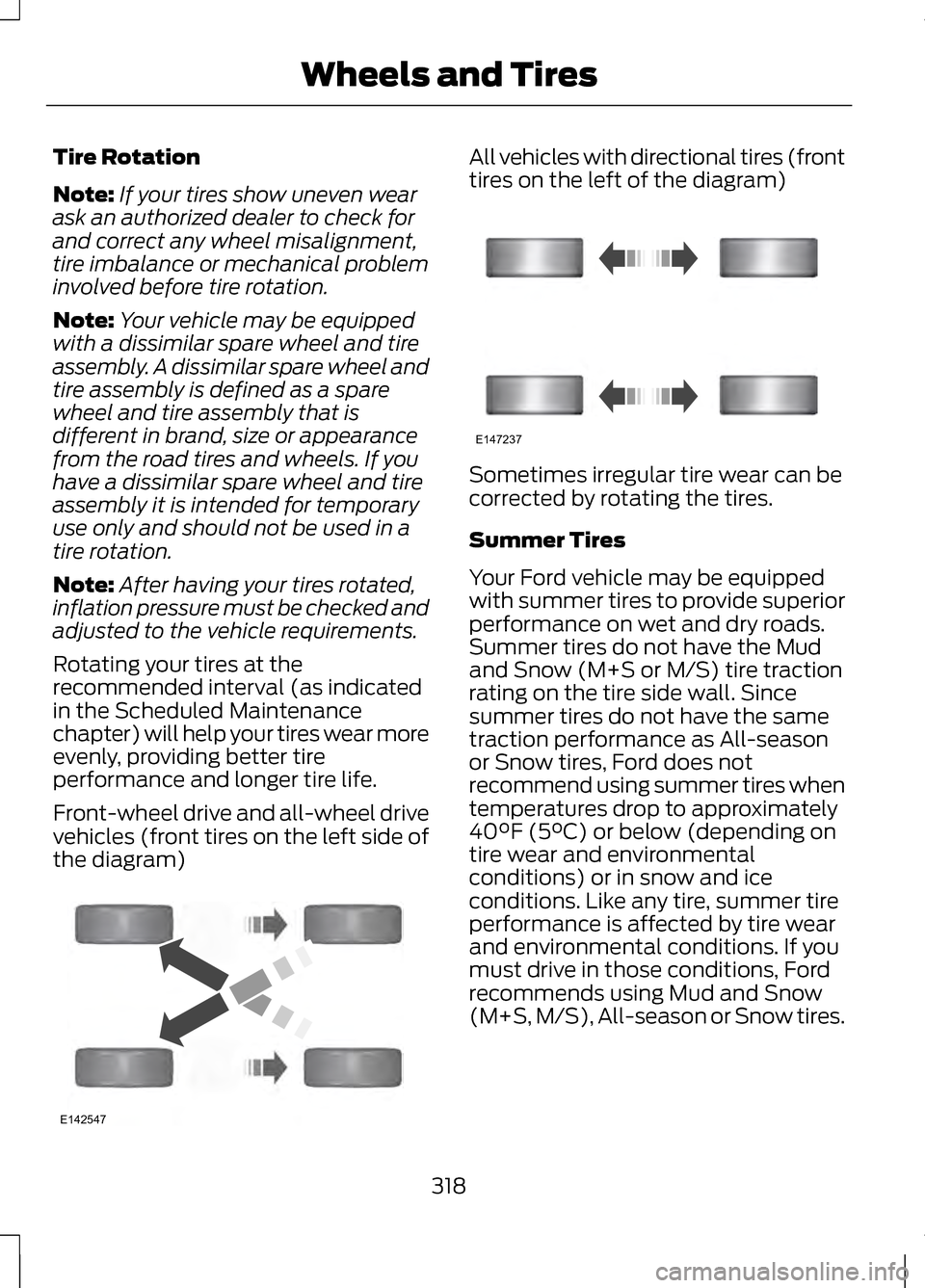
Front-wheel drive and all-wheel drive
vehicles (front tires on the left side of
the diagram) All vehicles with directional tires (front
tires on the left of the diagram)
Sometimes irregular tire wear can be
corrected by rotating the tires.
Summer Tires
Your Ford vehicle may be equipped
with summer tires to provide superior
performance on wet and dry roads.
Summer tires do not have the Mud
and Snow (M+S or M/S) tire traction
rating on the tire side wall. Since
summer tires do not have the same
traction performance as All-season
or Snow tires, Ford does not
recommend using summer tires when
temperatures drop to approximately
40°F (5°C) or below (depending on
tire wear and environmental
conditions) or in snow and ice
conditions. Like any tire, summer tire
performance is affected by tire wear
and environmental conditions. If you
must drive in those conditions, Ford
recommends using Mud and Snow
(M+S, M/S), All-season or Snow tires.
318
Wheels and TiresE142547 E147237
Page 329 of 474
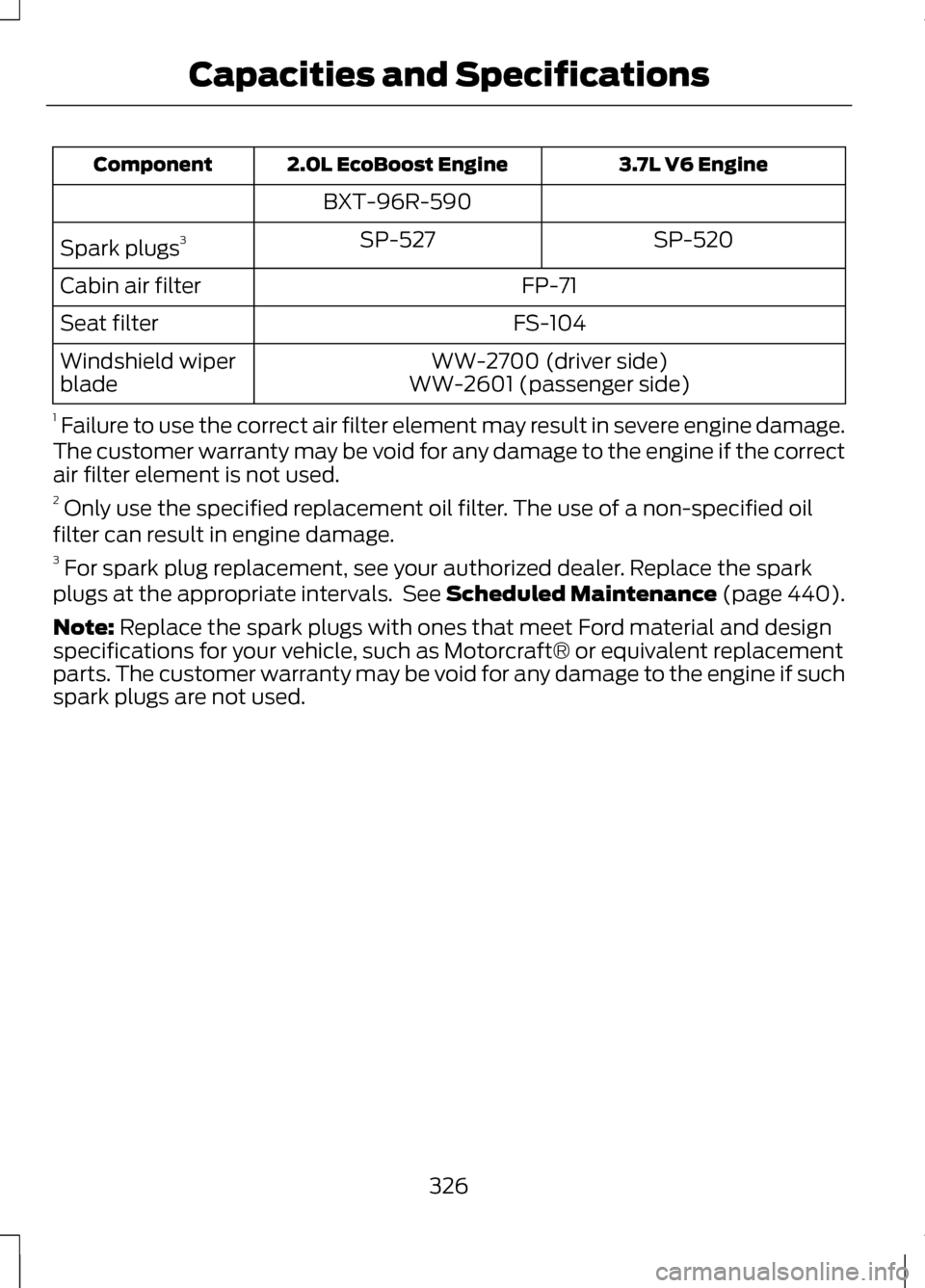
3.7L V6 Engine
2.0L EcoBoost Engine
Component
BXT-96R-590 SP-520
SP-527
Spark plugs 3
FP-71
Cabin air filter
FS-104
Seat filter
WW-2700 (driver side)
Windshield wiper
blade WW-2601 (passenger side)
1 Failure to use the correct air filter element may result in severe engine damage.
The customer warranty may be void for any damage to the engine if the correct
air filter element is not used.
2 Only use the specified replacement oil filter. The use of a non-specified oil
filter can result in engine damage.
3 For spark plug replacement, see your authorized dealer. Replace the spark
plugs at the appropriate intervals. See Scheduled Maintenance (page 440).
Note: Replace the spark plugs with ones that meet Ford material and design
specifications for your vehicle, such as Motorcraft® or equivalent replacement
parts. The customer warranty may be void for any damage to the engine if such
spark plugs are not used.
326
Capacities and Specifications
Page 334 of 474
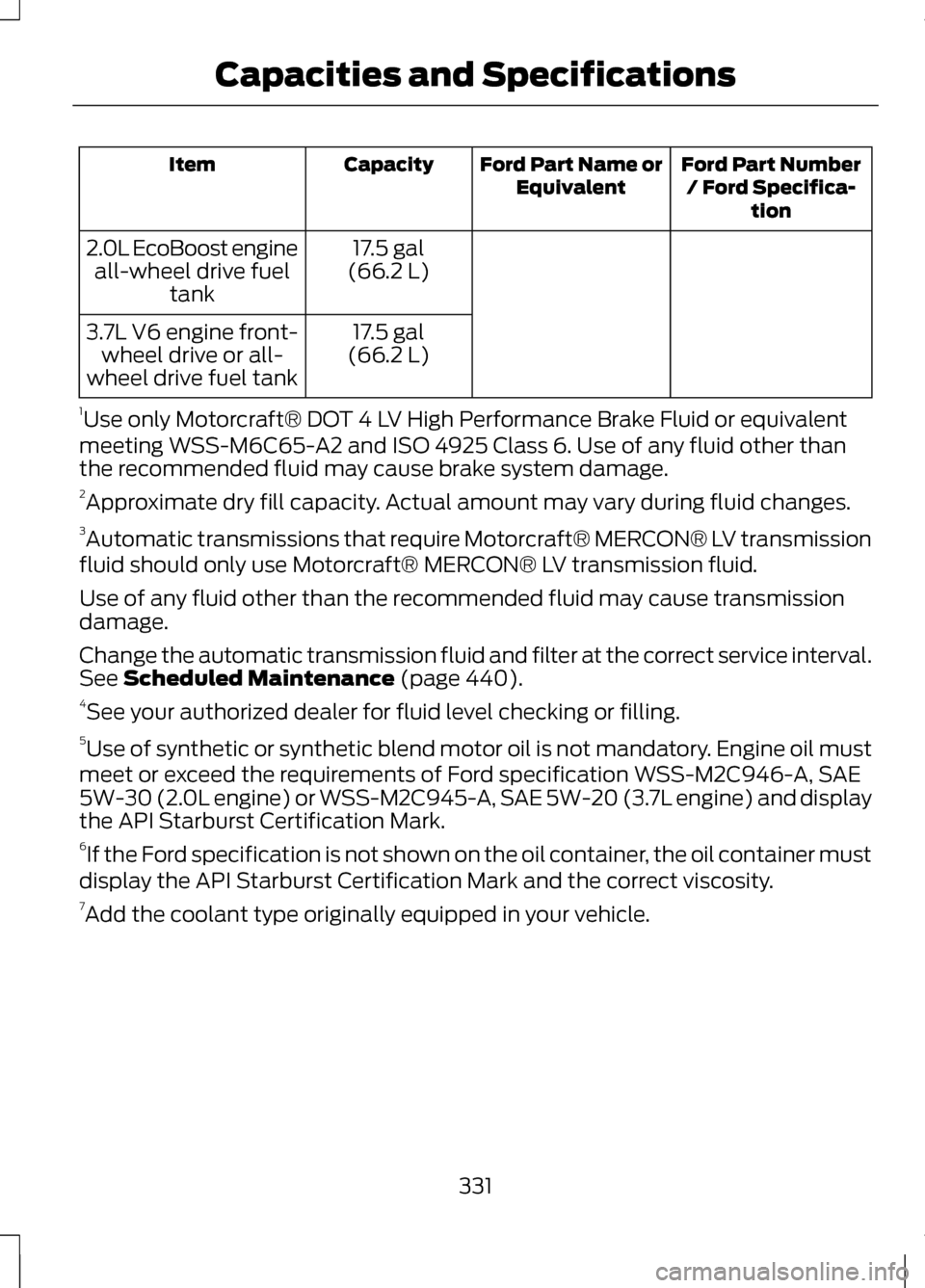
Ford Part Number
/ Ford Specifica- tion
Ford Part Name or
Equivalent
Capacity
Item
17.5 gal
(66.2 L)
2.0L EcoBoost engine
all-wheel drive fuel tank
17.5 gal
(66.2 L)
3.7L V6 engine front-
wheel drive or all-
wheel drive fuel tank
1 Use only Motorcraft® DOT 4 LV High Performance Brake Fluid or equivalent
meeting WSS-M6C65-A2 and ISO 4925 Class 6. Use of any fluid other than
the recommended fluid may cause brake system damage.
2 Approximate dry fill capacity. Actual amount may vary during fluid changes.
3 Automatic transmissions that require Motorcraft® MERCON® LV transmission
fluid should only use Motorcraft® MERCON® LV transmission fluid.
Use of any fluid other than the recommended fluid may cause transmission
damage.
Change the automatic transmission fluid and filter at the correct service interval.
See Scheduled Maintenance (page 440).
4 See your authorized dealer for fluid level checking or filling.
5 Use of synthetic or synthetic blend motor oil is not mandatory. Engine oil must
meet or exceed the requirements of Ford specification WSS-M2C946-A, SAE
5W-30 (2.0L engine) or WSS-M2C945-A, SAE 5W-20 (3.7L engine) and display
the API Starburst Certification Mark.
6 If the Ford specification is not shown on the oil container, the oil container must
display the API Starburst Certification Mark and the correct viscosity.
7 Add the coolant type originally equipped in your vehicle.
331
Capacities and Specifications
Page 405 of 474
Vehicle Health Report (If Equipped)
WARNING
Always follow scheduled
maintenance instructions,
regularly inspect your vehicle, and
seek repair for any damage or problem
you suspect. Vehicle Health Report
supplements, but cannot replace,
normal maintenance and vehicle
inspection. Vehicle Health Report only
monitors certain systems that are
electronically monitored by the
vehicle and will not monitor or report
the status of any other system, (i.e.,
brake lining wear). Failure to perform
scheduled maintenance and regularly
inspect your vehicle may result in
vehicle damage and serious injury. Note:
This feature is only available in
the United States.
Note: Your Vehicle Health Report
feature requires activation prior to use.
Visit www.SYNCMyRide.com to
register. There is no fee or subscription
associated with Vehicle Health Report,
but you must register to use this feature
Note: This feature may not function
properly if you have enabled caller ID
blocking on your cellular phone. Before
running a report, review the Vehicle
Health Report Privacy Notice.
Note: In order to allow a break-in
period for your vehicle, you may not be
able to create a Vehicle Health Report
until your vehicle odometer has
reached 200 miles.
Note: Cellular phone and SMS charges
may apply when making a report. Register for Vehicle Health Report and
set your report preferences at
www.SYNCMyRide.com. After
registering, you can request a Vehicle
Health Report (inside your vehicle).
Return to your account at
www.SYNCMyRide.com to view your
report. You can also choose for SYNC
to automatically remind you to run
reports at specific mileage intervals.
Cellular phone airtime usage may
apply when reporting.
The system allows you to check your
vehicle's overall health in the form of
diagnostic report card. The Vehicle
Health Report contains valuable
information such as:
•
Vehicle diagnostic information
• Scheduled maintenance
• Open recalls and Field Service
Actions
• Unserviced items from vehicle
inspections by your authorized
dealer.
Making a Report
To run a report by touchscreen, touch
the Information button, Apps, then
Vehicle Health Report. To run a report by voice
command, press the voice
button on the steering wheel
and, when prompted, say "Vehicle
health report".
402
MyLincoln Touch
™E142599
Page 443 of 474
General Maintenance
Information
Why Maintain Your Vehicle?
Carefully following the maintenance
schedule helps protect against major
repair expenses resulting from neglect
or inadequate maintenance and may
help to increase the value of your
vehicle when you sell or trade it. Keep
all receipts for completed
maintenance with your vehicle.
We have established regular
maintenance intervals for your vehicle
based upon rigorous testing. It is
important that you have your vehicle
serviced at the proper times. These
intervals serve two purposes; one is
to maintain the reliability of your
vehicle and the second is to keep your
cost of owning your vehicle down.
It is your responsibility to have all
scheduled maintenance performed
and to make sure that the materials
used meet the specifications
identified in this owner's manual. See
Capacities and Specifications
(page 325).
Failure to perform scheduled
maintenance invalidates warranty
coverage on parts affected by the lack
of maintenance. Why Maintain Your Vehicle at Your
Dealership?
Factory-Trained Technicians
Service technicians participate in
extensive factory-sponsored
certification training to help them
become experts on the operation of
your vehicle. Ask your dealership
about the training and certification
their technicians have received.
Genuine Ford and Motorcraft®
Replacement Parts
Dealerships stock Ford, Motorcraft
and Ford-authorized branded
re-manufactured replacement parts.
These parts meet or exceed our
specifications. Parts installed at your
dealership carry a nationwide 12
month or 12000 mile (20000
kilometer) parts and labor limited
warranty.
If you do not use Ford authorized parts
they may not meet our specifications
and depending on the part, it could
affect emissions compliance.
Convenience
Many dealerships have extended
evening and Saturday hours to make
your service visit more convenient and
they offer one stop shopping. They
can perform any services that are
required on your vehicle, from general
maintenance to collision repairs.
Note:
Not all dealers have extended
hours or body shops. Please contact
your dealer for details.
440
Scheduled Maintenance
Page 444 of 474
Protecting Your Investment
Maintenance is an investment that
pays dividends in the form of
improved reliability, durability and
resale value. To maintain the proper
performance of your vehicle and its
emission control systems, make sure
you have scheduled maintenance
performed at the designated intervals.
Your vehicle is equipped with the
Intelligent Oil-Life Monitor® system,
which displays a message in the
information display at the proper oil
change interval. This interval may be
up to one year or 10000 miles (16000
kilometers).
When ENGINE OIL CHANGE DUE or
OIL CHANGE REQUIRED appears in
the information display, it is time for
an oil change. Make sure you perform
the oil change within two weeks or
500 miles (800 kilometers) of the
ENGINE OIL CHANGE DUE or OIL
CHANGE REQUIRED message
appearing. Make sure you reset the
Intelligent Oil-Life Monitor® after
each oil change. See Engine Oil
Check (page 267).
If your information display resets
prematurely or becomes inoperative,
you should perform the oil change
interval at six months or 5000 miles
(8000 kilometers) from your last oil
change. Never exceed one year or
10000 miles (16000 kilometers)
between oil change intervals. Your vehicle is very sophisticated and
built with multiple, complex,
performance systems. Every
manufacturer develops these systems
using different specifications and
performance features. That is why it
is important to rely upon your
dealership to properly diagnose and
repair your vehicle.
Ford Motor Company has
recommended maintenance intervals
for various parts and component
systems based upon engineering
testing. Ford Motor Company relies
upon this testing to determine the
most appropriate mileage for
replacement of oils and fluids to
protect your vehicle at the lowest
overall cost to you and recommends
against maintenance schedules that
deviate from the scheduled
maintenance information.
We strongly recommend the use of
only genuine Ford, Motorcraft® or
Ford-authorized re-manufactured
replacement parts engineered for your
vehicle.
Additives and Chemicals
This owner's manual and the Ford
Workshop Manual list the
recommended additives and
chemicals for your vehicle. We do not
recommend using chemicals or
additives not approved by us as part
of your vehicle
’s normal maintenance.
Please consult your warranty
information.
441
Scheduled Maintenance
Page 445 of 474
Oils, Fluids and Flushing
In many cases, fluid discoloration is a
normal operating characteristic and,
by itself, does not necessarily indicate
a concern or that the fluid needs to be
changed. However, a qualified expert,
such as the factory-trained
technicians at your dealership, should
inspect discolored fluids that also
show signs of overheating or foreign
material contamination immediately.
Make sure to change your vehicle
’s
oils and fluids at the specified
intervals or in conjunction with a
repair. Flushing is a viable way to
change fluid for many vehicle
sub-systems during scheduled
maintenance. It is critical that systems
are flushed only with new fluid that is
the same as that required to fill and
operate the system or using a
Ford-approved flushing chemical.
Owner Checks and Services
Make sure you perform the following
basic maintenance checks and
inspections every month or at six
month intervals. Check every month
Engine oil level.
Function of all interior and exterior lights.
Tires (including spare) for wear and proper pressure. Windshield washer fluid level. Check every six months
Battery connections. Clean if necessary.
Body and door drain holes for obstructions. Clean if necessary. Cooling system fluid level and coolant strength.
Door weatherstrips for wear. Lubricate if necessary.
Hinges, latches and outside locks for proper operation. Lubricate if necessary. Parking brake for proper operation.
442
Scheduled Maintenance
Page 446 of 474
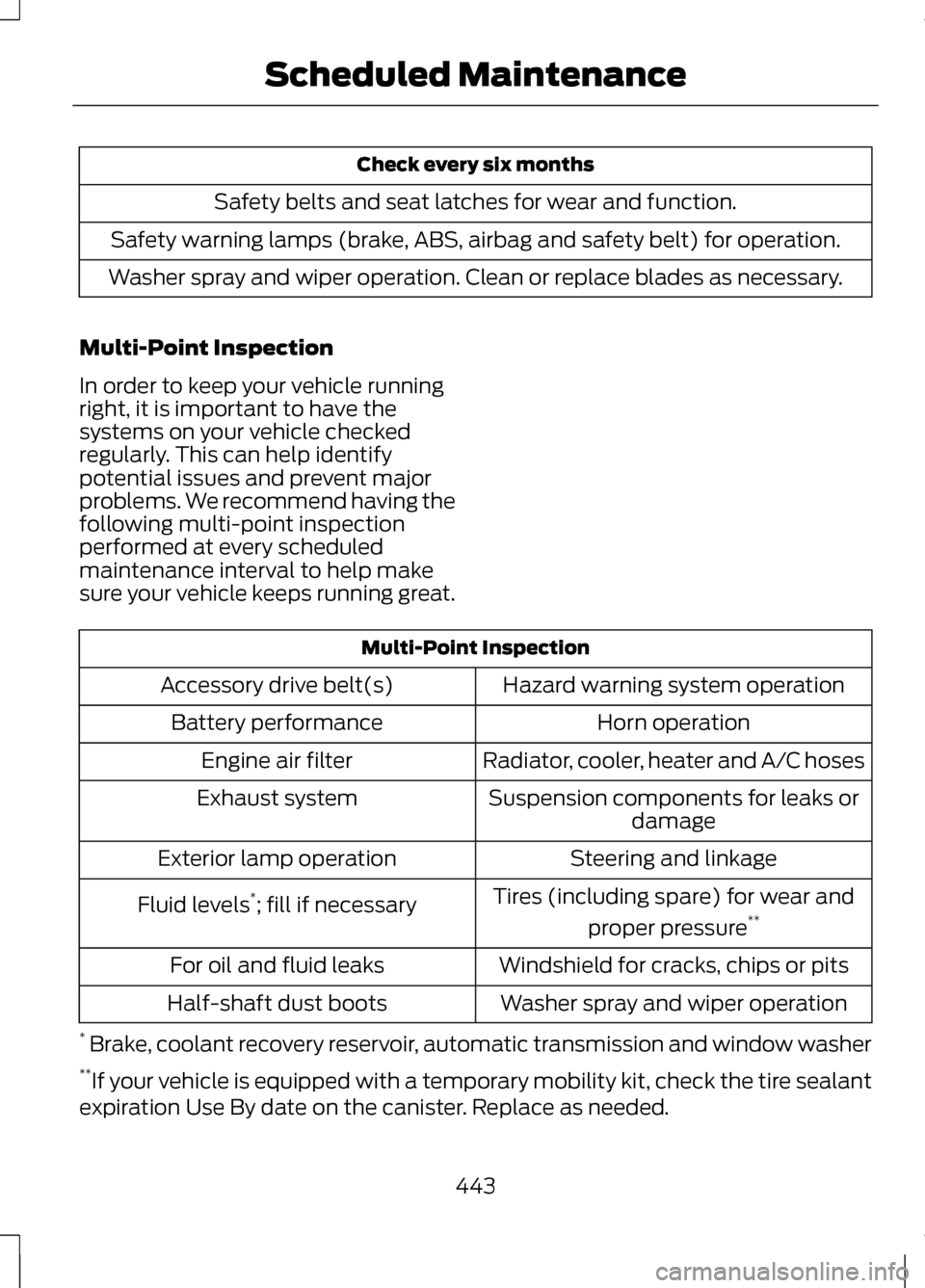
Check every six months
Safety belts and seat latches for wear and function.
Safety warning lamps (brake, ABS, airbag and safety belt) for operation.
Washer spray and wiper operation. Clean or replace blades as necessary.
Multi-Point Inspection
In order to keep your vehicle running
right, it is important to have the
systems on your vehicle checked
regularly. This can help identify
potential issues and prevent major
problems. We recommend having the
following multi-point inspection
performed at every scheduled
maintenance interval to help make
sure your vehicle keeps running great. Multi-Point Inspection
Hazard warning system operation
Accessory drive belt(s)
Horn operation
Battery performance
Radiator, cooler, heater and A/C hoses
Engine air filter
Suspension components for leaks ordamage
Exhaust system
Steering and linkage
Exterior lamp operation
Tires (including spare) for wear andproper pressure **
Fluid levels *
; fill if necessary
Windshield for cracks, chips or pits
For oil and fluid leaks
Washer spray and wiper operation
Half-shaft dust boots
* Brake, coolant recovery reservoir, automatic transmission and window washer
** If your vehicle is equipped with a temporary mobility kit, check the tire sealant
expiration Use By date on the canister. Replace as needed.
443
Scheduled Maintenance