transmission LINCOLN MKZ 2013 Workshop Manual
[x] Cancel search | Manufacturer: LINCOLN, Model Year: 2013, Model line: MKZ, Model: LINCOLN MKZ 2013Pages: 474, PDF Size: 3.79 MB
Page 276 of 474
![LINCOLN MKZ 2013 Workshop Manual Note:
Automatic transmission fluid
expands when warmed. To obtain an
accurate fluid check, drive the vehicle
until it is warmed up (approximately
20 miles [30 kilometers]). If your
vehicle has been op](/img/15/6980/w960_6980-275.png "LINCOLN MKZ 2013 Workshop Manual Note:
Automatic transmission fluid
expands when warmed. To obtain an
accurate fluid check, drive the vehicle
until it is warmed up (approximately
20 miles [30 kilometers]). If your
vehicle has been op")
Note:
Automatic transmission fluid
expands when warmed. To obtain an
accurate fluid check, drive the vehicle
until it is warmed up (approximately
20 miles [30 kilometers]). If your
vehicle has been operated for an
extended period at high speeds, in city
traffic during hot weather or pulling a
trailer, the vehicle should be turned off
until normal operating temperatures
are reached to allow the fluid to cool
before checking. Depending on vehicle
use, cooling times could take up to 30
minutes or longer.
Refer to your scheduled maintenance
information for scheduled intervals
for fluid checks and changes. Your
transmission does not consume fluid.
However, the fluid level should be
checked if the transmission is not
working properly. For example, if the
transmission slips or shifts slowly or
if you notice some sign of fluid
leakage.
1. Drive the vehicle 20 miles (30 kilometers) or until it reaches
normal operating temperature
2. Park the vehicle on a level surface and engage the parking brake.
3. With the parking brake engaged and your foot on the brake pedal,
start the engine and move the
gearshift lever through all of the
gear ranges. Allow a minimum of
10 seconds for each gear to
engage.
4. Put the gearshift lever in P (Park)
and leave the engine running. Note:
You will need to move the air
filter assembly to access the
transmission dipstick.
5. Remove the dipstick, wiping it clean with a clean, dry lint free rag.
If necessary, refer to Under hood
overview in this chapter for the
location of the dipstick.
6. Install the dipstick making sure it
is fully seated in the filler tube by
turning it to the locked position.
7. Remove the dipstick and inspect the fluid level. The fluid should be
in the designated areas for normal
operating temperature.
Moving the Air Filter Assembly
(Accessing the Dipstick) WARNING
Do not run engine with the air
filter disconnected.
273
Maintenance
Page 277 of 474
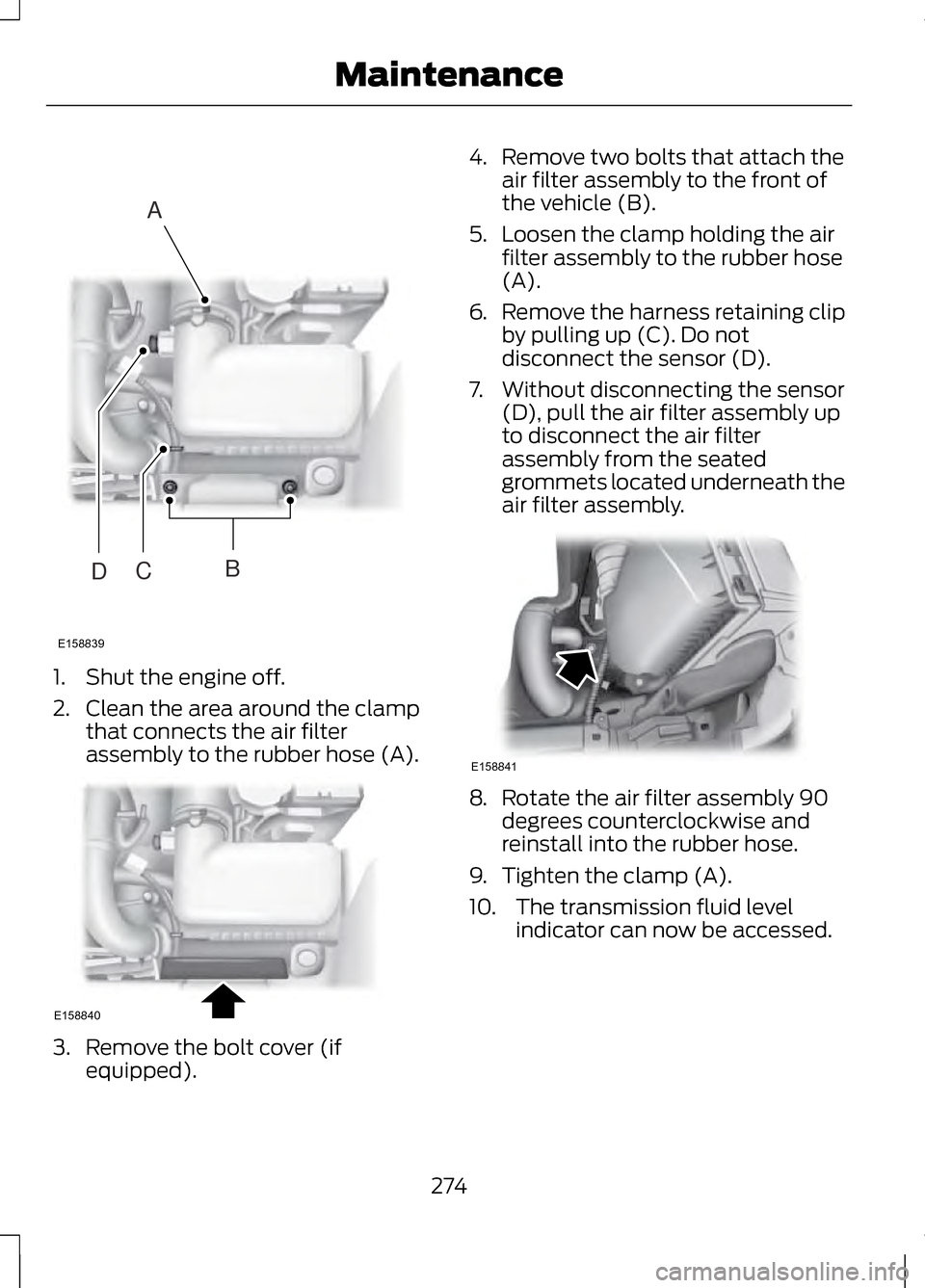
1. Shut the engine off.
2. Clean the area around the clamp
that connects the air filter
assembly to the rubber hose (A). 3. Remove the bolt cover (if
equipped). 4. Remove two bolts that attach the
air filter assembly to the front of
the vehicle (B).
5. Loosen the clamp holding the air filter assembly to the rubber hose
(A).
6. Remove the harness retaining clip
by pulling up (C). Do not
disconnect the sensor (D).
7. Without disconnecting the sensor (D), pull the air filter assembly up
to disconnect the air filter
assembly from the seated
grommets located underneath the
air filter assembly. 8.
Rotate the air filter assembly 90
degrees counterclockwise and
reinstall into the rubber hose.
9. Tighten the clamp (A).
10. The transmission fluid level indicator can now be accessed.
274
MaintenanceE158839
A
BCD E158840 E158841
Page 278 of 474
Checking the fluid level
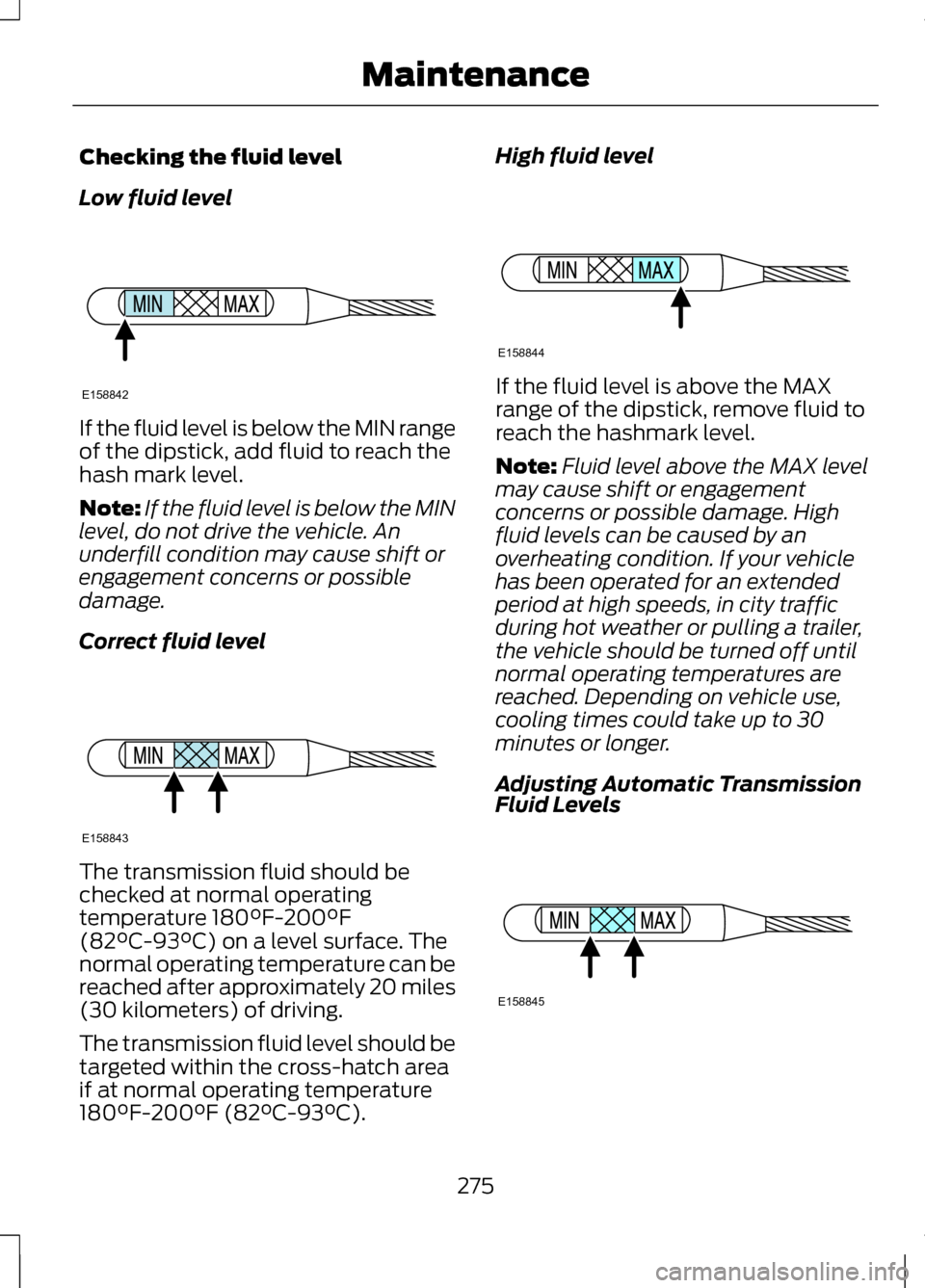
Low fluid level
If the fluid level is below the MIN range
of the dipstick, add fluid to reach the
hash mark level.
Note:
If the fluid level is below the MIN
level, do not drive the vehicle. An
underfill condition may cause shift or
engagement concerns or possible
damage.
Correct fluid level The transmission fluid should be
checked at normal operating
temperature 180°F-200°F
(82°C-93°C) on a level surface. The
normal operating temperature can be
reached after approximately 20 miles
(30 kilometers) of driving.
The transmission fluid level should be
targeted within the cross-hatch area
if at normal operating temperature
180°F-200°F (82°C-93°C). High fluid level
If the fluid level is above the MAX
range of the dipstick, remove fluid to
reach the hashmark level.
Note:
Fluid level above the MAX level
may cause shift or engagement
concerns or possible damage. High
fluid levels can be caused by an
overheating condition. If your vehicle
has been operated for an extended
period at high speeds, in city traffic
during hot weather or pulling a trailer,
the vehicle should be turned off until
normal operating temperatures are
reached. Depending on vehicle use,
cooling times could take up to 30
minutes or longer.
Adjusting Automatic Transmission
Fluid Levels 275
MaintenanceE158842 E158843 E158844 E158845
Page 279 of 474
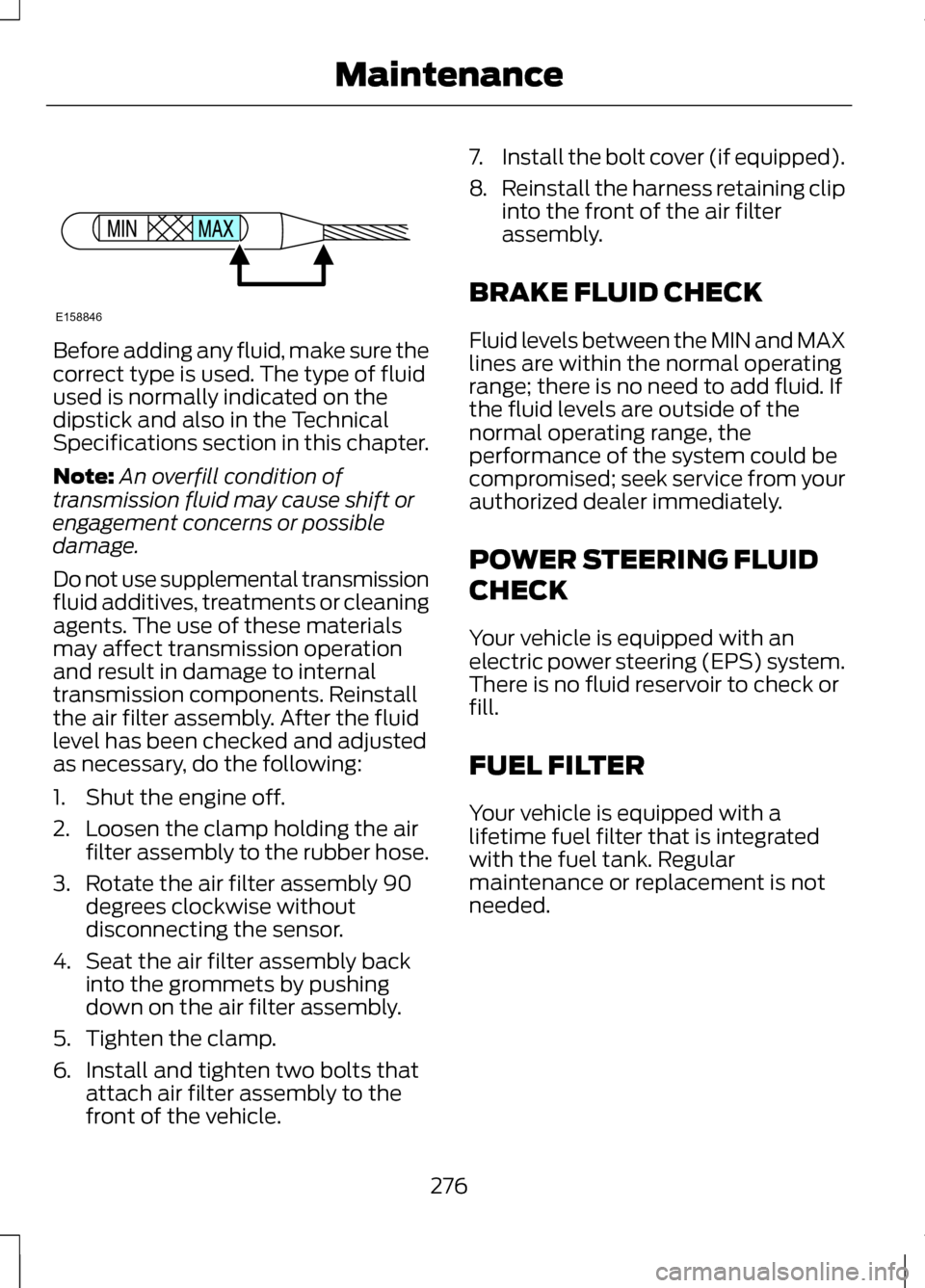
Before adding any fluid, make sure the
correct type is used. The type of fluid
used is normally indicated on the
dipstick and also in the Technical
Specifications section in this chapter.
Note:
An overfill condition of
transmission fluid may cause shift or
engagement concerns or possible
damage.
Do not use supplemental transmission
fluid additives, treatments or cleaning
agents. The use of these materials
may affect transmission operation
and result in damage to internal
transmission components. Reinstall
the air filter assembly. After the fluid
level has been checked and adjusted
as necessary, do the following:
1. Shut the engine off.
2. Loosen the clamp holding the air filter assembly to the rubber hose.
3. Rotate the air filter assembly 90 degrees clockwise without
disconnecting the sensor.
4. Seat the air filter assembly back into the grommets by pushing
down on the air filter assembly.
5. Tighten the clamp.
6. Install and tighten two bolts that
attach air filter assembly to the
front of the vehicle. 7.
Install the bolt cover (if equipped).
8. Reinstall the harness retaining clip
into the front of the air filter
assembly.
BRAKE FLUID CHECK
Fluid levels between the MIN and MAX
lines are within the normal operating
range; there is no need to add fluid. If
the fluid levels are outside of the
normal operating range, the
performance of the system could be
compromised; seek service from your
authorized dealer immediately.
POWER STEERING FLUID
CHECK
Your vehicle is equipped with an
electric power steering (EPS) system.
There is no fluid reservoir to check or
fill.
FUEL FILTER
Your vehicle is equipped with a
lifetime fuel filter that is integrated
with the fuel tank. Regular
maintenance or replacement is not
needed.
276
MaintenanceE158846
Page 281 of 474
Your vehicle is equipped with a
Motorcraft® maintenance-free
battery which normally does not
require additional water during its life
of service.
Note:
If your battery has a
cover/shield, make sure it is reinstalled
after the battery has been cleaned or
replaced.
For longer, trouble-free operation,
keep the top of the battery clean and
dry. Also, make certain the battery
cables are always tightly fastened to
the battery terminals.
If you see any corrosion on the battery
or terminals, remove the cables from
the terminals and clean with a wire
brush. You can neutralize the acid with
a solution of baking soda and water.
It is recommended that the negative
battery cable terminal be
disconnected from the battery if you
plan to store your vehicle for an
extended period of time.
To ensure proper operation of the
battery management system (BMS),
any electrical devices that are added
to the vehicle should not have their
ground connection made directly at
the negative battery post. A
connection at the negative battery
post can cause inaccurate
measurements of the battery
condition and potential incorrect
system operation. Note:
Electrical or electronic
accessories or components added to
the vehicle by the dealer or the owner
may adversely affect battery
performance and durability and may
also affect the performance of other
electrical systems in the vehicle.
When a battery replacement is
required, the battery should only be
replaced with a Ford recommended
replacement battery that matches
the electrical requirements of the
vehicle.
When the battery is disconnected or
a new battery installed, the automatic
transmission must relearn its adaptive
strategy. As a result of this, the
transmission may shift firmly when
first driven. This operation is
considered normal and will fully
update transmission operation to its
optimum shift feel.
If the battery has been disconnected
or a new battery has been installed,
the clock and the preset radio stations
must be reset once the battery is
reconnected.
Note: Always dispose of automotive
batteries in a responsible manner.
Follow your local authorized standards
for disposal. Call your local authorized
recycling center to find out more about
recycling automotive batteries.
278
Maintenance
Page 324 of 474
•
Wet weather driving capability.
• All-wheel driving capability (if
applicable).
3. Full-size dissimilar spare
without label on wheel
When driving with the full-size
dissimilar spare wheel and tire
assembly, do not:
• Exceed 70 mph (113 km/h).
• Use more than one dissimilar spare
wheel and tire assembly at a time.
• Use commercial car washing
equipment.
• Use snow chains on the end of the
vehicle with the dissimilar spare
wheel and tire assembly.
The usage of a full-size dissimilar
spare wheel and tire assembly can
lead to impairment of the following:
• Handling, stability and braking
performance.
• Comfort and noise.
• Ground clearance and parking at
curbs.
• Winter weather driving capability.
• Wet weather driving capability.
• All-wheel driving capability (if
applicable).
• Load leveling adjustment (if
applicable). When driving with the full-size
dissimilar spare wheel and tire
assembly additional caution should
be given to:
•
Towing a trailer.
• Driving vehicles equipped with a
camper body.
• Driving vehicles with a load on the
cargo rack.
Drive cautiously when using a full-size
dissimilar spare wheel and tire
assembly and seek service as soon as
possible.
Tire Change Procedure WARNINGS
When one of the front wheels is
off the ground, the transmission
alone will not prevent the vehicle from
moving or slipping off the jack, even if
the transmission selector lever is in
position P. To help prevent the vehicle from
moving when you change a tire,
be sure to place the transmission
selector lever in position
P, set the
parking brake and block (in both
directions) the wheel that is
diagonally opposite (other side and
end of the vehicle) to the tire being
changed. Never get underneath a vehicle
that is supported only by a jack.
If the vehicle slips off the jack, you or
someone else could be seriously
injured.
321
Wheels and Tires
Page 325 of 474
WARNINGS
Do not attempt to change a tire
on the side of the vehicle close
to moving traffic. Pull far enough off
the road to avoid the danger of being
hit when operating the jack or
changing the wheel. Always use the jack provided as
original equipment with your
vehicle. If using a jack other than the
one provided as original equipment
with your vehicle, make sure the jack
capacity is adequate for the vehicle
weight, including any vehicle cargo or
modifications. 1. Park on a level surface, set the
parking brake and activate the
hazard flashers.
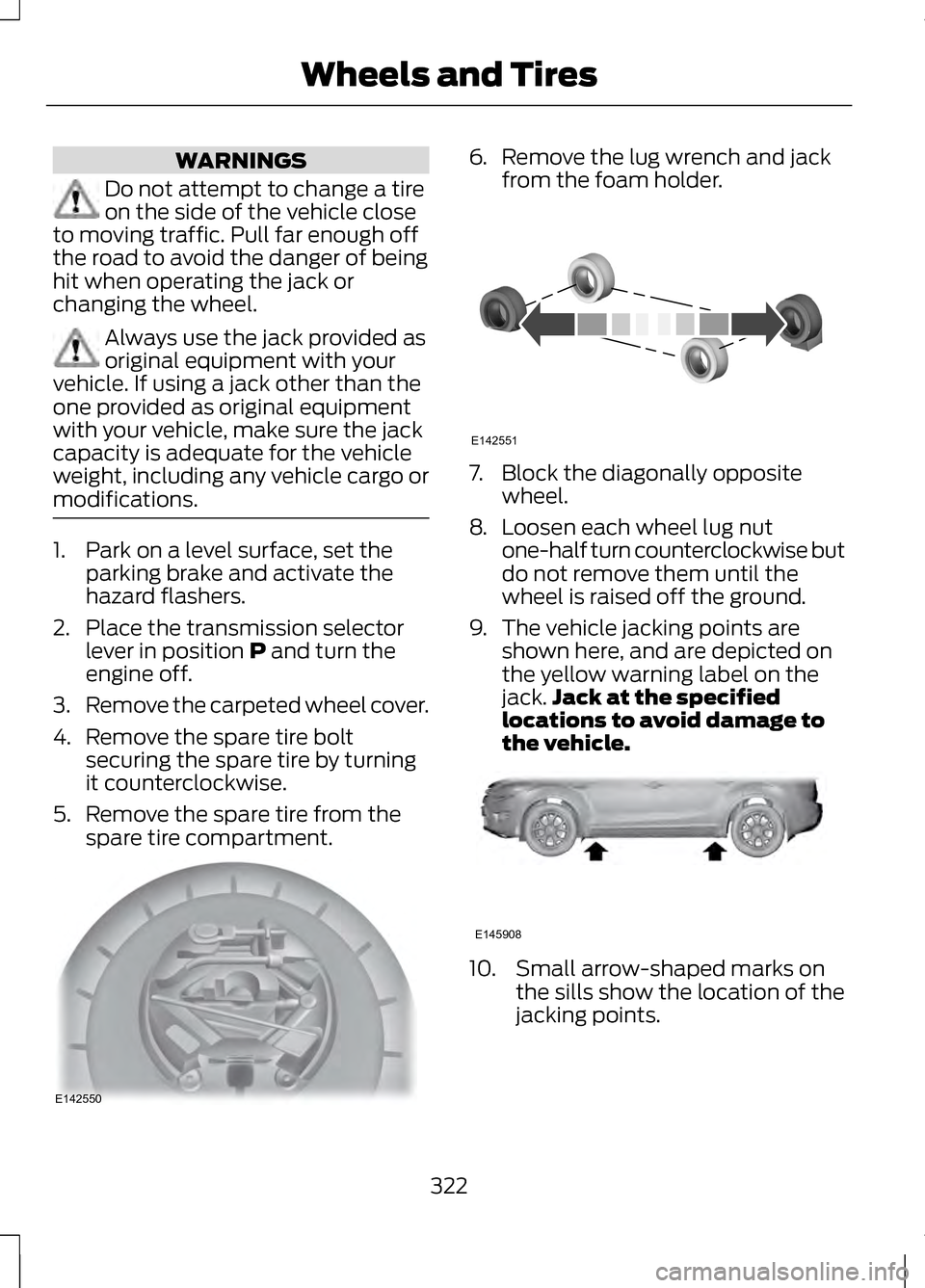
2. Place the transmission selector lever in position P and turn the
engine off.
3. Remove the carpeted wheel cover.
4. Remove the spare tire bolt securing the spare tire by turning
it counterclockwise.
5. Remove the spare tire from the spare tire compartment. 6.
Remove the lug wrench and jack
from the foam holder. 7. Block the diagonally opposite
wheel.
8. Loosen each wheel lug nut
one-half turn counterclockwise but
do not remove them until the
wheel is raised off the ground.
9. The vehicle jacking points are shown here, and are depicted on
the yellow warning label on the
jack. Jack at the specified
locations to avoid damage to
the vehicle. 10. Small arrow-shaped marks on
the sills show the location of the
jacking points.
322
Wheels and TiresE142550 E142551 E145908
Page 331 of 474
VEHICLE CERTIFICATION
LABEL
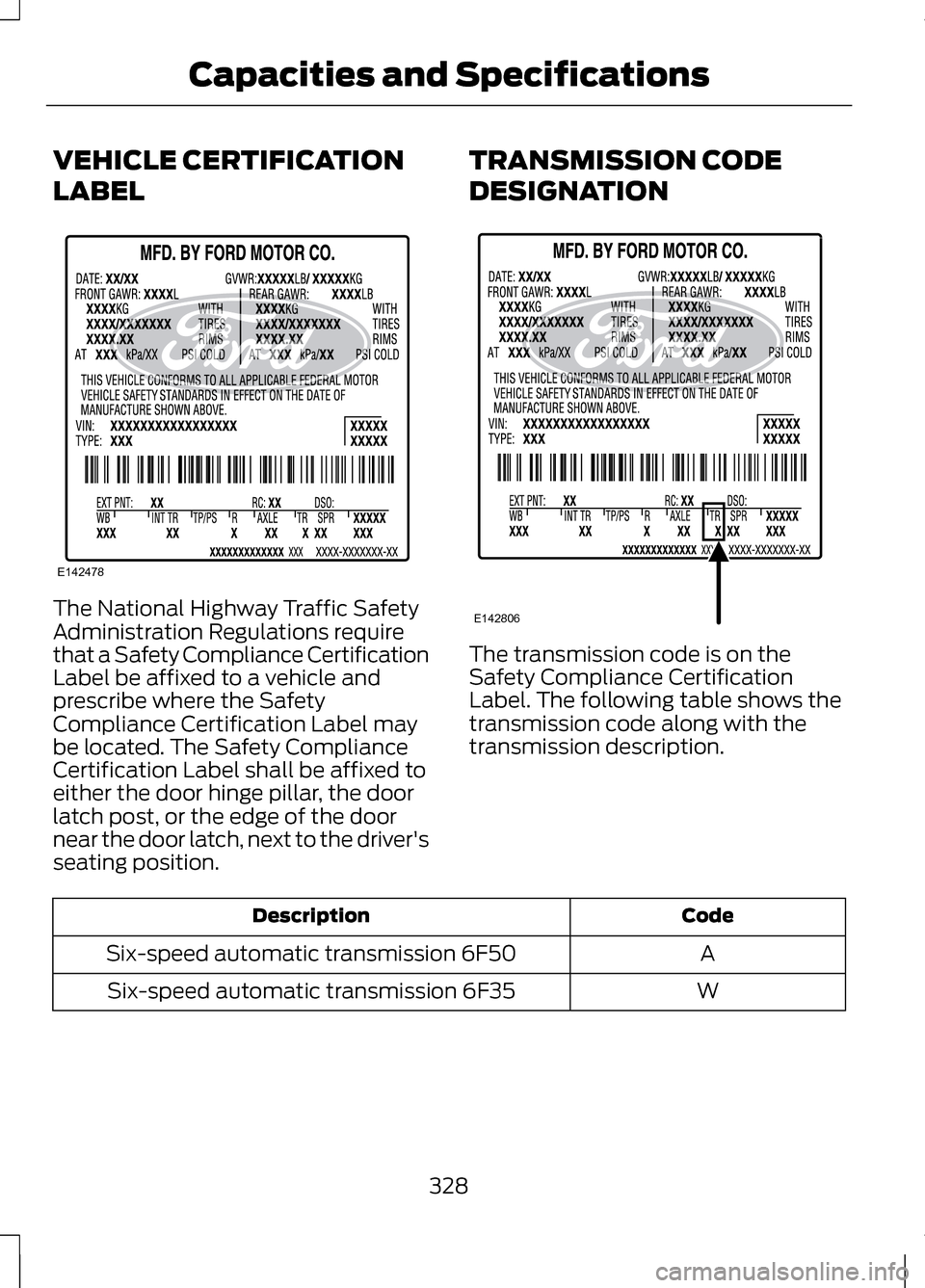
The National Highway Traffic Safety
Administration Regulations require
that a Safety Compliance Certification
Label be affixed to a vehicle and
prescribe where the Safety
Compliance Certification Label may
be located. The Safety Compliance
Certification Label shall be affixed to
either the door hinge pillar, the door
latch post, or the edge of the door
near the door latch, next to the driver's
seating position. TRANSMISSION CODE
DESIGNATION
The transmission code is on the
Safety Compliance Certification
Label. The following table shows the
transmission code along with the
transmission description.
Code
Description
A
Six-speed automatic transmission 6F50
W
Six-speed automatic transmission 6F35
328
Capacities and SpecificationsE142478 E142806
Page 332 of 474
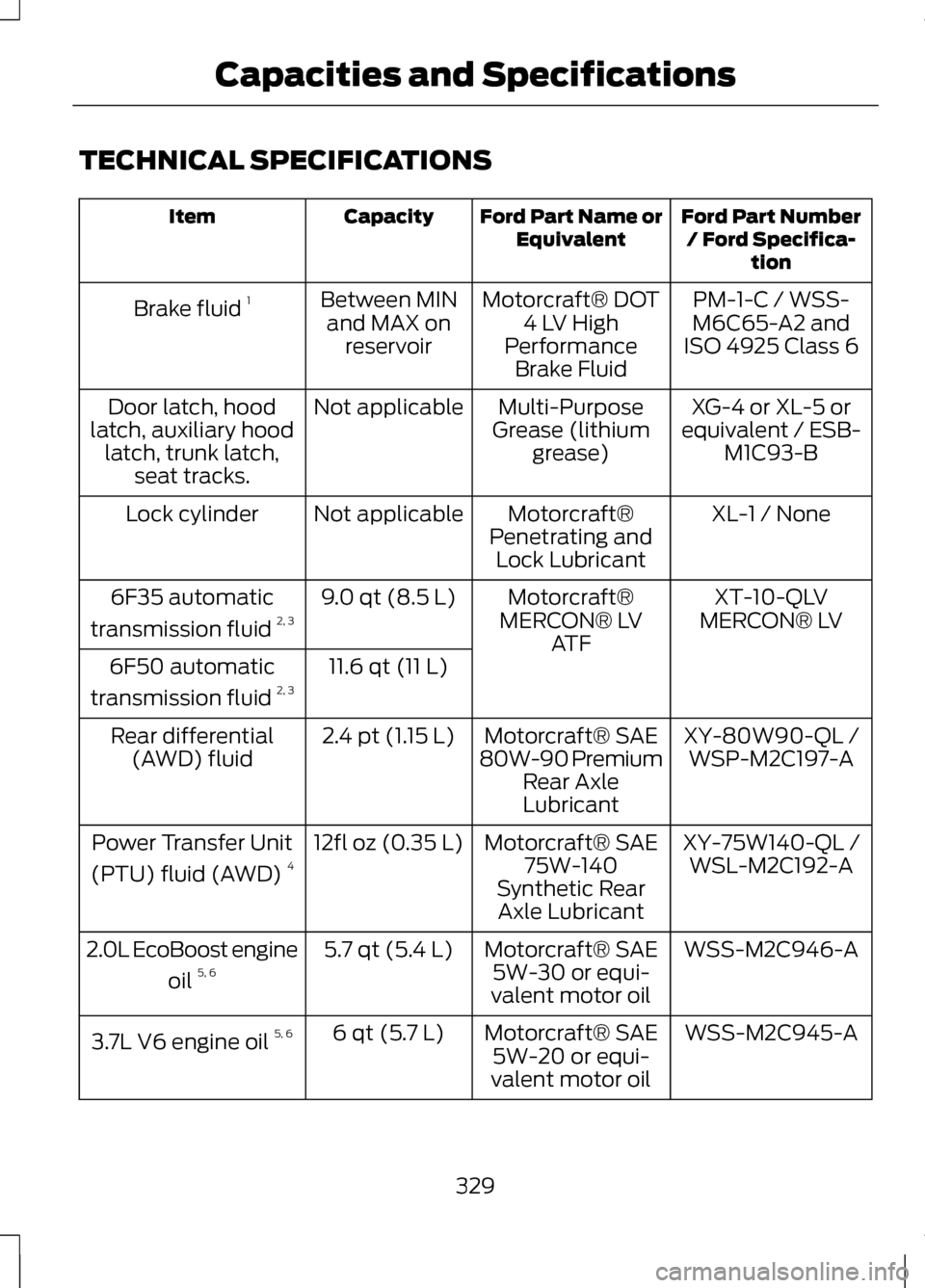
TECHNICAL SPECIFICATIONS
Ford Part Number
/ Ford Specifica- tion
Ford Part Name or
Equivalent
Capacity
Item
PM-1-C / WSS-
M6C65-A2 and
ISO 4925 Class 6
Motorcraft® DOT
4 LV High
Performance Brake Fluid
Between MIN
and MAX on reservoir
Brake fluid
1
XG-4 or XL-5 or
equivalent / ESB- M1C93-B
Multi-Purpose
Grease (lithium grease)
Not applicable
Door latch, hood
latch, auxiliary hood latch, trunk latch, seat tracks.
XL-1 / None
Motorcraft®
Penetrating and Lock Lubricant
Not applicable
Lock cylinder
XT-10-QLV
MERCON® LV
Motorcraft®
MERCON® LV ATF
9.0 qt (8.5 L)
6F35 automatic
transmission fluid 2, 3
11.6 qt (11 L)
6F50 automatic
transmission fluid 2, 3
XY-80W90-QL /WSP-M2C197-A
Motorcraft® SAE
80W-90 Premium Rear Axle
Lubricant
2.4 pt (1.15 L)
Rear differential
(AWD) fluid
XY-75W140-QL /WSL-M2C192-A
Motorcraft® SAE
75W-140
Synthetic Rear Axle Lubricant
12fl oz (0.35 L)
Power Transfer Unit
(PTU) fluid (AWD) 4
WSS-M2C946-A
Motorcraft® SAE
5W-30 or equi-
valent motor oil
5.7 qt (5.4 L)
2.0L EcoBoost engine
oil 5, 6
WSS-M2C945-A
Motorcraft® SAE
5W-20 or equi-
valent motor oil
6 qt (5.7 L)
3.7L V6 engine oil 5, 6
329
Capacities and Specifications
Page 334 of 474
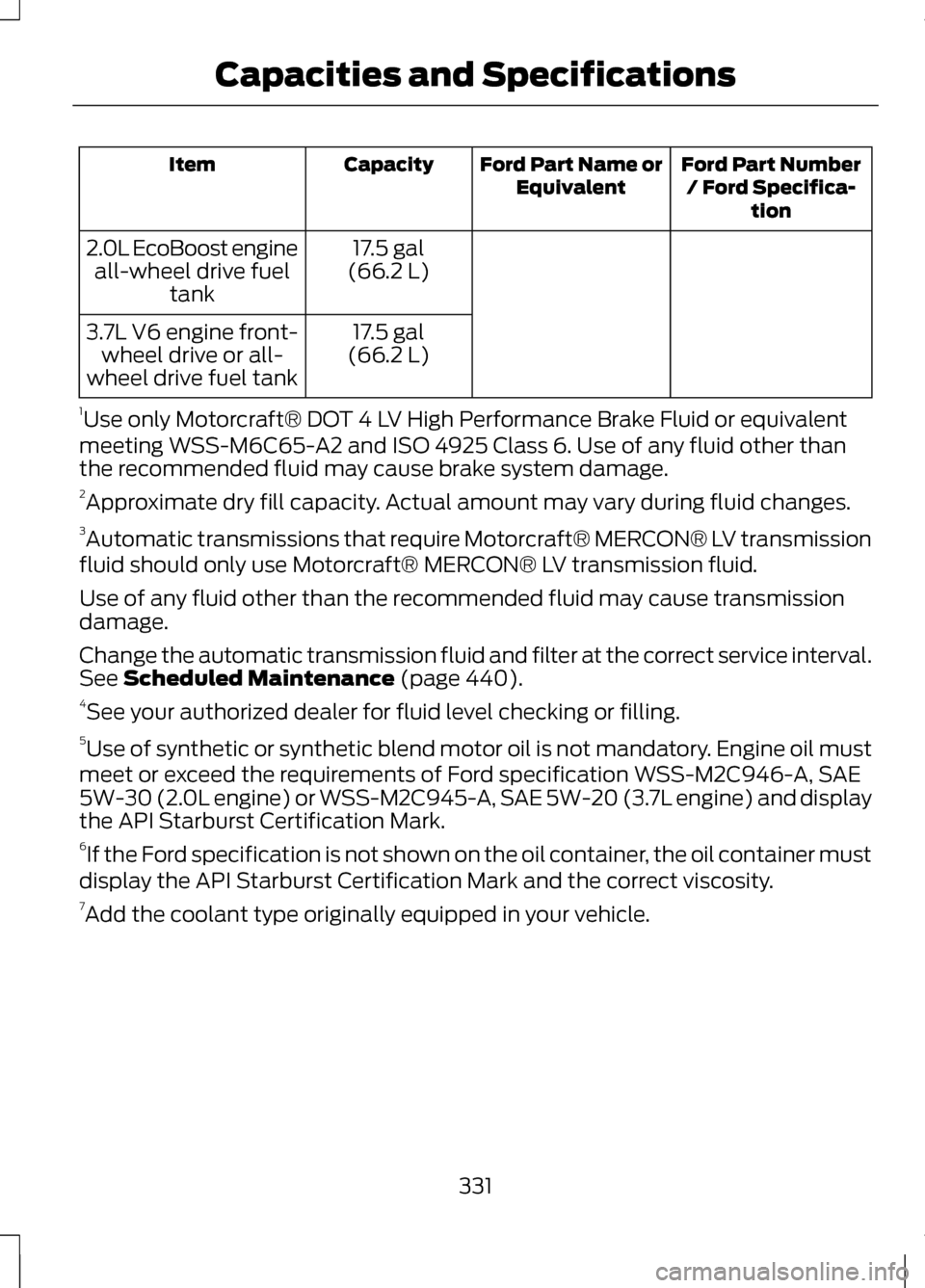
Ford Part Number
/ Ford Specifica- tion
Ford Part Name or
Equivalent
Capacity
Item
17.5 gal
(66.2 L)
2.0L EcoBoost engine
all-wheel drive fuel tank
17.5 gal
(66.2 L)
3.7L V6 engine front-
wheel drive or all-
wheel drive fuel tank
1 Use only Motorcraft® DOT 4 LV High Performance Brake Fluid or equivalent
meeting WSS-M6C65-A2 and ISO 4925 Class 6. Use of any fluid other than
the recommended fluid may cause brake system damage.
2 Approximate dry fill capacity. Actual amount may vary during fluid changes.
3 Automatic transmissions that require Motorcraft® MERCON® LV transmission
fluid should only use Motorcraft® MERCON® LV transmission fluid.
Use of any fluid other than the recommended fluid may cause transmission
damage.
Change the automatic transmission fluid and filter at the correct service interval.
See Scheduled Maintenance (page 440).
4 See your authorized dealer for fluid level checking or filling.
5 Use of synthetic or synthetic blend motor oil is not mandatory. Engine oil must
meet or exceed the requirements of Ford specification WSS-M2C946-A, SAE
5W-30 (2.0L engine) or WSS-M2C945-A, SAE 5W-20 (3.7L engine) and display
the API Starburst Certification Mark.
6 If the Ford specification is not shown on the oil container, the oil container must
display the API Starburst Certification Mark and the correct viscosity.
7 Add the coolant type originally equipped in your vehicle.
331
Capacities and Specifications