four wheel drive LINCOLN MKZ 2013 Owners Manual
[x] Cancel search | Manufacturer: LINCOLN, Model Year: 2013, Model line: MKZ, Model: LINCOLN MKZ 2013Pages: 474, PDF Size: 3.79 MB
Page 124 of 474
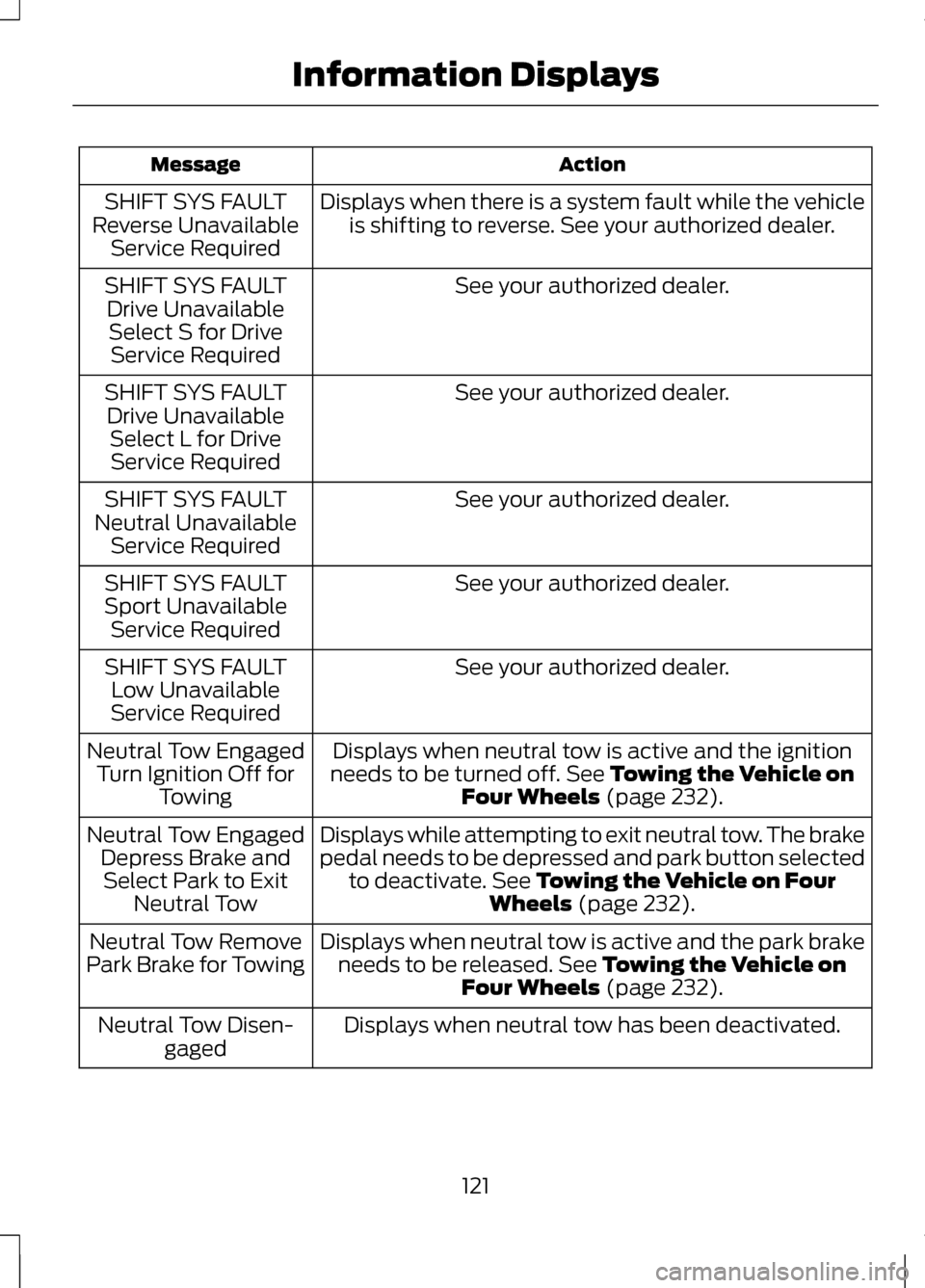
Action
Message
Displays when there is a system fault while the vehicleis shifting to reverse. See your authorized dealer.
SHIFT SYS FAULT
Reverse Unavailable Service Required
See your authorized dealer.
SHIFT SYS FAULT
Drive UnavailableSelect S for Drive Service Required
See your authorized dealer.
SHIFT SYS FAULT
Drive Unavailable Select L for DriveService Required
See your authorized dealer.
SHIFT SYS FAULT
Neutral Unavailable Service Required
See your authorized dealer.
SHIFT SYS FAULT
Sport Unavailable Service Required
See your authorized dealer.
SHIFT SYS FAULT
Low Unavailable
Service Required
Displays when neutral tow is active and the ignition
needs to be turned off. See Towing the Vehicle on
Four Wheels (page 232).
Neutral Tow Engaged
Turn Ignition Off for Towing
Displays while attempting to exit neutral tow. The brake
pedal needs to be depressed and park button selectedto deactivate.
See Towing the Vehicle on Four
Wheels (page 232).
Neutral Tow Engaged
Depress Brake andSelect Park to Exit Neutral Tow
Displays when neutral tow is active and the park brakeneeds to be released.
See Towing the Vehicle on
Four Wheels (page 232).
Neutral Tow Remove
Park Brake for Towing
Displays when neutral tow has been deactivated.
Neutral Tow Disen-
gaged
121
Information Displays
Page 174 of 474
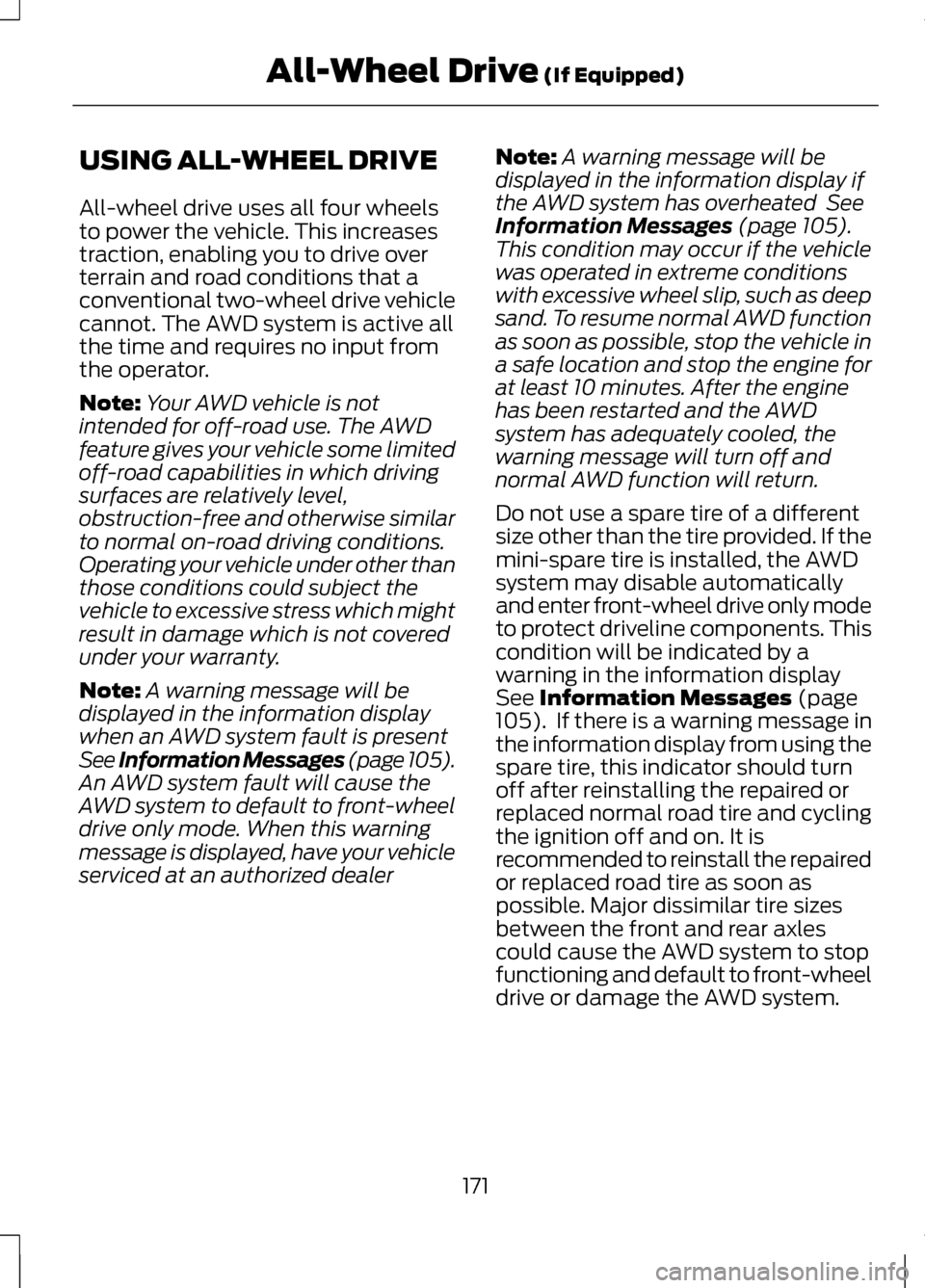
USING ALL-WHEEL DRIVE
All-wheel drive uses all four wheels
to power the vehicle. This increases
traction, enabling you to drive over
terrain and road conditions that a
conventional two-wheel drive vehicle
cannot. The AWD system is active all
the time and requires no input from
the operator.
Note:
Your AWD vehicle is not
intended for off-road use. The AWD
feature gives your vehicle some limited
off-road capabilities in which driving
surfaces are relatively level,
obstruction-free and otherwise similar
to normal on-road driving conditions.
Operating your vehicle under other than
those conditions could subject the
vehicle to excessive stress which might
result in damage which is not covered
under your warranty.
Note: A warning message will be
displayed in the information display
when an AWD system fault is present
See Information Messages (page 105).
An AWD system fault will cause the
AWD system to default to front-wheel
drive only mode. When this warning
message is displayed, have your vehicle
serviced at an authorized dealer Note:
A warning message will be
displayed in the information display if
the AWD system has overheated See
Information Messages (page 105).
This condition may occur if the vehicle
was operated in extreme conditions
with excessive wheel slip, such as deep
sand. To resume normal AWD function
as soon as possible, stop the vehicle in
a safe location and stop the engine for
at least 10 minutes. After the engine
has been restarted and the AWD
system has adequately cooled, the
warning message will turn off and
normal AWD function will return.
Do not use a spare tire of a different
size other than the tire provided. If the
mini-spare tire is installed, the AWD
system may disable automatically
and enter front-wheel drive only mode
to protect driveline components. This
condition will be indicated by a
warning in the information display
See
Information Messages (page
105). If there is a warning message in
the information display from using the
spare tire, this indicator should turn
off after reinstalling the repaired or
replaced normal road tire and cycling
the ignition off and on. It is
recommended to reinstall the repaired
or replaced road tire as soon as
possible. Major dissimilar tire sizes
between the front and rear axles
could cause the AWD system to stop
functioning and default to front-wheel
drive or damage the AWD system.
171
All-Wheel Drive
(If Equipped)
Page 176 of 474
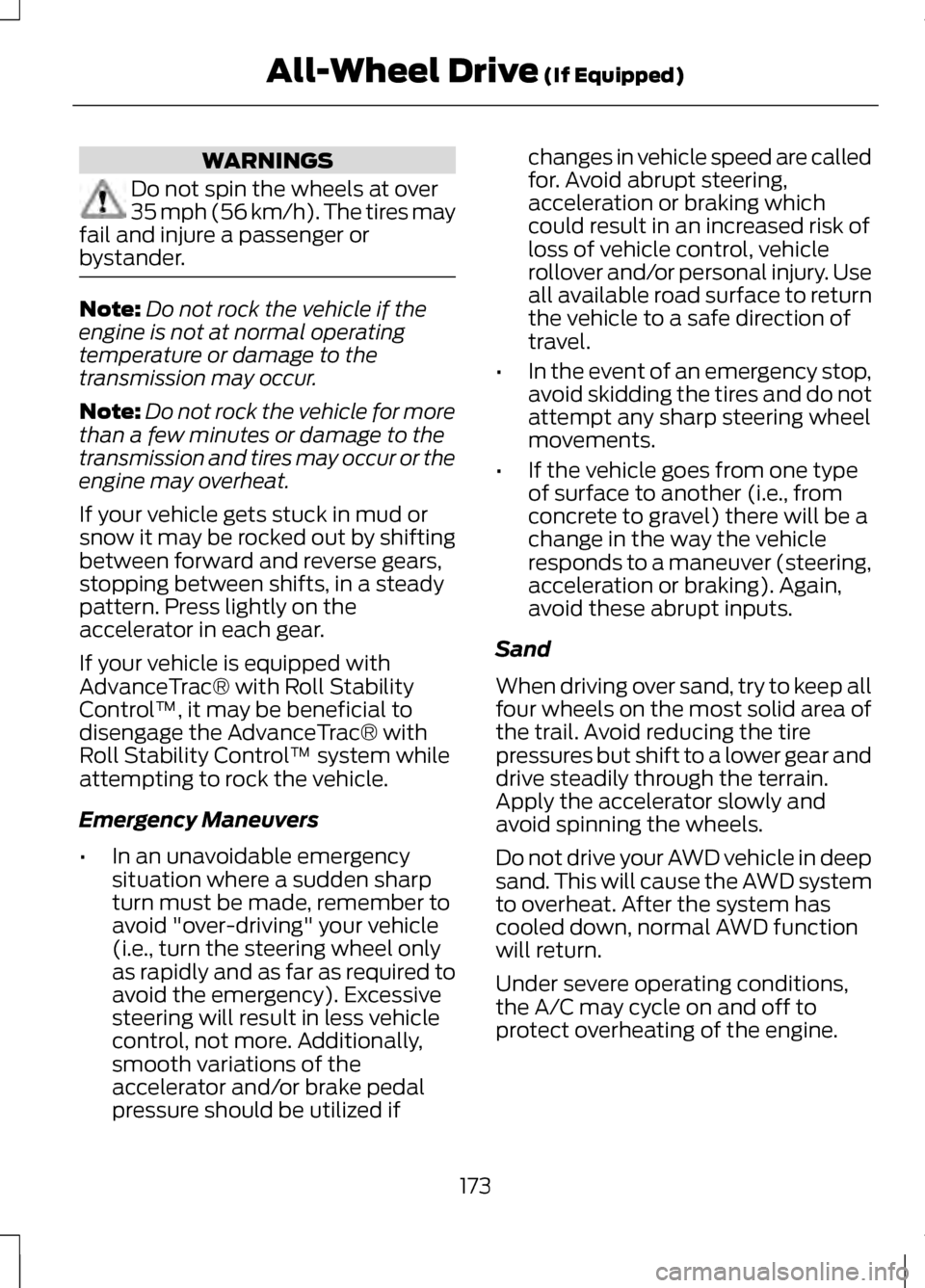
WARNINGS
Do not spin the wheels at over
35 mph (56 km/h). The tires may
fail and injure a passenger or
bystander. Note:
Do not rock the vehicle if the
engine is not at normal operating
temperature or damage to the
transmission may occur.
Note: Do not rock the vehicle for more
than a few minutes or damage to the
transmission and tires may occur or the
engine may overheat.
If your vehicle gets stuck in mud or
snow it may be rocked out by shifting
between forward and reverse gears,
stopping between shifts, in a steady
pattern. Press lightly on the
accelerator in each gear.
If your vehicle is equipped with
AdvanceTrac® with Roll Stability
Control ™, it may be beneficial to
disengage the AdvanceTrac® with
Roll Stability Control ™ system while
attempting to rock the vehicle.
Emergency Maneuvers
• In an unavoidable emergency
situation where a sudden sharp
turn must be made, remember to
avoid "over-driving" your vehicle
(i.e., turn the steering wheel only
as rapidly and as far as required to
avoid the emergency). Excessive
steering will result in less vehicle
control, not more. Additionally,
smooth variations of the
accelerator and/or brake pedal
pressure should be utilized if changes in vehicle speed are called
for. Avoid abrupt steering,
acceleration or braking which
could result in an increased risk of
loss of vehicle control, vehicle
rollover and/or personal injury. Use
all available road surface to return
the vehicle to a safe direction of
travel.
• In the event of an emergency stop,
avoid skidding the tires and do not
attempt any sharp steering wheel
movements.
• If the vehicle goes from one type
of surface to another (i.e., from
concrete to gravel) there will be a
change in the way the vehicle
responds to a maneuver (steering,
acceleration or braking). Again,
avoid these abrupt inputs.
Sand
When driving over sand, try to keep all
four wheels on the most solid area of
the trail. Avoid reducing the tire
pressures but shift to a lower gear and
drive steadily through the terrain.
Apply the accelerator slowly and
avoid spinning the wheels.
Do not drive your AWD vehicle in deep
sand. This will cause the AWD system
to overheat. After the system has
cooled down, normal AWD function
will return.
Under severe operating conditions,
the A/C may cycle on and off to
protect overheating of the engine.
173
All-Wheel Drive (If Equipped)
Page 179 of 474
Note:
Excessive tire slippage can
cause driveline damage.
AWD vehicles have advantages over
2WD vehicles in snow and ice but can
skid like any other vehicle.
Should you start to slide while driving
on snowy or icy roads, turn the
steering wheel in the direction of the
slide until you regain control.
Avoid sudden applications of power
and quick changes of direction on
snow and ice. Apply the accelerator
slowly and steadily when starting
from a full stop.
Avoid sudden braking as well.
Although an AWD vehicle may
accelerate better than a two-wheel
drive vehicle in snow and ice, it won ’t
stop any faster, because as in other
vehicles, braking occurs at all four
wheels. Do not become overconfident
as to road conditions.
Make sure you allow sufficient
distance between you and other
vehicles for stopping. Drive slower
than usual and consider using one of
the lower gears. In emergency
stopping situations, apply the brake
steadily. Since your vehicle is
equipped with a four wheel (ABS), do
not “pump ” the brakes. See Hints on
Driving With Anti-Lock Brakes
(page
178). for more information on
the operation of the anti-lock brake
system (ABS). Maintenance and Modifications
The suspension and steering systems
on your vehicle have been designed
and tested to provide predictable
performance whether loaded or
empty and durable load carrying
capability. For this reason, Ford Motor
Company strongly recommends that
you do not make modifications such
as adding or removing parts (such as
lowering kits or stabilizer bars) or by
using replacement parts not
equivalent to the original factory
equipment.
Any modifications to a vehicle that
raise the center of gravity can make it
more likely the vehicle will rollover as
a result of a loss of control. Ford Motor
Company recommends that caution
be used with any vehicle equipped
with a high load or device (such as
ladder or luggage racks).
Failure to maintain your vehicle
properly may void the warranty,
increase your repair cost, reduce
vehicle performance and operational
capabilities and adversely affect driver
and passenger safety. Frequent
inspection of vehicle chassis
components is recommended if the
vehicle is subjected to off-highway
usage.
176
All-Wheel Drive
(If Equipped)
Page 199 of 474
Switching Cruise Control Off
Note:
You will erase the set speed if
you switch the system off.
Press and release OFF or switch the
ignition off.
USING ADAPTIVE CRUISE
CONTROL
(IF EQUIPPED) WARNINGS
Always pay close attention to
changing road conditions,
especially when using adaptive cruise
control. Adaptive cruise control
cannot replace attentive driving.
Failing to follow any of the warnings
below or failing to pay attention to the
road may result in a collision, serious
injury or death. Adaptive cruise control is not a
collision warning or avoidance
system. Adaptive cruise control will not
detect stationary or slow moving
vehicles below 6 mph (10 km/h). Adaptive cruise control will not
detect pedestrians or objects in
the roadway. Adaptive cruise control will not
detect oncoming vehicles in the
same lane. Do not use the adaptive cruise
control when entering or leaving
a highway, in heavy traffic or on roads
that are winding, slippery or unpaved. WARNINGS
Do not use in poor visibility,
specifically fog, rain, spray or
snow. Note:
It is your responsibility to stay
alert, drive safely and be in control of
the vehicle at all times.
The system is designed to
automatically adjust your speed to
maintain a proper distance between
you and the vehicle in front of you in
the same lane. You can select from
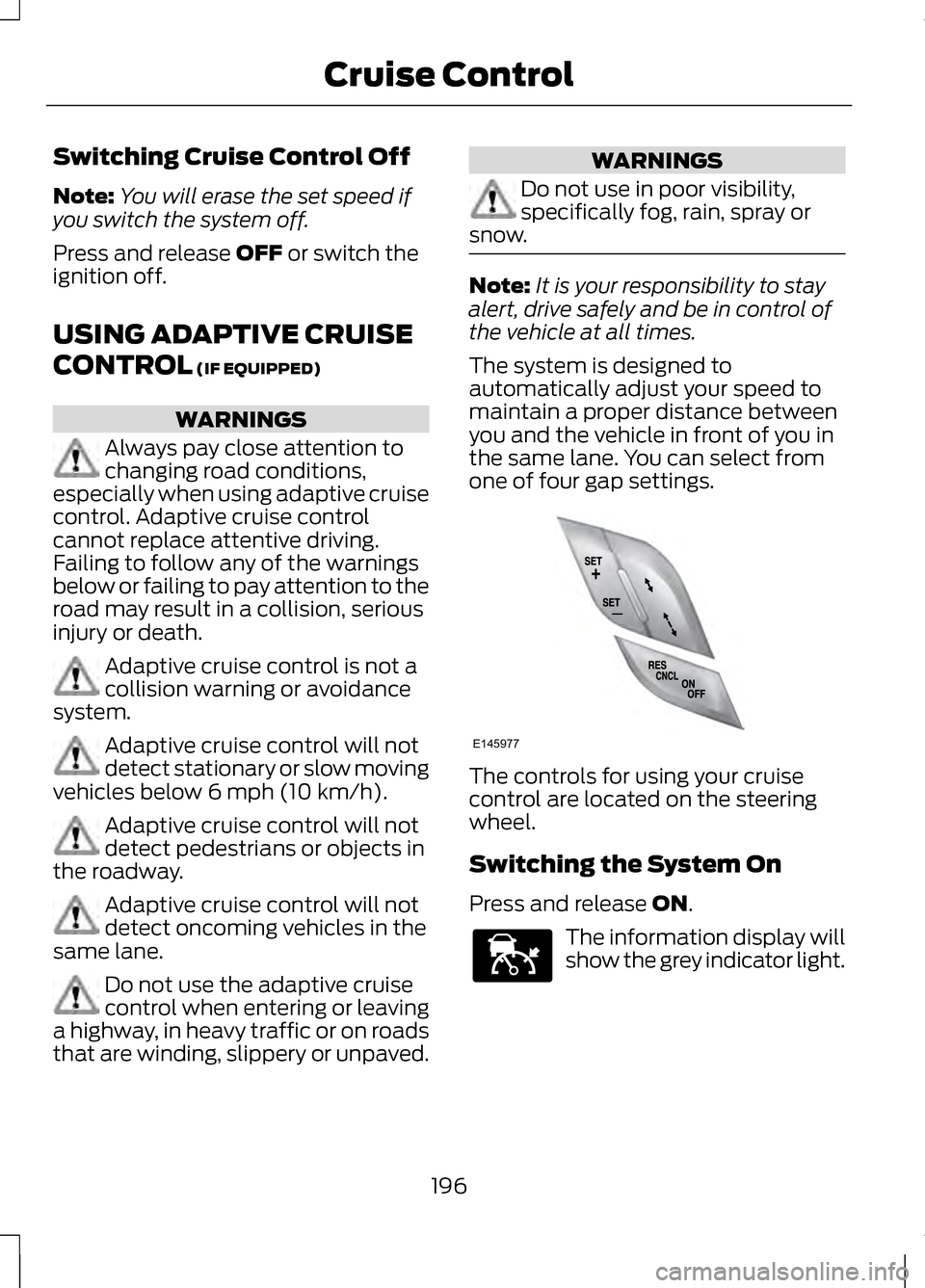
one of four gap settings. The controls for using your cruise
control are located on the steering
wheel.
Switching the System On
Press and release
ON.
The information display will
show the grey indicator light.
196
Cruise ControlE145977 E144529
Page 235 of 474
We recommend using a wheel lift and
dollies or flatbed equipment. Do not
tow with a slingbelt. Ford Motor
Company has not approved a
slingbelt towing procedure. If towed
incorrectly, or by any other means,
vehicle damage may occur.
Ford Motor Company produces a
towing manual for all authorized tow
truck operators. Have your tow truck
operator refer to this manual for
proper hook-up and towing
procedures for your vehicle.
It is acceptable to tow a front-wheel
drive (FWD) vehicle from the front if
using proper wheel lift equipment to
raise the front wheels off the ground.
The rear wheels can remain on the
ground when towed in this fashion.
FWD vehicles can also be towed from
the rear using wheel lift equipment;
however, the front wheels must be
placed on a dolly to prevent damage
to the transmission.
It is required to tow an all-wheel drive
(AWD) vehicle with a wheel lift and
dollies or flatbed equipment, with all
the wheels off the ground, to prevent
damage to the transmission, AWD
system or vehicle.
TOWING THE VEHICLE ON
FOUR WHEELS
Emergency Towing
You can flat-tow (all wheels on the
ground, regardless of the
powertrain/transmission
configuration) your disabled vehicle
(without access to wheel dollies,
car-hauling trailer, or flatbed transport
vehicle) under the following
conditions:
•
Your vehicle is facing forward so
you tow it in a forward direction.
• You place the transmission in
position N. If you cannot place the
transmission in position N, you
may need to override it. See
Transmission
(page 165).
• Maximum speed is 35 mph (56
km/h).
• Maximum distance is 50 miles (80
kilometers).
Recreational Towing
Note: Put your climate control system
in recirculated air mode to prevent
exhaust fumes from entering the
vehicle. See
Climate Control (page
126).
Follow these guidelines if you have a
need for recreational (RV) towing. An
example of recreational towing would
be towing your vehicle behind a
motorhome. These guidelines are to
make sure you do not damage the
transmission during towing.
232
Towing
Page 236 of 474
Vehicles Equipped with a 2.0L
Engine
Front-wheel drive (FWD) vehicles
CANNOT be flat-towed (all wheels
on the ground) as vehicle or
transmission damage may occur. You
must place the front wheels on a
two-wheel tow dolly. If you are using
a tow dolly, follow the instructions
specified by the equipment provider.
All-wheel drive (AWD) vehicles
CANNOT
be flat-towed (all wheels
on the ground), as vehicle or
transmission damage may occur. It is
recommended to tow your vehicle
with all four (4) wheels off the ground
such as when using a car-hauling
trailer. Otherwise, you cannot tow your
vehicle.
Vehicles Equipped with a 3.7L
Engine
You can tow your vehicle with all four
wheels on the ground using the
Neutral Tow feature, or with all four
wheels off the ground using a vehicle
transport trailer. If you are using a
vehicle transport trailer, follow the
instruction specified by the equipment
provider.
If you tow your vehicle with all four
wheels on the ground:
• Tow only in the forward direction.
• Release the parking brake.
Neutral Tow
Enter Neutral Tow mode by doing the
following: 1.
Put the ignition in accessory mode
by pressing the engine START
button without pressing the brake
pedal.
2. Select
Neutral Tow under the
Vehicle Settings menu in the
information display. See General
Information (page 100).
3. Press and hold the OK button to start the neutral tow process.
4. Press the brake pedal and select N
on the push-button
transmission.
5. Turn the ignition off by pressing the
engine START button without
pressing the brake pedal.
If the process is completes
successfully:
• the
N on the push-button
transmission blinks slowly
• Neutral Tow Engaged turn
ignition off for towing
appears
in the information display.
Note: If the parking brake is applied,
Neutral Tow remove park brake for
towing
appears in the information
display.
Note: Do not exceed 65 mph (105
km/h).
Note: Start the engine and allow it to
run for five minutes at the beginning of
each day and every six hours (or fewer).
Shut the engine off and verify that
Neutral tow engaged
appears in the
display before continuing to tow.
233
Towing
Page 297 of 474
•
Only use the sealing compound
before the use by date. The use by
date is on the lower right hand
corner of the label located on the
sealant canister (bottle). Check
the use by date regularly and
replace the canister after four
years.
• Do not store the kit unsecured
inside the passenger compartment
of the vehicle as it may cause injury
during a sudden stop or collision.
Always store the kit in its original
location.
• After sealant use, the tire pressure
monitoring system sensor and
valve stem on the wheel must be
replaced by an authorized Ford
dealer.
• When inflating a tire or other
objects, use the black air hose only.
Do not use the transparent hose
which is designed for sealant
application only.
• Operating the kit could cause an
electrical disturbance in radio, CD,
and DVD player operation.
What to do when a Tire Is
Punctured
A tire puncture within the tire's tread
area can be repaired in two stages
with the kit. •
In the first stage, the tire will be
reinflated with a sealing
compound and air. After the tire
has been reinflated, you will need
to drive the vehicle a short
distance (approximately 4 miles
[6 km]) to distribute the sealant
in the tire.
• In the second stage, you will need
to check the tire pressure and
adjust, if necessary, to the vehicle's
tire inflation pressure.
First Stage: Reinflating the Tire
with Sealing Compound and Air WARNINGS
Do not stand directly over the kit
while inflating the tire. If you
notice any unusual bulges or
deformations in the tire's sidewall
during inflation, stop and call roadside
assistance. If the tire doesn't inflate to the
recommended tire pressure
within 15 minutes, stop and call
roadside assistance. Preparation: Park the vehicle in a safe,
level and secure area, away from
moving traffic. Turn the hazard lights
on. Apply the parking brake and turn
the engine off. Inspect the flat tire for
visible damage.
Sealant compound contains latex. To
avoid any allergic reactions, use the
non-latex gloves located in the
accessory box on the underside of the
kit housing.
294
Wheels and Tires
Page 311 of 474
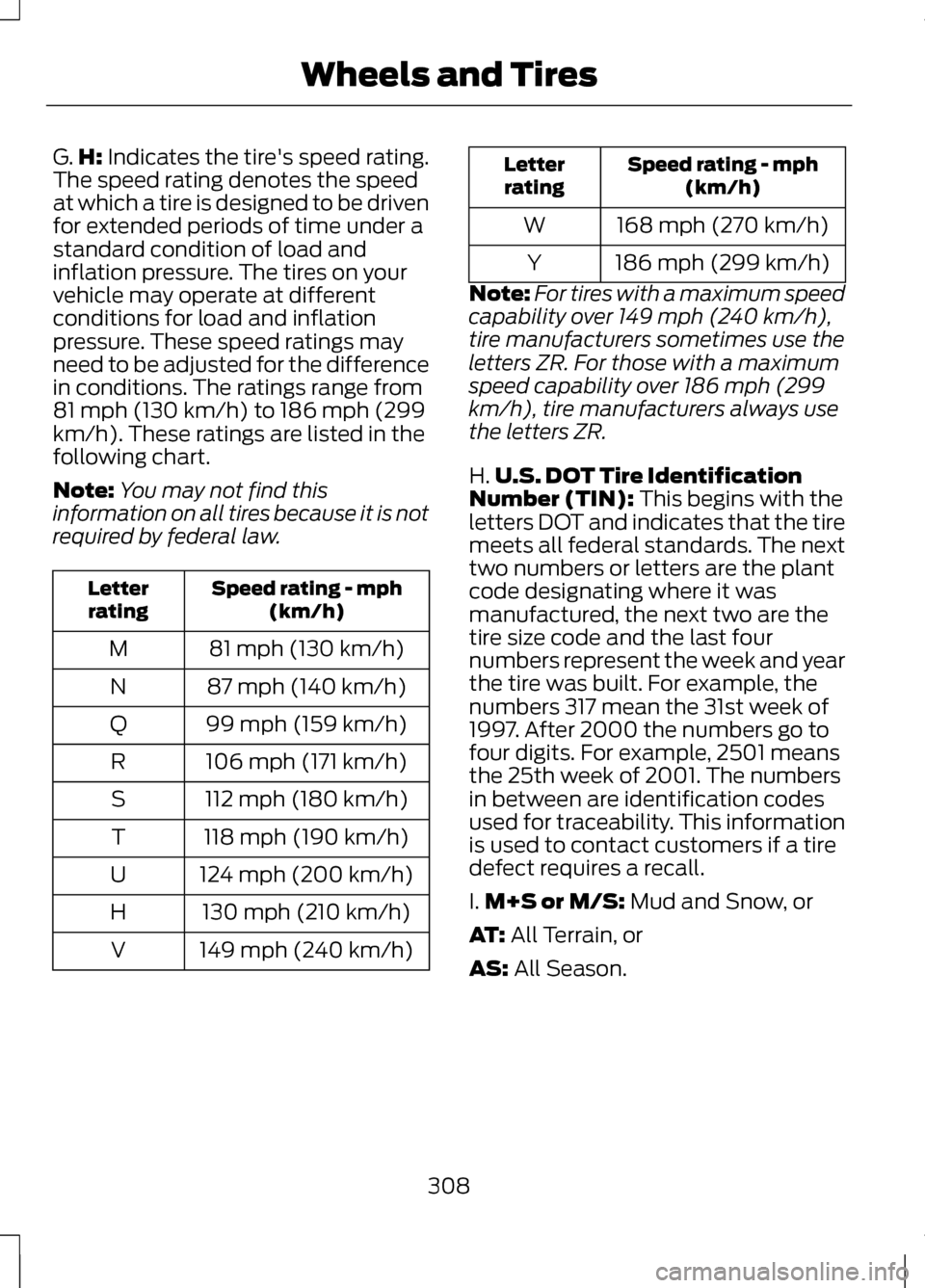
G.
H: Indicates the tire's speed rating.
The speed rating denotes the speed
at which a tire is designed to be driven
for extended periods of time under a
standard condition of load and
inflation pressure. The tires on your
vehicle may operate at different
conditions for load and inflation
pressure. These speed ratings may
need to be adjusted for the difference
in conditions. The ratings range from
81 mph (130 km/h) to 186 mph (299
km/h). These ratings are listed in the
following chart.
Note: You may not find this
information on all tires because it is not
required by federal law. Speed rating - mph
(km/h)
Letter
rating
81 mph (130 km/h)
M
87 mph (140 km/h)
N
99 mph (159 km/h)
Q
106 mph (171 km/h)
R
112 mph (180 km/h)
S
118 mph (190 km/h)
T
124 mph (200 km/h)
U
130 mph (210 km/h)
H
149 mph (240 km/h)
V Speed rating - mph
(km/h)
Letter
rating
168 mph (270 km/h)
W
186 mph (299 km/h)
Y
Note: For tires with a maximum speed
capability over 149 mph (240 km/h),
tire manufacturers sometimes use the
letters ZR. For those with a maximum
speed capability over 186 mph (299
km/h), tire manufacturers always use
the letters ZR.
H. U.S. DOT Tire Identification
Number (TIN):
This begins with the
letters DOT and indicates that the tire
meets all federal standards. The next
two numbers or letters are the plant
code designating where it was
manufactured, the next two are the
tire size code and the last four
numbers represent the week and year
the tire was built. For example, the
numbers 317 mean the 31st week of
1997. After 2000 the numbers go to
four digits. For example, 2501 means
the 25th week of 2001. The numbers
in between are identification codes
used for traceability. This information
is used to contact customers if a tire
defect requires a recall.
I. M+S or M/S:
Mud and Snow, or
AT:
All Terrain, or
AS:
All Season.
308
Wheels and Tires
Page 313 of 474
M.
Maximum Inflation Pressure:
Indicates the tire manufacturers'
maximum permissible pressure or the
pressure at which the maximum load
can be carried by the tire. This
pressure is normally higher than the
vehicle manufacturer's recommended
cold inflation pressure which can be
found on the Safety Compliance
Certification Label (affixed to either
the door hinge pillar, door-latch post,
or the door edge that meets the
door-latch post, next to the driver's
seating position), or Tire Label which
is located on the B-Pillar or the edge
of the driver ’s door. The cold inflation
pressure should never be set lower
than the recommended pressure on
the vehicle label.
The tire suppliers may have additional
markings, notes or warnings such as
standard load, radial tubeless, etc.
Additional Information Contained
on the Tire Sidewall for LT Type
Tires
Note: Tire Quality Grades do not apply
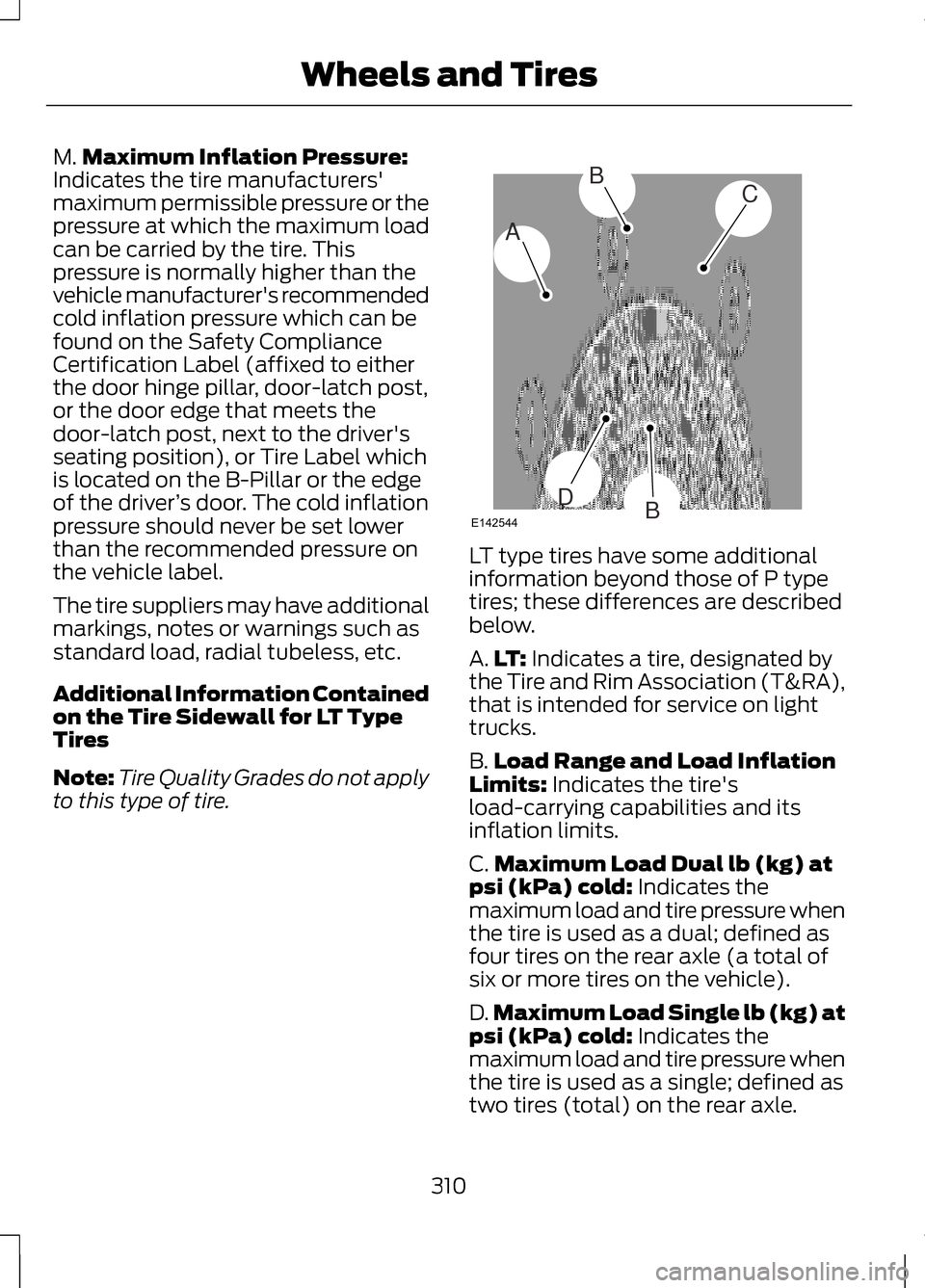
to this type of tire. LT type tires have some additional
information beyond those of P type
tires; these differences are described
below.
A.
LT: Indicates a tire, designated by
the Tire and Rim Association (T&RA),
that is intended for service on light
trucks.
B. Load Range and Load Inflation
Limits:
Indicates the tire's
load-carrying capabilities and its
inflation limits.
C. Maximum Load Dual lb (kg) at
psi (kPa) cold:
Indicates the
maximum load and tire pressure when
the tire is used as a dual; defined as
four tires on the rear axle (a total of
six or more tires on the vehicle).
D. Maximum Load Single lb (kg) at
psi (kPa) cold:
Indicates the
maximum load and tire pressure when
the tire is used as a single; defined as
two tires (total) on the rear axle.
310
Wheels and TiresA
BC
BDE142544