ESP LINCOLN MKZ 2014 User Guide
[x] Cancel search | Manufacturer: LINCOLN, Model Year: 2014, Model line: MKZ, Model: LINCOLN MKZ 2014Pages: 468, PDF Size: 4.49 MB
Page 99 of 468
Vehicle Settings and
Personalization
See General Information (page 101).
Fuel Gauge
Indicates approximately how much
fuel is left in the fuel tank (when the
ignition is on). The fuel gauge may
vary slightly when the vehicle is in
motion or on a grade. The fuel icon
and arrow indicates which side of the
vehicle the fuel filler door is located.
Engine Coolant Temperature
Gauge
Indicates engine coolant temperature.
At normal operating temperature, the
level indicator will be in the normal
range. If the engine coolant
temperature exceeds the normal
range, stop the vehicle as soon as
safely possible, switch off the engine
and let the engine cool.
WARNING
Never remove the coolant
reservoir cap while the engine is
running or hot.
WARNING LAMPS AND
INDICATORS
The following warning lamps and
indicators will alert you to a vehicle
condition that may become serious.
Some lamps will illuminate when you
start your vehicle to make sure they
work. If any lamps remain on after
starting your vehicle, refer to the
respective system warning lamp for
further information.
Note: Some warning indicators appear
in the information display and function
the same as a warning lamp, but do
not display when you start your vehicle.
Adaptive Cruise Control (If
Equipped)
E144524
The speed control system
indicator light changes color
to indicate what mode the
system is in: See Using Adaptive
Cruise Control (page 199).
On (white light): Illuminates when the
adaptive cruise control system is
turned on. Turns off when the speed
control system is turned off.
Engaged (green light): Illuminates
when the adaptive cruise control
system is engaged. Turns off when
the speed control system is
disengaged.
96
Instrument Cluster
Page 101 of 468
Engine Coolant Temperature
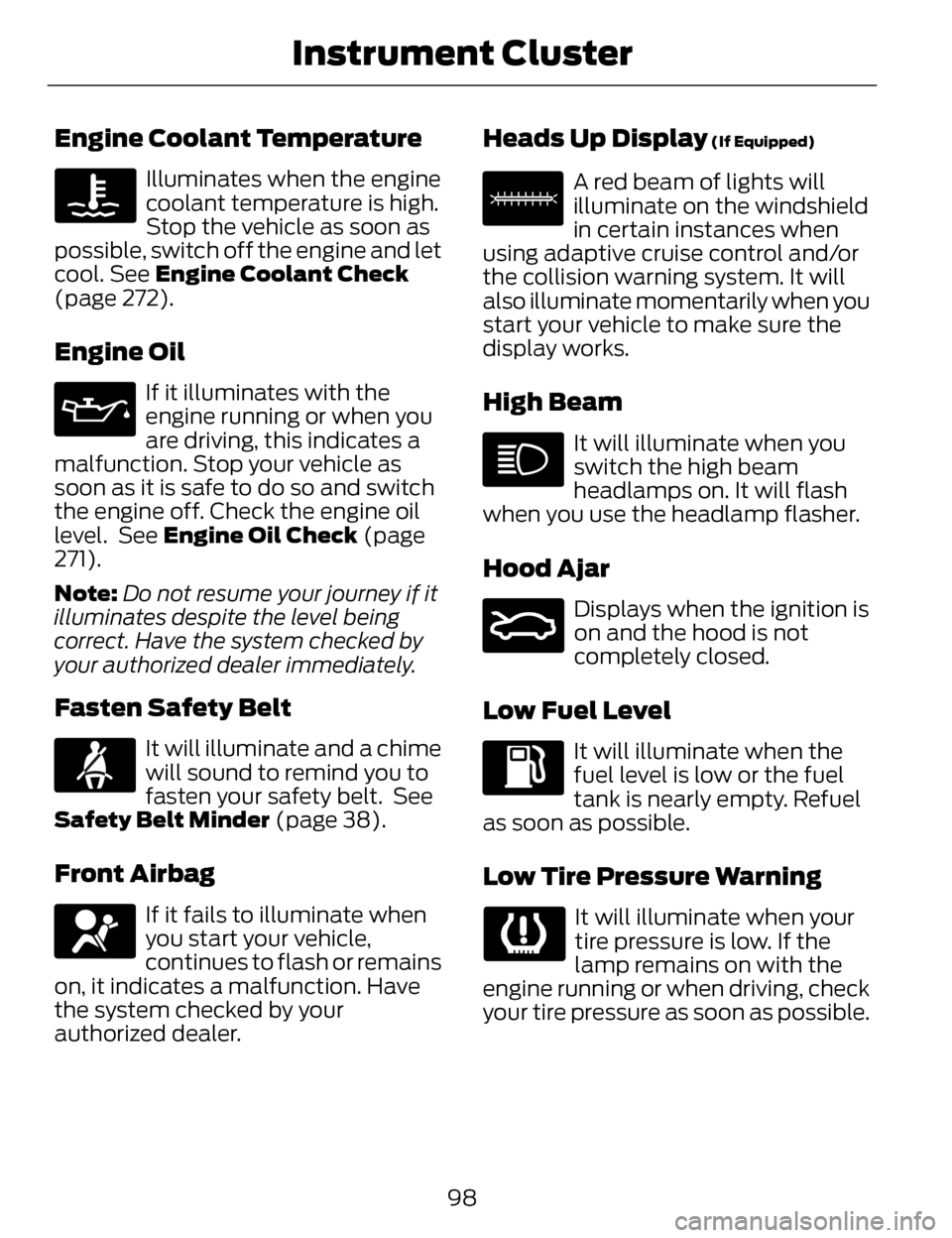
Illuminates when the engine
coolant temperature is high.
Stop the vehicle as soon as
possible, switch off the engine and let
cool. See Engine Coolant Check
(page 272).
Engine Oil
If it illuminates with the
engine running or when you
are driving, this indicates a
malfunction. Stop your vehicle as
soon as it is safe to do so and switch
the engine off. Check the engine oil
level. See Engine Oil Check (page
271).
Note: Do not resume your journey if it
illuminates despite the level being
correct. Have the system checked by
your authorized dealer immediately.
Fasten Safety Belt
It will illuminate and a chime
will sound to remind you to
fasten your safety belt. See
Safety Belt Minder (page 38).
Front Airbag
If it fails to illuminate when
you start your vehicle,
continues to flash or remains
on, it indicates a malfunction. Have
the system checked by your
authorized dealer.
Heads Up Display (If Equipped)
E156133
A red beam of lights will
illuminate on the windshield
in certain instances when
using adaptive cruise control and/or
the collision warning system. It will
also illuminate momentarily when you
start your vehicle to make sure the
display works.
High Beam
It will illuminate when you
switch the high beam
headlamps on. It will flash
when you use the headlamp flasher.
Hood Ajar
E159324
Displays when the ignition is
on and the hood is not
completely closed.
Low Fuel Level
It will illuminate when the
fuel level is low or the fuel
tank is nearly empty. Refuel
as soon as possible.
Low Tire Pressure Warning
It will illuminate when your
tire pressure is low. If the
lamp remains on with the
engine running or when driving, check
your tire pressure as soon as possible.
98
Instrument Cluster
Page 104 of 468
GENERAL INFORMATION
WARNING
Driving while distracted can
result in loss of vehicle control,
crash and injury. We strongly
recommend that you use extreme
caution when using any device that
may take your focus off the road. Your
primary responsibility is the safe
operation of your vehicle. We
recommend against the use of any
hand-held device while driving and
encourage the use of voice-operated
systems when possible. Make sure you
are aware of all applicable local laws
that may affect the use of electronic
devices while driving.
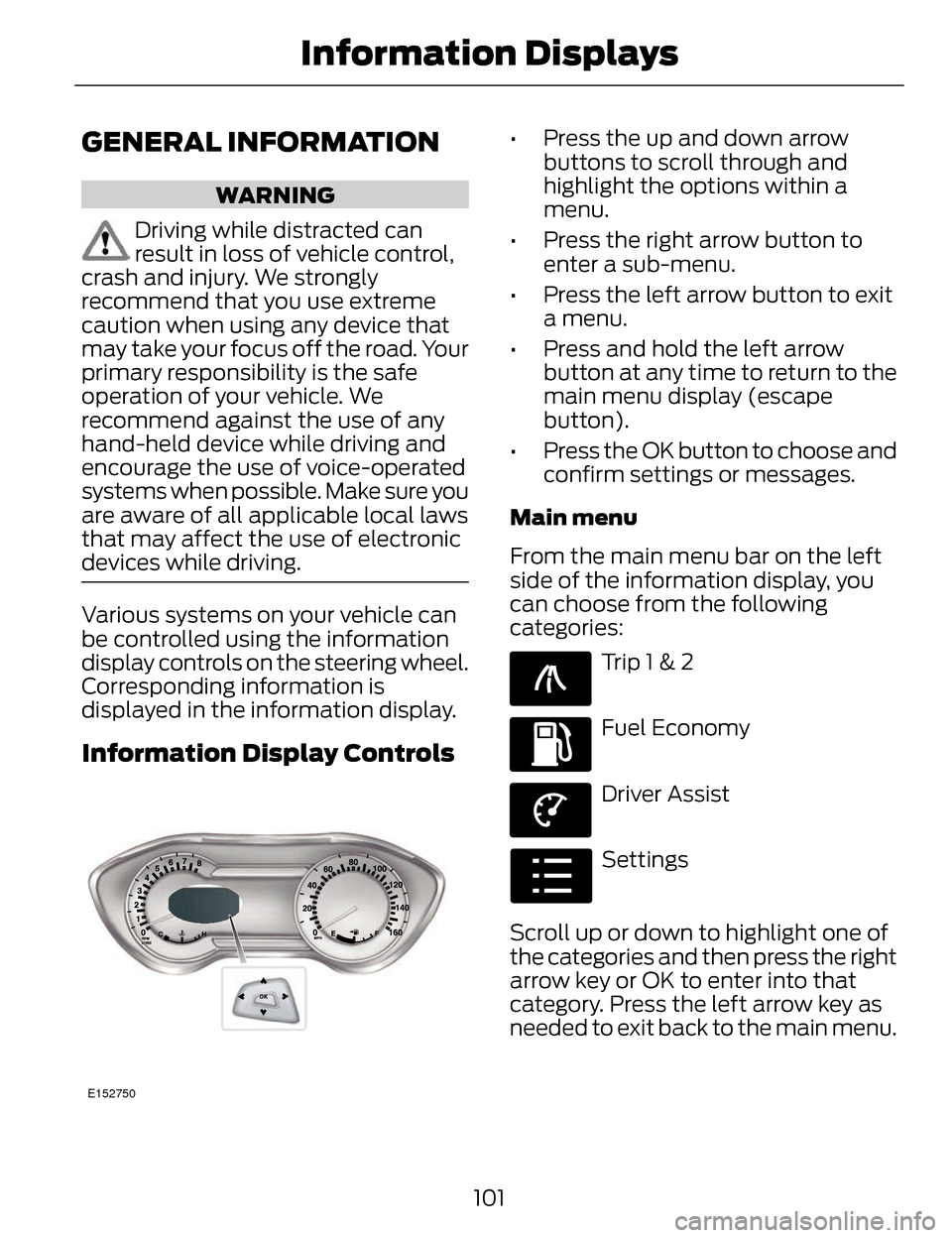
Various systems on your vehicle can
be controlled using the information
display controls on the steering wheel.
Corresponding information is
displayed in the information display.
Information Display Controls
E152750
• Press the up and down arrow buttons to scroll through and
highlight the options within a
menu.
• Press the right arrow button to enter a sub-menu.
• Press the left arrow button to exit a menu.
• Press and hold the left arrow button at any time to return to the
main menu display (escape
button).
• Press the OK button to choose and confirm settings or messages.
Main menu
From the main menu bar on the left
side of the information display, you
can choose from the following
categories:
E138660
Trip 1 & 2
E144640
Fuel Economy
E144639
Driver Assist
E100023
Settings
Scroll up or down to highlight one of
the categories and then press the right
arrow key or OK to enter into that
category. Press the left arrow key as
needed to exit back to the main menu.
101
Information Displays
Page 128 of 468
Do not expose discs to direct sunlight
or heat sources for extended periods.
MP3 Track and Folder
Structure
Audio systems capable of recognizing
and playing MP3 individual tracks and
folder structures work as follows:
• There are two different modes forMP3 disc playback: MP3 track
mode (system default) and MP3
folder mode.
• MP3 track mode ignores any folder structure on the MP3 disc. The
player numbers each MP3 track on
the disc (noted by the .mp3 file
extension) from T001 to a
maximum of T255. The maximum
number of playable MP3 files may
be less depending on the structure
of the CD and exact model of radio
present.
• MP3 folder mode represents a folder structure consisting of one
level of folders. The CD player
numbers all MP3 tracks on the disc
(noted by the .mp3 file extension)
and all folders containing MP3
files, from F001 (folder) T001
(track) to F253 T255.
• Creating discs with only one level of folders helps with navigation
through the disc files.
If you are burning your own MP3 discs,
it is important to understand how the
system reads the structures you
create. While various files may be
present, (files with extensions other
than mp3), only files with the .mp3 extension are played; other files are
ignored by the system. This enables
you to use the same MP3 disc for a
variety of tasks on your work
computer, home computer and your
in-vehicle system.
In track mode, the system displays
and plays the structure as if it were
only one level deep (all .mp3 files
play, regardless of being in a specific
folder). In folder mode, the system
only plays the .mp3 files in the current
folder.
AUDIO UNIT - VEHICLES
WITH: PREMIUM
AM/FM/CD
WARNING
Driving while distracted can
result in loss of vehicle control,
crash and injury. We strongly
recommend that you use extreme
caution when using any device that
may take your focus off the road. Your
primary responsibility is the safe
operation of your vehicle. We
recommend against the use of any
hand-held device while driving and
encourage the use of voice-operated
systems when possible. Make sure you
are aware of all applicable local laws
that may affect the use of electronic
devices while driving.
Note: The MyLincoln Touch system
controls most of the audio features.
See Entertainment (page 364).
125
Audio System
Page 143 of 468
E164098
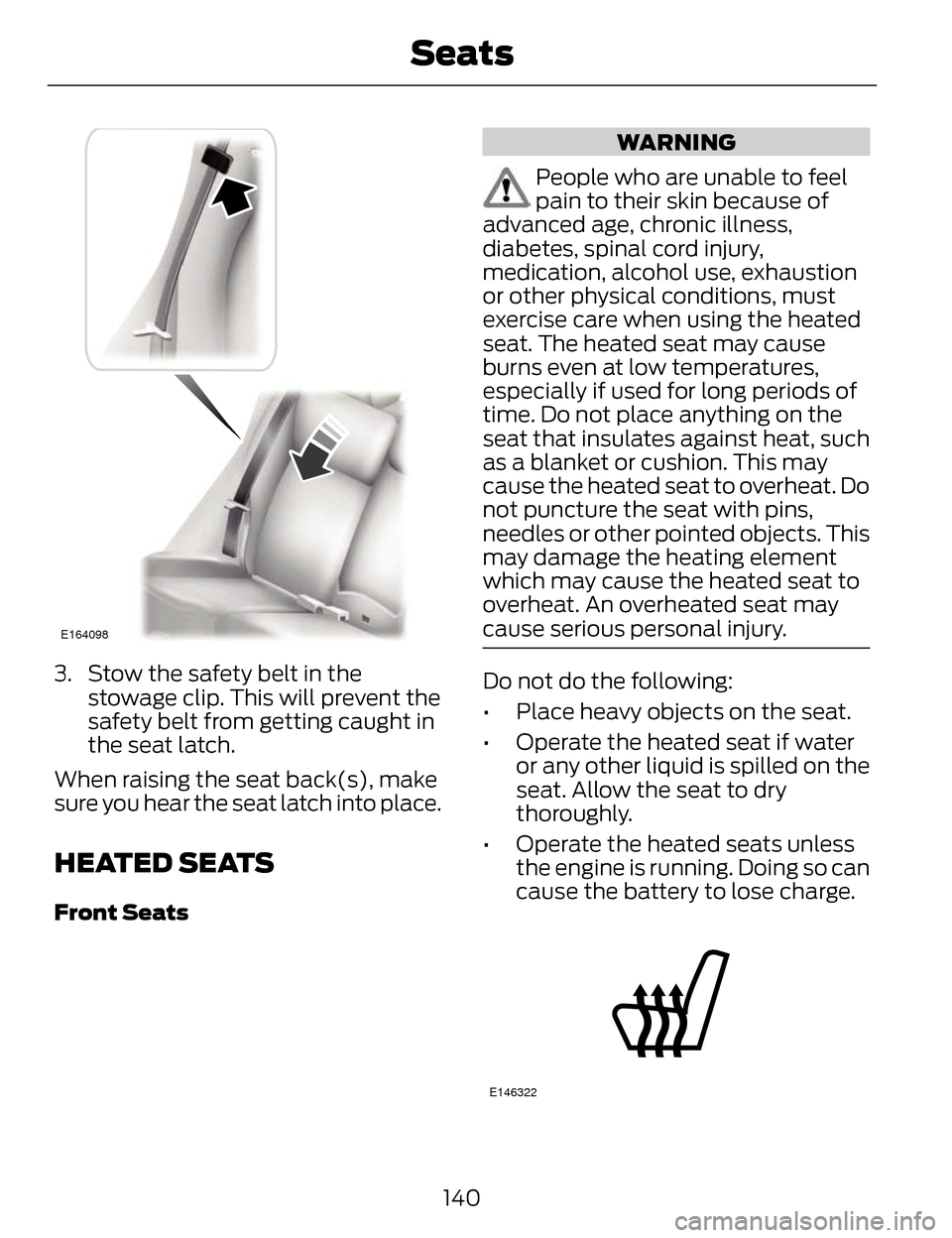
3. Stow the safety belt in thestowage clip. This will prevent the
safety belt from getting caught in
the seat latch.
When raising the seat back(s), make
sure you hear the seat latch into place.
HEATED SEATS
Front Seats
WARNING
People who are unable to feel
pain to their skin because of
advanced age, chronic illness,
diabetes, spinal cord injury,
medication, alcohol use, exhaustion
or other physical conditions, must
exercise care when using the heated
seat. The heated seat may cause
burns even at low temperatures,
especially if used for long periods of
time. Do not place anything on the
seat that insulates against heat, such
as a blanket or cushion. This may
cause the heated seat to overheat. Do
not puncture the seat with pins,
needles or other pointed objects. This
may damage the heating element
which may cause the heated seat to
overheat. An overheated seat may
cause serious personal injury.
Do not do the following:
• Place heavy objects on the seat.
• Operate the heated seat if water or any other liquid is spilled on the
seat. Allow the seat to dry
thoroughly.
• Operate the heated seats unless the engine is running. Doing so can
cause the battery to lose charge.
E146322
140
Seats
Page 144 of 468
Touch the heated seat symbol on the
touchscreen to cycle through the
various heat settings and off. Warmer
settings are indicated by more
indicator lights.
Rear Heated Seats (If Equipped)
WARNING
Persons who are unable to feel
pain to the skin because of
advanced age, chronic illness,
diabetes, spinal cord injury,
medication, alcohol use, exhaustion,
or other physical conditions, must
exercise care when using the seat
heater. The seat heater may cause
burns even at low temperatures,
especially if used for long periods of
time. Do not place anything on the
seat that insulates against heat, such
as a blanket or cushion, because this
may cause the seat heater to
overheat. Do not puncture the seat
with pins, needles, or other pointed
objects because this may damage the
heating element which may cause the
seat heater to overheat. An
overheated seat may cause serious
personal injury.
Note: Do not do the following:
• Place heavy objects on the seat.
• Operate the seat heater if water or any other liquid is spilled on the
seat. Allow the seat to dry
thoroughly.
The rear seat heat controls are
located on the rear of the center
console. The heated seats only operate when
the ignition is on.
E146322
• Press the heated seat symbol to
cycle through the various heat
settings and off. Warmer settings
are indicated by more indicator
lights.
• Press again to deactivate.
The heated seat module resets at
every ignition run cycle. While the
ignition is on, press the high or low
heated seat switch to enable heating
mode. When activated, they will turn
off automatically when you turn the
engine off.
VENTILATED SEATS (IF
EQUIPPED)
The ventilated seats will only function
when the engine is running.
E146309
To operate the ventilated seats:
141
Seats
Page 150 of 468
1. Press and hold the program buttonon the garage door opener motor
until both blue indicator lights turn
on.
2. Release the program button. Only the smaller round indicator light
should be on.
3. Press and release the program button. The larger purple indicator
light will flash.
Note: The next two steps must be
completed in 30 seconds.
4. Press and release the Genie Intellicode 2 hand-held
transmitter’s previously
programmed button. Both
indicator lights on the garage door
opener motor unit should now
flash purple.
5. Press and hold the previously programmed button on the visor
for 2 seconds. Repeat this step up
to 3 times until the garage door
moves.
Programming is now complete.
Clearing a HomeLink Device
To erase programming from the three
HomeLink buttons press and hold the
two outer HomeLink buttons until the
indicator light begins to flash. The
indicator light will begin flashing in 10
to 20 seconds, at which time both
buttons should be released.
Programming has now been erased,
and the indicator light should blink
slowly to indicate the device is in train
mode when any of the three
HomeLink buttons are pressed. FCC and RSS-210 Industry Canada
Compliance
This device complies with Part 15 of
the FCC Rules and with RSS-210 of
Industry Canada. Operation is subject
to the following two conditions: (1)
this device may not cause harmful
interference, and (2) this device must
accept any interference received,
including interference that may cause
undesired operation.
Changes or modifications to your
device not expressly approved by the
party responsible for compliance can
void the user’s authority to operate
the equipment.
147
Universal Garage Door Opener
Page 158 of 468
Important Ventilating
Information
If you stop your vehicle and the leave
the engine idling for long periods, we
recommend that you do one of the
following:
• Open the windows at least 1 inch(2.5 centimeters)
• Set your climate control to outside air.
ENGINE BLOCK HEATER (IF
EQUIPPED)
WARNINGS
Failure to follow engine block
heater instructions could result
in property damage or serious
personal injury.
Do not use your heater with
ungrounded electrical systems
or two-pronged adapters. There is a
risk of electrical shock.
Note: The heater is most effective
when outdoor temperatures are below
0°F (-18°C).
The heater acts as a starting aid by
warming the engine coolant. This
allows the climate control system to
respond quickly. The equipment
includes a heater element (installed
in the engine block) and a wire
harness. You can connect the system
to a grounded 120-volt AC electrical
source. We recommend that you do the
following for a safe and correct
operation:
• Use a 16-gauge outdoor extension
cord that is product certified by
Underwriter’s Laboratory (UL) or
Canadian Standards Association
(CSA). This extension cord must
be suitable for use outdoors, in
cold temperatures, and be clearly
marked Suitable for Use with
Outdoor Appliances. Do not use an
indoor extension cord outdoors.
This could result in an electric
shock or become a fire hazard.
• Use as short an extension cord as possible.
• Do not use multiple extension cords.
• Make sure that when in operation, the extension cord plug and heater
cord plug connections are free and
clear of water. This could cause an
electric shock or fire.
• Make sure your vehicle is parked in a clean area, clear of
combustibles.
• Make sure the heater, heater cord and extension cord are firmly
connected.
• Check for heat anywhere in the electrical hookup once the system
has been operating for
approximately 30 minutes.
155
Starting and Stopping the Engine
Page 160 of 468
SAFETY PRECAUTIONS
WARNINGS
Do not overfill the fuel tank. The
pressure in an overfilled tank
may cause leakage and lead to fuel
spray and fire.
The fuel system may be under
pressure. If you hear a hissing
sound near the fuel filler door (Easy
Fuel capless fuel system), do not
refuel until the sound stops.
Otherwise, fuel may spray out, which
could cause serious personal injury.
Automotive fuels can cause
serious injury or death if misused
or mishandled.
The flow of fuel through a fuel
pump nozzle can produce static
electricity, which can cause a fire if
fuel is pumped into an ungrounded
fuel container.
Fuel ethanol and gasoline may
contain benzene, which is a
cancer-causing agent.
When refueling always shut the
engine off and never allow
sparks or open flames near the filler
neck. Never smoke or use a cell phone
while refueling. Fuel vapor is
extremely hazardous under certain
conditions. Avoid inhaling excess
fumes.
Observe the following guidelines
when handling automotive fuel: • Extinguish all smoking materials
and any open flames before
refueling your vehicle.
• Always turn off the vehicle before refueling.
• Automotive fuels can be harmful or fatal if swallowed. Fuel such as
gasoline is highly toxic and if
swallowed can cause death or
permanent injury. If fuel is
swallowed, call a physician
immediately, even if no symptoms
are immediately apparent. The
toxic effects of fuel may not be
visible for hours.
• Avoid inhaling fuel vapors. Inhaling too much fuel vapor of any kind
can lead to eye and respiratory
tract irritation. In severe cases,
excessive or prolonged breathing
of fuel vapor can cause serious
illness and permanent injury.
• Avoid getting fuel liquid in your eyes. If fuel is splashed in the eyes,
remove contact lenses (if worn),
flush with water for 15 minutes and
seek medical attention. Failure to
seek proper medical attention
could lead to permanent injury.
157
Fuel and Refueling
Page 167 of 468
EMISSION CONTROL
SYSTEM
WARNINGS
Do not park, idle, or drive your
vehicle in dry grass or other dry
ground cover. The emission system
heats up the engine compartment and
exhaust system, which can start a fire.
Exhaust leaks may result in entry
of harmful and potentially lethal
fumes into the passenger
compartment. If you smell exhaust
fumes inside your vehicle, have your
dealer inspect your vehicle
immediately. Do not drive if you smell
exhaust fumes.
Your vehicle is equipped with various
emission control components and a
catalytic converter that will enable
your vehicle to comply with applicable
exhaust emission standards. To make
sure that the catalytic converter and
other emission control components
continue to work properly:
To make sure that the catalytic
converter and other emission control
components continue to work
properly:
• Use only the specified fuel listed.
• Avoid running out of fuel.
• Do not turn off the ignition while your vehicle is moving, especially
at high speeds.
• Have the items listed in scheduled maintenance information
performed according to the
specified schedule. The scheduled maintenance items
listed in scheduled maintenance
information are essential to the life
and performance of your vehicle and
to its emissions system.
If you use parts other than Ford,
Motorcraft or Ford-authorized parts
for maintenance replacements, or for
service of components affecting
emission control, such non-Ford parts
should be the equivalent to genuine
Ford Motor Company parts in
performance and durability.
Illumination of the service engine soon
indicator, charging system warning
light or the temperature warning light,
fluid leaks, strange odors, smoke or
loss of engine power could indicate
that the emission control system is
not working properly.
An improperly operating or damaged
exhaust system may allow exhaust to
enter the vehicle. Have a damaged or
improperly operating exhaust system
inspected and repaired immediately.
Do not make any unauthorized
changes to your vehicle or engine. By
law, vehicle owners and anyone who
manufactures, repairs, services, sells,
leases, trades vehicles, or supervises
a fleet of vehicles are not permitted
to intentionally remove an emission
control device or prevent it from
working. Information about your
vehicle’s emission system is on the
Vehicle Emission Control Information
Decal located on or near the engine.
This decal also lists engine
displacement
164
Fuel and Refueling